Personal Deity Worship | 20 Dec 2022 | ISKCON Juhu, Mumbai | Srila Gopal Krishna Goswami
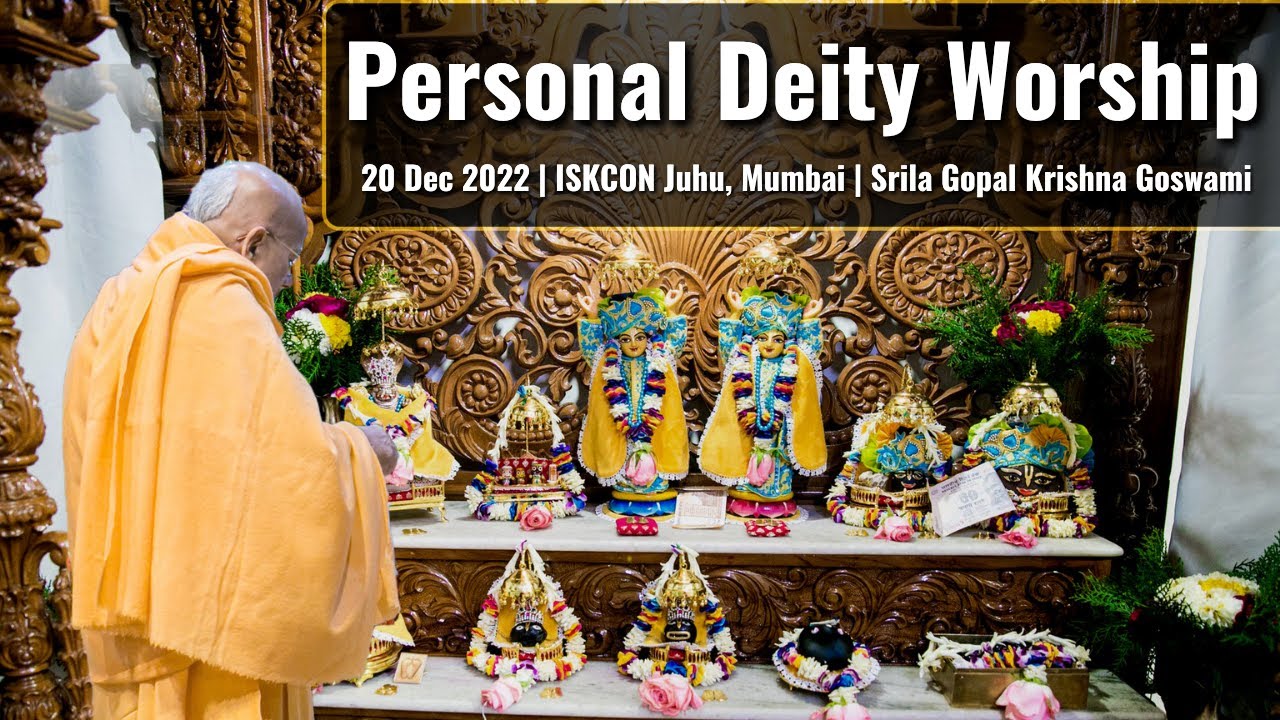
The video records a devotional session at ISKCON Juhu, Mumbai, led by Srila Gopal Krishna Goswami. It opens with traditional chanting (Hare Krishna mantra, salutations to deities, and reverence to the guru) establishing a personal deity worship atmosphere. The core of the session is a reading of Srimad‑Bhagavatam Canto 10, Chapter 43 (the episode where Krishna confronts and kills the elephant Kuvalyapīḍa) in Sanskrit, followed by an English translation. Interspersed are purports and commentaries drawn from Srila Śrīdhara Svāmī, Śrīla Bhaktisiddhānta Sarasvatī, A. C. Bhaktivedānta Swāmī Prabhupāda and other acharyas. The commentary explains the symbolic meaning of the elephant, the purpose of Krishna’s playful violence, the various perceptions of the onlookers, and the devotional rasa (madhurya) that arises when a devotee witnesses Krishna’s divine sport. The lecture also links the episode to the practice of personal deity worship, emphasizing how the devotee’s love for Krishna is deepened by contemplating his pastimes. The session concludes with a brief purport summarising the spiritual import of the episode.
Chapters
Madhurya li laguna rupa nana, bhikshana swadhane lo lupasya. Vande guru Sri Charana rebindam, nikunjayo nora thikeli siddhi. Yah yah lividio tira bhikshaniya. Namah Om Vishnu Padaya Krishna Prashtaya Bhutale Sriyate Bhaktivedanta Swami Tinnamine Namaste Saraswati Devi Gauravani Pracharine Gaurabhaktabrinda Jai Shri Krishna Chaitanya. Prabhu Nityananda. Shri Advaita Gadaadhar Shiva Sadi. Gaurabhaktabrinda Jai Shri Krishna Chaitanya. Namo namaha tulasi Krishna prasannamunamaha. Prasada Krishna sevapabho yahyavilasi. Hare Krishna, Hare Krishna, Krishna Krishna Hare Hare. Hare Rama, Hare Rama, Rama Rama Hare Hare. Jai Tulsi Maharani, Jai Tulsi Maharani, Tulsi Maharani, Jai Tulsi Maharani. Jai Bhande Devi, Jai Bhande Devi.
You want to read? Yes, Mama. Uh, 43 chapter. You can read from text 1. Text 2. Only translation proper. Chapter 43, Text 1. Chapter 43, Krishna Kills the Elephant, Kovalya Pīda. Text 1. Śrī Caitanya Mahāprabhu said, 'O chastiser of enemies, Krishna and Balarama, having executed all necessary purification, then heard the kettle drums resounding at the wrestling arena, and they went there to see what was happening.
Parabrahman.
Śrīla Śrīda Svāmī explains the word kṛṭṣo-cau. Having executed all necessary purification, as follows. Two days previously, Krishna and Balaram had executed their purification, their relief from offense, by performing heroic deeds. Lord's resound: Even after we have made our power known by breaking the vow and by performing other feats, our parents have still not secured freedom. Kamsa is again trying to kill them. Therefore, although he is our maternal uncle, it will not be wrong for us to kill him. They assured their offenselessness by this reasoning. Text 2: When Lord Krishna reached the entrance of the— entrance to the arena, He saw the elephant Kuvalya appeared, blocking his way at the urging of his keeper. For what? The elephant keeper revealed his malicious intent by blocking Lord Krishna's entrance into the arena. Text 3: Securely binding up his clothes, securely binding up his clothes and tying back his curly locks, Lord Krishna addressed the elephant keeper with words as great as the rumbling of a cloud. Text 4. Lord Krishna said, O driver, driver, move aside at once and let us pass. If you don't, this very day I will send both you and your elephant to the abode of Yamraj. Text 5. Thus threatened, the elephant keeper became angry. He goaded his furious elephant. He goaded his furious elephant, who appeared equal to time, death, and Yamaraja, into attacking Lord Krishna. Text 6 translation. The lord of the elephants charged Krishna. Anga, the lord of the elephants, charged Krishna and violently seized with him his trunk. But Krishna slipped away, struck him a blow, and disappeared from his view among his legs. Parpat, Lord Krishna struck the elephant with his fist and then disappeared among his legs. Text 7. Infuriated at being unable to see Lord Kṛṣṇa, the elephant sought him out with his senses, with his sense of smell. Once again, Kuvalapida seized the Lord with the end of his trunk. Only to have the Lord forcefully free himself. Purpose: Lord Krishna allowed the elephant to seize him so that the beast would be encouraged to keep fighting. Once Kovaldeepita had thus become proud, Lord Krishna again thwarted him with his superior potency. Text 8: Lord Krishna then grabbed the powerful Kovalalapida by the tail and playfully dragged him 25 bow lengths, as easily as Garuda might drag a snake. Text 9: Ewo! As Lord Achyuta held on— as Lord Achyut held on— text 9— as Lord Achyut held on to the elephant's tail, the animal tried to twist away to the left and to the right, making the Lord swear in the opposite direction as a young boy would swear when pulling a calf by the tail. Text 10: Krishna then came face to face with the elephant and slapped him and ran away. Kuvalyapida pursued the Lord, managing to touch him again and again with each step, but Krishna outmanoeuvred the elephant and made him trip and fall. Text 11. As Krishna dodged about, he playfully fell on the ground and quickly got up again. The lagging elephant, thinking Krishna was down, tried to gore him with his tusks but struck the earth instead. Text 12. His prowess Foiled, the Lord Elephant Kuvalapida went into a freezing rage out of frustration. But the elephant keepers goaded him on, and he furiously charged Krishna once again. Text 13. The Supreme Lord, killer of the demon Madhu, confronted the elephant as he attacked. Seizing his trunk with one hand, Krishna threw him to the ground. Text 14. Lord Hari then climbed onto the elephant with the ease of mighty lion, pulled out a tusk, and with it killed the beast and his keepers. Text 15. Leaving the dead elephant aside, Lord Krishna held on to the tusk and entered the wrestling arena. With the tusk resting on his shoulder, drops of the elephant's blood and sweat sprinkled all over him, and his lotus face covered with fine drops of his own perspiration, the Lord shone with great beauty. Text 16. My dear King, Lord Baldev and Lord Janardana, each carrying one of the elephant's tusks as his chosen weapon, enter the arena with several coward boys. Text 17. The various groups of people in the arena regarded Krishna in different ways when he entered it with his elder brother. The wrestlers saw Krishna as a lightning bolt, the men of Mathura as the best of males, the woman as Cupid in person, the coward men as their relative, the empire's rulers as a chastiser, His parents as their child, the king of abhujas as death, the unintelligent as the Supreme Lord's universal form, the yogis as the absolute truth, and the Vrishnis as their supreme worshipable deity.
Purport.
Śrīla Śrīdhara ṣvāmī quotes the following verse which explains the 10 attitudes toward Krishna described here. Rodhro adbhūtāśya śrīṅāro asyam viro dayātatah bhayāṁ kāśya vivatsāḥ śāntaḥ saḥ premaṇa bhaktiḥ. There are 10 different moods. There are 10 different moods. Fury perceived by the wrestlers, wonder by the men, conjugal attraction the woman, laughter the cowards, surely the kings, mercy his parents, terror comes, ghastliness the unintelligent, peaceful neutrality peaceful neutrality, the yogis, and loving devotion, the Vrishnis. Srila Vishvanatha Chakravarti points out that people like the wrestlers, Kamsa and the impious rulers perceive Krishna as dangerous, angry, or threatening because they fail to understand the actual position of the Supreme, because they fail to understand the actual position of the Personality of Godhead. Actually, Lord Krishna is everyone's friend and well-wisher, but because we rebel against him, he chastises us, and thus we may perceive him as threatening. Krishna, or God, is actually merciful, and when he punishes us, that is also his mercy. Śrīla Bhaktisiddhānta Sarasvatī ṭhākura quotes, The following Vedic statement: Rasa vayasah rasyaam he evaayam labdhava nadii bhavati. He himself is rasa, a taste or mellow of a particular relationship, and certainly one who achieves this rasa becomes anandi, filled with bliss. Taittiriya Upanishad 2.7.1. Śrīla Bhaktisiddhānta Sarasvatī quotes a further verse to explain the word rasa. Pratīya bhāvan vartam yasya cāmat-kāra-bhārā-bhū hṛdī-sattva-jale-bādhām svādataye sa rāṣo-matāḥ. That which is beyond imagination, heavy with wonder, and released in the heart, shining with Goddess, shining with Godness. Such is known as rasa. As Lalitapakosa Swami elaborately explains in his Bhaktirasamrta Sindhu, there are 5 main rasas: neutrality, servitude, friendship, parental love, and conjugal love, and 7 secondary rasas amusement, humor, chivalry, compassion, fury, fear, and dread. Thus altogether there are 12 rasas, and the superior object of them all is Sri Krishna himself. In other words, our love and affection are actually meant for Sri Krishna. Unfortunately, out of ignorance We stubbornly try to squeeze happiness— we stubbornly try to squeeze happiness and love out of material relationships which are not directly connected to Krishna. And thus life becomes a constant frustration. The solution is simple: surrender to Krishna, love Krishna, love Krishna's devotee, and be happy forever. Text 18. When Kamsa saw that Kovalipida was dead and the two brothers were invincible, he was overwhelmed with anxiety. O King, Text 19. Haridwar. Variegated ornaments, garlands, and garments, just like a pair of excellently costumed actors, the two mighty armed lords shone splendidly in the arena. Indeed, they overpowered the minds of all onlookers with their effulgences. Text 20. O King, as the citizens of the city and the people from outlying districts gazed upon those two Supreme Personalities from their seats in the galleries, the force of the people's happiness caused their eyes to open wide and their faces to bloom— faces to blossom. They drank in the vision of the Lord's faces without becoming satiated. Text 21-22. The people seemed to be drinking Krishna and Balaram with their eyes, licking them with their tongues, smelling them with their nostrils, and embracing them with their arms, reminded of the Lord's beauty, character, charm, and bravery. The members of the audience began describing these features to one another according to what they had seen and heard. Purport: Naturally, those who assembled in Mathura for the wrestling festival had heard the latest news of Krishna's and Balaram's adventures in the city, how the Lords had broken the sacrificial vow defeated the bullies and killed. Those who assembled in Mathura for the wrestling festival had heard the latest news of Krishna's and Balaram's adventures in the city. How the lords had broken the sacrificial vow, defeated the police, and killed the elephant Kuvalya Pidra. And how that the people were seeing Krishna and Balaram enter the arena. And now that people— that— and now that the people were seeing Krishna and Balaram enter the arena, their greatest expectations were confirmed. Krishna is the embodiment of all beauty. Fame and opulence, and therefore those assembled in the wrestling arena became fully satisfied by glorifying what they had heard of him and were now seeing. Text 23: The people said, these two boys are certainly expansions of the Supreme Lord Narayana who have descended to this world in the home of vasudeva. Text 24. This one, Krishna, took birth from Mother Devaki and was brought to Gokul, where he has remained concealed all this time, growing up in the house of King Nanda. Text 25. He made Putana and the whirlwind demon meet with death, pulled down the twin Arjuna trees, and killed Sankhachuda, Keshi, Denuka, and similar demons. Text 26-27: He saved the cows and the cowards from a forest fire and subdued the serpent Kaliya. He removed Lord Indra's false pride by holding up the beast of mountains with one hand for an entire week, thus protecting the inhabitants of Gokul from rain, wind, and hail. Text 28: The gopis overcome all kinds of distress and experience great happiness by seeing His face, which is always cheerful with His smiling glances and ever free of fatigue. Text 29: It is said that under his full protection, the Yadu dynasty will become extremely famous and attain wealth, glory, and power. Text 30: This lotus-eyed elder brother of his, Lord Balaram, this lotus-eyed elder brother of his, Lord Balaram, is the proprietor of all transcendental opulences. He has killed Pralamba, Vatsak, Bakha, and other demons. Perfect. In fact, two of the demons mentioned here were killed by Krishna, not Balaram. The reason for the, the reason for the mistake is that as news of Krishna's widespread among ordinary people, the facts became somewhat muddled. The same tendency can be observed in modern newspapers. Text 31. While the people talked in this way and the musical instruments resounded, wrestler Charuna addressed Krishna Balaram with the following words. Parvat. Charuna could not tolerate that the audience was praising Krishna so highly. Therefore, he had to say— therefore, he had to say something to the two brothers. Text 32. Charuna said, O son of Nanda, O Ram, you too are well respected by courageous men. And are both skillfully at wrestling. Having heard of your prowess, the king has called you here, wanting to see for himself. Text 33: Subjects of the King Who Try to Please. Subjects of the king who try to please him with their thoughts, acts, and words are sure to achieve good fortune, but those who fail to do so will suffer the opposite fate. Text 34. It is well known that coward boys are always joyful as they tend their calves, and that the boys playfully rest wrestle with each other while grazing their animals in the various forests. Here Charuna explained how the two brothers came to be expert at wrestling. Text 35: Therefore, let's do what the king wants. Everyone will be pleased with us, for the king embodies all living beings. Text 36: Hearing this, Lord Krishna, who killed to wrestle and welcomed the challenge, replied with words appropriate to the time and place. Text 27. Lord Krishna said, all the forest dwellers, we are also subjects of the Bhoju king. He must gratify his desires. For such behavior, will confer upon us the greatest benefit. Fact 38: We are just young boys and should play with those of equal strength. The wrestling match must go on properly so that irreligion does not taint the respectful members of the audience. Text 39. Charuna said, you are not really a child or even a young man, and neither is Balaram, the strongest of the strong. After all, you playfully killed an elephant who had the strength of a thousand other elephants. Text 40. Therefore, you two should fight powerfully, wrestlers. There is certainly nothing unfair about that. You, O descendant of Vṛṣṇī, can show your prowess against me, and Balarama can fight with Muṣṭika. Thus end the purports of the humble servant of His Divine Grace A.C. Bhaktivedānta Swāmi Prabhupāda to the 10th canto, 43rd chapter of the Śrīmad-Bhāgavatam entitled Krishna Kisses the Elephant, Vrīlapīda. Next chapter, pada. Chapter 44: The Killing of Kamsa. Text 1: Śrī Kṛṣṇa Gosvāmī said, thus addressed, Lord Kṛṣṇa made up his mind to accept the challenge. He paired off with Charuṇa and Lord Balrāma with Muṣṭika. Text 2: Seizing each other's hand and locking legs with each other, The opponent struggled powerfully, eager for victory. Text 3: They each struck, they each struck fists against fists, knees against knees, head against head, and chest against chest. Purpat. The word ardhni in this verse may indicate the elbow as well as the fist. Thus, blows were perhaps also struck with their elbow, a technique seen today in various martial arts. Text 4: Each fighter contended with his opponent by dragging him about in circles, showing and crushing him, throwing him down and running before and behind him. Purport. Śrīla Śrīdhara ṣvāmī explains that the word pariramba indicates crushing one's opponent with one's arms. Text 5: Forcefully lifting and carrying each other, pushing each other away, and holding each other down, the fighters hurt even their own own bodies in their great eagerness for victory. Parvat. Prajñāvagūṣṇama explains that although Kṛṣṇa and Balrāma did not, of course, harm themselves, it appeared that way to Charuṇa, Muṣṭika, and others of mundane vision. In other words, the Lords were fully absorbed in the pastime of being wrestlers. Text 6. My dear king, all the women present considering the match an unfair, unfair fight between the strong and the weak, felt extreme anxiety due to compassion. They assembled in groups around the arena and spoke to one another as follows. Text 7: A woman said, 'Alas! What a greatly irreligious act the members of this royal assembly are committing.' As the king watches this fight between the strong and the weak, they also want to see it. Purpat. The idea the ladies are expressing is that even if the king somehow wanted to see such an unfair match, why should the respectable members of the assembly also desire to see it? These feelings are natural. Even nowadays, if in a public place we find a violent fight going on between a very strong, large person and a weaker, a smaller person, we are aroused to indignation. Compassionate women are especially offended and enraged by such unfair violence. Text 8. Text 8. What comparison can there be between these two professional wrestlers with limbs as strong as lightning bolts and bodies resembling mighty mountains, and these two young immature boys with exceedingly Tender Limbs. Text 9: Religious principles have certainly been violated in this assembly. One should not remain for even a moment in a place where irreligion is flourishing. Text 10 translation: A wise person should not enter an assembly if he knows the participants they are committing acts of impropriety. Impropriety. And if, having entered such an assembly, he fails to speak the truth, speaks falsely, or pleads ignorance, he will certainly incur sin. Text 11. Just see the lotus face of Krishna as he darts around his foe. That face covered with drops of perspiration brought on by the strenuous fight resembles a lotus covered with dew. Text 12: Don't you see the face of Lord Balaram with its eyes cooper red from his anger toward Mustika and its beauty enhanced by his laughter and his Absorption in the fight. Text 13. How pious are the tracts of land in Vraja! For there the primeval personality Godhead, disguising himself with human traits, wanders about, enacting his many pastimes, adorned with wonderfully variegated forest garlands. He whose feet are worshiped by Lord Śiva, and Goddess Rāma vibrates his flute as he tends the cows in the company of Balrāma. Text 14, sorry, purport. Text 13 purport: In this verse, the devoted ladies in the audience point out the difference between Mathura and Vṛndāvana. They want to indicate that in Vṛndāvana, Krishna simply enjoys with his girlfriends and boyfriends. Whereas here in Mathura, the Lord is subjected to harassment by the bullying tactics of professional wrestlers. Thus the ladies are condemning the city of Mathura because of their pain at seeing Krishna in what they consider an unfair wrestling match. Of course, Mathura is also one of the Lord's eternal abodes, but here the woman in the assembly express their love in a critical mood. Text 14. What austerities must the gopis have performed! With their eyes they always drink the nectar of Lord Krishna's form, which is the essence of loveliness and is not to be equal— is not to be equaled or surpassed. That loveliness is the only award of beauty. Fame and opulence. It is self-perfect, ever fresh, and extremely rare. The word meaning and translation for this word are from Śrīla Prabhupāda, Caitanya-caritāmṛta, Adilīla 4.156, text 15. The ladies of Vraja are the most fortunate of women because with their minds fully attached to Krishna and their throats always choked up with tears. They constantly sing about him while milking the cows, winnowing grain, churning butter, gathering cow dung for fuel, riding on swings, taking care of their crying babies, sprinkling the ground with water, cleaning their houses, and so on. By their exalted Krishna consciousness, they automatically acquire all desirable things. Text 16. When the gopis hear Krishna playing his flute as he leaves Vraja in the morning with his cows or returns with them at sunset, the young girls quickly come out of their houses to see him. They must have performed many pious activities to be able to see him. As he walks on the road, his smiling face mercifully glancing upon them. Text 17. Sukadeva Gosvāmī continued, as the woman spoke thus, O hero of the Bharatas, Lord Krishna, the master of all mystic power, made up his mind to kill his opponent. Text 18. Out of affection for the two lords, their parents Devaki and Vasudeva became overwhelmed with sorrow, became overwhelmed with sorrow. When they heard the woman's fearful statements, they grieved, not knowing their son's strength. Perfect. Naturally, Krishna's parents would lament in the situation, thinking, why did not we keep our sons at home? Naturally, Krishna's parents would lament in the situation, thinking, 'Why did not we keep our sons at home? Why did we allow them to participate in this corrupt exhibition?' Text 19. Lord Balaram and Mustik, expertly displaying numerous wrestling techniques, battled each other in the same way that Lord Krishna and his opponent did. Text 20. The harsh blows from the Supreme Lord's limbs fell like crushing lightning bolts upon Charuna, breaking every part of his body and causing him more and more pain and fatigue. Charuna's elbows, arms, knees, and other limbs were all weakening. Text 21. Furious, Charuna attacked Lord Vasudeva with with the speed of a hawk and struck his chest with both fists. It appears that, it appears that Charuna, realizing he was being defeated, became furious and made a final attempt to defeat Lord Krishna. The demon certainly had the spirit of a good fighter, but if he hoped for victory, He was certainly in the wrong place at the wrong time with the wrong person. Text 22-23. No more shaken by the demon's mighty blows than an elephant struck with a flower garland, Lord Krishna grabbed Charuna by his arms, swung him around several times, and hurled him onto the ground with great force. His clothes, hair, and garland scattering, the wrestlers fell down dead like a huge festival column collapsing. Perfect. Sri Sridhar Swami explains the word Indra Dvaja as follows: In Bengal, on the occasion of a certain festival, people erect a tall column in the form of a man and decorate it with flags, banners, etc. He, Charvuna, fell just as such a pole might fall. Text 24-25. Similarly, Mustika struck Lord Balabhadra with his fist and was slain. Receiving a violent blow from the mighty Lord's palm, the demon trembled all over in great pain. Vomited blood and then fell lifeless onto the ground like a tree blown down by the wind. Text 28: Confronted next by the wrestlers, by the wrestler, um, Koot, Lord Balaram, the best of fighters, playfully and nonchalantly killed him with his left fist. Oh King! Text 27. Then Krishna struck the wrestler's shala in the head with his toes and tore him in half. The Lord dealt with Toshala in the same way, and both wrestlers fell down dead. Text 28. Charuna, Mustik, Kuta, Shala, and Toshala. Having been killed, the remaining wrestlers all fled for their lives. Text 29: Christian Balaram then called their young coward boyfriend to join them, and in their company, the lords danced about and sported, their ankle bells resounding as musical instruments played. Perfect. Nowadays we see that in championship boxing matches, as soon as there is victory, all the friends and relatives of the victorious boxer rush into the ring to congratulate him, and often the champion will dance about in great happiness. Exactly in this mood, Krishna and Balaram danced about celebrating their victory with their friends and relatives. Text 30. Everyone except Kamsa rejoiced at the wonderful feat Krishna and Balaram had performed. They exalted Brahmanas and great saints, exclaimed, "Excellent! Excellent!" Purport. It is understood that as the best of the Brahmanas and saints were exclaiming, "Excellent! Excellent!" The worst of the Brahmanas, namely Kamsa's priests, were seriously grieving. Text 31. The Bhujji king, seeing that his best wrestlers had all been killed or had fled, stopped the musical performance originally meant for his pleasure and spoke the following words. Kamsa said, drive the two wicked sons of Vasudeva out of the city. Confiscate Kamsa's state. Drive the two wicked sons of Vasudeva
More from PRASAD

Rare Pastimes & Timeless Lessons of Guru Mahārāja | Stories Every Disciple Should Hear

ISKCON Legends- pure devotees meet-HH Jayapataka Swami, HH Gopal Krishna Goswami, HH Radhanath Swami



Jagannātha Ratha-yātrā Through Śrīla Prabhupāda's Mercy | 29 April 2006 | Nairobi, Kenya

Lord Jagannātha's Appearance Pastime | 21.07.2019 | ISKCON Calgary | Śrīla Gopāla Kṛṣṇa Gosvāmī

The Ācārya Teaches by His Own ExampleGuṇḍicā Mārjana by Guru Mahārāja #shorts

Guṇḍicā Mārjana – Lord Jagannātha's Pastime | 21.7.2019 | ISKCON Calgary |Śrīla Gopāla Kṛṣṇa Gosvāmī

H.H. Gopāla Kṛṣṇa Gosvāmī Mahārāja - Exemplary Sādhana and Deity Worship # shorts

भगवान की कृपा कैसे प्राप्त होगी ? | 11 Jan 2014 | Punjabi Bagh | Srila Gopal Krishna Goswami

Material Education vs Spiritual Education | Srila Gopal Krishna Goswami #shorts