Personal deity worship | Srila Gopal Krishna Goswami
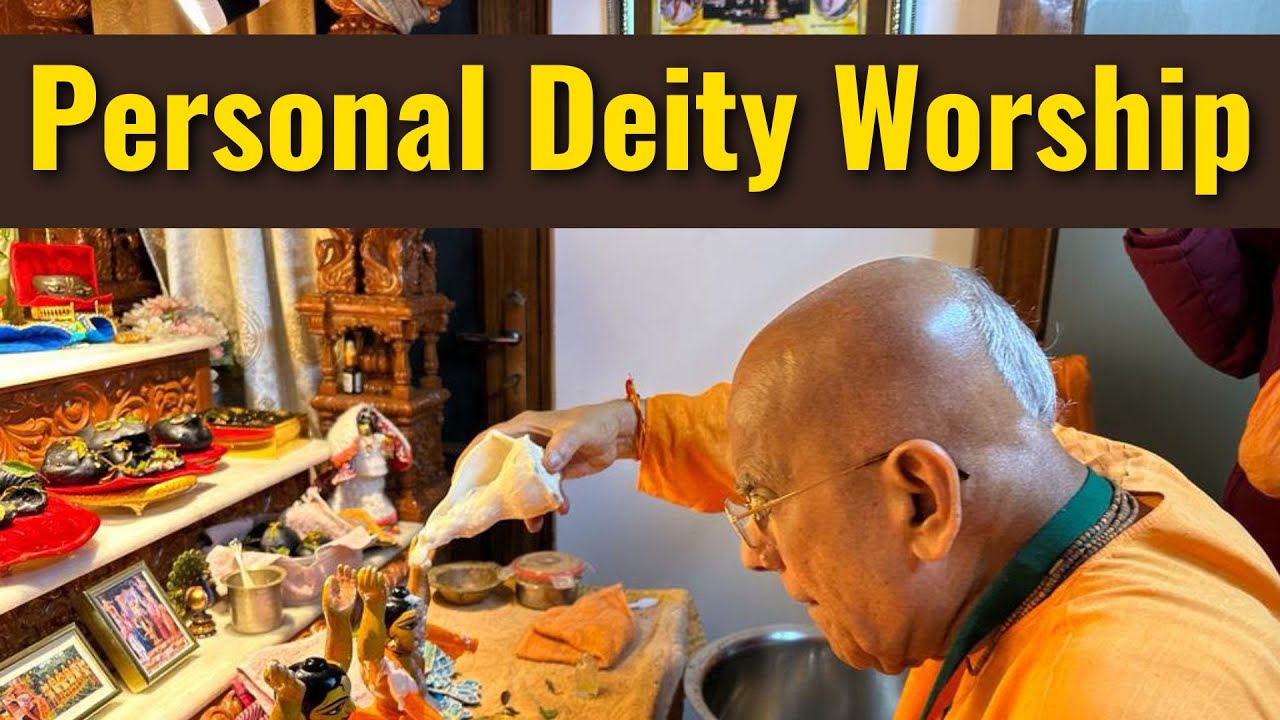
Srila Gopal Krishna Goswami explains Krishna's supremacy through the Bhagavatam's account of his battle with demon Bāṇasura, where Yogamāyā bewilders even Lord Shiva. He then tells how King Nṛga, reborn as a lizard due to a karmic mistake in charity, is rescued by Krishna, showing how devotion to Krishna brings liberation.
Chapters
Text 1: Shri Shuka Vachya. Translation: Parpat. Sugadeva Goswami said, 'O descendant of Bharata, the relatives of Aniruddha, not seeing him return, continued to lament as the four rainy months passed. After hearing from Narada the news of Aniruddha's death, and his capture, the Vrishnis who worship Lord Krishna as their personal deity went to Śrīmad-Dvārakāpur. With Lord Balrāma and Lord Kṛṣṇa in the lead, the chiefs of the Sāttvaka clan—Pradyumna, Satyaki, Gauḍa, Śāma, Śarana, Nanda, Upananda, Bhādra, and others—converged with an army of 12 divisions and laid siege to Banasūra's capital, completely surrounding the city on all sides. Banasura became filled with anger upon seeing them destroy his city's suburban gardens, guards, watchtowers, and gateways, and thus he went out to confront them with an army of equal size. Lord Rudra, accompanied by his son Kartikeya and the Kramathas, came riding on Nandi, his bull carrier, to fight Balaram and Krishna on Bana's behalf. Śrīla Siddhārṣvāmī states, purport, that the word Bhāgavān is used here to indicate that Lord Śiva is by nature all-knowing and thus well aware of Lord Kṛṣṇa's greatness. Still, although Śiva knew Lord Kṛṣṇa would defeat him, he joined the battle against Him to demonstrate the glories of the Supreme Personality of Godhead. Śrīla Viśvanātha Ṭhākura ṭhākura states that Lord Śiva entered the battle for two reasons. First, to increase Lord Kṛṣṇa's pleasure and enthusiasm, and second, to demonstrate that Lord's incarnation as Kṛṣṇa, although enacting human life pastimes, is superior to other avatāras, such as Lord Rāma-Candra. Śrīla Viśvanātha Ṛkārṭī further states in this regard that Yogamāya, Lord Kṛṣṇa's internal potency, bewildered Lord Śiva just as she had bewildered Brahmā. In support of this statement, the Ācārya cites the phrase Brahmarudra di Mohanam, from Bhaktirasamrita Sindhu. Of course, Yogmaya's job is to make his— to make fine arrangements for the Lord's pastimes. And thus Shiva became enthusiastic to battle the Supreme Lord Krishna. Text 7. A most astonishing, tumultuous, and hair-raising battle then commenced with Lord Krishna matched against Lord Shankar and Pradyumna against Kartikeya. Lord Balaram fought with Kumbhanda and Kupa-karna, Shyama with Banasana, and Satyaki with Bhand. Brahma and other ruling demigods along with Siddhas, Charanas, and great sages, as well as Gandharvas, Apsaras, and Yakshas, all came in their celestial airplane to watch. With sharp-pointed arrows discharged from his bow, Sharanga, Lord Krishna drove away the various followers of Lord Shiva—Bhutas, Pramathas, Guhyakas, Dakshinis, Dakinis, Yatudhanas, Vetalas, Vinayakas, Pretas, Mathas, Pishachas, Kusumandras, and Brahmarachasas. Lord Shiva, wielder of the trident, shot various weapons at Lord Krishna, wielder of Sharanga. But Lord Krishna was not, was not in the least perplexed. He neutralized all these weapons with appropriate counter weapons. Lord Krishna counteracted a Brahmastra with another Brahmastra, a wine weapon with a mountain weapon, a fire weapon with a rainy weapon, and Lord Shiva's personal Paśupatastra weapon with his own personal weapon, the Narayanastra. After bewildering Lord Shiva by making him yawn with a yawning weapon, Lord Krishna proceeded to strike down Banasura's army with his sword, club, and arrows. Lord Kartikeya was distressed by the flood of Pradyumna's arrow. Raining down from all sides, and thus he fled the battlefield on his peacock as blood poured from his limbs. Kumbhanda and Kupakarana, tormented by Lord Balaram's club, fell down dead. When the soldiers of these two demons saw that their leaders had been killed, they scattered in all directions. Banasura was furious to see his entire military force being torn apart. Leaving his fight with Satyaki, he charged across the battlefield on his chariot and attacked Lord Krishna. Excited to a frenzy by the fighting, Banasura simultaneously pulled taut all the strings of his 500 bows and faced 2 arrows on each string. Lord Sri Hari split every one of Banasura's bows simultaneously and also struck down his chariot driver, chariots, and horses. The Lord then sounded His conch shell. Just then Banasura's mother Kottar, desiring to save her son's life, appeared before Lord Krishna naked and with her hair undone. Lord Gadagraja turned his face away to avoid seeing the naked woman, and Banasura, deprived of his chariot, his bow shattered, took the opportunity to flee in the city. After Lord Shiva's followers had been driven away, the Shivjwar, who had 3 heads and 3 feet, passed forward to attack Lord Krishna. As the Shiva Jyotir approached, he seemed to burn everything in 10 directions. Shri Lavishwana Chakravarti quotes the following description of the Shiva Jyotir: Jyotirastri padastri shira, shadbujho navalochanaha, basma praharanodrodraha, kaalan takayamukhama. The terrible Shiva Jyotir had 3 legs, 3 heads, 6 arms, and 9 eyes. Showering ashes, he resembled Yamaraja at the time of universal annihilation. Text 23. Seeing this personified weapon approach, Lord Narayana then released his own personified favorite weapon, the Vishnu-jwar. The Shiva-jwar and Vishnu-jwar thus battled each other. The Shiva-jwar, overwhelmed by the strength of Vishnu-jwar, cried out in pain. But finding no refuge, the frightened Shiva-jwar approached Lord Krishna, the master of the senses, hoping to attain his shelter. Thus, with joined palms, he began to praise the Lord. As pointed out by Śrīla Viśvanātha ṛkṛti, it is significant that the Śiva-jeweler had to leave the side of his master, Lord Śiva, and directly take shelter of the Supreme Personality of Godhead, Lord Śrī Kṛṣṇa. The Śiva-jeweler said, "I bow down to You of unlimited potency, the Supreme Lord, the Supersoul of all beings. You possess pure and complete consciousness." and are the cause of cosmic creation, maintenance, and dissolution. Perfectly peaceful, You are the Absolute Truth to whom the Vedas indirectly refer. Previously, the Shiv-jwar felt himself to be unlimitedly powerful and thus attempted to burn Sri Krishna, but now he himself has been burned, and understanding that Sri Krishna is the Supreme Lord, he humbly approaches to bow down and offer praises. Praise to the Absolute Truth. According to the Ācāryas, the word 'śarvātmānam' indicates that Lord Śrī Kṛṣṇa is the Super Soul, the giver of consciousness to all living beings. Kṛṣṇa confirms this in Bhāgavad-gītā 15:15, 'mat-ta-smṛtir-gyānam apu-hanam ca'—from Me come remembrance, knowledge, and forgetfulness. In his commentary, Śrīla Viśvanātha Ṛakarūti emphasizes that the Śrīvijñvara has realized in many ways Lord Kṛṣṇa's supremacy over his own master. Lord Śiva. Thus the Śiva-jeweler addresses Kṛṣṇa as anantaśakti, the possessor of unlimited potency, parasya, the Supreme Controller, and sarvātmā, the Super Soul of all beings, even of Lord Śiva. The words kevalam gyaṭhi-mātram indicate that Lord Kṛṣṇa possesses pure omniscience. According to our limited understanding, we act in this world, but Lord Kṛṣṇa with His unlimited understanding performs infinite work of creation, maintenance, and annihilation. As Śrīla Jīva Gosvāmī points out, time, fate, karma, the jīva and his propensities, the subtle material elements, the material body, the life air, false ego, the various senses, and the totality of these as reflected in the living being's subtle body—all these constitute your material illusory energy, māyā, an endless cycle an endless cycle like that of seed and plant. I take shelter of You, the negation of this Maya. Purport: The word bijeruh pravaaha is explained as follows. The conditioned soul accepts a material body with which he attempts to enjoy the material world. That body is the seed of future material existence, because when a person acts with that body, he creates further reaction . Which grows roha into the obligation to accept another material body. In other words, material life is a chain of actions and reactions. The simple decision to surrender to the Supreme Lord releases the conditioned soul from this futile repetition of material growth and reaction. According to Śrīla Śrīdhara Svāmī, the words tan nishedhām prapatti indicate that the Supreme Personality of Godhead, Lord Śrī Kṛṣṇa, is nishedhāvadi-bhūtam, the limit of negation. In other words, after all illusion is negated, the Absolute Truth remains. The process of education may be succinctly described as a way of eradicating ignorance through the attainment of knowledge. Through inductive, deductive, and intuitive means, We attempt to refute the specious, the illusory, and the imperfect and elevate ourselves to the platform of full knowledge. Ultimately, when all illusion is negated, that which remains firmly in its place is the Absolute Truth, the Supreme Personality of Godhead. In the previous text, the Śrīvācārya described the Supreme Lord as sarvātmānam kevalam jñāntimatram, pure concentrated spiritual consciousness. Now the Śrīvācārya concludes his philosophical description of the Lord by saying in the next in this text that the various aspects of material existence are also potencies of the Supreme Lord. Śrīla Viśvanātha ṛkṛti mentions that the Supreme Lord's own body and senses, as implied here by the word tan-niśeḍaṁ, are non-different from the Lord's pure spiritual existence. The Lord's body and senses are not external to Him, nor do they cover Him, but rather the Lord is identical with His spiritual form and senses. The full absolute truth, unlimited in fascinating diversity, is Lord Sri Krishna. Text 27. With various intentions, you perform pastimes to maintain the demigods, the saintly persons, and the codes of religion for this world. By these pastimes, you also kill those who stray from the right path and live by violence. Indeed, you, your present incarnation is meant to relieve the earth's burden. As Lord Krishna states in Bhagavad-gita 9th chapter, 29th verse, 'Samo ham sarva bhutesu, na medvesyos tino priyaha, ye bhajanti tumah bhaktyam aititesu chapya ham.' I envy no one, nor I am partial to anyone. I am equal to all, but whoever renders service unto me in devotion is a friend in me, and I am also a friend to him. The demigods and the sages, deva and sagun, are dedicated to execute executing the will of the Supreme Lord. The demigods act as cosmic administrators, and the sages, by their teachings and their good example, illumine the path of self-realization and holiness. But those who transgress the natural laws, the law of God, and live by committing violence against others are vanquished by the Supreme Lord in His various pastime incarnations. As the Lord states in Bhagavad-gītā, 4th chapter, 11th verse. Yeh yatha mam prapadyante, tāṣputheva vajāmiham. He is impartial, but he responds appropriately to the acting of the living beings. Text 20. I am tortured by the fierce power of your terrible favor weapon, which is cold yet burning. All embodied souls must suffer as long as they remain bound to material ambitions and thus averse to serving Your feet. In the previous verse, the Śrīvijñāra stated that those who live by violence will suffer similar violence at the hands of the Lord. But here he further states that those who do not surrender to the Supreme Lord are specially liable to punishment. Although the Śrīvijñāra himself had acted violently up till now, since he has surrendered to the Lord and rectified himself, he hopes to receive the Lord's mercy. In other words, He has now become the Lord's devotee.
Text 29. The Supreme Lord said, O three-headed one, I am pleased with you. May your fear of my fever weapon— O three-headed one, I am pleased with you. May your fear of my fever weapon be dispelled. And may whoever remembers our conversation here have no reason to fear you. Here the Lord accepts the Śiva-jora as his devotee and gives him his first order, that he should never frighten by hot fever those who faithfully hear this pastime of the Lord's. Text 30. Thus addressed the Maheshvara-jora, bowed down to the infallible Lord and went away. But Banasura then appeared, riding forth on his chariot to fight Lord Krishna. Text 31. Carrying numerous weapons in his thousand hands, O King, the terribly infuriated demon shoots many arrows at Lord Krishna, the carrier of the disc weapon. Text 32. As Bana continued hurling weapons at him, the Supreme Lord began using his razor-sharp chakra to cut off Banasura's arm as if they were tree branches. Text 33. Lord Shiva felt compassion for his devotee Banasura, whose arms were being cut off, and thus he approached Lord Chakrayudha, Krishna, and spoke to him as follows. Sri Rudra said, text 34. Sri Rudra said, you alone are the absolute truth, the supreme light, the mystery hidden within the verbal manifestation of the absolute. Those whose hearts are spotless can see you, for you are uncontaminated like the sky. Perfect. The Absolute Truth is the source of all light and is therefore the supreme light, self-luminous. Absolute Truth is explained confidentially in the Vedas as Vedas and is therefore difficult for an ordinary reader to understand. The following statements quoted by Shri Laljeeva Goswami from Gopal Tapani Punishad. So how the Vedic sound occasionally revealed the Absolute? They, the four Kumaras, said to Brahma, please tell us how to worship Govinda, the Supreme Soul and the foundation of all that exists. He is the chief of all living beings. And tam ha devam atma vritti prakasham— one realizes that supreme Godhead by first realizing one's own self. The great Acharya Jīvagūṣāmī also quotes a verse from the Śrīmad-Bhāgavatam 7.10.48, udham param brahma manuśrīlingam, which refers to the supreme truth concealed in a human-like form. Since the Lord is pure, why do some people perceive Krishna's form and activities as impure? Ācārajīva Gosvām Ācārajīva explains that those whose own hearts are impure cannot understand the pure Lord. Śrī Viśvanātha Chakravartī ṭhākura further quotes The Lord's own instruction towards Jnana in Sri Hari Vamsa. Tat param paramam Brahma sarvam vivacchate jagat mamevattat ghanam tejo jatam arasi baharata. Superior to that total material nature is the Supreme Brahman from which the entire creation expands. O descendant of Bharata, you should know that the Supreme Brahman consists of my concentrated effulgence. Thus, to save his devotee, Śiva now glorifies the Supreme Lord Kṛṣṇa, his eternal worshipable master. The Lord's bewildering potency induced Śiva to fight with Lord Kṛṣṇa, but now the fight is over, and to save his devotee, Lord Śiva offers these beautiful prayers. Text 3536. The sky is your navel, fire your face, water your semen, and heaven your head. The cardinal directions are your sense of hearing. Harval plants the hairs on your body, and water-bearing clouds the hair on your head. The earth is your foot, the moon your mind, and the sun your vision. While I am your ego, the ocean is your abdomen, Indra your arm, Lord Brahma your intelligence, the progenitor of mankind your genitals, and religion your heart, you are indeed the original Purusha, creator of the worlds. Part 2. Shri Lalaji Maharaj explains that just as the tiny bugs living inside a fruit Cannot comprehend the fruit. So we tiny living beings cannot understand the Supreme Absolute Truth in whom we exist. It is difficult to understand the cosmic manifestation of the Lord, what to speak of His transcendental form as Sri Krishna. Therefore, we should surrender in Krishna consciousness and the Lord himself will help us understand. 37. Your current descent into the material realm, O Lord of unrestricted power, is meant for upholding the principles of justice and benefiting the entire universe. We demigods each depending on Your grace and authority, develop the 7 planetary systems. As Lord Śiva glorifies Lord Kṛṣṇa, a doubt may arise since apparently— Since apparently Lord Krishna is standing before Lord Shiva, as a historical personality with a human-like body. However, it is out of the Lord's kolhasa that He appears to us in a form visible to our mundane eyes. If we want to understand the Absolute Truth, Sri Krishna, we must hear from recognized authorities in Krishna consciousness. Such as Lord Krishna himself in the Bhagavad-gita, or from Lord Shiva, a recognized Vaishnava authority, who here glorifies the Supreme Personality of Godhead. Text 38. You are the original person, one without a second, transcendental and self-manifestating. Uncaused, You are the cause of all, and You are the ultimate controller. You are nonetheless perceived in terms of the transformations of matter affected by your illusory energy, transformations you sanction so that the various material qualities can fully manifest. Perfect. The Acharya's comment as follows on this verse. Srila Sridhara Swami explains that the term adya-purusha, the original purusha, indicates that Lord Krishna expands himself as Mahavishnu, the first of the three Purusha who takes charge of cosmic manifestation. The Lord is ek adityaha, one without a second, because there is no one equal to the Lord or different from him. No one is completely equal to the Supreme Godhead, and yet because all the living beings are expansions of the potency of the Godhead, No one is qualitatively different from Him. Śrī Caitanya Mahāprabhu nicely explained this inconceivable situation by stating that the Absolute Truth and the living beings are qualitatively one but quantitatively different. The Absolute possesses infinite spiritual consciousness, whereas the living being possesses infinitesimal consciousness, which is subject to being covered by illusion. Srila Jayagosa Swami, commenting on the term Adi Purusha, quotes from the Satva Tantra, Vishnu Stutri Nirupani. There are three forms of Vishnu for cosmic manifestation, etc. Srila Jayagosa Swami also quotes a statement of the Lord's form Shruti, purvam evaham ihasam. In the beginning I alone existed in this world. This statement described the form of the Lord called the Purusavatar, who exists before the cosmic manifestation. Śrīla Jīvagosvāmī also quotes the following śruti mantra, Tat puruṣasya puruṣatkam, which means such constitutes the Lord's status as Puruṣa. Actually, Lord Kṛṣṇa is the essence of the Puruṣa incarnation because He is Turiya as described in the present verse. Jīvagosaṁ explains the 4th Turiya, literally the 4th. Sorry, this is, uh, 38 is going on. Text 38 is 38. And Temple Lawrence 44 is going on. Read more. Next book, text 39. O Almighty One, just as the sun, though hidden by a cloud, illuminates the cloud and all other visible forms as well, so you, although hidden by the material qualities, remain self-luminous and thus reveal all those qualities along with the living entities who possess them. For good, here Lord Shiva further clarifies the idea expressed in the final two lines of the previous verse. The analogy of the clouds and the sun is appropriate. With its energy, the sun creates clouds which cover our vision of the sun. Yet it is the sun that allows us to see the clouds and all other things as well. Similarly, the Lord expands His illusory potency and thus prevents us from directly seeing Him. Yet it is God alone who reveals to us His covering potency, namely the material world. And thus the Lord is Ātma-pradīpa, self-luminous. It is the reality of His existence that makes all things visible. Text 40. Their intelligence bewildered by your Maya, fully attached to children, wife, home, and so on, persons immersed in the ocean of material misery sometimes rise to the surface and sometimes sink down. Purport: Śrīla Śrīla Rādhā Swāmī explains that rising in the ocean of misery indicates elevation to higher species such as demigods, and that being submerged refers to degradation to lower species, even to immovable forms of life such as trees. As stated in the Vayupurana, vipreyas chavanti brahmatva sthavar tayoho, the living being rotates between the position of Brahma and that of an unmoving creature. Srila Jiva Gosvami points out that Shiva having glorified the Lord, now pursues his original intention of securing the Lord's grace for Bāṇasūra. Thus, in this and the following 4 verses, Lord Śiva instructs Bāṇa on his actual position in relation to Lord— relation to the Lord. Śiva appeals to the Lord for compassion toward Bāṇa appears in text 45. Text 41. One who has attained this human form of life as a gift from God, yet who fails to control his senses and honor your feet, is surely to be pitied, for he is only cheating himself. Lord Shiva here condemns those who refuse to engage in the devotional service of the Lord. Text 42. That mortal who rejects you, his true self, dearest friend and Lord, for the sake of sense objects, whose nature is just the opposite, refuses nectar and instead consumes poison. The person described above is pitiable because he rejects that which is actually dear. The Lord, and accepts that which is not dear and is ungodly— temporary sense gratification which leads to suffering and bewilderment. Text 43. I, Lord Brahmā, the other demigods, and the pure-minded sages have all surrendered wholeheartedly unto You, our dearmost Self and Lord. Text 44. Let us worship You, Supreme Lord, to be freed from material life. You are the maintainer of the universe and the cause of its creation and demise. Equipoised and perfectly at peace, You are the true friend, self, and worshipable Lord. You are one without a second, the shelter of all the worlds and all souls. Śrīla Śrīla Daṣadvāmī states that the Lord is a true friend because He seats one's proper intelligence into motion. If one desires to know the truth about God and the soul, so Jīyoga Swāmī and Śrī Viśṇuñācārkoṭhitāgur both emphasizes that the term bhāva-pavarga-yā indicates the highest liberation of pure love of Godhead, characterized by unalloyed devotional service unto the Lord. Śrīla Viśnānu ṣakuritākura also explains that the Supreme Lord is samam, perfectly objective and balanced, whereas the living, other living beings having an incomplete grasp of reality cannot be perfectly objective. Those who surrender unto the Lord also become fully objective by taking shelter of His Supreme Consciousness. Text 45. This Bāṇasura is my dear and faithful follower. And I have awarded him freedom from fear. Therefore, my Lord, please grant him your mercy, just as you showed mercy to Prahlada, the lord of the demons. Lord Shiva feels inclined to help Banasura because the demon showed great devotion to Lord Shiva when he proved— when he provided a musical accompaniment for Shiva's Tandava dance. Another reason Bana is an object of Lord Shiva's favor is that he is a descendant of the great devotee Prahlada and Bali. Text 46. Supreme Lord said, my dear Lord, for your pleasure, we must certainly do what you have requested of us. I fully agree with your conclusion. Perfect. We should not think it strange that the Supreme Lord Krishna here addresses Lord Śiva as Bhagavan, Lord. All living beings are part and parcel of the Lord, qualitatively one with Him, and Lord Śiva is an especially powerful, pure entity who possesses many of the Supreme Lord's qualities. Just as a father is happy to share his riches with a beloved son, so the Supreme Lord happily invests pure living beings with some of his potency and opulence. And just as a father proudly and happily observes the good qualities of his children, the Lord is most happy to glorify the pure living beings who are powerful in Krishna consciousness. Thus the Supreme Lord is pleased to glorify Lord Śiva by addressing him as Bhagwan. Text 47. I will not kill this demonic son of Verochani, for I gave Prahlāda Mahārāja the benediction that I would not kill any of his descendants. Text 48. It was to subdue Banasura's false pride that I severed his arms. And I slew his mighty army because it had become a burden upon the earth. Text 49. This demon who still has four arms will be immune to old age and death, and he will serve as one of your principal attendants. Thus he will have nothing to fear on any account. Text 50. Thus attaining freedom from fear Banasura offered obeisances to Lord Krishna by touching his head to the ground. Bana then seated Aniruddha and his bride on their chariot and brought them before the Lord. Text 51. At the front of the party, Lord Krishna then placed Aniruddha and his bride, both beautifully adorned with fine clothes and ornaments, and surrounded them with a fully military division. Thus Lord Krishna took his leave of Lord Shiva and departed. Text 52. The Lord then entered his capital. The city was lavishly decorated with flags and victory arches, and its avenues and crossways were all sprinkled with water. As conch shell ankhas and dundubi drums resounded. The Lord's relatives, the brahmanas, and the general populace all came forward to greet him respectfully. Text 53. Whoever rises early in the morning and remembers Lord Krishna's victory in his battle with Lord Shiva will never experience defeat. Thus end the purports of the humble servants of His Divine Grace AC Bhakti Taranaswami Prabhupada to the 10th canto, 63rd chapter of the Srimad Bhagavatam entitled Lord Krishna Fights with Hanasura. Next chapter is the Deliverance of King Nriga. Should I continue? Text 1. Summary. This chapter describes how Sri Krishna released King Nirguna from a curse and instructed the royal order on the great danger of taking a Brahmana's property. One day, Samba and other young boys of the Yadu dynasty went to the forest to play, and after playing for a long time, They became very thirsty, and being looking for water, inside a dry well they found an amazing creature, a huge lizard resembling a hill. The boys felt sorry for it and tried to pull it out, but after several attempts with leather, leather thongs and ropes, they saw that they would not be able to rescue the creatures, rescue the creature. And thus they went to Lord Krishna and told him what had happened. The Lord accompanied them to the well and, extending his left hand, easily lifted the lizard out. By the touch of Lord Krishna's hand, the creature transformed at once into a demigod. Then Lord Krishna asked, 'Who are you, and how did you assume such a lowly form?' The divine being replied, my name was King Riga, son of Ikshwaku, and I was famous for giving charity. Indeed, I gave away countless cows to numerous Brahmanas. But on one occasion, a cow belonging to a first-class Brahman wandered into my herd. Unaware of this, I I gave this cow in charity to a different Brahmana. When the cow's previous owner saw the second Brahmana taking this cow away, the first Brahmana claimed the cow as his and began arguing with the second Brahmana. After quarreling for some time, they approached me and I implored them to each take 100,000 cows in exchange. For that one cow and to please forgive me for the offense I had unknowingly committed. But neither Brahmana would accept my proposal, and the matter remained unsettled. Shortly thereafter, I died and was taken by the Yamadutas to the court of Yama. Yama asked me which I preferred to do first: suffer the result of my sins or enjoy the results of my pious acts. I decided to suffer my sinful reaction first, and thus I assumed the body of a lizard. After King Raga had told this story, he offered prayers to Lord Krishna and then mounted a celestial airplane which transported him to heaven. Text 1: Sri Bhadrani said, O King, one day Samba, or Dhyumna, Charu, Bhanu, Gadha, and other young boys of the Yadu dynasty went to a small forest to play. Parpada. Śrī Śrīdhara Swāmī states that the story of King Nīrāga narrated in this chapter is meant to give sober instruction to all proud kings. Though in this incident Lord Kṛṣṇa also gave serious lesson to the members of His own family, who had become proud of their opulences. Text 2: After playing for a long time, they became thirsty. As they searched for water, they looked inside a dry well and saw a peculiar creature. Text 3: The boys were astonished to behold this creature, a lizard who looked like a hill. They felt sorry for it. And tried to lift it out of the well. Text 4: They caught on the trapped lizard with leather thongs and then with woven ropes, but still they could not lift it out. So they went to Lord Krishna and excitedly told him about the creature. Śrīla Jīvagosvāmī explains that because in this chapter the Yadū boys, even Śrī Prajñāma, are described as quite young, this must be an early pastime. Text 5. The lotus-eyed Supreme Lord, maintainer of the universe, went to the well. Prasad went to the well and saw the lizard. Then with his left hand, he easily lifted it out. Text 6. Text 6. Touched by the hand of the glorious Supreme Lord.
Harveldi. Harveldi. Okay.
Touched by the hand of the glorious Supreme Lord, the being at once gave up its lizard form and assumed that of a resident of heaven. His complexion was beautifully colored like molten gold, and he was adorned with wonderful ornaments cloths and garlands. Text 7. Lord Krishna understood the situation, but to inform people in general, he inquired as follows: Who are you, O greatly fortunate one? Seeing your excellent form, I think you must surely be an exalted demigod. Text 8. By what past activity were you brought to this condition? It seems you did not deserve such a fate. Oh, good soul, we are eager to know about you, so please inform us about yourself if, that is, you think this the proper time and place to tell us. Text 9. Sukadeva Gosvāmī said, thus questioned by Kṛṣṇa, whose forms are unlimited, the king, his helmet as dazzling as the sun, bowed down to Lord Mahādhava and replied as follows. Text 10. King Nṛgaṣa said, I am a king known as Nṛgaḥ, the son of Iksvāku. Perhaps, Lord, you have heard of me when list of charitable men were recited. Perfect. The Acharya points out here that Lord— that although a tentative expression is used, perhaps you have heard of me, the implication is that there is no doubt. Text 11: What could possibly be unknown to you, O Master? With vision undisturbed by time, you witness the minds of all living beings. Nevertheless, on your order, I will speak. Since the Lord knows everything, there is no need to inform him about anything. Still, to fulfill the Lord's purpose, King Raghav will speak. Text 12: I gave in charity as many cows as there, as there are grains of sand on the earth, stars in the heavens, or drops in a rain shower. The idea here is that the king gave innumerable cows in charity. Text 13: Young brown, milk-laden cows who were well-behaved, beautifully, and endowed with gold qualities— endowed with good qualities— who were all acquired honestly, and who had gilded horns, silver-plated hooves, and decorations of fine ornamental cloths and garlands. Such were the cows along with their calves that I gave in charity. Text 14-15. I first honored the Brahmanas who were recipients of my charity by decorating them with fine ornaments. Those most exalted Brahmanas whose families were in need were young and possessed of excellent character and qualities. They were dedicated to truth, famous for their austerity, vastly learned in the Vedic scriptures, and saintly in their behavior. I gave them cows, land, gold, and houses, along with horses, elephants, and marriageable girls and maidservants, as well as sea, sea, sea, silver, fine beads, clothing, jewels, furniture, and charities. In addition, I performed Vedic 5 sages and executed various pious welfare activities. Text 16: Once a cow belonging to a certain first-class Brahmana wandered away and entered my heart. Unaware of this, I gave that cow in charity to a different Brahmana. For what? So Śrīla Swāmī explains that the term duḥjā-mukhya, first-class Brahmana, Here indicates a Brahmana who has stopped accepting charity and would thus refuse to accept even 100,000 cows in exchange for the cow that had been improperly given away. Text 17. When the cow's first owner saw her being led away, he said, 'She is mine!' The second Brahmana who had accepted her as gifts replied, no, she is mine. Nraga gave her to me. Text 18. As the two Brahmanas argued Read. As the two Brahmanas argued, each trying to fulfill his own purpose, they came to me. One of them said, 'You gave me this cow,' and the other said, 'But you stole her from me.' Hearing this, I was bewildered. Text 19 and 20. Finding myself in a terrible
More from PRASAD

Rare Pastimes & Timeless Lessons of Guru Mahārāja | Stories Every Disciple Should Hear

ISKCON Legends- pure devotees meet-HH Jayapataka Swami, HH Gopal Krishna Goswami, HH Radhanath Swami



Jagannātha Ratha-yātrā Through Śrīla Prabhupāda's Mercy | 29 April 2006 | Nairobi, Kenya

Lord Jagannātha's Appearance Pastime | 21.07.2019 | ISKCON Calgary | Śrīla Gopāla Kṛṣṇa Gosvāmī

The Ācārya Teaches by His Own ExampleGuṇḍicā Mārjana by Guru Mahārāja #shorts

Guṇḍicā Mārjana – Lord Jagannātha's Pastime | 21.7.2019 | ISKCON Calgary |Śrīla Gopāla Kṛṣṇa Gosvāmī

H.H. Gopāla Kṛṣṇa Gosvāmī Mahārāja - Exemplary Sādhana and Deity Worship # shorts

भगवान की कृपा कैसे प्राप्त होगी ? | 11 Jan 2014 | Punjabi Bagh | Srila Gopal Krishna Goswami

Material Education vs Spiritual Education | Srila Gopal Krishna Goswami #shorts