Personal form of Krishna | BG 12.2 | 06 May 1995 | Śrīla Gopāl Kṛṣṇa Goswāmī Maharaja
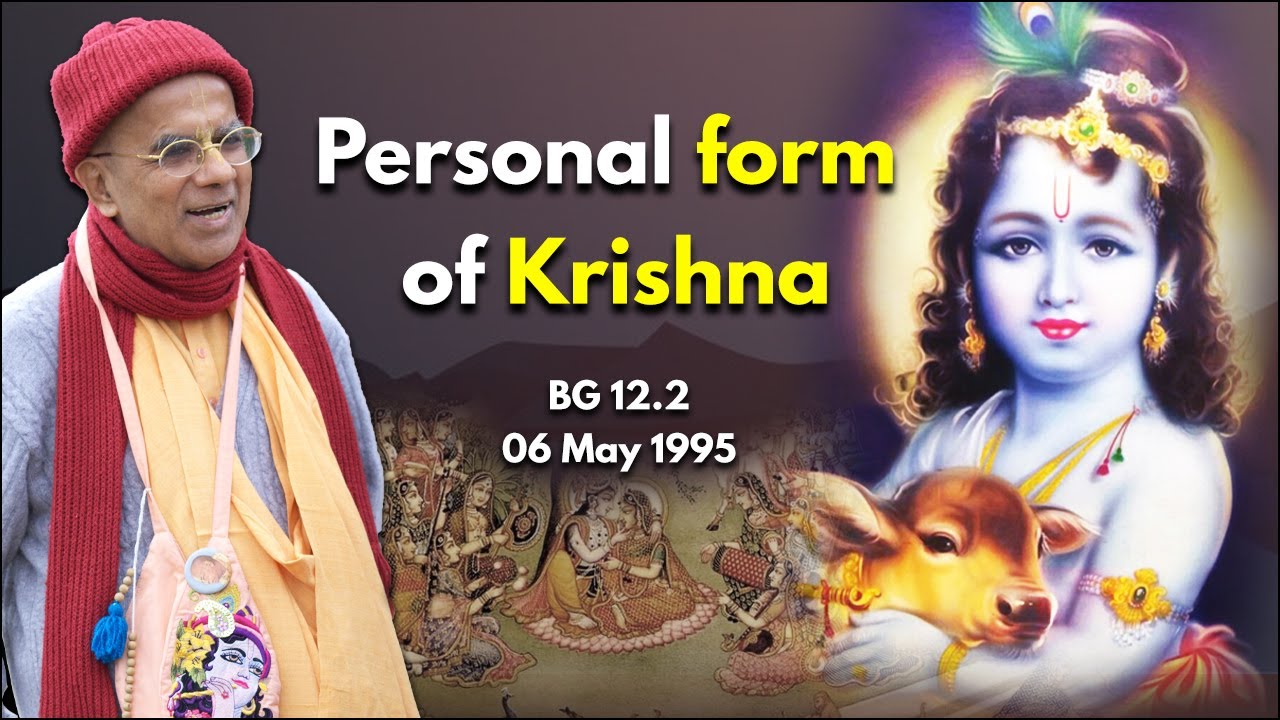
In this devotional lecture, Śrīla Gopāl Kṛṣṇa Goswāmī Maharaja expounds on Bhagavad‑gītā 12.2, explaining that worship of Krishna’s personal form is the most perfect path compared with worship of the impersonal Brahman. He outlines three progressive stages of understanding God—Brahman, Paramātmā, and Bhagavān—using everyday analogies (the train‑observation story and climbing a mountain) to illustrate increasing clarity. The talk recounts several of Krishna’s pastimes (the defeat of Putana, Yashodā’s vision of the universe, the lifting of Govardhan Hill) to demonstrate Krishna’s transcendental nature and personal form. Emphasis is placed on the central practice for Kali‑yuga: chanting the holy names (Hare Krishna) as the most effective means of self‑realization, supported by stories of Haridās Thākura and Caitanya Mahāprabhu. The speaker describes practical devotional service—chanting, hearing, reading, cooking prasāda, temple cleaning—as expressions of constant engagement with Krishna. He also highlights Srīla Prabhupāda’s mission, the upcoming centennial celebration of ISKCON, and the urgency of using the rare human life for devotional purpose. Throughout, the lecture blends scriptural citations, vivid analogies, and persuasive exhortations to inspire listeners to adopt personal‑form worship and name‑chanting as their spiritual priority.
Chapters
Om Namah Bhagavate Vasudevaya! Om Namah Bhagavate Vasudevaya! Om Namah Bhagavate Vasudevaya! Om Namah Bhagavate Vasudevaya! So according to the Vedic scriptures, God can be understood in different phases or ways. There is Param Bhagavān, Paramātmā, and Bhagavān. So I would like to read Bhagavad-gītā. Arjuna inquired, which are considered to be more perfect, those who are always properly engaged in devotional service, or those who worship the impersonal Brahman, the unmanifested? Now, Kṛṣṇa's answer to this. Text 2. The Supreme Personality of Godhead said, Those who fix their minds on My personal form, are always engaged in worshiping Me with great transcendental faith, are considered by Me to be most perfect. Namaste. Purport by His Divine Grace A.C. Bhaktivedanta Swami Prabhupada. Jai Śrī Prabhupāda. In answer to Arjuna's question, Kṛṣṇa clearly says that he who concentrates upon His personal form, and who worships Him with faith and devotion is to be considered most perfect in yoga. For one in such Kṛṣṇa consciousness, there are no material activities because everything is done for Kṛṣṇa. A pure devotee is constantly engaged. Sometimes he chants, sometimes he hears or reads books about Kṛṣṇa, or sometimes he cooks prasādam or goes to the marketplace to purchase something for Kṛṣṇa. Or sometimes he washes the temples or the dishes. Whatever he does, he does not let a single moment pass without devoting his activities to Kṛṣṇa. Such action is in full samādhi. Om akyānti vinandasya kya nānjanāśavakyā ca kṣrīrmaṇitā jīnāṇ tasmāśvīpida veda-mām. So the reason I'm discussing this is when I was coming in the car just now, someone sitting in the car asked me a question, which was, if God is all-pervasive, how can God still have his personal form? So we see in these two verses that we read, Arjuna asked Krishna, which is superior? What is most perfect? Those engaged in your devotional service, or those who worship the impersonal Brahman, the unmanifested? In other words, there are many people who think that God is all-pervasive, and since God is all-pervasive, he does not have a spiritual form, and they just worship the impersonal aspect of God. They think God is everywhere, everything is God, you are God, I am God, everyone is Narayana. So they think everyone is Narayana, so everyone can be worshipped. Now Kṛṣṇa, in response to this very simple question from Arjuna, he said, "Those who fix their mind on my personal form and are always engaged in worshiping me with great and transcendental faith are considered by me to be more perfect." So Kṛṣṇa is clearly explaining in response to Arjuna's query that worshiping him in his personal form is far superior to worshipping the impersonal aspect of God. I had explained earlier that God can be understood in different stages. The very initial elementary stage of understanding God is known as the stage of Brahman realization. A little more mature understanding of God is known as the stage of Paramātmān realization. And even further, a more mature stage of understanding God is known as the stage of Bhagavanri life. Just like you may go to school, you may get a high school degree. So that's also a degree. But then you may get a bachelor's degree, which is higher than a high school degree. And then you may get a doctorate degree, for example, which is even higher than a bachelor's degree. Our spiritual master used to explain, he explained us this with two very simple examples that we will present to you. Once in India, A new railway station was built in a town. So the villagers were discussing, "Oh, the train is going to come to our village for the first time. What does the train look like?" So they decided that they would send a delegation of 3 people to the railway station to see what the train looks like and to report back to the villagers at large. So the first of the 3, he saw the train coming. And he saw the light of the train, the engine, you know, in front of those days they had these coal engines. So these coal engines had a big light in the front. So he saw the light shining very sharply. So he ran back to the village and said, I saw the train. And people said, what does the train look like? Oh, there's a big light that shines a lot. The other person, he waited to see the light and he also saw the engine, and he saw a few compartments. So he ran back and he gave his understanding of what the train looked like, and his understanding was the light and the engine, and he saw some compartments from a distance. The third person was even more intelligent. He stayed behind, saw the light, saw the engine, saw all the compartments, saw the train leave the station, and he ran to the villagers and said what the train looked like. Now which of the three definitions is more perfect? First person, second person, third one? Third one. So similarly, Brahman realization is compared to just seeing that strong light of the engine. Paramātmā is a little more advanced. But when you accept God in His personal form, That is the highest of all. Just like you may see a mountain top from a great distance. From a great distance, you may only see the mountain top. But if you are able to climb up the peaks, you may see a little bit of variety on the mountain top. But if you are able to go on the top of the mountain, then naturally you can see it very clearly. So God, He manifests Himself in His transcendental form. In the Bhagavad-gītā, Kṛṣṇa says, janma-karma-cāme devyam evāṁ vivadi-tātpad-aha. My coming and going is both devyam. So what does devyam mean? Devyam means transcendental, beyond the material modes. You may say, "Well, I'm also transcendental. Come on, I chanta Hare Kṛṣṇa." You may be chanting Hare Kṛṣṇa, But we do not possess the same omnipotent qualities that Kṛṣṇa possesses. For example, you and I get old, we have white hair, cheeks get wrinkled, organs get weak, get hospitalized, etc. But Kṛṣṇa doesn't get old with the passage of time. Just like you see this very famous picture of Kṛṣṇa on the Battle of Kurukṣetra. How old does he look? Be impartial. Just pretend you've never heard of Kṛṣṇa before. If I just showed you this picture, how old does this personality look? So anyway, even if you show it to the grossest atheist who doesn't believe in God, he won't say more than 20 or 25. But Kṛṣṇa was 128 years of age by material standard at this time. So Kṛṣṇa doesn't age. With the passage of time. Why? Because he is completely transcendental. Then when Kṛṣṇa comes on this planet, he also performs superhuman activities. Just like, for example, when Kṛṣṇa came on this planet at a very young age, you all know the story how Kāṁṣa was killed. Kāṁṣa was Kṛṣṇa's maternal uncle, but he was warned that the child of your sister was going to kill you. So Kamsa employed every trick to see that the child would die. So he sent a very powerful demon, Putana. And Putana came. There was a big party going on. Kṛṣṇa's father was a very rich man. Though he was just a vaishya, He was an agriculturalist, he wasn't a business magnate. There were no business magnates at that time. At that time, man's asset was measured in terms of how much land he had and how many cows he had, not in terms of how many billions of dollars you have in the bank. So there was a big party going on and Putana disguised herself as a very beautiful lady. So nobody suspected her. And then she took Kṛṣṇa and she tried to get Kṛṣṇa to suck milk from her breast. In India in those days, even now, sometimes ladies, they have, they are able to put poison in their breast. So when, with this process, the child dies. But Kṛṣṇa was able to suck Putana's life. Then one day Kṛṣṇa was playing with his friend. And he defeated some of his friends. So they came complaining to Mother Yāsodā, "Your son, he is creating a lot of mischief." So when the son returned home, the mother said, "Have you eaten any dirt today?" Kṛṣṇa said, "No, I haven't eaten any dirt." But the mother would not believe it. So the mother said, "Okay." "Open your mouth." Just like when you have some tonsils, you go to the doctor, he says, "Open your mouth." And when Kṛṣṇa opened His mouth, what did the mother see? She saw the whole universe. Then she was amazed. Then there was another incident. Kṛṣṇa's father and all the other farmers in Vṛndāvana, they would offer offerings to Lord Indra. Every year. Who is Lord Indra? The king, in charge of rain. Just like we have a premier, prime minister, and ministers in a country, there is the Supreme Lord and various demigods who are in charge of different departments. So, and Krishna had successfully induced his father and the other vrajabasis to stop the yearly sacrifice, which was for the pleasure of Indra. When he saw that the vrajabāsīs had stopped the animal sacrifice. So Indra retaliated. How did he retaliate? He released unlimited rainfall. And this rain was falling, not like you and I have experienced the rain, but it was coming down in the form of heavy pillars. Can you believe it? There was lightning and thundering, and all of Vrindavan was flooded because Indra said, "I'm going to teach these people a lesson." So what did Kṛṣṇa do? He lifted the Govardhana Hill. And He was able to lift the Govardhana Hill with the nail of the smallest finger of His left hand. You know, your right hand fingers are more powerful than your left hand fingers. But Kṛṣṇa was able to lift the mountain. And this Govardhana Hill is not a small mountain. Some of you may have done parikrama. It takes 5, 4, 5 hours even if you do brisk walking, and 6, 7 hours if you do leisurely walking. It's about 22, 23 square miles. We now have a very nice temple right at the foothill of Govardhan. So anyway, Krishna was able to lift this mountain. Please do not think, our so-called modern Indian friends think, "Oh, all this is mythology." Whoever saw Krishna lifting Govardhan Hill? You may not have seen, but the Govardhan Hill is still there. You, you can still go to Vṛndāvana and see the very part of locations where Kṛṣṇa performed His wonderful pastimes. So we don't have enough time to explain in greater detail, but the point we are making is that Kṛṣṇa, when He comes, He performs superhuman activities. So God is a person. God manifests Himself. In His archa-vigraha form or in His mūrti form. Just like the many people, especially the impersonalist who are known as vāyavādī, who may come to a temple of the Lord and say, "Hey, you worship these deities, mūrtis? You think this is God? This is just some statue made of marble." So God becomes God when you see Him with the right eyes. And if you're trying to understand God through your own material senses, then God cannot be understood. So Krishna manifests Himself in His archa-vigraha form so that the conditioned souls can focus on God, worship Him, serve Him. Just like in the purport of this verse that we read, Prabhupada was explaining how a pure devotee is constantly engaged in serving the Lord. So there are so many ways how you can serve the Lord. You can serve the Lord by chanting and hearing. You can serve the Lord by describing the glories of the Lord to other people. You can come and sweep the temple of the Lord. After all, the Lord is the Supreme King. Just like in the Bhagavatam, you see an example of how King Amritashura, he was also sweeping the temple of the Lord. The important point is that somehow or the other, We must engage in service to the Lord, and if we engage in service to the Lord, then our life becomes perfect. So service to the Lord can be done through our various senses, but it all begins with chanting and glorifying the Lord. In Kali Yuga, people are not too interested in self-realization. In Kali Yuga, people are misguided. In Kali Yuga, people are unfortunate. Unfortunate in the sense that Self-realization is right on the bottom of their list. Everything else is important but Self-realization. Am I right? I must go to school, I must send my children to school, I must make this, I must do that, but Self-realization is not so important. So the Lord has very kindly presented very simple and sublime method for Self-realization in this age. And that is the process of chanting the holy names of the Lord. In the Caitanya-caritāmṛta, there's a dialogue between Haridas Thakura and Caitanya Mahāprabhu. Haridas Thakura was born in a Muslim family but very attached to the chanting process. He used to chant the holy name 3 lakh times every day. So Haridas, so Caitanya Mahāprabhu, just like a conscientious father, he gets very concerned when his children leave home and go away. So similarly, the Supreme Lord, Āhamvijñāpradāpitā, our seed-giving Father, He is very concerned when He sees that we, the rebellious children, want to rebel and live independent of Him. So Caitanya Mahāprabhu asked Haridas, "Haridas, please tell me, how will people be saved in Kali-yuga?" And Haridas replied, "Hā-nāma-hā-nāma-bālikāye nāmabhāsa." By taking to the chanting of the holy names of Kṛṣṇa. So chanting the holy names of Kṛṣṇa is a sure means through which we can understand God. Now in the beginning we may have no taste for chanting. Just like in the beginning, our stage is compared. If somebody is suffering from joint disease and you give him sugar cane, is any doctor here? Anyone? Will the patient be able to experience the sugar, the sweetness of the sugar cane? Yes? No. When you're suffering from joint disease and even if you're given sugar cane, you will not be able to experience the sweetness of sugar cane. So similarly, when you are chanting, initially you may not be able to experience the spiritual nectar of the Holy Name. But just like as you progressively recover from your diseased condition, you begin to experience the nectar of the Holy— of the sweetness of sugar more and more. So similarly, As we chant, we begin to enjoy the chanting more, more, more. In the Śrīmad-Bhāgavatam, it is said, knowingly or unknowingly, anyone who chants the Holy Name will get the benefit for chanting the Holy Name. The example is given that sometimes a child may innocently place his hand in fire, but the fire will not say, "O, you are a child. I am not going to burn you today." But the hand will get burnt, isn't it? So knowingly or unknowingly, anyone who chants the Holy Name, he is going to make, he is going to make spiritual advancement. So this Kṛṣṇa consciousness movement is teaching people how we can worship God, how we should take advantage of this very human life, Because as we've heard again and again, most of you that I see here are people who've been coming to ISKCON programs for a long time. And you've all heard many times before how this human form of life is a very rare privilege, and how this human form of life is obtained after going through millions of births and deaths. So when something is obtained with great difficulty, we tend to value it. Just like your newspaper that comes, you don't hide it because it's something available cheaply. If you have some diamonds or jewelry, you hide it carefully. So similarly, we have this rare human body, and why should we use this body for an unhappy purpose? Many times people say, yes, yes, yes, I am going to take to spiritual life, but I I'm not ready for spiritual life now. I'll take to spiritual life a little later. So the answer is that good things should not be postponed. As it is said, what should be done? An auspicious thing should never be postponed. An auspicious thing should be executed immediately. So Prabhupada wanted all of you, the whole world to be happy. Chetanai mahāprabhu. Who appeared on the planet 500 years ago, He had predicted, priṭhividyācchitāt nāgarādhigraḥ, that in every town and village of the world, the Holy Name should be sung. But somebody had to come to make that possible, and that was Śrīla Prabhupāda. And next year, as many of you may know, our movement is going to be celebrating the 100th anniversary of Śrīla Prabhupāda. On this planet. In the material world, we celebrate centennials of politicians, war heroes, etc. But actually, nobody has done as much for humanity as Śrīla Prabhupāda was able to do in a brief span of only 14 years. So, so worship of God in His personal form is superior to worship of God in the impersonal form. 1. 2. God is always transcendental. Those who underestimate God's personal form are actually insulting the Lord. 3. We can understand God by chanting the holy names of Kṛṣṇa. 4. You understand the science of self-realization by approaching a bona fide representative of the Lord. Śrīla Prabhupāda was able to explain to us exactly what Kṛṣṇa wants us to do. In the various books He wrote, in the purports He wrote. Fifth, we should all take advantage of this rare human life and profit our existence by taking to this process of chanting the names of Kṛṣṇa. Kṛṣṇa is not different from His name. Kṛṣṇa is omnipotent, omniscient. Kali-kale nama rupa Kṛṣṇa avatār. Kṛṣṇa incarnates in His Holy Name. And even if we don't feel like, we should still chant. Just like many times the weather is very rough, huh, it snows a lot. Nobody wants to go out, but still don't you go to work? You know if you don't go to work, you're not going to get your paycheck. Sometimes it's very hot. Never gets very hot in your country, but in India, as many of you know, sometimes it gets very hot. So does a housewife say, "It's too hot today, so no prasādam, no cooking. I'm not going to sit next to the fire." The housewife still goes, sits next to the fire, and does the cooking, isn't it? Why? Because she considers it her duty to do it. So similarly, pleasant or unpleasant, we also have a duty, a duty towards the Supreme Lord. You use a little bit of water and you have to pay the government, isn't it? I was recently told, I was in Washington for 2 weeks, and they told me that they really doubled, they doubled or tripled the cost of the water now. Water has become very expensive because the government is making sure the water is pure. So anyway, you get a little bit of water from the municipality, you have to pay. You use electricity, you have to pay, isn't it? Even though all that they do is manipulate the resources given by God. Because all this electricity that you see is either coming from water or from coal or from gas, which is all given by Kṛṣṇa. So for anything you consume, you have to pay a certain price. Just see the various gifts that God has given us. He's given you this very wonderful human body. You go to buy glasses, you have to pay. You go to buy contact lenses, you have to pay. Can you imagine how much you would have to pay to buy a pair of eyes? Is there any shop that sells a pair of eyes? That Hakim Abdu'l-Shem, does he sell eyes? No. Then is there any shop, there are shops that sell hearing aids, but is there any shop that sells you a pair of ears or a pair of nose, nostrils? Or any shops in Toronto that sell tongue that you can buy, you can choose the size of the tongue? There are no shops. So, and then your human body. So if we analyze, just this body which Kṛṣṇa has given you is the greatest gift. And then the sunlight you get, the energy, the wind, just like today is a very pleasant day. So all this nice weather, etc. So if we analyze and we enumerate the various gifts given by God, you will see the list is so vast. Isn't it? Still nobody talks about glorifying God. At least when America was founded, the founding fathers of American Confederation were very religious. So they established in the Constitution, ah, first principle, religious freedom, "In God We Trust." So they established that. So in trust in God should not just be verbal. Our trust in God has to be real and it should be practically demonstrate it. And how will we demonstrate? We demonstrate by doing what Kṛṣṇa wants us to do. Just like I can see most of you have children. So most of you have children, and as parents you want your children to be obedient to you. Am I right? If I do a confidential survey of all the parents and ask them, they all say, "Yes, we want our children to be totally submissive to us." Isn't it? But the reality is the children are almost not so submissive. As they get older, they get more distant. Anyway, so the point is that just like you measure, one thing is Kṛṣṇa is not a sentimental God. We as parents are sentimental, so we always say our sons and daughters are heroes and heroines. But Kṛṣṇa is not like that. Kṛṣṇa is not a sentimental God because the laws of nature are very strict. When you don't follow the laws of nature, then yamaraja is there to punish you. Some people have a concept of God as being so merciful, doesn't matter what you do, God is there to, you know, to pardon you. But that's a wrong understanding. God is merciful, but the laws of material nature operate very stringently, and if you break the laws of nature, becoming fallen, the victim of perishment. So we should please follow Kṛṣṇa's instructions. We just repeat every time what Kṛṣṇa has said, that is to chant Hare Kṛṣṇa. If you chant Hare Kṛṣṇa and do what Kṛṣṇa says, you'll be happy, peaceful, and spiritually wealthy, definitely. Hare Kṛṣṇa. Hale Krishna, Hale Krishna, Krishna Krishna, Hare Hare, Hare Rama, Hare Rama, Rama Rama, Hare Hare.
More from PRASAD

Rare Pastimes & Timeless Lessons of Guru Mahārāja | Stories Every Disciple Should Hear

ISKCON Legends- pure devotees meet-HH Jayapataka Swami, HH Gopal Krishna Goswami, HH Radhanath Swami



Jagannātha Ratha-yātrā Through Śrīla Prabhupāda's Mercy | 29 April 2006 | Nairobi, Kenya

Lord Jagannātha's Appearance Pastime | 21.07.2019 | ISKCON Calgary | Śrīla Gopāla Kṛṣṇa Gosvāmī

The Ācārya Teaches by His Own ExampleGuṇḍicā Mārjana by Guru Mahārāja #shorts

Guṇḍicā Mārjana – Lord Jagannātha's Pastime | 21.7.2019 | ISKCON Calgary |Śrīla Gopāla Kṛṣṇa Gosvāmī

H.H. Gopāla Kṛṣṇa Gosvāmī Mahārāja - Exemplary Sādhana and Deity Worship # shorts

भगवान की कृपा कैसे प्राप्त होगी ? | 11 Jan 2014 | Punjabi Bagh | Srila Gopal Krishna Goswami

Material Education vs Spiritual Education | Srila Gopal Krishna Goswami #shorts