Prayers of Gajendra | SB 8.2.33 | 09 Feb 1997 | New Delhi | Śrīla Gopāl Kṛṣṇa Goswāmī
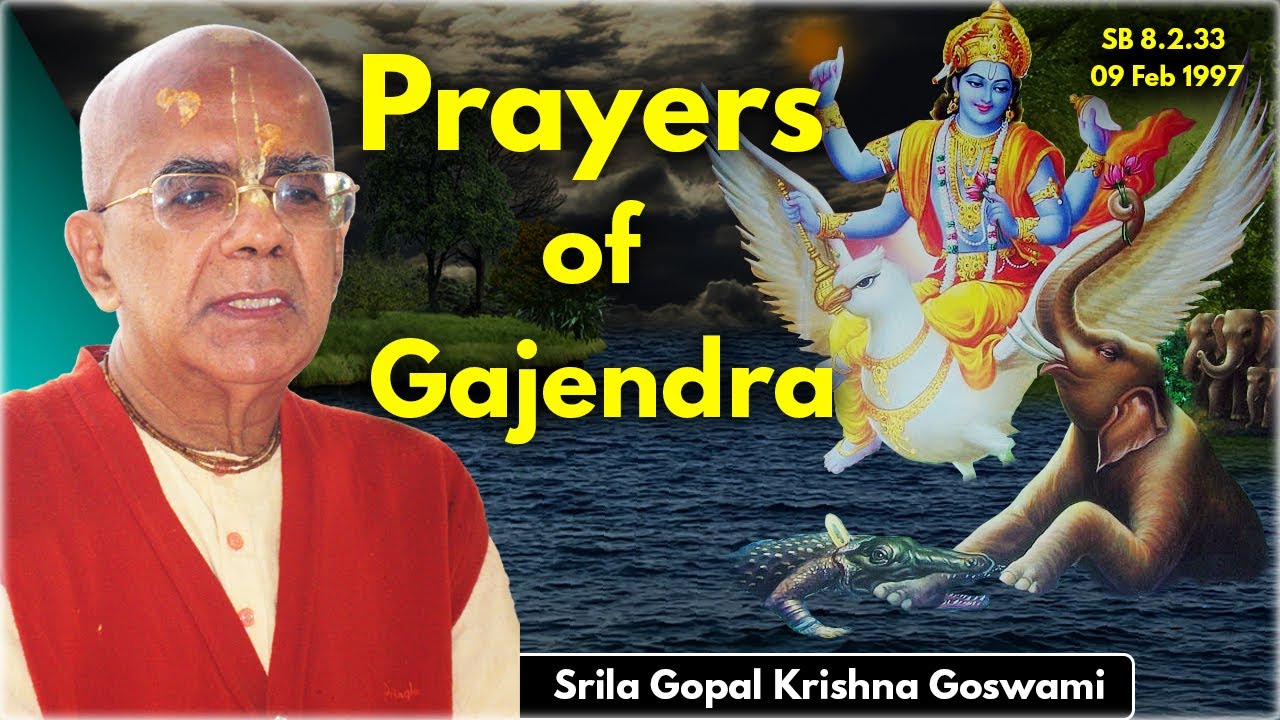
In this devotional lecture, Śrīla Gopāl Kṛṣṇa Goswāmī expounds on the Gajendra‑mokṣa episode from Canto 8, Chapter 2, Text 33 of the Śrīmad‑Bhāgavatam. He begins with a series of Sanskrit chants and praises, then narrates the back‑story of Gajendra (the elephant‑king) and the crocodile king, explaining how both were cursed by sages and how their past‑life identities (King Indradumna and King Huhu) shaped their present forms. The core of the talk focuses on Gajendra’s desperate struggle with the crocodile, his remembrance of devotional prayers from a previous life, and his ultimate surrender to Lord Kṛṣṇa, who rescues both beings with the Sudarśana‑cakra. The speaker draws multiple theological lessons: the impermanence of material power, the inevitability of death (time as a snake), the necessity of surrendering to the Supreme Personality of Godhead, and the process of purification through devotional service (chanting, hearing, association). He also discusses the hierarchy of servitude, urging seekers to serve the greatest—Krishna—rather than lesser authorities, and illustrates this with anecdotes about a villager seeking the “greatest” to serve. The lecture weaves contemporary analogies (advertising, product endorsement, queue‑line frustrations) to highlight how human anxiety mirrors material life, contrasting it with the freedom of a devotee who places all anxiety on pleasing Krishna. The talk concludes by emphasizing that sincere surrender guarantees liberation, that a devotee’s body becomes the last body, and that Krishna’s name, address, and “telephone number” are openly available through chanting the Hare Kṛṣṇa mantra.
Chapters
Om Namo Bhagavate Vasudevaya! Om Namo Bhagavate Vasudevaya! Om Namo Bhagavate Vasudevaya! Om Namo Bhagavate Vasudevaya! Primaṭbhāgatam— Kanto 8, Chapter 2, Text 33. Yahā kāśta neṣu balinunātākura gaḥ. Praśanda vegaḍavidhāvato briṣaṁ. Vitām prapaṇām paripātiyaḥ bhayāṇ. Mṛkyu pradāvāt yara nāmtam imāhi. Sadāti svāpasantikām bandehaṁ Śrī-guru Śrī-utāpasa-kām-lam Śrī-guruṇvaiśṇa-maṁṣṭha Śrī-lupāṁ sa-grājatām sahā-jñāra-gūnā-tanvitām tam sa-jeyevam sadvetaṁ sa-baddhu-taṁ prajñā-saītaṁ Kṛṣṇa-cetanya-devaṁ Śrīrādhā Kṛṣṇa-padāṇa saha-ganān-lalitā śrī viśākāṇvitāṁ śaḥ. Hē Kṛṣṇa karunāsyendu dīnā-bandhu jagāt-vate. Gopesa gopika-kānta rādhā-kānta namo sutek. Tāpta-kāñcana-gorā-gī, rādhē-bhrindāvā-nēśvari, viśvānu-sūti-devī, pranamāmi harī-pīk. Jai Śrī Kṛṣṇa, cetaṇya, rābho-nityānanda, Śrī Advaita-gadādha, Śivaśali-gorbhaktā-bhrindā. Hare Kṛṣṇa, Hare Kṛṣṇa, Kṛṣṇa, Kṛṣṇa, Hare, Hare. Hare Rāma, Hare Rāma, Hare Rāma. The Bhāgavatam is sweet wherever you open it. The Bhāgavatam has been compared to a sugarcane. Sugarcane, whether you bite on the top, bottom, middle, it's sweet. So the Bhāgavatam, doesn't matter where you open, Every shloka is transcendental and very sweet. But still, some sections of the Bhāgavatam are little more sweeter than the other sections. And we are entering into a very, very nectarian section of the Bhāgavatam, the prayers of Vajendra, which you're going to read from next chapter onwards. This section is a very wonderful section. Which conveys, which describes very wonderfully the position of the Supreme Personality of Godhead. Gajendra, as you know, is an elephant. But he's not an ordinary elephant. He is the king of the elephants. Near this Taraka mountain, there was a very big forest, and Gajendra was the king of that forest. And he was such a powerful elephant that even all the— even the lions were scared of him. Can you imagine a lion being scared of an elephant? So usually everyone is scared of the lion, but even the lion and the tigers, when they used to see Gajendra walking, they would run away. And the weaker animals like the cats, the wolves, the rats, the rabbits, They used to feel completely protected by Gajendra. Usually it's the other way around. The big animals are like the dadas and the small animals are prey for the big animals, isn't it? But Gajendra was so magnanimous that the small animals felt, "Oh, now nothing to worry, no one's going to eat us up." And the big animals were hiding when Gajendra would walk. Anyway, because he was in the body of an elephant, He had the propensity of the elephant. In other words, whatever body you get, you take on those characteristics. Just like if a living entity becomes a dog, for example, then he's not going to speak sweetly, he's going to bark, he's going to, you know, pass stool and urine like a dog, move his tail, etc. So Gajendra was not an ordinary elephant because in his previous birth he was a king known as King Indradumna. And King Indradumna was a king of southern India. And after retiring from his royal duties, the king had retired. He had retired and he had gone to practice meditation. And when the king had gone to practice meditation, actually there was a great sage, Agastya Muni, who came over there and the king did not offer him any respect, any welcome, etc. So the king got angry. The sage, Agastya Muni, got angry and he cursed him. Because he was like a dumb man meditating, but here was a great sage, Agastya Muni. So at least the king should have offered him some respect, but he didn't. So the sage, Devana Rishi, cursed him, "You will become like an elephant." And of course, I think I explained this point the other day, that this curse of the great sages is actually a blessing. The chastisement of the spiritual master is actually a blessing. Because not only was he cursed, but there was another king, King Huhu, who was an inhabitant of the Gandharva planet, who was also cursed by a sage called Devala Rishi. Because once King Huhu was playing in the water with his female associates, and by mistake he pulled the leg of a sage who was also swimming nearby. Devil Rishi. And Devil Rishi got very angry, and the king apologized for this mistake, but still he was cursed to become crocodile. But the sage said, "Don't worry, this curse is a blessing for you." So the king very willingly accepted the curse, and then as you will see, it was a blessing. It was a blessing both for the King Indradumna and for King Huhu. Why? Because one became a crocodile and the other became an elephant. And over here we see that the elephant Gajendra, who had gone into the river to enjoy with the sea elephants, his feet got trapped in the mouth of the crocodile. And in the verses that we have read so far in this chapter, we have seen that the elephant tried its best to pull its leg out of water. Normally, if you describe to an ordinary person the encounter between the elephant and the crocodile, any man will say, "Oh, crocodile, no match for the elephant, isn't it? Well, crocodile is a small animal, the elephant is a giant." So well-built, in one minute it can sweep the crocodile off the river. But over here we saw that the crocodile, he had the elephant's legs firmly in its mouth, and for a thousand years the battle went on. The battle that was the elephant attempting to pull its leg out and the crocodile just holding on. And as we have read, the elephant became weaker and weaker and the crocodile became stronger and stronger. Now at this point, the elephant was fearful of death. As Prabhupāda explained in the purport, almost everyone is scared of death. The elephant knew that, "Now I'm going about to die." So by the arrangement of the Lord, The elephant remembered this stotras, the prayers that he knew as king in the dūmna. The devotional service never goes in vain. So as king in the dūmna, he had done devotional service. And now in his next birth, when he gave up the enjoying propensity, when he, when he had no alternative but to depend on the Lord, He remembered those prayers that he had memorized in his previous life. Actually, for the period when the crocodile had the elephant's leg, these are cricket matches, football matches, so all the demigods, they were all watching. The elephant's leg is in the mouth of the crocodile. They were watching and they were hoping that the elephant will turn to the demigods for help. But the elephant did not turn to the demigods for help. In his previous life he was a devotee of Lord Viṣṇu. So he turned straight to Lord Viṣṇu. And he— over here we see that Gajendra is describing the Supreme Personality of Godhead. But in the next chapter you will read about the wonderful prayers of surrender. That Gajendra offers. Actually, all devotees who are serious about Kṛṣṇa consciousness, they must read these Gajendra's prayers of surrender again and again to understand how a devotee should surrender to the Lord. And as you know, in the end, the Lord was so pleased by the prayers of Gajendra that He came down on the back of the Garuda, and with the Sudarśana-chakra, He pierced the crocodile. And as a result, both of them got liberated, the crocodile and the elephant. So we know to everyone. In other words, to know God, you have to qualify yourself. God is all-pervasive, but to understand God, we have to become purified. But God has many characteristics, but one of them is pavitram, He is the purest of all. And in order to understand Him, we also have to become pure. We also have to become free of our contamination. Therefore, we have this process of devotional service. Because devotional service is the process, beginning with the process of chanting and hearing, is the process of purification of the heart. It's a process of purification of the mind. It's a process of purification of the intelligence. It's a process of purification of the senses. The mind, the intelligence, and the senses are all completely corrupted, polluted at the moment. But as you begin the process, of executing devotional service, the dirt begins to lessen. Just like when you take medicine, the germs in the body begin to get weak. So the Supreme Personality of Godhead is not known to everyone, but only His devotees. But He is very powerful and influential. So Kṛṣṇa has many characteristics. You can't even enumerate or list The various characteristics of the Supreme Lord. But one of His characteristics is that He is very powerful. Aishvarya-samādrasya viryasya yasyaśāśraya. Viryasya. Viryasya means He is the strongest. There is no one who is stronger than Kṛṣṇa. Can anyone imagine that anyone can lift a mountain as big as Govardhana Hill? Which is 22 kilometers today, but at that time it was bigger because every year the Govardhan Hill is getting shorter and shorter, it's shorter. And he lifted it with the smallest, with the nail of the smallest finger of his left hand. And he lifted it at the time when there was unlimited rain, thundering, and the rainwater that was falling was not like water, it was as heavy as pillars. Falling from the sky. Just like you have these pillars in this temple room which is designed as a restaurant. So the water that was coming down when Indra was angry at the bridge bāthis, each drop of rainwater was as heavy as this pillar or even heavier. And it was all falling on Govardhan Hill. And at the same time it was thundering, lightning. Still the mountain did not even move. You know, sometimes when we carry weight, we struggle, you know, we struggle and the Suitcases moving, you see coolies carrying suitcases at the railway station, you know. It's not that they carry it all still. But Kṛṣṇa, when He was carrying the Govardhana Hill, it didn't even tilt. No tilting, nothing, straight. And the Vṛjapāṭṣis, for the period that they were under the Govardhana umbrella, they were all looking at Kṛṣṇa's face and they did not even feel any hunger or thirst. That was Kṛṣṇa. So Kṛṣṇa is very powerful and influential. Therefore, although the serpent of eternal time, which is fearful and forth endless, chases everyone, ready to swallow him, the one who fears the serpent takes shelter of the Lord. So what Gajendra is saying is, the serpent of time destroys everything. Time has been compared to a snake or a sāmpa. A snake Swallows everything, huh? So time destroys everything. You may be very handsome, very powerful, but time will make sure that you don't remain powerful for long, isn't it? You see in the political circles of the world, a man may get elected by a landslide victory today, but after 3 years people are ready to throw him out, isn't it? A man may be very healthy today, but after some years he gets paralysis, he gets some other disease, etc. So time acts as the representation of the Lord. What does Kṛṣṇa say in Bhagavad-gītā? "Time I am, the destroyer of everything." So what Gajendra is saying that the Supreme Personality of Godhead reveals only to His devotee. And time, it actually destroys everything. It destroys everyone. But one who takes shelter of the Supreme Personality of Godhead, he is not affected by the propensity of fear. Basically, in material life, doesn't matter how strong, powerful you may be, Everyone is fearful, isn't it? So there are so many different types of bhaya that we all have. Fear is one of the propensities of material life. When Brahmājī created this material universe, Brahmājī first created the principles of nescience. What were the principles of nescience? First Brahmājī created the fear of false Deception. That means identifying with the body. We all identify with the body. Then Brahmanji created another aspect of nescience, which is fear of death. Everyone is fearful, aham, of death. Everyone is fearful of somebody else becoming stronger. Then Brahmanji created this propensity of anger after frustration, aham, that there is You get— you become angry and then you get frustrated. Then Brahmanji created this false sense of proprietorship and the illusory concept of life. So Brahmanji created these 5 different aspects of nescience. In other words, this propensity of fear, this is there due to strong bodily attachment. We are very, very attached to this body. We don't want the body to suffer. Why? You don't want the body to suffer because you want to use the body as a medium for sense enjoyment. That's why you don't want the body to suffer, isn't it? If you can get sense enjoyment without the body, then you wouldn't care for this body. Like in America, you see, People go jogging even when it's -20 temperature. Am I right, Jnani Ganya? They go jogging. It's so cold you can't even stand outside. Ah, but they're out jogging, you know, on the jogging tracks. Now why do they do that? They do that because they realize that jogging is good for their health, and good health is essential for sense enjoyment. So therefore they don't want the body to get weakened in any way. So the point is that There is fear. We have this fear of losing what we have. So what Gajendra is saying, if you take shelter of the Lord, then even fear will run away. Therefore he tells the Lord, "I therefore surrender unto Him, the great and powerful supreme authority, who is the actual shelter of everyone." So in mature life, we all want to serve the greatest, isn't it? Prabhupāda gave us a story that once there was a, there was an uneducated man in a village, but in his heart he always had the desire that I must serve the greatest, the biggest, the most important man. Just like in mature life, If somebody becomes Prime Minister, President, important man, then everybody wants to become his friend, isn't it? Everybody wants to be friendly to a great man. So this man wanted to be a servant of the greatest, but he didn't know who the greatest was. He was a simple villager. So he went to the village and he found out that the local District Magistrate, everyone said, "Oh, Saib, Saib, Saib, Saib, Saib." He is the greatest. So he went to him and said, "Can I become your servant?" He said, "Yes, you can." So he became his servant because he thought he was the greatest man. A little later he realized that this man who is the chief of the village or the town, he is also not the greatest. He has somebody above him that he reports to. A little later he saw that that new boss that he's serving, who he thought was the greatest, is also reporting to somebody. Somebody was coming in a horse carriage regularly, and when he would come, his new boss would bow down to him. So he think, "Oh, this man also must be having somebody greater than him." So he asked him, "Can I become a servant of this man that who came in a carriage and he bowed down to him? Who was that man?" Says, "Oh, he is the agent of the king. I report to the king, so the king sends his voice-roy to me from time to time. Can I become a servant of that voice-roy?" Then he became a servant of the voice-roy. But then he realized that the voice-roy also bows down to somebody else. He asked the voice-roy, "I thought that you were the greatest, but now I see that even you go and bow down to somebody." 'Yes, I am a servant of the king.' He said, 'Can I become a servant of the king?' Then he became a servant of the king. So when he was serving the king, one day he saw that the king also bowed down to somebody. There was a saintly man who came to the palace of the king, and the king bowed down, touched his feet, washed his feet. ." So the man was surprised. He said, "Oh, I thought this king was the greatest, but now I see he bowing down to somebody." So he went to the king and he found out from the king that that saintly person was a representative of Lord Viṣṇu. So then he said, "Can I become a servant of that man?" Then he became a servant of that Lord Then he saw that that sadhu, he was also bowing down to someone. He used to go to the temple and bow down to the temple of Lord Viṣṇu. So he said, "Oh!" He asked the sadhu, "Can I become a servant of Lord Viṣṇu?" He said, "Yes." So he went to the temple of Lord Viṣṇu, but the temple doors were closed. So it was a very cold night, he went to sleep in the night in front of the temple door. But in the morning when he got up, he found that the chādara was wrapped around his body, and he became a great devotee of Lord Viṣṇu. So the point is, Gajendra is saying, "You are the supreme authority." So Kṛṣṇa is the supreme authority. Even the demigods all take shelter of Kṛṣṇa. Lord Brahmā, Lord Indra, Lord Śiva, you name it. When Mother Yāsodā had her son open her mouth in response to the complaints of the other children that, that Kṛṣṇa has swallowed dust, she saw the whole universe. And when Kṛṣṇa showed His universal form to Arjuna, what did Arjuna also see? He saw all the demigods within the body of Kṛṣṇa. So this premise that the demigods are equal to the Supreme Lord, or that all gods are one, is contrary to religious scriptures. Because people in our country don't attempt to understand through the authentic sources, they falsely conclude that everything is all one, all gods are one. But all gods are not one. Now, being, acknowledging Kṛṣṇa as the Supreme Lord. Eka la Īśvār Kṛṣṇa ar sab bṛtāya. Bṛtāya means knocker, sevak. So, eka la Īśvār Kṛṣṇa, eki Īśvārai, Kṛṣṇa, bhākisab unke sevaka. Everybody else is a servant. So acknowledging that Kṛṣṇa is the source, Kṛṣṇa is the Supreme, Does not in any way imply that we are disrespectful to the demigods. No. We are very respectful. But by, just like when you water the root of the tree, you automatically nourish the tree, the branches of the tree. When you are hungry, all the parts of your body become weak. Am I right? But then do you try to feed each part individually? Huh? No, you just feed one part stomach, and through the stomach it goes everywhere. So similarly, one who is intelligent understands that there is the supreme authority that is above everyone. So if you want to serve the greatest, serve the supreme greatest. There is no one greater than Kṛṣṇa. So if you want to serve the greatest, serve the greatest, the greatest. The God of gods, the Supreme, the boss of bosses, that is Kṛṣṇa. And by serving the greatest, you will never be a loser. Even if you have done your devotional service incomplete, Kṛṣṇa was asked in Bhāgavad-gītā, what is the position of one who embarks on this path of devotional service and then he can't complete it? Uskā kiya hota hai. What happens? Kṛṣṇa says, nothing is lost. He either takes us both in the family of brahmanas, or He takes us both in a rich family so that he can continue his devotional service. In other words, devotional service stands you in eternal credit. See the example of Gajendra. Gajendra in his previous life had remembered all the prayers. And in this life, when he was in difficulty, he remembered the śrutis that he had learnt in his previous life. And he was able to take shelter of the Supreme Lord, and he was able to glorify the Supreme Personality of Godhead. So we must— an intelligent person must understand that there is a Supreme Controller. That Supreme Controller has a name, He has an address, He has a telephone number. You know, when Prabhupāda was setting up this ISKCON society in America, Prabhupāda, some people advised Prabhupāda, "We should call this International Society for God Consciousness." Where Prabhupāda said, "No, why God consciousness? Kṛṣṇa consciousness." ISKCON wouldn't sound so good, isn't it? But ISKCON sounds very catchy. So Prabhupāda said, "No, God has a name. Why just make it God consciousness? It is Kṛṣṇa consciousness." So the Supreme has a name. He has an address, huh? His address is Gauka, Vṛndāvana. And He never leaves Vṛndāvana. When it's time to kill the demons, He expands His vāsudeva kṛṣṇa and kills the demons. And He has a telephone number that you can reach Him via. And the telephone number is? It's not— It's not like a private or unlisted number. Like in the Western countries, in the big people, their numbers are always unlisted. Even if you call up, telephone enquiry, they'll never give it to you. "Sorry, it's unlisted." In India, I don't think they have that. They have? Unlist? Okay, so they have unlisted, many people unlist their phone numbers. But Kṛṣṇa's phone number is public. And when he chanted the Hare Kṛṣṇa mantra, then he at once established connection with Kṛṣṇa. So the Lord says, "mithyū sannā harai ca ham." "I am all-devouring death." So the atheist doesn't believe in God, ha? He's always busy challenging God. Then God comes to him in the form of death. So Kṛṣṇa is all-pervasive. And one who is intelligent, He takes shelter of the Lord. Now what happens when you take shelter of the Lord? What does Gajendra say? "I therefore surrender unto Him, the great and powerful Supreme Authority, who is the actual shelter of everyone." Kṛṣṇa says, "Arjuna, please declare to the world." What? "My devotee will never perish." Kaunteya prajñāni hi nama bhakta pranayati. He doesn't say Himself. Of course He does say. "Sarva-dharma-paritajyā mām ekaṁ śrī-nama-jahāṁ sarva-pāpebha-mokṣam imāśu-caḥ." Kṛṣṇa says: "Give up all varieties of religiousness, surrender to Me, I will protect you." That He says in the 18th chapter. In the 18th chapter, He summarizes the philosophy of the Gītā. But before that, Kṛṣṇa has told Arjuna: "You declare to the world that My devotee will not perish." Just like, you know, The advertising industry actually, even though it doesn't promote God consciousness, but indirectly all their advertising angles are derived from the Vedic scriptures. I'll give you one illustration. Like the— in advertising industry, they often have a famous movie star or a sportsman saying, "Oh, I use this soap. I use this shaving cream." I use Action Shoes, I use— isn't it? The manufacturer doesn't say, "My shoes are the best." No. He'll get some famous personalities to say, "Oh yes, use this pager. This is the best pager in town." Isn't it? So why? Because they feel that if a famous man will say this product is good, then people will believe it. But if they say it is good, they'll say, "Oh, it is your product." So naturally you'll say it's good. Isn't it? So somebody else says, it has more credibility. So this idea is borrowed from Kṛṣṇa. Because Kṛṣṇa told Arjuna first, "You declare that my devotee will never perish." So then this original idea came from Kṛṣṇa. Kṛṣṇa told Arjuna, "You declare that my devotee will never perish." So Kṛṣṇa could have said, Kṛṣṇa said it Himself, but He said, "You say," just like In all the movies, hopefully devotees don't see movies anymore, but in the movies they always show there's a fighting between the hero and the villain, isn't it? Huh? Do they still show that? Okay. So there's always a fight between the hero and the villain, huh? And it appears that the hero is about to lose the battle, you know, and then people get panicky. Oh, our beloved hero is about to lose the battle. Then in the end the hero knocks the villain off. Throw them down the cliff or something, and, you know, then everyone got it, isn't it? Now this theme, this concept also has come from Kṛṣṇa. If you read the Kṛṣṇa book, you see that Kṛṣṇa used to fight with the demons, and when Kṛṣṇa used to fight with the demons, sometimes it would appear that the demons are winning the battle, and when it would appear that the demons are winning the battle, that the demigods would get worried, "Oh, our Kṛṣṇa is about to lose." But then right as their anxiety would increase, Kṛṣṇa would knock the demons off. You see? Just like when the Kāliya serpent— we're thinking of having a Kāliya-Kṛṣṇa diorama in our fountain. So when the Kāliya serpent had Kṛṣṇa wrapped around its coils, Kṛṣṇa's mother, father, relatives would all think, "Oh, now Kṛṣṇa is almost dead." Except Balaram, everyone knew, everyone was in anxiety that Krishna is going to die. Only Balaram knew that nothing will happen. And then when Krishna saw that his mother and father's anxiety was increasing and his mother was about to faint, then he finally stretched himself and he eventually Kaliya was defeated. So the point is all, then again the advertising industry works on that theory. If you try our product, you'll become happy. Isn't it? No? That's why don't they show always a smiling face? Whatever product they advertise, they never show a serious face. They always show a person trying that product and being happy. Isn't it? So that means they acknowledge that before you try my product, you're unhappy. But if you try my cigarette, you'll become happy. Isn't that the thing? So at least acknowledge that you are unhappy before that. So that's exactly what Gita says, dukkhalayam ashashritam, there is nothing but misery in life. But they say, try our product and become happy, and Krishna says, come to me and be happy. That's the only difference. They say, try our cigarette brand, our liquor brand, come to our country and be happy, and Krishna says, no, forget all this, come to me. And I'll give you happiness. So that's exactly what is being illustrated in the purport, that death has to come to everyone. But why not prepare yourself before death? Now in the purport, Prabhupāda brings up a point that someone may say, "Oh, don't your devotees die? If your devotees didn't die, then I would see the value of surrendering to Kṛṣṇa." "Well, you're going to die, I'm going to die, so what's the big deal?" You know. "Why should I go to Kṛṣṇa? Why don't I stay on my path of sense enjoyment?" So Prabhupāda answers that. A devotee also has to give up his body, but one who surrenders to Kṛṣṇa fully, then this body is the last body for him. Ah, that's the difference. Then this body is the last body for him. Kṛṣṇa says, "Then you come back to Me and get a spiritual body." And in the spiritual body, no old age, no disease, no wrinkles on the cheek, no death, and climate is perfect, and you'll be with Kṛṣṇa always. So a devotee also dies, and the devotee is not scared of death because he knows that, "That devotional service that I have done, this will not go in vain. This will stay to my eternal credit." I, even if I have not completed my devotional service, Kṛṣṇa is going to give me birth in the family of devotees where from a young age I'll be exposed to Kṛṣṇa consciousness, or I'll go back to Godhead. So there's nothing to be lost. Whereas for a non-devotee, there's a lot to lose. You waited for millions of years to get this human body, and now that you got this human body, you sinned. You drank poison. Hari hari bhikṛte janma-ganayinu manuṣya janma-pāya rādhā-kṛṣṇa-vābādya jānyaśuṇya-pīśā-kainu. You drank poison. Now go back. Go back of the line. It's just like, you know, sometimes you stand in a line. Previously when they had the Soviet Union, there used to be big lines for everything, you know. Huh? You know that? People used to stand in line to get their bread, milk, everything. Huh? So anyway, people stand in lines. Of course, in India people don't believe in lines. So, you know, in India, in India it's the principle of survival of the fittest. So in every bus stop they may write, "Please queue," but nobody believes in queue, you know. If you're strong, if you're mighty, you get in the front. But in many parts of the world they do believe in lines. You stand in line. So just imagine you're standing in line. For hours and hours. Finally, your turn comes, and the man says, "Go back at the end of the line." So how do you feel then? Frustrated, isn't it? You shout. So that is exactly what happens. You stand in line, you go through all the lower forms of life. You've gone through species that live in water, species that live in land, species that fly, insects, animals. Now you get this human birth. And then you live like animals. Okay, go back. Go back to the lower forms of life and pay for all your karma and wait for millions of years more till you get a human birth. Therefore, one who's intelligent uses his rare human body for the purpose of Kṛṣṇa's seva. And Kṛṣṇa's seva can be done. So Gajendra over here is pointing out This main point that at some or the other one must take shelter of the Supreme Personality of Godhead and become fearless. So this section of the Bhāgavatam is very, very powerful. It will force us to take shelter of Kṛṣṇa, the Supreme Personality of Godhead. And if you take shelter of the Supreme Lord, then you can be saved from the samsara of birth and death, be saved from fear, be saved from anxiety. And you'll be happy. A devotee in all situations is free of anxiety. A devotee's only anxiety is, "How can I become more Kṛṣṇa conscious? How can I avoid wasting even one minute? How can I utilize all my time, energy, resources in service of Kṛṣṇa?" That should be our main anxiety. Our anxiety should not be, "Oh, how am I going to get this for myself?" Our anxiety should be, "How can I please Kṛṣṇa more?" "how can I bring more and more people to Kṛṣṇa?" Just like now we are in a marathon to complete this Śrī Śrī Rādhā Pārtha Sardī Palace for the benefit, glory of Prabhupāda. So that should be an anxiety. "How can we complete this project very fast? How can we work hard so that we can complete this project fast?" That should be our anxiety. And if that is our dominating anxiety, then Kṛṣṇa will reciprocate and make it the instrument to become a tool to make his temple. Kṛṣṇa is using all of us as instruments. Kṛṣṇa doesn't need anyone, but he is so merciful, he gives us the chance to do seva. When you get, when you are called upon to do some seva, don't feel bad. Rather, you should thank Kṛṣṇa for giving you the chance to do seva. Because the chance to do seva you get after millions of births and deaths. So Gajendra is in a very difficult position, but his fortunate position is that he's remembered the Supreme Personality of Godhead and he's glorifying the Supreme Lord as the supreme authority and as the only real source of, only real shelter of everyone. And by taking shelter of Kṛṣṇa, You can become fearless. Then you understand that nothing is in your hand. Everything is being under the hand of Kṛṣṇa. Everything is controlled by the laws of nature. Based on our karma, we are all going through the cycle of birth and death, experiencing happiness and distress. And based on karma, everything is being controlled. You are not the controller of everything, anything. So you just make the effort and leave the results in Kṛṣṇa's hand. And that is the summary of the Bhāgavad-gītā. Make the effort and leave the results in My hand. Don't think you are the controller because you don't control anything. So taking shelter of Kṛṣṇa, which is feasible through the agency of chanting, hearing, devotee association, is what we should be hankering for. Hare Kṛṣṇa. Hale Krishna, Hale Krishna, Krishna Krishna, Hare Hare, Hare Rama, Hare Rama, Lama Lama, Hare Hare.
More from PRASAD

Rare Pastimes & Timeless Lessons of Guru Mahārāja | Stories Every Disciple Should Hear

ISKCON Legends- pure devotees meet-HH Jayapataka Swami, HH Gopal Krishna Goswami, HH Radhanath Swami



Jagannātha Ratha-yātrā Through Śrīla Prabhupāda's Mercy | 29 April 2006 | Nairobi, Kenya

Lord Jagannātha's Appearance Pastime | 21.07.2019 | ISKCON Calgary | Śrīla Gopāla Kṛṣṇa Gosvāmī

The Ācārya Teaches by His Own ExampleGuṇḍicā Mārjana by Guru Mahārāja #shorts

Guṇḍicā Mārjana – Lord Jagannātha's Pastime | 21.7.2019 | ISKCON Calgary |Śrīla Gopāla Kṛṣṇa Gosvāmī

H.H. Gopāla Kṛṣṇa Gosvāmī Mahārāja - Exemplary Sādhana and Deity Worship # shorts

भगवान की कृपा कैसे प्राप्त होगी ? | 11 Jan 2014 | Punjabi Bagh | Srila Gopal Krishna Goswami

Material Education vs Spiritual Education | Srila Gopal Krishna Goswami #shorts