Qualities of a Brahmana, Initiation Lecture | ISKCON Detroit | 19.8.23 | Śrīla Gopāl Kṛṣṇa Goswāmī
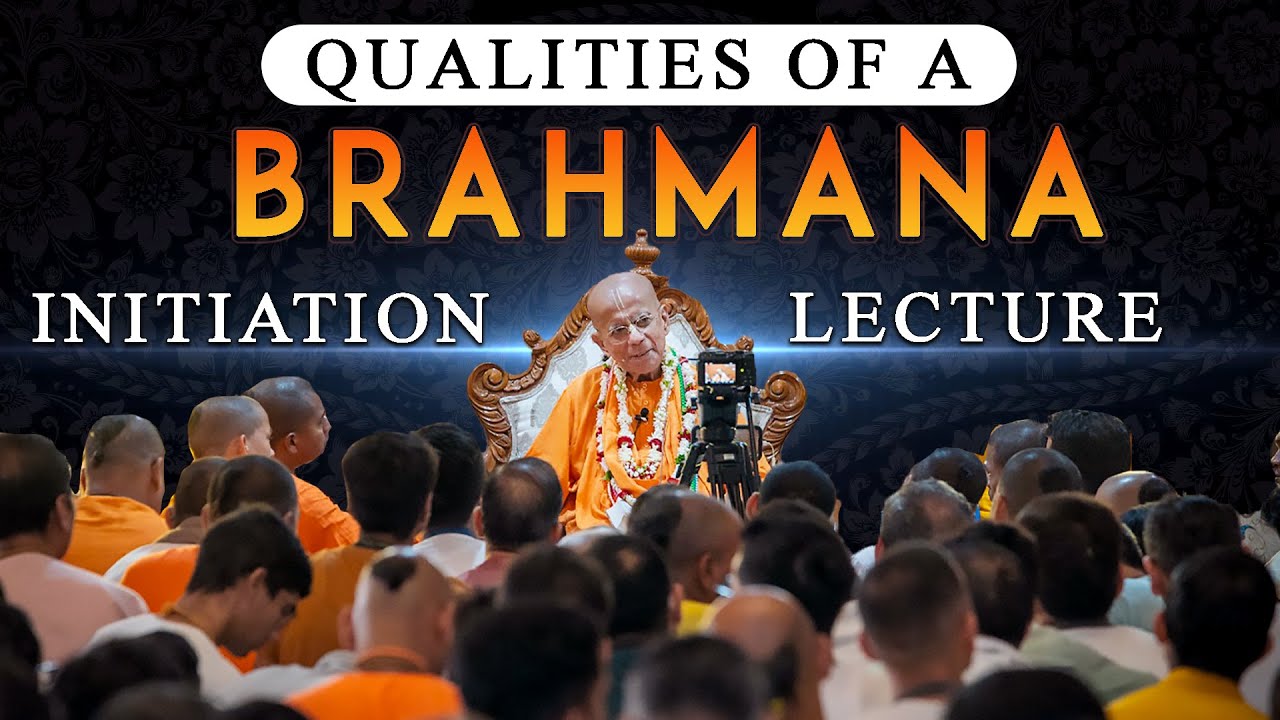
The video records an initiation lecture delivered by Śrīla Gopāl Kṛṣṇa Goswāmī at ISKCON Detroit. The speaker explains core Vedic concepts relevant to new initiates: the three types of birth (physical, devotional through chanting, and Brahminical/yogic initiation), the four regulative principles that govern a devotee's lifestyle (no meat, fish, eggs, onion/garlic; no intoxication including tea and coffee; no illicit sexual activity; no gambling), and the qualities expected of a Brahmana such as peace, self‑control, austerity, purity, tolerance, honesty, knowledge, wisdom, and religiosity. He emphasizes the importance of chanting the Hare Krishna mantra (minimum 16 rounds daily, 25 on auspicious days) as a means to control the senses and progress spiritually, and stresses regular study of the Bhagavad‑Gītā, Śrīmad‑Bhāgavatam, and other Bhakti literature. The lecture also outlines the practical initiation procedure—giving a bead, assigning a spiritual name, and committing to the prescribed japa schedule—while highlighting the role of A. C. Bhaktivedānta Swāmī Prabhupāda in preserving Vedic knowledge, the need to view Krishna as the supreme deity rather than equating all gods, and the value of applying one’s personal skills (business, art, cooking) in service to the Lord. The speaker cautions against criticism driven by jealousy, encourages respectful correction of misconduct, and underscores that initiation is a serious vow to live a life of devotion.
Chapters
of rābhadāma-samskara. This is the Vedic system. According to the Panchātattvika system, however, even though everyone is sūdra due to the absence of rābhadāma-samskara, if a person has but a little tendency to become Kṛṣṇa conscious, he should be given the chance to elevate himself to the transcendental platform of devotional service. Hare Krishna. You've heard this voice before. I speak on this word every initiation program. Can you hear me?
Yes.
In the back? Yes. All of you understand. Births in the hand. 3 types of birth. How many? 3 types of birth. One is from the womb, or shoka jnana. Shoka means— and shoka jnana means birth as a result of a seminical discharge. This birth is common to human beings and to animals. Animals also take their birth is through some neglect this time. Just having a human body and not having worshipped the Lord is a waste of time. The second birth is realized when you get initiated into the chanting of the Hare Krishna mantra. And today there's a very few devotees are getting initiated initiated into the journey of the Hare Krishna movement. This is called— second life— this is called samitsra. And third was the Vedic and Brahminical initiation, which is called yogic initiation. And with this Brahmin initiation, you can, you can touch the Lord from ante to the Lord. Hare Krishna. So, human life is very rare. And if human life should be short, self-realization— not Chaitanya has made the process very easy. So in this one initiation is given, one chance, 16 hours. For a year and a half at least, he would engage to follow 4 regulated principles: no meat, fish, and eggs; no intoxication, drinking and smoking; no illicit sex life; if one is married, he lives according to the direction of the scriptures; and no gambling. These 4 are —prayer of sinful life and prayer of— So those who are initiated, very fortunate, fortunate because I'm so many person that you come process of devotionism. And Prabhupāda said, you don't come to Kṛṣṇa consciousness unless you have pious karma behind you. So, we hope that you come, you come, by coming to Krishna consciousness, you will progress your life. Prabhupāda gave us the pure message of Godhead. Can you hear that? Prabhupāda gave us the pure message of Godhead. He did not adulterate anything or water anything, no. Why do we chant Hare Kṛṣṇa mantra? Because this is recommended in the scriptures. Hare Rāma, Hare Rāma, Hare Rāma, eh, okay, well, lower the silver in the same way. Why do we read the Bhāgavata or the Bhāgavad Gītā? These are books written by the Lord or spoken by the Lord. So, everything that you see in this world, Sometimes people say, "There are too many rules in this world." This is for our benefit. Austerity, tapo, austerity is very necessary. Now, the chanting of the Holy Name is beneficial in any situation. Even if a drunkard says, "The taste of the liquor is Kṛṣṇa." It is benefit. We are here to devote to Kṛṣṇa. But in order to take full advantage, we should avoid offences. Yeah, and we should not criticize somebody. If you see somebody doing something wrong, you can in a humble way get it corrected. Approaching one of those senior monks. But we should not criticize someone just out of jealousy, because he may not be better than me. So this should be avoided. There was a Brahmin monk in Abu Dhabi, became an enemy of Srivaddha. Why? Because the whole buddhism had a renounce of his house for one full year. So he ordered meat all in front of— she was— next morning when she was opening the door, she saw meat. She said, "Neighbors, come and see." But Krishna, who he believed in, Who knows? Never. You are never free. He had to suffer and suffer till even Shiva, he forgave him. The point is, there are many examples which all of you, I'm sure, have heard before. So, we should not be amazed or criticising people, especially women. Because we just don't like that person. Next, consider the name of living gods to be equal to the Supreme Lord. Before we became Hare Krishna consciousness, we were brought up in the atmosphere, all gods are one, take any path, you'll get the same result. Is that true? You want to go from Detroit to New York, Can you take any road and reach New York? Yes, no? No. Similarly, to think that all gods are one, you worship anyone of your choice, is wrong concept. Scripture established Ishvara Paramatma, which is a divine God. The main controller is Ishvara. But he wants to be in control of that head, Kṛṣṇa. So, you should deliberate the instruction of the spiritual master, or you consider him to be an ordinary person. Who is a spiritual master? Understand, if he chastises, this is for our happiness. Then we should not think that the Vedic scriptures are outdated. The Vedic scriptures are not outdated. The Britishers sent Sanskrit scholars to India, British scholars, to study Sanskrit. And— Sanskrit. And then they started writing books in which they said everything in the scriptures is mythology. Similarly, Hindus would also say, "Oh, that PhD doctor from England said that, how can he be wrong?" And they did have faith. But Prabhupada took the Vedic scriptures to every corner of the globe and he established the temples there. So that's because of Prabhupada's faith. This is transcendental knowledge. It is eternal and universal. So, Veda means knowledge. And this is knowledge spoken by the Lord and coming to us as a text. So, we should not deride the Vedic scriptures. Nor should we consider the chanting— nor should we consider the glories of chanting Hare Kṛṣṇa to be imagination. For graduation. But you should not think that, "Oh, the Holy Name cannot be so powerful. I'll chant the Holy Name 16 rounds and I'll also chant privately other devi-god mantras." We should have full faith that if we chant around 16 rounds minimum, then there will be love of God. Prabhupāda, when he started ISKCON, in New York. The first temple is all devotees. Chant 64 rounds a day. They were only American devotees at that time. So they tried 1, 2, 3, 4 days. Then Prabhupada said, okay, you can't do 64, do 32 rounds. And then they started doing 32. And they said they started, but they could not do 32 also. They went to Prabhupada and said, "32 is too much also." Then Prabhupada said, "16 is no fire." Not that. So Prabhupada gave us a 16 quota, and 25 rounds on auspicious days. I cannot face it. But if we have time, we can more than 16. Chanting less than 16 is— but if you want to have time, you don't have to chant every one mantra. You just chant Brahman. I can do this. It will be no headache. We should very cautious, almost silly. If you follow the 4 regulations, then it covers everything. The chanting of the holy name is not some karma-kanda activity. Karma-kanda is a sort of business engagement with the Lord. I will do this for you, and you will do this in exchange. That is not our practice. And then to preach the message to the faithless. Lord Caitanya said, "Jāre lakho saikāu, Kṛṣṇa ho pade." Wherever you see, please tell everyone about Kṛṣṇa. So Kṛṣṇa is teaching. So we should understand that we tell everyone to chant Hare Kṛṣṇa, The deep meaning of the Hare Kṛṣṇa mantra may be revealed after the person has developed some element of faith. Just like you meet a stranger on the street, he says, "What's your name?" You tell him what your name is. You're not going to tell him your whole home address, phone number, till you have more confidence. The man is— So don't be there, let's say, Loriya lōrī-nāma prasādhvayinām. Then to maintain that attachment in spite of chanting the holy names of the Lord— That is when you come to Kṛṣṇa consciousness, you realize what is undesirable and what is desirable. So since times immemorial we are engaged in sinful activities. So, we retain material attachment. I become a devotee of Brahman, but I'm still playing cricket. I still watch every cricket game. No, that's enough. Once you come to Krishna consciousness, getting initiated, you will see not a minute should be wasted in idle activity. I'm used to seeing movies. So you may not be initiated, doesn't matter. I'll see these as movies. That is ananda. So meditation and attachment are not an asset to you. They are liability. Therefore, Lord Caitanya talks in another Gosvāmī, 'Samparibhūtaṁ pheribhūmaṁ' and you take everything on paper. So on the spiritual path, initiation means taking a vow, 'I'll be serious,' and that means whatever commitment we are making, we will honor it. It's like I said in the beginning, there are 4 initiations in Buddhism: gommi, vishuddhi, bodhichitta, and arhati.— with the sex life we look at. So when we make a spiritual devotion to the Self, we experience spiritual happiness. Prasad RAVAL said, people do not know how big a happiness can be found. Big happiness can be found by taking to the path of devotion to the Self. So we hope that all of you, those who are accepting 15 or 16 devotees who are accepting initiation in chanting of the Holy Name. They chant 16 rounds every day. On special days, it's not compulsory, but it is recommended to chant more, 25 rounds. And read Prabhupāda's books regularly. Prabhupāda wanted These books should be read. What do these books contain? The philosophy spoken by Kṛṣṇa and the philosophy treated by the Lord of Prabhupāda, his purports. Prabhupāda, when he would be translating, he would keep in front of him, would keep in front of him the commentaries of Puruṣa and Ācārya and included what was necessary from their purports and presented it all to us in simple language in the Bhaktivedanta purport. How many of you read books every day? You should read Papakṛṣṇa, one word with purport, or more. You should buy a sweet. Kṛṣṇa is very pleased when you distribute His books. Kṛṣṇa is very pleased when you study His books. When you read His books, Kṛṣṇa says, "Here is someone trying to understand Me. Let Me give him the understanding, where he can come to Me." So, 1842. So we hope that— we hope that all of you will take your devotion somewhere. Very seriously. Sometimes people think, "Oh, now I'm initiated. I don't have to go to the temple. I don't need anything from the temple." Sometimes we see a foolish candidate thinks that after initiation I can become lax. That is wrong. So we hope that you all will be good devotees. Now, 3 devotees are also taking second initiation, or Brahminical initiation. Brahmin should be by guna and not by jnana. That is very important to understand. So, those who are receiving Brahmin initiation must know what are the qualities of a Brahmin. Who knows what are— Who knows the famous words that describe the qualities of a Brahmin? Someone knows? Yeah? Peace and both— peacefulness, these are the qualities the Brahmins should develop. Peacefulness, self-control, austerity, purity, tolerance, honesty, knowledge, wisdom, and religiousness. These are the natural qualities by which Brahmana's world. So, a Brahmana should be peaceful, but he can only be peaceful if you are single-pointed. I want spiritual life and nothing else. So, a Brahmana should not be meditating. This is material desire I have to achieve, and this is spiritual desire. You will be peaceful if your mind renounces desire for Sensory pleasures, enjoyment. Then a Brahmana must have self-control. Self-control means control your senses. The time I say, "Take me to that restaurant," but as a genuine Brahmana, he believe in austerity. Self-control means Control your senses. And what is the best way for controlling senses? What? What is the best way for controlling senses? By doing what? Chanting the Holy Name of the Lord. The senses need engagement. So, if you are a businessman, you can do business and relate a percentage of your profits especially in Kṛṣṇa's mercy. If you are an artist, then you can use your artistic talent to paint pictures for Kṛṣṇa. All the pictures that you see in Prabhupāda books are all done by devotee artists. If you are a good cook, you cook prasād raṇa. So whatever your skills are, use it in service of the Lord. Austerity. Austerity means doing what you don't want to do. And austerity in the beginning is painful, but then it turns into happiness. It's like you're going for an operation. It's austere. Who likes being cut? But when you recover and receive your activities, You say, "Oh, it's good, I will do that." So, our austerity is give up what is detrimental for Self-Realization. And the same one is favorable. And purity. You must have heard this phrase, "Purity is a force." We heard that before? Purity is a force. That means, what does it mean, purity? We don't call somebody a good singer, come and sing in the temple. Why? Because there is lack of purity. So similarly, we yesterday, instead of hearing mundane songs, you chant spiritual songs. And purity will come by how? By chanting Hare Krishna. What it also teaches is, as I say, "Cheezo zappan." "Vorene." "Cheezo mein bhajan." "Toshu tisvorn." The heart will become cleansed by the chanting of the Hare Krishna mantra. And then you will be able to concentrate on spiritual life. And tolerance. In the material world there is happiness and distress. Heat and cold. Sometimes we're insulted; sometimes we are praised. So when you're insulted if you feel bad— 'Asu' . If it's all red both of these... Let's say your disease and getting impatient. You've been to one or two doctors, this is not getting cured. So then what do you think? You should still tolerate it. Understand, this is the result of my karma. I have to tolerate it. Sometimes we have a teaching assignment that is difficult. Take care of that child. More tolerant than a tree. Tree is so tolerant. In summer, people cut— in summer, the tree gives us shade, that he is always willing to serve. Then, honesty. We should be honest. Once a teacher told the student, "Go and find out who your father is." And so, one boy, the son of a Parsi, he went to his mother and said, "Mother, I want to know in school who is my father." And the mother said, "Son, if you ask me truly, I don't know who your father is." And he went and told the teacher, and the teacher told the students, "I don't know who your father is." So, a Brahmin should be honest, at least in dealing with other devotees. I tell all, every businessman must say, "From you I make no profit." Prasad Raaval says in the Bhagavad Gita, "If you make a profit, how will you serve God?" So, there must be honesty. It's better to make an honest living by sweeping the floor rather than making a show. So, he must be honest in everything. In the material world you will say, "I'm making no profit, they make profit." That will not be dishonesty. Then there will be knowledge. Brahmins must have knowledge. One of the requirements for Brahmin is you should have done Bhakti Shastra. Bhakti Shastra, it doesn't mean you must read a book. We have books here, you know, a lot. So Brahman should be knowledgeable. You know, he knows the philosophy. Our movement is a philosophical movement. Unless we understand the philosophy, we can't make progress. So we hope that those who are accepting Brahman will try to cultivate these qualities and try to be Brahmanas in action. Not that we say something and do something else. We preach something and do something else. Is that correct? And those who are brahmanas, they must do some deity service in a temple. Brahmanas can cook prashad for the Lord and the devotees. Brahmanas can cook prashad You can touch the Lord, you can dress the Lord. You should also do some level of deity worship. Unfortunately in our temple, because there is a shortage of manpower sometimes, we give primarily initiation fast. The fast is slow. Brahmin masses were disqualified. We have removed that. If he can initiate her in Brahman, she'll become genuine Brahman. Okay? Hare Krishna. Hare Krishna. I believe you want to rehear from Ananda Nandan and Nityakrishna. So does anyone have any questions? You're going to make a commitment in front of the deities, in front of the spiritual master, in front of the Vaisnava, or in front of a video camera. It is being recorded. I have You can come a little bit forward.
Still, you can come a little bit forward so that we have passage for all the initiates.
Could you all hear the lecture in the back? Yes, Guruji. full religious business. And then, and then they come to me, I give them the bead and avoid it. Hare Krishna. So we're doing a fast-track process. There's a group of oldies going to be— Jagadguru Prabhupāda would call out the names, and the candidates, they first offered respects to Prabhupāda. Then when they go to Jagadguru, he would tell them the pranāmāṁsā, and before they get their position. And then when they come to me, I give them the beads and your name. And along with your name, I give you a slip of paper I'll get your name in a minute.
Okay. So one more time to repeat, when your name is said, please go and offer pranāmām to Śrī Prabhupāda, come to me here, I'll ask you the questions, you answer loudly, and then go to Guru Mahārāja, he'll give you the beads and the name.
Yes?
So first is Amarnath Reddy. Second is Ashok Singh. Please ready, stand behind right now.
You can call 4 names at a time.
Jayraj Deo Rajan and Rajkumar.
Om Pranam Sri Prabhupada.
Loudly, whatever you say, please loudly.
Please make way so they can come. And again, we have, according to the scripture, You know, it's like between— okay, your spiritual name is Amrāṣma Chetanīya Prāṣad. Lord Caitanya, who is the immortal being.
Om Ratma Caitanya Das Ki.
It will be loud, Mr. Prasad Raaval. Meaning of this?
Lord Caitanya, who is the immortal being. So how many rounds you'll be chanting? 16 minimum. What are the 4 regular principles?
No intoxication, including tea, coffee. No illicit sex, no gambling, and no meat eating, including fish, egg, onion, and pumpkin.
Everything from Padma Shri. Please go forward.
Your name? Ashok Singh. Ashok Singh. The translation is: Lord Kṛṣṇa, who is blissful and attractive and who never laments.
Hare Rama, Hare Krishna, Hare Rama, Hare Krishna. The meaning of the name is Lord Krishna who is blissful and attractive and who never laments.
And the other two names? Rajkumar and—
Jai Raj, Dev Rajan. You can sit. So what are the four regular— what is— how many rounds you will chant?
16 rounds, uh, identity chanting and 25 rounds in tapasya.
What are the four regular principles?
Uh, non-meat eating, including onion garlic, No intoxication, including tea, coffee. No gambling. No illicit sex. Jai Raj Dev Rai. Jai Raj Dev Rai. Your spiritual name is? You are Dishwara Sham Das. It means Lord Krishna, who is the Lord of all the universe. Now you go here. And then after— you should move in the back. You should stand in front. Pranam, sir. How many rounds you will be chanting? Minimum 60 rounds in total, 20 rounds during each session.
What are the 4 regular precepts?
No meat eating, including no eggs, no honey, no caffeine, no intoxication, including no coffee, no tea, no gambling, no gossiping. After taking a bead, again you go forward and chant the pranamas loudly, because if you chant the mantra here, there'll be traffic jam. It means Lord Krishna, Ukeshwar, who is the king of the kings.
How many rounds in a Gurujayati?
Minimum 16 rounds and during Ekadasi is 25 rounds.
What are the 4 regulations?
No meat eating including egg, fish, onion, garlic. Second is no intoxication includes coffee and tea. Third is no gambling.
Fourth is no, uh, illegal drugs. Please come.
Venkatesh. Venkata. His Persian name is Venkatesh. Venkatesh is Lord Vishnu, who is the ocean of compassion. Rivo! Maybe more beans.
How many rounds will be chanting? What are the 4 Redemptive Principles?
You can start getting ready. You finish here. Please come forward. Okay, you are— Your name? Ankit Das. Special name is Ashina Mohini Devi Dasi. Please, worshiping, charming Shrimadī Rādhārādhī.
How many rounds will we chant? What are the 400 principles? Manisha.
Don't get Pranamada when you come to me. Bow down and go ahead and get Manisha. Your special name is? Manasi Yamna Devi Sasi. You mean, what do you do? Do I do it?
Where are the foreign workers? Come forward, sit here. After you get, then your business is there and change. Shama Dev and Sujata, please come forward.
Your name? My name is Shobana. Shobana is my name. Your spiritual name is? Shobha mayi Shri Devi nasi. Meaning Lakshmi Devi is attractive who possesses Shobha.
Re-roll! How many rounds will we jam?
16. No intoxication, including tea and coffee, and no illicit sex and no gambling. Just to clear that offer of business is after you're done. Thank you. Your name? Shama Dev. Shama Dev. Your name is both for Shama. Where is your name? Shama Malini Devi Das. Sri Maiti Radhika, who made garland of beautiful flowers. Hare Krishna, Hare Krishna, Hare Rama, Hare Rama.
Hare Krishna, Hare Krishna.
More from PRASAD

Rare Pastimes & Timeless Lessons of Guru Mahārāja | Stories Every Disciple Should Hear

ISKCON Legends- pure devotees meet-HH Jayapataka Swami, HH Gopal Krishna Goswami, HH Radhanath Swami



Jagannātha Ratha-yātrā Through Śrīla Prabhupāda's Mercy | 29 April 2006 | Nairobi, Kenya

Lord Jagannātha's Appearance Pastime | 21.07.2019 | ISKCON Calgary | Śrīla Gopāla Kṛṣṇa Gosvāmī

The Ācārya Teaches by His Own ExampleGuṇḍicā Mārjana by Guru Mahārāja #shorts

Guṇḍicā Mārjana – Lord Jagannātha's Pastime | 21.7.2019 | ISKCON Calgary |Śrīla Gopāla Kṛṣṇa Gosvāmī

H.H. Gopāla Kṛṣṇa Gosvāmī Mahārāja - Exemplary Sādhana and Deity Worship # shorts

भगवान की कृपा कैसे प्राप्त होगी ? | 11 Jan 2014 | Punjabi Bagh | Srila Gopal Krishna Goswami

Material Education vs Spiritual Education | Srila Gopal Krishna Goswami #shorts