Questions Answers Regarding Sādhana Bhakti | Rus-Split | 1992 | Śrīla Gopāl Kṛṣṇa Goswāmī Mahārājā
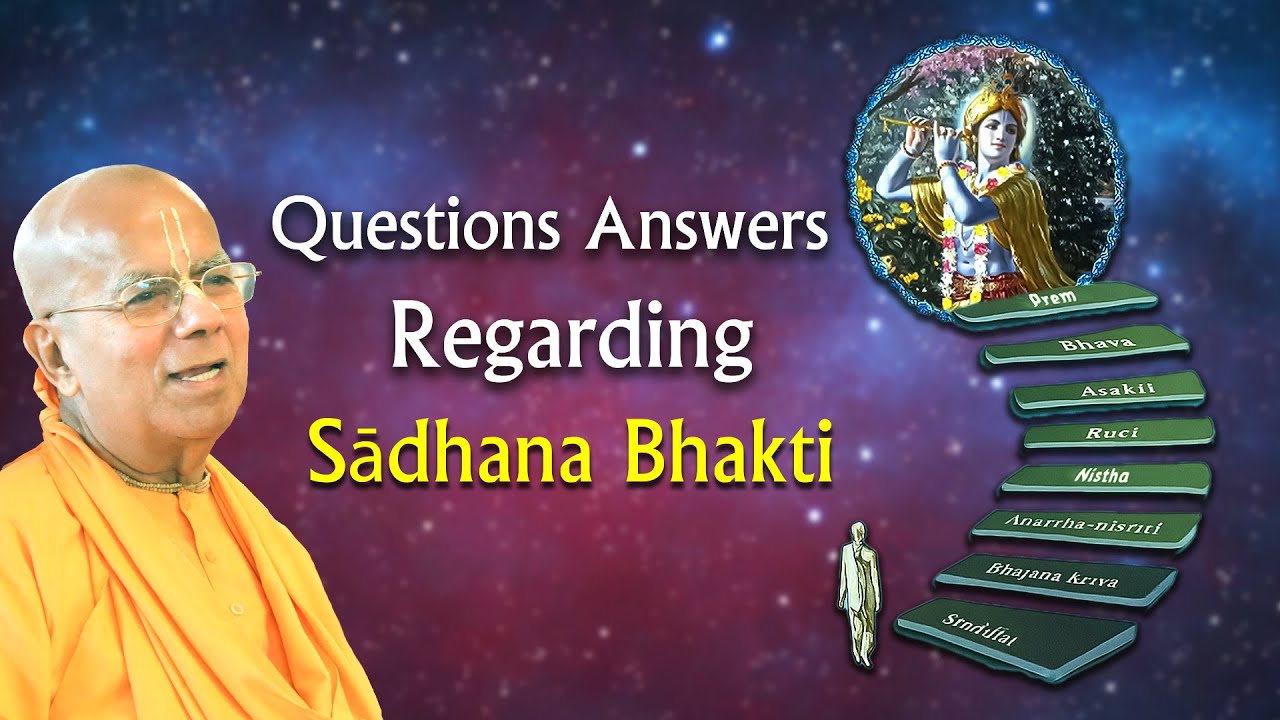
In this extended Q&A session, Śrīla Gopāl Kṛṣṇa Goswāmī Mahārāja addresses a wide range of practical and philosophical issues faced by ISKCON devotees and book distributors. He begins by linking sincere sādhanā‑bhakti (chanting, reading, and guru‑sadhu‑śāstra) to the ability to resist material illusion and defines a "true capitalist" as one whose heart is devoted to Rādhā and Kṛṣṇa. He then gives concrete guidance on how to approach important persons and businesspeople—emphasising neat appearance, presenting the ancient wisdom of the books, and tailoring the pitch to the listener’s education level. The discussion moves to the danger of losing taste for devotional service, explaining that loss stems from internal cheating (Vaishnava aprāda) and that adherence to guru‑sadhu‑śāstra prevents it. Humility is illustrated through numerous anecdotes from Caitanya Mahāprabhu, Rishabhadeva, and other scriptural figures, showing how respect for all beings sustains service. A substantial portion of the talk focuses on book distribution: the primacy of this activity, strategies for pricing, handling objections about cost, literacy, or lack of time, and the importance of presenting the books as universal knowledge rather than sectarian material. He recounts ISKCON’s 1974 letters clarifying that book distribution must be balanced with other temple duties (cooking, deity worship, cleaning) and that both should be pursued intelligently. The speaker stresses the role of spiritual association (satsanga) in transforming lives, recounting stories of the hunter, Valmiki, and others to illustrate how association recharges devotees like batteries. He outlines the nine‑fold process of devotional service as the shelter for the soul and warns against the mind’s deceit, offering practical techniques (daily chanting, mangala‑āratī, avoiding the ten offenses) to keep enthusiasm stable. Finally, he answers logistical questions about traveling sankirtan, the austerities of Babaji, and how to maintain humility and enthusiasm in the face of criticism or personal difficulty. Overall, the lecture blends scriptural exposition, historical ISKCON policy, and hands‑on advice for devotees seeking to deepen their practice while effectively spreading Krishna consciousness.
Chapters
If you sincerely follow the process of sadhana-bhakti, chanting, reading, etc., then you will get the strength to stay away from the illusory energy. So please take to this process as Maharishi Mahesh Yogi has said, and be happy. And please make others happy also. We want the whole world to be happy. Right now in your country there's a mad rush for capitalism. Everybody wants to make money, money, money, bingi bingi. But that will not make them happy. The true capitalist is one who has love of Rādhā and Kṛṣṇa. When Caitanya Mahāprabhu was talking to Rāmānanda Rāya, Caitanya Mahāprabhu asked Rāmānanda Rāya, "What is the true capitalist?" So Rāmānanda Rāya said, "The true capitalist is one who has love of Rādhā and Kṛṣṇa." So tell people, when you buy these books, you will become a real capitalist. "Really?" Tell them, "Yes, guaranteed." And you are not telling a lie. So we We want you to be capitalist and make others capitalist.
Hare Kṛṣṇa.
Hare Kṛṣṇa. So I'll take on questions for a few minutes.
Could you explain how we can preach to important persons, business people?
How do you preach to important people? You mean preach to them on the streets or preach to them in their offices? Well, you should tell them, of course, when you go to them you should be dressed up neatly. Even if you have dhoti, kurtas, They must be neatly ironed and all that. And go to the officers, tell them these books contain knowledge that will make you happy. Tell them these books contain very ancient wisdom, millions of years old. One good thing in your country is that people are fond of reading in any case. So tell them, you read so many books, but these books haven't satisfied you or the society. Please try reading these books, see the difference. Tell them since thousands of years, thousands, millions of people have read these books and changed their lives. Any of the motives we can tell you later in a smaller group.
He wants to maintain his family, his relatives and so on. And at the same time he or she wants to serve in the temple. Is this desire self-imposed?
Well, in different varnas and āśramas one has different duties. In the grihāsta āśrama one has different duties than in the brahmachari and sannyāsi āśramas. In the grihāsādhyāma, there are some material duties to also take care. But the material duty should not become an impediment for making spiritual progress. Because if spiritual progress is the ultimate goal of life, then life has to be so adjusted so that this goal can be realized. More philosophical questions. We discussed Lord Viśṣṇudeva's teachings. You can ask some questions based on the philosophy you heard. You are saying that when devotee is preaching, he loses taste. Prasad RAVAL. So my answer is, if you are preaching, you should not lose the taste. If you lose the taste due to preaching, that means there's something that you're doing which is wrong. Just like if you're serving in the temple or serving at home, wherever, you cannot lose taste if you're serving. You cannot get fried if you're serving, because service to Krishna is totally satisfying. Then why is it that sometimes devotees say, I've lost taste? And how do you reach that stage that you will eventually lose the taste? You want to know the answers? So we can lose the taste for devotional service by Vaishnava aprāda. I was explaining last night how when the Vaishnava aprāda gets to a point, then Kṛṣṇa decides, "Now this man is unfit to chant My holy name." And then the living entity gets so entangled that he doesn't have time to chant. Now the other point is that you can never lose taste for any aspect of devotional service if you are executing service according to Guru-sādhu-śāstra. If you meet some devotee who says, "I have lost taste," that means that devotee was internally cheating while externally acting like a devotee. So you may want to know what is internal cheating. Externally I am making a show I am devotee, but inside my heart I am just contemplating sense enjoyment. I am not chanting my 16 rounds nicely in the morning. I am not attending, following the path of sadhana-bhakti. If we don't take these precautions, then internally you'll become spiritually weak. Your mind will be always agitated, and then very easily you will give up to it.
Uh, there is different types of distribution in different modes, and that's again, if you put it to the stupid books and then it has to be resolved to a number, you have to put it to books, then it's, uh, there is no Well, we should be attached to the effort that we make.
If you make a sincere effort, the result will automatically come. Just like Krishna told Arjuna, do your duty and leave the results in my hand. So Arjuna did his duty, fought in the battle, in the end he was victorious. Prabhupada was ordered, take Krishna consciousness, bhakti, and his teachings to the Western world. So Prabhupada went on endeavoring to execute the orders of Bhaktisiddhānta Sarasvādī. In the end, after 25 years of struggle, he came to the West. Even after coming to the West, for 1 year he had absolutely no success, but he still went on persisting with his duty. So as book distributors, when we go out, our attachment should be to carrying out the orders of Guru and Kṛṣṇa. They want us, jārī-tāko tāhe kaho kṛṣṇa-padeś. Caitanya Mahāprabhu told, everyone has to Whoever you see, please give him knowledge of Kṛṣṇa. So that should be our guiding spirit. And even if you have no qualification, Kṛṣṇa will create the qualification in you. Please don't forget, Kṛṣṇa is in your heart. He is in the heart of the person you approach. And Kṛṣṇa in the heart can understand how sincerely you are trying to carry out guru and Kṛṣṇa, trying to serve guru and Kṛṣṇa. So when you are sincerely endeavoring, Kṛṣṇa in the heart will give you the intelligence And Kṛṣṇa says in the Gītā, "Those who worship Me with devotion, I make up what they lack and I preserve what they have." So you may have no ability. Many times devotees say, "Oh, I am very shy. I don't like talking." This is impossible for any book distribution. If you make an effort, Kṛṣṇa will do everything else for you. What is humility? Explained in the lecture. Humility means offer all respects to everyone. But don't expect anything in return. If you go out and distribute, let's say, 100 books every day, don't expect next day the devotees must clap and say, "Boy, bravo, you did so many books." Don't expect any honor in return for the service you do. Offer respects to everyone and consider oneself to be a fool. Caitanya Mahāprabhu displayed humility in many different ways, even though He was very strict in His preaching. When He went to Banaras— Banaras is a city where there were a lot of māyāvādīs, jñānis. They had theoretical knowledge of the but they did not accept the personal nature of God. So they were surprised, why is Caitanya Mahāprabhu just chanting and dancing like a madman on the street and not studying the Vedānta? Caitanya Mahāprabhu said, "My spiritual master considered me to be a fool, so he said, 'You just chant Hare Kṛṣṇa.'" On another occasion once Caitanya Mahāprabhu in a debate with a very powerful Sanskrit pandit called Kashmiri Pandit had defeated him. In his arguments. So all of Caitanya Mahāprabhu's disciples, they started making fun of him. Caitanya Mahāprabhu chastised them. He stopped it. He said, you can't make fun of him. So Caitanya Mahāprabhu, even though the other Kṛṣṇaī pundit was defeated by Caitanya Mahāprabhu in the Sanskrit debate, Caitanya Mahāprabhu did not take any pride, or he did not let his followers just laugh at him. When Caitanya Mahāprabhu went in the assembly of Vaishṇavas, in the assembly of this māyāvādīs, He sat down at the entrance where people wash their feet before going in. So there's so many examples. Offer respects to— you see, in spiritual life you do not become poor by offering respects to other Vaiṣṇavas. Every Vaiṣṇava has some good quality, or everybody is a mixed blessing. In Kali-yuga we are all mixed blessings, Prabhupāda said. So meditate on the good quality of every Vaiṣṇava. You'll say, but I can't see any good qualities, it's all bad. That's wrong. So meditate on everyone's good quality, that is known as bindavan vision. But if you're always finding fault in everyone, that is material vision. Kṛṣṇa sees the good qualities of everyone, but He also sees the bad qualities. The bindavan vision means looking at the good qualities of everyone. And when you're looking at somebody else's good qualities, then your respect for him will automatically increase. Generally our tendency is we look at everybody else's bad qualities and we look at our good qualities. If we have so much good quality, we'll make it big like a mountain. And if somebody else has few bad qualities, we'll make it big like a mountain. We multiply our good qualities by 100 and we divide other people's good qualities by 100. Can you follow that? So then what happens? You become so good, the other person become so bad. So look at everyone's good qualities. You know, when Lord Ramachandra was going to rescue Sita from Sri Lanka, Hanuman brought a big army of monkeys to help make a bridge across the Indian Ocean, and they were all throwing big, big rocks so that very soon a bridge could be made. But there was a small spider over there that was trying to clear the water for Lord Ramachandra's army to cross over. Hanuman said, "Get out of the way. You are blocking our way." But Lord Rāma said, "No, this spider is also trying to serve Me. That is his ability and he is serving Me according to his ability." So Lord Rāma-chandra took service even from the spider. So similarly the spiritual master in engaging devotees, he takes service from everyone. But we have to be careful how we serve. You respect karmis by seeing them as conditioned souls, fallen children of God, and you endeavor to give them Kṛṣṇa consciousness. How do you respect animals? By recognizing their right to live, so we don't harm them. Christians say animals have no soul.
Bogus.
Of course they have a soul. They did, but you haven't read their teachings. Jesus Christ said, thou shalt— thou shalt always chant the names of the Lord. There's so many statements in the Bible where Jesus Christ talks about glorifying the Lord by chanting his holy name. The Western countries, there still exists a group called Salvation Army. Have you heard of Salvation Army? In your country also. Okay, anyway, Salvation Army, till about 20 years ago, they used to regularly go out on the streets and chant the names of Jesus Christ like we do right now. The problem is the true Christian groups don't want to follow the real teachings. And the Quran also talks about chanting the names of God in many places. God, you see, you have a pocket dictionary and a big dictionary. Pocket dictionary also has the meaning. Big dictionary, those are But what is the difference between the two dictionaries? Big dictionary has many examples and more thorough meaning, and pocket dictionary only little bit. So this is the difference between the Vedic philosophy and the other religions. The Vedic philosophy is like a big dictionary, gives many examples, many stories, vast literature. But in the other scriptures, there is knowledge of God, but limited knowledge of God. What kind of people are these? They are chanting this karatausa to stay in soul. Huh? What? People have no knowledge. This is like Buddha, Śrīmad-Bhagavatam, Jesus Christ, these are the same. Well, in their next life they may come to Kṛṣṇa. I was recently in Africa, Kenya actually. So I went to do a group in Kisumu. Kisumu is in Africa. So I went to a very conservative Christian group. They are all vegetarians. So there I saw they had a mixture of everything. They were chanting Hare Kṛṣṇa and other names also. It is good. Slowly, slowly they'll come to a higher level. Actually, when they greeted me, they were all, 200-300 of them, chanting Hare Krishna and playing Prabhupāda's tapes as a walk tape. It's just like walking into an ISKCON temple. The next time I come, I'll bring a video of that show. I'll take on questions, talk a bit, be sure. King Rishabdev was the son of King Nabi. King Nabi's wife's name was Merudevī. The father had arranged a very big sacrificial fire in which all the demigods and the great sages were present. And the sages asked him, "Please manifest a desire that you may have." And King Nabi said, "I would like to have God to appear as my son." So the Lord said, "You want a son like me? That is impossible. So a son like me, Nobody else, nobody else can be like God. So the Lord decided that He will become His son, and He appeared in the form of Rishabhdev. So in Sanskrit, the word Rishabh means the best. So King Rishabhdev was the king of the whole planet. Just like today you have so many countries on this planet. Just like you devotees have seen within your own eyes, at one time there was one Soviet Union. Now there are 15, 16 countries. One became 16. At one time the whole planet was one country known as Bharatvarsha. Bharat was the son of King Rishabhdev. So King Rishabhdev was the king of the whole planet. But the Vedic kings, they were not attached to their possessions. And they considered it their duty to also give the citizens knowledge about the goal of life. So Maharaja Rishabhdev, he had 100 sons. You will say, ordinary man cannot have 100 sons. This looks like some Some storybook story. He was God. God has millions of sons. What is 100? But so his 100 sons were all educated in spiritual understanding. But still he considered it his duty to educate them firmly about the goal of life. So after Maharaj Rishidev's eldest son King Bharat became old, he told the younger sons, "Now all of you please follow King Bharat." And he left home. He started traveling everywhere like an Avadhūta. But he was a real Avadhūta, not the Kali-yuga imitators. And then just the stool from Mahārāja Rāja Dev's body used to give fragrance up to 80 miles distance. I want to stop now. Etā paślim vaprāuṣya. Yogyavaprāuṣya vodnyavetṣu.
What is the special austerity of Babaji's?
Babaji wears one piece of cloth around his body. And sits in one place and chants all day, doesn't move around. Babaji is difficult in this age. Many people go to Radha Kun and Vrindavan and become Babaji, but Prabhupada said do not recommend that. So since all the devotees are sitting here, I want to mention few points to all of you. After this class, we're going to serve prasad, so devotees can eat prasad, and I will be having a council meeting with some of the senior members the Almādhā Temple for about half an hour. As I told you yesterday, today for the next few hours I want to meet with different groups of devotees. In the meantime, you all can have prasāda, and then Mahāśakti can come and do some bhajans which you all can participate in. I'll start lecturing again at about 4 or 5 o'clock. Now, there is no doubt that book distribution is our most important activity in our movement. There's no question about that. We encourage everybody to get a taste for book distribution. But at the same time, other aspects of service also has to be done. We cannot stop all aspects of work just in the name of book distribution. Actually, this reminded me of a development that took place in ISKCON in 1974. Prabhupada had sent a letter out to all the temples saying that book distribution was most important. But then some devotees started misunderstanding that. They reduced the standard of deity worship, cooking. They reduced all temple standards. Standards just to concentrate on book distribution. But then Prabhupada wrote back many letters in which he clarified this point, and they are extracts from two letters of Prabhupada which I would like Vishnu Prabhu to translate and read. So I just wanted to say that we— our philosophy is not that we just do book distribution and stop everything else, but also our philosophy is not that you avoid book distribution by doing other types of work. We want to encourage and beg everyone to take part in book distribution, because this is one medium to save the suffering humanity. But at the same time, other temple services like cooking for the Deities, cooking for devotees, Deity worship, cleaning, all these functions also have to go on. On Sundays when you have festival and devotees, outsiders coming, devotees must be here to do kirtan, receive the guests. So Everything has to be intelligently balanced, and the temple administrators must tax their brains to see how they can intelligently balance so that book distribution can be pushed on and other essential services also maintained. Are there any questions on this point from any of you? You can be frank. I'm here to help all of you.
And how to organize traveling sankirtan?
We can have a meeting with the traveling sankirtan devotees, and then we can discuss this. Yes, some devotees will have to be kept behind to serve in the temple. This Vaja-hreemana song was composed by the great devotee Govinda Das. So very briefly, the meaning is as follows. In the material world, nothing works perfectly. This is imported sound system from England. Imported from England but made in Taiwan. So on the one hand, we can say this is British sound system, but actually this Taiwanese. So Govinda Das is sick. Hare Krishna. We have taken all of you to the mountains of Almata now. So Govinda das is saying, "Oh my dear mind, please take shelter of the son of Maharaja Nanda." Because if you take shelter of the son of Maharaja Nanda's lotus feet, then you'll become fearless. Yesterday I had explained in the Gītā class last night the importance of focusing the mind on the Supreme Lord. So the mind at the present moment is fearful. We are fearful of so many things. The materialist is fearful. He may lose what he has. If you're doing a job, you're fearful you may get fired any day. In the communist system, nobody would be fired. Nobody used to get fired. But in the capitalist system, everybody is getting fired. So the businessman is fearful somebody else may steal his business. One nation is fearful another nation may take their— may harm them. So many— there's so many different types of fear in everyone's mind. So Govinda Das is saying, my dear mind, You can only become fearless if you take shelter of the son of Maharaj Nanda. Just like when a child is holding the hand of his father, even if a big dog comes, he doesn't get scared. He just hides behind the father, isn't it? So similarly, once you take shelter of the son of Maharaj Nanda, Krishna says, kānte pradījāne hi nirme bhakta pranāśyati, my devotee will never perish. So Krishna guarantees that his devotee will always be protected by Him. Is there anybody else who can give you this guarantee in today's world? No one can. So when Krishna says, my devotee will always be protected, this does not mean that the devotee will not have to face difficulty. What this means is that even if a devotee has to face difficulty, he will be protected by the Lord. Just like Pariksit Mahārāja was cursed by a Brahmin boy to die in 7 days. So how did Krishna protect him? By sending Śukadeva Gosvāmī. So similarly, So we devotees should not get discouraged if we have to face difficulties. Actually, difficulties for a devotee are opportunities to further deepen his relationship with the Lord. So Kṛṣṇa Govinda Dāsa is saying, durlabha māṇava jānava-saṭ-saṅge. Durlabha is a Sanskrit word which means very difficult, ochintrudhna. So human life is obtained with very great difficulty. We should not forget that. But there are unfortunate realities, we forget it. You may say, every day we hear that, what is the news? I'm getting bored of hearing the same thing again and again. In spite of hearing every day, still so many people fall in maya even after coming to Krishna consciousness, isn't it? So to hear it again and again will not hurt. Drona mahāmānta, jānāmāt satsange. Now that you've got this human life, please take devotee association, take spiritual association, because by spiritual association you'll get purified and you'll purify others. Why do we tell all devotees please go out and preach? Why do we tell them, please go out and do book distribution? Please go out and hurry now? Because when we go out and give our association, the other people are inspired to investigate the goal of life. If each of you were to ask yourself, how did I finally come to this blissful path? You will answer that you met a devotee, you went to some program, you received a book, you had some type of spiritual association that made you realize Oh, you're on the wrong path. Maybe your path needs correction. So the point is that spiritual association enables one to wake up to spiritual life. Once upon a time, there was a hunter who used to derive great pleasure in half-killing animals. Narada Muni was passing by the forest and he saw many half-killed animals. He said, who is the cause of all this? Proud hunter said, I. And Narada Muni told him that this is a very sinful activity. Why are you half-killing these animals? Why don't he just kill them? Nārada Muni told him the philosophy of the soul, how the soul doesn't die and how by engaging in the sinful activity he will take, have to take on sinful reaction. And by that association with Nārada Muni, the hunter got so purified that he would not even step over an ant. Similarly, there was another great sage by the name of Valmiki. Valmiki previously was very sinful. He was killing. Stealing, doing everything obnoxious. One day in the forest, he saw a great sage coming. He said, "Give me!" The sage said, "I'll give you, but first you tell me, who do you want it for? Why do you want it?" He said, "I want all the wealth you have for my parents, wife, children. I want them to be happy." So the sage said, "Do you realize that if you take things by sinful activities, you will have to suffer the reaction. He said, no problem, I'm doing this crime for my relatives, they will all share the sinful reaction, not me alone. So the sage said, I'm waiting over here, go home and ask your parents, wife, and children if they will share the sinful reaction, and if they will, I'll give you unlimited wealth. So the great sage came to the parents and said— I'm sorry, the Valmiki, the murderer, He came to his parents and said, "I have just discovered that I will have to suffer for all the crime I was committing to make you happy. Will you please share just 25% of the crime?" The parents said, "We didn't tell you to commit this crime. We thought you were getting money through honest means. We can't share any sinful reaction." Then he went to his wife, said, "All this jewelry, saris that I was buying for you was all obtained from money from devious means." Now a great sage has told me I will have to suffer for all this crime. Will you please share just 25% of the punishment that I will get? Wife said, oh, I didn't know you were doing all these dirty things. I can't share the punishment. The children also said the same thing. Then he went back to the sage and said, yes, you are right, I'm doing this crime for others, but nobody is ready to share the sinful reaction due to me. Then he gave up his sinful activity, but he was so sinful that the sage told him, "Chant the names of Rama, Rama, Rama, Rama." But he was so sinful that the word Rama wouldn't even come out of his mouth. What came out of his mouth was "Mara, Mara, Mara." Mara, Mara is written in exactly the reverse way of Rama, Rama. Rama is R-A-M-A and Mara is M-A-R-A. But Mara in Sanskrit means— Mara in Sanskrit means murder, murder, murder. Then by saying Māra, Māra, Māra, gradually he started saying Rāma, Rāma, Rāma. Then he meditated for 60,000 years, and that great sage Valmiki then compiled the Ramayana. So by spiritual association, anybody's life can change. So spiritual association is very necessary. Devotee takes association and gives association, just like you have these rechargeable batteries. You know rechargeable batteries? You recharge them for 8-10 hours, then you can use them for 6-8 hours. So we recharge ourselves in the association of senior devotees, and then we go out and charge others. So spiritual association is a must—taking association and giving association. We should not be miserly. Kripana. In Bhagavad-gītā, viṣṇayate kripanaślāva. Kripana means miserly. So miserly is one who has something but he doesn't know how to use it. That's like in India, I know many, many very rich people, but when you look at them, you will think he's a pauper. They will save all the money, they won't even enjoy it, and they won't even show that they have money. They don't want anyone to know they are rich, so they will even walk with— they will even walk with sometimes torn clothes because they don't want anyone to ask them for money. So this is tripana, miserly man who doesn't know what to do with his wealth. So similarly, you have this human body. If you do not use this human body to serve God, then again you become a kripana. And if you have spiritual association and you don't give it to others, then again you are a kripana. So don't be a kripana. Go and give your association, because till you don't give your association, how will people be saved? If Prabhupada would not have gone to America, where would all of us have been? Caitanya Mahāprabhu would not have appeared. Where would all of us have been? If Caitanya Mahāprabhu would not have given this sublime process of chanting the holy names, where would we all be? Because in the previous ages the system of self-realization was far more complicated than just chanting the names of Kṛṣṇa. Kṛṣṇa-yādhāyatā vaiṣṇuṁ treta-yo yajñato mā ke dwapar-e parīcayānaṁ kala-uṭhad-dhāri-kṛṭṇaṇaṁ. In the Viṣṇu Purāṇa it is said as follows. In the Viṣṇu Purāṇa it is said In the Satya Yuga, the means of self-realization was meditation on the Lord. People used to meditate up to 60,000 years. I just gave you the example of Valmiki. But today, where can you meditate? Even if you climb on top of the Almata Mountains, can you meditate? Every time I come to Almata, they tell me they'll take me to the top of the mountain, but I've never been on the top. So even, but even if you go on the top, there is no silence, there is no peace. The Himalayas are 28,000 feet. Let's imagine he managed to get on top of the Himalayas. Do you think he will have peace over there? The planes can fly even on top of the Himalayas now. So this meditation is not possible in this age. Then came Treta Yuga. In Treta Yuga, the means of self-realization was very elaborate sacrifices. Those sacrifices, many brahmins were needed and pure ingredients like milk, butter, grains, etc. Neither are the brahmins nor the pure ingredients available. Then came Dvarpa-yuga. Dvarpa-yuga people would present very expensive offerings to the Lord in the temple. That's also not possible in this age. Nobody has lot of denki to give. And if you give lot of denik, then either the thieves will come or the government will nationalize them. Even when there's nothing in the house, thieves come. And if there is something in the house, plenty of thieves will come. So we are so fortunate to have Caitanya Mahāprabhu. For having presented this sublime prasada, Hare Kṛṣṇa. Hare Nāma, Hare Nāma, Hare Nāma eva kevalam. Kalo nasteva nasteva nasteva eva kathīra-nyata. So just like we became fortunate, we have to make others fortunate. So Nukumana Dāsa is saying, "I am not at all happy in day and in night." I am just giving you a summary presentation of this meaning, so it's a little brief. Edhāna yobana-paṭṭhā-parījana itte kiyaçe para-dhīti re. He says, I thought my wife, children, relatives, they will protect me, but they can't protect me. They can't even protect themselves. How will they protect you? Kāmala-dala-jala-jīvana-tala-māla. He compares this human life to a drop of water on a lotus leaf. So he says, just like a drop of water fall off the lotus leaf at any time, this human body can end at any time. Therefore, I take shelter of Bāja Hārīpāda Nityānanda. Of Lord Śrī Kṛṣṇa. And how to take shelter? Through the ninefold process of devotional service. śarana-kīrtanā-smāndana-māndanam pāda-sevanam dasyare puja-nā-sakītana ātmāne vedana govinda-dāsa abhilāsa-re. The ninefold process are chanting, hearing, meditating. So we follow the ninefold process to take shelter of the stana mahārāja-nanda. So this song of Govinda-dāsa should be carefully meditated upon. And thus we'll be able to perfect our life. Hare Kṛṣṇa. Hare Kṛṣṇa. So I'm not going to keep you all here for much longer because I know you devotees have to go home. Plus I have to go home, pack up, and come back to the airport at 2 o'clock in the night. So we'll just cover a few essential points. So there were few sankirtan questions that devotees asked me, and I told them to ask me in the class. So I'll answer those questions and just make few brief announcements. So we had a meeting with all the devotees today. Sometimes there is desire, sometimes there is no desire. Hatha prāvata. Is the desire to eat prasāda always or sometimes? Desire to go to sleep always or sometimes? Like that. No, no, that is because we are attached to eating, attached to sleeping, but our attachment to Kṛṣṇa is not there. He has spoken the truth. So that is there because We become a victim of the mind and the senses. When you listen to the mind, sometimes the mind is in good mood, sometimes in bad mood. So vyāsadeva, the great sages have said, never listen to the mind. Only start listening to your mind when you become a pure devotee. Till that stage is reached, don't listen to your mind. The mind is the biggest cheater this world has produced. But we are telling him, oh, you watch, Ochin Karoṣa Prabhu. We are saying, "You are my best friend, so don't listen to the mind." See, even when the mind says, "You can't go on book distribution," tell them, "I am not going to listen to you." Therefore Bhaktisiddhanta Sarasvati said, "Every morning you get up, beat your mind 100 times with your shoes, and every night again 100 times." But make sure you don't beat them with heavy boots, or we may see all of you with bandages. So don't beat your mind, just ignore the mind.
Can you explain how can we persuade people that books actually are not so expensive?
What price do you sell books at? 200 rupees. 200 at least. In Ukraine they're selling it for 260. Moscow also 250, 260. You should tell them that that is the cost of the books. Tell them everything is going up every day. You know that everything is expensive, so you have to preach from that angle. Even the Bible they're selling for 200, 300 rubles. So even when we were selling these Gita for 40 rubles, some, some people were saying, 'Etha ochindorga.' I know even when these big Bhagavad Gita were 20 rubles, some people would say, 'No, no, no, it should be 10.' So you tell them, the point is Those who don't want to take, they will find some excuse or the other. And if they are really sincere, then tell them, "Okay, for you I have a cheaper book. You can't pay 260 rubles, how much can you pay? 100? Okay." We have books for every price. We don't control this capitalistic economy. In days of communism we sold the same book for 40 rubles. It's a free market economy now.
How can we persuade people to buy books if they say that we don't read anything at all? If they say—
If they say, "We don't read anything at all." So you tell them, "But you look so educated. Why don't you read?" Tell them, "I thought you were a PhD, you are a doctorate degree holder." So he will say, "Oh, do I really look like an educated?" Tell him, "You look very philosopher. You look like an intellectual scholar." When you tell him, "You look like an intellectual scholar," then his heart will melt. You tell him, "So far you haven't read, but now you must start reading." Now what will you do if the person says, "I have no time to read." As a Mayavada approach. I'm asking you to say, "Your books are very good, but I have no time, I'm very busy." I tell him usually that life is very short and death can come at any moment.
What if it comes very soon?
What will you say? You approach me for book, I tell you I'm very busy, I have no time. Too many things.
I usually say that actually they won't be so busy all their life. Some time will come when they go to the temple.
Tell them the points you two made are right, but I'll give you another point. Tell them this book is for busy people. This book is not— tell them this book is not for idle people, because this book will tell you how we can do the same amount of work in less time. It's a fact. When you surrender to Kṛṣṇa, then what appears like a mountain becomes like a small Speak. So tell them, this is for busy people just like you, and all the busy people all over the world are reading these books, and they have been reading it since thousands of years. Would they, if they say that they belong to some different creed? Oh, if they say, I belong to a different religion, huh? Yeah, Christian, yeah, Muslim. Tell them this book is for entire humanity. It is not a religious book. They'll say, then what is it? It's a book of knowledge, knowledge for whole humanity. Don't you want knowledge? No. Who can say I don't want knowledge?
Sometimes they say, but they don't open.
They say you don't want knowledge, but we are begging you to please try and take advantage of this knowledge. There's so many things you don't want. Sometimes you have to take advice of great sages.
Sometimes in the temple there are a lot of problems and it's very difficult to maintain taste for service, taste for the process. How can we Even how can it be fixed, at least be fixed on our level, not to degrade in the atmosphere of all these troubles.
You see, in the material world there will always be some problems somewhere. Sometimes devotees say, "Oh, I don't like devotees, there's too much politics, and I'm going back to karmi life." In karmi life you will have million times more problems than you find with devotees. Don't forget that. Now, If we want to maintain our taste for devotional service, it is very important that we get up every morning for mangala arati, we chant our rounds in the morning, we read every day, and we do some service. If you do these things, then you will never lose taste. That is guaranteed. The medicine that Kṛṣṇa has given us is guaranteed, but the patient is not taking the medicine properly. That is the problem.
Sometimes we meet people while distributing books who say that actually these these books are very difficult to understand. And by saying like that, they influence all the others who are surrounding the distributor. How can we persuade these people? And how can we—
Well then, sir, frankly, this is your personal view. We know thousands of people who are saying it is very easy to understand. Every day we are distributing 3,000-4,000 books a day in the old Soviet Union. Why are people buying? Because they are finding it satisfactory. Tell them read it, and if there's something you can't understand, you can always come and meet us in the center in Almaty. Or give them your name and address, they can always write to you.
In Moscow, just before Akhmatyarov. And they, and actually the seminar came to a conclusion that actually it's not efficient to distribute on the spots now. It's one conclusion. The second is that actually It's not efficient to distribute books on the spots. And the second conclusion is that, you know, to encourage, to make books more attractive, we must artificially make the price higher. And then we can just, yeah, because—
No, I don't think so. I think you misunderstood the seminar. I'm not aware of this, so I cannot comment.
Sometimes the attention of people is pointed not at books, but at you. To yourself, they say, oh, how nice are you, how nice you are, how nicely you are telling all these things. How should we behave in this case?
Ita ucin karasva prasada. Therefore I said in the morning, a devotee must be very presentable, a devotee must be very humble, enthusiastic. Prabhupada said these books are sold because of the enthusiasm of his disciples. The karmis have never seen such enthusiastic individuals as devotees. So when the main devotees were fully convinced about the books they are distributing, They are amazed. So we should present very humbly and nicely and be humble with them. Don't lose your temper. Somebody comes to your table and doesn't buy a book, don't start cursing him. Don't say, "You didn't buy a book, you're going to go to hell now." Even if they don't buy a book, tell them, "Hare Kṛṣṇa, we are waiting for you. Come back whenever you decide." Sechāzeta paślani vāpras. Okay.
How can we make our enthusiasm stable, not going up and down?
Yes, this is a big challenge in Kali-yuga, how to make enthusiasm stable. By the same formula that I gave in answer to that mataji's question, all problems are solved if you chant your rounds nicely. At the same time, you must avoid the 10 offenses. If you chant your rounds every day, read books every day, get up for mangalārti every day, and don't offend any Vaiṣṇava, you'll always be enthusiastic. That's a new way of phrase, ya. I don't know which ācārya gave this theory. Rāgūṇa-gābhakti is a very long process. Rāgūṇa-gābhakti means state of spontaneous devotional service. Lama, lama le ale.
More from PRASAD

Rare Pastimes & Timeless Lessons of Guru Mahārāja | Stories Every Disciple Should Hear

ISKCON Legends- pure devotees meet-HH Jayapataka Swami, HH Gopal Krishna Goswami, HH Radhanath Swami



Jagannātha Ratha-yātrā Through Śrīla Prabhupāda's Mercy | 29 April 2006 | Nairobi, Kenya

Lord Jagannātha's Appearance Pastime | 21.07.2019 | ISKCON Calgary | Śrīla Gopāla Kṛṣṇa Gosvāmī

The Ācārya Teaches by His Own ExampleGuṇḍicā Mārjana by Guru Mahārāja #shorts

Guṇḍicā Mārjana – Lord Jagannātha's Pastime | 21.7.2019 | ISKCON Calgary |Śrīla Gopāla Kṛṣṇa Gosvāmī

H.H. Gopāla Kṛṣṇa Gosvāmī Mahārāja - Exemplary Sādhana and Deity Worship # shorts

भगवान की कृपा कैसे प्राप्त होगी ? | 11 Jan 2014 | Punjabi Bagh | Srila Gopal Krishna Goswami

Material Education vs Spiritual Education | Srila Gopal Krishna Goswami #shorts