SB 1.2.19 The Path Of Pure Goodness | Rus-Split | 04.7.92 | Śrīla Gopāl Kṛṣṇa Goswāmī Mahārājā
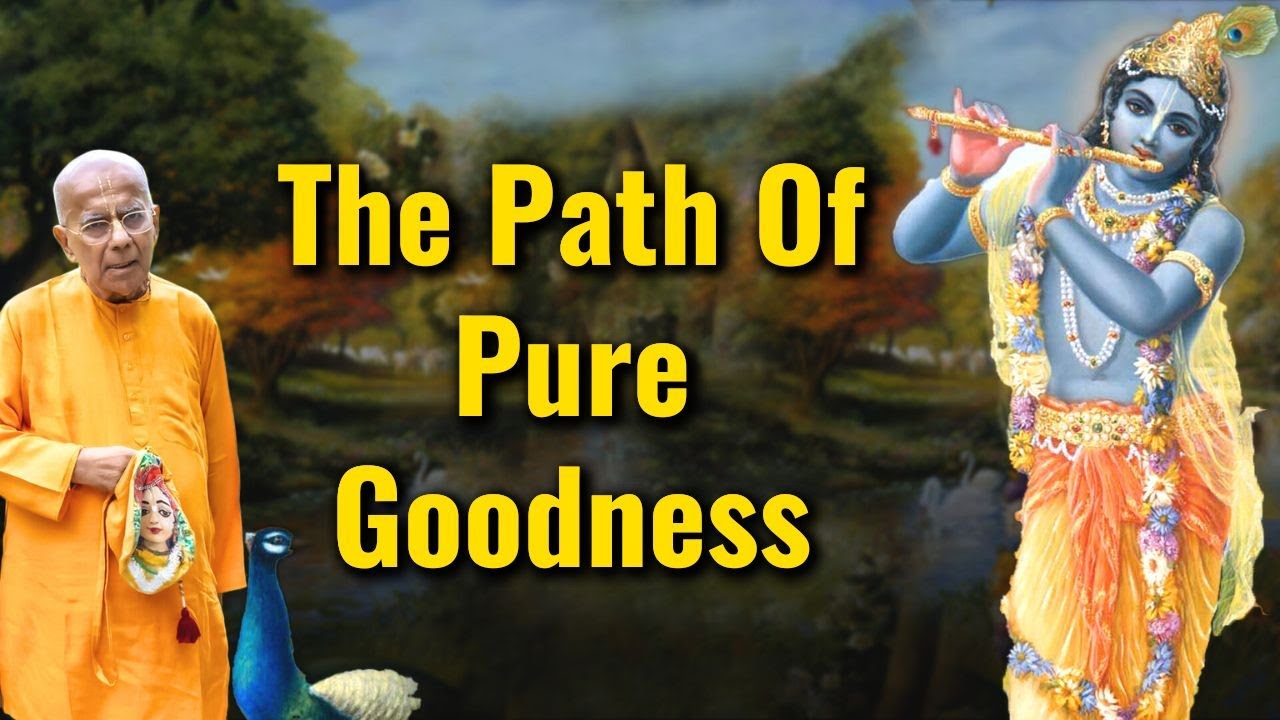
The lecture interprets Śrīmad‑Bhāgavatam 1.2.19, explaining that the verse describes the "path of pure goodness" – a state of unalloyed devotional service in which the influences of passion (kāma) and ignorance (tamo) are eliminated. The speaker contrasts the three material modes (goodness, passion, ignorance) with the higher state of sudha‑sattva (pure goodness) and shows how the Bhāgavatam uniquely focuses on this state, unlike other Vedic texts that only discuss fruitive goodness. He recounts the narrative of how the Bhāgavatam was transmitted (Vyāsadeva → Śukadeva → Sūta Gosvāmī) and why Sūta’s discourse in the second canto is central for Vaishnava practice. The talk then shifts to practical Vaishnava life: the necessity of attentive chanting, hearing, and purity; the development of devotional qualities such as compassion, tolerance, magnanimity, and the distinction between bhajanakriya (self‑focused) and goṣṭha‑nandī (service‑oriented) devotees. A large portion is devoted to the ISKCON missionary mandate – book distribution and preaching – illustrated with historical anecdotes (Prabhupāda’s health, Jādabharata, Kapiladeva, Nityānanda, etc.). The speaker emphasizes that enthusiasm, purity, and the guidance of guru‑paramparā are the engines that turn individual devotion into collective spiritual outreach, and that the ultimate goal is to replace material “poison” with the nectar of Krishna consciousness for all humanity.
Chapters
Śrīmad Bhāgavatām, First Canto, Chapter 2, Text 19. Dādā, dādā, rājā, rājā, tamoh, tamoh, bhāvoh, bhāvoh, kāma, kāma, nāmadāyaṁ, nāmadāyaṁ, ca, ca, ye, ye, keṭā, keṭā, Jeta eternā vidhāṁ, sthītam satve prasiddhati, rārāyaṣṭhamo bhāvā, kāma-lovādayāśca ye, jeta eternā vidhāṁ, sthītam satve prasiddhati, Sātre Prasādatī. Hare Kṛṣṇa! Hare Rādhā-Kṛṣṇa Prabhu Nityānanda Śrīya Advaita Gadaḍhaśiva Chadekaur Maḥakura. Hare Kṛṣṇa! Hare Kṛṣṇa! Kṛṣṇa! Kṛṣṇa! Hari-Hari! Hari-Rāma! Hari-Rāma! Rāma! Rāma! Hari-Hari! Tadurājastamobhāvā kāmālova-dayāśaye ceta eternā vidham sthītam satve pasiddhati. So this verse of the Śrīmad-Bhāgavatam is being spoken by Suta Gosvāmī. This chapter of the Bhāgavatam called Divinity and Divine Service is actually the most important of all the chapters in the Bhāgavatam, because in this one chapter In every verse of this chapter, such important philosophy is communicated that if we take advantage of it, you can perfect your life. A lot of the lectures Prabhupada gave were from the verses of this chapter, because each verse in this chapter is very, very important. So as some of you may know, the Bhāgavatam was spoken on several different occasions. When you read the Śrīmad-Bhāgavatam, you sometimes read Śukadeva Gosvāmī speaking to Parīkṣit Mahārāja. And sometimes you read Sūta Gosvāmī speaking to the sages in Namaśvaranya. So many times devotees have asked this question: How is it that sometimes Śukadeva Gosvāmī is speaking and sometimes Sūta Gosvāmī is speaking? The answer is that the Bhāgavatam was first delivered by Vyāsadeva to his son Śukadeva Gosvāmī, and then Śukadeva Gosvāmī recited it to the dying Parīkṣit on the banks of the river Ganges in Hastinapur. Hastinapur is the present-day Delhi. And not far from Hastinapur was a very famous park called Namasharanya. Actually, it was a forest. It's one night's journey from Delhi, from Hastinapur. Namasharanya was a park which was noted for spiritual discussion. Just like in your country, in every Russian city there's a big, uh, square in the center of the city where they used to have these political rallies and military parades. So similarly, this park Namasharanya This forest, Namaśvaranya, is noted for spiritual discussion. It has a very conducive atmosphere for spiritual discussions. So the great sages used to meet there to discuss spiritual topics. So 60,000 great sages were assembled performing a big fire sacrifice, and they were assembled over there because they wanted to discuss how people in Kali-yuga will be saved. This is the difference between Vaiṣṇava devotee and a non-devotee. The Vaishnava devotee is concerned about the welfare of everyone, not just his welfare, whereas a non-devotee of course has no interest in God. And even the religious individual is just concerned about his own liberation. So Sutaka Swami was selected to be the leader of the 60,000 sages assembled in Namaśvaranya. He was selected as the leader because he was the most learned of all. And he was presented with a very simple question: to please enlighten the audience as to how civilization could be saved in the coming Kali Yuga. Just like you go to an astrologer to find out what is your future, so these great sages are like spiritual astrologers. They could predict what the symptoms in Kali Yuga would be, and therefore the solution that they have given is not some temporary solution for some limited time or for some certain country on the planet, but for the entire planet and for eternity. Therefore, this philosophy is also known as sanatana-dharma, eternal philosophy. So in this verse, Suta Gosvami is explaining that as soon as irrevocable loving service is established in the heart, the effects of passion and ignorance begin to diminish. So irrevocable loving service, that means service which will— which is there and which will not stop. In other words, Suta Gosvāmī is pointing out that when you get involved, when you get established on the path of devotional service, then the effects of passion and ignorance that are responsible for keeping you away from God are destroyed. Due to the influence of passion and ignorance, the living entity stays away from God and he engages in a variety of different sinful activities. Therefore, the Bhāgavatam is presenting the path of pure goodness, not just goodness. In the Bhāgavad-gītā, you must have read about the three modes of material nature: goodness, passion, and ignorance. Ignorance is the lowest of all. Higher than ignorance is passion, and superior to passion is goodness. However, goodness is also not the ultimate goal, because goodness could be compared to the execution of fruitive work. Fruitive work means You are definitely following the laws of God, but you still have some expectations in return. And therefore you follow the rituals, you, you go through the sacrifices, but it is sort of business transaction. And Krishna also explains that as long as one is under the influence of the mode, there's always a competition for supremacy going on. Just like we see in countries like India, many people have spiritual knowledge They are devotees of Kṛṣṇa. They even chant, they read the Bhāgavad-gītā, and they associate with devotees. But because they have not come to the level of pure goodness, they still have a taste for sense enjoyment. So on the one hand they will execute religious activities, on the other hand they will also execute sinful activities. The vast Vedas that were compiled by Vyāsa Deva had knowledge about goodness, but not exclusive knowledge about pure goodness. That is why when Vyāsa Deva approached his spiritual master Nārada Muni on the banks of the river Sarasvati, he told him that, why is it in spite of the fact that I have compiled this Vāsavidyā literature, I'm still feeling unhappy? And the answer given by Nārada Muni was, because you have not exclusively presented these science of pure goodness or pure devotional service. And then came the Śrīmad-Bhāgavatam. So we see in the Śrīmad-Bhāgavatam The entire concentration is on one theme only, the theme of pure goodness. There are 18,000 verses in this Bhāgavatam, and not one verse of the Bhāgavatam promotes fruitive activities. Not one verse promotes sense enjoyment, and certainly not one verse promotes or encourages ignorance. All the 18,000 verses have one common theme: pure goodness, pure devotional service. So goodness is superior to passion and ignorance, but not the ultimate answer. And passion and ignorance are responsible for living, keeping the living entity entangled in material existence, birth after birth. And due to the influence of passion and ignorance, the living entity is transmigrated from one body to another body. Therefore Bhagavatam says, kāma-sa nendriyā priti labho jīvita yāvata, jīvasya tatvajigyāsa nārthayāśraya-karma-bhi. The Śrīmad Bhāgavatam Prasada in the first canto is saying that life's desire should not be sense enjoyment, but life's desire should be to examine the goal of life, how one can establish one's relationship with God. Ji wasitatva yajñāsa. And the Lord replied, it is lust only, the all-devouring enemy of the living entity, which can never be satisfied and which is always burning like fire. So lust, lust means desire to engage in sinful activities. Lust doesn't mean just sex life. Lust means desire to engage in activities of sense enjoyment. And of the various forms of sense enjoyment available, sex life is considered the most important, or the most important source of all. In the Bhagavad-gītā, Kṛṣṇa says that one who has controlled his mind is living happily in the city of 9 gates. This body has been compared in the Bhagavad-gītā to be a city. And in this city you have 9 gates. You have the 2 ears, the 2 eyes, the 2 nostrils, the mouth, the anus, and the genital, and the rectum. So one who's illuminated with spiritual knowledge, he lives happily in the city of nine gates because he knows all these activities of sense pleasure, they have a beginning and they have an end. It is not that these senses can go on giving you satisfaction eternally. They have a beginning and they have an end. Therefore Bhagavad-gītā says one who's intelligent, he doesn't run after them. That is why the great sage Rūpa Gosvāmī has said kāmadīnam kathīnapalita-dhūrṇī-deṣa. I have been trying to satisfy these lusty senses of mine since times immemorial, but they are ungrateful masters. They're never getting satisfied. They're never getting satisfied. The senses will never tell you, I've had enough now, don't disturb me. Now I've had enough, now I don't want anything else. Concentrate on spiritual activity. Therefore, one has to, with the help of spiritual knowledge, With the help of spiritual guidance from shastra, sadhu, and guru, one has to learn the art of controlling the senses. In the 11th canto of the Bhāgavatam, it is said that just like when you have a ghee wick burning, and then if you add butter to it, the flame will just get higher and higher but not diminish. So similarly, the Bhāgavatam says that by engaging in activities of sense pleasure, the desire for sense pleasure will just increase and not go down. There are some so-called cheating religions existing today that advocate you can have sense enjoyment, and when the senses are satisfied to the maximum, then you can concentrate on spiritual activity. The nature of senses is you can never, never, never satisfy them. Just like through the hearing process we know that if you drink poison, it is going to kill you. Through the hearing process you know that if you stand on a, on a speeding car, you're going to die. In front of a speeding car. Similarly, so you don't actually drink poison to see whether you're going to die or whether you heard was false. In other words, in our day-to-day lives, we obtain knowledge through the hearing process. You hear in the morning, today is going to be a rainy day on the radio, so you leave your home with an umbrella. So similarly, in spiritual life, we obtain knowledge through the hearing source. We don't rely on our senses because our senses are imperfect. So through the hearing source, through the agency of the great sages, we have understood The sense enjoyment is drinking, is equal to drinking poison. Therefore one great devotee, Narottama Das Thakura, has said, Hari hari bhefle janma guna inu, Radha Kṛṣṇa bhājya jānya śūnya priṣā khainu. Having obtained this rare human body and not having worshiped Rādhā and Kṛṣṇa, I have simply been drinking poison uselessly. Therefore the Bhāgavatam says, Stop drinking poison. But we are so addicted, we say, "No, let me drink poison." It is just like the hog on the street. If you see the hog is eating stool. You don't see hogs in Bhārivastava properly, but you see them in India. You see the hogs are eating stool. And you go to the hog and try and give the hog some nice foodstuff to eat, but the hog will not take it. Prabhupāda used to give us a story which his spiritual master used to often relate. So once there was a man absorbed in flying the kite, and he was so absorbed in flying the kite that he was about to fall off the roof. And somebody ran up to him and said, come on, careful, you're going to fall off the roof. But he said, don't disturb me, let me go fly the kite. Therefore, that is the condition of society today. They just want sense enjoyment, and, and right till their last breath, till old age, that is all they want. Once Prabhupada was driving through Los Angeles He saw a movie poster called Is There Sex After Death? So, so Prabhupada said in his lecture, yes, there is sex after death, because that's all that these— that's all the materialists are worried about, sex life. So if they can have sex life after death, then they don't mind dying. That is their logic. So they can be guaranteed that, you know, you can continue with your sex life, then they don't mind dying. So Prabhupada said, yes, you can have sex after death, but not as a human being, not as in an apartment but as a dog or a cat or some other animal. As long as sense enjoyment is available, they don't mind even going to hell. But they fail to understand that the pain in hell is so severe that, well, at that point the living entity suffers very, very deeply. And you can read about this in the 5th Canto of the Bhāgavatam. So we are living in a society where from young to old everybody thinks the sense enjoyment is the goal of life. So there is lust, Lust is there, that means the manifestation in the heart that the senses should be served with pleasure. One should engage in some activity of sense enjoyment. Then there is anger. When do you become angry? You become angry when you can't get your normal quota of sense enjoyment. Then there is greed. That is, I want, want unlimited sense pleasure. As much as you get, the materialist thinks is less than what he should be obtaining. There is envy. One individual is envious of another individual. We are envious of the animals. Why are they envious of the animals? Why do the human beings eat animals? They eat animals because they're envious of them. They say, all this earth is for our enjoyment. How dare you come and share it with us? So we'll eat you on our dining table. You can eat them on the dining table, but don't forget, tomorrow they're going to eat you. Just like in your— in the summer season, all over your country, I've seen everywhere people go fishing. Even young 5-year-old kids, I see they go fishing. So you can fish as much as you want today, but tomorrow those very fishes are going to have a feast out of you. So envy is there, and then there's madness, illusion. So all these enemies of spiritual life, they can be contained if you learn the process of pure devotional service. In this verse, Śrīla Gosvāmī is talking about lust, desire, and hankering. So There are unlimited desires in the heart, but all these desires are in relationship to the senses. So a devotee also has desires, but the devotee is still called desireless. Why is a devotee called desireless? Because his desires are consistent with the desires of the Supreme Lord, and because his desires are consistent with the desires of the Supreme Lord, he is addressed as desireless. So we have to replace material desires with spiritual desires. And the living entity's hankering, hankering for different sources of sense pleasure. Now in the purport of this verse, Prabhupada is referring to many significant points. First of all, Prabhupada talks about the brahma-bhuta state. Brahma-bhuta state is also called ātmānanda. Ātmānanda means one is fully self-satisfied. So this satisfaction, spiritual satisfaction, It's complete, whereas material satisfaction is incomplete. When material satisfaction is incomplete, by that we mean the following: just like you may— an alcoholic man, he drinks, but then he stops drinking. He thinks, I've had enough for the day. But so he has a little bit of satisfaction, but then tomorrow again his appetite for liquor comes up and again he starts to drink. Then again he stops, then again he starts, because This sense enjoyment by any material satisfaction is temporary. It is not complete. But spiritual satisfaction is complete. Spiritual satisfaction is complete. Therefore, one doesn't hanker for material activities as a source of pleasure if one is fully engrossed in the process of devotional service. Rūpa Gosvāmī in Nectar of Devotion has talked about three different types of happiness. Happiness through material means, happiness through impersonal process, and happiness through devotional service. Rupa Gosvāmī says happiness through material means can come to an end at any moment. Happiness through impersonal Brahman realization, even if multiplied a trillionfold, is only a small fraction of the happiness you can get by serving the Lord. Whereas happiness through devotional activities is not only complete, but the nature of happiness, spiritual happiness, is it is always increasing, increasing, increasing. This can only be understood by by one who is practicing the process of devotional service and not by an outsider. An outsider cannot understand it. Just like if you show a bottle of honey, for the person to believe that the honey is sweet, he has to taste it, not just look at the bottle. So the brahma-bhūta state— in the 18th chapter of the Bhāgavad-gītā, Kṛṣṇa talks about the brahma-bhūta state. Kṛṣṇa says, brahma-bhūta prasannātmā na so cāti na khaṇṣati. Sama-sarveshu bhuteshu madbhaktyam labhate param. He says one who is transcendently situated, he doesn't hanker and he doesn't lament. So these are the two diseases of material existence. You hanker for what you don't possess and you lament for what you have lost. Everybody is suffering from these two diseases— hankering, lamenting. You see your next-door neighbor with some more material facility, you hanker, you should also have that. And then you're lamenting, oh, I had this, now this has gone away. I had this, this has gone away. Just like the old people are lamenting for the youthful days. So we have to free ourselves from this disease of hankering and lamenting. The devotee is satisfied with what is provided by the will of the Lord. In the 4th canto of the Bhāgavatam, we read about very wonderful instructions from Nārada Muni to the prasādhas. The prasādhas had performed very extreme austerities for 10,000 years, and as a result, Nārada Muni was very pleased with them. So Nārada Muni told the prasādhas, If you want to please the Lord, the following are necessary. Dayāya sarvā-bhūteṣu santuṣṭhayena kena vā sarvairindya-pāśanti-āca tu śadyaśu janārdana. He said dayāya. Dayāya means manifesting mercy. Why do we concentrate on book distribution, harināma, and prasāda distribution? Because that's our way of manifesting mercy. Different people have different concepts of mercy. Some people are so merciful that if a drunkard comes to them and says, "Give me some money, I want to buy some beer," they say, "Okay, take some money, go and buy some beer." It's very common in America. People donate money for buying beer. One who is blind wishes that everybody was blind. One who is miserable loves that everybody be miserable. So one who is addicted to sense enjoyment will distribute mercy also from the angle that people can have sense enjoyment. Just like in India you see a lot of rich people They have so many charitable programs, so many, but 99% of these charitable programs are aimed at sense enjoyment. And when we preach to them that sense enjoyment is bad, they say, "No, this is normal life. How can you live without all this?" So we'll discuss more about the Daya, mercy, when we discuss why we do some kīrtan. Then dayāsāraḥ santoṣṭaye nā keṇavaḥ. Sāntoṣṭa means satisfied with what is provided by the will of the Lord. So the devotee, The devotee must be satisfied by what is provided by the will of the Lord. Sometimes Kṛṣṇa may give you a palace, sometimes you may have to live underneath a tree, but devotee is satisfied with what is provided by the will of the Lord. Devotee knows that the Lord is the controller of everything. Not a blade of grass moves without Kṛṣṇa's permission. So even when the devotee is put in difficulty, he does not get disturbed. See, Parīkṣit Mahārāja, He was cursed to die. Did he get angry at the Lord? No, he just took this as a blessing of the Lord and an opportunity to, uh, get out of this entanglement of material existence. Look at the history of the Pandavas. Look at the history of Mother Queen Kunti. Look at the history of Prahlāda. Even look at Lord Rāmachandra, the Supreme Personality of Godhead himself. He was about to be coronated king. Everything was ready. The celebrations were going on in full swing. At the last minute, his stepmother came to Dasharatha and said, "You remember, you once gave me a promise that anything I request you, you will fulfill. So I want my son to be placed on the throne and Rāma please be sent in exile." And Rāma accepted it. So a devotee is satisfied in all situations, whether it's comfortable or uncomfortable, because he is deriving satisfaction from the holy name and the power of devotional service. How is it that devotees of this Krishna Consciousness movement are able to just chant, follow the four regulative principles, and without any material possessions still be satisfied? There's a spiritual reason for it. The living entity is spiritual in nature, and therefore, being spiritual in nature, what he really needs is something spiritual and not material for satisfaction. Therefore, when the devotee engages in devotional activities, devotional activities consisting of chanting, reading, serving, they totally satisfy mankind's need. That is why when you are chanting holy names, when you are engaging in devotional service, you can avoid the so-called sources of sense enjoyment that people are hankering for. So this satisfaction comes once you are fully absorbed in devotional activities. There are three types of devotees: nitya-siddha, kriyā-siddha, sādhna-siddha. These are three means for becoming self-realized. Nitya-siddha refers to those who are eternally liberated. Sādhna-siddha refers to those who, by following a process of sādhna-bhakti, become eligible for liberation. So we in Kṛṣṇa consciousness follow the process of sādhna-siddha. I think we all realize that none of us here are nitya-siddhas. Are there any nitya siddhas in Parivrajna? So there are no nitya siddhas. And we don't want to be kripa siddha also. Kripa siddha means where you do some extraordinary service and then you get some mercy of the Lord and you become Self-realized. Our process is sadhana siddha. We follow the process of bhakti as it is enunciated by the parampara. And by following that process, you will get the kripa, the mercy of the guru and parampara, and become Self-realized. Therefore, you see, the devotees who are engaged on this path sincerely, they are spiritually happy. And hence, due to the strength of spiritual satisfaction, they can reject what is unwarranted. So this is known as Ātmabhūta, Ātmānandī, or Brahmanbhūta. That is when you're fully satisfied by virtue of the satisfaction you get from chanting the holy names. In the material world, no one is ever satisfied. People are going from one location to another, one place to another thinking the grass is greener on the other side. You know this saying, grass is greener on the other side? What's the Russian equivalent? So grass is not green anywhere. In England, if you go to London, you see advertising signs over there, fly to Moscow and be happy. But in Moscow they say fly to England and be happy. If you're living in Delhi, people think if they come to New York then they'll be happy. But if you're living in New York, they're thinking if they go to Delhi they'll be So everybody is thinking, if I can just change my position, I'll be happy. Just like the people of your country are under big illusion at the moment. They are thinking that now we got rid of communism, capitalism will make us happy. So everybody is looking forward to the days when they'll be happy like people in America and Europe, when they'll have the so-called high standard of living. They feel they got cheated by communism. It did not give them as much sense of enjoyment as capitalism was giving people. But the devotee's understanding is No, for now, whether it's capitalism, socialism, communism, nothing can satisfy the individual. There is only one ism that will satisfy everyone, that is Krishnaism. So we are not hankering, or we are not enamored by the so-called different ideologies that, that are being presented by the materialists. We are only hankering to follow Krishna's instructions as they're coming down through the guru-parampara. So when you take to the path of devotional service then you can eliminate the influence of passion and ignorance, your eternal enemies for spiritual advancement. Now in this verse, Kṛṣṇa is— or Suta Gosvāmī is referring to the sudha-sattva stage, which Prabhupāda also talks about in the purport. That is the stage of pure goodness. So devotee in the mode of unalloyed goodness, Prabhupāda says in the purport, he harms no one. The nature of a devotee is He does not even want to harm an ant. You know the story in the Bhāgavatam of King, King Rādhūkana and Jatbharata? No. The story of the Bhāgavatam, it's a very long story, but the summary of the story is that Jatbharata, Jatbharata in one of his previous births was King Bharata. So Jatbharata, when he was in the capacity as King Bharata, he was the king of the whole planet. And this, this whole planet at that time was known as Bharata-varṣa. Today only India is known as Bharata. Bharata of today is not what it was thousands of years ago. At one time, even your Russia was known as Bharata Varsha. Actually, I know a professor in India who says that he has enough evidence to show how the Vedic culture was being practiced all over Russia. He has historical evidence to show that. So King Bharata had renounced his beautiful wife, children, and he had retired in the forest to practice meditation. But when he went to the forest, unfortunately he developed attachment to a deer. He got so attached to the deer that he would not even eat without the deer being there. And even for one minute that the deer would be out of sight, he would get very worried. So one day when the deer was out of sight, King Bharata was searching for the deer, he died. So what does the Bhagavad-gītā say? Yamyam bhāpī smaranaṁ bhavām. Wherever one's mind is at the moment of death, what happens to him? What happens? I'm asking you all. Yes, he'll attain that state without fear. The King Bharata attained that state. And what was that state? The state of a deer. But in the Bhagavad-gītā, Kṛṣṇa also says, my devotional service does not go in vain. Doesn't he say that? Kṛṣṇa quoted. So Kṛṣṇa says devotional service is not wasted. So he did not have to stay for very long in the body of a deer. And very soon he took his birth in the family of a brahmana, in which he was known as Jadbharata. So In that birth, he decided he was going to pretend as if he was deaf and dumb because he realized in his previous birth he gave up his beautiful wife, he gave up his children, he gave up his wealth, he gave up his kingdom, he gave up his comfortable palace, but he got stuck in an attachment to a deer. So he didn't want to repeat the same mistake. So he wanted— he was taking full precautions. And when he was operating in society like a deaf and dumb man, people were throwing stones at him. Still he did not get disturbed. They were saying, "Oh, you're madman, mad crazy man." But he was fixed in his meditation. But one day there was a king, king called King Rahugana, who was being carried in a palanquin. Just like we carry the Deities in a palanquin, sometimes, you have Rath Yatra here, we carry Lord Jagannath in a palanquin. So the king is also carried in a palanquin. And those who are carrying the king, they needed certain assistance. So they requested King Jadbharata. He was very handsome, very well-built, to help. So when Jadbharata was carrying the king, the other palanquin carriers were more of a sudra mentality, but Jadbharata was of a brahminical mentality. So Jadbharata would not even step over an ant before keeping his feet on the floor. He would see for the next 3 feet if there was any ant or not. So because he was walking so slowly, The speed of the palanquin became very slow, and the king got very, very angry. When the king got angry, the other palanquin carriers said, "Sir, don't shout at us. It is because of this new man that we've added to the team that your palanquin is going slowly." And then the king started chastising Jādabharata. But then Jādabharata finally responded to the chastisement that the king was giving. And Jādabharata, by his powerful preaching, completely destroyed the king's illusion that he was the king. A devotee is nobody's enemy. Actually, Jadbāhar told the king, "Today you are the king and you are very proud of your position, but this body is very temporary. Tomorrow you could be where I am and I could be where you are." And he explained how one who identifies with the body is nothing but a fool. So devotee does not even want to harm an ant, forget harming another entity. Prahlāda Mahārāja was being trained by his teachers to learn the art of diplomacy, but Prahlāda Mahārāja was not at all interested in that knowledge. Prasad RAVAL was not interested. He said, I don't want to learn this diplomacy of dividing society into friends and enemies. So a devotee does not harm every— anyone. He's a well-wisher of everyone. And that because he realizes that everyone is part and parcel of the same family, family of the Supreme Lord. Everyone is part and parcel of the family of the Supreme Lord. He wants everyone to be delivered through the medium of Krishna consciousness. In the concluding lines of the purport, Prabhupada says a devotee is qualified with all the good qualities of God. Quantitatively, of course, no one can measure to the Lord's qualities. Quantitatively, Kṛṣṇa's qualities are increasing every second. Our qualities are not increasing every second. But devotee cultivates the basic good qualities that are there in the scriptures. So the various qualities that the devotee should cultivate, in the 13th chapter of the Bhāgavad-gītā, the 20 aspects of knowledge written, and then in Lord Caitanya and His teachings to Sanatana Gosvāmī, He described 26 qualities. Then these same qualities are summarized in Lord Kāpiladeva's answer to his mother Devāhūti. His mother Devāhūti wanted to know what are the qualifications of a saintly personality. So in response to the inquiry of Devāhūti, Kāpiladeva said, teteśvākaruni-kahāsūrdha-sarvadhīnam ajita-satrava-santa-sāttva-sādhubhuṣanāḥ. This verse is to be found in the 3rd canto of the Bhāgavatam. Kapiladeva is the incarnation of the Supreme Lord. His mother's name was Devāhuti and Ātyātsa Kadāma-muni. So Kadāma-muni actually married— Devāhuti was the daughter of a king. She was brought up in great riches. And Kadāma-muni was a great sage, very powerful mystic yogi. So when the king came and told him, please marry my daughter, he said, I'll marry your daughter, but only on one condition. After I give her a son. I will leave home. So Kadama Muni was such a powerful yogi, he took his wife in an aeroplane. So in that aeroplane he created mountains, rivers, oceans, parks. These days when you want to see mountains, oceans, river, parks, all you have wallpaper. They put the wallpaper on the wall to make you believe this is reality. Or if you're flying in the aeroplane They show you movies with nice parks and oceans and all that, but Kadama Muni created really parks, mountains, and very beautiful flowers. They were giving such nice fragrance. That airplane was almost as big as a— as a Bolshoi Gora. So after Kadama Muni left home, after his son Kapiladeva was grown up, he left his wife in the care of his son and he left home. So the mother told the son I'm an old lady. You are like the axe that can cut my tree of attachment. Please enlighten me. How can I get out of the cycle of birth and death? And the son said, Mother, take to the process of devotional service. Actually, the mother knew that Kapiladeva was the incarnation of God, but because when she was— when he was in the womb of Devahuti, Lord Brahma had come and told her that the child in your womb is not an ordinary child but the incarnation of God. So when Kapiladeva told her to associate with devotees, she said, what? How do I recognize who's a saintly person? There are many people who claim they are saintly people, isn't it? Are they really saintly? In your country it is not so bad as yet because people are just, you know, now with the new freedom, more and more religious groups are coming up. But in countries like India and other Western countries, there's so many so-called saintly people, and they all say, I'm the true agent of God, and they give so many bogus, uh, so much of false advice. I was recently traveling from Rome to London. So at Rome airport, a British lady came up to me and she started talking to me about the philosophy, about Krishna consciousness. So I asked her, you know, what is her spiritual background. She said, I had come to Rome to meet Krishna. I said, to meet Krishna? That's— then she showed me a picture of her guru. Her guru was the Italian version of the Indian Sai Baba. Have you seen pictures of Indian Sai Baba? He has long hair and he always has his hand like this as if he's giving his blessings. So I said, how do you say that this man is Krishna? She said, this man, my guru, is equal to Sai Baba in India, and Sai Baba in India is the same as Krishna. Therefore my guru is also Krishna. So There's so many so-called false religions. How do you recognize who the real saintly personality is? So Kapiladeva said, these are the qualities of a saintly personality. He's very merciful. He's very tolerant. Very merciful. Friend of everyone. So devotee is everybody's friend. Even if somebody criticizes you, you should still be his friend. And living in the family of devotees duties. We don't classify, oh, this Prabhu is my friend, this Prabhu is my enemy. And ajitaścātra-vacanta— he is inimical to no one and he lives by the scriptures. So by the regular practice of this process of sadhana bhakti, you will develop all these qualities. Takes time. Now it doesn't come overnight. So we have to accept the scriptures as they are, then you'll benefit and develop these qualities. If we accept the scriptures on our own terms or we interpret them then you will not get any benefit. Prabhupada used to give an example that once there was a miserly man. He had a chicken, so he used to get eggs out of the chicken. But one day he thought, it's very good, I get the eggs, I sell the eggs, but I have to feed the chicken. That is not good. So he said, I'll cut the neck of the chicken, so then I won't have to feed, I'll save money, and I'll still get the eggs. So he cut the neck, but then he didn't get any eggs. So if you take Krishna out of the scriptures, then how can you benefit from the scriptures? So there's so many people who've given their own interpretation, but you won't get any benefit. When you accept the scriptures, kaktana, yes, then you'll get full potency. And when you accept the instruction of the spiritual master, kaktana, yes, then you'll get full benefit. So we should take to this process of unalloyed devotion with complete conviction and faith. And if you take it with complete faith, then you will always be spiritually happy. Then you'll be brahmabhuta. The devotees are always smiling, they're always content. Material world is a world of artificial smiles. Just like people smile when they— when someone's about to take a photograph, they just artificially smile because they all want to look happy. If you ever take someone's photograph and he's in a serious mood, he tells you, tear that photograph apart. Because everyone wants everyone to believe that he's happy. But we know that is artificial happiness. Real happiness is manifested by devotees. They begin to dance at 4:00 in the— 4:30 in the morning in Mangalaraj But the karmis never dance at 4:30 in the morning. They don't get to be in the mood of dancing till they have had a lot of liquor and nightclub atmosphere, then they dance. So devotee is still self-contained because he has the holy name and the instructions of the spiritual master as his assets. So therefore the devotee can resist the temptation of lust, anger, greed, envy, hatred. The devotee knows the art of converting last to love, because love means love can only be targeted towards God and nobody else. So sūdra-sattva stage, yes, it is superior to the stage of just sattva. In goodness, you still have desire for sense enjoyment. I gave a vague exam— I gave an example. Just like in India, I see many people are manifesting goodness, but these same people in the evening, they go and drink and do other things. They're not consistent in being in goodness, because Krishna says in Bhagavad-gītā, there's always a competition going on between between the three modes. Whereas in sūda-sātva, pure goodness, there is no room for sense enjoyment. It is superior by nature, I would say. Sometimes cannot use the mercy of spiritual master. Why they cannot use them? Many times, you know, people come and say, Guruji, please give us your mercy. So I tell people, mercy is no problem. Problem is finding appropriate customers, people who want to use the mercy. So your question is very appropriate. So why someone doesn't use the spiritual master's mercy, why someone doesn't use Kṛṣṇa's mercy is the same. Because he wants to use Maya's mercy. There is competition going on. Should I take Maya's mercy or guru's mercy? Maya says, come on, I'm being so merciful to you, I'm giving you so much sense enjoyment. What is Kṛṣṇa and your guru giving you? Nothing. Just promises, post-dated checks they're giving you. They're telling you one day you'll go back to Godhead. Is there really life after death? They're just falsely making you believe, yes, there is life after death. There is nothing after death. So enjoy me now. I'm yours and you're mine. So, etanāśa problem. Etanāśa problem niya tulkā vāśasya. See, how to develop love for devotees? What does Krishna say? Krishna says, one who says he's my devotee is not my devotee. One who says he's a devotee of my devotee, he is my devotee. You know that story of the Rāsa Muni and Amṛśma Rāja? Is nāita? It is nāita. Eta ochen karaśo rāskaasa. When the Rāsa Muni went to the Supreme Lord to beg forgiveness of what he had done to Amṛśma Rāja, the Lord said, I cannot excuse you. He said, if you go to my devotee, he'll forgive you. So you can develop love for the devotee when you develop love for God. You cannot develop love for devotees when you don't love, when you don't have love for Krishna's teachings After all, your respect for devotees is there. Once you recognize devotees, it's part and parcel of the Supreme Lord and servants of the same Master. Your love for the devotees, your love for the spiritual Master, your love for Kṛṣṇa— these will all develop by taking one medicine. And that medicine is attentive chanting of the holy names of Kṛṣṇa. It is just like when you are hungry, you put food in the stomach and all the parts of your body become strong. So this is the solution to all problems, not just chanting 16 rounds. But chanting Gudrāṇa attentively, remembering Kṛṣṇa is non-different from His name. And when you're chanting the holy name, Kṛṣṇa is dancing on your tongue. And because you're chanting the holy names of the Lord, you must be attentive, not inattentive. Just like when you go to see a big man, you don't go to sit and sit in front of his office and then fall asleep. So when you're chanting Kṛṣṇa's name, you're chanting the biggest personality's name. You are sitting right next to Kṛṣṇa, so you should be fully alert. When you are chanting the Hare Kṛṣṇa mantra, you should be doing only one thing, only hear attentively. It's hear attentively the names as you utter them from your lips. Just concentrating on the sound vibration, hearing attentively, then you will feel maximum reciprocation. But when you're chanting the Holy Name and you're thinking about 50 other things you want to do today, then it's not good. Can you give us some of those testimonies, evidences, uh, that, uh, putting Kali Chakra had been spread in Russia? Well, I can't do that because I don't know the history, but this professor who I know, he's putting together a book to prove that. I haven't studied Russian history, at least not Russian history that was hundreds and thousands of years ago. But this man is a PhD in Russian history. When we address spiritual master, if we got some problem with spiritual life, we want him to help us. So, I mean, is it enough to address spiritual master on the net, or we have to see him personally, right? And this spiritual master, obviously, it's happening now online. Spiritual master is like a spiritual doctor. And when you write a letter to him, you are just presenting your facts to him. You should present your facts, and a spiritual master can identify your problem by reading your letter, and you should then follow his advice. Ita vashava prasada. What do you mean by mental level? Maybe you should elaborate. You mean if you want some guidance, you don't write to him, but you just meditate and the answer will come? Well, if your meditation is very pure, then the Lord in the heart may give you the correct answer, but it's better to write. Just like Prabhupāda said, sometimes devotees would dream that in the dream Prabhupāda came and said this, or Kṛṣṇa said this. So Prabhupāda said, when the spiritual master is on the planet, the instructions of the spiritual master in dreams are not important. What the spiritual master wants to tell you, he'll physically tell you. Because devotees would often say, Prabhupāda, I dreamt that you told me to do this, or Kṛṣṇa said I should do this. So Prabhupāda said, don't listen to these dreams. How do you preach to those who are envious of the scriptures? Basically, the full Madhya Madhva Kari looks at 4 things. He looks at the Lord, the devotees, those who are envious of God, those who have no knowledge of God but are not envious of God, and those who are openly atheistic. So when he sees those people who have no knowledge of God but are innocent, he preaches to them. And if he sees that some people are openly atheistic and blasphemous of scriptures, he stays away from our experience in your country is that most people are innocently unaware of God. So when you preach, they become aware. Even though the people in the country say they're openly— they're atheistic, but they're really not hardcore atheists. Try preaching to them But if they don't listen, then what can you do? You have done your duty. Prabhupada says in the Bhagavad-gītā that sentimentality should not be there in religion. In other words, one should logically and rationally understand why we do what we do. And you can get rid of sentimental feelings by understanding the philosophy of Kṛṣṇa consciousness. You know, there are many organizations where you can go and get initiated in the first day you go. So even in the Gaurīya Māṭha in India, which is a sister organization which was founded by Bhaktisiddhānta Sarasvatī Ji, today you can go and get initiated, get harināma initiation within a month after you join. But Prabhupāda did not allow that because he wanted people to understand the philosophy before initiation. So it depends towards whom your sentiment is. If you're sentimental towards Krishna, then that is not bad, because even if you're shedding false tears for Krishna gradually they'll become real tears. Like if you go to Vrindavan, you'll see a lot of people shedding false tears, rolling on the ground saying Krishna, Krishna. But at least your devotees, if you're sentimental towards Krishna, you're not cheating the public. But they cheat the public, innocent people. But, um, but if your devotees are sentimental towards Krishna, if you keep chanting, that gradually that sentimentality will become real love. But if you're sentimentally attached to family relatives who are preventing you from becoming Krishna conscious, then that is bad. Any other question? Yes, I told that the difference between real Krishna and Sai Baba— real Krishna carried Govardhan Hill on the nail of the smallest finger of his left hand. And when he carried Govardhan Hill, at that time Indra was releasing unlimited rain and there was lightning, thundering. And when Krishna was carrying the Govardhan Hill, it did not shake for a second. It was steady, straight. And during the period that Krishna was carrying Govardhan, none of the inhabitants of Vrindavan felt any hunger or thirst. So that is the real God. When Krishna opened his mouth to his mother, what did she see? The whole universe. When you open your mouth to the doctor, what does he see? He sees nothing but, uh, mucus, and then tells you, close it, close it. And he throws the spoon away. So, so I just want to— therefore this Krishna conscious movement is known as the Sankirtan movement. You can travel to any corner of the world, everywhere you see that the main emphasis is on Sankirtan. So what is our understanding of Sankirtan? Lord Caitanya, he propagated the Sankirtan movement. He introduced everyone to the Supreme Lord, to the process of chanting the holy name.. And Lord Caitanya, as he traveled, he made everyone Krishna conscious. When Lord Caitanya went to southern India, he went to southern India with his sankirtan party, and people from great distance would even come to— would— were coming to see Lord Caitanya. But just by seeing Lord Caitanya doing sankirtan, they would all begin to chant and dance. And when they would return to their respective villages, other people, by seeing them, would also begin to chant and dance. And Lord Caitanya made even the Muslims chant. And even the animals chanted down. So this was the potency of Lord Caitanya. Whenever Lord Caitanya would go, there would be millions of people following him. When Lord Caitanya came to the Mohammedan Qazi, because the Qazi was stopping Lord Caitanya's sankirtan movement, he had over 100,000 people accompanying him. So Lord Caitanya has been described by Nārādhana ṣṭhākura as the most merciful of all incarnations. So Lord Caitanya, as the most merciful incarnation, has given all his followers a very important order. What is that order? Who knows what is that order? Jare dakho tahé kahó Kṛṣṇa upadesḥ. You know this saying in Bengali? Njet. Jare dakho tahé kahó. Jare dakho means whoever you see. Tahé kahó, that means tell him. Kṛṣṇa upadesḥ. Kṛṣṇa upadesḥ means instructions of Kṛṣṇa. Prasad RAVAL. So whoever you see, give him instructions of Kṛṣṇa. And why instructions of Kṛṣṇa? Because instructions of Kṛṣṇa are for everyone's benefit. Kṛṣṇa being the eternal father of everyone, he's our well-wisher. Devotee recognizes three things: Kṛṣṇa is the father, he's the enjoyer, and he's our well-wisher. So once you recognize that Kṛṣṇa is your well-wisher and enjoyer, then you don't want to be the false enjoyer. Today we all want to be the false enjoyer because we don't know who the real enjoyer is. It's like in the body, the real enjoyer is always the stomach, not the hand or the leg. If you— if the hand and the leg tries to become the enjoyer, then you starve. So the real enjoyer is Krishna. I say, once the parts of the body, they were— they had a meeting and they were saying, why is it that all the food goes into the stomach? Why should the stomach be the enjoyer always? So they said, well, we're going to teach the stomach a lesson now. We won't feed any food to the stomach. So they decided to stop feeding the stomach. A few days later, they discovered that they all became weak. They all became weak. Why? Because they were not feeding the stomach. So they all started feeding the stomach again. So similarly, when you don't serve Krishna, you become weak. So this science of serving Krishna is unknown to modern society because that is Kali Yuga. Kali Yuga means You forget God. You're lazy, misguided. Leaders are blind, followers are blind. So the Vaishnava devotee takes it upon himself to deliver the conditioned souls with this transcendental knowledge. There are two types of religious people. One is known as bhajanakriya. Bhajanakriya is those who are only worried about their own liberation. And the Vaishnava who's interested in the welfare of everyone. Goshtanandī, bhajanānandī. So all of you who are trying to become devotees now None of y'all are not supposed to become bhajanānandī devotees. Bhajanānandī means all 24 hours you do bhajan, but that is not easy. You may say I'm bhajanānandī, but you'll end up sleeping most of the time. We are goṣṭha-nandī devotees. That means we do our bhajan for purification and we also serve Kṛṣṇa as needed. So you can serve Kṛṣṇa in many different ways, but Kṛṣṇa says, of all types of devotee, the dearmost devotee is one who's always preaching My glories. In the 18th chapter, Kṛṣṇa says Aya idam paramam goyam. The dearest devotee is one who is always preaching my glory. So Krishna recognizes all his devotees, the one who is cleaning the floor, the one who is washing the pots, but he embraces the devotee who preaches for him. Because preaching means taking big risk, preaching means becoming humble, preaching means displaying compassion, preaching means displaying mercy, preaching means displaying tolerance. Lord Caitanya described to Sanatana Gosvami 26 qualities that a Vaishnava should cultivate. But these 5, 6 qualities that I have just briefly mentioned, they form part of the 26. But now they've removed his statues everywhere. So this is material life. One day you're flagged, you are a king. The other day you're a pauper. So devotee has to be tolerant. He should be undisturbed whether he's honored or dishonored. So when you go on sankirtan, you really have to practice tolerance. You may approach so many people, "Please take a book, please take a book," but they may not respond. People, "Please take a book, please take a book," but they may not respond. So you have to— you're forced to increase your dependence on Guru and Kṛṣṇa. Sometimes the weather is too hot, sometimes it is very cold. Pagoda niyat kākṣivod niya siddha. Inagda halodna, inagda jāraka. But you still have to go and do your duty. Because a Vaiṣṇava has to become adhīra, that means undisturbed. And when you go out to do sāmkīrtana, your senses also agitate you because you see so much māyā in exhibition right in front of you. When you're inside the temple, you don't see as much māyā in action as you see once you go on the street. Is that a problem? So when you're in sāmkīrtana, you have to practice internal tolerance and external tolerance. Internal tolerance means you tolerate the disturb, the agitation of the senses. And external tolerance means you tolerate heat, cold, honor, dishonor. Sometimes you have to carry the book bags, book bag on your back. Sometimes you have to carry it in your hand. So some kīrtan activity forces you to become tolerant. Then a devotee is magnanimous. Magnanimity is one of the qualities of a Vaiṣṇava. And who is the most most magnanimous incarnation ever to appear. Why is Chaitanya Mahāprabhu described as the most magnanimous incarnation? Uh, he distributed love of God freely without discrimination. Actually, I don't think any of the incarnations ever charged any fees for distributing love of God. But Lord Chaitanya did not make any condition. Krishna made condition. Krishna said, I will protect you, but only on one condition. What is that condition? If you surrender. If you surrender to me. But Lord Caitanya did not say, I will give you love of God only if you surrender to me. He poured love of God like the clouds pour water, like the clouds pour water without discrimination, whether the water is falling on mountains, rock, oceans, rivers, fertile land. So similarly, Lord Caitanya bestowed this process of love of God upon on everyone. Therefore, Narottama Das Thakura says, Shri Kṛṣṇa Caitanya Prabhupāda, you're the most merciful incarnation ever to appear. Lord Caitanya said, I'm a transcendental gardener and I'm carrying with me a big supply of fruits, but these are special fruit. It's not like what fruit you buy in the store. If you If you bite on this fruit, you become free from birth and death. So Lord Caitanya said, anybody who eats this fruit of love of God, he'll become free from the miseries of birth and death. So Lord Caitanya is that incarnation who brought a big supply of fruits of love of God. Actually, in the Caitanya-caritamrita, it is explained that this storehouse of love of God, it was lying locked up in a big safe, just like you lock up money or diamonds in a big safe. But you know what Lord Caitanya did? He broke the seal of that safe and he took that love of God and told everyone, take it, take it, take it. So for thousands of years, this process of love of God was lying locked up in the safe and nobody had the key to it. Well, Lord Caitanya broke the seal and he has given what was in that safe to all the devotees of this Krishna conscious movement. And he has instructed the devotees of ISKCON Distribute this process of love of God. And what is to be distributed has been presented by Prabhupada in his books. That is why this movement is based on book distribution, because inside these books is the philosophy how to develop love of God. And anybody who reads his books will understand that he's not this body. What do these books do? All you have to do is just think what they did to each one of you. Did all of you come to Krishna consciousness by first reading these books? Is there anyone in this room who did not come to Krishna consciousness due to reading these books of Prabhupada? You did not read the books before? Yes. Anyway, even if you did not read a book, you spoke to some devotee, isn't it? Yeah. So that is the same as reading a book, because the devotee who preached to you, he had read the book. The devotee who preached to you, how would he know what to preach unless he was convinced by reading Prabhupada's book? My point is, I don't think any of you got a divine inspiration that Krishna came to you in a dream and said, now please go to the ISKCON temple and give up your nonsense activities? Did anyone get that divine inspiration? No. So all of you came through books. So just like we became fortunate from our unfortunate position by reading these books, we have to make others fortunate also. And you can make people fortunate only if you give them the opportunity to read these divine books of Prabhupada. Therefore, Prabhupada encouraged book distribution. He was so keen that everybody read these books, because in these books you have Krishna speaking and all the great ācāryas' commentary. This— all the spiritual masters' commentaries have been summarized in Prabhupāda's books. So when you give these books out, you're giving Prabhupāda a chance to directly speak, penetrate their hearts. And Prabhupāda tells them, you are not this body. You can tell them you're not this body, but when Prabhupada tells them you're not this body, it has more effect. And when Krishna tells them you're not this body, it also has a lot of effect. So when you're distributing these books, you're giving Prabhupada and Krishna an entrance into their heart, to their homes, and to their friends. Therefore, through these books, you can create a spiritual revolution. Actually, many times in India and in America, Prabhupada gave the example how Communism spread by book distribution. When communism was at its peak all over India, you could see books of the Communist Party in India with, uh, their books for sale. At that time, their trucks used to go everywhere and sell their books in India. So Prabhupada used to say, see how these books are making so many people communistic. The books have a very powerful influence. And in the introduction to the Bhāgavatam, Prabhupada says, since thousands of years, so many volumes of books have been written But these books have failed to bring peace on Earth because there's a spiritual vacuum in society. So this spiritual vacuum can be filled by these transcendental books. That is why Prabhupada encouraged book distribution, because the materialists are all drinking poison, and devotees' desire is to replace poison with nectar, replace pīśa with amṛta. Pīśa means poison, amṛta means nectar. Therefore devotees are enthusiastic to preach. If you are convinced about the importance of saving people from going to hell. In the Lord, when Durvasa Muni came to the Lord, the Lord told him, "My devotees are so dear to Me that for My pleasure they sacrifice their wives, children, homes, comforts, everything." Therefore the Lord said, "I reside in their heart and they reside in My heart." Actually, Kṛṣṇa is in everyone's heart, but everyone doesn't know how to see Kṛṣṇa. Like there are electric wires behind the wall, but you don't know how to take out a connection, but the electrician knows how to get a connection. So similarly, by reading these books, people understand how to reciprocate with God. So the secret to success in sāmkīrtana is a simple formula that Prabhupāda gave, which every devotee should have it stuck to his tongue. And the formula is: preaching is the essence. So various types of service is there, but most important service is telling people about Krishna. Therefore, preaching means book distribution. When you go in Hare Kṛṣṇa-namaṣvara, devotees are distributing books. In India, when people would come to see Prabhupāda, so many people would come for his darshan, but after darshan he would always inspire them to buy a book. But the ability to preach, or the desire to preach, or the mood to preach comes from one very important element. What is that element? Purity. Purity. Our mantra is purity, purity, purity. But purity comes from attentive chanting, attentive hearing. You see, hearing is very important in spiritual life. Prabhupada many times used to give us his own example. He used to say, I used to hear very attentively. You, as some of you may know, Prabhupada was, before he took sannyāsa, in the Grihastha Ashram. Of course, everything about Prabhupada was transcendental. This was just external. So Prabhupada was engaged in business, and he would regularly go and hear his spiritual master's lectures. But very often his spiritual master would be in a different town. So many people would come to listen to his lectures, but many people would get up and go away because they sometimes may not be able to attend the lecture or some excuse or the other. But Prabhupada would never go. Prabhupada would keep listening attentively. So Bhaktisiddhanta Ji, when he saw that Prabhupada was hearing so attentively his lectures, always he said, this boy hears nicely and one day he will preach strongly. Attentively. So Prabhupada used to say, because I heard nicely from my spiritual master, therefore I'm preaching nicely today. So we have to hear attentively, hear the holy name attentively, hear the Bhagavatam class attentively. Every day you have Bhagavatam class in the temple. It is not that you only listen attentively when spiritual master is speaking, and when other Vaishnavas are speaking, you fall asleep. Of Bhagavatam. When you're hearing the Bhagavatam, you should always hear it attentively. Doesn't matter who's speaking, even if it's a new bhakta speaking, as long as he's speaking about Krishna and surrender to Krishna. Because hearing and chanting will give you the understanding of purity, and they will give you the enthusiasm that you need for book distribution. Why are our devotees able to distribute so many books? Prabhupada in so many letters He said, "It is unbelievable in history that so many books are being distributed in one day by one person." Like even recently in the, amongst the Moscow devotees who were preaching in the, what I call the new gold mine, Siberia, some of them were distributing 1,000 books a day. So how is it possible? This comes from enthusiasm. If devotees are enthusiastic, then they can inspire anyone. To take these books. Once in 1976 in Bombay, I'd arranged a big display of Prabhupada's books at the very prominent bookstore in Bombay, India. And all of Prabhupada's books were on display in the window, they were displayed in the book rack inside, everywhere. Tolka, Prabhupada's Kunigi. But even after one month, not many books were sold. So I went to Prabhupada and I told him, Prabhupada, we had all these books in display, book rack, everything, but not many books were sold after one month. Prabhupāda said, "Yes, books were not sold because the salesmen in the stores are not enthusiastic." He said, "My books are sold because of the enthusiasm of my disciples." So it is due to the enthusiasm that Prabhupāda disciples and grand-disciples have that these books, books are being sold. And because it was of the enthusiasm of Prabhupāda to follow the instructions of his spiritual master to write and distribute books, books that Prabhupada— in that we are accepting Prabhupada's instruction. So in almost every letter that Prabhupada wrote, in so many darshans and purports, Prabhupada encouraged everyone to concentrate on book distribution. Not because he wanted to make a profit, because Prabhupada was in constant anxiety how to save people from going to hell. So as devotees, we should not worry, where is my prasad, where is my place to sleep? We should be worried, how can we save people from going to Every second millions of people are dying on the planet and they're all headed for hell. So we have to save them by giving them our association, giving them transcendental knowledge, telling them how to use this rare human body. Actually, if you calculate the number of people who are preaching the message of God, is not much. The other day Dr. Ketosky in Moscow had come to visit me at the temple. He's neither Dr. Ketosky, he's that original Ketosky that Prabhupada met in 1971. So I was telling him how Prabhupada, when he said that communism without God will fail, how we can see 20 years later it has come true. So he wanted to know how many devotees were living in our ashrams. So I told him about 100. He said, what do these 100 devotees do all day? Because the average outsider thinks, oh, these devotees are just eating and sleeping. That's what they do in India also. India, they think, oh, these sadhus, Hare Krishna sadhus, they just sleep and eat all day. So I told him, these 100 devotees are preaching to the 12 million people of Moscow how to become God conscious. And for 12 million people, 100 people are nothing. Just like in your city of Vladivostok, I was told yesterday the population is little over 1 million. And how many full-time devotees in this audience from Vladivostok? How many? How many devotees? About 8. You got also, huh? Very good. It's very good. Your president goes out on book distribution sometimes, but most of the time— yeah, yeah, yeah, pretty much. So let's say even if you have 20 or 25 or 30 full-time book distributors in Vladivostok, let's say. So to convince 1 million people to give up nonsense and take Krishna consciousness, how many people does each man have to preach to? That means one man has to preach to 40,000, 50,000 people, my mathematical advisor tells me. So to preach to 40,000, 50,000 people, you have to do a lot of effort. So the challenge ahead of us is very, very big. Even though the Krishna conscious movement is expanding But frankly, everyone has to dedicate himself to this mission of Lord Caitanya. And we have to dedicate ourselves to this mission in the mood of Lord Nityānanda. What is special about Lord Nityānanda's mood? Anybody knows? There's something special about Lord Nityānanda's mood, even more special than Lord Caitanya's mood. He preached even to such fallen souls. Yes, but there's something else to this. He wanted to change the demonic mentality of the person. The special mood of Lord Nityānanda is that even when he was physically hit, he did not stop begging them, those who hit him, to preach chant. Of course, he was preaching to people like Jagai Madhai, but Jagai Madhai did something to him which people don't do to you. What did they do? They took blood out, and Lord Caitanya was so angry that he ran with his Sudarshan Chakra, just like Krishna ran with his Sudarshan Chakra to save Arjuna when Bhisma was about to kill Arjuna. Well, Nityānanda stopped Caitanya Mahāprabhu from using the Sudarshan-chakra. And by Lord Nityānanda's humble, submissive, persistent preaching, Jagai-Mādhāi began to change in their heart. They began to think, look at this man, we have taken blood out of him, still he's begging us, please chant, please chant. So Lord Nityānanda not only preached to Jagai-Mādhāi But Lord Nithyananda preached in spite of being attacked by Jagai Madhai. Of course, when you go out preaching, you don't tell them, "No, just hit me purposely because you want to show you're as heroic as Lord Nithyananda." But if something was to happen in a natural way, then tolerate it the way Nithyananda did. So we are followers of Lord Nithyananda. Lord Nithyananda is the incarnation of Lord Balaram. Balaram means spiritual strength. So we have to preach in the mood that Lord Nithyananda preached, because everybody today is worse than Jagai Madhai. At least Jagai, Madhai were born in Brahminical family, but then they became devotees. But they were not born devotees. But today almost everyone is a born devotee. You see the difference? Just like Hiranyakāśipū. Hiranyakāśipū was very fond of gold and women, but there's another aspect of Hiranyakāśipū's personality that we don't very often meditate on. That is, Hiranyakāśipū also believed in the power of yagya. Sacrifice, austerity. He performed so many austerities for thousands of years. He even stood on his toes with his hands toward the sky, looking in the sky, and all the ants were all over his body. And when his brother was killed, he, he told Hiranyaksha's wife, don't worry, you're not this body, the body is temporary, so what's the harm if he has died? So, Hiranyaksha, but, but these days nobody believes in austerity. So actually you're preaching to a civilization today that is million times times more fallen than Jagai Madhai and Hiranya Kashyapu. So some of you may say, oh no, then it's impossible. How can we preach? I'm not so powerful myself. How can I preach? You may not be powerful, and you may never become powerful. And even if you become powerful, you should always think, I am not powerful. But when you attempt to distribute books, when you attempt to preach, then you get the mercy of Lord Caitanya, Lord Nityananda, Prabhupada, and the spiritual master. And it is that mercy which is working through you you, that will convince others to become Krishna conscious. Lord Caitanya told Sanatana Gosvāmī— Sanatana Gosvāmī was thinking of committing suicide, but Lord Caitanya told Sanatana Gosvāmī, this body is not yours anymore, your body is mine. I'm going to use your body to establish places of pilgrimage and principles of religion and society. So this is the mission of the spiritual master, to engage all the disciples in service of Lord Krishna's principle That is how to give Kṛṣṇa to everyone. And Prabhupāda told us how to give Kṛṣṇa— distribute books. Therefore he said, distribute books, distribute books, distribute books. And he said, as long as you distribute books, I will never die. We never say that Prabhupāda has died because the Vaiṣṇava never dies. He lives in his teachings. And Prabhupāda said these books will be read for the next 10,000 years. Kali Yuga is going to go on for 427,000 more years, but religion will go on only for for 10,000 more years. So your devotees have to do book distribution only for 10,000 more years. Tolkā, nīyati śrūya. So your devotees have to do book distribution only for 10,000 more years, because after 10,000 years, the moment you talk of God, they'll kill you. So you don't have too much time left, only 10,000 years. So we have to engage in this activity of book distribution for the welfare of the whole world, and enthusiasm and purity are the key to success in preaching. Enthusiasm and pure purity means getting off the mental platform. I think all of you know the meaning of mental platform. I'm this body, I can't do this, I can't do it, impossible. Because you don't understand how spiritual mercy comes. Once you follow the instruction, then you know how spiritual mercy acts through you. So Thakur Bhaktivedanta said every Vaishnava should become a touchstone. You know what is touchstone? Everything you touch, it becomes gold. Of course, you people don't have the power to really give them gold, but you should become like a touchstone. Whoever you meet, inspire him to chant Hare Kṛṣṇa. And when Kṛṣṇa sees that you have inspired someone to become Kṛṣṇa conscious, then He embraces such a devotee. Why? Because all these conditioned souls are the lost children of the Father. Kṛṣṇa is getting anxiety seeing so many colorblind conditioned souls away from him. He wants everyone to come back to him. So when you help bring back Krishna's children to the father, he's very indebted to such a devotee. And when you sell someone a book, you have planted the seed of devotional service. Prabhupada said reading these books is the same as chanting Hare Krishna. So anybody who reads the— buys the book, reads it also, so they're chanting Hare Krishna. And what is our business? To make everyone chant Hare Krishna. So make everyone chant Hare Krishna getting them to read these books. And you'll get them to read the books if you go out and distribute them. So you be happy and make others happy by this activity of book distribution. Hare Krishna. Hare Krishna. Any way to develop enthusiasm? If there was a medicine for sale, we would just sell that medicine in every temple of ISKCON, and devotees could just drink it and become enthusiastic. But there isn't medicine for sale. You become enthusiastic when you stop listening to the mind. And you stop listening to the mind when you understand, when you read and chant, when you have faith in words of Guru, Sadhu, Shastra. Right now we all have too much faith in what our mind says is right, but you have to give up that faith. How to become compassionate in practice? Yes, how do you become compassionate in practice? Because very often we know the value of book distribution, we know this philosophy. It's not that what I'm telling you today you've heard for the first time. Time. You probably heard it a thousand times, but repetition is necessary to drive the point home. Prabhupada says in the Gita, so you become compassionate by practicing how to become compassionate. Like, how do you become a doctor? Not by just reading the books. After you read the books, there is one-year internship. So when you practice preaching, so when you practice preaching, you are becoming more and more compassionate. You see, I'll give you an example because I I spent a long time with Prabhupada, especially in the last few years when he was on the planet in India. I saw many times when Prabhupada was not well, the Ayurvedic doctor would come and look, see Prabhupada, and tell Prabhupada, okay, Swamiji, you must take rest. If you don't take rest, this problem, you know, your health won't get better. The problem that Prabhupada's secretaries had was to get Prabhupada to stop preaching. So I remember in Bombay once in 1976, A very big Ayurvedic doctor came and he told Prabhupada to stop his evening darshan. So Prabhupada said, okay. So he told his secretary and myself to meet all the people who came on his behalf. So some people came in the evening and we just started talking to them, and Prabhupada heard some people had come, they wanted to meet him. So Prabhupada said, send them in, and Prabhupada started preaching to them. So whenever we, whenever we would remind him, the doctor said, no, no, no, you should take rest. Rest. He never listened. He would just go and preach again. And he translated these books also. Even when he had so much of pain in the body, of course he still did not stop his translation work. I always tell the devotees wherever I go how he translated the 10th Canto, Part 3. I saw, because those days I was with Prabhupada, I saw how he was so sick he could not even sit, he could not even speak, or he could hardly see or hear. He had 2 or 3 devotees helping him so he could sit down with the pillows on his back. One devotee was holding the microphone next to his mouth, and with every— and another devotee was reading out the Sanskrit from these, from the original Sanskrit, from the Bhāgavatam. And Prabhupāda was just whispering. His voice was just loud enough so he could whisper the translation and purpose, because he was very concerned. He wanted to leave behind as much, as many books as he could so people could read and save themselves. Because Prabhupada was an unalloyed pure devotee of God, we see how Krishna is making us successful today. Krishna is making you all successful, making us successful in book distribution, preaching, whatever we do. Why? Because he wants to glorify Prabhupada more and more. Because Krishna was very pleased with his pure devotee service, now Krishna is empowering all of you to become powerful preachers so that you all can glorify Prabhupada by making people read these books. Develop compassion. Prabhupada is here in Vladivostok, in Vaikuntha, and everywhere. He's everywhere. He's with his devotees everywhere. Prabhupada was the eternal associate of the Lord. He came to deliver a mission and he's gone back to the Lord, but he's also present in his teachings. So if you're meditating on his instructions, if you're following his instructions, then you're associating with him even now Prabhupada used to say about his spiritual master— Prabhupada always had a picture of his guru on his desk, and he would say, my spiritual master is always with me. Prabhupada was with all those who are taking shelter of his instructions as they come down to the guru-parampara. By following your guru's instructions, who's following Prabhupada's instructions, you also feel Prabhupada's presence. So I think I'll stop now. Hare Krishna, Hare Krishna, Krishna Krishna, Krishna Krishna.
More from PRASAD

Rare Pastimes & Timeless Lessons of Guru Mahārāja | Stories Every Disciple Should Hear

ISKCON Legends- pure devotees meet-HH Jayapataka Swami, HH Gopal Krishna Goswami, HH Radhanath Swami



Jagannātha Ratha-yātrā Through Śrīla Prabhupāda's Mercy | 29 April 2006 | Nairobi, Kenya

Lord Jagannātha's Appearance Pastime | 21.07.2019 | ISKCON Calgary | Śrīla Gopāla Kṛṣṇa Gosvāmī

The Ācārya Teaches by His Own ExampleGuṇḍicā Mārjana by Guru Mahārāja #shorts

Guṇḍicā Mārjana – Lord Jagannātha's Pastime | 21.7.2019 | ISKCON Calgary |Śrīla Gopāla Kṛṣṇa Gosvāmī

H.H. Gopāla Kṛṣṇa Gosvāmī Mahārāja - Exemplary Sādhana and Deity Worship # shorts

भगवान की कृपा कैसे प्राप्त होगी ? | 11 Jan 2014 | Punjabi Bagh | Srila Gopal Krishna Goswami

Material Education vs Spiritual Education | Srila Gopal Krishna Goswami #shorts