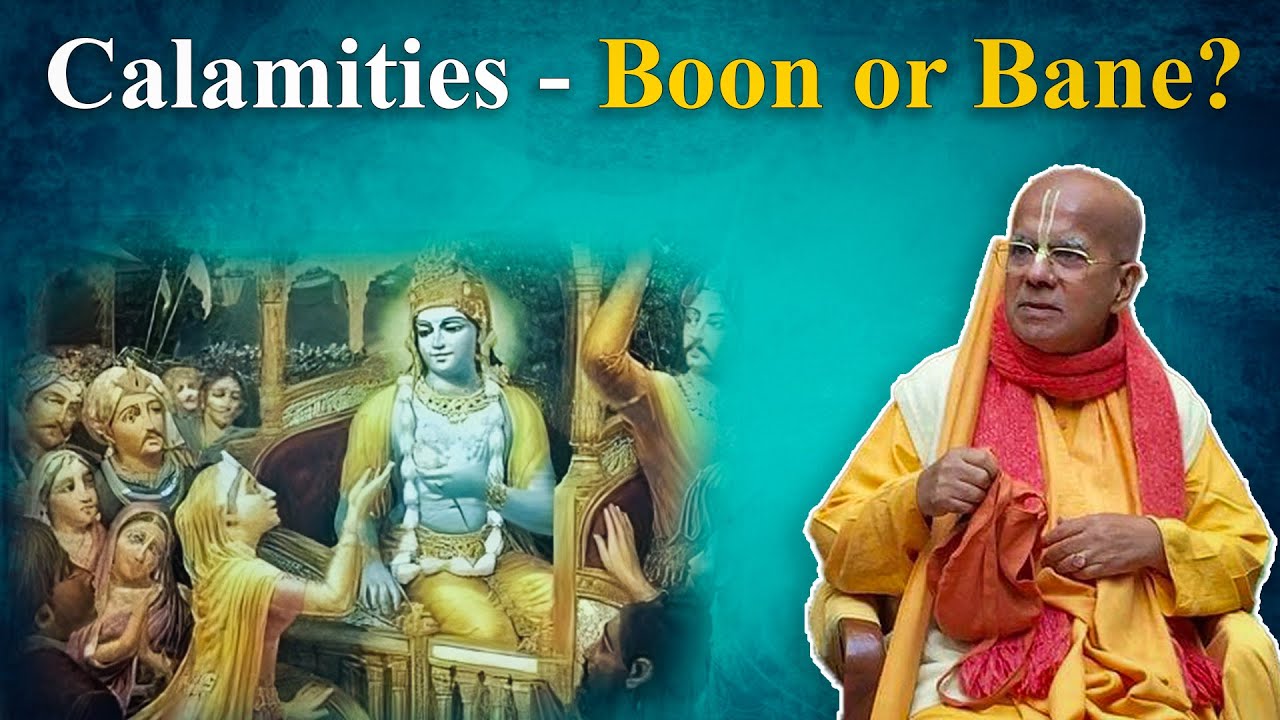
In this lecture, the speaker (presenting as Gopāl Kṛṣṇa Goswāmī) examines Srimad Bhagavatam 1.8.25, the prayer of Queen Kunti, focusing on her unusual request that calamities may repeatedly arise. The talk connects this verse to the Bhagavad‑Gītā’s classification of four types of devotees, illustrating how distress can become a catalyst for purification when one surrenders to Krishna. The speaker recounts two illustrative stories from the Gaudiya tradition: a thief who, while plotting to steal Krishna’s opulent jewels, becomes purified simply by thinking of Krishna, and the child‑prince Dhruva, whose intense austerities transform his desire for material power into ecstatic devotion. These narratives support the central claim that any encounter with the Divine—positive or negative—purifies the seeker. The lecture then expands to a broader theological view that material existence is essentially a realm of temporary calamity, citing Prabhupāda’s purports and analogies (e.g., the ocean reduced to a calf’s hoof‑print). The speaker contrasts the devotee’s acceptance of hardship with the non‑devotee’s turn to material escapism, attributing the difference to past karmic tendencies. Finally, the talk situates Queen Kunti’s prayer within the Mahābhārata context, describing the Pandavas’ hardships, Duryodhana’s conspiracies, and the protective role of Krishna, thereby reinforcing the theme that calamities, when faced with devotion, become opportunities for spiritual advancement.
Chapters
Om namo bhagavate vasudevaya. Om namo bhagavate vasudevaya. Om namo bhagavate vasudevaya. The last night, after going from the program, we had another preaching session in Lev's house, and after that I lost my voice. So I was wondering if I should come today or not, but I felt I could use the modern sound system and communicate with all of you. So I'll just give you all a class and a small darshan, but no kirtan. So we're going to discuss text 25 From the 8th chapter of the first canto. Om akyāṇate virandasya jñānaṇ janāśala-kyaḥ cakṣer-milita-niṇataḥ māyāśrī-gurave namaḥ vipāda-santu-tāhasaśvat-tatra-tatra-jagat-guruḥ bhāvata-darṣṇam yātsayaḥ apanar-bhāvata-darṣṇam. We are reading to you devotees from the prayers of Queen Kunti. Queen Kunti was not an ordinary lady. She was a very exalted devotee of the Lord. Queen Kunti was the wife of Maharaja Pandu and the mother of the Pandavas. So Queen Kunti had to undergo a series of difficulties. First, at a young age, her husband died. Pandu, Maharaja Pandu. And then she was one of the two co-wives of Maharaja Pandu, and it was decided that she should stay on and take care of the children and not voluntarily die with her husband. So Queen Kunti, she knew that Kṛṣṇa was the Supreme Personality of Godhead. Not everyone could recognize Kṛṣṇa as the Supreme Personality of Godhead even when the Lord was present on this planet. Therefore, we see that in this chapter Queen Kunti has glorified Kṛṣṇa as the cause of all causes, as one who exists within everything and outside everything. Now in this verse particularly, Queen Kunti is saying that, "My dear Lord, if you desire, please may the calamities come again and again." Now normally nobody invites calamities. Everybody is scared of calamities. Everyone is scared of difficult situation. But here we see that Queen Kunti is saying, my dear Lord, please may the calamities appear again and again. In the Bhagavad Gita, Krishna says that 4 types of individuals surrender to me. The chaturvidābha-jāntemaṁ ye jana-rojana-ārjuna. One is who's in distress. The other is one who's inquisitive. Third, the genuine seeker of knowledge. And fourth, one who wants wealth. So Krishna says all these four can be considered to be auspicious because at least they're taking shelter of me, and by worshiping me, they will gradually get purified. Just like the sun has the power to cleanse even stool water and urine water, Similarly, Krishna has the capacity to purify the devotee of his impure desires and bring him to this pure platform of devotional service. In this connection, there's a nice story of a thief that Prabhupada used to relate. There was once a thief who would go to all spiritual discourses and steal people's shoes. In India, when people go to spiritual discourses They take the shoes out at the entrance, and this— and there's some people whose profession is to go to these discourses and steal the shoes. So there was a professional thief hearing the discourses by a saintly personality, and the saintly personality was describing Krishna's opulences. After all, who is God? God is one who's in possession of sex opulences in unlimited degree. And the 6 opulences of God are: He is the wealthiest of all, He's the most beautiful, famous, the most knowledgeable, the strongest, and also the most renowned. So this saintly personality was describing Krishna's opulences and how Krishna's body is decorated with valuable emeralds and diamonds. And he also described that Krishna is playing in the courtyard of Nand Maharaj, and he can be found in Vrindavan. So the thief, he said, I'm going to go and meet Krishna, I'm going to talk to him sweetly and gradually steal all his diamonds. So the thief, he was constantly meditating how he would approach Krishna, and till for the journey till Vrindavan, he was just absorbed in meditating how he will trick Krishna and steal the various diamonds, etc. So finally the thief reached Vrindavan. He saw Krishna was decorated with all these valuable diamonds, so he asked Krishna if he could have these diamonds. Krishna said, no, if I give you these diamonds, my mother will get angry at me, but let me ask my mother first. So Krishna came back the next day and said, okay, my mother said you can take these diamonds. But the thief had got so purified by thinking of Krishna that he said, no, now I don't want these diamonds. So by thinking of Krishna positively or negatively, one gets purified. However, a devotee thinks of Krishna positively. Kamsa was also thinking of Krishna, but he was thinking of Krishna negatively. Negatively means thinking of Krishna unfavorably. Similarly, we have the story in the Bhagavatam of Dhruva Maharaj. Dhruva Maharaj had performed very great austerities because when he was a young child, he was insulted by his stepmother. His stepmother had prevented him from sitting on his father's lap, saying, because you didn't take birth from my womb, you can't have the honor of sitting on your father's lap. So Dhruva Maharaj went crying to his mother and said, my stepmother has stopped me from sitting on my father's lap. Can you help me? The mother said, I can't help you because your father doesn't like me. Is there anyone who can help me? She said, yes, I've heard that God can help everyone. Where can I find God? In the forest. So Dhruva Maharaj set out to go to Maduvan, the forest. It is near Vrindavan. Dhruva Maharaj was instructed by Narada Muni how to perform the austerities in the forest. Nārada Muni gave him the mantra Om Namo Bhagavate Vasudevaya, and he told him to make a form of the Lord mixed with mud and water and meditate on that form. So Dhruva Maharaj practiced extreme austerity in the forest of Madhuvan. Now, at the end of his period of austerity, at the end of 6 months, the Lord appeared. The Lord appeared and said, Dhruva, now tell me What do you want? Rupa said, my dear Lord, I was looking for broken glass, but now I found a diamond, and now I don't want anything. Because when he saw the personal form of the Lord, he had such great ecstasy that the idea of having a very opulent kingdom was totally vanished. So the point is this, that the process of service to Krishna It's so powerful that positively or negatively, whichever way one comes in contact, one will only benefit and not be a loser. That is why a devotee is not scared of a difficult situation also, because in every situation the devotee remains aligned to the Supreme Lord. So therefore, the devotee accepts all types of situation, pleasant or unpleasant, as the causeless mercy of the Lord and adjust accordingly. Now, why is it that one person in distress turns to God and another person in distress turns to the vodka bottle or other sinful activities? The answer is that those who turn to God turn to God because of past pious activities, and those who don't turn to God don't turn to God because of their past sinful activities. So a devotee, when he has to face some difficulty, he just views this as an opportunity to further meditate upon the Lord. And when he has to meditate on the further on the Lord, he just becomes free from the cycle of birth and death. Because for the devotee, the Lotus Feet of the Lord are the object— is the— are the object of meditation. It is said, to cross over this vast ocean It's impossible. But the vast ocean gets reduced to the water contained in the hoofprint of a calf. Just like, you understand, the hoofprint of a calf. So the footprint of a calf makes small ponds of water. So for anyone, even a child can jump over the footprint of a calf, but nobody can jump over the vast ocean. So Krishna says 'One who takes shelter of Me, for him this vast material ocean becomes reduced to water contained in the hoofprint of a cow.' In the purport of this verse, Prabhupada mentions that this material world is nothing but a place of calamity. Yes, the kālayam asyacchitam. This means place of misery, and everything is temporary. So there is nothing but calamity. What appears happiness It's just like, uh, and just for a second, there was a great devotee called Vidyapati. He has said that this so-called material happiness, it's just equal to a drop of water that is given to a thirsty person. If you're thirsty and somebody gives you a drop of water, that drop of water will not quench your thirst. Similarly, when you're hungry, one small morsel of chapati or kleb is not going to fill your hunger. So similarly, The material world at best just offers you an ounce, a drop of happiness. In the olden days, the system of punishment was that the criminal would be taken in the middle of the ocean and they would dip his head underwater. Just bring the head out of water only for a second so he could breathe, and again dip his head underwater. So that is exactly what material life is. You get only little bit of happiness just for an instant, otherwise there's nothing but calamity and distress. Further, ashashatam. Ashashatam means that everything is temporary. So everything is temporary. You may be a very rich man today, but there's no guarantee that you'll remain a rich man tomorrow. You may be very healthy today, but there's no guarantee that you'll be healthy tomorrow. Material world is nothing but a place of uncertainty. So the devotee recognizes— Prabhupāda used to say, material world is no place for a gentleman. Therefore, the devotee prepares for the spiritual world. So Queen Kunti has acknowledged in this chapter how on so many difficult occasions she and the Pandavas were protected by Krishna. As you know, Pandu, the brother, died. Pandu was the younger brother of King Dhritarashtra. Actually, Dhritarashtra should have become king, but because he was blind, his younger brother Pandu became the king. And when Pandu died, naturally his sons were supposed to become the king. But when Pandu died, all the Pandava brothers were very young, young children. So Dhritarashtra became the caretaker of these young children. Until these children grew older, Dhritarashtra was taking care of the administration. Dhritarashtra had a brother, had a son called Duryodhan. So Duryodhan was very greedy. Duryodhan was thinking, now when these Pandavas grow old, they will become the king, they will take the kingdom. So Dhritarashtra was inspired By his son Duryodhana, that some of the other— these Pandavas may be killed. So Duryodhana and the Draupadi, they tried many tricks by which the Pandavas would be killed. For example, on one occasion they were fed a cake which was full of poison. Draupadi told them, I have built a very nice house for all of you, please come and live there. The house was made of wax. Lama Lama Ale Ale.