SB 1.9.25- Bhismadeva's 9 Instructions to Pandavas | 25.8.23 Detroit | Śrīla Gopāl Kṛṣṇa Goswāmī
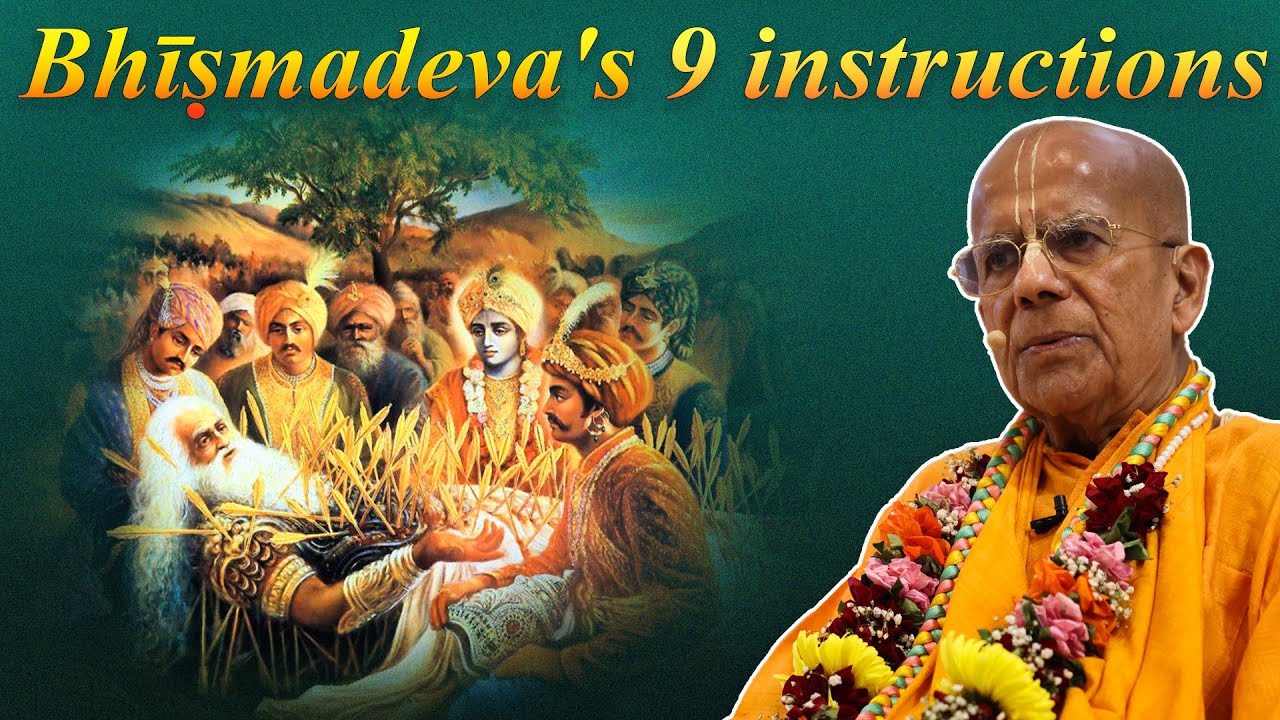
Śrīla Gopāl Kṛṣṇa Goswāmī explains Bhīṣmadeva's nine instructions to the Pandavas: purity, anger control, truthfulness, equality, simple living with high thinking, forgiveness, care for others, and the guru-devotee relationship. The lecture offers practical guidance for managing time, handling criticism, and integrating devotional service into daily life.
Chapters
Om namah shivaya! Om namah Shivaya! Om namah Shivaya! Om namah Shivaya! Once you discover this life teaching— it's reflected of course in Kena Upanishad chapter 9 text verse 5.
Sutovāccha, sutovāccha, vishiras tad āparnyaṇ, vishiras tad āparnyaṇ, shayanam śarapaṇjaraye, shayanam śarapaṇjaraye, apricchat vividhāṇ karmā, apricchat vividhāṇ karmā, shinām ca nuṣṇvatā, shinām ca nuṣṇvatā, Translation: Sutaguru Swami said, Maharaj Yudhishthira, after hearing Vishwadev speak in that appealing tone, asked him in the presence of all the great rishis about the essential principles of various religious duties. Translation.
Yeah, yeah, perfect.
Vishwadev, speaking in that appealing tone, convinced Maharaja Deshshir that he was very soon passing away. And Maharaja Deshshir was inspired by Lord Shri Krishna to ask him of the principles of religion. Lord Shri Krishna inspired Maharaja Deshshir to ask Vishwadev in the presence of many great sages indicating thereby that the Lord's devotee like Pīśaddev, although apparently living as a worldly man, is far superior to many great sages, even Vyasadev. Another point is that Pīśaddev at that time was not only lying on a deathbed of arrows but was greatly aggrieved because of that state. One should not have asked him any questions at that time. But Lord Śrī Kṛṣṇa wanted to prove that His pure devotees are always sound in body and mind by dint of spiritual enlightenment, and thus in any circumstances a devotee of the Lord is in perfect order to speak of the right way of life. Yudhiṣṭhira also preferred to solve his problematic questions by asking Piśadi, rather than ask anyone else present there who was seemingly more learned than Pīśalī. This is all due to the arrangement of the great wheel carrier, Lord Śrī Kṛṣṇa, who establishes the glories of His devotee. The father likes to see the son become more famous than himself. The Lord declares very emphatically that worship of His devotee is more valuable than the worship of the Lord Himself.
Prasad Raaval. I'm happy to be here. Beautiful temple, beautiful deity. If you can't hear or understand what he's he raised his hand. So, the first Kanto was actually given by him. That was a very important introduction. I wanted to make sure that he know and receive the benediction that he could choose the moment of departure. And after the battle of Kurukshetra was over and Yudhishthira was father of the king, his lineage was gone. Now it's time to depart. And he was lying on a bed of arrows and Krishna approached him presently. Aum guruh padma prasadam. And he began to speak. "Oh, I did this." This time he had a great fortune. Amazingly, the Lord was living in his body. So, this way, he was very knowledgeable. So, Prasada Prabhu said, "Hey." So, they say, "Why should a person who is about to die be bothered by these mundane questions?" And, eventually, he did not want to be glorified anymore. He wanted to show to the world that by the body he was the inner of it. He said, "Sound and mind." We saw him in a prayer, he whispered, "Papa." He said, "Papa, it is the last day." Prasad RAVALAD RAVALAD was very sick, very, very sick, but he did not stop preaching. He was dictating the Bhagavatam. He was so sick, he could hardly even sit down. He was lying flat on the bed. He was living in a devotee prison there. Murgi, that Sanskrita local, and he came into his office with a chair. And Prasad RAVAL was there to tell him the purpose. Even though he was in a seemingly very difficult position, but he was always so calm and he translated the— Prasad. So this was the day that he was going to get very valuable instructions. All she could share is a few lines. Honestly, is this one can question? Somebody say, why the Lord asking anybody? Lord knows everything. The Lord does this to glorify everybody. This is the unique art of Guru Mahārāja. The Guru Mahārāja is the servant of the Lord. The Lord is famous for that. Similarly, in Kirtan Charit, you read that, "Kirtanam adho agra maneroi, speaking of affection." Who would not love her? Who would not love her? For the very nature of it, of Manohara, the dance is made of affection. And he was moving, he was going, and when he was leaving Devi Anjali, Swami Mookambalacharya was astonished, impressed with it, and he wanted to ask her, "Love, but here you are a man." Yes. "Where do you go?" So, "No, my child, who is the Lord?" "My dear Lord," is the way he's talking here, "you have made a devotee of Amma Devi." And the man, the man was a little bit good-hearted, and he had his patience, patience, no one asked questions, and Amma Devi told him. So, the Krishna is telling you this, He always worried what are the duties of individual and how should one lead a normal life. But when he had narrowly made his worries, how would you live, what would I do, so it, principle of Zen became Over here.
Yes.
Swamiji said not to become angry. He said, "Nithyananda Deva Ji, don't become angry." He has seen the Nithyananda. He teaches that. Lasciate and breathe. Aspirate, vibrate. Hindi means well. Prasad RAVAL say, "Nijāyā nijāyā nijāyā nijāyā nijāyā." The explanation is as follows. When we get angry, if the problem is holding our mask, when you get angry, you don't get your quota of respect or anything material. How many people, they come anywhere. People go anywhere, they don't get what they want. And whatever they want, they become angry. And how to do is anger to be controlled by the common thing like You know, the body everywhere. My eyes are just taking a blink of light. It's still there. It was there before you were born. It is still there. So we had a little talk about it. I'm glad it was understood that Krishna has been told that we're going to get the book out of Sanskrit grammar. No become angry. So generally, angry spirit avoid it. But in case of Lord, is another. Akhajanā, I have created tolerance. And this is another here, you see. That is, Lord give angry. When we, when we become angry, then He saw that, but I heard the Archbishop of Toronto, when they watched the video, what I got, he said, "It's over there." "Where will we be housed?" "It's over there." And peace. "Bolo Krishna, I love Krishna, follow Krishna's teachings." "Bolo Krishna, we stand up with Him, O Krishna." "Ashtadhamani Padaye." "I love Krishna, worship Krishna." "Hey, follow Prasad Raaval's teachings." I was like, "How could I?" Many houses that came, they would receive me. "Oh, Ajahn Jagjavan! How fortunate we are!" They would say, "What can we do for you?" And I would say, "What would we do? What would we do?" told him he would have it. So one day he went to another village. People said, 'We need a doctor.' So he said, 'I know.' And she was putting up school for the girls. And when he had ready 12 devotees who were understanding the experience— or enough, and the rest was not enough. So they became angry. And so they criticized that. They, the experts, they were thinking, we should promote the most foreign people for the city, Krishna consciousness. So they did require a What are the most feeling, anxious, energetic? How are you with that? That you're better with what Moina and Ramana said than what you made it. They go sitting there, they don't dance. Drunk all the time. "If we will rescue these two people, then Lord Chaitanya's glory will be enhanced." So therefore, he told her, "Then, however, we stop drinking and avoid it." And the two immediately followed the boy. I never went to the procession. They persisted and finally, Raja Rangaiah threw a stone and guarded it. He said, "I'm going to Supreme Lord." He knew what would happen. He gave me everything he had. When he took care of the prisoners who were exposed, And then the monk was in a state of anger, he said, "What do you know? This is what you expect." And he said, "I did not choose to live. I'm having this stuff." And then when I was ready to prepare the depression, they saw what could help me and You will be ill with it. So anger can be used when the word of the Lord, or the temple of the Lord, or the preaching of the Lord is being curtailed. But don't become angry when somebody else has made a mistake, or you didn't get what you want. The happiness and distress that we get He's going to a court. Ramana Maharshi says, "My dear friend, you will work as hard as you want, but you won't get one drop more happiness than what is your destiny. So don't go and never, you will not receive it." So everyone should be avoiding the courts. Not to lie, or whatever. He says not to lie. And what is the situation today? We do nothing except lie. This person actually is He said, "I'm not a murderer. I don't lie." So the principle of the Indian says, "That has been the truth." So lying and cheating has been the name of the game today. Unless you can lie and cheat, you will do anything that someone equal Gita, that one day take 36 years to clear up all the backlog. So, as long as you have not completed, you are alive. So, the first lie is misinterpreting the scriptures, translating or explaining the scriptures suggested by your nonsense. At the beginning of the talk, I was lying and presenting everything. And we also know to lie, especially when you worry. You generally avoid lying. When the Baba Gita Papa says, therefore quote, you could have been a businessman, And you would say, every time, maybe you will say, "My brother, I don't make no profit." And he will give it. And if he makes a profit, Prasad RAVALI, why? Why will you do this business? You don't make a profit. So, he said, "I don't like." Our business is there. We might make no profit, but he will make profit. So, we said, "We won't lie." He said, "What is the teacher's answer to it?" "Find out who your father is." So, he took all the students, "Find out, explain to me the identity of your father." One student asked his mother, "Mother, I have to report to my teacher who asked me who my father is." The mother had loose character. She said, "I really don't know who your father is." And then the student had to do this for the teacher. So, I was in school for We should not lie. So lying in the material world is common, but in the spiritual world, or especially, everyone is truthful. And even if he had a mistake or he said a lie, he should— okay, we should speak this truth. If he has a little wrong, we should speak this truth. So another principle for a civilized human being is not to lie. Then he said, to equally distribute wealth, to equally distribute Here the Congress— he is the Congress of Nepal, but when the Congress was— the Congress had a couple of principles, and they gained a majority, and I hope we could— and the Congress should work with the world.— going to Lenin's Stalin. And wealth should be equally distributed. And the former Soviet Union is a prime example. But in reality, everything under communism, wealth was not distributed equally. Very unfortunate, people had everything, and citizens had nothing. So there should be no doubt wealth should be equally distributed, and what should be in Kali Yuga? It's nothing. There is a rich and greedy nature. The poor remain being poor, or improving to some degree, but the wealth is not distributed evenly. Ishuparishad says, Ishuparashadika, Once it came as much as it needs for human death, not beyond that. If wealth was equally distributed, then one would be very happy, because he had everybody happy. But in a balanced materialistic system, then whether there is socialism or capitalism, wealth will not be distributed equally. And because some people have so much, they develop for the next 10 generations. It's so much wealth. And some have nothing. Is that right? If everything is distributed equally, then there will be harmony in society. Now we have a society of have and have-nots. What do you do? Some people have too much, some people have too little. And that creates unbalanced society. So, Ishupareja says, "Keep as much as you need from the other." So, that is simple realized being. Probably we should say, we stand for simple realized being. So think simple, live simply, and think high. What does high thinking mean? You think about the world of life. What am I here for? What is my role as an avatar of the Ganesha? You are inquiring into what is the goal of life. So this spiritual doctrine is Simple, because I think as a captain of any job, high living is simple thing. There are people living high, and they can. If they don't have enough money, they may borrow, steal. I won't live high. Many people live by getting their credit cards. High living and simple thinking. Simple thinking means, "We are sitting under a grassy walk. We have something to eat. We have somebody to date." So that happens in a society, materialist belief. High living, simple thinking, that creates all the pollution, and you preach it and believe in anything. If somebody believes in anything and is not personal, then wealth can be equally distributed. And that's what I said. Distribute wealth equally, not that some people have too much and some people have nothing. 4. To forgive. Forgiving is a necessary maximum quality. We should have the mood of forgiveness. We should not have the mood of tit-for-tat. You know what is tit-for-tat? You do this, I'm going to do this. You give me one slap, I'm going to give you two slaps. You do this, and I'll do that. So, but here, this is what he is saying. Learn forgiveness. Forgiveness means you forgive everyone who tried to harm you. For example, the Saurashan Duryodhana left nothing unturned. They placed my boy abroad to deprive me upon Mother's Night was right on. And then I heard, "Oh, here's a walk with all of these rations." I looked at him and said, "If you listen what I wanted," he said, "Now the government is out of control. They will hang you." I said, "I want to listen." It was a langar. I'm very sorry that so many people died in the marathon. And here, a big palace was built. They gave them the best facility, but somebody was constantly trying to kill them. And the year before the facility, they had this rath yatra, singing, a large group of politicians having conference. But then who came? Who came to break this touch-up? Vidura. Vidura came. "You fool! You tried to kill me, my dear brother, and you are doing it as a mercy." Then Prasad RAVAL told, "When Vinayak Maharaj came here," He did not say, you're trying to, you know, try to poison the food, you tried to burn our house. They were living in a house made of thatch, and they could have conspired, and the house was set on fire. But part of us escaped because they were given previous warnings. So, the missionaries, he tried very hard to kill us, but here we put him in jail. He said, "Here, catch, this is me." So, the only issue given I've seen cases where somebody insulted Prabhupada in a lecture at a public school, and Prabhupada was still very merciful to the person who insulted him. Prabhupada was giving a lecture at a Christian school on jail, and the lady would ask Prasad RAVAL questions after the lecture. There was one Indian who used to come to meet Prabhupāda often, and he told me that I am going to hear the same thing like Prabhupāda. I said, "Prabhupāda was instructed in Pāli at Christian school which was full of missionaries and fathers and nuns." Why is that English? You will ask me this question. Anyway, Baba was looking, and when he went to party, he told me to call him. Baba blessed him before leaving. So, the worry is forgiven. The only thing that I'm going to definitely take revenge. Of course, the worry is not for the person that was killed. Terrorism. You had to defend yourself. In India, you see, our temples are very heavily protected. Like in the Delhi Temple, they have 11 guards from the government and 1 police officer, 14 guards. 14 guards! Because if you have terrorists attack, But one must say that when Gandhi didn't get his rights, we do not agree with it. In the business world, if you have borrowed money from a bank and don't pay it, they won't give you money in future. That's miserable. And it is pretty terrible here. We should Be forgiving. If somebody has done some wrong, he comes to you, "Please excuse me." You should say, "No!" I'm not going to forgive you. Strike back at you. So we should have the mudra of forgiving. Even the enemy. We did try to divide the sangha. It offended the enemy. He's my friend. He is my— Prasad and I were being trained by— his father wanted to train Prasad in dividing society into friend and enemy. He's my friend, he's my enemy. But I'm not interested in this, because everybody is my friend. I have no enemy. So, in the morning, when sun to forget, if the sun comes, the body has to say, "Hey, listen, we should go out in the air and forget it." Brahmanuropa, so the Brahman was very envious of Śrīvās. So, in front of Śrīvās's house, he placed half an India, I was worshiping my Durga, liquor, meat. Śrīvāmī opened the door in the morning. He said, "Oh, what has happened in this big liquor?" He said, "Prasād RAVAL." I was pretending as if I was a devotee of Kṛṣṇa, but I was a devotee of Durga. Nobody believed what happened to him. Offender. He got hit with leprosy. He went on suffering. But he was vegetarian. He took a bath in the Ganga. When they found out he was suffering from leprosy, they approached him. Prasad RAVAL said, "You try to offend them, defame them, you will have to take the curse of the lepers." And we had peace, but— So, the Baba went and said, "Who forgave him?" And she was really happy, forgive, and, uh, "Sadhguru ji is forgiving." "To be educated only by what is led by the mind." This is something very relevant today. Today the concept of getting educated only by what was led by the mind is almost dead. In the US, in the Indian society, everything is really is accepted as normal, especially in America, the land of so-called liberalism. So here in this place, you must have a legitimate mind, and you can get children only after marriage. But these days that's so common that people don't get married. They have a limited 11 years after that, we were married. And when he married, then he, etc., he became crazy. He went crazy. You find it in America. I don't know. So, what I prefer to say is that you want to 'You should get married.' Prasad RAVAL, he saw all these couples living and he told them all to get married. Of course. So, Mr. David King gave very valuable instructions and he specifically said, 'When you bring a child, make all intention Whenever it be, this is the law. You get married and then you give your sārśana. And then they're going to religious teachings. If you are in mind and— this is not an idea— To be pure in mind and body. Pure in mind and body. Ah, you may become pure in mind. Most people you find will say, "I'm pure, I'm sincere." But mind is pure. But that is illusory. They don't understand the meaning of purity. Like how many understand the meaning of sattva, sattva is very easy. So, how do we become pure in mind and body? Ah! Question. I become pure in body and mind. Washing the mind with soap. That's like a dirty cloth will become clean when you wash. Become pure in mind by by executing devotional service. And he advises that, chanting the name of the Lord. You know, when you do meditation, closing eyes and going to sleep, and thinking how you are working towards purity. He said, 'Rādhā-Mādhava-Voṣṭhāṇḍaḍa.' It follows right body and the mind. But he had been a yogi, he was very No one else thinks that. So, I don't pay for his words. What does he say? Change one at once. One day, he will change the whole yoga body. It cleanses your mind, cleanses your body. It cleans the body, heart, brain, spine, where you are using The senses is having to do. So, purify the mind. Purify the mind and mood. If you purify the mind, then you can refrain from engaging in immoral activities. So, this chanting of the Holy Name has several benefits. And one of the main benefits is to purify the heart. What's the pollution of our heart? But you know how that is heavily contaminated, right? And without cleaning, you will be wearing clean clothes, taking a bath and cleaning your body, but that's not cleaning the mind. Cleaning the mind is required, especially at the end, at the standing ending of the talk. So, when I'm done with the changing. Yes, we can depend on that. We can all speak from our experience. Before we became a Kṛṣṇa consciousness, most of the people were engaged in nonsense activity, or completely impure activity. Then after we began the changing process, after reading the book, after associating with devotees, What do we see? We see another, huh, weakening. And if it's not weakening, then you should get concerned. Just like if you have high temperature and your temperature is not coming down, then you feel very concerned. The same way as you would be if our But see how temperature is not coming down. You should get alarmed. There is nothing wrong with the medicine. The problem is the patient. It's not the medicine that is lacking anything. Om Rigney was complete. But the patient is either chanting Adi Anubhi or committing too many offenses, or the spirit is having reaction as the language was then, impure, nothing creative. So, your own body and mind, the different senses, they give you the right to serve the Lord. Your legs, your legs drive you to the temple of the Lord. And if you are going to do business to make money, what will be the intention? I'm going to live high now. What will be the intention? You can sell the house. So, this attempt in our Kṛṣṇa Vaiṣṇava movement to become pure is for the meaning of what is there The world itself is purified by the mind. Sometimes you see cases where even though a chela, a Kṛṣṇa, he is climbing blue, washing pots in the temple. He is living in a mountain temple. He lives in the city. The last 35 years he comes every day to clean the pots of the temple. Sri Subhadra is serving. He made me pray all day, sweeping the floor. My body was worn, servant. Then he covered the body with some blanket and eventually began to chant. So we had to purify our body and mind. And the only way I could chant and regain the senses in service to the Lord. If you engage your senses in service to the Lord, then it will advance in service of mind and body. Then, you won't be inimical towards anyone. You become meek. So, you know what I mean? Unfriendly. A Vaishnava should not be difficult to anyone. Don't hate anyone. Don't think, "This man is my permanent enemy. This man is trying to give me death. I'm going to retaliate." He is not my friend. Don't be difficult to everyone. That in another language means, be friendly to everyone. Everyone, there is a great— you take for your friend who will be immigrant towards anyone. If you be friendly towards him, or could be a day you go laugh with his mother. He described to me what are the qualities of a sadhu. And then he spoke his famous verse, which is, He's a friend of everyone. So, he's a friend of everyone. So, he said, "Don't be inimical to anyone." Actually, when there's a situation where you're very angry with somebody, there is a bigger thing in the mind. Engaged by— when you think negatively about anybody, you, you, or the other person, the mind is getting absorbed in undesirable activity. So befriending everyone, everyone as it is, and even your very good friend. What's the use of worrying about He then placed it on top of my finger and said, "I am your real friend, and I have got a medicine to cure you." What is that medicine? It's before you. So, as you advance spiritually, you won't consider anyone to be your enemy, but your best friend. Everyday critics, we give them up. Sometimes in the evening, we have many court cases. Baba says, "There are these Iskari people say, 'You cannot read the Hare Krishna, but the Hare Krishna minister, he gets special benefit.'" So our goal should be friendly to everyone. Now this may not be possible immediately, but that's the goal that we should work for. We should develop our character in such a way that we have a friendly attitude to everyone. Hello. should be simple and taking care of some of the bodies. So we didn't discuss this point. They were very nice to them, simple, simple living, simple living in very many ways, again in simple living, and it was to see harmony in society. Why are we a modern world in development? What was the cause of that? This is security. Everybody has a security guard. Why? Because there is scared, something undesirable. So everybody should be simple in living, simple lifestyle, and take care of some ordinary things. So we have people who are dependent on the others. If you have people who are subordinate, take care of them. We see that everywhere. You can study the welfare of dogs and cats. If you have your cat or dog, you take care of them very nicely. Even some dogs will bend down to get a good bottle. Like Buddhist learning is more than Those who had pets, dogs, they considered others as ordinary. But the other dogs, they catch and kill. And the cow, no one thinks that my cow should be protected. But that cow gives you milk and sustains you. But the cow is not protected. Slow down. So, and for cars we don't care, but for our own pets we care. So, no, it wasn't cats, their master who cared. And I was told that, yeah, when she, when my dog and children, when you got children, what do you do? Someone told me that Taking care of human beings— taking care of a dog is more expensive than taking care of a human being. They have insurance. They're busy working morning to night, so they have dog walkers. Going through the market, they're on top of We saw a lady taking one dog out, two dogs out, and she took out 12 dogs. So we asked her, she said, "Ah, she's a dog walker, making it a lot of fun." So we had pets, we did everything with them, but beyond that we don't care. Whatever it will now happen, we don't care. But our way of, of devoting to me should take care of all our subordinate. So most importantly, there again, he says to be simple. So these teachings are very practical, and these characteristics or qualities which were— I, I discuss it because in the 9 principles These are— you heard them before, but it's being re-emphasized. These 9 principles should be practiced in a civilised society. So— "Patience is number 2, will be equality." So number 1 is enlightenment, but 2, take care of subordinates. This is what repeated in 2 different interesting— You take care of subordinates. A master must take care of those who are serving him. In one idea, Even today people remember, "Amar." Why? Because at that time there was complete harmony in society and there were no disease, no death. And Lord Ram, Lord Ram would, Lord Ram would disguise himself and go from house to house household to find out if people have any grievances, if they have any problems. So, and every citizen in the world. Baba says that the government's duty is to see that everybody has employment, everybody has work, everybody has money. They can help. So, every kind of body, you look after. It's a body. So, God is in power. With Him, everything is ended. The body. So, but you take care of the body. But the God will teach you. Don't worry, He will give you. The employers don't care for the employees. So, as I said, whether king, prasād RAVAL, or president or prime minister, the head of a state must make sure that all the necessities of life are provided to the citizens. That is the duty Everybody wants to become a rāṇa. I'm becoming a rishi. In the olden days, the rīyamāvāda rāṇas were also rāja rishi. In the head of state, myself quality, in the head of state, then I will be spiritual quality, then it will be— if the government just extracts taxes from the people and doesn't provide them with the necessities of life, then after death the individual is— what do you hear?— is scary. Esqueezable machine. They give speed, which is related to Ishwari Yoga. So, what are they? Law of nature. All are very, very strict. So, if a king is thinking, "I must take care of all my subordinates," and this is the principle. But these are— he thinks, but nobody is actually taking that into mind. To see it come true. So, everybody has been giving information about qualities we should develop. Of course, I was told by everybody, this is all very good, this PRASAD RAVAL, everybody, how people should live is highly helpful. He will be there forever. He gave a very nice point, suggestion, how a civilized society should operate. Would it be ideal if we had these 9 principles in practice? There would be no wars, no tension. Today society is so corrupt. The biggest, the fastest growing industry is the armament industry. Countries don't have money for food, they have to buy armament. And why they are doing this armament? Because, because everybody wants more, more, more, more. Every station exploited poorly. And the first thing they're getting, fighting about it. Every— every day the world was going to break into two countries. One country was anxious to from brother to brother to attack. The world, the nation of the world, He just wasn't. So all the wars and killings, terrorism of such a major force, all led to God. He did not get— he was a spiritual educator. And in the absence of spiritual guidance, he knew all those things anyway. So these teachings of Mr. Prasad are very relevant. And at the end, as devotees, we should try to develop these qualities that will help us in our spiritual progress. Hare Krishna.
Friend and enemy.
Friend and enemy. You don't consider anybody to be your enemy. He may be criticized with you, but he's not your enemy. Of course, if somebody breaks into your house, you have to retaliate. You may call the police. But generally, No confession in any way, to be, you know, enemy.
You're talking about the preaching, how should we be more tolerant while preaching?
Should we be more tolerant?
Like, how? Like, sometimes we get agitated, disturbed.
Someone may criticise you, "Hey, he's selling his books." And we get criticised in India also. Some people say, "Why should the devotee go on the streets? Why did the devotee go on red lights?" So our answer is that the devotee looks for every opportunity to engage everyone in the work So, we've come to you with Bhagavad Gītā in our hands. You don't have the time to go to a shop for them. So, the point is, when you are preaching, some will support you, some will not. Some will oppose you, may even try to hit you. Really wish you wish me. Stricted, but we have to keep enough, enough. Oh, your question is— I think you answer question. Answer the question. Thank you. Yeah. Purified mind means the mind is seeking of Kṛṣṇa and His instruction, or His līlā, or His teaching, or His doing, His avoiding. Your mind is seeking for some spiritual talk. Otherwise, the mind meditation is thinking about material talk. Krishna says in the Gītā, "Make friends with the mind." Make friends with the mind. Or an enemy. So, friends is being— the mind is now thinking based on Kṛṣṇa's instruction. And the mind is just concentrating Material subject matter, it might be considered to be your enemy. Because I say, the decision is hard. Why? It can be your friend, or it can be your enemy. More question?
Maharaj, how does a devotee remain peaceful even in so much tribulation like Bhishma Deva?
Bhishma Deva was a very, very great devotee, and he was very sound in mind and heart. I don't think we can imagine peacefully you are standing, but at one moment you'll have to sleep on a bit of— How does a devotee remain peaceful in trouble, in tribulation? Well, the worry is The word is angry. Actually, I require punishment thousands of times more. But Kṛṣṇa is so kind. He's given me only one punishment. I want a better life. Why did Kṛṣṇa do this to me? Why do bad things happen to good people? One should not say, "Na, I have become a devotee, everything that I should become bored. Every decision of my parents, all of them, totally enemies. I will share, why did my business go with Allah?" So we don't come to a devotional service with the idea that that everything I do will turn to gold. So new problems in life came there. As we have experienced, you conquer one, one, one disease and you need another. And there was a very devoted people that mentioned Of course, only if I can get Heaven I love. My head will be like that, I will get Heaven. Somebody comes to the Heaven, spoke about Heaven, they find that the problem is still there. Abrahāmā Mukhāyāmā Lokā, mid-way body will be the top of head. One piece is mid-way. So, the devotee, if he has to go through suffering, what does he say? "Why everyone is so kind?" He has a minimum of English. "We continue our prayers and our new love. We continue our calamities." Has anyone ever seen that? In the famous prayer Om Jai Jagadguru Ji, the devotees sing, The Bodhisattva's constantly praying, "I will not have any suffering, I will not have that." But the Bodhi, in different situations, as Prasad RAVAL said, he needed time and day, because the more time and days I have, the faster will I get freedom from both of them. We don't intentionally invite trouble, but if some disease comes, we don't register a rise. Because if that's Krishna, then you are with me, but Kṛṣṇa is the movement. The following 4 regulative principles, would that help purify the mind, I mean the body, or not? We all believe it, even though we're not so certain. It's just like we wish to stand with the example. Or maybe like people who mourn us in India. I'm not speaking Hindu, Jehovah's Witnesses, Buddhist, you know, chanting. But what is a young woman, when they go there, they just chant What your question is? You know, you said earlier that to purify the mind, chanting, which is pretty simple explanation, but engaging all your senses in the service of Kṛṣṇa will purify the body. The body, we are also chanting. You may drive a car, killing somebody, so even now we don't want to If we are angry, therefore it is said, unless you take the devotional path, you cannot even become peaceful.
Prasad Raaval. Guru Maharaj Ji, in the Krishna consciousness we have so many services like worshiping the deity, distributing books, reading more, chanting more, and especially for those of us who are working, we only have like 3 or 4 hours in the day left after we work. So oftentimes there's a confusion which one to do. Should I do more media work? Should I do more book distribution? Should I do more chanting. So how do we understand what we should do on a day-to-day basis? Please, what should we increase more?
Well, within 24 hours, frankly, there is enough time for— even if you work for 8 hours, there is enough time for for the crucial activity and material activity, taking care of the body. So, you are just pressured off. Same time, then, then you become— whatever you do, you will go away with a shanty, sādhaka. That is imperative.
Actually, my question was connected to his question, so it got answered. Is there a way, as a householder having a job, What's the fastest way to remember that I have to cultivate these 9 qualities and to actually cultivate them?
Well, it is everybody's own mind. It is your own determination. You have determination that I must do any activity in the world. I give a little bit of Students push very hard to secure good marks. And, in addition to that, we have a social progress, once we have the equality, we will be able to endeavor for a purer society. You're practicing Mahāyoga and you'll be inundated by big qualities. Any influence of a few people, you can't know the big quality.
So, what is the thin line between forgiveness and love?
You know, like Krishna mentioned in Gita, you know, 'forgive not the violence that fight against you.' Forgiveness, no, there is another part there also. Forgiveness is somebody is nagging you and You don't think that you should also do it, but you forget. Kṛṣṇa was happy when he does a gītā fight, because it is your duty as a Kṛṣṇa's head to fight. Please devote, fight with your mind entirely dedicated to Me. And if you're not in any way connected or forgiven, or forgiveness means you're in no state for that. But of course, the only forgiveness you're not saying—
I'll keep repeating it, but it's like I have the same question on forgiveness, that how should one look at the situation when you get offended, um, to really forget and forget immediately instead of keeping people out of it and reacting on it. How should one look at the situation?
If you are awakened. Yeah, if you feel awakened. I am telling you, it is very dependent in which way we have been enlightened. If you think you have been healed of all It's a good thing. I think it's helping you to come into yourself. If somebody's trying to harm you, and then upon the deathbed, then you can forgive them. But if somebody's trying to harm you, and then at the point of death, then that's enough, it's finished. It's not going to come here again, or if it comes again, somehow, then you turn him over to the police. But it depends how, what happens. Every case is different, but in general, we should have a forgiving nature. As we deal with the black spot, in the material world, I'm not going to tell the police what to do. You should forgive the people. When they did a maximum of dealing, and you need quality in all the relations you do, but it is even getting karma. You, if we tell, if we tell that, tell the government to follow, sometimes the government will follow, but in the present environment, government say, simply, I want to have more electric, water, Will you do more questions?
We understood that Krishna inspired you to start to ask the question to Vishwadev to prove how pure the devotee would be, right?
Like in the— The devotee is always having in mind and moving. Right.
What I was trying to understand is, because of some sin, he just ended in that situation on deathbed, right? What's going on in his mind, like, when he's answering this 9th principle? What's going on in Vishnu Dev's mind when he responded to minister with these 9 principles? Like, was he having regret? Because he is a great sage, a divine sage, he followed 9 principles and he's explaining the 9 principles but in the deathbed. So, like, what was going on in Vishnu Dev's mind?
In his mind, he was always thinking of his beloved master, Krishna. That was the last word he would say. In mind, he was always thinking of him. But the moment they had him, and his last breath was gone, he went along with them. The farmers were so renounced, they said, "Okay, you don't want to give us the work you are doing, then give us 5 million years." I'm going to give it up for the world. Shantiya. Shantiya, I appreciate it. But everybody then, they were the same. Last question.
Gūmaraḍ, the Bonaparte guru, not different from Krishna? Krishna, and same time, like serving, same time when you desire to serve to Guru, at same time you also, same time devotee need help, same time. So which one first priority to serve, Guru or devotee? English? Bonafide Guru, not different from Krishna. So, desire to serve you, to Guru, and same time—
Guru is definitely different, different way. Guru is servant of Krishna. He is not equal to Krishna.
So, when he is serving Guru and same time, same time also devotee need help, so which one first priority to help, Guru or devotee?
If anybody, devotee was there before, Will you understand anything? Thank you.
More from PRASAD

Rare Pastimes & Timeless Lessons of Guru Mahārāja | Stories Every Disciple Should Hear

ISKCON Legends- pure devotees meet-HH Jayapataka Swami, HH Gopal Krishna Goswami, HH Radhanath Swami



Jagannātha Ratha-yātrā Through Śrīla Prabhupāda's Mercy | 29 April 2006 | Nairobi, Kenya

Lord Jagannātha's Appearance Pastime | 21.07.2019 | ISKCON Calgary | Śrīla Gopāla Kṛṣṇa Gosvāmī

The Ācārya Teaches by His Own ExampleGuṇḍicā Mārjana by Guru Mahārāja #shorts

Guṇḍicā Mārjana – Lord Jagannātha's Pastime | 21.7.2019 | ISKCON Calgary |Śrīla Gopāla Kṛṣṇa Gosvāmī

H.H. Gopāla Kṛṣṇa Gosvāmī Mahārāja - Exemplary Sādhana and Deity Worship # shorts

भगवान की कृपा कैसे प्राप्त होगी ? | 11 Jan 2014 | Punjabi Bagh | Srila Gopal Krishna Goswami

Material Education vs Spiritual Education | Srila Gopal Krishna Goswami #shorts