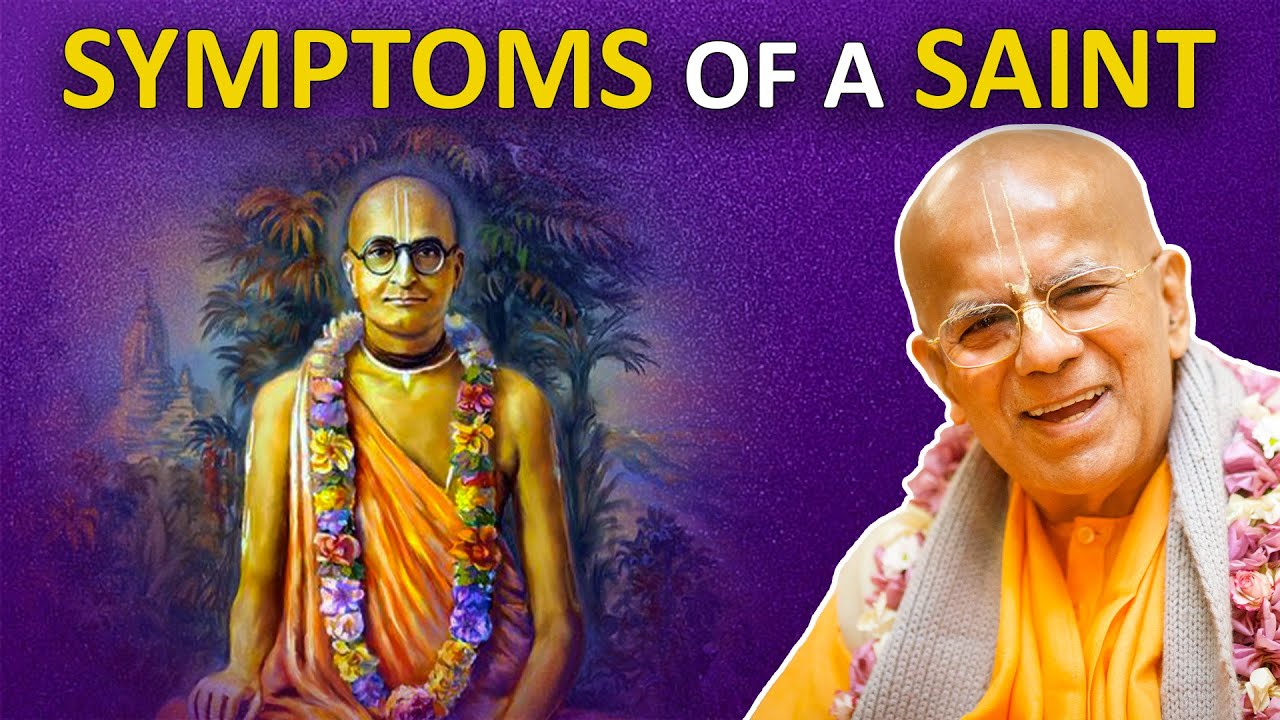
In this devotional lecture, Śrīla Gopāl Kṛṣṇa Goswāmī Mahārāja explains the characteristics of a saintly personality as described in a verse spoken by Lord Kapila to his mother Devahūti. He interprets each quality—tolerance (titikśava), mercy (karuṇikā), universal friendliness (surdas sarvadhainam), non‑enmity (ajātāśātrava), peacefulness (śānta), and scriptural living (sādhu)—and relates them to the challenges of material duality and the need for a spiritual mindset. The talk emphasizes that true mercy is the transmission of transcendental knowledge through book and prasadam distribution, not material philanthropy. Practical Krishna‑consciousness discipline is outlined: chanting 16 rounds, observing the four regulative principles, regular study of the Śrīmad‑Bhāgavatam, association with devotees, deity worship, and creating a home temple. The speaker critiques modern pseudo‑spiritual movements (e.g., Rajneesh) that promote sense‑enjoyment, and stresses that peace of mind arises from single‑pointed devotion. A brief Q&A session addresses penance, Bhagavad‑Gītā commentaries, guru obedience, accelerating saintly qualities, and the development of mercy. The lecture concludes with community guidance on cooperating with temple authorities, preserving pure Vaishnava teachings, and avoiding worship of demigods.
Questions this video answers
No. Only penance you need is as follows: chant 16 rounds, follow the four regulative principles, read the Bhāgavatam, follow the spiritual master. Even if you have a job, it does not matter.
There are thousands of commentators of the Bhāgavad‑gītā, but many have twisted its meaning to present their own views. Prabhupāda said that if you want to give your own viewpoint, you may, but you should not use the Gītā as a source. He called such distorted works ‘kakānayas’.
Those who do not carry out the orders of the guru will not be able to make spiritual advancement. You can bring the matter to the attention of your spiritual superiors at the pashālī.
The qualities will develop automatically, but you should also know what qualities you have to develop. Knowing the destination helps you gauge progress, just as a driver watches the mileage.
You may not yet have the mercy you think, but by following the guru’s instructions and doing book distribution, this quality will develop automatically.
Chapters
Bhūṣanāham tetekṣvākaru-nikāhaḥ surdha-sarvadhēnam jātāśatabhāṣantaḥ sadbhāsadabhūṣanāham tetekṣvākaru-nikāhaḥ surdha-sarvadhēnam So we have selected this verse for discussion today because this verse presents the characteristics that a saintly personality should develop. All of you who are here are here because you have some interest in spiritual life. So what are the characteristics of a saintly personality? I explain in this verse. So these qualities of a saintly personality should be developed by everyone regardless of whether one is in the brahmachari ashram or vihāsta ashram. These qualities were explained by Lord Kāpīla in conversation with his mother Devahūti. Lord Kapiladeva is the incarnation of the Supreme Personality of Godhead, Lord Śrī Kṛṣṇa. His mother Devahuti once asked him, she said, "My dear son, I am simply an old person. Please guide me. How will I become free from the cycle of birth and death?" The son said, "Mother, you can become free from the cycle of birth and death by taking to the process of devotional service." The mother said, Sān, how do I get the opportunity to understand what is devotional service? The sān said, Mother, by associating with saintly people. Then the mother said, how do I recognize who is a saintly person? And then Lord Kāpīla Deva has described in this verse the characteristics of a saintly person. So first quality that he mentions is titikśava, which means tolerant. So a devotee, or one who wants to become a devotee, He has to be very tolerant because in the material world there will always be duality. Today your body is honored, tomorrow it is dishonored. Today it is hot, tomorrow it is cold. Today you are victorious, tomorrow you are defeated. So in the material world there will always be duality because we are identifying with the body. When the body gets what it wants, we become happy, and when the body doesn't get what it wants, we become sad. But the devotee is advised to be tolerant in all situations. You have to operate on the spiritual platform, not the material platform. You have to understand that this body will always be facing some type of difficulty. From the moment the child is born to the moment he dies, this body is only experiencing difficulty. It is just the illusion that makes us believe, no, there's happiness. So when the child is born, the child is born crying. And then there is disease, there is old age. And as you get old, then the fear of death begins to haunt you. So in summary, there is always difficulties and there is duality in material existence. Therefore devotee must be titikśva, very tolerant. Then karu-nikāha. Karu-nikāha means to be merciful. So there are different concepts of mercy. Just like in India, once you become a rich man, they start to do a lot of philanthropic charitable work. And charitable work means they'll build a hospital, open schools, and do other type of social work. We're not saying this is bad, but this is certainly not the true manifestation of mercy. Real mercy means to give people the knowledge by which they can become free from the cycle of birth and death. Real mercy means to give people the knowledge by which they can free themselves from this material entanglement and develop love of God. That is why the Krishna Consciousness movement do not believe in decorating a dead body but believe in going to the root cause of our entanglement, that is forgetfulness of our relationship with God. What is the value of decorating a dead body? In most of the traditions around the world, the custom is that when you die, before the body is cremated or buried, they decorate it very opulently. Is that in Uzbekistan also? Like in India, among the Hindus, before they cremate the body, burn the body, they decorate the body. And in the Western countries also, before they bury the body, they do so much of makeup that many times even the relatives cannot recognize the body. What's the value of decorating a dead body? So similarly, if you— let's take for example, you've opened a medical hospital, you're giving someone free medicine and helping him recover his health. But if you have not taught him that he must give up sinful activities, then you have actually, um, got him more entangled than before. Because when he recovers from his sick health, he will engage again, engage, engage in sinful activity. And then for all the sinful activity he engages, he will have to face the reaction. Therefore, the true understanding of mercy is giving people transcendental knowledge. Therefore, our Krishna conscious devotees give people transcendental knowledge. And how do we give transcendental knowledge? Through the medium of book distribution. Through the medium of Hare Kṛṣṇa, through the medium of prasad distribution. So giving people this transcendent knowledge about God constitutes real mercy. When you have a boil with pus inside, you can't blow that boil. You have to press the boil to get the pus out. So similarly, if you want to free people from entanglement, then we have to give them this knowledge of pure love of God. And just like the sun is not Hindu, Muslim, Christian, similarly God is neither Indian, Hindu, Muslim, Christian, Jewish. Religion means the science by which you develop love of God, and the result of development of love of God is you reduce your so-called attachment for material activities. So this is real mercy, giving people knowledge of God by which they can give up the sinful activities and get attached or glued to the instructions of the Lord as it is sent through the disciplic succession. Another quality of a saintly personality is surdasarvadhainam. Surdas sarvadhayina means he's friendly to all living entities. So a devotee is friendly to everyone. In material society, we are busy dividing society into friends and enemies. We say, he's my friend, he's my enemy. This man is from my community, so he's my friend, he can stay here. He's not from my community, he can't stay here. He's my friend, he's my enemy. So this is not the mentality of a saintly prasadin. Lajmanaj, as you know, was the son of a very powerful king. What was the king's name? Hiranyakashipu. So Hiranyakashipu was an expert diplomat, very great diplomat. Like when his brother Hiranyaksha was killed, so Hiranyaksha's wife was naturally crying. Then Hiranyakashipu went over there and started telling his brother's wife, don't worry, there's no need to cry. After all, the body is temporary. That which is born has to die. So Hiranyakashipu wanted his son trained up in the art of diplomacy. But Praṣad said, my dear father, I'm not interested in diplomacy. To me, I have no enemy. To me, everyone's my friend. So surdasarvadhīnam, a devotee is friendly to everyone. This mentality, I like this person, I don't like him, this is material. A devotee is friendly even to the animals. He does not want to harm even the animals. Even the animals have a right to live. Therefore the devotee does not take pleasure even in stepping over an ant. He sees the entire creation of the Lord as the family of the Lord, and therefore he is friendly to everyone. So we in Kṛṣṇa consciousness do not discriminate between male, female, whether one is rich or poor, which country one may have been born in, which nationality he may be born in, whether he is educated or not educated. The only qualification needed is the desire to serve the Lord. So we should endeavor to be friendly to all living entities. In the material world, we have a concept of fa— of brother or sister. What is the brother? Who is born from the same mother and the same father. So from a spiritual angle, we are all brothers and sisters because we are all born from the same father. And the animals are the less intelligent children of God. So therefore, the devotee respects the entire creation of the Lord. Then ajātāśātrava. Ajātāśātrava means inimical to none. In other words, devotee is not unfriendly to anyone, friendly to everyone. Śānta. Śānta means peaceful. Now, very honestly, if I was to ask all of you a simple question, is your mind peaceful? Very few of you would say yes. Is your mind peaceful? Why is the mind not peaceful? Only because of one reason. In the mind there are variety of different desires, unlimited desires, and these desires are multiplying every minute. You know that Kṛṣṇa's qualities are increasing every minute. That is why no one can estimate Kṛṣṇa's qualities. We started the class about 20 minutes ago, but in 20 minutes Kṛṣṇa qualities have gone up so many times, and by the time you finish the class it would have gone up even more. Therefore it is said no one can estimate the greatness of Kṛṣṇa. But also our desires are increasing every minute and they're changing every minute. Today I want this, tomorrow I want that. That is why the mind is not peaceful. On the one hand I want to become spiritual, on the other hand I still have material desires that I can't abandon. I realize the goal of life is Kṛṣṇa-prema, but still my material attachments are there. And to break these material attachments is very truṭṇa. That is why you, you are not peaceful. But if on the other hand you become single-pointed, you say you only have one goal to achieve, Krishna-prema, love of God. And Rūpa Gosvāmī has said, accept everything favorable for spiritual advancement, reject everything unfavorable for spiritual advancement. So if you accept everything favorable and reject everything unfavorable, then your mind will become peaceful. In English there's a saying, you want to have your cake and eat it too. Like yesterday evening we saw the tots. Now on the one hand we say, "Tōr tocin krasibi, yā niya ye lag." We don't want to eat it. But on the other hand you say, "No, no, it's so tasty, I must eat it." So if you eat it, then the cake will not be left. And if you don't eat the cake, then it will be left, but you can't eat it. But you can't eat the cake and still see the beautiful cake in front of you. Is that prabhupāda? So similarly, if you want to develop love of God, you have to give up something. You cannot develop love of God, you cannot be absorbed in Kṛṣṇa-prema, and at the same time trying to fulfill your different material desires. Rūpa Gosvāmī has said, kāmadīnam kathinā-palīda-dhūrṇī-deṣa. I have been trying to satisfy my senses since times immemorial, but they're not getting satisfied. Why? That's the nature of sense desires. You can never satisfy them. Have you heard of this Rajneesh organization? "Vāśakoratoṭha, Rajneesh." Anyway, it's a very debauchee organization. Now of course Rajneesh is dead, but he committed a lot of crime before dying. He used to call himself God. He criticized all the Vedic scriptures. So his philosophy was, have as much sense enjoyment as you want, then you will get tired and then you can meditate. But the nature of sense enjoyment is it can never be satisfied. You don't have to drink poison to know that poison can kill you. Through the hearing process, you know if you drink poison, you'll be dead. So do you touch poison? La? Do you stand in front of the highway, in front of the speeding car, to see if the car is going to knock you down or no? Do you jump off the 10-story of a skyscraper building to see whether it will really break your bones or no? No. Because through the hearing process, you have learned that these things are bad. Dangerous. Similarly, through the hearing process, we know that sense enjoyment is bad for spiritual life. Then the question is how to give up sense enjoyment. You may say, Swamiji, what you're saying is very correct, I agree 100%, but how to give it up? Devyasya guna-may mama-maya-durata yah mama evāme prapadyante mayām etām taranti te. Krishna says the overcoming illusion energy consisting of the three modes is not easy to overcome, but Krishna also says If you surrender unto me, then you can overcome. So you can overcome the temptation to engage in sinful activities by absorbing yourself in devotional activity. If you absorb yourself in devotional activities, then you can free the mind from material contamination. So shanta means peaceful. So you will become peaceful when your mind is only thinking of Krishna, or Krishna's instructions, or his pastimes, or his desires, or his form, but something connected to Krishna. The nature of the mind is it cannot be idle even for one second. So therefore the mind should always be engaged in positive devotional activities. Then sadhva. Sadhva means living by the scriptures. So everything we see, we do has to be done according to scriptures. Nothing independent of the scriptures. If we act independent of the scriptures, then spiritual advancement will become difficult. Scripture means words of God. Nasta prayi sha vadrishu nityam bhagavat seva ya bhagavati tamashloke bhakti bhavati naishtaki. By regularly hearing the Bhāgavatam, all that is auspicious is there and loving devotional service unto the Lord is established. By regularly reading the Bhāgavatam, loving devotional service to the Lord is established and all that is inauspicious is destroyed. So we must study the Bhāgavatam. If you cannot come to the temple every day, then please study in your home. Read every morning. I see in this audience there are many of you who practice Kṛṣṇa consciousness at home. So there's no problem. Please practice Krishna consciousness at home. In order to succeed spiritually, Chaitanya Mahaprabhu has given the following guidelines: Chant Hare Krishna mantra, read the Śrīmad-Bhāgavatam, associate with devotees because devotee association inspires you to stay on the spiritual path, worship the Deity with faith, and reside in a sacred place. Of course, we're not saying everybody has to move to Vrindavan or Mathura to reside. If everybody moves to Vrindavan, then who will preach in Tashkent and all over the world? And the price of land in Vrindavan is already so high, it will get even higher. So stay where you are, but convert your house to be Vrindavan. It is not the physical Vrindavan that is only important, it is the mental Vrindavan that you have to create. Vrindavan is the consciousness where you remember Krishna, glorify Krishna. So make your house into a temple of the Lord. And if you're doing these things, then you will never be separated from the spiritual master and Krishna. In fact, Prabhupada said disciple should always act in such a way that he's never away from the spiritual master. That is, the disciple associates with the instructions of the spiritual master. So by following these guidelines, one can make spiritual advancement. So we must always live by the scriptures, and then we'll be able to develop love of God. These are very briefly the qualities of a saintly personality that we have explained. All of you are also saintly. Otherwise, why would you take interest in spiritual life? Please endeavor to develop these qualities and you'll always be happy.
Hare Krishna.
Hare Krishna. I only have 5 minutes for questions. I'll take questions from the audience instead of—
Is it necessary to undergo severe penances to advance in spiritual life?
No. Only penance you need is as follows. Chant 16 rounds, follow 4 regulative principles, read Bhāgavatam, follow spiritual master. And even if you're doing a job, doesn't matter.
Are there any more commentators of Bhāgavad-gītā?
There are thousands of commentators of Bhāgavad-gītā, not one or two. But these commentators have twisted the Bhāgavad-gītā to present their own meaning. They've taken the Bhāgavad-gītā and given their own viewpoint. Prabhupāda said, if you want to give your own viewpoint, give it, but don't use the Gītā as a source. Because Bhāgavad-gītā is a very famous book, so people say, okay, it's a Maya commentary, but they distort the real meaning. Therefore Prabhupāda called it kakānayas. So, Madam, go ahead.
And she was asking about some Vaiṣṇava commentaries.
Vaiṣṇava commentaries, yes, there are many, there are few. Please come here, I want to speak.
What should we do if you see that some devotees do not carry out the orders of their guru?
Those who do not carry out the orders of the guru will not be able to make spiritual advancement. They will not be able to develop love of God.
And what should I do when I see somebody who is doing like that?
Well, you can bring it to the attention of your spiritual superiors at the pashalini.
Can we speed up the process of developing of these saintly qualities, or we should just try to pursue it slowly? Krishna, and all these qualities will develop automatically.
Yes, they will develop automatically, but at the same time you should also know what qualities you have to develop. Just like when you're driving in a car to a certain distance, automatically you're headed for your destination, but you also want to know how many miles are left to reach the destination. So just stop at this point. Hare Śrī Vāprasa. Baladeva Vidyābuṣaṇ was a very great Ācārya, and he wrote a commentary on the Bhāgavad-gītā. So Prabhupāda, in his English presentation of the commentary, has taken very heavily from Baladeva Vidyābuṣaṇ's commentary and Viśvanātha Chakravartī ṭhākura's commentary. Genuine saint doesn't try to supersede the previous Ācārya. He takes the teachings of the previous Ācārya. So Prabhupāda took the teachings of the previous Ācāryas, their commentaries, and presented it in a simple manner and added wherever needed. So I just want to discuss few points with the devotees.
Baburaj, don't have mercifulness to people, but I don't have mercifulness for people to whom I preach on Sankirtan. Can you give me blessing to have mercy?
Yes, you may not have the mercy you think. It is a fact most of us don't have this quality of mercy, but by following the instructions of Guru and doing book distribution, this quality will automatically develop. So I'm going to be leaving now, so I just want to discuss few points.
When are you coming to our place next time?
Maybe January. So I want all you devotees to please work cooperatively. Many of you live outside, some of you live in the temple. I want to request all of you to please cooperate with Madhav Goswami and the temple authorities. If you have some valuable suggestions to make, You can make the suggestions in a nice Vaiṣṇava way. There is room for improvement and your suggestions will be welcome. One thing is clear, the path for Self-realization, for spiritual advancement should only be what Prabhupāda has taught us. There is no need to worship any demigods. Our Vaiṣṇava philosophy is very clear. You water the root of the tree and all the branches get watered.