SB 4.9.31 Lessons to learn from Dhruva & Prahlāda Mahārājā | Rus-Split | 5.7.92 |Gopāl Kṛṣṇa Goswāmī
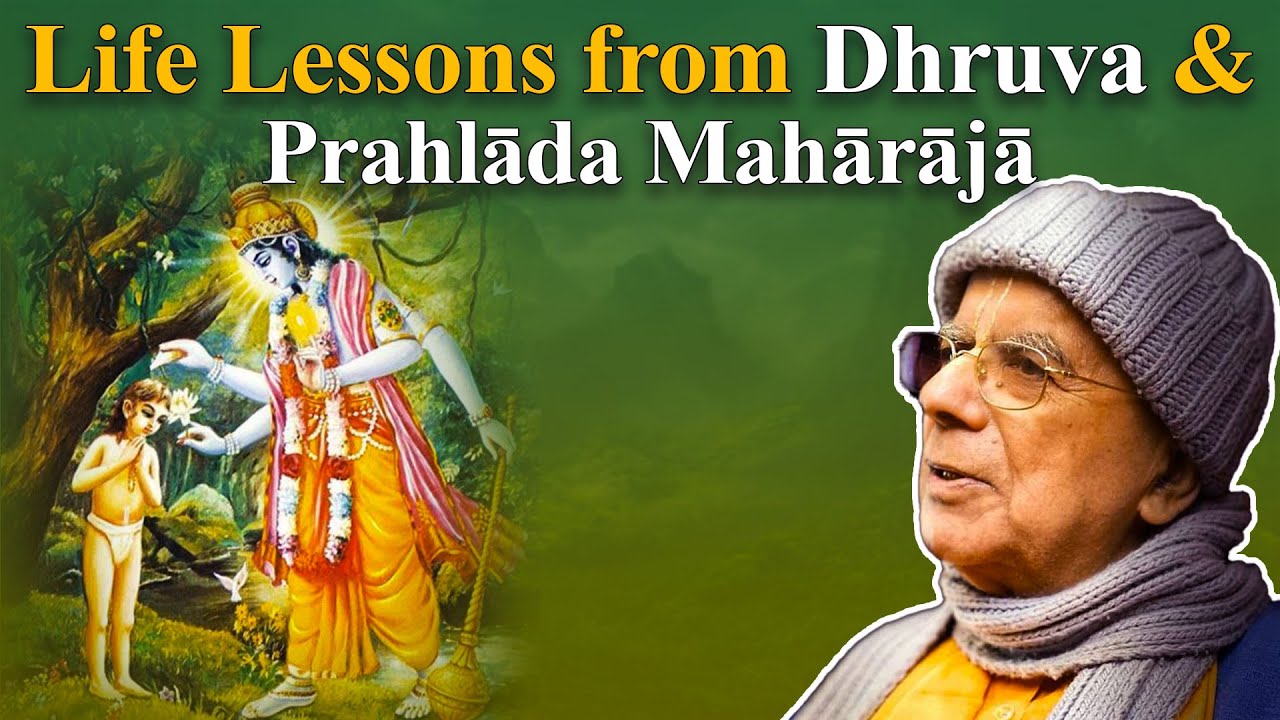
In this devotional lecture, the speaker recounts the story of Dhruva Maharaj from the Bhagavata Purana, emphasizing his early anger at his step‑mother, his quest for God, the testing by Narada Muni, and the extreme austerities he performed in the forest of Madhu‑van. The narrative highlights Dhruva’s realization that asking the Lord for material wealth is foolish, as expressed in a verse where he likens material desire to broken glass and divine service to a diamond. The talk connects this episode to broader scriptural teachings: the Bhagavad‑Gītā’s classification of pious seekers, the perishable nature of material existence, and the importance of seeking pure devotional service. The speaker also discusses the forgiving nature of Vaishnava devotees, using Dhruva’s grace toward his step‑mother and parallels with Yudhiṣṭhira, Prahlāda, and other exemplars. He warns against the ten Vaishnava offenses that can hinder the benefits of chanting the holy name, and presents Aruna Gosvāmī’s five qualities for spiritual advancement (enthusiasm, determination, patience, scriptural fidelity, and renunciation of non‑devotee association). Throughout, the lecture interweaves scriptural citations (Bhagavata Purana, Bhagavad‑Gītā, Caitanya‑caritāmṛta, Rūpa Gosvāmī) and practical advice for devotees, urging them to chant sincerely, avoid offenses, and pray for the opportunity to serve the Lord eternally.
Chapters
Om Namah Bhagavate Vasudevaya. Om Namah Bhagavate Vasudevaya. Om Namah Bhagavate Vasudevaya. Om Namah Bhagavate Vasudevaya. So today we are going to discuss a verse about Dhruva Maharaj. You have all heard of Dhruva Maharaj. Āntāvāt, āho bātā mama nātmāyām, manda bhāgyasya paśyata, bhāvācchidāpada mūlaṁ, gātvyāya seyad Āntāvāt. Aho bātā mama nātmāyām, manda bhagyāsa paśyata, bhāvācchira-pada-mūlaṁ, gatvāya-seyaṁ antavaḍ, aho bātā mama nātmāyām, Manda bhagyasya paschata, bhāvācīrāpada-mūlām, gatpāyasayaṁ tavāt, bhāvātāmāma nātmāyaṁ. Manda bhagyasya paschata, bhāvācīrāpada-mūlām, Gatvāya seyantāvāt. Obātama manatmayām. Manda bhagyasya paśyata. Bhāvā cidāpada-mūlām. Gatvāya seyantāvāt. Om Jai Jai Anand Ji, Jai Anand Ji, Nāśalākyā, Chakṣurmilita Nīnātās, Māyā Śrī Gurave Namah. Śrī Caitanya Mahāprabhu, sthapitām yena bhūtale, saimrūpakadāmayāṁ dadāti svāpādanti-kam. Bande ham Śrī Guru Śrīyuta pada-kam lan Śrī Gurunvaishnava-nāśa. Śrī Rūpaṁ sakraja-tam sahāgina rāguṇa-tāṁ tam-taṁ-sa-devaṁ. Sadhvetaṁ savaḍhūtam parijanāsāitam kṛṣṇa-cetanya-devaṁ śrī-rādhā-kṛṣṇa-padāṁ sahāgana-dalitā śrī-viśākā-nitāmśā. Jai Śrī Kṛṣṇa-cetanya-prabhu-nitananda Śrī Advaita-gadādha. This verse is being spoken by Dhruva Maharaj. Dhruva Maharaj in this verse is feeling very embarrassed that at one time he had desired a kingdom. That would be even more opulent than that of his father, grandfather, and great-grandfather. The background is as follows. Dhruva Maharaj, when he was a young boy, he was prevented from sitting on the lap of his father. Being a young boy, he was playing with his father, and he was trying to get on his father's lap, but his father was seated next to his stepmother, and his stepmother stopped Dhruva from sitting on the father's lap. She said that you haven't taken your birth from my womb, therefore you cannot sit on your father's lap. And this angered Dhruva Maharaj very much. So Dhruva Maharaj went crying to his mother, and he told his mother what had happened, and he asked his mother if there's anybody who could help him. And his mother said The only person who can really help you, what I've heard, is God. So Dhruva Maharaj asked her where God can be found. And the mother said, I've heard from great sages that God can be found in the forest. So then Dhruva Maharaj was about to go to the forest when he met the great sage Narada Muni. Great sage Narada Muni asked him what was the cause Of course, actually Narada Muni was sent by the Lord to test out Dhruva Maharaja's determination. And Narada Muni told Dhruva Maharaja that, "You are just a young boy and your mother was just playing with you, your stepmother. Don't take her words seriously. Forget about going to the forest to search for God. Go and play." Dhruva was determined and he said, "If you want to stop me from going to the forest to look for God," Then I don't want to have to do anything to deal with you. So Nārada Muni, when he saw that Dhruva was determined to find God, then he not only told him where to go, but he also told him how to find God. Nārada Muni told him, he gave him the mantra, Om Namo Bhagavate Vasudevaya. He told him to go to the forest known as Madhu Vān. And he also told him how to make a form of the Lord. Based on mud and water, and then to meditate on that form of the Lord. So Dhruva Maharaj actually went to the forest with an ambition. His ambition was— he had two goals. One was to take revenge for the insulting words that his stepmother had given. Second was to teach his stepmother a lesson by getting a kingdom that would be even better than what his father, grandfather, great-grandfather ever had. So Dhruva Maharaj, he went to the forest and he practiced extreme meditation with extreme austerity. Narada Muni actually was very pleased when he saw that Dhruva Maharaj was very determined to find God. So Dhruva Maharaj accepted the advice of his mother Suniti, which was later on confirmed by Narada Muni, and he went to the forest known as Maduvan. Actually, this forest Maduvan is not far from our Krishna Balaram Temple in Vrindavan. When our devotees come to Vrindavan, they all go to this temple Madhuvan also for, uh, to pay their respects in that temple. So Dhruva Maharaj went to the forest and started practicing extreme austerities. In the first month of the austerity, he ate once every 3 days fruits and berries. But these are not fruits and berries that you and I eat. These are fruits and berries that you find in the forest that the monkeys eat. And in the second month of the austerity, Dhirubhai Maharaj started eating once every 6 days, but he was eating only dry grass. Just imagine eating once every 6 days and only dry grass. And the third— if your devotees started eating with these days with production being so expensive, we had our devotees switch over to this diet, our food bill would go down like anything. And the third month, Dhirubhai Maharaj was eating— was only drinking water, and that too once every 9 days. And the fourth month, Dhruva Maharaj became a master of the breathing exercise, and he was breathing only once every 12 days. In other words, Dhruva Maharaj has become completely fixed in his meditation on the Supreme Lord. And in the fifth month, Dhruva Maharaj, by his meditation, had become so powerful that in the fifth month he was able to stand only on one leg, like a column stands straight, and his mind was fully fixed on the Supreme Personality of Godhead. Actually, Dhruva Maharaja had so become so powerful that even the demigods— by his austerities— that even the demigods were getting scared of him. So Dhruva Maharaja pleased the Supreme Lord by his austerities, and as a result, the Supreme Lord personally came and blessed Dhruva Maharaja. Sitting on the bank of Garuda On the back of Garuda, the Lord personally descended to give Dhruva Maharaj His darshan. This is the unique relationship between the Lord and the devotee. Devotee tries to serve the Lord and the Lord also tries to serve the devotee. When Kṛṣṇa is pleased by a devotion, He comes personally to see His devotee. He comes personally to serve His devotee. He even disguises Himself so that He may trick the devotee to take service from Him. So Dhruva Maharaj was fully absorbed in meditation, and when he opened his eyes, there he saw the Lord right in front of him. So when Dhruva Maharaj saw the Lord, he actually was surprised and he wanted to glorify the Lord. But because he was a young child of only 5 years old, he could not really come up with the proper words to glorify the Lord. But the Lord touched Dhruva Maharaj's forehead with his conch shell. And Dhruva Maharaj was inspired with wisdom by which he was able to glorify the Supreme Lord with choice words. But after he saw the personal form of the Lord, Dhruva Maharaj felt so ecstatic that he began to feel embarrassed that at one time he had expressed a material desire to the Lord. And that material desire was that I want a kingdom which would be even more opulent than that of my great-grandfather. So in this verse that we are reading today, I just gave you a little background to this verse. In the verse that we are reading today, Dhiravan Maharaj is making the point that asking the Lord for something perishable is actually an act of foolishness. In the Bhagavad Gita, Krishna says, 4 types of pious people come to me. Chaturvidha bhajantimam ye jana rajana rajana artho jagyatra artha ki jani cha arthar samrajna ṛgva. One is who wants money, the other who is in distress, the third who is inquisitive, and the fourth is a genuine seeker of knowledge. So Kṛṣṇa says, all these four are pious, but of these four, the most pious are those who have come to Me genuinely to seek knowledge or to render devotional service. So in the material world, everything is perishable. This is what Dhruva Maharaj is stating in this verse, how everything is eventually perishable. Therefore he says, "I was so foolish that I asked the Lord for a kingdom which also is perishable." So Dhruva Maharaj is lamenting that he had that desire. Actually, when the Lord offered Dhruva Maharaj all benedictions, any benediction that he may like, Dhruva Maharaj said, "My dear Lord, I was a fool. I was looking for broken, broken cut glass, but now I found the diamond. So if You want to give me any benediction, please give me the benediction that I may always remain in the association of devotees and serve You." So this is the benediction that the devotee desires, the opportunity to associate with devotees to execute devotional service, because devotee knows that everything is perishable. Now Drona Maharaja said, "I was looking for broken cut glass, but now I have found a diamond." So Krishna consciousness is a diamond and material life is like broken cut glass. Because what happens when you step on broken cut glass? You cut yourself. So it doesn't matter what type of material benediction you may get. This benediction will not take you back to Godhead. The only benediction that will take you is if you have the opportunity to execute devotional service. So from this we can learn that the only real asset that one should— the only thing that one should pray to the Lord for is the opportunity to engage in devotional service of the Lord birth after birth. Of course, in the case of Dhruva Maharaj, the Lord knew that even if he gets a kingdom, Dhruva Maharaj would not be affected by the opulence of the kingdom. Therefore, Dhruva Maharaj eventually was given a very opulent kingdom and Dhruva Maharaj ran, he ruled as the king for 36,000 years. And Dhruva Maharaj, Krishna did give him this kingdom. Why? Because Krishna knew that Dhruva Maharaj would not be affected by the opulence. So in this verse, the Druva Maharaja is saying that taking shelter of the lotus feet of the Lord can immediately cut off the chain of the cycle of birth and death. So the cycle of birth and death is a very painful experience. Therefore Krishna says in the Bhagavad-gītā, the two characteristics of material existence, one is the kāleyaṁ, the other is the śarṣataṁ. One is that everything is temporary and the other is that there is nothing but misery. So in the material world everything is difficult. Prabhupāda said in a lecture that in the material world everything is difficult, in the spiritual world everything is easy. Material world is called, uh, Kuntaloka and the spiritual world is called Vaikunta. This is called Kunta because in the material world there's nothing but misery and anxiety. And the spiritual world is Vaikunta which means happily, no anxiety, no misery. So unless one takes shelter of the lotus feet of the Supreme Personality of Godhead, one cannot become free from the cycle of birth and death. One may elevate himself even to the higher planets, one may even go till Brahmaloka, but if one doesn't take shelter of the lotus feet of the Lord, you cannot become free from the cycle of birth and death. So in the purport, Prabhupāda quotes the verse from Rūpa Gosvāmī, anyābhilāsa dasu yunyam gānakan vādhya naurata manu-kalena Kṛṣṇa-salālēm bhaktur uttamaḥ. This is a very important verse of the Śrī Bhakti-rasāmṛta-sindhu, in which Rūpa Gosvāmī is saying that one should become, one should take to the process of devotional service without desiring anything at all. In the Caitanya-caritāmṛta, there's another statement, Krishna bhakti naskāma atayeva śānta, bhakti mukti siddhi-kāmi sakāli-ashānta. That the devotees of Lord Śrī Kṛṣṇa, they're always peaceful. Why? Because they are naskāma. That means they serve the Lord without expecting anything in return. And in comparison, the other so-called transcendentalists, because they have so many material desires, They are not peaceful. So when we take to the process of devotional service, one should not maintain, one should not ask the Lord for material desires. Therefore, Caitanya Mahāprabhu has taught us that we should just pray to the Lord for the opportunity to serve birth after birth. Therefore, Caitanya Mahāprabhu said, "O Sannām Mahārāja Nanda, I am your eternal servitor." And somehow or the other I have fallen into the ocean of birth and death. Please therefore pick me up from this ocean of birth and death and fix me as one of the atoms of Your lotus feet. So this is our prayer. Because it is only the process of pure devotional service that can ultimately give one satisfaction. So when Dhruva Maharaj went back, his father of course, as I said, was feeling very sorry that due to his being under the influence of Surīcī, he prevented Dhruva from sitting on his lap. So, but when Dhruva went back, his father was very, very happy. And a significant thing is that even though Suriṣī, the stepmother of Dhruva, had prevented Dhruva from sitting on the father's lap, when Dhruva went back, he even offered her respects. Suriṣī is the stepmother who had actually prevented Dhruva from sitting on the father's lap. But after having performed a charity and obtained the mercy of the Lord, Dhruva did not have any anger left towards her at all. In fact, Dhruva, when he offered his obeisances to his stepmother, she blessed him and said, "You may live very long." Just like water, water automatically flows down by nature. So similarly, one who becomes a devotee of the Lord, he automatically gets the respect of everybody in society. A devotee of the Lord does not ask for any respect, but wherever he goes, he automatically gets respect. Therefore, Chinakya Pandit, Chinakya Pandit presented a question. He said, who is more famous, a rich man or a devotee of the Lord? And he said that a rich man just known in his local village local town, but a devotee of the Lord is known in every corner of the world. Just like you don't know who the rich men in India are, you don't even know who the rich men in Japan are right next to you, but a devotee of the Lord everybody knows everywhere. Just like you can travel to any corner of the world, everywhere people know Prabhupāda now. But if you go to a small village and ask them, "Do you know who the richest man in India is?" Hardly anybody would know it. But if you ask them, do you know who Bhaktivedanta Swami Prabhupada, the founder of the Hare Krishna movement, is, the chances are you'll meet a lot of people who'll say they know. Another thing you see is the forgiving character of a devotee. Even though Suriṣī had prevented Dhruva Maharāja from sitting on his father's lap, Dhruva had absolutely no anger towards her. We also see in the Bhāgavatam that Yudhiṣṭhira, He had absolutely no anger against Dhṛtarāṣṭra after the Battle of Kurukṣetra was over. When the Pāṇḍavas were young, and even when they became older, Dhṛtarāṣṭra and his son Duryodhana tried their best to annihilate them so the kingdom would go to Duryodhana. Rākhe Kṛṣṇa mare ke, mare Kṛṣṇa rākhe ke. Who Kṛṣṇa wants to protect, no one can annihilate, and who Kṛṣṇa wants to protect, no one can "Who Kṛṣṇa wants to protect, no one can annihilate, and who Kṛṣṇa wants to annihilate, no one can protect." So Kṛṣṇa's mercy was on the Pandavas. Even though Duryodhana and Dhritarāṣṭra tried their best to get rid of them, they were always protected. In the Battle of Kurukṣetra, Dhritarāṣṭra had lost all his sons, grandsons, everyone. Dhritarāṣṭra was left all alone after the Battle of Kurukṣetra. So, when— what did Yudhishthira do? Yudhishthira told his uncle, "Uncle, you have no place to stay. Please take this big palace and stay in this big palace very comfortably." And Yudhishthira made an arrangement by which Dhritarashtra and his wife Gandhari could live in complete comfort. In fact, Yudhishthira was so respectful to Dhritarashtra, he gave him such nice facilities that Dītarāṣṭra began to think that at last I have become a king. This is the forgiving nature of a Vaiṣṇava. Even if somebody insults you, even if somebody puts you into difficulty, the devotee does not retaliate. Now the devotee, he is very forgiving. He will tolerate even if another Vaiṣṇava insults him. But the Lord does not tolerate such an offense. That is the real thing. Just like Dhruva Maharaj, he forgave Surīcī, but because Surīcī had committed an offense at the feet of a very exalted Vaiṣṇava, Dhruva Maharaj, she later on had to pay the price for it. Dhruva Maharaj completely forgave Surīcī, but because what she had rendered offense was a gītā, she had done it innocently, because at that time Surīcī did not know that Dhruva is such an exalted devotee, but nevertheless she insulted him. So therefore in the end she had to die in a very terrible way. Her son died in the forest, and then she became mad and she died. Therefore Caitanya Mahāprabhu has explained that when one is chanting the Hare Kṛṣṇa mantra, one should be very careful in avoiding Vaiṣṇava aprāda. If you offend devotees, offend the holy name, then that is very, very serious. Therefore, this has been compared to a mad elephant offense. Once when Haridas Thakur was describing the glories of the Holy Name, there was, uh, there was an individual called Gopal Chakravarti who doubted the value, the credibility of the Holy Name. So Gopal Chakravarti insulted Haridas Thakur. He said, these people are just sentimentalists. They say that the Holy Name is so powerful and offenseless, chanting and take you back to Godhead. Everybody was very angry at Gopal Chakravarti, but Haridas Thakura was peaceful. And in the end, Gopal Chakravarti was attacked with leprosy. So offenses, the, the, the Vaishnava offensive attitude towards the Holy Name, these are very disturbing for the— these are, these become great impediments on the path of spiritual advancement. So in the execution of devotional service, We should make sure that we avoid the 10 offenses. In the Caitanya-caritāmṛta it is said, bhau janma-kāre yadi śrāvana-kīrtanā tabūtana pāya kṛṣṇa-pradheprema-dhana. One may go on chanting the names of Kṛṣṇa birth after birth, but if one commits offenses, then he will not get the full benefit of the holy name. He will not be able to develop love of God. Even though you may chant the holy name birth after birth, therefore We have to chant the— there are different stages of chanting the holy names of Krishna. The initial stage is when you chant and commit offenses at the same time. Then when you come in contact with devotees, you start living in the temple, you get initiated, you become aware of the philosophy, then you become aware of the 10 offenses. Then one should endeavor to minimize these offenses. And then is the last stage, that the stage of purified chanting. That's the stage when you chant and don't commit any offenses at all. So we should be aware of these offenses. Not that we just recite these offenses every morning and we just memorize them, but actually we have to apply it into practice, all these offenses. And then we'll be able to take full advantage of the chanting of the holy names of Krishna. So Dhruva Maharaja was fixed in austerities, and even for the 36,000 years that Dhruva Maharaja ruled over the planet, he went and performing austerities. Actually, this incident took place in Satya Yuga, because in Satya Yuga people used to live for 100,000 years. Our, our modern-day scientists like, would like us to believe that the lifespan is going up day by day, but actually that is wrong. And even if you were to calculate from a material angle, the way they present the statistics is also wrong. For example, they calculate the lifespan just based on how long a person lives. They don't calculate the number of babies that they kill in the mother's womb. So if they were to calculate how long a person lives, uh, taking into account the number of babies they're killing in the womb, then you will see the lifespan has really gone down very much. From the character displayed by Dhruva, we can also see how determined he was. So without determination, it is difficult to succeed on the spiritual path. Ārūpa Gosvāmī has given us the following guidelines for making spiritual advancement. Sahaṇ-nisṭaya-dhārya-tattva-kammapravartanaṭ-saṅgatyāge sato vraite. He says one should be enthusiastic. Enthusiasm is a must for spiritual advancement. Yesterday we were talking about enthusiasm in terms of book distribution. But doesn't matter what service you have, whether you're cooking for the deities or whether you're cooking or running a café or whatever. One should be enthusiastic about his devotional service. Then nishtayat. Nishtayat means determination. And we cited the example of Dhruva Maharaj was determined to find the Lord. So even though Narada Muni was testing him and trying to discourage him, Dhruva Maharaj, because he was determined, he went to the forest, practiced austerities, which eventually captured the mercy of the Lord. So Prabhupāda gives the example in the Bhāgavad-gītā of the bird that had her eggs stolen by the ocean. She asked the ocean to return the eggs. The ocean did not return the eggs. She threatened the ocean that if you don't return my children, I'll dry you up with my small mouth. The ocean laughed and said, try it, see how long you will take. But she was determined, so she started drying up the ocean with a small mouth. News gradually spread to Garuda, and when Garuda heard what this small bird had to undergo, he personally came. Garuda came and threatened the ocean, and then the ocean got scared and returned the children to the bird. So Prabhupada cites this example to show that just like the small bird, she was determined to do something which was from a material angle an impossible goal to achieve. To go and dry up the huge ocean by small birth is an impossible task. So similarly, even if something is difficult, if we approach it with determination, with the purpose of pleasing Krishna and Guru, Krishna who's in the heart will give you the intelligence to do it. In the Bhagavad Gītā, Krishna says, those who worship me with devotion, I preserve what they have and I make up what they lack. So there's so many things we lack, but Kṛṣṇa says He makes it up. When Kṛṣṇa sees, here is somebody who wants to serve Me, he's determined to serve Me, but these are his shortcomings, Kṛṣṇa gives the intelligence by which one can execute that activity. So we should be determined to execute the service that we are assigned. We should be determined to chant our rounds attentively. We should be determined to hear the Bhāgavatam attentively. We should be determined to execute all aspects of devotional service attentively. Then daryat. Daryat means patience. We must have patience. Not that you come to devotional service and right away you say, "Now where is Kṛṣṇa? Where is Kṛṣṇa? Why is Kṛṣṇa not talking to me? Why can't I personally see Him all the time?" So patience is necessary. Tat tat karma pravartanāt. We don't concoct the process of self-realization. But we follow the process as enunciated by the great ācāryas. Dharmāṁ tiṣākṣat bhāgavat-praniṭham. Religion means the words of God. So we accept the teachings of the Lord as they're coming down through the disciplic succession. So our process is follow the parampara and not concoct. Sanga tyāgi. Give up the association of non-devotees. Of course you can't give up the association of non-devotees completely. Even when you go on book distribution, you have to associate with non-devotees. And some of you may be working or, you know, studying. You have to associate with non-devotees. So the answer is that we associate with non-devotees only to the extent necessary and not more than that. And we associate with non-devotees not to be influenced by them, but to influence them. That means that when you see non-devotees engage in different aspects of the illusory energy You don't get captured by them, but rather devotee is always thinking, "How can I influence them?" And sata vrajate, he lives by the scriptures. If we take advantage of these guidelines, then we can execute devotional service. So in the case of Dhruva Maharaja, we see that Dhruva Maharaja was determined, and eventually he was able to capture the Lord. Being a Vaishnava, Dhruva Maharaja was forgiving, and he even forgot the offense that his stepmother had committed. But the Lord doesn't forgive somebody who offends a Vaiṣṇava. Take for example Prahlāda Mahārāja and Hiranya Kāśipū. Prahlāda tolerated all the insults and offenses of Hiranya Kāśipū. We all know everything that Hiranya Kāśipū tried to stop Prahlāda from worshiping Kṛṣṇa. But did Kṛṣṇa tolerate it? No. When Kṛṣṇa saw that now Hiranya Kāśipū has become so demonic, that now he wants to kill his beloved devotee. Kṛṣṇa appeared from the column, from the pillar, in a half-man, half-lion form to protect his devotee Prahlāda and to kill the demon who was ready to kill Prahlāda. And even after having killed Hiranyakāśipu, Lord Nrsimhadeva was still so angry. He was so angry that even Lord Brahmā and Lord Śiva, Lord Brahmā could not go near him. Even Goddess Lakshmi, who always sits at the feet of the Lord, could not go near Him because He was in so much anger. Why was He so angry? Because Hiranyakashipu was trying to kill His beloved devotee. So even after he was killed, the Lord's anger continued. And it is only Prasad who had the courage to go and garland the Lord, and then His anger at once went away. So in the execution of devotional service, One should have— one should be cautious to avoid offenses, especially by Śrīla Prasāda RAVAL. And a devotee on the devotional path, he doesn't want to ask the Lord for anything perishable because he knows all material achievements are perishable. He knows that even if I become a king, I can only stay in this position for some time. Therefore, the devotee prays to the Lord for devotional service, and he feels embarrassed when he asks the Lord for material things. That's our prayer to the Lord, that we may always be engaged in devotional service. And we pray by chanting the holy names of Krishna. When you chant the holy names, you're praying, you're appealing to the Lord, "My dear Lord, please may I be engaged in devotional service." And the more sincerely we chant, the greater will be the reciprocation from the Lord. Hare Krishna. Hare Krishna. Please ask Krishna, what is the difference between being enthusiastic Being determined means that— what's the difference between enthusiastic and determination? Well, enthusiastic means you try hard. Enthusiastic means you're happy to try to do that service. And determined means even if there are some obstacles, you still want to push ahead. So you should be both enthusiastic and determined. Without enthusiasm and determination, you can't succeed on the spiritual path. You see how enthusiastic the materialists are for sense enjoyment? They have been defeated so many times by the illusory energy, but they're still thinking, "Oh, now this next move is going to give me happiness." So we have to be enthusiastic about serving Kṛṣṇa. But from Dhruva Mahārāja, you can learn how determined he was. You can learn how to be determined. Hare Krishna! Hare Krishna! Krishna Krishna! Hare Hare! Hare Rama Hare Ramana Maharshi! Lama Lama! Hare Hare! Hare Krishna! Hare Krishna!
More from PRASAD

Rare Pastimes & Timeless Lessons of Guru Mahārāja | Stories Every Disciple Should Hear

ISKCON Legends- pure devotees meet-HH Jayapataka Swami, HH Gopal Krishna Goswami, HH Radhanath Swami



Jagannātha Ratha-yātrā Through Śrīla Prabhupāda's Mercy | 29 April 2006 | Nairobi, Kenya

Lord Jagannātha's Appearance Pastime | 21.07.2019 | ISKCON Calgary | Śrīla Gopāla Kṛṣṇa Gosvāmī

The Ācārya Teaches by His Own ExampleGuṇḍicā Mārjana by Guru Mahārāja #shorts

Guṇḍicā Mārjana – Lord Jagannātha's Pastime | 21.7.2019 | ISKCON Calgary |Śrīla Gopāla Kṛṣṇa Gosvāmī

H.H. Gopāla Kṛṣṇa Gosvāmī Mahārāja - Exemplary Sādhana and Deity Worship # shorts

भगवान की कृपा कैसे प्राप्त होगी ? | 11 Jan 2014 | Punjabi Bagh | Srila Gopal Krishna Goswami

Material Education vs Spiritual Education | Srila Gopal Krishna Goswami #shorts