SB 5.5.5- Price to pay for developing love of God | Rus-Split | 14.01.91 | Śrīla Gopāl Kṛṣṇa Goswāmī
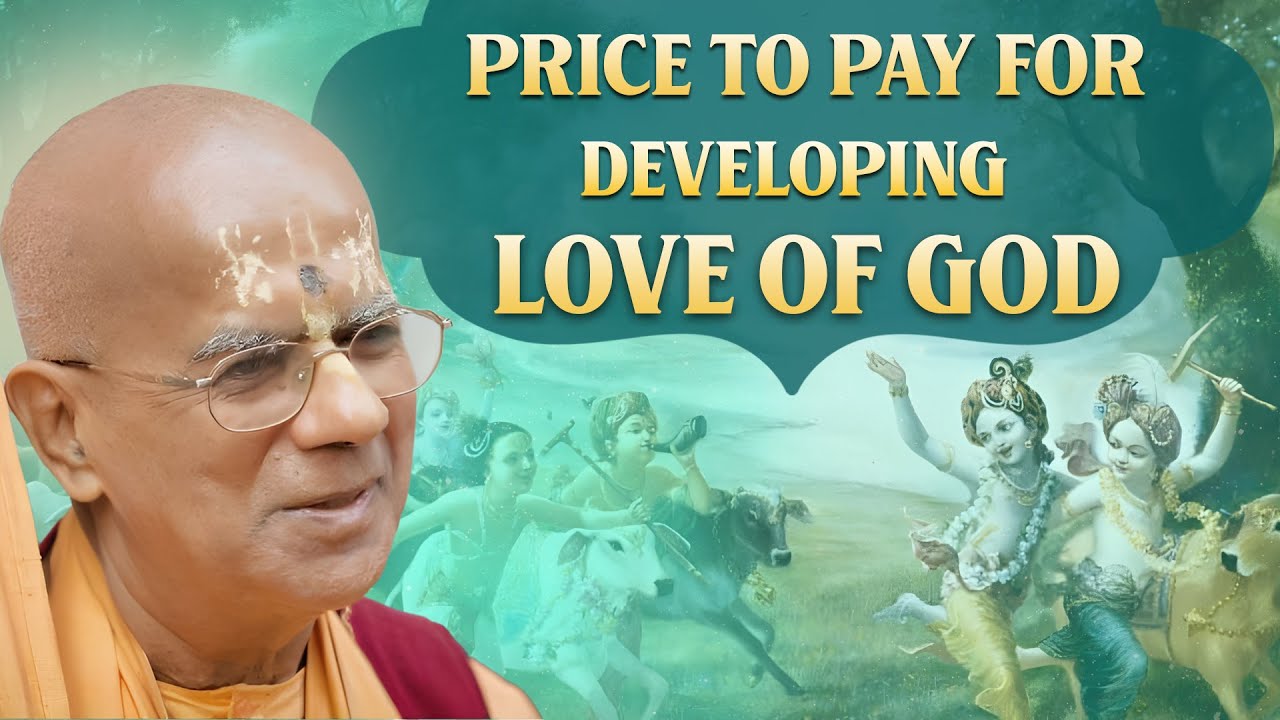
In this Bhāgavatam class Prasad Raval provides a running commentary on Śrīmad‑Bhāgavatam Fifth Canto, Chapter 5, Text 5, focusing on the verse spoken by Lord Viṣṇudeva to his sons. He explains the spiritual responsibilities of fathers and spiritual masters, the distinction between karma, vikarma and akarma, and the sevenfold miseries that arise from ignorance. The lecture emphasizes the need to abandon sense gratification, purify the mind, and adopt devotional practices such as chanting, reading the Bhāgavatam, and service (book distribution, harināma) as “medicine” for the mind. Raval discusses how suffering relates to past karma and divine mercy, the nature of the soul and consciousness, and answers numerous audience questions about spiritual concepts, the qualities of a strong devotee, proper etiquette, and the role of association with materialists. Throughout, he uses vivid analogies (steering wheel, uncontrolled elephant, lotus) to illustrate mind control and encourages earnest, disciplined devotion as the price for developing love of God.
Questions this video answers
Actions without material motivation.
Forbidden actions.
According to Vedic scriptures, fruitive activity performed for material results.
The soul is the cause of consciousness; when the soul leaves the body, consciousness ceases.
Yes, but it is purified consciousness.
Chapters
Śrīmad-Bhāgavatam, Fifth Canto, Chapter 5, Text 5. The Sanskrit verse is written on the board, so it will be easy for you to follow. Parā-bhāvās, parā-bhāvās, sāvās, sāvās, odaḥ, odaḥ, jāto, jāto, yāvāyaṇaḥ, yāvāyaṇaḥ. Karma! Karma!
Karma!
Prabhavastravadabhodhajāto yāvāṇa-jijyāsata ātmataḥ twaṁ yāvād kriyastāva vidāmmano vaid-karmātmakam yena śrīya-bandhā. So this verse is being spoken by Lord Viṣṇudeva to his hundred sons. Lord Viṣṇudeva, as you probably know, was a king of the whole planet. But he was also the incarnation of Godhead. So when God appears, He appears in order to establish the principles of religion. Parītanāya sālunām vidyāśritya duṣkataṁ dharmā-saṁstha-panārthaya sambhavāmi yogiyoge. Kṛṣṇa appears to establish dharma. So when the Lord appears, He sets an ideal example so that others can follow Him. Just like when the Lord appeared as Prasāda Mahārāja, He acted like an ideal king, and his instructions to his citizens are very important for the entire humanity. So similarly, in the form of Lord Rāṣadeva, the Lord has presented very valuable instructions for the entire humanity. Lord Rāṣadeva has explained to his sons that one should not become a father unless he can deliver the children back to Godhead., and one should not become a spiritual master till one can deliver his disciple back to Godhead. In other words, Mahārāja Rūpa Gosvāmī has pointed out the responsibilities of a father, the responsibilities of the spiritual master. Mahārāja Rūpa Gosvāmī has clearly said, one should not become a father, one should not become a mother, one should not become a husband, or one should not become a worshipful demigod till he can take his dependence back to Godhead. So Mahārāja Rishideva's instructions are to be meditated upon by every devotee. This was one of Prabhupāda's favorite topics of discussion, Mahārāja Rishideva's teachings. And, uh, Mahārāja Rishideva's teachings, uh, alone can guide us on the path of perfection. Therefore, these teachings are known as the philosophy of Bhāgavad-dharma. In the verses prior to this, Mahārāja Deva has explained that sense gratification must be given up at all costs. Nayham dehā dehā vājamne loke kastam kāma-mṛtavitā-bhūjām ye tapo divyam putakal yena satvam śrīdaye dasmad-bhama-so'kyam anantam. Mahārāja Deva has explained that one must utilize the human life for tapasya and not use the human life like cats and dogs for eating, sleeping, defending, mating. And Maharāja Viśṣṇudeva has also explained in the previous verse that one who considers sense gratification the aim of life is very foolish because such a person does not realize that as long as he engages in sinful activities, he will have to go on taking bodies which will offer him nothing but pain. So Maharāja Viśṣṇudeva explains that those who are interested in Kṛṣṇa consciousness They do not want to do anything which is not related with Kṛṣṇa. So whether you are a housewife, whether you are a brahmācārni, whether you are a brahmācārī, whether you are a husband, whether you are a sannyāsī or a brahmana, does not matter. Our philosophy is nothing should be done which is independent of Kṛṣṇa. Just like 2 days ago, on Saturday, I was explaining to all of you That Caitanya Mahāprabhu said what? He said two rules we must never forget. One rule is always remember Kṛṣṇa. The other rule is never forget Kṛṣṇa. So those who are interested on the spiritual path, Mādhava Rāja Deva says, one should not associate with worldly-minded people who are only interested in eating, sleeping, defending, mating more than necessary. Now the devotees of this Kṛṣṇa conscious movement also do have to associate with worldly-minded people. Just like when you go out on book distribution, you go out on book distribution and you approach the karmis to take these books. It's not that you approach the devotees to take the books. So you may want to wonder, how is it that on the one hand Rūpa Gosvāmī Mahārāja is saying not to associate with materialists, And then on the other hand, the leaders are encouraging you to go out and associate with the materialist to distribute books. So the answer is that we associate with the materialist only to the extent that it is necessary to give them Kṛṣṇa consciousness. And we, beyond that, we don't associate with the materialist at all. For example, when we go out on harināma, or book distribution, we will talk to the materialist only something related to getting them to take a book. We're not going to sit down with them and discuss the whole philosophy of material life or what the politicians are saying or what the Communist Party leaders are saying. And let's suppose somebody is a student. Like, I know that many of you also go to schools and colleges. So somebody is a student, then you may go to the school or college, but whatever you're studying, you should be meditating. That this is for the glorification of Kṛṣṇa, and therefore you should minimize association with worldly-minded people and just concentrate on what is essential. And if somebody is working in an office or whatever, then again, the, the understanding should be that I'm here only to use this facility to serve the Lord, and one should not get attached but just serve as necessary. In other words, as the Bhāgavad-gītā says, One should operate, one should be like a lotus flower that is in water, but it is not touched by the water. Now in the verse that we are discussing today, Maharāja Rūpa Gosvām is especially giving us the following message. He is saying that one who doesn't inquire about the goal of life, he is going to be defeated by ignorance. In other words, one who doesn't inquire about the goal of life, Bhārata-rāja-dev says he is going to experience unlimited miseries. The miseries that we encounter are of 7 different forms. One is birth, which as we know is very painful because you always see the child coming out of the mother's womb crying. Then there is disease, and doesn't matter how much advancement modern science may make, nobody can escape disease. If you go to many countries in Europe and America, You have to wait for 2 to 1 month to get a doctor's appointment because everybody is diseased, everybody is turning to the doctors. And then there is old age. Doesn't matter what you do, you cannot avoid old age, which is very painful. And ultimately, of course, there is death. Then there are natural disasters like earthquakes, floods, etc. For example, it is sometimes it gets very cold, sometimes it is very hot. Like now it is snowing outside. This is another aspect of misery. Then of course your mind is troubling you. The mind is always troubling you in so many different ways. The mind is troubling you by presenting unlimited desires for sense enjoyment. The mind is troubling you by presenting desires to obtain what somebody else has and you don't have. The mind is troubling you by— when you hear that some relative or friend of yours dies or falls sick, then the mind troubles you. Oh, my close relative is about to leave his body, or he's in pain. And then of course there are other living entities troubling you. Even animals like insects and bugs and flies can trouble you. And of course there are other human beings who are also troubling you. So Maharāja Rāṣyabhāva is saying that these 7-fold miseries that you realize are only due to ignorance. In other words, if you are in knowledge, Then the same form of miseries are also there. But at least when you have spiritual knowledge, you are preparing to give up this body. And once you give up this body after having executed devotional service, then there is no question of taking material birth again. So as long as one engages, be rest assured that you are going to experience nothing but miseries. Everything has a price, and the price that you have to pay for developing love of God is giving up sense gratification. Sense gratification is a function of ignorance, and spiritual life 5 is the function of spiritual knowledge. So Maharaj Ji was saying that if you execute karma, then you are going to get the reaction. Now I want to explain to you what karma here means, because any action also means karma. But any action that you perform falls under one of the three categories which are known in Sanskrit as karma, vikarma, aukarma. Who knows what is the meaning of akarma? Anybody knows?
Yes. Actions without material motivation.
What is the meaning of vikarma?
Forbidden actions.
And what's the meaning of karma?
According to Vedic scriptures.
So karma, vikarma, akarma. Akarma means activities which are strictly according to direction of guru and Kṛṣṇa and for which you don't take reaction. Just like, for example, A devotee is going out on book distribution every day. Now when he is walking on the street, some entities may be killed because there are so many entities everywhere. Even in the water that you drink, there are unlimited entities. And sometimes when you are buying, somebody is buying a book, he is giving you some money. By mistake you may give him 1 or 2 less rubles. The point is that because you are engaged in that activity according to superior direction, then that activity does not get you bonded in any way. Now, vikarma is activity which is completely against the orders of the Lord. And by engaging in vikarmic activities, one goes to hell. Now, karma means activity which is according to the scriptures, but where the goal is also sense enjoyment. Another name for this category is fruitive activity. So fruitive activity is a sort of business transaction, is a business activity. You tell the Lord, "I am doing this, this, this, but in exchange I may get the following result." Just like people go to the church and say, "God, give us our daily bread." The Hindus go to the temple and pray to the Lord, "God, please give me money. Please let my children pass in good exams. Please may I never fall sick. Please may there be no misery at all. Please, please, please." So the point is that this is fruitive activity. Of course, fruitive activity is better than being a gross materialist who doesn't acknowledge the position of God. But please understand that we are teaching through this Kṛṣṇa consciousness movement not just religion. We are teaching the highest religion, which is selfless service to God. So there's a big difference between pure religion and motivated religion. Even in the material world, even those who are religious, Frankly follow the path of motivated religion where everything is with a certain motive. But Kṛṣṇa consciousness is presenting something which is beyond all this. That is pure religion. Just like in the verse that we were discussing yesterday in the Bhāgavatam class, we saw how Vyāsadeva, even though he had compiled the Vedic literature, the Mahābhāgavata, The Upanishads, the Vedānta, still he was feeling dissatisfied. He was not feeling satisfied. What was the reason? He has not exclusively glorified the Supreme Lord or talked about bhakti only. In the Vedas he talks about bhakti, but he always also talks about karma-kanda. But in Śrīmad-Bhāgavatam, only bhakti, no karma-kanda. Therefore we are trying to educate all of you to the highest standard of perfection. Now, Mārādhārī Śrīdhvānanda in this verse, is making one other very, very important point. And that point is, as long as the mind is impure, consciousness will be impure. In other words, Maharishi Avadhuta Deva is showing a direct correlation, a direct link between mind and consciousness. So wherever your mind is, that is the type of consciousness you're going to have. If the mind is impure, the consciousness is going to be impure. If the mind is pure, then the consciousness is going to be pure. So Maharishi is pointing out that we must make our mind pure and not keep it impure. Just like when there is— when the sun is shining, when there are no clouds, you can see everything clearly. But when there are clouds, and just like now it's cloudy, so outside you can't see everything clearly. So due to the impurity of the mind, our consciousness also remains impure. When is the mind considered to be impure? Who will answer?
When it has material desires.
Yes, when the mind has material desires, then the mind is considered to be diseased. And when you are diseased, even if somebody cooks very nice samosas, pakodas, halwa and all in front of you, but if you are diseased, your tongue cannot enjoy it. So similarly, when the mind is full of material desires, then you cannot enjoy the, you cannot enjoy the beauty of the Holy Name. You cannot appreciate the spiritual message that you are hearing. You cannot appreciate the beauty of Kṛṣṇa. Kṛṣṇa is the mūhya, most beautiful object, but with an impure mind you cannot appreciate. It is just like a man who is intoxicated. When a man is intoxicated, He cannot see anything, he cannot understand anything. But when the effect of intoxication goes away, then he can see things, then he can speak properly. So similarly, as long as our mind is impure, the living entity cannot have a clear consciousness. Consciousness means desires. Consciousness is what is keeping us alive. The materialists want to know what is the proof of the soul and the presence of the soul in the body. The proof is consciousness. But right now the consciousness is polluted. Just like these days, I'm sure in your country also, everybody is talking about the pollution of the air. But nobody is talking about the pollution of the consciousness. The pollution of the consciousness is a far more serious problem than the pollution of the air. Because as long as the consciousness is polluted, you cannot really be happy. So the Vedic scriptures are recommending again and again, Purify the mind. The very scriptural thing. Purify the mind. You can make the mind your friend. Right now the mind is your enemy. It's not your friend. Mana eva manushanam kārnaṁ bandhaya mokṣaya bandhaya viṣveṣaṁ go moktaṇḍar viśveṣaṁ manaḥ. This mind is the cause of your bondage and the cause of your liberation. The mind which is used in service to the Lord, It is the cause of your liberation. And the mind, when it is used against the direction of the Lord, is the cause of your bondage. In the morning when it's time to get up for mangalārtī, the mind says, "No, no, no, you worked very hard, just go to sleep." Actually, it does not matter whether you're living in the temple or whether you're living at home. The principle of mangalārtī should not be compromised. If you're living at home with your karmī relatives, Then you can have mangalātī very, very softly. But the principle of doing the samsāra prayers in the morning should not be forgotten. Spiritual life means getting up early in the morning. If you can't get up early in the morning, then it is not possible to chant good quality rounds. Even the materialists agree that the mind is most fresh early in the morning. Sleep is an extension, is a manifestation of ignorance. And everybody loves to sleep. You have trouble getting up in the morning, you have trouble being awake when you are doing japa, you have trouble being awake when the Bhagavad-gītā class is going on. The only time when you don't have trouble keeping awake is when you are eating prasāda. So because everybody likes to satisfy the tongue. So mind has to be trained just like a small child. A small child may be notorious, but the small child is disciplined by the parents. So the mind has to be disciplined. But to discipline the mind is difficult. So what do we do? Do we just accept defeat or do we try? Fortunately, we have the medicine that can control the mind. It will help you in controlling the mind once you recognize that the mind is the biggest cheater. It will help you to control the mind once you recognize that you are fool number one. It will help you to control the mind once you recognize The mind has been cheating you since many, many births, not just this birth. And how does the mind cheat you? By convincing you Maya is more beautiful than Kṛṣṇa. That's all. Just one basic theme the mind is always trying to present. Always be with Maya and please don't go to Kṛṣṇa. So the mind will take you, will present so many ideas why you should not go to Kṛṣṇa. The mind will give you so many points why you should not surrender to guru. Because the mind is very strong. The mind is very obstinate. Obstinate means even if you tell something, the mind does not listen. The mind is very turbulent. The mind is very fickle. Arjuna says, "Tantala imanah kṛṣṇa." It is more difficult to control the wind than to control the mind. Like I was told that today morning it was very windy. So Arjuna is saying, it's easier to control the wind than to control the mind. So we have to endeavor to control the mind. We have this battle with the mind.
Don't get defeated.
You may want to know why is the mind important. Just like when you are driving a car. When you are driving a car, isn't the steering very important? If you turn right, if you turn the steering to the right, then the wheels will go to the right. If you turn the steering to the left, the wheels will go to the left. So the mind is compared to the steering wheel. So whichever direction you want to take the mind, that is the way it will go. That freedom is given to everyone. If we misuse our independence, then we take the mind on the destructive path. And if you use your mind, then you take it on the constructive path. No doubt that mind is strong, but it is weaker than Kṛṣṇa. So we must, somehow or the other, learn to discipline the mind. The mind is contaminated by the three modes: goodness, passion, ignorance. In the Vedas, the example is given that the mind is like an uncontrolled elephant. I think in your country you only see elephants in the zoos, but in India you can see elephants even on the road. In fact, in India, if you are going on the road and you see an elephant, it is considered very auspicious. And when we have our Rath Yatras in India, right ahead of the procession is the elephant in which we always have some children sitting on it. But when the elephant goes uncontrolled, then Okay, then you had it. We have the Padyatra in India, so they had an elephant, and about 2 years ago the elephant went out of control, and the elephant went and I think killed a man and knocked so many villages down. When an elephant is running wild, everybody gets scared and runs away. So the mind is compared to an uncontrolled elephant in the Bhāgavatam. And the mind is full of lust and anger. Lusty desires are there, and when the lusty desire cannot be realized you become angry. The mind is conducted by goodness, passion, ignorance— these are the three bosses of the mind. Therefore we recommend the process of devotional service. The process of devotional service is the medicine that can control the mind just like if you chant your rounds Hare Kṛṣṇa! Hare Kṛṣṇa!
Kṛṣṇa! Kṛṣṇa!
Hare Krishna! Hare Rādhā!
Namaḥ Hare Kṛṣṇa!
If you chant your rounds attentively every morning and you read the Bhāgavatam every morning, even if you stay at home, does not matter, then you will find the mind will be controlled all day. Just like when you eat prasāda, you feel totally satisfied. And then if you have eaten prasāda and your stomach is full, and then somebody gives you more prasāda, what do you say? Thank you, I don't want anymore. So similarly, when you have chanted your rounds nicely in the morning, and you have read the Bhāgavatam in the morning, even if you read for half an hour, then in the daytime when you go out to do your service and temptation from Maya will appear in front of you, the mind will reject it. Just like these days they have computers, and the computer is trained to accept something and reject something. So the computer is trained to reject something, Then even if you put that data in, the computer will reject it. So you have to similarly train your mind. And what is that training? Very simple program. You don't have to go to a computer school to learn how to program the mind. The simple program is, when the mind is talking of sense enjoyment, reject it. And when the mind is thinking of Kṛṣṇa, accept it. And then the consciousness will also become pure. What is the symptom of purified consciousness? Now you have the telephone. Previously we didn't have the telephone here. No disturbance. Telephone is a blessing and a curse. I can see when the class is going on, the bell is ringing, so everybody gets distracted. So when the mind is pure, the consciousness will also become pure. So what is the symptom of purified consciousness? I only want to do what Guru and Kṛṣṇa tell me. Because they know what is good for me. Vyāsadeva knows what is good for us. So he has already told us what is good for us. So we just have to have faith. And accept it. And by faith, if you have the proper faith, then you will get purified. And then what happens? You go back to the kingdom of God where you accept a spiritual body. And in the spiritual body there is no misery at all. In the 18th chapter of the Gītā, Kṛṣṇa has explained that there are 3 types of happiness. One is happiness in the mode of goodness. And what is the characteristic of this? In the beginning it is bitter and in the end it is sweet. When you have to follow the rules and regulations, in the beginning your mind will complain, but then it will become sweet. And happiness in the mode of passion is which in the beginning is bitter— is sweet and in the end bitter. So when you engage in sense enjoyment, you're getting some happiness now, but later on there's going to be suffering. And happiness in the mode of ignorance is which from beginning to end is influenced by laziness and ignorance. So majority of the people today are trying to pursue happiness through the influence of ignorance and passion, whereas Kṛṣṇa consciousness means forcing happiness to the platform of śūda-sattva, purified consciousness. Kṛṣṇa says, bahū-nāma-jñāṇa-mānti, jñāṇa-vamāṁ prapadyante vāsudeva-sarvām iti samātmā-suddhurlabhāḥ. He who surrenders to Me, he gets this knowledge after many, many births and deaths. So all of you are very fortunate in that after many millions of births and deaths, now you have come to realize that Kṛṣṇa is the cause of all causes and the Supreme Lord. So you should take to this Kṛṣṇa consciousness seriously, control the mind, and purify your consciousness. This is a guaranteed process. So without any hesitation you can accept it. And then there will be happiness and no misery at all. Hare Kṛṣṇa.
Hare Kṛṣṇa.
Hare Kṛṣṇa. Hare Kṛṣṇa. So, any questions from the learned sages? Well, all of you are also sages because you are pursuing the spiritual path.
Yes.
What is the difference between the soul and consciousness? What is the real position of consciousness? Is it connected with our material life?
Okay, okay, okay. Prasad RAVAL. Okay, let's keep it. So because the soul is there, there is consciousness. The soul is the cause of consciousness. When the soul leaves the body, no consciousness. So consciousness is, uh, consciousness is the result of the presence of the soul. And the soul is in the heart.
Sir, and is there any consciousness in the spiritual body in the waking state?
Yes, of course, there is consciousness, but that is purified consciousness. More questions?
If she asks Kṛṣṇa for— Huh? If she asks Kṛṣṇa for spiritual advancement, his child, what is— If he asks what? Spiritual advancement for his child.
If you ask Kṛṣṇa for spiritual advancement for your child or for yourself, then that is correct prayer. That is not fruitive work. Caitanya Mahāprabhu himself asked for the same thing. He said, na dhanam na janam na sundaram kavitām vā jagadīś-kamaye mama janmani janmīśvare bhaktād bhaktirāitukītyāye. "My dear Lord, I don't want wealth, I don't want materialistic followers, I don't want beautiful women." I only want the opportunity to serve You again and again, again and again. Tākur Bhakti Vinod said, "My dear Lord, I pray that only that in my next birth I may even take my birth as a worm, but in the house of a Vaiṣṇava." So a devotee should pray, "My dear Lord, since times immemorial I've been rebelling against You. Now I'm Yours." Please take me and use me as you see fit. You may make me dance, you may make me do anything, but now I'm yours. Now I'm yours, you may use me as you see fit, as you see proper. But you must really mean it. Don't tell Kṛṣṇa that and in your heart say, "No, no, no, no, I want māyā at the same time." Because when Kṛṣṇa sees you really want māyā and you're just speaking to Him nicely like this from the top, then He also reciprocates. Because He can cheat anyone, but He can't cheat The Paramātmā. Just like when you go out on book distribution. When you go out on book distribution and if you are always thinking, "Oh, here I am to distribute the mercy of the Lord, and here I, please my Lord, may I become the instrument by which I can distribute this philosophy." Then Kṛṣṇa, who is in the heart, will reciprocate with you. This is known as samādhi. Samādhi doesn't mean you just close your eyes and go to sleep. Samadhi means that you are always praying to Guru and Kṛṣṇa in the heart. Please help me. Make me an instrument by which I can save the conditioned souls from going to hell. And when your mind is thinking about positive things, then automatically it will not think of something negative. Very simple formula. Just like this glass. If this glass is full of water, then you cannot add any milk inside this glass.
Because we, we, we— can have some material desires in our mind. When we say Krishna, it may be even unknowingly we—
In karma yoga.
Yeah, we are doing with intention to get something. Does it mean that we are engaged in karma yoga most?
No, it is bhakti yoga because you are doing it with love and you are doing it under the direction of guru and Kṛṣṇa. Even if it is karma yoga, by doing that activity you will get purified. Just like A new bhakta comes out and he comes and joins the temple and he is told, you go out and do book distribution. You go out and take part in Hare Naam. He does not even understand the value of book distribution, but he still does the activity. So just by executing that activity, he gets purified. Yes.
How previous sinful activities, previous karma acts influence, how previous karma influence on devotee? And if devotee gets some, you know, suffering, how can distinguish? Is it due to previous karma or due to Kṛṣṇa's arrangement?
Good question. Kāraṣya vairājaṁ. So the question is, how does your past karma influence your activities today? So past karma does play a major role in our life. But Kṛṣṇa says, sarva-dharma-paritajya mām ekaṁ śrī-nama-jām-tvam sarva-pāpebhyo mokṣami māso caḥ. —"That if you surrender to Me, then I will free you from the reactions of the past karma." So your past karma may be very bad, but if you surrender to Kṛṣṇa, Kṛṣṇa promises, by executing devotional service, you can destroy the effect of past karma. Just like when you light fire, then garbage is burned to ashes. And all of you who are chanting Hare Kṛṣṇa have done something pious in your previous life. You have done devotional service. Otherwise you would not have come to this level today. Unless all of you have not done devotional service in the past life, you cannot be attracted to Kṛṣṇa in this life.
If you are suffering somehow, does it mean it is sent by Kṛṣṇa? It's our, due to our previous karma?
The suffering is also due to past karma and the karma of this life. But you must realize that by becoming a devotee of Kṛṣṇa, Your suffering quota is greatly minimized. Just like, for example, according to your past life, you may have— you should lose your whole hand. So instead of losing your hand, now you may only lose, cut your finger. So the suffering is there, and that is also the causeless mercy of Kṛṣṇa. Because if the suffering is not there, then you will think, "Oh, material life is so enjoyable. Let me stay here. Why should I go back to Godhead?" So when you have to go through suffering, you should be grateful to Kṛṣṇa. Who knows that famous prayer of Queen Kunti? You don't have to know the Sanskrit, just tell me the rooski translation.
Yes, better I get sufferings than to lose associations.
Well, Queen Kunti said, "My dear Lord, please You may increase my suffering, because the more suffering You give me, The more I meditate at the lotus feet, and the more I meditate at the lotus feet, the faster will I get freedom from birth and death. Of course, don't create suffering, but only if it comes naturally, then you must accept it. It's not that if you're cooking in the kitchen for Kṛṣṇa, you purposely put your finger in the fire and burn it. Or if you're going on some kīrtan, you purposely get caught by the militia to show how brave you are. Only when the suffering comes naturally, then you accept it. Yes.
Why sometimes devotee, you know, lose desire to— why sometimes devotee loses desire to, you know, perform some practical service?
You lose desire to do service only due to one reason, that is maya. And maya becomes strong when you don't take the medicine. Just like, you know, sometimes you have a disease. Just like I know a devotee in India, He has— if he doesn't take medicine, then he becomes crazy. So he has to take the medicine to have his mind always in proper focus. So similarly, if you don't chant your rounds nicely and read, then you become crazy. And when you become crazy, then you go on strike against Kṛṣṇa. Then you say, "No, I will not serve Kṛṣṇa. I will only serve my sweet māyā." Yes. I'm just going to take questions for 5 more minutes. I'll stop in about 10 minutes the most.
Yes. It is written in scriptures that when one meditates on the Supreme Personality of Godhead, he enters their spiritual planets. And when one meditates on the impersonal aspect of Godhead, he enters the shining of impersonal Brahman. And what happens when one meditates on the Paramātmā?
It's a very good question. So when you meditate on Paramātmā, you also go to the upper planets where again you have the opportunity of approaching the Supreme Lord. Yes.
Is it possible to move from Vaikuntha planets to Goloka Vrindāvana?
Yes, why not? It is possible to go on moving up and up. It is nice to hear that all your devotees are desiring to go to Vaikuntha, Goloka Vrindāvana. How many devotees want to go back to Goloka Vṛndāvana? How many devotees want to take their next birth as a devotee, but even if he has to go to hell, doesn't matter? I see that more devotees want to go to Goloka Vṛndāvana than go to hell as a devotee. But a devotee of the Lord, even if he has to go to hell, he doesn't worry at all. Because wherever he goes, he is with Kṛṣṇa. And when you are with Kṛṣṇa, you are in Goloka Vṛndāvana. Just like this temple. This temple is not in Moscow. This temple is in the spiritual world. When you go out on sankirtan, you are standing next to a metro station and distributing books, and you are thinking about Kṛṣṇa, then you are not at that metro station, but you are in Vaikuntha.
He is saying that it is said that Kṛṣṇa appears at the end of Dvapara Yuga. But in Śrīmad-Bhāgavatam it is said that This millennium, Dwapara Yuga and Treta Yuga changed their places. Changed their places? Yeah, the sequence changed. Dwapara Yuga and Treta Yuga. And he is asking if it's some contradiction. Where is the contradiction?
I can discuss it later with you. When you are driving me, I can discuss it. Okay, any more questions?
What means to be serious in Kṛṣṇa consciousness?
What means to be serious in Kṛṣṇa consciousness? Good question. Serious in Kṛṣṇa consciousness means that even when you, even when somebody is trying to tempt you to into māyā, you reject it. Just like when your body is in pain, normally you may have 100 desires, but when your body is in pain, you only have one desire: get rid of the pain. And while the body is in pain, all those 100 desires go in cold storage. So similarly, Seriousness in Kṛṣṇa consciousness means one-track mind. Rūpa Gosvāmī said, "Accept everything favorable for spiritual life and reject everything unfavorable." Any more questions? First of all, before I hear your question, I want to congratulate you for having shaved your beard off at my request. So that shows that you have genuine sincerity. Okay, now your question.
He is asking, why, if it is said that Even once becoming in contact with Krishna consciousness somehow, person, you know, get attraction to Krishna and so on. He wants to hear Holy Name like this Tajpur. But why then devotee can leave Krishna consciousness after he is connected with Krishna for a long time.
So the question is, after coming to Kṛṣṇa consciousness, how do you give up Kṛṣṇa consciousness? Today you are dancing in ecstasy in the kīrtana and tomorrow, ha, you don't want to go near the devotees. I have seen that sometimes when devotees fall into māyā and you telephone them, the moment they find out it's a Hare Kṛṣṇa devotee, they bang the phone or they say, "Oh, he is not at home," or, "He has fallen sick," or something. So you give up Kṛṣṇa consciousness only when you stop taking the medicine. Just like I gave that example earlier, if you don't take the medicine, then you will become insane. So when you don't chant, then slowly you'll become diseased again. Right now we are in a diseased condition and we are trying to recover from the diseased condition by taking the devotional service. But if you don't take the medicine, you will become diseased again. I think I told you this story. Once Caitanya Mahāprabhu went to Hridaya-sthakura. Hari-dāsa was not feeling good. He was sick. So Caitanya Mahāprabhu told him, "Hari-dāsa, you have been chanting Hare Kṛṣṇa all your life," because he was chanting 300,000 times a day. "So now you can stop chanting. And if you walk out in the snow with warm clothes and boots and your head covered, then you won't fall sick. So if you are always chanting śrī-rādhā-nām-kṛṭṇa-nām, then māyā cannot touch you." Kṛṣṇa-sūrya-samā-māyā-hayandhikā yaḥ api śrāntaye nī-māyā-dhikāḍa. Where there is Kṛṣṇa, there is no room for māyā, just like when there is sunshine, there is no room for darkness.
Okay? And what punishment, you know, the person will get, the devotee who is rejecting Kṛṣṇa consciousness?
He is giving up. Well, it all depends how he is rejecting. It's not that there is one fixed punishment for everyone. It depends how sinful he becomes. Any All right, so I'll stop over here now. Ah, should I stop now? Do you have any more questions, or I will stop now?
What is the qualities of, you know, strong devotees?
So what are the qualities of a strong devotee? A similar question was asked in the Śrīmad-Bhāgavatam by Devādhūti to her son Kapiladeva. Devādhūti was the mother of Kapiladeva. She told her son, I'm an old lady, I do not know how to end this miserable condition of life. So the son said, "Mother, you must take to the process of bhakti." But the mama said, "How can you cultivate bhakti?" So the son said, "In the association of devotees." But then the mother said, "How do you define a devotee?" So that is very similar to the question you have asked, isn't it? So a good devotee must have these qualities: teksyava karunikaḥ surda sarva-dhīnam. Ajātāś-cātra-vā-santā-sādhvā-sādhvabhūśanāḥ. A devotee must be fixed in serving the Lord. Tetekśvā means he must be very humble. Tetekśvā means he must be very tolerant. Karu-nikāha means he should be very humble, merciful. Sūda-sarvadhāhīnā means he must be friend of everyone. Sometimes, you know, even amongst devotees you have, "He is my drooga, he are my friends, and they are my enemies." So when he's giving a class, I'm not going to go and listen to the class. When my friend is giving a class, then I will go to attend the class. When my guru is speaking, then I will go to the class. But if other Vaiṣṇava is speaking, no, no, no, I will not go to the class. So that is not Vaiṣṇava culture. Then ajātāśātravaśānta. He must be peaceful. He must be fixed in the scriptures. So the point is a fixed-up devotee is one who only wants to do what Kṛṣṇa, Prabhupāda, and the guru have said. And one who wants to speculate, not associate with devotees, not come to the temple, not do anything practical to execute devotional service like book distribution or preaching, then he's not a fixed-up devotee. Like, even if you're a grihastha living outside, even if you're a devotee living at home, going to school or doing a job, still you must try and do some practical service also to expand this Krishna consciousness movement. Just like when you are sick, the doctor tells you two things. One, take the medicine. Two, take the diet. So medicine is chanting and reading. Diet is seva, service. So both are important because sometimes devotees think, oh, I'll only chant my rounds, stay at home, and not do any service. That is also not a healthy attitude. Any other questions? Yeah, sure. How long should I go on, sannyās? When should I stop? You tell me. I can go on all day. Well, your devotees are sitting down and wait. Right. Yeah, okay.
Yes. Sometimes senior devotee may commit some mistake and my junior devotee talk about, maybe in some soft way, yeah.
If you see that senior devotee has done some mistake, you may very humbly with folded hands say, "Prabhuji, I know you're very senior, but I see with my limited senses the small mistake that you may be making. So in all humility, with straw in my mouth, I'm offering this suggestion to you." But don't take that opportunity to put him down or criticize him. When you put the straw in your mouth You have to become very humble because the straw is on the floor and everybody is walking on the straw. So many times I heard that Prabhupāda, when he would lecture in India, after the lecture he would tell the people, "With straw in my mouth, I am begging you, please chant Hare Kṛṣṇa." Therefore, when you address each other, you should call each other Prabhu. We should not call people by first names, you know. Even if some of the new bhaktas, you can call them Prabhu. Prabhu means master. So it doesn't matter whether he's initiated or not. You can address everyone as Prabhu. Yes, our music teacher.
It is said that women are less intelligent, and for example, Mahabharata was written for women, children, like this. But why, you know, highest form of devotion was manifested?
First of all, I must clarify that women are less intelligent on the material platform, but if they surrender to Kṛṣṇa, then Kṛṣṇa says They are both equal. Secondly, the gopīs were not from this material world. The gopīs were special devotees who had done tapasya for thousands of years to get Kṛṣṇa as their husband.
Hare Kṛṣṇa, Hare Kṛṣṇa, Kṛṣṇa, Kṛṣṇa, Hare, Hare, Hare. Allez, allez, allez!
More from PRASAD

Rare Pastimes & Timeless Lessons of Guru Mahārāja | Stories Every Disciple Should Hear

ISKCON Legends- pure devotees meet-HH Jayapataka Swami, HH Gopal Krishna Goswami, HH Radhanath Swami



Jagannātha Ratha-yātrā Through Śrīla Prabhupāda's Mercy | 29 April 2006 | Nairobi, Kenya

Lord Jagannātha's Appearance Pastime | 21.07.2019 | ISKCON Calgary | Śrīla Gopāla Kṛṣṇa Gosvāmī

The Ācārya Teaches by His Own ExampleGuṇḍicā Mārjana by Guru Mahārāja #shorts

Guṇḍicā Mārjana – Lord Jagannātha's Pastime | 21.7.2019 | ISKCON Calgary |Śrīla Gopāla Kṛṣṇa Gosvāmī

H.H. Gopāla Kṛṣṇa Gosvāmī Mahārāja - Exemplary Sādhana and Deity Worship # shorts

भगवान की कृपा कैसे प्राप्त होगी ? | 11 Jan 2014 | Punjabi Bagh | Srila Gopal Krishna Goswami

Material Education vs Spiritual Education | Srila Gopal Krishna Goswami #shorts