Secrets of transcendental loving services | SB 3.9.30 | 25 Jan 1994 | Montreal | Gopāl Kṛṣṇa Goswāmī
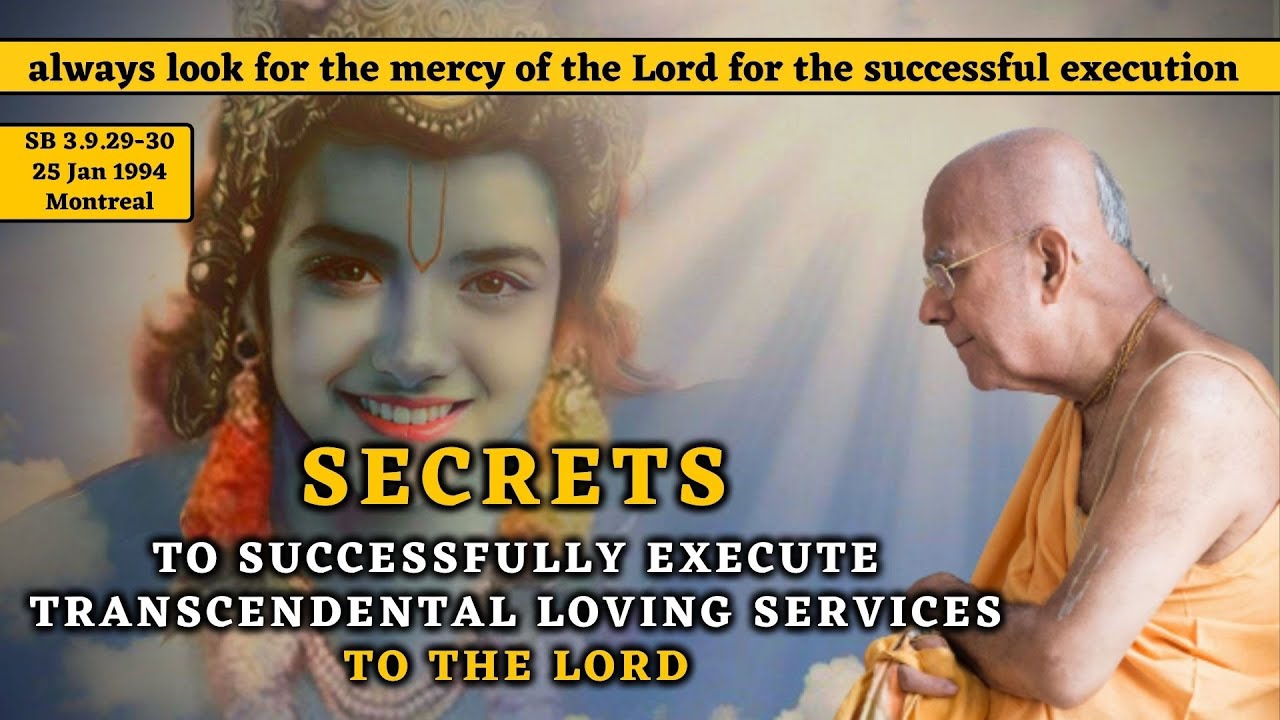
In this devotional lecture, the speaker expounds on Śrīmad‑Bhāgavatam 3.9.30, where Lord Brahmā, anxious about the monumental task of creating the universe, offers prayers of glorification to the Supreme Lord. The Lord reassures Brahmā, declaring that the requested authority has already been granted. The talk uses this scriptural episode to illustrate several core principles of Krishna‑conscious service: the importance of humility when entrusted with responsibility; the necessity of divine grace and the blessings of the spiritual master, guru, and scriptures; the limits of material or academic knowledge compared with transcendental understanding attained through bhakti; and the practical means of cultivating humility—chiefly through chanting Hare Krishna and preaching. The speaker weaves numerous scriptural citations, anecdotes about Arjuna, Srila Prabhupāda, Caitanya Mahāprabhu, Sanātana Gosvāmī, and modern scientific endeavors to contrast materialist pride with devotional gratitude, emphasizing that all abilities stem from Kṛṣṇa. The lecture concludes that recognizing Kṛṣṇa as the ultimate controller and offering service with love ensures success in spiritual assignments.
Chapters
Om namo bhagavate vasudevaya! Om namo bhagavate vasudevaya! Om namo bhagavate vasudevaya! Om namo bhagavate vasudevaya! Oh my God— oh no... No way? The Supreme Personality of Godhead then said, "O Brahma, O depth of Vedic wisdom, be neither depressed nor anxious about the execution of creation. What you are begging from Me has already been granted before." Translated by His Divine Grace A.C. Bhaktivedanta Swami Prabhupada. Any person authorized by either the Lord or His bonded representative is already blessed, as is the work entrusted to him. Of course, the person entrusted with such a responsibility should always be aware of his incapability and must always look for the mercy of the Lord for the successful execution of his duty. One should not be puffed up because he is entrusted with certain executive work. Fortunate is he who is so entrusted, and if he is always fixed in the sense of being subordinate to the will of the Supreme, he is sure to come out successful in the discharge of his work. Arjuna was entrusted with the work of fighting on the battlefield of Kurukshetra, and because he was so entrusted, the Lord had already arranged for his victory. When Arjuna was always conscious of his position as subordinate to the Lord, and thus he accepted Him as the supreme guide in his responsibility. Anyone who takes pride in doing responsible work but does not give credit to the Supreme Lord is certainly falsely proud and cannot execute anything nicely. Dhamma and persons in the line of disciplic succession who follow in His footsteps are always successful in the discharge of loving transcendental service to the Supreme Lord. Very powerful purpose. Hare Kṛṣṇa. Māvidā-garbhagastandrim sarga-udyamam vāhaḥ panmayā paritam yajreḥ jñānmām partha-yate bhāvan. So this chapter is called Brahma's prayers for creative energy. And the Lord in this 29th verse is replying to the glorification of the Lord that has been offered in the previous 28 verses of this chapter. We see in the entire Bhāgavatam, composed of 18,000 verses divided into 12 cantos, That this same trend is visible again and again, how the different devotees of the Lord, they are always glorifying the Supreme Lord. Just like we see in this chapter how the devotee, how Lord Brahmā is using choicest language to glorify the Supreme Personality of Godhead. And we see this throughout the Bhāgavatam. We see Lord Śiva doing this in the fourth canto. We worship, we read Lord Indra doing that. We read about Lord Brahmā doing this again and again. So all this goes to confirm that Kṛṣṇa is the Supreme Personality of Godhead. And it is all this intelligence who don't really try to, try to understand the scriptures who falsely conclude that the demigods are equal to the Supreme Lord or independent from the Supreme Lord. Now Lord Brahma, Lord Brahma had performed great meditation, and as a result he was searching for the source of his existence. He started looking in all the four directions, and because he was searching in all the four directions, he got this forehead. Therefore he's known as the four-headed Brahma. And the foolish first As it has been explained that the Lord could see that Brahmā was very anxious about the planning and construction of the different planetary systems. After all, to construct the whole universe comprising the different planetary systems is certainly not an easy task. Even when He— if you're involved, even if you talk to some devotees who have some construction experience, Who has some construction experience, you're constructing a temple. How many architectural meetings you have to have? So many engineers, architects, you know, construction engineers, this engineer, that engineer, and how many times you have to meet and revise and make sure. And this is just constructing a small building. Just a small building requires months and months of planning and then monitoring and revision. But here Brahma, he was going, he was given the task of arranging all the different planetary systems in outer space to accommodate the different kinds of living entities, human beings, lower than human beings, higher than human beings. So all these different planets are situated in space, in the universe, which accommodates the different grades of living entities. So Brahmā was very concerned How is he going to go to— how is he going to do this? And he was specially depressed upon seeing the devastating water. So the Lord has heard the wonderful glorification that Brahmaji has offered, and he's also observed the concern that Brahma has at the task that has been assigned to him. So the Lord is saying, and so the Lord now starting in this verse is beginning to reply to the concern that Lord Brahmā has had. So the Lord in replying is saying, the Lord is telling Lord Brahmā, he doesn't need to be depressed or anxious about the execution of creation. What you're begging from me has already been granted. The Lord Brahmā is considered one of the 12 mahā-jñānas. He is self-born. Toṁ bhūḥ naraḍa-saṁbhūḥ kramaḥ kāpīlo-mānūḥ pralādhabhu-janaḥ-poṇḥiṣmoḥ baliḥ vāya-sakīrvayaḥ. So Lord Brahmā has a very exalted position. He is considered one of the 12 mahā-jñānas. And he's known as Swāmbhu, or self-born. So Lord Brahmā, he was given this task of taking charge of the creation because of the fact that he had executed austerities, concentrated meditation. And because of having executed these austerities, Brahmājī was given this very gigantic task. Therefore Lord Brahmā confirms in the Third Canto of the Bhāgavatam that the Supreme Personality of Godhead, He is adho-ksudha. Adho-ksudha means that actually He is very, very difficult to understand. But if one executes tapasya, then one can understand this Personality of Godhead who Who is that bhaukṣadya? And the nature of this tapasya, as Lord Rāṣālaiva explained in the Fifth Canto, is, aha, tapo divyam pratikayeena satvaṁ, that this austerity must be completely transcendental in nature. For example, we also are aware of the materialists performing different austerities. Even to make it big in the material world, one certainly has to go through a lot of endeavor, isn't it? Just like in the snow to go out and earn work, if not nobody really likes it. So this is why, and we have the so-called transcendentalists who adopt their own means of austerity. But if austerity is performed authentically, and then one can really please the Supreme Lord and understand the Supreme Lord. So Lord Brahmā, He was given this knowledge about the Supreme Lord as a result of His meditation. And Lord Brahmā has very nicely composed the Brahmā-samhita, which was also very greatly cherished by Śrī Caitanya Mahāprabhu. And in the Brahmā-samhita, Lord Brahmā offers us a glimpse into the transcendental nature of the Lord's Personality. We get information about the Lord's transcendental Personality in all the Vedic scriptures. But Lord Brahmā, in the Brahmā-samhita, He also has very nicely explained the different transcendental attributes of the Lord. For example, Lord Brahmā says, govindamādhī puruṣaṁ samāmohām vedaṁi, how Kṛṣṇa Govinda is the original person. And adhvitaṁ maśūta-manādhī ananta-rūpaṁ, how the Lord's body is Advaita. No difference between His body and soul. Acyuta. He is infallible. He manifests Himself in unlimited transcendental form. Avedesa-durlabham adurlabham ātmabhakto. To understand the Lord by just reading the Vedas or academic pursuance is actually impossible. There are so many so-called Vedic scholars. You know, like in the universities and campuses, religion, religious studies are very common, and they study the Vedānta. But actually, and there's so many scholars who study the Vedas for academic reasons. Like if you go in India to the Sanskrit institutions, you find that the students in that institution have memorized the whole Bhāgavad-gītā, they have memorized so many verses of the Bhāgavatam. They have it virtually in their throat. So they call that in Sanskrit, kanta. That means you have everything in your throat. But actually, if you look at their characters, you don't see them practicing what is being studied and explained. They will say, quote Lord Brahmā, say, "Ādurlabham ātmā bhakto." That if we take to the process of devotional service, then one who becomes My devotee, then he can understand. That is why in several verses in this chapter, Prabhupada is constantly making this one theme. In several purports in this chapter, Prabhupada has quoted this one verse, bhakti-mām abhijñāṇanti, from the Bhāgavad-gītā, to highlight the point that unless one takes to the path of devotional service, one cannot understand the science of God and one cannot really understand the various transcendental attributes of the Lord. So any person authorized by the Lord or His bona fide representative, Prabhupada says in the opening lines of the purport, is already blessed. As we said earlier, the many, many important points that Prabhupada made in this purport that would be worthwhile to meditate upon. So Lord Brahmā, He was authorized By the Supreme Lord. Caitanya-caritāmṛta explains, kṛṣṇa-śakti-vinānāhe, avatārā. Without the grace of Kṛṣṇa, unless one is blessed by Kṛṣṇa, you cannot really succeed in your assignment. So Prabhupāda here says, any person authorized by the Lord or His representative. So when you are given a spiritual assignment by the Lord or His bona fide representative, then one becomes blessed and one becomes blessed in the work that he is assigned. So Lord Brahma had a very challenging task. He himself was bewildered. He himself did not know how— he himself was bewildered how to situate the different pankhari systems to accommodate different grades of living entities. But because he was given that task by the Supreme Personality of Godhead, because the Supreme Personality of Godhead was pleased with him because of his having executed severe austerities, the Lord is telling Brahmā, "You do not have to have any fear, and you don't even have to feel depressed." So why? Because Lord Brahmā was authorized, was assigned this task, and he was authorized to execute this. So we must understand, as Prabhupāda explains in the purport, that on our own we are totally incapable and very, very limited. But if you are able to obtain The blessings of the Lord and His representative and the representative, then actually we can understand. Just like these days it's very common for the scientists to try and understand this universe, isn't it? They have, like for example, in America they have a space program called NASA, and they're literally spending billions and billions, you can't even, hundreds of billions of dollars. In this. And all over the world we are aware of scientists trying to understand this whole philosophy of creation, how the creation takes place, how the different universes of Kṛṣṇa are located, the location of different planetary systems, etc. But actually these attempts will not really be successful. Prabhupāda used to give us the example of Dr. Fogg trying to measure the length and breadth of the Indian Ocean, and in attempting to measure the length and breadth by questioning how many times the size of his belly is the, is the vast ocean, he eventually died. So we must understand that the science of God and the information of the creation can be understood through the pages of the Śrīmad-Bhāgavatam. So a person entrusted with a certain task must understand that if he is doing it for the pleasure of the Lord, thinking about the Lord at the same time, then he will be successful. And if anyone is not materially successful by having executed that task, He has actually pleased the Lord. In the Bhagavad-gītā we see that Kṛṣṇa instructs Arjuna. What does He say? Tasma sarveśya kaleśo mām manaṁ smaraya yudhāca. "Arjuna, you go ahead and engage in this battle with your mind dedicated to Me." So Kṛṣṇa, He formed Arjuna. So you don't have to worry about the soldiers assembled on this battle. They've already been killed, but you just become the instrument. Nimitta-matra. So that point is also stated by Prabhupada in the purport. Nimitta-matra. You become My instrument. So we as devotees have to become the instrument of the spiritual master, the Srila Prabhupada, the Supreme Lord. In carrying out the Kṛṣṇa conscious duties. We see in the Caitanya-caritāmṛta that Sanatana Gosvāmī, when he was going to meet Caitanya Mahāprabhu, on the way he had developed a very severe disease and there was pus coming from his body. And he was mentally thinking that, "When I go to Jagannātha Puri, I will throw myself." under the wheel of Lord Jagannatha and, you know, end his life. But Caitanya Mahāprabhu, He could understand what was in Sanatana's mind. So Caitanya Mahāprabhu told Sanatana Gosvāmī that, "This body doesn't belong to you. I am going to use this body to establish principles of religion and places of worship." This body doesn't belong to you. So Prabhupada explained to me, purport, that this body doesn't belong to us, but it belongs to the Lord, and actually should be used for service to the Lord. Just like as Caitanya Mahāprabhu told Sanatana Gosvāmī that, "I am going to use your body to establish principles of religion." So on our own, We have no capacity, but when we are empowered, blessed by the spiritual master, by sadhus and by shastras, then actually one becomes empowered. For example, we all know that Prabhupada was highly successful in his preaching effort, but did Prabhupada ever take the credit No. Prabhupada never wanted to take the credit. Even in his last days, just days before he left the planet, we had the privilege of being next to him, and Prabhupada was saying, "Actually I did nothing at all. Nothing. Actually my only qualification was I tried to follow my spiritual master, and, but I actually," so it was all his credit. Credit. So this was the humility which Prabhupāda manifested. He always felt that whatever success he was having was due to the blessings that Śrīla Bhaktisiddhānta ṛṣī was bestowing upon him. He always knew that it's by the mercy of the Lord only is this going to succeed. So a devotee must recognize that he is not the controller. Eventually Kṛṣṇa is the controller. And one who is actually intelligent does his duty with his mind dedicated to the path of the Lord, the instruction that one receives, and then one becomes empowered. So we must understand how the science of God works and how the desires of the Lord get manifested to the instructions that one may receive, and how we carry out these instructions, even if it is actually at the first task, then actually we will be pleasing the Lord, we will be pleasing the representatives of the Lord, and we will be actually successful in executing devotional service. So we must understand that how we get the mercy of the Lord. So the devotee's understanding is that Kṛṣṇa is the controller and we act for the pleasure of the Lord. In the purport, Prabhupāda says that one should not become proud in executing his assigned work. This point is very clearly made by Prabhupāda. Anyone who takes pride in doing responsible work but does not give credit to the Supreme Lord, They are certainly falsely proud and cannot execute anything nicely. So Prabhupāda is telling us what is the important instruction, how one must cultivate humility in the execution of devotional service. The materialists are very proud of their so-called achievements. They never like to give credit to God, isn't it? Just like in these days of high technology, high-tech, There is no doubt the scientists are able to create so many wonders. Actually, if you look at the speed at which technology is advancing, there is no doubt that one gives appreciation to the scientists for what they are doing. But if you probe even further, you will see that the scientists are able to create this advanced technology because of something else that they have which has been given to them by Kṛṣṇa. And what is that? Intelligence. Great. The scientists are able to do whatever high-tech they are creating because of the intelligence, the brain substance given by Kṛṣṇa. If that intelligence was not there, if those eyes were not there, if those ears were not there, if the different organs were not there, they would not be able to perform what they have performed. Hence, one should give gratitude to the Supreme Lord for having given the facility as a result of which one is able to create, one is able to execute what he does. That is why Kṛṣṇa says, "I am also the ability in man." Isn't it? So whatever ability one may have, we must recognize that it is coming from Kṛṣṇa and hence use it in the service of Kṛṣṇa. So the materialists are falsely proud of their possessions, they falsely proud of their country, etc., but they do not really give gratitude to God. And even if they do give gratitude, they have such perverted ways of thanking God. Just like in America, they have this Thanksgiving Day, and how do they celebrate Thanksgiving? They celebrate Thanksgiving by and turkeys is in it. It's a day on which they are supposed to thank God for all the various resources given by God. And how do they thank it? They thank God by killing His innocent children. So the devotee, he understands. The devotees thank God by actually serving the Lord. The materialists, they want to use God's kingdom, but they don't want to use God's kingdom in service to the Lord. They have properties to take. They want God's kingdom without God. They want to go to heaven, but they are making material plans. Just like Ravana. Ravana was thinking that he will be able to build a staircase to go to heaven. He thought, "What's the need of performing these pious activities? I will build a staircase to go to heaven." It's the same way the materialists have also been endeavoring through various means like like spacecraft, etc. Uh, the first Russian Sputnik was launched in outer space in 1952, and then when that was launched successfully, they very proudly boasted, very soon they'll have a facility by which mankind will be able to regularly travel to outer space and so on. So we have seen '52, now it's '94, but they haven't really made that much progress. Maybe some progress. So the devotee must understand. The materialists don't understand how everything is coming from the Lord and He is the controller, but the devotee understands. So one should never become proud of the work one is assigned. That is why Prabhupada often used to quote this verse from the Sixth Canto as a key to spiritual advancement. Which one? Jnanād viprimekīna sarvur api saishyam mama. Amanina mana dena ketana visarāhārī. On one occasion, Prabhupāda was with one of his godbrothers, and Prabhupāda, as we know, was in the pharmaceutical business at one time before he— when he was in the Vṛndavana ashram. So Prabhupāda had prepared a white honey, and he was telling his godbrother, that there's a new tonic that he has prepared. So his godbrother said, "Arey, babu, this tonic I do not want. Give me the tonic by which I can develop love of God." Prasad RAVAL said, "I know the formula, but the medicine is not ready as yet." So his godbrother said, "Give me the formula at least." So when he persisted, then Prabhupada gave him the formula. And he said, "Deny the peace of Nityānanda, the road of peace." So this is a formula for developing love of God. Today Prabhupada is warning us again and again in various purports, including the purport of the words that we are reading today. The one who takes pride will, will eventually and not succeed. So this humility is very, very important in executing devotional service. In the Caitanya-caritāmṛta we read about the great devotee Vāsudeva, Vipra, how he was suffering from leprosy. And then Lord Caitanya embraced him. And when He embraced him, his leprosy was totally gone. The pus and all coming up from his body, everything was gone and he became very handsome. Beautiful. So he became concerned that I may not become proud now. Previously I was suffering from this disease and nobody was even coming next to me. Now my Lord Caitanya's embrace has become so handsome, so I may not become proud. So he asked Caitanya Mahāprabhu, he said, "Now You've made me so handsome, I'm fearful that I may not become proud." "Please tell me how I can remain humble." So Caitanya Mahāprabhu told him. What did he say? "Chant Hare Kṛṣṇa and preach to others the importance of chanting Hare Kṛṣṇa. And in this way you will always remain humble." So in the purport to this verse, Prabhupāda comments, just like Vāsudeva Viśva was cured, the members of the Kṛṣṇa conscious society have also been cured by this Kṛṣṇa conscious movement. So now it is their duty, if they want to remain humble, to chant and to preach the glories of chanting Hare Kṛṣṇa mantra. And if they chant and preach the glories of chanting Hare Kṛṣṇa mantra, then they will always remain humble, always remain humble. So the devotee trying to practice humility, offers respects to everyone without expecting anything in return at all. And when he does succeed in his service, he knows that this success is being realized due to the mercy of the spiritual master and Kṛṣṇa. He doesn't think, he doesn't think it is all his credit, but he always gives the credit to superior Vaiṣṇavas. And if that is the mentality one has, then one will be able to stay humble by offering respects to others, looking at the good qualities of every Vaiṣṇava, and giving all credit to superior Vaiṣṇavas and the Supreme Lord, and realizing that I am just an instrument. There's a higher plan that is being manifested and communicated, and I'm just an instrument. Just like Arjuna, on the battlefield he was so hesitant, he was giving so many arguments, but ultimately he got convinced that he must act for the pleasure of the Lord without listening to his mind, but listening to the mind of the Lord. So similarly, as devotees or spiritual students on the spiritual path, we also have to recognize that our own mind is always deceiving us. Though we consider the mind to be the best of friends, the mind is the most unreliable, deceitful, and the worst of enemies. Because the mind is so conditioned to accepting things that are conducive to the body and detrimental to spiritual goals, that we tend to accept what the mind wants more easily. Therefore, Prasad Raaval often said, to be on the spiritual path Rather than listening to the contaminated mind, we should listen to the purified mind. And the purified mind of the Supreme Lord, His instructions as contained in the scriptures and has been communicated to the Vaishnavas in the disciplic succession. If we accept that as a medium, just like Arjuna was fully convinced, "Yes, I must do what Kṛṣṇa wants me to do," then actually one will succeed in the assignment that has been given. And we can practically see this happening all over the world. There's so many parts of the world where we've seen that new people join the Kṛṣṇa consciousness movement. They're bhaktas just for 2 months, 3 months, that's all. But they have heard that Prabhupāda wanted book distribution. They've heard that Lord Caitanya wanted preaching. They've heard that their spiritual master is emphasizing book distribution. So they say, "Oh yes, now I must go and preach." And they go out and preach. And they distribute hundreds of books a day. They really gradually build up, they distribute so many books a day. See, they are not fully, it's not that they have become mahātmās, it's not that they are fully convinced about every word that is there in the scriptures. But there is element of faith that this is what is being desired by Caitanya Mahāprabhu, the great ācāryas, Prabhupāda, and the present Vaiṣṇavas. So I must go and do it and become an instrument in Lord Caitanya's service. Plan to flood this place, flood this planet with love of God. So recognizing that is the inner desire of the Lord and inner desire of the all the great acaryas, and work endeavoring to realize that inner desire empowers one to succeed in what may appear to be an insurmountable task. That is why in the Caitanya-caritāmṛta it is explained that by the mercy of Caitanya Mahāprabhu, A blind man can see, isn't it? Kṛṣṇa's Kavirāja explains this. By the mercy of Caitanya Mahāprabhu, a blind man can see, a lame man can walk, a deaf man can hear. In fact, it is said a lame man can even cross mountains. Forget walk, cross mountains by the mercy of Caitanya Mahāprabhu. A deaf man can hear. A blind man can see. So in other words, if we approach the path of devotional service in a humble frame of mind with firm faith in the words of guru, sadhu, and shastra, recognizing that this is how the plan of the Lord is being revealed, then even if there are so many shortcomings, Kṛṣṇa will take charge. Just like Kṛṣṇa says in the Bhāgavad-gītā, "Those who worship Me with devotion." What does Kṛṣṇa do? He does two things: "I preserve what they have and I make up what they lack." "I preserve what they have and I make up what they lack." But those who worship Me with devotion. That's why Kṛṣṇa also says: "Teṣāṁ sarava yuktana vajratan sviti-pūrva-kam." phidipurvakam. Phidipurvakam means with love. So those who worship Me with love, not grudgingly— of course even if you do service grudgingly you still get benefit, but especially those who do it with love— then Kṛṣṇa says, "I preserve what they have and I make up what they lack." So what Kṛṣṇa? Kṛṣṇa is complete in all respects. Om purnam adha purnam idaṁ. He is not bereft of anything, but Kṛṣṇa is bereft of one commodity. And what is that? Love of God, love of His devotee. So when Kṛṣṇa sees that here is a conditioned soul trying to break his relationship with material entanglements and come to Me, when He sees that here is somebody endeavoring, then Kṛṣṇa will situate in the heart, sarvātama caḥan hirdi sāni viṣṇu. Mataḥ śrītil-jñānam aho hanam ca. I am the source of remembrance and I am the source of forgetfulness. Īśvara-sarva-bhūtanam hṛdayaśrājṇa teṣati. The Kṛṣṇa residing in the heart understands our desire, the purity of our desire. And just like we smell a flower and recognize the fragrance of the flower, so Kṛṣṇa recognizing the intensity and sincerity of our desire, reciprocate and gives us the necessary intelligence so that we can succeed in the main assignment given to the devotee. So the important thing is to depend upon Kṛṣṇa. The important thing is to have firm faith in the scriptures. The important thing is to be convinced that I am fool number one. Just like Caitanya Mahāprabhu, when he was in Vṛndāvana, And the Māyāvādīs told him, "Ari-bā, you are such a great Vedānta scholar, what are you doing over here chanting like a madman, crazy man?" Just like even now when we go in Hare Kṛṣṇa-nama, many Indians also say, "Crazy, what are you doing this? This is not in our religion." So they didn't want Caitanya Mahāprabhu to do this. But what did Caitanya Mahāprabhu say? "I was simply a fool. I am simply a fool." So my spiritual master said I should just chant. So that is the mentality. I am simply a fool, and if I execute, Lord has entrusted to the bona fide prasada, then I will be able to succeed. But Kṛṣṇa wants our love. Initially, of course, we don't have love, but by following the prasada of sadhana-bhakti, by following the prasada of rules and regulations, one gets to the point where he will be able to develop love for the Lord. It is a gradual process. One should not think, "So here I have come to Kṛṣṇa consciousness. Why don't I have spontaneous love manifesting? Why isn't Kṛṣṇa talking to me?" That's why Rūpa Gosvāmī says, "Dhārya." One should be patient. So if we follow the process, if we follow the process of Vaiṣṇava-bhakti, if we execute the process, then gradually Our intelligence will get sharper and sharper. Our spiritual understanding will get more and more matured, solidified, consolidated. And then with a sharp intelligence, we will be able to destroy what is undesirable. Just like Vemahuti told Lord Kṣrīla Deva, "You are the transcendental axe with which I will cut my entanglement." So the spiritual instructions that one receives are the transcendental axe that destroys one's utopian plans. And if we take, if we recognize that, then we can get the mercy of the Lord. And the more we depend upon Kṛṣṇa, the greater will be our success on the spiritual path. So to summarize the verse, the Lord, after listening to the various prayers, that have been offered by Lord Brahmā in this verse. In this chapter, the Lord is beginning to respond to Brahmā's concern and anxiety as to how He is going to go out, how He is going to carry out the gigantic task of taking charge of the creation. And Prabhupāda has elaborated on this in the purport by saying how one must, in a humble frame of mind, the mission of the Lord fully depending on the Lord, and then one becomes empowered by the Lord, and one is successful in this mission. Hare Krishna. Hare Krishna. Hare Krishna, Hare Krishna, Hare Krishna, Hare Krishna.
More from PRASAD

Rare Pastimes & Timeless Lessons of Guru Mahārāja | Stories Every Disciple Should Hear

ISKCON Legends- pure devotees meet-HH Jayapataka Swami, HH Gopal Krishna Goswami, HH Radhanath Swami



Jagannātha Ratha-yātrā Through Śrīla Prabhupāda's Mercy | 29 April 2006 | Nairobi, Kenya

Lord Jagannātha's Appearance Pastime | 21.07.2019 | ISKCON Calgary | Śrīla Gopāla Kṛṣṇa Gosvāmī

The Ācārya Teaches by His Own ExampleGuṇḍicā Mārjana by Guru Mahārāja #shorts

Guṇḍicā Mārjana – Lord Jagannātha's Pastime | 21.7.2019 | ISKCON Calgary |Śrīla Gopāla Kṛṣṇa Gosvāmī

H.H. Gopāla Kṛṣṇa Gosvāmī Mahārāja - Exemplary Sādhana and Deity Worship # shorts

भगवान की कृपा कैसे प्राप्त होगी ? | 11 Jan 2014 | Punjabi Bagh | Srila Gopal Krishna Goswami

Material Education vs Spiritual Education | Srila Gopal Krishna Goswami #shorts