Sense gratification has to be arrested | Gopal Krishna Goswami | SB.6.18.32-33-34 | 28 May 1983
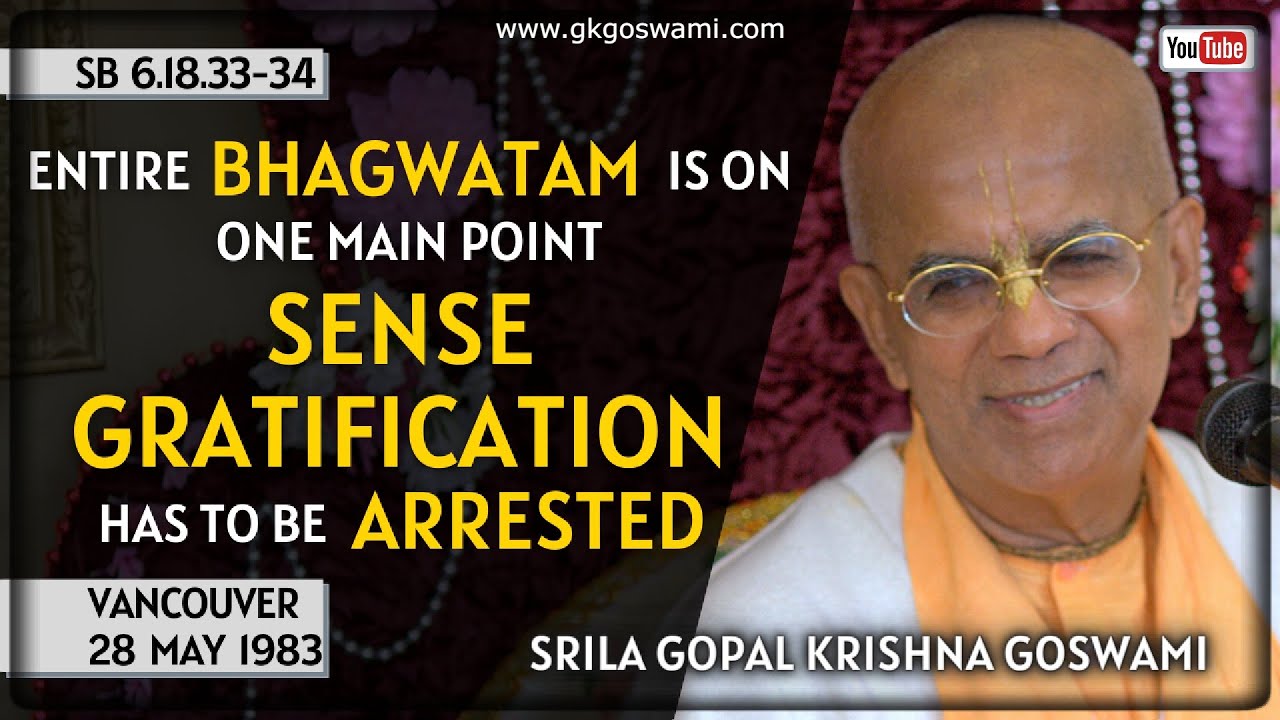
In this extensive lecture, Prasad Raval interprets Srimad Bhagavatam 6.18.32‑34 and related scriptural passages to argue that worship of demigods or a husband is a provisional step for those attached to material sense gratification. The ultimate goal is to recognize the Supreme Lord (Vāsudeva) as the sole enjoyer and devote all senses to pure devotional service. Raval explains the classification of spiritual aspirants (fruitive workers, yogis, moksha‑seekers, jñānis) and contrasts them with niskāma (desire‑free) devotees of Krishna. He emphasizes that sense gratification is the internal enemy that must be arrested, likening it to bees being stung while seeking honey, or to a prostitute’s husband. The lecture stresses the necessity of constant "spiritual medicine"—daily chanting, class attendance, guru puja—and warns against premature cessation, which leads to spiritual relapse. Internal enemies (lust, anger, greed) are portrayed as more dangerous than external obstacles; conquering them enables effective external work such as temple building and outreach. Raval uses numerous analogies (bees, fire, medicine, commercial advertising) to illustrate how material desires distract devotees and how disciplined, full‑time devotional employment is required for spiritual progress and for attracting conditioned souls to Krishna consciousness.
Chapters
Om namo bhagavate vasudevayaam! Om namah bahguruteh vassudevayam! Om namah bahguruteh vaasu devaayam! Om namah bahguruteh vastu divayahm! Om namaha Bhagwate Vasudevayasumma— Om Namaho Bahagawathe Vaasudhevaayo'om... Translation: A husband is the supreme demigod for a woman. The Supreme Personality of Godhead, Lord Vāsudeva, the husband of the Goddess of Fortune, is situated in everyone's heart and is worshiped through the various names and forms of the demigods by proative workers. Similarly, a husband represents the Lord as the object of worship for a woman. Purport by His Divine Grace A. C. Bhaktivedānta Swāmī Prabhupāda. The Lord says in Bhagavad-gītā: Whatever a man may sacrifice to other gods, O sons of Kuntī, is really meant for Me alone, but it is offered without true understanding. The demigods are various assistants who act like the hands and legs of the Supreme Personality of Godhead. One who is not in direct touch with the Supreme Lord and cannot conceive of the exalted position of the Lord is sometimes advised to worship the demigods as various parts of the Lord. If women, who are usually very much attached to their husbands, worship their husbands as representatives of Vāsudeva, the women benefit just as Arjuna benefited by calling Narayana his son. Arjuna was concerned with his son, but because of his attachment to the name of Narayana, he attained salvation simply by chanting that name. In India, a husband is still called pati guru, the husband spiritual master. If husband and wife are attached to one another for advancement in Kṛṣṇa consciousness, their relationship of cooperation is very effective for such advancement. Although the names of Indra and Agni are sometimes uttered in the Vedic mantras, the Vedic sacrifices are actually performed for the satisfaction of Lord Viṣṇu. As long as one is very much attached to material sense gratification, the worship of the demigods or the worship of one's husband is recommended. Patīr evahī nārī-nām dāivatam paramāṁ smṛtam manasa sarva-bhūtānām vāsu-devaśrīyā patīr sa eva devatā-lengge nāma-rūpavikaupte ijyati bhagavān-pum-bhi sṛbheṣapati-rūpa-dhek. So this was— is pointing out that the Supreme Lord is the husband of the Goddess of Fortune. The Supreme Lord is situated in everyone's heart, and He is also worshiped through the various names and forms of the demigods by prajña workers. The different classes of transcendentalists— there are those who follow the karma-kanda portion of the Vedas. The purpose of following the karma-kanda portion of the Vedas is that in exchange for the sacrifice or the ritual that one executes, one will be able to realize some economic benefit in exchange. So such a worker is called a fruitive worker. So the fruitive workers approach the demigods, and then there are those who are trying to perfect the different types are mystic siddhis. There are in total 8 different types of mystic perfections. And these are called the yogis. And then there are those who want to become one with the Supreme. They are called those who want moksha, or become one with the Supreme. And then there are the jñānis. But all these types of workers are called in the Caitanya-caritāmṛta to be lusty. And in comparison, the devotees of Lord Viṣṇu are called free of all desires. And these four other types of transcendentalists that we just mentioned are called those with desires, or sākāma and niskāma. So there are two types of transcendentalists. One are niskāma and the other are sākāma. One is without desire, the other is with desire. Kṛṣṇabhaktas niskāma-ātayevo śanta. The devotees of Kṛṣṇa, they are niskāma. They have no desire at all except the desire to serve the Supreme Lord. Hence they are always peaceful. And bhakti-mukti-siddhi-kāmī-ātayevo aśanta. And in comparison, the other types of transcendentalists, such as what is being pointed out in this verse, they are They are not peaceful because they have material desires. So as it is being pointed out, and as stated in the purport, that the Supreme Lord is the real enjoyer of all sacrifices. When one understands that the Supreme Lord is the real enjoyer of all sacrifices, when one understands that He is the only real enjoyer, or puruṣa, and everybody else is female or prakriti, then one is in his constitutional position. But when we try to become puruṣa, when we all try to become the enjoyers, that's when a very uncomfortable situation comes into existence. So in the material world we see that everyone is attempting to become a puruṣa, but thou— everyone is seeking enjoyment. Though everyone is trying to please the senses in a sweet manner, the reality is that as they taste honey, they're also bitten by the other bees. Just like the bees, they go to the honeycomb, but to enjoy the honey, but when they go inside, they are also attacked by the other bees. So though on the one hand the bees are trying to enjoy the honey, but that enjoy is also accompanied by the other bees attacking the bee. So similarly, in the material world, we see we may attempt to have sense enjoyment or please the senses in a sweet manner, but along with this there's also pain. Along with this there's also discomfort. So just like the bees, they go to the beehive And when they go there, they are also attacked by the other bees. Similarly, the living entities are pursuing from morning to night the path of sense enjoyment. Like the bee goes to different flowers, similarly we are going to different sources to extract money. But though we may get, or we may even succeed in getting what we want, still we get attacked by the other bees. The human being, he is attacked by other competitors. One nation is attacked by other nation. So the point is, just like the bee cannot be in the honeycomb or in the beehive without attack from other bees, the living entity cannot just taste the sweetness of the honey. Along with the sweetness of the honey, he also has to experience pains. So the correct understanding is to just accept the Supreme Lord the cause of all causes, the husband of the goddess of fortune, who is situated in everyone's heart as the real worshipable object. That is what we have to understand as to who is the real worshipable object. Or we hear in the verse, it is said, the husband is the supreme demigod for a woman. And in the purport, Prabhupada also makes reference to the custom in India called pati-guru. The husband is a spiritual master. That is in the situation where the husband is exclusively directing the wife to accept Kṛṣṇa as the real Puruṣa. And this point is confirmed by Prabhupāda in the last lines of the purport. Prabhupāda states in the concluding lines, as long as one is very much attached to material sense gratification, the worship of the demigods or the worship of one's husband is recommended. So the point is, the worship of one's husband or the worship of the demigods is recommended only when one is attached to the process of sense gratification. The Vedic scriptures give us information how one can gradually be elevated to the state of pure goodness. So executing offerings to the demigods is better than executing no offerings at all. But gradually one has to come to the point where he worships the Supreme Personality of Godhead as the only real enjoyer. For example, in Kṛṣṇa consciousness, whether one is in a male form or in a female form, one recognizes that the only real enjoyer is the Supreme Lord. He is the only male He is the only Puruṣa, and all others are prakṛti, female or subordinate. So we direct all our attention just towards the Supreme Lord. Whether it's the husband or the wife or the children, everyone is directed to give his love to the Supreme Lord because He is the supreme lovable object. So this is The big problem in society today, that everyone does not accept that the Supreme Lord is the real worshipable object and the real source of happiness. As the Bhāgavatam says, basically the society is composed of those who want to imitate the activities of other animals. Swāvidvāra-hoṣtar-karaye sāṁstu tāpuru-śāpaṣu. These are the dogs, hogs, camels, and asses. Who are also glorifying other people who have the same mentality. And because they are also glorifying other people who have the same mentality, nayat karna patopito jātu-nāma-gadagrajaha, the resolute determination to glorify the Supreme Lord who wipes away everything inauspicious does not come. In other words, the resolute determination to glorify the Supreme Lord. The resolute determination to engage in the process of devotional service develops when we are not interested on the path of sense gratification, when we are not interested in imitating the activities of the dogs, hogs, camels, and asses. If we want to imitate the activities of these different animals, then the resolute determination to approach the Supreme Lord and to consistently worship the Supreme Lord will not be very strong. As it is stated in the Bhāgavatam, the lotus feet of the Lord are the means by which one can destroy his material desires. So the point is that one has to reach the stage where he just interested in executing straight devotional service. And if one is not engaged in executing devotional service, one feels really vacant. As Caitanya Mahāprabhu said, yuga itam nimishena ca kṛṣṇa-prabhuṣayitam sunyāitam jagat-sarvam tovindra-virahena me. That, "My dear Lord, I am feeling all vacant in Your absence." So the devotee feels vacant when he is not meditating on the Supreme Lord. The devotee feels very uncomfortable when he is not meditating on the process of devotional service. The materialists are also meditating, but there is a difference. The difference is that our meditation is to please the Supreme Lord, and the materialist meditation is they constantly try to please their senses. Now they have failed to satisfy their senses. Now They have continued the path of sense gratification for so many lifetimes. Still they do not realize that this is not the right path. So this is actually a big problem that the materialists are misled. They don't want to understand what is the real path. So the devotees, however, they remain convinced that the path of devotional service is a real path. One has to be determined to execute devotional service just like we see The story of Dhruva Maharaj. Dhruva Maharaj was very determined to realize a kingdom more opulent than his father and grandfather. In fact, Dhruva Maharaj was being discouraged even by Narada Muni. A question may arise, why should Narada Muni discourage a great devotee from worshipping the Supreme Lord? Dhruva Maharaj was only 5 years of age and when he set out to meditate according to the advice of his mother. Narada Muni told him many times, "Why do you want to do this? You are just a young child, you are just a young boy. You don't have to take your mother's, stepmother's insult seriously." But Dīvāmānanda was determined to worship the Supreme Lord. Of course, his desire at that stage was mature. His desire at that stage was to realize a kingdom even more opulent than Brahmā's. But nevertheless, because he was determined to approach the Supreme Lord and he did not want to get discouraged at any cost, he was eventually successful in realizing the bliss of devotional service. And the desire to have an opulent kingdom was replaced by the desire to continue the worship of the Supreme Lord. So the point is that from this incident of Dhruva Mahārāja, We can understand that we have to be determined to serve Kṛṣṇa. That determination is very, very necessary. Without determination, it is not possible to succeed on the spiritual path. There's so many obstacles constantly that one has to face. The biggest obstacle, however, is not very far, but it's right there. That's the mind. The mind is constantly presenting a variety of obstacles to make spiritual advancement. The mind is constantly running in so many different directions, and the expert transcendentalist, he has to be able to counter or to control the wanderings of the mind. If one is able to control the wanderings of the mind, then one can succeed on the spiritual path. So the point is that the transcendentalist must recognize that to succeed on the spiritual path, one has to go through obstacles, one has to go through difficulties. But if one is determined to succeed, then he'll be able to conquer the different senses. The senses are always demanding satisfaction. In the Bhāgavatam, this body is compared to a bamboo structure. Just like when you're building a structure, like right now we're building a temple, you can see the structure is composed of beams and the cross beams and the pillars. So similarly, this body, it is explained, is also made of a structure of bamboos. That is, you have the ribs, you have the hands, you You have the legs, and these are all made of bones. And these bones are covered. What are they covered by? They are covered by the skin. They are covered by the nails. They are covered by the hair. And in this body there are 9 openings, like the 2 eyes, nose, nostrils, ears, tongue, anus, genitals. And these openings, the Bhagavad-gītā says, are giving foul smell. That is, these openings are constantly demanding for sense gratification. That is compared by the great sages to foul smell. Just like when you're passing through an area where you get foul smell, you really don't feel like going through that area. You close your nose, or you're just anxious to run out of that area as fast as you can. Some of you who've been to India may have experienced experienced that. In many parts of India you really get foul smell, and usually what they do, tell the driver, close the windows and just ride through. So Bhāgavatam says that this body is like a bamboo structure, and just like a bamboo structure can be very easily destroyed, this body can also be very easily destroyed. And The 9 openings in the body are giving false milk. So the point is, as long as the desires are to satisfy the senses through the material means, it is called false milk. And this can be changed. It's just a question of training. Just like, for example, when these children are brought to the Kṛṣṇa consciousness movement, these same children Even if they're born of pekkari parents, they change so fast based on the training they get. So just like within wood there is fire, and with the rubbing of the wood the fire is kindled. Similarly, if we train ourselves properly, then the fire of devotional service will emanate, then the fire of devotional service will blaze. So the transcendentalist understands that except for the process of devotional service, except for the process of pure devotional service— we are not talking about mixed devotional service, we are not talking about devotional service with motives. Initially the motives may be there, but as the Bhāgavatam and the other scriptures explain, gradually those have to get purified. It cannot be too gradual. That's another thing. If it is too gradual, Then again, it's a big problem. The advice of the spiritual master, the great sages, and the shastras is the devotional service of Vishnu executed just at the termination of this life, one can return to the kingdom of the Lord or to the Vaikuntha planet. That means that we have to be very serious in executing Kṛṣṇa consciousness. We cannot afford to take chances. As we were explaining last evening, the opportunity for executing spiritual practices is a very rare privilege. As the Caitanya-caritāmṛta states, brahmānda brahmī dekṛṇo bhāgavano jī-gurū-kṛṣṇa-prasādhipāya bhakti-lata-vīda, that it is only after traversing through many, many millions of births and deaths does one get the opportunity to execute devotional service. So this opportunity that has been presented should be availed of. And to avail of this opportunity of executing devotional service means that we don't want to play with fire at all. We don't want to play with sense gratification at all. We don't want to even contemplate sense gratification, because if we contemplate sense gratification, then one will gradually get attached to it.. And as we get attached to it, then the desire to fulfill it will also be there. So the devotee, he is also contemplating. The mind is a friend and the enemy. So his contemplation is how spiritual advancement can be made, how material attachment can be destroyed. Um, it is explained that with the acts of enlightenment With the axe of spiritual knowledge, one has to destroy the material attachment. With the axe of knowledge, you have to just cut the tree of material entanglement. So as long as this tree of material entanglement is there, it will— we will not be able to realize the full bliss of devotional service. Just like you may be planting seeds in the garden, but if the crop disease— if the crop disease is around, then the crops will not be allowed to grow. The flowers will not be allowed to blossom. The crop disease will kill it. Similarly, if we maintain material desires, then the beautiful flower of devotional service will not be allowed to grow. So the point is that sense gratification has to be arrested. And the— this area is so important. That in the entire Bhāgavatam we see that emphasis is placed upon this point. In the entire Bhāgavatam. Right now we are reading the 6th Canto, and even in the 6th Canto Prabhupāda is making the point that the worship of the Supreme Lord is the real business. If you read the 1st and the 2nd Cantos, also the same point is being made. If you read the 12th Canto, 11th Canto, 10th Canto, also the same point is made. If you read the Viṣṇu Purāṇa, also the same point is made. If you read the Caitanya-caritāmṛta, also the same point is made. If you read the Bhāgavad-gītā, also the same point is made. So why is it that the same point is made again and again? We were explaining this to our sāṅkhyataṇa devotees also. When you come in as a bhakta, you hear the philosophy that sense gratification is obnoxious. It is compared to false substance, false smell. And even when you become a sannyasi, you are still hearing the same message. The sense gratification should be avoided. Why? Because this is the enemy. So we have the constant— we keep reminding ourselves of the enemy. We cannot think that we can hear about the enemy for 1 or 2 days and then forget. No. This is a constant enemy. Because in the struggle with the inferior energy, the inferior energy is always attempting to confuse us. The inferior energy is always attempting to again claim us as a victim. So the point is that again and again the importance of pure devotional service is emphasized. The style of emphasis may vary, but the bottom line is the Prasad RAVAL is saying that sense gratification should be curbed, sense gratification should be controlled, sense gratification should be avoided so that one can focus all his attention on the Supreme Lord. Just like in an agricultural field, there is unwanted grass, it wipes away, it eats up the water that is being used to plant for the new crop. So similarly, we may Endeavor to make spiritual advancement, but because the material desires are still there, they tend to take away our enthusiasm. They tend to destroy our determination. The determination gets affected, the enthusiasm gets affected, patience gets affected, uh, everything, only because of material desires. When we have material desires in the heart then we cannot be patient to realize the bliss of chanting the Hare Kṛṣṇa mantra. Then you want results immediately, and if you don't get immediate results, you are looking for something new. If you have material desires, then the determination to succeed on the spiritual path is found wanting. If you have material desires, then one is not tolerant also. So the point is, the common enemy for forgetting Kṛṣṇa, the enemy for not developing the different characteristics that one is advised to develop to succeed on the spiritual path is the maintenance of material desires. So we must recognize this as a real enemy and we must destroy this. And the process of destroying this is the acts of knowledge. So this knowledge that we hear every day in the Bhāgavatam class, actually Every day, doesn't matter who gives the bhāgavatam class, the bona fide speaker will direct the audience towards only one path: service to the Supreme Lord, service to the spiritual master, giving up immature activities. So we constantly need to remind ourselves of this most important message, to remain in the fire of devotional service. As long as one is in the fire of devotional service, one will be happy and peaceful. We have seen even within this Kṛṣṇa consciousness movement, when people walk out of the process of devotional service, when people walk out of the process of serving the Supreme Lord, then they lose their illumination, they lose their glamour, they lose their happiness, and they have to again struggle for survival. We know of even those who are in very important positions, but Because they departed from the path given by Prabhupada, they are now suffering severely. So the point is that we have to take to this process very, very seriously. We must understand that sense gratification at any level is a thing of the past. The analogy is cited that when the elephant gets very lusty, the elephant goes in the Ganges water, and with the Ganges water, the elephant's lust disappears and it becomes cool again. So similarly, the devotee, he takes shelter of the cool waters of the process of devotional service, and this, if we take shelter of this process of devotional service, then the lust, anger, greed, which are described to be the internal enemies, they can all be arrested and they can all be destroyed. So the point is that these internal enemies have to be conquered. As Prabhupada used to say, one may conquer over many continents, but unless one conquers over the internal enemies, one has conquered over nothing at all. So what we really need to conquer is conquer over the internal enemies like Pariksit Maharaja had done. Pariksit Maharaja had conquered over the internal enemies of lust, anger, and greed. And therefore, when he was cursed by this Brahmin boy, he did not get upset at all. Normally, a king or somebody who was protected in the womb by the Supreme Lord, he would not expect to be cursed at a young age. And Parīkṣit, because he was an unflinching, unalloyed devotee of the Lord, could easily have counteracted it. But because he had conquered over his lust, anger, and greed, which are known as the internal enemies. External enemies, there may be so many, but the internal enemy is more dangerous than the external enemy. Internally we have to remain united. Just like, for example, even in spreading this Kṛṣṇa consciousness movement, there may be differences with the karmis, and there may be differences amongst the devotees. But the differences amongst the devotees is more dangerous than the differences amongst the karmis. Therefore, the devotees have to remain together, united. United we stand and divided we fall. So we have to remain united internally. Just like Prabhupada said, if you have debts, internal debts and external debts, if you owe money within the society and externally, Prabhupada said the internal debts are more important. Because it is very important that the devotees work together to propagate the cause for Vṛṣṇa's Krishna Consciousness movement was established. So similarly, the conquering over the internal enemy is more important than conquering over the external enemy. If you conquer over the external enemy but do not conquer over the internal enemy, then the conquering over the external enemy is useless. Just like, for example, you may get permission from the city to do harinamaṇ-pāda. You may even get permission from the city to do paraphernalia on the streets or wherever. But unless you have conquered over the internal enemy—lust, anger, and greed—we will not be able to execute even we are given the permission to do what we have to do. Therefore, it is more important that we conquer over the internal enemies. And if we conquer the internal enemies, then conquering over the external enemies will not be difficult. Queen Kunti had to go through so many obstacles, but because she had conquered over her internal enemy, namely lust, anger, and greed, she was able to face the external obstacles with great ease. When do external obstacles become a threat? The external obstacles become a spiritual threat when we have not conquered over the internal enemy. And when we have conquered over the internal enemy, then the external objects do not become a threat. Then the external manifestation of Maya does not become a threat. Just like a devotee, what does he think? He thinks that everything is an extension of the Lord. Like a woman in love with someone, she may see the husband dressed up in different dresses, but in reality she's seeing the person behind the dress. So similarly, the devotee, he feels the hand of the Lord, the presence of the Lord in every object that he sees. So wherever, whatever he sees, he sees the beauty of the Lord is being covered, just like a man is covered by the dress. A devotee sees a very beautiful house, he says, oh, this is the intelligence of the Lord that is covered by some bricks and some stones and cement. He sees a beautiful object, He says, "Oh, this is the beauty of the Lord that is covered by this structure." So the devotee has to learn to see the presence of the Lord everywhere. In every entity that you see, see the presence of the Lord. The Lord is being covered by that entity, by that object. And if we develop the spiritual vision of seeing the presence of the Lord everywhere, then the question of enjoying that object will naturally not arise. Just like if you walk into a department store, if you walk into department store, you know that every object in the department store and all the shelves belongs to the owners of that store. So the question of your taking that object without paying just doesn't arise. So similarly, we have to train our vision to the extent that we see the presence of the Lord in everything that we see. And when you see the presence of the Lord in everything that you see, then there'll be no question of wanting to enjoy. Because you're seeing the presence of the Lord, the natural understanding would be that the Lord is the enjoyer, and my business is just to serve the Lord. So the point that we're making is that you succeed on the path of devotional service regardless of which varna or āśrama one belongs to, one must gain, one must conquer over the internal enemy. Then the external obstacles will not appear disturbing. Just like the Pāṇḍavas. The Pāṇḍavas, though they were unalloyed devotees of the Lord, they also had to face extensive obstacles. It is not that the path of devotional service is a path of roses. There are tests at every second. At every second in the material world, there will be turbulences. Just like we were giving the example of the bee that goes to the honeycomb or the beehive to enjoy. On the one hand, the bee is tasting the sweetness of the honey, but on the other hand, the other bees are coming and attacking that bee. So for a moment, the bee is enjoying, and the other moment, the bee is experiencing some pain. So that goes on in material life. But if one is engaged in pure devotional service, Then of course there is constant happiness. But because the devotee is operating in the material world, he is ready to face the obstacles. No one expects that there will be no duality in the material world. Material world means duality. Today there is happiness, tomorrow there is distress. But the chaitanya-caritamrita says, just like the waves are constantly flowing in the ocean, So similarly, the devotee recognizes that in the mature world there will constantly be duality. So he doesn't get affected by the duality. Just like the ocean, the waters come or it doesn't come, but it is flowing so smoothly. So we have to become a dhīra. We have to become equipoised in all situations. We cannot be affected by the dualities. We should be prepared for the duality. Just like in an ocean, there's so many waves. So the duality is going to be there. You cannot avoid it. Today you're feeling happy, tomorrow you're feeling sad. But that happiness and sadness that you're feeling is a function of the mind. The body is intact. Nothing is happening to the body. The— you're still moving exactly the way you were when you were happy. But it is just the mind that is making you feel sad, that is making you feel happy. When a friend dies or relative dies or falls sick, nothing really happens to your body. It is just the mind that is becoming sad, and that mind transfers the pain to the whole body. So the point is that we have to train the mind to be ready to face dualities. If we train the mind to be ready to face dualities, then we will not be disturbed whatever the situation may be. So we have to conquer all the internal enemies, and then even if one is cursed to death, like Parikṣit Mahārāja was cursed, one will take this as the mercy of the Lord. So we do not want to be attracted to temporary claims. Be immortal. He sees the fire and the moth thinks, here's an opportunity to please the eyes. And the moth goes and sits on that fire and he destroys himself. And similarly, the fish gets destroyed by wanting to satisfy the urge of the tongue. So similarly, one who's on the path of sense gratification is compared to a man who has many wives, and each of the wives is demanding satisfaction. And when a man has many wives, he's in anxiety how to satisfy these many wives. So the mitcholis is an anxiety how to satisfy these senses. And the Bhagavad-gītā says that one who's on the path of sense gratification actually is a husband of the prostitute. These senses, when they're on the path of sense gratification, they are compared to prostitutes. And to be a husband of the prostitute is not the privileged position, of course. These days, times have changed. It may not make much of a difference, but in any sane society, to be the husband of a prostitute, it doesn't— it is a very, uh, unbearable thing. So when one is on the path of sense gratification, one is actually a husband of the prostitute, because the senses are like prostitutes. They are ready to go to anyone, whoever can satisfy them. And if our spiritual intelligence gets stolen by these senses, then that is the very shameful position and an unbearable situation. So the point is that we must recognize that these senses are like serpents and we have to remove the poisonous fangs from these senses. We have to change the direction in which these senses can be satisfied. That is, the senses have to be used constantly, consistently in the service to the Supreme Lord through the medium of pure devotional service. So this we must always remember that whether one is a male or a female, whether one is a father or a husband or a child, whether— whatever the position may be, the real object is to serve the Supreme Personality of Godhead. So this is the desire of the devotee The devotee is operating at various levels, but his desire is always to engage in devotional service and to engage everyone in devotional service. Sometimes a devotee may be manifesting his preaching in an overt manner, sometimes he may be in a disguised manner, but the bottom line is always the same: to inject Kṛṣṇa consciousness. Sometimes it may not be visible, just like a saintly person sometimes may have to adapt the preaching technique according to time and circumstances. Like the example is given of the fire. The fire is burning, but the fire is also burning below the ashes. When the fire is burning below the ashes, you cannot see the fire, but the same fire will eventually blaze outside the ashes also. But even underneath the ashes, the fire is still burning. So similarly, the devotee sometimes may in a disguised manner want to preach Kṛṣṇa consciousness. Just like our devotees, in order to facilitate the propagation of Kṛṣṇa consciousness, they adopt various techniques. They may even wear normal dress to distribute some paraphernalia. But the goal is one. The goal is to engage everyone in the process of Kṛṣṇa consciousness. So at times we may be able to see the fire, at times we may not be able to see the fire. At times the devotees Though he may be in a spiritual uniform, at times he may not be in a spiritual uniform. But the point is, the desire should always be to spread the flames of the spiritual fire. The desire should always be to inject the process of Kṛṣṇa consciousness in everyone that we see. So this is very important, the broadcasting of this transcendental knowledge. Kṛṣṇa is giving us such nice facilities. To expand Krishna consciousness. As we were discussing yesterday, the creation of wonderful temples is also a means by which the conditioned souls can be attracted. Just like Prabhupada, when he was on this planet, he built this most opulent temple in Bombay. And the reason why Prabhupada wanted to build this very opulent temple was to attract those who are attracted to glamour, opulence, to the process of devotional service. So similarly, we have seen that even in New Vrindavan, since the opening of the Prabhupada's palace, thousands and thousands of people are being attracted to the process of devotional service. At least they want to come and look into who is Prabhupada, what is this Kṛṣṇa consciousness movement doing. And similarly, as we were stating yesterday, the opening of the center in Detroit has also created spiritual history by the media all over the world wanting to get information about the Detroit Cultural Center. I just got a call last evening from Sridhar Swami, the president of Bombay Temple, and he was saying that the media is coming to him and asking for information about the Detroit Center and the Detroit opening. So it is a fact that if intelligently plant. Even uplands can be used to attract the conditioned souls. So the construction of the Radha Madhan Mandir palace will also be a means by which the conditioned souls will be brought to the process of devotional service. So Kṛṣṇa has given us this very wonderful paṣyāti for expanding Kṛṣṇa consciousness. So we have to be completely determined to to destroy all material entanglements with the axe of spiritual knowledge. And if we can destroy all material entanglements with the axe of spiritual knowledge, then Kṛṣṇa will make us even more powerful instruments to bring the conditioned souls to the process of devotional service. The potency that one realizes is coming from the Supreme Lord, and the potency that one realizes is in proportion to our degree of surrender. So we must recognize our internal enemy. We should be willing to conquer over the internal enemies. And if we are consistently trying to defeat and keep the internal enemies in control, that is what we literally have to do. It consistently attempt to keep the internal enemies in control because the internal enemies will always want satisfaction. Rūpa Gosvāmī has Says, thou have attempted to satisfy for such a long time still the demanding satisfaction. So we have to, with the weapon, with the axe of the spiritual knowledge, destroy the fog of material desires, destroy these— the desires for material sense gratification, and then the determination to stay on the path of devotional service will be very strong. So to summarize, this was First is pointing out the position of the husband, pointing out as long as one is interested in sense gratification, one may approach the husband or the demigods. But when one is interested in rendering pure devotional service, whose principal characteristic is devoid of any level of material sense gratification, then one directs his attention towards the Supreme Lord because He is the real puruṣa, the real enjoyer, and this is the true true understanding of human life. The true understanding of human life is that everything is meant for the pleasure of the Lord. Hence, all the senses have to be directed consistently in the process of devotional service. Not that the senses be directed in the process of devotional service for the morning hours, and in the day hours the senses contemplate sense gratification. If that's the plan that we will follow, then the process— then the meditation on sense gratification education will steal our spiritual intelligence, and even that morning hour worship that we are doing will gradually stop. We have seen that ourselves. Even in the Canadian temples I have seen over the years that they have been devotees who were coming to Mangala-Arati, coming to class, coming to Guru Puja, but not doing any service. This was the position 4 years ago. Then 3 years ago they stopped coming to Mangala-Arati, but they— and they stopped coming to class, but they would come to Prabhupada's guru-puja and to feed the Deities. And then they gradually reduced it to 5 days a week, just like they work 5 days a week. And this time I saw these people not coming to the temple at all. They don't even come to greet the Deities. They don't even come to Prabhupada's guru-puja. So the point is that it— this is a result of what? This is a result of part-time employment of the senses in service to the Lord. Devotional service is full-time employment. That means for full 24 hours, these senses have to be employed in serving, meditating on the process of devotional service. We cannot prematurely stop to take the spiritual medicine. Just like when you are recovering from a disease, if you think, "So now your temperature has come down. Now I can stop taking the medicine." Then you can get a relapse again. So that happens even amongst devotees. They come to the Kṛṣṇa consciousness movement, they stay in it for a year or two, few years, and they think they have understood the process of human, perfecting human life, they have understood everything, and they begin to abstain from taking the medicine. And because they begin to abstain taking the spiritual medicine, then they get a spiritual relapse. Spiritual relapse means you go back to where you were. So the 11th canto talks about this, that one cannot prematurely stop taking the spiritual medicine. If we prematurely stop taking the spiritual medicine, if we prematurely stop taking the diet, then we get a spiritual relapse. And spiritual relapse means going back to material activities. So we have to be very careful if you don't want to relapse. Just like when you're recovering from a severe disease, the doctor tells you don't Don't walk, don't eat this. And if you go ahead and eat this, then again you get the disease which you were just trying to recover from. So we're trying to recover from the disease of wanting to please our senses. And in order to recover from this disease, we have to take the spiritual medicine on a regular basis. And if you prematurely stop to take this medicine, then you'll get a spiritual relapse. Therefore, the Bhāgavatam says that one cannot stop meditating on the lotus feet of the Lord till he returns to the Vaikuntha planet. And in Vaikuntha planet, the resolve, determination is so strong that one doesn't forget. So we cannot take any chances in this human life. We have to keep taking the medicine and the diet till the end of this life. Antena ansmiti. And if we keep taking the medicine and the diet the end of this life, then we will be able to remember Kṛṣṇa even at the moment of death. Hare Kṛṣṇa. Hare Kṛṣṇa. The advice is that we have to assign priorities, and the first priority for a devotee is chanting 16 rounds attentively, avoiding the 10 offenses. As the Caitanya-caritāmṛta states, bhāvajanmakārī yadi śraunakṛṭṇa tabūtā Hare Kṛṣṇa, paṭhe prema-dhana. You may go on chanting Hare Kṛṣṇa for many, many births, but if you don't avoid the 10 offenses, then the ecstatic love of God will be absent. So this is the first priority. Do 16 rounds and be conscientious when you're doing your rounds. Not that you do your rounds half asleep. Then you must come to mangalājī. You must come to class. You must come to Guru Puja, finish the morning program, and after that, then go to your service. But we have a tendency to think that hard work will give us an exemption from spiritual practices. Just like when you file your income tax return, you claim deductions. If you have a wife, you can claim X amount. If you have children, then you can equalize increase the deductions. So there's also a tendency amongst devotees to try to claim what they call spiritual deductions. I've worked hard for the past one week, so I can deduct mangalārti from my schedule. Then I work a little more hard, then you go on increasing your deduction. Just like the bigger your family have, the more deductions you can claim. So there's a tendency amongst devotees to claim what is called spiritual deductions. And if you go on claiming spiritual deductions, then gradually your spiritual life will be down to zero. You understand? So we have to understand this point. Like, I was very disturbed yesterday when I was told that the morning program frankly has become very slack. Uh, you know, I don't want to publicly discuss the names of those those who have slackened off. But everyone knows who are the ones who have been slackening off. And that is compared to prematurely stopping to take the medicine. Actually, the Bhāgavatam talks about this point, that if you prematurely stop to take the spiritual medicine, then you're going to get a spiritual relapse. So in order to keep the atmosphere so charged, like Kṛṣṇa has given us this very wonderful facility. I mean, without doubt, the facility we have in New Gokulānanda is one of the best in the whole movement. There are not too many projects across the movement which have so much land right in the middle of the city. I mean, Burnaby is almost the middle of the city. So we can make this whole project very glamorous. We are talking about spiritual glamour, not material glamour. If The inhabitants of his community assigned priorities, and the first priority is taking the spiritual medicine and not wanting to claim deductions. Just like, you know, when you go to someone, "Why didn't you come to Mangala-Ārati?" They always have an excuse. "Oh, I didn't come to class. Prabhupāda, I slept very late. I travel a lot. I work very hard." So this habit of wanting to claim spiritual deductions must self. You know, the problem is, now this has been discussed so many times, we still are so obstinate. You know, this leads on to the other point, that the material conditioning is so strong, so strong, that even though we have taken several doses of vaccination, the material disease still manifests itself the day you stop not taking vaccination. Just like a diabetic patient, those who have serious diabetic patients, I've seen they have to take those injections, you know, 2 or 3 times a day. And the moment they don't take those injections, boy, you know, their whole health collapses. So we are actually all like diabetic patients. If we don't chant, if we don't come to Mangalati, then again the material fever goes up, you know, just like there's some tablets you take, the temperature goes down. So if you want the material temperature to remain down, then you have to take the spiritual medicine in the most auspicious hours. And if you don't get up at the right time, you don't chant at the right time, then how can you chant in the day? If you can't, if you can't chant in the most auspicious period, how will you chant in the other periods when the tendency to engage in sense gratification is deeper? Actually, even amongst the materialists, the desire for sense gratification is the weakest in the early morning hours. The early morning hours are so purifying that even the materialist doesn't think of obnoxious activities. But as the day proceeds, you know, he begins to think more and more about sense gratification. So we should take full advantage of the auspicious hours. Yeah. Covered this last time. The strong are getting stronger, the weak are getting weaker in this Kṛṣṇa conscious movement. It's Narada Muni, when he was trying to instruct Dhruva Maharaja not to worship the Supreme Lord, he said a devotee, he deals with people differently. For example, when a devotee meets somebody who is more advanced, he is very happy. To meet Him and associate with Him. When a devotee meets somebody who is less advanced than him spiritually, then he feels compassionate upon such a person. And when a devotee meets another person of an equal status, he reciprocates by giving friendship. So the point is that when we have an opportunity to associate with a person Bhagavatam, or the Bhag-Bhagavatam, to associate with the Bhagavad-gītā, The message of the Bhāgavad-gītā, we should take full advantage of it, that we become happy to associate with the message of the Lord. We become happy to associate with those who are broadcasting the message of the Lord. So the point is this, that the Bhāgavad-gītā class was a program not started by us. It was a program started by Śrīla Prabhupāda when he started the movement in 1966. And a lot of, lot of devotees think, oh, this is basic, this is ABCs. Actually, if we just understood the ABC of spiritual life, then we would have no problem at all. If you just understood the second chapter of the Bhagavad-gītā, all your problems would be solved. If you just understood the second chapter, that the body is temporary, the soul is eternal, the body is not meant for enjoying, then you have understood the whole philosophy. But the reality is that even if we go to the— we read the Cītāṇcātama-ītā, we haven't really understood even the second chapter the Bhagavad-gītā. So the point is we have to get out of this bodily identification, and in order to get out of this bodily identification, we need to hear the Bhagavad-gītā's message also on a daily basis. Just like a commercial manufacturer, he does not just tell you for a month to buy his product and then he stops advertising. He keeps bombarding you. Many, many of you were kids You saw these commercials for these soft drinks and the same GM cars, and you're still seeing those commercials, isn't it? They haven't given up on trying to tax your brain to buy their product, isn't it? These big manufacturers, they don't give up. Air Canada doesn't give up in attempting to try to get you to fly on their plane. They're always trying to get you to fly on their plane, or any manufacturer. He keeps advertising. So we have to keep also advertising, and that is we have to keep hearing these spiritual commercials. Actually, when you go to the Bhāgavatam classes, either what you actually hear are spiritual commercials. Well, these spiritual commercials are very healthy, and the other commercials, if you get attached to them, then you lose your intelligence. So we have to get attached to spiritual commercials. Just like I was on a radio show in Edmonton yesterday. Was a real nice talk show, almost a 2-hour talk show in which Alan Knott, the big D program of Alberta, the Ted Patrick of Alberta, was there. So that was a wonderful opportunity to preach. But in between the talk show, there were so many commercials, and the announcer didn't like the commercials. You know, every time the commercial would come on, he would make a face. But he told us, But the people love it. Because the people love to hear these commercials. Just like the materialists, they love to hear commercials, we also love to hear spiritual commercials. We should be keen to hear Kṛṣṇa-kathā. Because that will cleanse our heart.
More from PRASAD

Rare Pastimes & Timeless Lessons of Guru Mahārāja | Stories Every Disciple Should Hear

ISKCON Legends- pure devotees meet-HH Jayapataka Swami, HH Gopal Krishna Goswami, HH Radhanath Swami



Jagannātha Ratha-yātrā Through Śrīla Prabhupāda's Mercy | 29 April 2006 | Nairobi, Kenya

Lord Jagannātha's Appearance Pastime | 21.07.2019 | ISKCON Calgary | Śrīla Gopāla Kṛṣṇa Gosvāmī

The Ācārya Teaches by His Own ExampleGuṇḍicā Mārjana by Guru Mahārāja #shorts

Guṇḍicā Mārjana – Lord Jagannātha's Pastime | 21.7.2019 | ISKCON Calgary |Śrīla Gopāla Kṛṣṇa Gosvāmī

H.H. Gopāla Kṛṣṇa Gosvāmī Mahārāja - Exemplary Sādhana and Deity Worship # shorts

भगवान की कृपा कैसे प्राप्त होगी ? | 11 Jan 2014 | Punjabi Bagh | Srila Gopal Krishna Goswami

Material Education vs Spiritual Education | Srila Gopal Krishna Goswami #shorts