Six Principles of Surrender - HH Gopal Krishna Goswami - CC Madhya - Vancouver Canada -14 July 2012
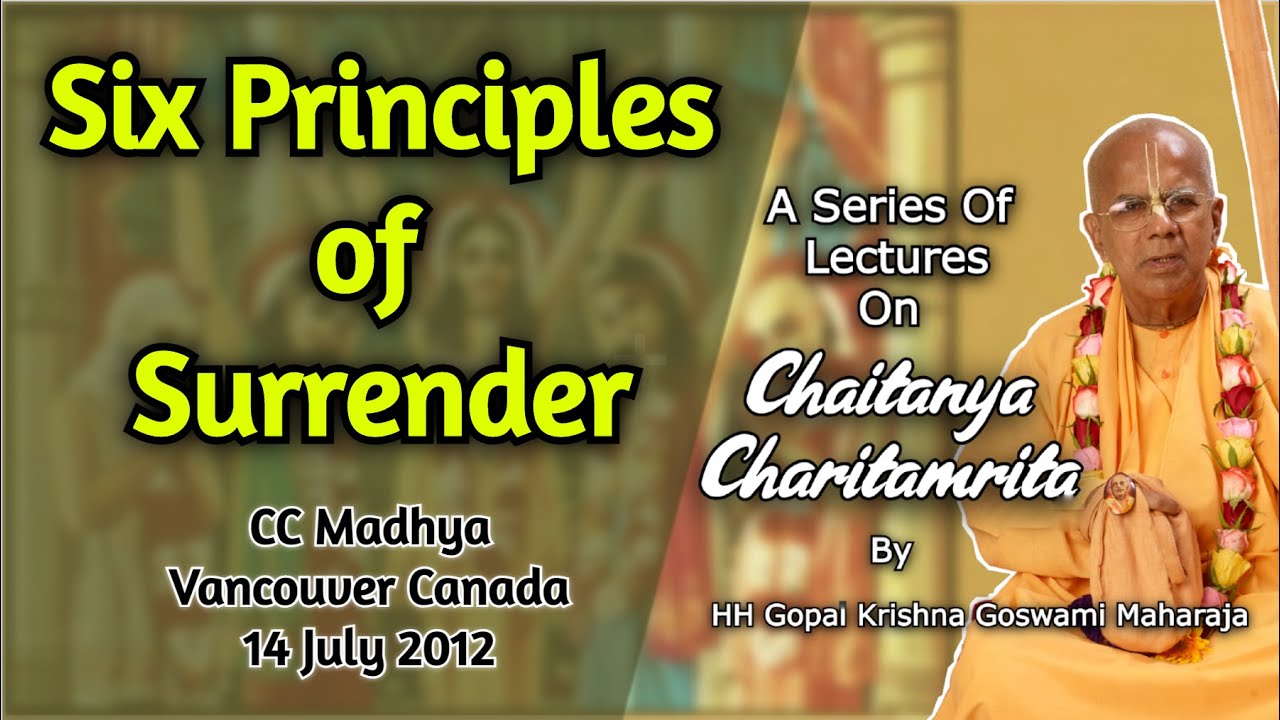
In this 2012 Vancouver lecture, His Holiness Gopal Krishna Goswami explains the concept of śrī‑nāgati – surrender – as taught by Caitanya Mahāprabhu. He outlines the six principles that constitute true surrender, emphasizing humility as the final and essential principle. The talk weaves historical anecdotes of Caitanya Mahāprabhu, Rūpa and Sanātana Gosvāmīs, and other early devotees to illustrate how surrender manifests in renunciation, generosity, and service. Practical guidance is offered on core devotional practices – śrāvana, kīrtana, and chanting the Hare Kṛṣṇa mantra – including advice on chanting speed, the importance of hearing the name, and the role of spiritual association (sadhu‑sanga) in preventing spiritual pride. Goswami stresses the universality of the Kṛṣṇa‑consciousness message, urging regular study of Caitanya‑caritāmṛta, Śrīmad‑Bhāgavatam, and the Bhagavad‑gītā, and highlights the transformative power of surrender through stories of healing and personal change. The lecture concludes with a brief Q&A on chanting tempo and the use of devotional books, reinforcing that sincere, humble surrender leads to spiritual advancement.
Chapters
The following is a lecture by His Holiness Gopalakrishna Goswami Maharaj delivered on Śrī Caitanya-caritāmṛta-mādhya-rīra delivered on 14th of July, 2012 in Vancouver, Canada. Om namo bhagavate vasudevaya. Om namo bhagavate vasudevaya. Om namo bhagavate vasudevaya. I was meditating what to speak on. We have such a broad area to choose from. Since the audience is primarily consisting of devotees, I thought we would discuss the 6 principles of surrender, or śrī-nāgati, with all of you. Is that a good idea? What does śrī-nāgatī mean? Surrender. Of course, we have a farm nearby. Oh, Śrīla Yudhiṣṭhira. Means to surrender. So Caitanya Mahāprabhu, who is known as the Supreme Lord, Śrī Kṛṣṇa Caitanya, Rādhā-Kṛṣṇa, ahaṇyā. Rādhā-Kṛṣṇa appeared as Caitanya Mahāprabhu. And Caitanya Mahāprabhu is described as the most merciful of all incarnations. Saraswatā Mahāśākara was a great Vaiṣṇava poet. Actually, he was a prince, and even though he was born in a royal family, he was very attracted to pure devotional service, and he gave us many wonderful bhajans and songs In one of the verses, Śrī Kṛṣṇa's Caitanya Prabhu dares to Ramana Maharshi. So in this well-known Maikāyavacana Bhājan, Guru Mahāprabhu says, "Hāṭhī pavāni duḥ tava avatāla." Caitanya Mahāprabhu appeared to reclaim the fallen people of Kali-yuga. And Śrī Caitanya Mahāprabhu conveys the mood of humility when He says, "There is no one more fallen than me. Therefore, my claim for Your mercy is perfect." So Caitanya Mahāprabhu distributed this process of Kṛṣṇa consciousness, and Caitanya Mahāprabhu had predicted This is chanting of Holy Name will be spread to every town and village of the world. Prithi buddha-atithata nagarādhigām sarvāda-pritiāra-vagamūra. In every town and village, the Holy Name will be chanted. And due to the sacrifice and hard work of Śrīla Prabhupāda, today the Hare Kṛṣṇa mantra is being chanted in almost every corner of the globe. So Caitanya Mahāprabhu firstly gave instruction on the path of the devotional service. This morning we were explaining Caitanya Mahāprabhu, one of our ācāryas, instructed devīs and the pānditas about the importance of Śrīmad-Bhāgavatam. Caitanya Mahāprabhu also gave very valuable instructions to the two brothers, namely Rupa Gosvāmī and Sanātanāma Gosvāmī. Rupa and Sanātanāma from the very beginning had no interest in governmental work. Their main concern was just discussing Kṛṣṇa-kathā, and their main business was counting society and giving people knowledge about Kṛṣṇa. But as few historians have said, they were forced into working for Nawab Hussein Shah, a Mohammedan ruler who had captured power by manipulation in Bengal. Their heart was a joint Chaitanya Mahāprabhu's movement. Śrīla Prabhupāda Swāmī was the first to leave, leave brahman service. Śrīla Prabhupāda Swāmī had at one time approached Caitanya Mahāprabhu with a request that he be allowed to leave his brahman service and travel with him. And Śrīla Prabhupāda Swāmī and Caitanya Mahāprabhu told him, to stay on the job. But later, Rūpa Gosvāmī finally left, and when he left his government service, he had a whole room full of gold coins. Imagine! And he distributed his wealth in a very exemplary manner. He gave 50% of his wealth to the Brahmanas. He kept 25% for future emergencies and 25% he distributed to his relatives. When Caitanya Mahāprabhu and Śrīla Prasada Gosvāmī met Caitanya Mahāprabhu in Dāmatkali, they both said, Then the society considers us to be very strong. But ke āri, I don't even know what is my constitutional position. This was the humility. A little later, Śrīla Dvāruṣvāmī also left his government service. Caitanya Mahāprabhu instructed Rūpa Gosvāmī on the prāsāda devotional service in prayāga, which is today known as Ābha. And in summary, Caitanya Mahāprabhu explained, brahmānta-bhāvidya-kulum bhākavānudhi, virūtiśyatva-vāya-bhaktir adhāvidhi, how a living entity is going through So many births and deaths, and the fortunate entity receives bhakti-latā-bhīja. What does bhakti-latā-bhīja mean? The seed of devotional service. Or, by that, practically speaking, what it means is knowledge that devotional service is the ultimate goal of life. Understanding that only by devotional service can I please the Lord. Understanding that by engaging the senses in service of the Lord can one make spiritual advancement. You receive this knowledge about devotional service. But then, just receiving the knowledge that devotional service is important is not sufficient, isn't it? You have to go beyond that. And He explains that just like a seed grows when it is watered, this seed of devotional service will grow when it is watered. And then watered means the process of śrāvanaṁ and kīrtanam. Śrāvanaṁ, kīrtanam, as you know, forms the basis of our spiritual life. Doesn't matter whether you are a householder or a brahmachari or sannyāsi, śrīmad-kṛṣṇa-namaṁ is a must if you want to make spiritual advancement. This process is not something new. This process has been presented long, long ago, and since time immemorial, this process is being adopted as a means of purification. So, 'shāman ke śrīnam'— and we'll discuss more of that later— is a must for spiritual development. But sometimes what happens is, in our extreme, then we become artificially proud. "Oh, I'm such a great devotee, I'm chanting, I'm initiated of Rāma," and so on. So He said that when these unwanted weeds grow, they should be plucked out. And how do you recognize these unwanted weeds are growing? In the association of devotees. Scriptures recommend strongly the importance of sadhu sangha, to stay in spiritual association. Okay, quickly. Thank you. So spiritual association is a must. Caitanya Mahāprabhu also explained in His Nātha Mukta Vāmi that one should minimize one's association with holy-minded people. In other words, we should associate with worldly-minded people only as much as necessary, and as far as possible, take advantage of spiritual associations. Ahead, Caitanya Mahāprabhu further explains that the seed of devotional service, of the beautiful garden of devotional service, can get ruined. How? By committing vaisnava prāṇa. Therefore, our scriptures remind us again and again about the value, about the importance of avoiding vraja-dvāsana. Śrīla Bhāgavata Swāmī was interested by Caitanya Mahāprabhu. To go to Vṛndāvana and to identify the places where Lord Caitanya, where Lord Kṛṣṇa had performed His pastimes, and to write books on the process of devotional service, and to construct temples. Many of the temples that you see in Vṛndāvana All the principal temples of Vṛndāvana were built on the inspiration given by the Gosvāmīs. And if today we are able to go to Vṛndāvana and identify the places where the Lord performed His pastimes, we owe this gratitude that the Caitanya Mahāprabhu and His associates where they went and identified the places where the Lord had performed His pastimes. Tulpakāśamī was the first to withdraw from His government service, and a little later, Sanatana Mahāprabhu also withdrew. Sanatana Mahāprabhu had on one occasion informed the king that he was sick. So he wasn't really sick. He was telling the Srimad Bhagavatam with 30 pundits. He assembled 30 brahmanas and all day they were engaged in telling the Srimad Bhagavatam. The king became impatient. He was concerned that Sanatana was not healed. He had to go and fight the king of Hrisha. So the king sent his royal physician to see what was wrong with Sanatana Goswāmī. These days, if somebody wants to come to your house, He rings the bell, and if you don't want him to come in, you don't respond. But those days these facilities were not there. So the doctor came right in, and there he saw that Sanatana Goswami was healthy, just telling the Śrīla Bhāgavatāmṛta with the other saints. PRASAD RAVALAD. The king asked that Sanatana was for me. Sanatana was respectful, he went, and the king chastised him. Your brother has proved to be irresponsible, and now you're also acting in a very irresponsible manner. "Come and resume your duties. I want to go and fight with the king of Orissa." The king of Orissa was a human king at that time. Śrīla Dharmaswāmī admitted that he had no interest left in his royal duties, and he was only interested He challenged the Bhagavan. Sanatana Swami overthrew the king. "You are in power. You can punish me as you like." And the king handed him in prison. Sanatana received a letter from his brother who informed him that he had deposited some money with a local grocery store. And Srila Aditya Swami used that money to escape from the prison and head for Varanasi, where Caitanya Mahāprabhu was staying in the house of a devotee called Chandraśrīkara. Chandrasekhar belonged to a schedule caste. The Lord Caitanya demonstrated by His actions that in this age we are all sudras, kala sudras of Allah. The only qualification required is devotional service, and if somebody was a devotee, then the Lord would stay in her, within her household. So, Śrīla Dharmaswāmī proceeded to meet Caitanya Mahāprabhu in Vāndhāsi. And on the way, He stopped for a night's rest at what you would call a motel or an inn or whatever, a rest house. Sannātha was traveling with his servant Paul, Ishan, and the owner of the hotel or inn was a very smart man. Too smart. He had an astrologer who worked with him in the reception area, and the astrologer would sign up how wealthy the guest is. If the guest would be very rich or something, they would plunder him. So this astrologer advised the owner, "So this is a very rich tourist, very rich man." So he was very proud, courteous, and all that. As Sanatana had experience in government service, in diplomacy, he knew, he suspected that this man wants something. If someone is very nice with you, don't you get suspicious? So Sanatana was a little suspicious about this man's intentions. So he asked his servant, 'Is there— are you carrying any wealth with you?' Īśāṇa, the servant, was carrying wealth with him. He didn't— he concealed this from Srila Dvāruṣvāmī. So when he was asked, 'Are you carrying any wealth with you?' He said, 'Yes, I am.' I'm carrying 7 gold coins with me. Would you like to be— How many was he carrying? He was carrying 8. He was carrying 8 gold coins. So, Srila Prasada said, "Why are you carrying death with you?" He took the 7 gold coins. He took the 7 gold coins. And he handed them over to the owner of the hotel. The owner said, "I cannot take from you. I was going to kill you tonight and take this, but now that you have come to me yourself, I can't take it from you. I am too embarrassed." Sri Radhan said, "If you don't take it, somebody else will kill me and take it. So better you will take it." And then Sri Radhan proceeded with help of the hotel manager. Sri Radhan was walking on secluded paths because he was a well-known personality in the Nawab's kingdom. He was virtually like a prime minister. Rupa and Sanātan were holding the most important portfolio in the government of Rādhā, insha'Allah. They were virtually like the prime minister and the finance minister. And at that time, 500 years ago, the richest kingdom The richest kingdom on the planet was the kingdom of Bengal. Historically, India was the richest country at that time, and the richest part of India was the Republic of Bengal. So you can just imagine how important positions they were holding. So Sanatana was well known So he naturally had escaped from the prison. He was put in the prison by the king. And he naturally had to head to meet Caitanya Mahāprabhu, walking through secluded roads so that nobody could see him. So all the way, Sanātan stopped to meet his brother-in-law, whose name was Śrīkāra. Śrīkānta was also working for a Mahāmudra king. It appears that at that time the Mahāmudras had captured power in many parts of India. So Śrīkānta had come with 300,000 gold coins to purchase horses, and when he saw Sanātan with a big beard praying to old gods, 'What is this? Come on, come stay with me.' He gave him a very expensive blanket or cloth to wear on the top. Siddhartha then finally reached his destination. What was his destination? Varanasi. He was going to Varanasi to meet, to meet Caitanya Mahāprabhu. And Caitanya Mahāprabhu was a resident in the house of Chandrasekharacharya. So Caitanya Mahāprabhu recognized that Prasada had now reached. So He told Chandrasekhar, "Go outside. There's a great sage standing over there." Sri Mata Chandrasekhar came outside to the balcony. He could not see any great sage. He saw one man with a long beard, but he concluded, "This person is not Moola. He is not Nisargadatta." So he went back and said, "There's no one there. There's no sadhu there." The Chaitanya Mahāprabhu said, "Go back again and see more carefully." So he came back and said, "No, I don't see any sadhu there. All I see is a mula with a big beard." The Chaitanya Mahāprabhu then told him, "This man is no mula. He is a great sage. Bring him in." So he had fear because he was, he had to walk many days and days to reach his destination, which was to meet Caitanya Mahāprabhu. So Caitanya Mahāprabhu embraced him, and when he embraced him, he was so touched, Sundaśrīkṛṣṇa was just surprised. He could recognize This person was very special. And Caitanya Mahāprabhu was just looking at the expensive chāda that Sanātan was wearing. He could understand that Caitanya Mahāprabhu wasn't happy that on one hand he had renounced everything, on the other hand he was dressed so oppositely. Especially if one is in a renounced order, one should live very simply. Simple living, high thinking. So Sanatana went to the bank for the candies, but there was an old man with a tone quill. Sanatana then told him, "Sir, I want to offer you This nice expensive shawl. And will you give me the torn quilt in exchange? The man said, the man said, are you joking? Are you serious that you are going to give your expensive shawl in exchange of a torn quilt? Sanatana said, "No, he's serious." And Sanatana then appeared. So now they appeared in front of Caitanya Mahāprabhu with that gold plate, and Mahāprabhu was very pleased. Mahāprabhu said, a good physician, he doesn't cure a patient, unless the symptoms of some disease remain. A good pain physician also prevents, takes away the symptoms. So the point, if you just said, 'Well, it would take to renounce order and try to deliver the opulent life,' it doesn't convey a good message. So this way Caitanya Mahāprabhu was very pleased with Sanātana Gosvāmī, and He instructed Sanātana Gosvāmī of the process of devotional service. When Caitanya Mahāprabhu was in Vārānāsi, there was also an assembly of Māyāvāisaniyānis taking place. They were having a big session and they were studying the Vedānta. These Mayavadīs became critical of Caitanya Mahāprabhu. They would say, "He is taking sannyāsa in our sampradāya." 'Why is he studying the Vedanta? Why isn't he studying the Vedanta? What else an āsī is he? He is rambling and chanting like a madman.' So they were two oldies, Taparmisa and Chandrashekar. They could not tolerate the goodness alone of Caitanya Mahāprabhu. Caitanya Mahāprabhu himself did not care. Caitanya Mahāprabhu breathed the art of tolerance. But his devotees, when they saw, were very concerned. Then a brāhminā came to meet Caitanya Mahāprabhu and said, "I know you don't eat in the homes of other people." "Prasāda māni vāikeva prasāda." And he invited the Māyāvādī sannyāsis also for prasāda. So Caitanya Mahāprabhu came to the assembly, and the Māyāvādīs were seated on a higher platform. Caitanya Mahāprabhu, when He came, He offered his obeisances. He showed humility. And where did he go and sit? He went and sat where people washed their feet before entering the temple. He practiced complete humility in his dealings. And if I want to say any display, One of his transcendental opulences. When God appears, he performs superhuman activities, and these activities cannot be duplicated or imitated by anyone. So Chaitanya Mahāprabhu was sitting down, but the Vaiṣṇava, he was sitting on a higher level, and from his face They emanated so much of fragrance as a thousand of sandalwood together. So when these Mayavadi sannyasis saw this, they could see that this sannyasi is not an ordinary sannyasi. And then there was a debate. And in the debate, Caitanya Mahāprabhu said, My spiritual master considered me to be a fool. He said, "All that you are capable of doing is jānaṁ Hare Kṛṣṇa-kṛṣṇa-bhāgavata." And later on, all these Māyāvādī sannyāsis were inspired by Caitanya Mahāprabhu, and they all took to the path of pure devotional service. They all became Vaiṣṇavādas. In this way, Caitanya Mahāprabhu converted all the prāsa sannyāsis to the path of Vaiṣṇava-dharma. Caitanya Mahāprabhu, in his pastimes, he converted everyone he met to the path of Vaiṣṇava-dharma. Once Caitanya Mahāprabhu had a discussion with a Buddhist leader, and Caitanya Mahāprabhu defeated him in a philosophical argument. So the followers of this Buddhist, they wanted to embarrass Caitanya Mahāprabhu. What did they do? "He defeated our guru, so we want to take revenge." So what did they do? They took some contaminated food on a metal plate, and they told Mahāprabhu, "Here is Mahāprabhu's shop. Please taste this Mahāprabhu's shop." So as they were offering the contaminated food to Caitanya Mahāprabhu, An eagle came from the top, and the eagle picked up the contaminated food and dropped the heavy metal plate on the head of the Guru. When the heavy metal plate fell on the head of the Guru, the Guru, what happened? He fainted. He fainted when the heavy metal plate fell on the head. So the followers of the Buddhist leader felt very repentant. They felt repentant. They said, "Ah, this is due to our offenses. We had this evil plan of embarrassing this Swami Anandasee." So they went to Prasad RAVAL and begged forgiveness. And they weaved their entire plan. And they pleaded, "Please, please, please, seva guru." What did Chaitanya Mahāprabhu say? "Go and chant the Hare Kṛṣṇa mantra in the ears of your guru." So they went. And chanted the Hare Kṛṣṇa mantra in the ears of their guru, and their guru came to consciousness. And then all these buddhas also became Hare Kṛṣṇa devotees, and they all started chanting the Hare Kṛṣṇa mantra. So there are so many wonderful pastimes of Caitanya Mahāprabhu, where Caitanya Mahāprabhu was on His tour of southern India. On His tour of southern India, it's very memorable, Bhaktisiddhānta Dī travelled to all these places and identified the places where Caitanya Mahāprabhu had personally travelled. So when Caitanya Mahāprabhu was travelling in southern India, He came and stayed. He was traveling with his entourage, and people would come to see him from a great distance. From a great distance, they would come and see Caitanya Mahāprabhu dancing, chanting. And just by seeing Caitanya Mahāprabhu chant and dance, they would also begin to chant and dance. And then when these devotees would go back to their respective villages and towns, others, by seeing them chant and dance, they would also begin to chant and dance. Just like a disease spreads from A to B to C. Spiritual disease also spreads from A to B to C. Just like Śrīla Prabhupāda, he came to the former Soviet Union in 1971. At that time, the country was under strict communism. Religion was banned. The communists had converted all the churches into factories and museums. And in that environment, Prabhupāda ventured to plant the seed of Kṛṣṇa consciousness. So Prabhupāda was staying in a hotel which was right downtown Los Angeles. So one of Prabhupāda's servants, Śyāmsundara— this is the same Śyāmsundara who carved the full Jagannātha Deity of Vṛṣṇa. As you know, the first Vāsyādhva Vṛṣṇa was held in Jagannātha Puri, and these Deities were carved by Śrīla Prasada. You know the story? There was— we have Jagannātha in our temple. Suvādhī, Mādhavi, She had gone to an Indian store called Foss Glass and there she saw some 3-inch dolls. She saw the Deity of Jagannāṭhāma and Bhāgavān, and they were being sold as Indian dolls made in America. So she just purchased one of them. She purchased one of them and she brought it, she put it in a purse, He came and sat down in front of Prabhupāda and said, "Prabhupāda, show me this doll." "How do I come to the Indian doll?" So Prabhupāda offered him the reasons to the doll and said, "It's not Indian doll. This is Lord of the Universe. Check it out." And he inquired that, "Were the other two dolls along with this?" She went back to the store, and then the storekeeper said, "Yes, it is set up free." So she brought it free into the stall. Deedi, Jagannātha, was a pandava. And Prabhupāda asked his disciples, "Is he the only here who knows how to carve?" And Śaṁṣuddha said, "How will I know how to carve?" He was a chemical engineer by education. So he carved the full Jagannātha Deities. I was just in San Francisco for Smāli-ātra last Sunday. The Deities are so, so beautiful and so big. Viśvāmṣu had gone with Prabhupāda, along with another secretary, to write to the former Soviet Union. And they were looking for a shop Where they can buy milk? Most Russians at that time didn't speak English, and they didn't speak Russian. So they were asking many people on the road, "Anywhere where they can buy milk?" They couldn't find anyone, and they found one Russian who was friends with an Indian boy working here, son of somebody working in the Indian Embassy. And he spoke broken English. He said, "I'll take you to a shop where you can buy milk." And they got the milk. And as they were walking, they discovered that this boy wanted to do yoga. So Shyamsundar told him, "I'm here with my teacher, the yoga teacher." And he said, "Can I meet him?" So he was brought to the hotel where he met Prabhupāda. He just met Prabhupāda for 4 days. And Prabhupāda preached him Kṛṣṇa consciousness, taught him Buddha-koka, had initiated him, and left the country. And then one devotee started preaching Kṛṣṇa consciousness, and today there are thousands and thousands of devotees in over 150 temples. So by spiritual association, by spiritual touch of the potency of the preacher, conditioned souls get inspired to take to devotional service. So Prabhupāda planted the seed of Kṛṣṇa consciousness in many parts of the world, and the seed is continuing to grow, grow, and fruitify. So Caitanya Mahāprabhu, when He was in southern India this way, He inspired everyone to take to the process of chanting Hare Kṛṣṇa. And then He came and stayed in the house of a devotee called Karmā. Karmā was a Brahmin devotee. And a householder. Caitanya Mahāprabhu stayed in his house, and Caitanya Mahāprabhu and the brahman considered himself very fortunate in that Caitanya Mahāprabhu stayed in his house. He said, "I am so fortunate that the demigod of worship has come to stay in my house." Who watches me drink the water. So this Paramābrahman expressed a strong desire that he wanted to travel with Caitanya Mahāprabhu and leave home. But Mahāprabhu told him, "There's no need to leave home." Stay where you are and do the following. What were the instructions? Chant Hare Kṛṣṇa daily. Read Śrīmad-Bhāgavatam and Bhāgavad-gītā. Associate with the devotees. Worship with the Deity with faith and reverence. And fifth, reside in adhāna. And Caitanya Mahāprabhu said, "You chant the holy name, nīmān bhāgavatam, you will never be separated from Me, and I will not be separated from you." That Caitanya Mahāprabhu gave the householders valid instruction that even the householders of Āśrama, You can hope to make progress, provided you take advantage of the spiritual direction. If you take advantage of the spiritual advice, then we can all make spiritual advancement. And if we don't, we take shortcuts, then that will not be realized. So when Caitanya Mahāprabhu was there, He had departed from the house of the school of Brahman, and there was a devotee suffering from leprosy. This devotee was suffering from leprosy, but he was indeed a very compassionate soul. His whole body was full of boils, and his whole body— these boils had pus in them, and his whole body was full of germs. And he was so compassionate that when a germ would fall off his body, He would lift it back and paste it back on his body. Can you imagine? So he heard the previous night that Caitanya Mahāprabhu had come to stay in Prabhupāda's house. And whoever Caitanya Mahāprabhu met, he gave everyone the same instruction: Chant Hare Kṛṣṇa and read What? And? He said, he gave the same instruction to everyone. That's the beauty of Kṛṣṇa consciousness. You can say we preach Kṛṣṇa consciousness, but our message is the same everywhere. It's not that the message gets adjusted to country or this environment in which we are. The basic message is the same. The philosophy that is being— has been heard again and again. It's not that every time we hear a class we hear something else, completely new philosophy. The philosophy is the same because our process is just follow the path given by the Supreme Lord. Supreme Lord in the 4th chapter gives us a history of the Bhagavad-gītā. He said, "I imparted this knowledge to whom?" To the son of Adam. From whom the knowledge came to Manu, the father of mankind. And then the knowledge came to the king called Charaka. King Charaka ruled over the planet at the commencement of Kṛṣṇa-yuga. And it was in his dynasty later that Āramchandana appeared. But in course of time, the knowledge was lost. And now I am giving you again. Why? Because you are my friend and devotee. Therefore you can understand the transcendental secrets of the great science. So devotional service is a great science. It's not that what you learn in school and college is giving terribly good science. It's a great science. Great science, and this great science can be understood only if we receive it from an authorized source. Just like before the appearance of Bhagavad-gītā As It Is, there were so many editions of the Bhagavad-gītā, and there still are, but if you carefully analyze what the Bhagavad-gītā As It Is has done, nor the Gītā has done. The Bhāgavad-gītā, as it is, has been translated in almost 70 international languages of the world, and people are reading it. Why? Because it answers all our questions and gives us guidance into how to lead a life of peace and happiness. So our philosophy is nothing new. Caitanya Mahāprabhu used to study the Gītā. He didn't preach the same philosophy. All our Ācāryas have given the same message. So our, the secret of success is just being true to the teachings of the Lord and the Ācāryas. And if you are true to the teachings of the Lord and the Ācāryas, then there will be spiritual success. So, and this devotee, his name was Vāsudeva Vipra, his whole body was full of pus, and he was so compassionate that when a germ would fall off his body, he would lift it and put it back. So he heard that Lord Caitanya has come and he's staying in the house of Kurma. So he proceeded to reach Kurma's house, and when he reached Kurma's house, He discovered that, what did he discover? The Lord has left. And when he discovered the Lord has left, he was heartbroken. He almost fainted because he had such great love. He was such a great devotee of Caitanya Mahāprabhu. Caitanya Mahāprabhu, is none else but the Supreme Lord, who is also present in everyone's heart as a— as the Paramātmā. So as the Paramātmā, Caitanya Mahāprabhu could understand that Vāsudeva Gopāla has come to his house to see him, and not having seen him, He is grief-stricken. So Caitanya Mahāprabhu came back. He came back to meet Vāsudeva Vṛkṣṇa. As he came back, he came to the house of Kurma Brahman and embraced this Brahman. Mahāprabhu didn't care that this man is suffering from leprosy. His whole body is full of pus. He embraced him, and when he embraced him, Prasad Raaval got transformed to, to what? To a young handsome man. He became a young handsome man. His disease was all gone, his old age was all gone, and he became very beautiful. And handsome. Then this Brahman, 'Asa Vibhra', he knew that this has been realized due to the service, due to the mercy of Caitanya Mahāprabhu. So then he embraced, he offered prayers from the Bhāgavatam. These were the prayers offered by Sudama Brahman that we read about in the 10th Canto. Sudama Brahman was a friend of the Lord. He was a poor Brahman, but he was content. That's the nature of a Brahman. He's content in every situation. In material life, you're always grumbling over your hand, as much as you have, It doesn't satisfy you, isn't it? Just like Nārada Muni says, a hungry man can be satisfied when you give him food to eat, a thirsty man can be satisfied when you give him water to drink, a peeing man can get satisfied when he has the opportunity to shower. But a breathing man, can he satisfy? No. If he was breathing man too, greedy man. So greedy man can never be satisfied. As much as they give is less. They want more. But this sadhana brahmin was fully content. Brahmins are content in every situation. But his wife knew her husband has a rich friend. So his wife would constantly tell him, "Come on, why don't you go and meet your rich friend and do archives cooking?" Sri Kṛṣṇa was when he came to see the Lord in Dwārakaṇa. The Lord received him very warmly. How Prāṇaśmiṇu received. He washed his feet, gave us a message how to serve Prāṇa, how to receive Prāṇa. The Lord asked him, 'Sudama,' they recall their childhood pastimes. "Did he bring something good for me?" And Sudama asked, "What did he bring with him?" The shipwright, very hesitatingly, he thought that, "Krishna, my friend, is the king of Ardhā. I'm going to give him the shipwright's." But very hesitatingly he gave it, and the Lord was very, very pleased. Without asking anything, Siddhartha proceeded to return home. He came there with the intention of asking his friend, but he didn't ask anything, and he was headed back home. And then when he returned to his residence, what did he see? He saw a hut, transformed you to palace. He saw a skinny wife with torn sari transformed into a very beautiful wife with nice clothing. So Sadāna Brahman knew that this was possible by the mercy of his dear friend, Kṛṣṇa. So he offered many wonderful prayers quoting from the 10th Canto the prayers that were offered by Śrīla Mahāprabhu. Who offered these prayers? Asadeva Vipra. Asadeva Vipra was transformed from an ugly, diseased individual to a very handsome young man. But then there arose a certain amount of fear in him. The fear was previously I was so diseased, so doctors No one will ever come near me. Now I become so handsome. I may not become proud. Generally, people tend to become proud when, when, when they are very rich, when they are very beautiful, when they have power, money. These things make a person proud. And pride is an impediment on the path back to Godhead. Pride is a big impediment. So, Suddāma Brahman did not want to be proud. The nature of a devotee is he doesn't want to be proud. He wants to be a servant of everyone. That is the ideal mentality a devotee should have. That's why Caitanya Mahāprabhu gave us this verse, which was, 'Nāḍa-viśrī-nityena tukarau vijñāyaṇcaḥ, āmaṇi na māṇa deṇa-kṛṭṇa-viṣravaḥ.' This verse is so important, the Kṛṣṇa's karmā says, 'Make a garment of this verse.' And where should you hang the garment? Around your neck. In other words, Remind yourself of the importance of being tolerant, respectful to everyone without expecting anything in return, and to consider oneself to be even lower than a blade of grass. So this verse is so important, and in Chaitanya Mahāprabhu instructed, Srila Dada Gosvāmī on the 6 principles of śrīnāgati. And the 6th principle of śrīnāgati is, is, is, is humility. Humility is an essential ingredient of surrendering to the Lord. If you want to surrender to the Lord, we should also practice humility. So this Vāsudeva Vipra was very concerned that he may not become proud now that he has become so handsome and so healthy. So he begged Caitanya Mahāprabhu for guidance as to how, what should he do to remain humble and meek. And then the body of Mahāprabhu says, "Shan hai Kṛṣṇa." and preach the glories of the Gītā and Bhāgavatam to, to, to everyone. And read. And Caitanya Mahāprabhu said, this way you will all remain humble and united with Me. So Prasāda RAVAL in the purport of this līlā in the Caitanya-caritāmṛta explains that just like Caitanya Mahāprabhu instructed Vāsudeva Vipra to always chēṇa Hare Kṛṣṇa and preach the glories of Bhāgavad-gītā. The devotees of this Kṛṣṇa conscious movement have also been saved from an obnoxious life. So these should also what should they do? Chēṇa Hare Kṛṣṇa and preach the glories of Hare Kṛṣṇa. So that should be our mentality, that should be our desire, to chant and to preach the glories of the Holy Name, preach the glories of the Gītā and Bhāgavata. And if you preach the glory, people will respond. The other day I was in Boise. Boise, as you know, is a small city, not a very big city. And we only have about 5, 15, 20 devotees there. It's a very beautiful spot. But one thing good over there is many of the devotees have the mood of preaching. And then when the young housewives with children, they go into book distribution. Or kutsi, we have the boys. So there was one guest, a very good guest who was there. Bhāvī in this program, and I was introduced to him saying, "He was a bookie the other day." One of the mahants, he was gone on a bookie spree, he had been quite a bookie, and now he starts to come to the temple regularly, he's reading the Gītā, which is great significance to him. So the scope of preaching is unlimited. You can preach anywhere. Everywhere there are religions, though, waiting to be contacted by the devotee of the Lord or Kṛṣṇa consciousness. Therefore, Caitanya Mahāprabhu instructed, "What is done? Dāne dābho." Dāne dābho. "Tell what you see. Preach to him the glories of the Holy Name." So this is our unlimited pastime of Caitanya Mahāprabhu. Caitanya Mahāprabhu instructed Srīla Nārada Mahāprabhu, He said, We should accept what is favorable, reject what is unfavorable, understand that Kṛṣṇa is your protector and maintainer, and make our desires consistent with the desires of the Lord, and practice humility. So, this Kṛṣṇa consciousness process is meant to inspire the conditioned soul to take to the path of devotional service and eventually to surrender to the Lord. Sometimes this surrender is a little painful. Sometimes we fear surrender. We think, "If I surrender, I'm going to lose everything. I'm going to lose my independence. I'm going to lose—" But what do we have? We're going to lose everything in any case at one point or another. It is much better that we willingly engage in devotional service Because devotional service, the caitanya Mahāprabhu explained in the Śrīmad-Bhāgavatam, resulted in the only wonder, and any spiritual happiness. So we should take to the process of Kṛṣṇa consciousness. We are so fortunate. We have the pure process of devotional service. Prabhupāda gave us pure dikṣā. And we have the wonderful books, wonderful temples, Wonderful association of devotees, etc. We should take advantage of this association to make spiritual advancement. And that should be our goal. That should be everybody's concern. Am I making spiritual advancement or not? And our goal should be to make spiritual advancement. And that's our goal, to make spiritual advancement. That Kṛṣṇa will have. What does Kṛṣṇa say? "Those who worship Me with devotion, I preserve what they have, and I, and I make up for their lack." Just like in the Brahmanabhīla, Kṛṣṇa saw that His mother was trying to tie Him down, and she tried, she was trying her best to tie Him down, but even taking all the ropes together, Gopurālāyaṁ nāmi. Two fingers. Then pointed to Śrī Caitanya Mahāprabhu, "Okay, now my mother can tie me down." And she tied him down. So when Kṛṣṇa sees that we are sincerely trying to turn around, we are trying to be attentive in turning around, we are trying to read the philosophy, state Kṛṣṇa consciousness, then Kṛṣṇa gives us the facilities by which we can chant and make spiritual advancement. So, the more we hear, the more we get inspired to stay on the path of devotional service. Therefore, the great sages advise us about the importance of śrīmad-bhāgavatam kīrtanam. Śrīmad-bhāgavatam kīrtanam means, not only chanting and hearing the Holy Name, but also chanting and hearing the Paṣṭhis and the leaders of the Supreme God. And there is nothing that you are going to hear that is coming new for the first time. You have heard these past times. These past times are so transferable. The more you hear, the more you get inspired to surrender. The more you hear, the faster the cleansing process. The more you hear, the greater is the spiritual happiness. And the more you hear, the more attached you get to the prāsāda devotional service. To be able to get attached to the prāsāda devotional service, one is the key instrument: śrīla and Caitanya Mahāprabhu. So we should take advantage of this prāsāda and imblow ourselves with śrīla Caitanya Mahāprabhu, and then we'll be able to make spiritual advancement. Repeat this fast spiritually. Sometimes we take it too lightly, and, you know, it is dated every step. Even for devotees, we have seen it dated every step. The human body can end at any time, and the only thing that counts is darshan, which is love. If you take to this path seriously and execute the process, then that goes into the other. Hare Kṛṣṇa. Hare Krishna. Hare Krishna. Any questions? We didn't go too late. It's— any questions? No questions? Prasad Raaval. When we chant Mahārāṣṭra Hare Kṛṣṇa, is it okay to change different speeds or different meters? Different speed? Yeah. What do you mean by different speed? Like, is it better to keep steady the same, you know, Breathing or is that okay to change? Sometimes we go too fast and sometimes we go too slow. That's what you mean? Yeah, sometimes not very slow, very fast, but we have to change it, so— That's okay, as long as you're chanting and hearing. The important thing is hearing. But we don't want to chant so fast that you can't hear the man's words clearly. You know, there was once a father who told his son, "Please chant 16 rounds every day." The next day the father said, "Did you chant your rounds?" He said, "Yes." "Ah, so fast?" He said, "On the first beat, I chanted a whole mantra." Then he says, "Riddho riddho riddho riddho riddho riddho." So, you chant. You shouldn't chant so fast either. It should take you about 7 minutes around, 7 to 10 to chant. But if the speed varies a little bit, that's not a serious problem. The important thing is Be attentive while chanting the Holy Name. Okay? Any more questions? How many of you have a set of Caitanya-caritāmṛta in English language? But the set is probably for decoration purposes. We see. Of course, these books are so powerful, even if we have them for decoration. Actually, all the devotees should have sets of these books in their home. Kṛṣṇa Bhāgavatam, etc., etc. And these books are so powerful that anybody who reads these books will be able to perfect their life. All of these Sikhs, Prabhupāda said, "We'll Bhagavad-gītā in high school, Bhāgavatam in college, etc., etc." full of them. But there's no difference between, as Prabhupāda often said, "Teaching of Caitanya Mahāprabhu and the teaching of Mādhurya Kṛṣṇa." So please read these books and you'll get so much nectar, then your mind will not be attracted to visual things. Hare Kṛṣṇa. It's a little late. Hare Kṛṣṇa.
More from PRASAD

Rare Pastimes & Timeless Lessons of Guru Mahārāja | Stories Every Disciple Should Hear

ISKCON Legends- pure devotees meet-HH Jayapataka Swami, HH Gopal Krishna Goswami, HH Radhanath Swami



Jagannātha Ratha-yātrā Through Śrīla Prabhupāda's Mercy | 29 April 2006 | Nairobi, Kenya

Lord Jagannātha's Appearance Pastime | 21.07.2019 | ISKCON Calgary | Śrīla Gopāla Kṛṣṇa Gosvāmī

The Ācārya Teaches by His Own ExampleGuṇḍicā Mārjana by Guru Mahārāja #shorts

Guṇḍicā Mārjana – Lord Jagannātha's Pastime | 21.7.2019 | ISKCON Calgary |Śrīla Gopāla Kṛṣṇa Gosvāmī

H.H. Gopāla Kṛṣṇa Gosvāmī Mahārāja - Exemplary Sādhana and Deity Worship # shorts

भगवान की कृपा कैसे प्राप्त होगी ? | 11 Jan 2014 | Punjabi Bagh | Srila Gopal Krishna Goswami

Material Education vs Spiritual Education | Srila Gopal Krishna Goswami #shorts