Śrī Īśopaniṣad 10: 18 Elements of Spiritual Knowledge | Rus-Split | 20.5.90 | Gopal Krishna Goswami
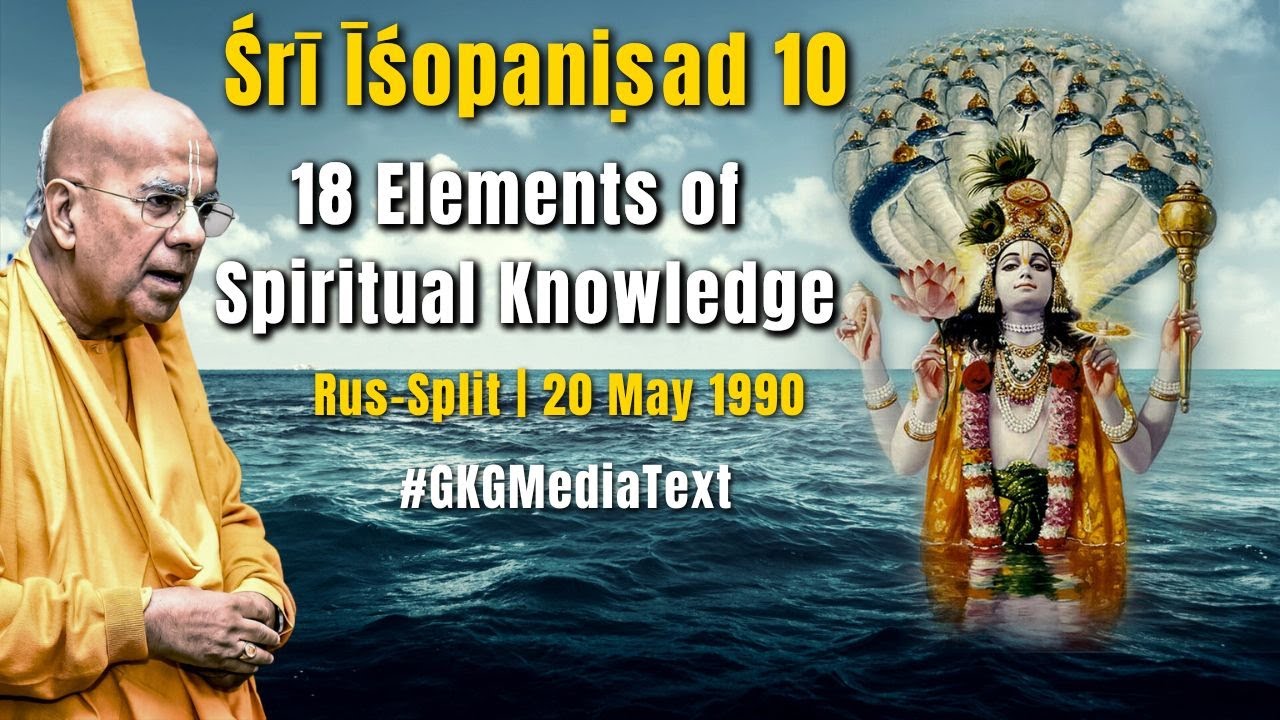
In this extensive lecture, Gopal Krishna Goswami explains the 18 elements of spiritual knowledge that A. C. Bhaktivedanta Swāmī Prabhupāda listed in his commentary on the Īśopaniṣad verse 10:18. He contrasts mundane knowledge, which keeps one trapped in material illusion, with spiritual knowledge that leads to liberation. The talk covers each element – becoming a perfect gentleman, understanding true religion, tolerance (titikṣā), honesty, humility, service to a bona‑fide spiritual master, adherence to the regulative principles, simple living, detachment from body and material relations, recognizing the impermanence of life, and cultivating devotion (bhakti) – illustrated with stories from the Bhagavad‑gītā, Śrīmad‑Bhāgavatam, Caitanya‑caritāmṛta and the lives of Prabhupāda, Madhvendra Puri, Īśvara Puri, and others. The lecturer repeatedly stresses that actions have corresponding results, that spiritual progress requires sacrifice, and that true religion is the practice of Krishna‑consciousness, not merely external rituals. After the lecture, a Q&A session addresses practical concerns: the order and importance of the elements, the nature of liberation, the role of a guru, the meaning of ‘grihā’, how to avoid offenses while chanting, and how to handle doubts, black‑magic, or conflicting guidance. The session ends with a reminder that devotion, tolerance, and simple living are the essential means to attain the promised spiritual result.
Chapters
So in this verse of the Iṣopaniṣad, it is clearly being stated that one result will be obtained if you follow the laws of God, and another result is obtained if you defy the laws of God. To think that the same result will be obtained regardless of how we act, it's just an act of foolishness. Just like, for example, you cannot expect that the student who studies hard and the student who does not study, they will both secure the same grades in the school. Nor can you expect that the person who works hard in the factory and the person who doesn't will both get the same salary. Similarly, you cannot expect that regardless of how we act, the end result is going to be the same. In the 5th Canto of the Śrīmad-Bhāgavatam, there is a very detailed discussion of hellish planets and heavenly planets. And it is explained how for different types of sinful activities one is sent to different hellish planets, and for different types of pious activities one is sent to different heavenly planets. So there are so many universities, institutes of learning, just like in your Moscow city you have this great university, Moscow University. But is there any department in this university that tells you what happens after death. So there is no department that tells you what happens after death. And society is being conducted in such a manner that nobody is teaching us this basic information, what happens after death. And due to ignorance, people are becoming nationalistic, identifying with the body, identifying with the senses. And as a result, the real goal of life is being missed. Mundane knowledge is like a heavy turban. Thakur Bhaktivedanta has said that if somebody is getting drowned with a heavy turban, then he will sink faster than somebody who is not wearing a turban. So mundane knowledge is like a heavy turban, and because of this, the living entity is being drowned in the illusion of sense enjoyment. What is being accepted as knowledge actually is ignorance. Just like, for example, one may have big, big degrees. Like in, in your country, I see it's a custom, or people like to show the medals of the Second World War. So in India, people like to write their degrees next to the name. But what is the value of all these degrees if it does not teach you the answer to the basic question as to who you are? So what is knowledge is explained in the 13th chapter of the Bhagavad-gītā. And Prabhupāda in the purport has listed 18 points which could be considered to be elements of knowledge. First point is: One should, one should himself become a perfect gentleman and learn to give proper respects to others. So one can only become a perfect gentleman if he learns that everyone has a right to exist. You cannot become a perfect gentleman just by speaking softly to individuals If you are being cruel to the other living entities on this planet. A devotee of the Lord is a perfect gentleman because the devotee of the Lord does not want to harm even an ant. A devotee of the Lord is respectful to all living entities. The hunter who was transformed by Narada Muni was so careful that he would not even step on an ant. So a spiritualist is a perfect gentleman and he is respectful to everyone. We do not say that human beings have a right to live and the animals have been put on earth for our enjoyment. So perfect gentleman means who understands the Lord and His creation. So one may have all the material degrees, but unless one understands his relationship with the Lord, one cannot be considered to be a true gentleman. Another aspect of knowledge is to understand the true meaning of religion. One should not pose oneself to be a religious person just for name and fame. Like in some parts of the world, a person may put on even tilak just to make a show of being religious, but in private life be the opposite. We do not take to the religious path just to get some temporary name and fame. Rather, we take to the religious path to really develop love of God and also a dislike for material things. One should not be a source of anxiety to anyone. A devotee does not want to harm or inconvenience anyone, nor by his words, nor by action, nor through the mind. Because the devotee does not want to inconvenience any living entity. Yād-bhārta, the great brahman, he was stepping, keeping— before keeping his feet on the ground, he would make sure that for the next 3 feet there were no ants on the floor. So this understanding can only be developed if one has a true understanding of real religious principles. In the Bhagavad-gītā, Kṛṣṇa says, sarva-yo 'neṣu-kontya-murtaya-sambhavanti yaha aham brahma-mahadyo 'ne aham bija-padāpitā. "I am the seed-giving father of all living entities." So all living entities, all the living entities in the 8,400,000 species of life, They all have a right to live. Even by one word, one should not— a saintly person should not even speak such language by which somebody else may be offended. This does not mean the truth should not be spoken, because when you speak the truth, automatically you will displease somebody. Just like once Prabhupāda was giving a lecture and he was very boldly stating how the miscreants don't understand the position of Kṛṣṇa. So there was one lady in the audience, and the lady said, "Swāmiji, a sādhū should not speak like that, should not accuse others." But Prabhupāda said, "When you, when you have a boil, you don't blow over that boil, but you press it." So the point is, the truth has to be spoken, but the truth has to be spoken to establish the position of Kṛṣṇa. But we should not speak in a manner by which we may disturb others unless it is strictly according to scriptures. A devotee should be tolerant even when he is being agitated by others. The material principle is tit for tat, an eye for an eye. You do something to me, I'll do something to you. But a devotee does not lose his cool mind even when he is being provoked by others. In the material world, there will always be some agitation. There will be agitation from the senses, There will be agitation from other living entities. Your senses are always crying for more and more satisfaction. You may try to satisfy your senses with as much satisfaction as you want, but they can never be satisfied. One of the qualities of a Vaishnava is titikshava. Titikshava means he is tolerant. So this tolerance is to be practiced at two levels: internal tolerance and external tolerance. Internal tolerance means you tolerate the mind and the senses. When the mind and the senses are demanding sense enjoyment, you tell them, "No!" This is known as internal tolerance. Then you have external tolerance, that is, sometimes it may be hot, sometimes it may be too cold, sometimes you may be honored, sometimes you may be dishonored, sometimes there will be victory, sometimes there will be defeat, but in all situations you should remain equipoised, equal. So this is very important for a devotee to develop the quality of tolerance because In the material world, there will always be situations where you are being disturbed. Even when you go out and book distribution, there will be disturbance of the senses. So tolerance is one of the assets of a devotee's spiritual life. One should avoid duplicity in his dealings with others. Duplicity, duplicity means you say something and do another thing. You say something, you do another thing, and this is generally the tendency of the materialist. A devotee should be honest and straightforward. The truth can be presented in a palatable manner, but the truth must always be presented. For example, we all know that the materialistic tendencies of eating, sleeping, defending, mating are similar to the tendencies of the animals. But that does not mean that when you go out to preach or do book distribution, you tell them, "Mr. Animal, please take a book." So the truth, you may say, "Oh, I did not say anything lie. There is just, ah, the Vedas are saying that like this, that the—" Human beings who are engaged in sense enjoyment and leading lives like the animals, but the truth has to be spoken in a palatable manner. You can tell people, please take a book and tell them that in a nice way that the activities of the materialists are similar to the activities of the animals, but we should be respectful to everyone. Next is, one should search out a bona fide spiritual master, serve him, and inquire from him questions how to make spiritual advancement. So the Vedas say in order to advance spiritually one must approach a bona fide spiritual master. But one approaches a bona fide spiritual master for spiritual guidance, not for material guidance. One should have the service attitude. In Caitanya-caritāmṛta there is a very nice story of the spiritual master of Caitanya Mahāprabhu's spiritual master, Madhvendra Puri. Madhvendra Puri had two, had two disciples. One was Īśvora Puri, who was the spiritual master of Caitanya Mahāprabhu, and the other was Rāmacandra Puri, who was a fault-finder. Īśvora Puri was such a humble disciple that he used to even clean the stool and urine of his spiritual master, because when Rāmacandra Puri, when Madhvāndapuri was in old age, he was sick. So Īśvora Puri, his disciple, would even clean his stool and urine. And Rāmcandra Puri, on the other hand, was a fault-finder, and he was even criticizing his spiritual master. His spiritual master, Madhvārāmādhva, in old age was saying, "My dear Lord, when will I have pure love in my heart?" And Rāmcandra Puri, not understanding the humble attitude of his spiritual master, would just criticize him and say, "Why are you saying like this? Why don't you have Brahman realization?" And there is Ramchandrapuri. He started criticizing his spiritual master, and later on he also started criticizing God Himself who was appearing in the form of Caitanya Mahāprabhu. Ramchandrapuri had a— what he used to do, he used to first give prasāda to the other person to eat, and after the other person would eat, Then he would criticize and say, "Oh, look at that sannyāsi, he's eating so much prasāda." So Madhvāndapuri, he was very pleased by the humble service attitude of Īśvara-puri, and he blessed him. And Īśvara-puri later on became the spiritual master of Caitanya Mahāprabhu. And Rāmchandrapuri, on the other hand, because he was so offensive, he was cursed He was blasphemed by his spiritual master. And in the end, Ramchandrapuri became so offensive that even he started criticizing Caitanya Mahāprabhu. Once Ramchandrapuri went to the room of Caitanya Mahāprabhu and he saw a lot of ants in that room. It is not uncommon in tropical countries like India where even if you don't have sugar on the floor, you still end up having ants. So once Ramchandrapuri went into Caitanya Mahāprabhu's room And he saw a lot of ants in his room. So he said, "Oh, our sannyasis are eating so much sweets." But so, but Caitanya Mahāprabhu actually had not eaten any sweets. But he just started criticizing Caitanya Mahāprabhu. And he was, because he was criticizing that Caitanya Mahāprabhu was eating too much prasāda, Caitanya Mahāprabhu reduced his eating of prasāda by one-fourth. And finally, When, because Rām-jandapūrī had become so offensive, finally after he left Jagannātha-pūrī, then Caitanya Mahāprabhu started eating more prasāda. So we gave you this example, we gave you this example to show how one must serve the spiritual master. You have the example of Īśvora-pūrī, who was serving the spiritual master like a humble servant, even cleaning his stool and urine. And you have the attitude of Rām-jandapūrī, who was finding faults in his spiritual master, and in the end he became so offensive that he also started finding faults in Lord Caitanya. And he completely got distracted from his devotional path and he became an impersonalist. One must follow the regulative principles for making spiritual advancement, which are mentioned in the revealed scriptures. If you don't follow the regulative principles that are there in the scriptures, Then it will not be possible to develop love of God. These days there are so many religious groups, but how many of them are actually following regulative principles? Wherever I went, devotees told me that when they go on book distribution, they are approached by the Christians and others, and they tell them, "Why are you distributing Bhāgavad-gītā? Why don't you read the Bible?" The regulative principles must be followed because the regulative principles take one towards purification. And since God is the purest person, you can understand that pure person only if you also become pure. With impure senses, we cannot understand the pure person. So the regulative principles that we talk about— that regulative principle means abstaining from sinful activities. And as long as you're engaged in sinful activities, how can you understand bhoga? It is impossible. So to understand bhoga, you have to become pure. You have to give up sinful activities, and that means following regulative principles. If on the one hand you're trying to light fire and on the other hand you're trying to pour water, the fire will never be lit. So there is no harm if one should follow— if the practitioners of other religious scriptures want to— want to stay on their religious path. But the important thing is they must follow the regulative principles. If Lord Jesus Christ says, "Thou shall not kill," and we kill His innocent children, then that is certainly sinful. How can you develop love of God then? Impossible. One must be fixed in the tenets of the revealed scriptures. In other words, one should be fixed in the conclusion of the scriptures. Scriptures means words of God. Dharmāntya-sakṣād-bhāgavat-pranitām. And the words of God have to be followed if we want to develop Real knowledge, because there is a difference between mundane knowledge and spiritual knowledge. Every living entity suffers from 4 basic defects. He has a tendency to make mistakes, his senses are imperfect, he gets illusioned, and he has a tendency to cheat others. Even if he doesn't know the answer, he'll pretend as if he knows the answer. This is known as relative truth. Relative truth means it is true today, tomorrow it may change. But absolute knowledge never changes. Absolute knowledge means it was true yesterday, it's true today, it's going to be true tomorrow. Just like sugar. Sugar was sweet thousands of years ago. Sugar is sweet today. Sugar will remain sweet tomorrow. Water was liquid yesterday, is liquid today, will be liquid tomorrow. So similarly, the eternal religion of the living entity can never change. And that religion of the living entity is to serve God. Therefore, one must abide by the scriptures. If anyone follows the scriptures, then one will be correctly situated. I hope you remember that we are discussing elements of knowledge. We don't have to discuss elements of ignorance because we already know what the elements of ignorance are. Once we know the elements of knowledge, then everything outside of that is obviously ignorance. There are plenty of people teaching us about elements of ignorance, but nobody is teaching us about elements of knowledge. The schools, colleges, parents, relatives, clubs, etc. They're all talking about elements of ignorance, but nobody is teaching us the elements of knowledge. Therefore, we should carefully understand this verse of the Isha Upanishad, because this verse of the Isha Upanishad is stating the difference in results between culturing the path of ignorance and the path of knowledge. One should not do something by which his spiritual life will be spoiled. You should not do anything by which spiritual life can be ruined. Just like a businessman, a businessman will not do an activity by which his profit will be— he may suffer a loss. So one should, uh, one should not do anything by which spiritual life will be spoiled, because you have established that spiritual life is a real goal of life, and anything that compromises with achieving the real goal of life cannot be followed. So if your mind is telling you to do something which is against the Guru and scriptures, if your friends are telling you to do something which is against the Guru and scriptures, then we must avoid. One should not accept more than he needs for his maintenance. Spiritual life is based on the principle of simple living or high thinking. So simple living, simple living means living just to take care of your basic needs. The materialists are never satisfied. With what they have. As much as they have is less than what they should have. You go to a millionaire in America and he'll tell you, "Oh, how he's poor. He must have little more." He may have 10 cars, but still he's not satisfied. A greedy man can never be satisfied. Nārada Muni has said that. And in the absence of spiritual knowledge, you're always greedy. One should not falsely identify himself with his body, nor should he consider those who are related to his body his permanent assets. So spiritual life begins with understanding that you are not this body. Kṛṣṇa, He begins the instruction of the Bhāgavad-gītā with knowledge— what? You are not this body. And if you are not this body, how can these extensions of this body be yours? So what does this mean? Does this mean that the extensions of your body, namely the children, wife, etc., should be thrown out of the house? What this means is that We may do our duty towards them, but we should not be overly attached because any excessive attachment will later on cause pain. Obviously, if you have children, it's your duty to give them Kṛṣṇa consciousness. Maharāja Viśṇudeva said, "One should not become a spiritual master till he can deliver the disciples back to Godhead. One should not become a father till he can deliver the children back to Godhead." In the Śrīmad-Bhāgavatam, There's this very nice story of King Chitraketu that tells you how anything that gives you pain to— gives you pleasure today will give you pain tomorrow. Chitraketu was very attached to his son because he had obtained a son after a long time. But later on, when that son died, he became very, very sad. And when the dead son was suggested to go back home to the father, the dead son said, I've had so many mothers and fathers. Well, which one should I go back to? Another aspect of knowledge is to understand that the basic mysteries of life—birth, death, disease, old age—are there. And they—we should just make a permanent plan to free ourselves from these miseries and not a temporary plan. The materialists are making temporary plans to deal with the problems of birth, death, disease, old age. Just like, in order to hide old age, They will try to dye their hair, or even if they're getting bald, to have artificial hair grow or wear a wig. They're trying to— when their eyes are getting weak, they're hoping that they can wear glasses or contact lens so that the weakness of the eyesight can be overcome. When your cheeks get wrinkled, they do some makeup, plastic surgery. The point is that the materialists are always making some plans to hide the basic mysteries of life. But the devotee is not interested in making a temporary plan. The devotee is interested in finding a permanent solution. Therefore, he takes to the process of devotional service. Just like if you have a disease, you may go to a doctor. Now, the doctor can have two approaches. One can be he can give you a temporary solution. The other is he can find out what the real cause of the disease is and give you a permanent solution. So the spiritual approach is to take a permanent solution, not to do patchwork solution. Prahlāda Mahārāja said, when I look at the attempt of the materialist to convert a position of distress to a position of comfort, my heart begins to lament at it. Just like in your country, when you have to replace your teeth, they put that golden teeth or silver teeth. But if you were to get a teeth replaced in the West, in the Western countries, They have about 32 different shades of the white teeth. So when you put in other teeth, nobody even knows that you have an artificial teeth. If you don't, if your kidney is not working, they'll give you an artificial kidney, a kidney machine. So they are doing temporary solutions to hide their miseries, but nobody wants a permanent solution, which is devotional service to God. Another element of knowledge is that one should not be attached to more than the basic necessities, necessities of life for spiritual advancement. So as I have said, spiritual principle is prouṣṭaya viṣoko, simple living. Actually, in your country, your people are very fortunate because the whole philosophy of communism is that you should only have as much as you need for yourself. Our only disagreement with this philosophy is it does not acknowledge God as the proprietor. But in these so-called Western societies, people are so spoiled because everybody can accumulate as much as he wants., and as a result they have no time for spiritual life. So whatever people may say about the present system in your country, but I think the present system is very good in many respects because it forces everyone into simple life. Thus people can think about spiritual life. One should not be more attached to wife, children, and home than the revealed scriptures. This point we have already discussed. One should not be happy or distressed over desirables and undesirables created by the mind. The business of the mind is to accept and reject. One minute the mind will accept something, the next minute it will reject something. So this acceptance and rejection of the mind should be tolerated by the devotee. In the second chapter of the Gītā, Kṛṣṇa says, matraḥ sparśate kāunteya sittauṣṇa sukha-dhūkhaḍā, erga māpāyina nityastam tattva-śakṣvabhārata. That, "O son of Bharata, you should be equal in all situations." Just like the coming and going of winter and summer season, Similarly, the mind should be trained to be tolerant of honor and dishonor, victory and defeat. So the mind today will say, "I like this person." Tomorrow the mind will say, "No, I don't like it." Today I like this relationship, tomorrow I don't. Today they get married and pose for pictures smiling, and tomorrow they're cutting each other's throat in the divorce court. So this is mature life. When you become a disciple of the mind, you can never be satisfied. So Kṛṣṇa says in the second chapter, one should be tolerant. One should become an unalloyed devotee of the Supreme Lord. In other words, one should become a pure devotee of the Lord. Unless you become an unalloyed pure devotee, you cannot be satisfied. Bhāgavatam says we must come to the platform of pure devotional service. You may say that it's very difficult in Kali-yuga, in 20th century modern Russia, but it is not difficult. Sāve pūṇṣaṁ paro dharmo yato bhakti-advokṣajaye. Ahitukh pratyata yātmā-sukh-prasīdati. The self can only be satisfied when he engages in pure religion. Vyāsa Deva, even after having compiled this vast Vedic literature, was still unhappy. And when he asked his spiritual master, Nārada Muni, why was he unhappy, Nārada Muni said, because he had not exclusively written about the pure process of serving God. So there's a big difference between the knowledge of the Śrīmad-Bhāgavatam and the other Vedic texts. In the other Vedic texts you have information about how you can do fruitive work, karma-kanda. Karma-kanda is a type of business transaction. I will do this for you, Kṛṣṇa, but in exchange you must do this for me. Caitanya Mahāprabhu said, "My dear Lord, even if You trample me to death, You will remain my only worshipful Lord unconditionally." So we should become a loyal devotee of Kṛṣṇa. Of course, I must say that your devotees have been successful in this. Otherwise, so many of your devotees were in jail for the, in the early years of this movement in this country. And even when you were in jail, you were being told, "Give up chanting Hare Kṛṣṇa, eat meat, and you can get out of the prison." But your devotees refused to eat meat or give up chanting Hare Kṛṣṇa. So many of you have already passed this great test on this criteria. So Kṛṣṇa will always test His devotees. If you see Prabhupāda's life, you see there were so many tests in his life. If you see the life of the great devotees, the Pandavas, Prahlāda, Mārāja, Kuntidevi, Haridāsa ṭhākura, they were all tested. They all had to go through so many difficult situations. For nearly 25 years, Prabhupāda was struggling to start to go to the West to start this Kṛṣṇa conscious movement. His spiritual master had ordered him to write books and to publish books. So Prabhupāda had once translated the whole Bhāgavad-gītā. And at that time he had no assistance, no dictaphone, no typist, no assistance at all. The translation that Prabhupāda did after the Kṛṣṇa consciousness movement was started, he did that with the help, with his disciples helping him and using modern facilities like dictaphone, typewriters, and so on. So Prabhupāda had once translated the whole Bhāgavad-gītā, 1,100 pages. He has written the whole manuscript by hand. And he was looking all over India for somebody who would pay to publish that book. Finally, Prabhupāda found somebody who was ready to pay for the printing. But when Prabhupāda went to Calcutta to look for the manuscript to be published, he found out that his servant had sold the manuscript as old paper. So then Prabhupāda translated the whole Gītā all again, and even Prahlāda Mahārāja Haidājṭhākura, all these great devotees, they also had to go through their trials. You may say, "But I am not so advanced, so I can't go through the trials." But if we take shelter of Kṛṣṇa, Kṛṣṇa will give us the means and the strength to follow the difficult situation. We must remember that Kṛṣṇa may put His devotee into difficulty, but He will never abandon His devotee. Kṛṣṇa put Parīkṣit Mahājāna into difficulty. Parīkṣit Mahājāna was cursed to die by a Brahmin boy. But Kṛṣṇa sent him Śukadeva Gosvāmī to save him. Śukadeva Gosvāmī saved him by giving him this philosophy of Bhāgavad-gītā, Śrīmad-Bhāgavatam. On the battlefield of Kurukṣetra, Duryodhana was very upset that so many days of the battle had gone by and Arjuna was still alive. Duryodhana went to Bhisma Deva. Bhisma Deva was the most famous general. And he told him, "Why are you being soft on Arjuna?" Why is it that Arjuna still hasn't died? So Bhismadeva was a Kshatriya. And Kshatriya means one who belongs to the warrior class. And Bhismadeva felt very insulted. So he told, Bhismadeva said, "Okay, now I will fight so bravely that either Kṛṣṇa will have to break His promise or Arjuna is going to die." Actually Bhismadeva inside his heart was a great devotee of Lord Kṛṣṇa. And he wanted to prove to the world— that Kṛṣṇa, even if He has to break His promise, He will do anything to protect His devotees. So, because before the Battle of Kurukṣetra started, Kṛṣṇa had given His promise that He would not interfere in the battle and not take any sides. The Kauravas, when they were given their choice, they elected to have the latest of weapons and generals on their side. But when the Pāṇḍavas were given their choice, They decided to have Kṛṣṇa on their side. So Bheesmadeva had prepared 4 very sharp arrows that he was going to use to attack Arjuna the next morning. So Bheesmadeva had prepared these arrows and he kept them on the side of his bed, of his tent in the evening, and he said next day he was going to use these arrows at Arjuna. So Arjuna of course knew what Bheesmadeva was trying to do. So in the night, Arjuna stole the 4 arrows from Bhisma Dev's tent. Next morning, Bhisma Dev knew that this was Arjuna's trick. This battle of Kurukshetra was fought on the highest religious principles. In the evening, no one would attack each other, and in the evening, the 2 sides would eat prasad together. They would even play together, and they would never attack each other unless the other side was also armed. This is real war. These days when they have a war, they bomb in the night when everyone is sleeping. And they will kill anyone without discrimination, whether it's man, woman, old man, young child. So Bhisma Dev had determined, had resolved that he was going to fight so strongly that Arjuna would be killed or Kṛṣṇa would have to break His promise, which was that He will not interfere in the battle. So when the battle started the next day, Bhismadeva was fighting so strongly that Kṛṣṇa, who was on the chariot of Arjuna, could see that now Arjuna may die. Then Kṛṣṇa, He ran off His chariot. Even His cloth fell while He was running. And then He confronted Bhismadeva with the Sudarśana-cakra, and then Arjuna's life was saved. But Bhismadeva, when he saw Kṛṣṇa right in front of him in that position, He said, "Now the goal of my life is fulfilled." So the point is that a devotee must serve Kṛṣṇa with full attention. This is the point that Prabhupāda has made. And we have explained this point to point out that when you serve Kṛṣṇa with full attention, even if you are in a difficult position, Kṛṣṇa will always come to your rescue. Another element of knowledge is one can become a scientist or a philosopher and conduct research into spiritual knowledge. To prove that God exists. So we are not against technology, we are not against modern science. Prabhupada says modern science should be used to prove that God exists. Instead of using science to prove that God doesn't exist, science should be used to prove that God exists. So what we have done is we have briefly discussed the 18 elements of knowledge which Prabhupada has described in this verse of the Īśopaniṣad. Because the verse is stating "One result is obtained by the cultivation of knowledge, another result is obtained by the cultivation of ignorance." So we should not think that regardless of how we act, result will be the same. And as aspiring devotees, we should not think, "Oh, whether I chant 16 rounds properly or improperly, the result will be the same." One should also not think, "Whether I worship the Supreme Lord Kṛṣṇa or demigods, it is all the same." Just like when you go to a store, based on the price you pay, you get from the store the commodity. So Bible says, "As you sow, you shall reap." Gītā says, "Ye yathānmām prapadeyante." All of them, as they surrender unto Me, I will reward them accordingly. So this verse of the Śrī Īśāpaniṣad more or less summarizes the whole Vedic philosophy. It tells you very clearly what will happen if you follow the culture of knowledge, And what will happen if you are on the path of ignorance? Just like the government clearly tells you, if you follow the laws, then you can be left free as a free citizen. And if you don't follow the laws, then you have to go to the prison house. By making sacrifices, one will never be a loser. Obviously, to get something in spiritual life, you have to make some sacrifices. In material life, if you want some degree, you have to work very hard to get the degree. So similarly, in spiritual life also, you have to make sacrifices for a higher goal. And by making those sacrifices for Kṛṣṇa, one is always a gainer. As Caitanya Mahāprabhu said, ananda-buddhi-vardhanam pratīpatam puṇṇaṁ vraja-svādhānām. There will be spiritual happiness as we chant the holy names of the Lord. So we will stop over here and take on some vāprāsa. And after that, I was told that at 6 o'clock your devotees are going to have prasāda. Then I'll take a break for 20-25 minutes, and after prasad we will start again. Hare Kṛṣṇa.
Tell me honestly, did your devotees understand this? There was too much of philosophy in this discussion, very few jokes, because it was a serious topic. Did you all understand it? After your vāpras, I will ask you questions, see how much your devotees have understood. Those items which were you were discussing.
Are they manifesting one after another or all together, and which is most important of them?
Well, these items that we discussed, they are all elements of knowledge, and we should try to cultivate all of them. These are 18 elements of knowledge, and I thought that if you discuss these Because these elements of knowledge cover all aspects. If you make the effort, they will manifest. If you don't make the effort, they will not manifest. If you're chanting the skill, then these qualities will manifest themselves fast. That's why when you take the medicine according to the doctor's prescription, then the recovery is faster.
Living beings fall down into material world from particular planets, from their particular planets. When they get liberated, they return to their particular planets again, or they can return to some other planets?
The living entities, when they get liberated, they go back to the spiritual abode of the Lord. But there are different types of liberation. One can merge with the impersonal Brahman. That is also one type of liberation which the enemies of Kṛṣṇa also get.
Do they return to the same planets? Which they came from?
Depends whatever liberation they achieve.
Is it possible to follow principles which Kṛṣṇa preached and simultaneously not to be the devotee of the Lord? Is it possible to cultivate?
If you are following the principles which Kṛṣṇa preached, then you are automatically a devotee of the Lord. Devotee of the Lord doesn't mean that you have to necessarily shave your hair and live in the brahmachari ashram. Do you stay, do you go to school?
He's serving in the army.
So very good. You can serve in the army, still follow regular principles, chant Hare Kṛṣṇa and be a caro-sho-priyādhana.
You chant Hare Kṛṣṇa? No, he came here first time.
So after the prasādam session, we will talk more about Kṛṣṇa consciousness. Then you will increase your understanding.
How to avoid offenses while chanting japa? Good question.
How to avoid karasopaprasad? How do you avoid offenses? By being attentive. Just like when you are walking in the month of December when there is lot of snow on the ground and the road is very slippery, how do you walk? You don't walk on the slippery ice like you walk in in the month of May on the street? On slippery ice. Do you walk carefully or do you walk like a carefree man? How do you walk? Carefully. So similarly, you must chant your rounds carefully.
In Bhāgavat-gītā, Kṛṣṇa says whenever principles of religion distort, He comes personally to restore them. In another part of Bhagavad Gītā, he says that one should abandon all kinds of religiosity. So is it controversial? What is the meaning of real religion?
In Bhagavad Gītā, Kṛṣṇa says give up all varieties of—
of religion. And in the other part of Bhagavad Gītā, he says that whenever religious principles divide, He comes personally.
These are two different points that Kṛṣṇa is making. In one verse He is saying, "Come to Me," and in other verse He says that when religion becomes prominent, then He descends Himself. So I don't see the contradiction. Where is the contradiction?
It is said that devotee is friend to all living beings. Is it possible for devotee to have most intimate friends?
Yes, if you want to associate with those who are advanced devotees, it's why not possible.
He is interested, how do you select your disciples? How do you pick up your disciples? Do you see the Shiva's eye? Shiva's eye? Yeah. Or chakra, yeah. Or you, or it depends upon how many rounds devotees chant.
The devotees are initiated on the basis of their following regular principles and chanting rounds and association of devotees.
Can one have some particular desires concerning devotional service? For instance, searching, searching the building for temple, or—
Yes, in material life there's a slogan, variety is the spice of life. So in spiritual life there's plenty of variety. You can choose the service you want to do. You can do book distribution, you can cook for Kṛṣṇa, look for a building for Kṛṣṇa, paint for Kṛṣṇa, clean the temple for Kṛṣṇa, type for Kṛṣṇa. You can virtually do anything for Kṛṣṇa as long as it is approved by Guru-sādhu-shāstra. Only thing is you can't do anything illegal for Kṛṣṇa. You can even have— the Īśā Upaniṣad even talks about spiritual communism. So you can even have a complete communist state based on, for Kṛṣṇa.
Is it offensive if one chants improperly while he is sick?
Yes, if you are sick you may be a little improper, but then when you are okay you should chant properly.
If parents take to Kṛṣṇa consciousness and their children don't take to Kṛṣṇa consciousness, what is the duty? Of parents regarding their children, if their children are over 25 years?
It is better that these questions be discussed in a private meeting, because every situation is going to be slightly different. But the important point is that the parents or children must not give up their Kṛṣṇa consciousness because somebody else is objecting to it, because there will always be somebody objecting to Kṛṣṇa consciousness.
What are the mistakes or faults of devotee which Kṛṣṇa don't atone, don't forgive?
The worst offense is offending another Vaiṣṇava. Caitanya Mahāprabhu described this as a mad elephant offense. Just like you may have a very beautiful garden, but if the mad elephant is allowed to come in that garden, everything will be ruined. So similarly, We may chant Hare Kṛṣṇa and accumulate pious activities, but then when we commit offenses, we can nullify all that.
It is in Śrī Śrīpaniṣad, it says that we shouldn't consider our relatives, our physical relatives, as ours, our property. What relationship should be between children?
We can keep the relationship, but we must understand that these relationships are temporary. We may do our duty towards the relatives, but our duty should all be in terms of Kṛṣṇa consciousness.
How should we understand that the constitutional, the original position of living being is to be obedient to the orders coming from above? How should we understand this? It means that our—
just like the constitutional position of the hand is to serve the body, it means that our real position is to serve God.
What is complicated about that? He has read in Prabhupada's Lamrita that once in America when somebody approached Prabhupada and asked for initiation, Prabhupada told him, "Who is the God?" And he replied that God is Krishna. And Prabhupada agreed to take him as a disciple. Can you do the same thing and accept disciple?
Like this, when Prabhupada took disciples by just accepting that Krishna is God, at that time ISKCON was in a different stage of development. Now we have a high standard of initiation, and if you fall in that CAD standard, if you're following that standard of initiation, then I'll be glad to initiate you, but you have to come to that standard. Do you chant? So you should keep chanting.
It is said that the soul, before she fell down into material world.
He has the same question every time. Sadhguru, you have the same question every time. What's that?
The soul, before he fell down into material world, he had some egoistic aspirations. Yeah? He had some egoistic aspirations. So, Is it the same that these egoistic aspirations come before false ego, or it is false ego? Egoistic? Yeah. What do you mean egoistic? Egoistic is false ego. Yeah. Is it the cause of false ego, or it's the false ego proper? What is the cause of false ego?
Yeah. What?
Egoistic aspirations, egoistic desires.
I don't understand what you mean. Egoistic? Yeah. What is it? Egoistic? Yeah, egoistic. Egoistic and false ego is the same.
In the kīf, in kīf you said that guru should not be accepted by external features. How should we understand this?
The guru should be accepted on the basis of his purity and his teachings. In other words, external features I meant You don't select a guru like you select a movie star. You don't look at material— what I had said in key was you don't look at material points in selecting a guru. So what is the key point of the words of the Īśa Upaniṣad that we discussed today? Good. Karesha. The elements of knowledge that we discussed. You can say it in any order, so don't worry. I don't expect you to say it in the order that I discussed. That specific example that I gave about one who was finding fault with his guru and Krishna, served his guru like a menial servant, washing his stool and urine. Who was Īśvārapūrī?
Place and avoid the association with materialistic people.
Good point that I did not discuss in detail. I purposely did not discuss this point, but you must have read the point. Any more points? One should not be—
one should not be the cause of disturbance to, to others, and one should accept. Very good.
We should not give any pain. Everyone, everyone will have to sit on each other's shoulders. There is one very nice story which is as follows. Chaitanya Mahāprabhu used to go every day to have darshan of Lord Jagannātha. So Chaitanya Mahāprabhu had gone to have Lord Jagannātha's darshan. There was such a big crowd that there was one lady who wanted to see, have Lord Jagannātha's darshan, but she could not go in the front because it was very crowded. So then that lady While Lord Caitanya was watching Lord Jagannātha, she climbed up the pillar and she had her legs on Lord Caitanya's shoulders. So the others were telling her, "Get down, get down, get down! What are you doing?" But Lord Caitanya said, "No, let her stand on my shoulders." She's seeing Lord Jagannātha. So sometimes you may have to stand on someone's shoulders also. The Christians, for example, think That if you eat beef every day, it's okay, but just on Fridays don't eat beef. Fridays please eat only fish, and then there is no griha.
If you're killing the beef every day, it's okay, but on Friday please don't eat beef or meat, only fish is allowed, and no meat griha. And the Muslims are saying you can eat beef, you can eat fish, you can eat anything any day of the week. No problem. Just don't eat pork. Just don't kill a pig. That's all. And meat griha. And the Hindus are saying you can eat meat every day, it's okay. Don't eat beef. And on Tuesdays and Saturdays, don't eat meat. So you can eat meat 5 days a week and meat griha. And I'm sure the Russian Orthodox Church is saying even if you do sin, it is okay. As long as you go to the church every Sunday and you atone for it, and when you atone for it and apologize because Jesus Christ died for your sins, you can sin as much as you want. As long as you go every Sunday, atone, and then it's okay. So I like this question very much. What is griha? So till prasadam time, I will speak, I will answer this question, and at prasadam, at prasadam time, I will take a break for half an hour. And then I will lecture from this very famous verse from the second chapter of the Bhagavad Gita. So what is sin? This is a question that every spiritualist should ask. Just like in society, if you were to talk what is law? So what is the answer? Law is that law which is enacted by the parliament of the country. So there are various different types of laws. Like in the city of Moscow, the laws are made by the mayor and the local council. Then higher than that you have the Republic of Russia where the laws are made by the local legislative council. Beyond that you have the Supreme Soviet that makes laws for the whole country. Beyond that you have organizations like United Nations that make laws for the whole world. So there are many levels of controllers, but the supreme controller is Bhoga or Hare Krishna. So what is Griha and what is not griha, this has to be decided on the basis of the scriptures. Like, we cannot get together and decide what is crime in the Soviet Republic. That has been decided by the Supreme Soviet or the Legislative Council of this country. So similarly, we must accept this first point, that religion means words of God. Dharmāṇḍya-sākṣāt-bhāgavatsa-niṭāma. Religion means the words of God. Religion is not something that you and I can produce. So from one angle, it is a very simple answer. What is griha? You just examine with the help of the sadhus and the acharyas, what does religion say? And outside of that, everything is griha. The reason why the Christians, the Hindus, the Muslims, the Russian Orthodox, and the Jews differ on what is griha, because Nobody today believes in following the scriptures. Earlier I gave you the examples of the Christians and the Muslims and the Hindus, but you will be most amazed if I give you the example of what is griha according to the Jews. According to the Muslims, for example— I'm sorry, according to Jews, for example, if you eat meat, if the animal— they have what they call kosher meat, and if the animal is killed in the— in front of a rabbi in front of a priest of the Jewish temple, then the priest comes and certifies, yes, this animal was killed in front of me. So then it is called kosher meat, and then you are allowed to eat that kosher meat. That is bona fide. So the point that we are making is people have such a concocted version of what is griha. So I will tell you from the Krishna conscious angle what is griha. Doing anything what is opposed by Krishna. The devotee wants to take only Kṛṣṇa prasāda, not just vegetarian food. Of course, eating vegetarian food is better than non-vegetarian. Eating vegetarian food is better than non-vegetarian, but we have to go beyond that. Prabhupāda used to joke that even the monkeys and the pigeons are vegetarians, pure vegetarians, but they also have sex 100 times a day. So just being vegetarian is not the answer. We believe in taking only Kṛṣṇa prasāda. Krishna prasad is food that is eaten by Krishna. It is food that is mixed with Krishna's saliva. And when you eat food that is eaten or mixed by Krishna's saliva, then that food has a purifying effect. It purifies your brain tissues and gives you higher intelligence. And with that intelligence, you can discriminate between what is right, what is wrong. Then we don't take any— we don't take any meat, fish, or eggs. The reason we don't take meat, fish, or eggs is because animals are less intelligent children of God. Kṛṣṇa in the Bhāgavad-gītā says, patraṁ puṣpaṁ phalaṁ toyam. Kṛṣṇa is clearly telling us in the Gītā what we can eat and what we should not eat. This is not vodka. It may look like vodka. It is herbal tea for my throat. So then we don't take any type of intoxication. We don't take intoxication including tea and coffee because We don't want to use artificial stimulants to get happiness. The materialists need artificial stimulants for their happiness. Therefore they have so many addictions. Then we abstain from illicit sex. Kṛṣṇa says, "I also become sex life that is not contrary to religious principles." That means sex for the purpose of procreation. And no gambling. Now somebody who's initiated devotee, he has taken vows of chanting 16 rounds. He must carry out those vows every day. If he doesn't carry out those vows, then it is sinful. He follows the following four regulatory principles, he must follow, otherwise it is sinful. So there is the basic definition of grihā, and then there is the very rigid definition of grihā which depends upon the spiritual approach that the devotee wants to adopt. In other words, different people, even different devotees, may apply different spiritual standards. Some devotees, they want to be very strict because they want to make rapid spiritual advancement. Some may want to keep chanting Hare Kṛṣṇa but also commit offenses at the same time because they are not so determined. Some may say, "Oh, these rules are too strict. They cannot be applied in 20th century Western society, so there's no way I can follow them." Just see what Kṛṣṇa is promising you. Prompts a new entrance into the spiritual abode of the Lord, where life is deathless, where you have a spiritual body that will never get old, never get diseased, and that will never— you never have to go to hospitals. You will have no mental agony. You will, you will never have to die. You never have to visit anybody's funeral.
Where you'll never have to face the Moscow winter again, -40.
Where you will, where you will be 1,000 times more handsome than you are today.. And where the woman will be 1,000 times more beautiful than today. But still there's no conflict, because both the beautiful men and beautiful women are focusing on Kṛṣṇa. And where you would never have to stand in line to get your butter or milk or a plane ticket on Aeroflot or whatever.
Where each of you will have a private jet.
And that private jet is going to be made of gold and emeralds. Today the King of Saudi Arabia is the richest man in the world, but even he doesn't have a private jet made of gold and emeralds. And where you can pilot your plane and go wherever you want, no accidents. You don't have to worry about making rubles for your apartment rent or your food, prasadam or whatever. Where none of your friends or relatives will ever die, leave you. So just imagine So many good things Krishna says, if you come back to me, you will get. But of course, everything has a price.
So spiritual world also has a price.
The price is not in currency, nor is the price in rubles, nor is the price in pounds. Price is in terms of your dedication.
So you can understand that even if you have to sacrifice, if you have to sacrifice illicit sex, intoxication, gambling, and meat eating, what have you lost? You have tried to engage in these things for thousands of lifetimes.
Still you haven't got satisfied. So what makes you feel one more try is going to give you satisfaction? After all, how does Maya trick you? Maya tells you, try me once more and I will satisfy you so much that then you can just concentrate on spiritual life.
But after you try Maya once more, it says That wasn't proper.
Once more.
So that once more doesn't stop till your old age.
That once more only stops when death comes upon you.
So you have a choice.
Either you voluntarily give up sense enjoyment, or death will force you to give it up. If you wait for death to force you, then it will be a little too late to rectify. Because if you have been drinking poison all your life, then in the end obviously poison will have a negative effect. So the point is, whereas if you use your intelligence and give it up, then that is better. That is what Krishna says, that is what guru says, that is what sadhu says. So therefore we should take the advice of the shastras, guru, sadhu, and engage the senses in the positive way. When the mother doesn't want the child to create a disturbance in the house She gives the child some positive engagement, doesn't she? So similarly, if you don't want your mind and senses to agitate you, then engage them in Kṛṣṇa consciousness. You may say it's impossible to give up the grihā activities. Kṛṣṇa Himself says, devyai śakgunamayi mamāmayā dūruteya. Give up this māyā is very difficult. But Kṛṣṇa also says, if you surrender to Me, then you can give up māyā. Maya is strong, but there is one person who is stronger than Maya. So bhakti is stronger than Maya.
When you come to Kṛṣṇa consciousness, you have so many attachments and you tell yourself, "Yes, what the Guruji is saying is 100% right, but I have so many attachments. How will I take it up?" So how to give it up? That medicine also Kṛṣṇa gives you.
And that is by positive engagement in Kṛṣṇa consciousness. And you can see how thousands of young boys and girls all over the Western world, they have given up sense enjoyment by engaging in devotional service. Some of you may say, "Oh, I can understand that 5,000 years ago, 500 years ago in India it was possible to practice Kṛṣṇa consciousness, but now we are in 20th century, it is impossible." But here in 20th century we have thousands of examples. So what is Then what is grihā? We have given you the basic definition of grihā. Anything that's against the laws of God. But how rigidly you want to apply this definition depends upon each one of you. Kṛṣṇa consciousness can be practiced at various levels. Just like you have good, better, best. Best is higher than good. Good is better than, uh, good, better, better, better is better than good. Good is better than fair. Fair is better than poor. So it's all relative. It all depends upon you which highway you want to get into. I do not know in your country, but in America on the highway there are different lanes. So you may have some fear about giving up Maya. But take the advice of Guru Sadhu Shastra and you can give up Maya without any hesitation if you are ready to take the Kṛṣṇa consciousness.
You can see with your own eyes that does not matter how much sense enjoyment I have, I cannot have sense enjoyment for long in any case. Let's say there's so much emphasis in today's civilization on sex life. In the Śrīmad-Bhāgavatam, there's the story of King Ajāti. How King Ajāti engaged in this relationship unlimitedly, but in the end he was completely frustrated.
He said he was like a lusty goat.
So Prabhupāda was once Prasad Raaval was giving once talking to some devotees and he said, "Doesn't matter which way you look at it, sex life will always be painful." So if you engage in it the way the karmis are engaging, then you'll have so many diseases, diseases like AIDS, etc., which the karmis are having today. If you use contraception and do abortion, then the reaction will be very severe because all those who adopt these means, they have to go on transmigrating from one womb to another womb and they will never see the light again. So we must understand that unless we learn to control the senses, we'll have to pay the price in any case. Hare Kṛṣṇa.
Hare Kṛṣṇa.
I think all of you have to practice hatha yoga to sit in these places straight without moving for 3 hours. In the Soviet temples, all of you are automatically becoming hatha yogis because there's no place to sit, so all of you had to sit tight.
The question is, is it correct that any action beyond devotional service is a kind of sinful activity?
Any activity beyond pure devotional service? Yes. I explained already now. They can be, yes, pure devotional service is—
Just devotional service, not pure.
Just devotion. Yes, any activity out of devotional service will be sinful to some extent or the other. Even karma-kanda activities are sinful.
If you accept a disciple and one day he falls down, do you suffer sinful activities which he performs? And how it's being reflected to him?
How it will be reflected on the disciple? Yes. Well, as long as the disciple is following the spiritual master, the spiritual master agrees to take him back to Godhead. And if the disciple acts improperly, then it has an actual reaction on the guru. But the guru, but the guru has to accept disciples because he's taking the risk on behalf of Lord Caitanya Mahāprabhu and the guru from paramparā. He has to take the risk to try and save the conditioned souls.
We have discussed the point of duality. How, what is the cause of duality and how can we avoid it?
The cause of duality is obviously the desire to control other people, the desire to cheat other people.
Say, if one gets liberation in this lifetime, and it is said that his relatives 100 generations before and forward get liberation also, how it's possible if Everybody is individual soul. How can we liberate them?
Yes, like for example, in most countries of the world, when one member of the family becomes like a big minister or big man, then all his relatives also become rich people. So when one of you becomes a devotee, then you can liberate not 100 generations, but up to 13 generations. So I think what I'll do, I'll just take one more question and then stop because I want you to— the thing is I want— I'm only going to give you half an hour for Prasad.
We're talking about spiritual progress, but in Vedas it says that we should not desire even spiritual progress.
So the desire to have spiritual progress is good. That is the desire that you must have. If a devotee has a desire to serve Kṛṣṇa and Guru and go back to Godhead, then that is not considered selfishness. Can I take the other questions after the prasādam break for you, please, devotees?
Do you want to have a prasādam break, Suchāro?
So now we'll break for prasādam for half an hour and then I'll start the class again. What do you say? Or should I go on straight till 9 o'clock? Now Suchāro, can you announce to morals program to the devotees.
Is it, is it true that all who initiate, who take disciples in ISKCON society, are pure devotees?
At least they are trying to follow the pure path. Pure devotee means who trying to follow the pure path. And if they're trying to follow the pure path and they give the medicine, the same medicine to others, the medicine will work.
The, the six stanza of, uh, Gīrvāṣṭaka, um, says that the spiritual master is, is one who expert in helping gopīs. How can you comment on this?
Your question is, how is the spiritual master helping the gopīs? Yes, the spiritual master is helping the gopīs in serving Kṛṣṇa. So in other words, you have to understand from a spiritual angle, is the spiritual master is fully absorbed in desire to serve Kṛṣṇa. The spiritual master is fully absorbed in desire of wanting to serve Kṛṣṇa, and therefore he's helping the gopīs. The gopīs are the principal devotees of Kṛṣṇa.
But what is the difference between a guru of ISKCON? And what? And gurus, between them.
Guru of ISKCON means that the guru has been approved by the ISKCON society to have a certain minimum spiritual standard and is qualified to initiate. Whereas guru means— there are so many gurus in the market today, but you have to see how many are genuine gurus. There, there are, there are gurus who smoke, who drink, womanize, and they are calling themselves guru also. So when you say ISKCON guru, that means the ISKCON Society certifies that this person has a minimum spiritual standard. Iskcon, huh? Between different gurus of Iskcon. Oh, what's the difference between different gurus of Iskcon? Yes. Oh, I'm sorry, I thought your question was, what's the difference between Iskcon guru and other gurus? My translator speaks very softly, he whispers, so sometimes when he whispers I can't get it correctly. Your question, what's the difference between different gurus of Iskcon? In a way there is no difference.
If one became captivated by black magic, by black magic man, black magician, what shall he do? Simple solution.
Only Hare Kṛṣṇa can take away the effect of black magic. Otherwise you cannot take black— otherwise to overcome black magic is difficult.
But if she feels still worse after chanting Hare Kṛṣṇa?
It is not possible. It's just like saying after eating prasāda you will still be hungry. It is not possible.
You cannot be hungry after eating prasāda.
Can you feel from the distance how the disciple serves you? Every disciple. Prabhupāda said he was not God.
So the spiritual master never acts as if he is God. So Kṛṣṇa is Paramātmā. He knows everything in the heart. Generally the spiritual master can see the service of the disciple and understand whether the disciple is advancing or not.
Do you feel the service is being rendered by disciple?
Do I feel? Yeah. Well, I encourage disciples to be in regular touch with me so they can tell me what service they are doing. Prabhupāda used to tell his disciples to regularly write to him, and I do the same.
I don't claim to be God, servant of God, so I will not cheat you.
What is, what is the body?
Is this a lump of ignorance or it's a temple of God? Body.
The body is a temple. Ochhen karasova prasad. The body is the temple of God when it is being used to serve God, and it is a lump of ignorance when it is being used to serve Maya. Just like this apartment I came to this courtyard before it became a temple, and this was like an apartment of one or two families. And now this courtyard is a temple of the Lord. So it all depends how we want to use this body. If you are in Kṛṣṇa consciousness, then it's a temple of the Lord. Okay? Where do you live?
He stays in this temple at night, through night. He comes on Sunday, weekend.
Are you satisfied with the answer? So you're going to use your body at the temple of the Lord, or you give me your answer?
Okay, how many, how many letters, uh, do you, do you have every month? She's writing.
She— who is asking? I don't know.
How many letters do you receive?
Whose question is this? Yours. How many letters do you receive from Soviet Union or from everywhere? I don't keep a track. That's not an important question.
Can we have Mangala Rati after 9 o'clock in the morning?
Yes. Why you cannot have it before? Why she can't have it before?
Is it possible for sin to be in form of consciousness, in form of knowledge?
Is it possible for sin to be?
In form of knowledge.
In the form of knowledge?
Yeah. You should clarify your question a little more.
Is it possible to make a sin through a process of knowledge?
Sin through a process of knowledge means when you do sin knowingly.
For instance, some devotee, he feels the voice of Paramatma through heart, but initiated devotees tell him to do something else. So how can he solve this problem of controversy?
Between Paramātmā. He should not listen to the Paramātmā. The Paramātmā will tell you whatever you want the Paramātmā to say. Even when you're breaking the regulative principles, the Paramātmā will say you're doing nothing wrong. That is why Vedas say you must have a guru. Then when you become a pure devotee, then Paramātmā will speak to you. The Paramātmā is like a small child. You don't go to a small child for guidance what to do, but the same small child, one day when he becomes a grown-up man, then you'll go to him. So No, in your impure state the Paramātmā cannot be relied upon.
But when you become pure, then the Paramātmā can be relied upon.
When in temple there are devotees who have different gurus, how can they make guru puja? What is the process of?
This question can be discussed in a smaller meeting with managers. You can discuss with managers.
Can you explain, is there any difference between The faith, knowledge, and realization. And if there is, can you explain?
Difference between faith, knowledge, and realization. Faith is a beginning process. Like if you did not have faith in Kṛṣṇa consciousness, you would not be here today. But faith by itself is not the end of the road. Faith is the beginning, and faith must lead on to knowledge. Knowledge means understanding the philosophy, who you are, and then From knowledge comes realization. Realization is when you put that knowledge into practice. You may have the knowledge, but you may not realize it. Like in India, there's so many people, they have knowledge, but they don't have realization. You'll have people who know the whole Bhagavad-gītā by heart, but they don't practice it. You're satisfied? You live in Moscow? Since your devotees are from all over Soviet Union, I sometimes find out who is from where. You Soviet devotees are the most mobile devotees I've seen in the whole world. The most what? Mobile. You travel the most.
What is the fanaticism and can we apply it in Kṛṣṇa consciousness?
To be fanatic for Kṛṣṇa is good. Then you will never forget Kṛṣṇa. Right now everybody is fanatic for Maya. They don't want to forget Maya even old age. So become fanatic for Kṛṣṇa. Okay? Are you ready to become fanatic for Kṛṣṇa? Time will tell.
What is the meaning of acceptance of spiritual master? Is it the quick process or it's some long-term process? What does it mean?
You all have to excuse me. I picked up a throat infection in Riga. Accepting a spiritual master means agreeing to take direction from him for spiritual advancement. I mean, if you follow the spiritual master, then you will automatically be on the express highway. Otherwise, you will be on the slow highway I was talking about. Is that your question or do you have something else?
Is it a long-term process or it's a quick process, acceptance of spiritual master?
Obviously accepting a spiritual master is a quick process because it means you are following Kṛṣṇa's direction.
Is it true that the desire of the soul is the only— his freedom, the only form of his freedom?
Is it true that the desire of the soul is—
Is the freedom of his soul. The only freedom of him? No, I don't understand the question. That means that the desire of the soul is the only freedom. He is free only in this field, only in the field of desiring.
The living entity has a freedom of choosing or rejecting bhoga. Yes.
Is it possible to serve spiritual master without seeing him?
Yes, why not? You serve his instructions.
In the time of death, the soul is being carried to next body. But what about Paramātmā? Does he follow him or he stays some?
Yes, Paramātmā never leaves you alone. Paramātmā is such a good friend of yours that even if the soul goes in the body of a dog or a hog, it is still there with you.
What if the soul goes to hell?
I am at my still goes with you.
The question concerns unmanifested existence when everything is being annihilated. Yes.
What happens to the soul? Everyone goes to sleep. Just like in the night you go to sleep and in the morning you wake up again. So I know that many of your devotees have to travel very far, so I would like to end the program now because I have to have a meeting with some of the devotees who are being initiated tomorrow. So I will be lecturing tomorrow over here till 9 o'clock in the night. From 1 o'clock, we'll have the initiation ceremony at 12:30, and that ceremony will finish by 3, and I'm going to go on lecturing till 9 o'clock tomorrow night. Okay?
So you can invite, they can all come tomorrow. You can tell them. Hare Krishna.
More from PRASAD

Rare Pastimes & Timeless Lessons of Guru Mahārāja | Stories Every Disciple Should Hear

ISKCON Legends- pure devotees meet-HH Jayapataka Swami, HH Gopal Krishna Goswami, HH Radhanath Swami



Jagannātha Ratha-yātrā Through Śrīla Prabhupāda's Mercy | 29 April 2006 | Nairobi, Kenya

Lord Jagannātha's Appearance Pastime | 21.07.2019 | ISKCON Calgary | Śrīla Gopāla Kṛṣṇa Gosvāmī

The Ācārya Teaches by His Own ExampleGuṇḍicā Mārjana by Guru Mahārāja #shorts

Guṇḍicā Mārjana – Lord Jagannātha's Pastime | 21.7.2019 | ISKCON Calgary |Śrīla Gopāla Kṛṣṇa Gosvāmī

H.H. Gopāla Kṛṣṇa Gosvāmī Mahārāja - Exemplary Sādhana and Deity Worship # shorts

भगवान की कृपा कैसे प्राप्त होगी ? | 11 Jan 2014 | Punjabi Bagh | Srila Gopal Krishna Goswami

Material Education vs Spiritual Education | Srila Gopal Krishna Goswami #shorts