Śrī Īśopaniṣad 6- Three Types of Devotees | Rus-Split | 10 May 1990 | Srila Gopal Krishna Goswami
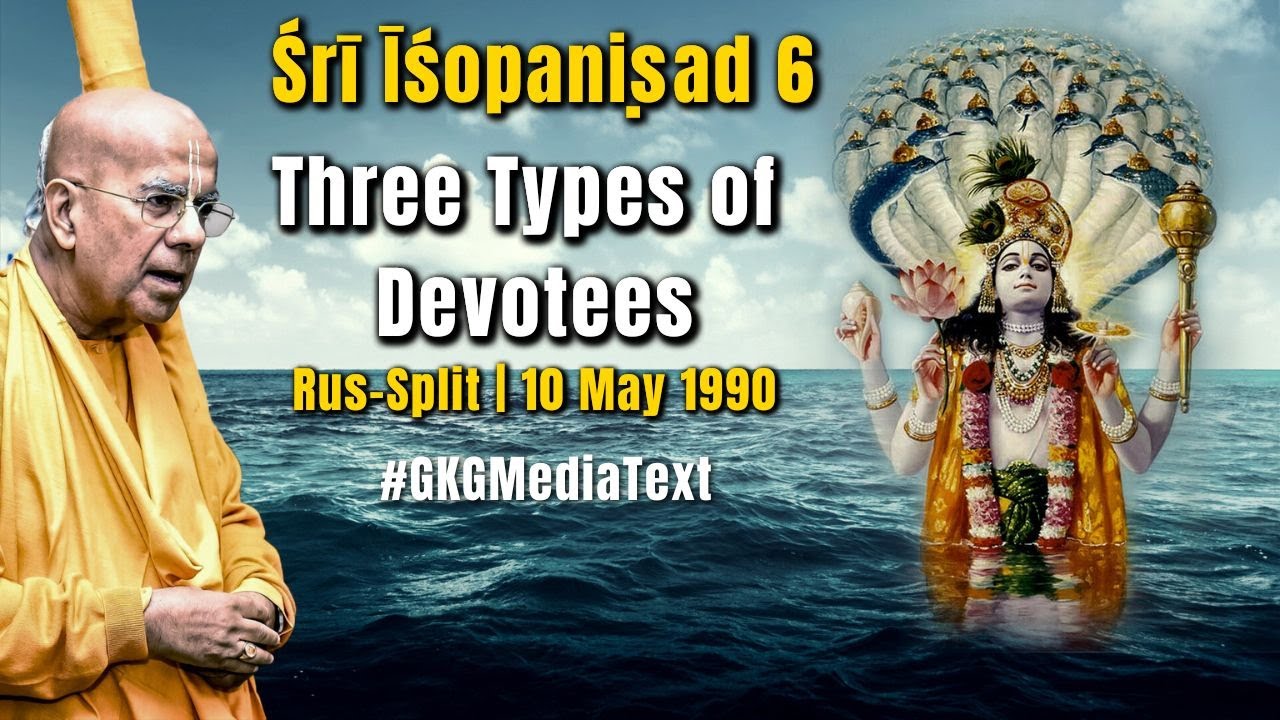
In this lecture Srila Gopal Krishna Goswami (Speaker A) expounds verse 6 of the Śrī Īśopaniṣad, focusing on the three categories of devotees described in A. C. Bhaktivedanta Swāmī Prabhupāda’s purport: kaniṣṭha‑adhikārī (the lowest), madhya‑adhikārī (the middle) and uttama‑adhikārī (the highest). He first chants the Sanskrit text, then outlines the Mahā‑bhāgavata’s view of the Lord’s omnipresence and the devotee’s relationship to the Lord. The lecture defines each class, their attitudes toward worship, other beings, and preaching, and links these qualities to real‑world religious conflicts, materialism, and the need for true spiritual leadership. The speaker stresses that true qualification—not birth—determines one’s status, that progress is achieved through guru‑paramparā, sincere chanting, and service, and that the Uttama‑adhikārī can guide society toward peace. A substantial Q&A segment follows, clarifying doubts about desire, preaching, the role of sannyāsa, and the practical meaning of the classifications. The talk concludes that the verse teaches the vision of seeing the Lord in all, and that cultivating the Uttama‑adhikārī attitude is essential for personal and societal transformation.
Questions this video answers
No, the uttama‑adhikārī has no material desires; the madhya‑adhikārī may have a little desire but can control it.
Yes, provided the madhya‑adhikārī truly follows his guru and the guru‑paramparā.
By following the orders of guru‑paramparā, sincere chanting, and practicing the four principles of the madhya‑adhikārī.
No; the essential requirement is that the master follows the guru‑paramparā, delivers the pure message, and sets a pure example.
A great devotee (mahā‑tmā) sees everything in relation with God.
Chapters
Om namo bhagavate vasudevaya! Ohm nomoh bahgawathe vaasudevayaaahh... Oomnamoo baaghwahte vassudheevayahyaan— "Om Namaha Bhagwathi Vasisuddhi Vaayas." ...Oumnumow Bahgwathee Vasu Deevaiahyyaam? "...Ohmnamo Baagaadeva Sudhevaiyah..." OM NAMOH BAAGWATHEE VA SU DEVAYAHYAN... OHMNAMA BHAA GA DE WAH SUDHEYVAIYAHAHHmm... So we're going to discuss text 6 of the Shri Ishopanishad. Yaas, yaas, yuh, yuh, sarvani, sarvani, utani, utani, atmani, atmani, evanupasyati, evanupasyati, sarva, sarva, Bhuteshu, Bhuteshu, Jātmānām, Jātmānām, Dāto, Dāto, Nāma, Nāma, Vijyugopasate, Vijyugopasate, Yāstu sarvāni bhūtāni, Yāstu sarvāni bhūtāni, Ātmānevanupasyati, Ātmānevanupasyati, Sarvabhuteshu Jātmānām, Sarvabhuteshu Jātmānām, Ātmānivānu paśyati. Ātmānivānu paśyati. Sarvabhūteṣu cātmānam. Sarvabhūteṣu cātmānam. Tat tvam na vijyugopasate. Tat tvam na vijyugopasate. Om Agyānātma-nandaśya-jñānānjanāśala-kyā-cakṣur-milatānyena tasmai śrī-gurave namah. Śrī Caitanya Mahāprabhuṣṇaṁ sthāpitā mīna bhūtelai, svayam rūpaka-dāmayāṁ dadāti svāpānanti-kām. Vande ham Śrī Guru Śrī Tapaḍakam lan Śrī Guruṇvaiṣṇava-nāsta. Śrī rūpam sāgajatam sahagana rāgu-nātāṇvitam tam sajevam. Sadveetaṁ sābuddhu-taṁ prijana-saītam kṛṣṇa-caitanya-devaṁ. Śrī Rādhā-Kṛṣṇa-prabhaṇsa-haginā-lalitā-śrī-viśākānetāṁ śrā. Jai Śrī Kṛṣṇa Caitanya Prabhu Nityānanda. Śrī Advaita Gadaḍa Śrī Vāsudeva Gaura-bhaktavṛndā. Hare Kṛṣṇa, Hare Kṛṣṇa, Kṛṣṇa, Kṛṣṇa, Hare, Hare, Hare Rāma, Hare Rāma, Rāma, Rāma, Hare, Hare. Yasya sarvani bhūtani ātmān evaṇu paśyati sarva-bhūteṣu-cātmānām tattva-nāvidyugopasate. So in the 5 verses that we have discussed so far, the Īśā Panishad has described the supreme position of the Lord and His transcendental attributes. But the Lord is never separated from His devotees. So after having described the transcendental nature of the Lord, the next 2 verses describe the nature of a pure devotee. Prabhupāda explains: that in this verse the position of a mahā-bhāgavata is being explained. What is the mahā-bhāgavata's special qualification? He sees everything in relationship with the Lord. He sees everyone as part and parcel of the Lord. And because he sees everyone as a part and parcel of the Lord, he feels respectful towards everyone. Therefore it is being explained, he neither hates anything nor any being. He has no enemies. In material society, everybody has some enemies. Sometimes one person doesn't like another person, one nation doesn't like another nation, one community doesn't like another community. But the Mahā-bhāgavat, He likes everyone. And the Īśa Upaniṣad explains that the Mahā-bhāgavat also sees that the Lord is everywhere. The Lord is also in every atom. So when you see the presence of the Lord everywhere, then you automatically understand that everything should be used in service of God. In the purport of this verse, Prabhupāda talks about three classes of devotees in society: uttama-adhikārī, madhyam-adhikārī, kaniṣṭha-adhikārī. The lowest of all three is kaniṣṭha-adhikārī. What is the kaniṣṭha-adhikārī's qualification. He goes to the place of worship, maybe the mosque, maybe the church, maybe the temple, maybe the synagogue. He thinks that God is only in the church or the synagogue or the temple and not everywhere. He cannot ascertain what is devotional service, and they just follow the routine rules and regulations thinking that my process of worship 'is better than your process of worship.' These kanishtha adhikaris are completely materialistic. They go to the place of worship, but they are not trying to develop pure love of God. And because they are always thinking that my worship is better than your worship, my religion is better than your religion, therefore there are also so many religious wars. Why are these religious wars being fought all over the world? Why is it that one community thinks his community is better than another community? Why is it that people think that one, one religion is better than another religion? This is due to not understanding what is real religion. Like in your country, the Muslims and the Christians are fighting in Armenia, and in India the Hindus and the Muslims are fighting, and in the Middle East the Jews and the Arabs are fighting, and in the, in Ireland the Protestants and the Christians are fighting. So all these so-called religious conflicts are going on because actually people are even below Kṇiṣṭhādhikārī level. And because they are even below that Kṇiṣṭhādhikārī level, they feel happy when they kill someone from another community. Just like in India, there's one community known as the Sikhs. You know, they wear turban and all. You may have seen that. So anyway, some of the Sikhs are at war with India. So all they do is they try and kill the Hindus now. And when they kill the Hindus, then they get lot of award from their community. So beyond the Kaniṣṭhā-dhikārī, you have the second level of devotee, which is known as the Madhyamādhikārī level. Madhyamādhikārī has four qualities, or there are four principles that he follows. First of all, he sees that there is one Supreme Lord. He acknowledges God and God is the chief. Then he sees the devotees of the Lord. Then he sees the innocent who have no knowledge about God, but if they are preached to, they can cultivate knowledge about God. Then he sees the gross materialists who have no desire to know about God, and even if they are preached to, they will not cultivate about God. So the madhyamādhikārī, he behaves differently in different situations. He loves the Lord and he wants to dedicate his life to God. He worships the Lord, follows the instructions of the Lord, and he makes friends with all those who are in devotional service. No one can live alone, so on the path of devotional service, certainly you can't live without devotees. He associates with other devotees, encourages them to do devotional service, and together they glorify the Supreme Lord. But then the Madhyamādhikārī also sees Oh, there's so many conditioned souls who have no knowledge about God, but if they are preached to, they will get attracted to God. They, in Kali-yuga, there are four principles of religion. The four principles of religion are austerity, cleanliness, mercifulness, truthfulness. So Prabhupāda says that in Kali-yuga, the quality of truthfulness is still there, in the sense that if the truthful message of God is presented, Then people will take to it. Just like Prabhupāda presented the truthful message of the Bhāgavad-gītā. He did not distort anything. He did not change anything. And what is the result? A spiritual revolution on this planet. It is not that the Bhāgavad-gītā is a new scripture. It is not that the Bhāgavad-gītā was only recorded in 1965, the year Prabhupāda came to the West. And it is also not that There was no translation of the Bhagavad-gītā before Bhagavad-gītā As It Is appeared. So the reason why Bhagavad-gītā, though translated many times, did not make any devotee, and the publication of Bhagavad-gītā As It Is has made so many devotees, is because the truthful message of Kṛṣṇa has been presented without any distortion. And the innocent people who are waiting for God consciousness have read these books and have come to realize, "Yes, this is the path, so let me take to this path." So if the truthful message is presented, then the innocent who are unaware about God will definitely take to this path. So the Madhyamādhikārī, as I said, he follows four principles. He sees the Lord, he sees the devotees of the Lord, he sees the innocent who have no knowledge about God, but who can take to God consciousness if they are preached to. And then the madhyamādhikārī, he sees those who are openly atheistic and those who have no faith in God. And those who are completely against God and atheistic, the madhyamādhikārī stays away from them. Prabhupāda says that the madhyamādhikārī doesn't go to those atheists who deny, who criticize the position of God. So the madhyamādhikārī He definitely has a preaching mood because he knows that the innocent, if they're given spiritual association, then they can be reformed. Based upon our purity, we can reform the conditioned souls by our association. Just like Haridas Thakur, the prostitute had come to seduce him, but Haridas was attached to the Holy Name and he was sincere devotee of the Lord. And in the end, what happened? The prostitute, she gave up her evil profession and became a devotee of Haridas. There was a hunter who made his killing his livelihood by killing animals. But that hunter, when he found out from Nāda Muni that this killing is very sinful and he will take on the negative karma, he gave up this profession and became so careful that he would not even step on over an ant. So beyond the Madhyamādhikārī level is the Uttamādhikārī level. He is considered in the most advanced stage of Self-realization. He sees everything in relationship with the Supreme Lord. He considers nothing independent of the Lord. Such a devotee of this type does not discriminate between an atheist and a theist or a devotee and a non-devotee. He knows the difference between a brahmana and a dog. He knows that if one is a brahmana, one is a brahmana due to his past karma, and if one is in a dog's body, it is also due to his past karma. He feels that a brahmana has not misused his position with God. So the Uttama Adhikārī, his vision is what is known in Vedas as the Vṛndāvan vision. Vṛndāvan vision means seeing Kṛṣṇa everywhere. When you have the Moscow vision, you see, or Leningrad vision, you see in terms of friends and enemies. Universal brotherhood means one family. The concept of one family under one father can only be understood from an Uttama Adhikārī. So we need an Uttama Adhikārī. Who can guide humanity as to how they can be, how they can live. By following the previous spiritual master, one is able to gradually realize perfection. So the uttama-adhikārī, he has a perfect vision. He considers the whole world to be part of his family. He has no friends, no enemies. He is everybody's well-wisher. So the uttama-adhikārī is also described in the Bhagavad-gītā In the Bhagavad-gītā, Kṛṣṇa says, vidyā vinayaḥ sampaṇe brahmane gāiviḥ astini śūnīchevaḥ sapaḥ ki caḥ sapaṇḍitaḥ samadarśanaḥ. Sapaṇḍitaḥ. Sapaṇḍitaḥ sees everyone with an equal vision. So, sapaṇḍitaḥ samadarśanaḥ vidyā vinayaḥ sampaṇe brahmane gāiviḥ astini. Vidyā. Vidyāya means spiritual knowledge. So the humble brahmana, by having this vidyā, transcendental knowledge, He is able to see everyone with an equal vision. Unless you have spiritual knowledge, you can't see everyone with an equal vision. Why is it that our politicians cannot see everyone with an equal vision? Because they do not have vidya, and because they don't have spiritual wisdom, they cannot understand the laws of God. So vidya vinaya samne brahmane kaivi hasina shuni chaiva svopakeya tsarpandita. So this Mahā-bhāgavata, one who has a perfect vision, is called by Kṛṣṇa as pandita, pandit. So pandit is a learned person. In Indian society today, the word pandit is very grossly misunderstood. We call almost anybody a pandit regardless of his spiritual qualification. So the perfect spiritual master, Mahā-bhāgavata, he has received knowledge through the parampara and he preaches according to shastra. In the Śrīmad-Bhāgavatam, it is said, dharmyam tu sakṣād bhāgavatpanitam. Religion means the laws of God. Śruti, smṛti, prāṇāḍi, pecherapancharaṭṭhaka videm vinā, ekāntiki haribhakti utpātaye vākalpate. That process of religion which is not based upon śruti and smṛti will simply create a disturbance in society. So in today's society, we have so many so-called religious groups, and every religious group is saying, my group is better than yours. So that is the tragedy. But the uttama-adhikārī does not get influenced by all this. He is always linked up with the Lord. In the Bhāgavad-gītā, there's a description of the uttama-adhikārī in one other verse where it is said, mahātmāna-simām prapadēvim prakrutiṁ āśṛtaha. So mahātmāna, the Mahā-bhāgavata uttama-adhikārī, he's always engaged in chanting the glories of the Lord. You cannot rubber stamp a Mahā-bhāgavata. Just like Prabhupāda used to say, they rubber-stamped Mr. Gandhi and they made him Mahātmā Gandhi. But Mahātmā word can only be used in connection with one who is always glorifying Kṛṣṇa. So the uttama-adhikārī, he follows the scriptures, he follows the paramparā. And the uttama-adhikārī is anxious to enliven others about the glories of devotional service. So Bhāgavad-gītā states in the 6th chapter that unless one is liberated from material desires, cannot become uttamādhikārī. This vision cannot be had by material politicians or after some material gain. This can only be realized by those who are just interested in serving the Lord without expecting anything in return at all. So the uttamādhikārī alone can show the path to the suffering humanity. Just like you have the United Nations. The United Nations has been formed for the purpose of creating world peace, isn't it? But the United Nations is not succeeding. The worldwide expenditure on armaments is about $5 billion a day. So why are we spending so much on arms? Because there's nobody to follow. So the leadership in society can be given by Uttama Adhikari. Yes, because they want to bring peace, but there is no peace. So we have to turn to the Uttama Adhikari for spiritual guidance. Just like in a body, They must be in the presence of the head, otherwise the body is considered dead. So if in the society there are no pure devotees, then the society is considered dead. So the uttama-adhikārī has a completely pure transcendental vision. But one should not try to imitate an uttama-adhikārī. One should not be a madhyam-adhikārī or kaniṣṭhā-adhikārī. No one should act like an uttama-adhikārī. And the uttama-adhikārī sees everything in relationship to the Lord. Phalāda's father was trying his best to get Phalāda. To identify people on the bodily platform. But Prahlāda was not at all interested because he was a mahajana, spiritual authority. So this verse is clearly stating that the pure devotee or mahā-bhāgavatara uttama-adhikārī, he sees the presence of the Lord everywhere. And if we serve the Lord with the understanding that I am fool number one, but the Lord knows what is best for me, then I can make spiritual advancements. When Caitanya Mahāprabhu was asked, As to why he wasn't chanting, reading the Vedānta instead of chanting the Hare Kṛṣṇa mantra. What did Caitanya Mahāprabhu say? He said, "People considered that I was a fool. My spiritual master thought I was a fool. So he told me, 'Just chant Hare Kṛṣṇa.'" So the uttama-adhikārī is very urgently needed. Uttama-adhikārī who sees everyone as a part and parcel of the Lord's body. He is the eternal well-wisher of everyone. Just like whenever Prabhupāda would write a letter to any disciple, he would say, your ever-well-wisher. Because the uttama-adhikārī is the eternal well-wisher of everyone. He has no enemies, but he wants everyone to prosper spiritually. Therefore, he's anxious to help everyone on the spiritual path. So the uttama-adhikārī must be in society. And by following the uttama-adhikārī only can you make spiritual advancement. Just like in our ISKCON society, we follow the topmost uttama-adhikārī, Śrīla Prabhupāda. Everything that Prabhupāda gave us is now proving to be so practical. And we are finding how by following this path it is so easy to give up sinful activities. So this Kṛṣṇa conscious movement is based upon the books of Śrīla Prabhupāda. And the books of Śrīla Prabhupāda contain not only his commentaries but also the commentaries of all the previous Ācāryas. And they are all the tamādhikārīs. And since Prabhupāda has summarized the commentary of the previous Ācāryas, when we read these books and we distribute these books, we are giving the uttama-adhikārī a chance to enter into the heart of everyone. The uttama-adhikārī, being well-wisher of the society, is always keen that everyone takes to devotional service. His bodily convenience is not important. Just like we saw in the case of Prabhupāda, so many times he would be so sick, doctors would tell him, please take rest, please take rest. But as soon as Prabhupāda would find out that somebody has come to see him, he would say, "Okay, let him come in." Why was Prabhupāda ready to preach even when doctors had told him to keep quiet and take rest? Because Prabhupāda knew that if he did not preach, nobody may preach to this individual. And if nobody preaches to him, then he'll miss the chance of going back to Godhead. So the Mahā-bhāgavatara uttama-adhikārī, he can give the manifesto by which society can be run. They can deliver society from the cycle of birth and death. And the Mahā-bhāgavat is a perfect example of spiritual life. And because he's a perfect example of spiritual life, he can inspire others also to the path of spirituality. So what we need in society today are Mahā-bhāgavats. What we need in society are these uttama-adhikārīs. And what we need in society are these books of Prabhupāda which are the same as the Mahā-bhāgavats philosophy. So in this verse, the author of Śrī Īśopaniṣad is giving us an explanation of the Vaikunṭha vision of the Mahā-bhāgavata. And we have explained how that there are three types of devotees. So with this, we'll end our discussion on this verse.
But uttama-adhikārī has no any material desires. And does it mean that madhyam-adhikārī has any material desires?
Manyam-adhikārī may have a little desire, but he can control it. But uttama-adhikārī has no desire at all. The madhyam-adhikārī, as I said in the class, is very dear to the Lord. But the amādhya-adhikārī knows his limitation, and because amādhya-adhikārī knows his limitation, he doesn't try to preach to the atheist. It is said that uttama-adhikārī, because of their spiritual vision, they see all the living beings in the same level because they see the spiritual selves on them. So they are not able to preach. And so in order to— They are not able to?
To preach.
Because they see that all is normal. And so they go down to the level of madhyamādhikārī and there they begin to preach. The uttama? Yeah. In other words, what you are saying is sometimes the uttama-adhikārī takes on the role of Madhya-mādhikārī to do the job. Just like when there is no Kṛṣṇa— sorry, just like sometimes when there is no Brahmā, Kṛṣṇa plays the role of Brahmā. So the uttama-adhikārī comes down to preach through the medium of madhya-mādhikārī. The problem in society is the kaniṣṭhā-adhikārīs are acting like the madhya-mādhikārīs, and the madhya-mādhikārīs acting like the uttama-adhikārīs. So those who have no knowledge about God or those who have very limited knowledge of God, they are acting like madhyamādhikārī. And those who have a little knowledge about God, they are saying, "We are uttamaādhikārīs." Like the Pope today is as separate as uttamaādhikārī, isn't it? At least for the Christians. But he can't even control his own senses to the extent that he must have meat every day. So similarly in India, in India there are so many so-called gurus They call themselves Jagadguru. Jagadguru means leader or guru of the whole world.
Every jīvātva become uttama-adhikārī. Or uttama-adhikārī only nitya-siddhis.
Or uttama-adhikārī what?
Only nitya-siddhis.
Every jīvātva can become an uttama-adhikārī. That is our philosophy. Our philosophy is not that you are a Brahmin by birth. Bhāgavad-gītā says, cha tur vannam mayāśrītam guna-karma-vibhāgasaḥ. Guna, according to the three modes of nature, before social and spiritual orders are created. When Prabhupāda's spiritual master Bhaktisiddhānta Sarasvatī was preaching, he was openly preaching that one can become a Brahmin only on the basis of qualification. So once the Brahmins in India, the caste Brahmins who were there, They had made a plan to kill Bhaktisiddhanta Ji because he was trying to preach. He was preaching openly. You cannot be a Brahmin on the basis of birth. You have to be on the basis of qualification. So these Brahmins had decided that they were going to murder Bhaktisiddhanta Ji. So in India, if you want to do some crime or something else, you usually tell the policeman, I'm going to do that. Here is your commission. Now don't bother us, huh. So they had told the police inspector where Bhaktisiddhānta Dāji was living in Calcutta, that we are going to kill this man. You please don't do anything. Bhaktisiddhānta Dāji was openly exposing these bogus so-called gurus and sampradāyas who are saying, oh, I am born in this sampradāya, now it should be Only I can be a Brahman. Nobody else can be Brahman. Some of you went to India. You may have gone to Jagannath Puri. There's Lord Jagannath Puri, very famous temple of Lord Jagannath. Now in that temple, they don't let anybody who is not a born Hindu go inside. Prabhupāda was very much against it. Prabhupāda said Jagannath means Lord of the universe. So how can you say Lord of the universe and the temple's only for the Hindus? Prabhupāda was so upset at these people. That he wanted ISKCON to build a big Jagannātha Puri Temple right in front of the old temple.
By which means can tanistha-adhikārī advance himself, lift up, up to the level of madhyam-adhikārī?
By following the orders of guru-paramparā. Therefore, one of you had asked that question, anybody can become an uttama-adhikārī by, for qualification. Kṛṣṇa is equal to everyone. Just like the sun is shining equally over everyone, whether it's a mountaintop or a barren field. When the clouds pour water, the clouds pour water equally over everyone. So Kṛṣṇa is also equal to everyone. So if you follow, it doesn't matter whether we may have taken our birth in a mleccha family, but if we follow the process, then we will become purified. Just like when Prabhupāda first went to India in early '70s with his Western disciples, many of these so-called traditional, so-called Hindus started criticizing Prabhupāda. Even some of Prabhupāda's own godbrothers were criticizing him. They were saying, "Oh, he's giving initiation to these Western hippies. He's giving initiation to these women." So there were so many fault-finders who were saying anything. So the point is that we have seen practically that does not matter what your background is. If you take to this process in a pure manner, the process will work.
Can we consider the second brahman initiation Like devotee becomes madhyamādhikārī in the sannyāsa, except in sannyāsa, like, he becomes tamādhikārī.
It's not so easy. You can even have sannyāsa initiation and you may be at the kṛṣṇaṇṣṭhādhikārī level. I mean, you can be, I said, not that he is, but he can be. But every devotee in ISKCON, especially after he is chanting Hare Kṛṣṇa mantra for some time, He must come and operate at least at the madhyam-adhikārī level. He must lift himself at least to the madhyam-adhikārī level. Uttama-adhikārī is a very, very advanced stage. This is interesting, huh, this verse?
Sometimes devotees try calculate on which level they are. And how should we consider such attempts to— Understand.
The problem is that most devotees are thinking they are at the uttama-adhikārī level and the others are at the kaniṣṭhā-adhikārī level. They have already decided that they are at the paramahansa level. The problem is figuring out where others are, what level the others are. So the thing is, as far as the devotee is concerned, he always thinks that he is at the lowest of all. Even if a devotee is at the uttama-adhikārī level, He will say that I am neophyte. Caitanya Mahāprabhu was God Himself, but Caitanya Mahāprabhu said, "My dear Lord, You are so merciful that You have put all Your transcendental energies in Your holy name, but I have no attraction for them." Prabhupāda had done so much work, isn't it? I was standing next to Prabhupāda when he was getting ready to leave his body. This was few days before he left his body. And Prabhupāda was saying, "I have done nothing at all. I just tried to follow my spiritual master, but I didn't do anything. Everything was done by him." So the point is that uttama-adhikārī, even if he is at that level, he will not say, "I am uttama-adhikārī." But the problem, like in India, in India you have so many sampradāyas and so many gurus. But these so-called bogus gurus, they call themselves Paramahansa Hanumān, Bhagavān, Swami so-and-so. Therefore Prabhupāda did not like using the word Jagadguru for him. One Swami in India goes from India to London for one day and he comes back and says, "I am now Jagadguru." So Prabhupāda said he did not want Jagadguru to be used for him. Say, even though Prabhupāda is the real Jagadguru, but we don't call him Jagadguru because we don't want to mix him with these other so-called cheaters.
Is it true that even Madhyamādhikārī can be a spiritual master and accept disciples.
Yes, as long as the madhyamādhikārī is truly following his guru, he can accept disciples. But he must be truly following his guru. Our Kṛṣṇa conscious process is so perfect that anybody who follows the guru and paramparā will be able to deliver the others also from the cycle of birth and death. Sometimes devotees keep figuring out, "Oh, now who is uttama-adhikārī, who is madhyamādhikārī?" You will never be able to figure that out.
Should we consider our spiritual master to be tamācikāra?
You should consider your spiritual master to be like the pure representative of Kṛṣṇa. In the Caitanya-caritāmṛta, Prabhupāda says that if somebody saw Nityānanda, somebody said Nityānanda has gone to the bar, to a liquor shop, but somebody knew that if Nityānanda has gone to the liquor shop, he has gone to preach to the person inside. So the point is, the disciple should always consider his spiritual master as the true messenger of God. But this does not mean that the spiritual master misuses this faith of the disciple. The spiritual master also has to be the perfect example of spiritual purity.
It is said that even on the level of Smātyāmādhikāre, the devotee sees that there is no different religions, the God is one and so on. And if all the teachers of different religions are at least on the level of Madhyamādhikārī, why is there so many different religions?
Well, the problem is the so-called religious leaders are not at the level of Madhyamādhikārī. Take for example, the biggest religious groups in the world, religious following is what? Christianity and Islam, isn't it? So they eat beef, meat, everything. So they are not at the Madhyamādhikārī level. So if the worldwide guru is not at the Madhyamādhikārī level, how can the follower be at the Madhyamādhikārī level?
You said that the spiritual master may be on the level of Madhyamādhikārī or Tamādhikārī. Makes it any difference for disciple, or the only important thing is that he is connected with Parampara through his guru?
So if the disciple sits down with a paper and pencil, and every word that the spiritual master takes out of his mouth, he tries to figure out, was he a uttama-adhikārī or madhyam-adhikārī, then the disciple is bogus, and the disciple will be wasting his time. So as long as the spiritual master is following his spiritual master in a pure manner, and he is delivering the pure message, and he is setting a pure example, the disciple must accept him as a bona fide agent of God.
Sometimes when devotee consider himself to be so fallen, it make troubles for his preaching, disturb him in preaching.
His preaching, yeah.
Because he is, yeah, I don't know.
Just because the devotee thinks he is very humble, Or just because the devotee is acting in a humble manner doesn't mean that. We do not believe in artificial renunciation. Artificial renunciation means when it is time to speak, you keep quiet. Just like I gave you that story, once Prabhupāda in, in 1977, Prabhupāda was lecturing every evening in Rishikesh in India. So, you know, if you have heard Prabhupāda's lecture tapes, you may have noticed Prabhupāda lectures very strongly and uses words like rascals, mūḍha. Prabhupāda said, when you are standing on a strong platform, then you can speak boldly. So there was one American lady in the audience. So that American lady said, Swāmiji, Swāmīs are not supposed to speak like this. Why are you using words like rascal and fools? And so Prabhupāda said, when you have a boil, You don't blow over that boil, but you press the boil, take the pus out. So the point is that just because one is considering oneself to be humble doesn't mean when it comes to speaking of philosophy he keeps quiet. In the Śrīmad-Bhāgavatam it is said that just like the branch of a tree, the branch of a tree, if it is carrying a lot of fruits, then due to the weight of the fruits of that, the weight of the fruits, The branches of the tree are being pulled down, and if the branch is not carrying any fruits, then the branch shoots up. So similarly, if one is developed in love of God, even if he is at the uttama-adhikārī level, he will act like at a very low level. He'll act like a— he'll act very humbly and very humbly. Okay. Any more questions? Any more questions on this topic? So I will ask questions. What is the key point of this verse?
It is said here that a great devotee, mahātmā, sees everything in relation with God.
How many classes of devotees does Prabhupāda talk about in the purport?
Atyaṁ yuktāṁ.
What is the definition of a kaniṣṭha-adhikārī?
Who can see the Lord only in the place of worship.
What else? What else does he do? Kanishtha Adhikārī has one other point which I mentioned.
She said that they consider their worship is best.
Kanishtha. And Madhya-mādhikārī. What are the principles of the Madhya-mādhikārī?
He loves the Lord, worships Him.
What else?
Follows His instructions. Follows His instructions.
So what are the four principles of Madhya?
Lord and worship Him. Understand who is devotee and make friends with them.
Does the Madhya Madhikari preach to everybody? No. Who does he not preach to? Beaters. And what is the definition of an Uttama Madhikari?
He sees Lord everything. And he sees that everyone is engaged in service to him, but he is preaching anyway.
Which is that verse in the Bhagavad-gītā that talks about the uttama-adhikārī? This is a little difficult question. I mentioned that verse twice in the lecture. Or if you don't know the Sanskrit, tell me the translation in ruski. Can anybody become an automatic hari or you only become an automatic hari on the basis of birth?
Everyone.
Everyone? So all of you are automatic haris? Are you automatic hari at the moment?
Everyone may, can come.
Ala ma ale ale.
More from PRASAD

Rare Pastimes & Timeless Lessons of Guru Mahārāja | Stories Every Disciple Should Hear

ISKCON Legends- pure devotees meet-HH Jayapataka Swami, HH Gopal Krishna Goswami, HH Radhanath Swami



Jagannātha Ratha-yātrā Through Śrīla Prabhupāda's Mercy | 29 April 2006 | Nairobi, Kenya

Lord Jagannātha's Appearance Pastime | 21.07.2019 | ISKCON Calgary | Śrīla Gopāla Kṛṣṇa Gosvāmī

The Ācārya Teaches by His Own ExampleGuṇḍicā Mārjana by Guru Mahārāja #shorts

Guṇḍicā Mārjana – Lord Jagannātha's Pastime | 21.7.2019 | ISKCON Calgary |Śrīla Gopāla Kṛṣṇa Gosvāmī

H.H. Gopāla Kṛṣṇa Gosvāmī Mahārāja - Exemplary Sādhana and Deity Worship # shorts

भगवान की कृपा कैसे प्राप्त होगी ? | 11 Jan 2014 | Punjabi Bagh | Srila Gopal Krishna Goswami

Material Education vs Spiritual Education | Srila Gopal Krishna Goswami #shorts