Śrī Īśopaniṣad 7: How to be free from anxiety? | Rus-Split | 12.5.90 | Srila Gopal Krishna Goswami
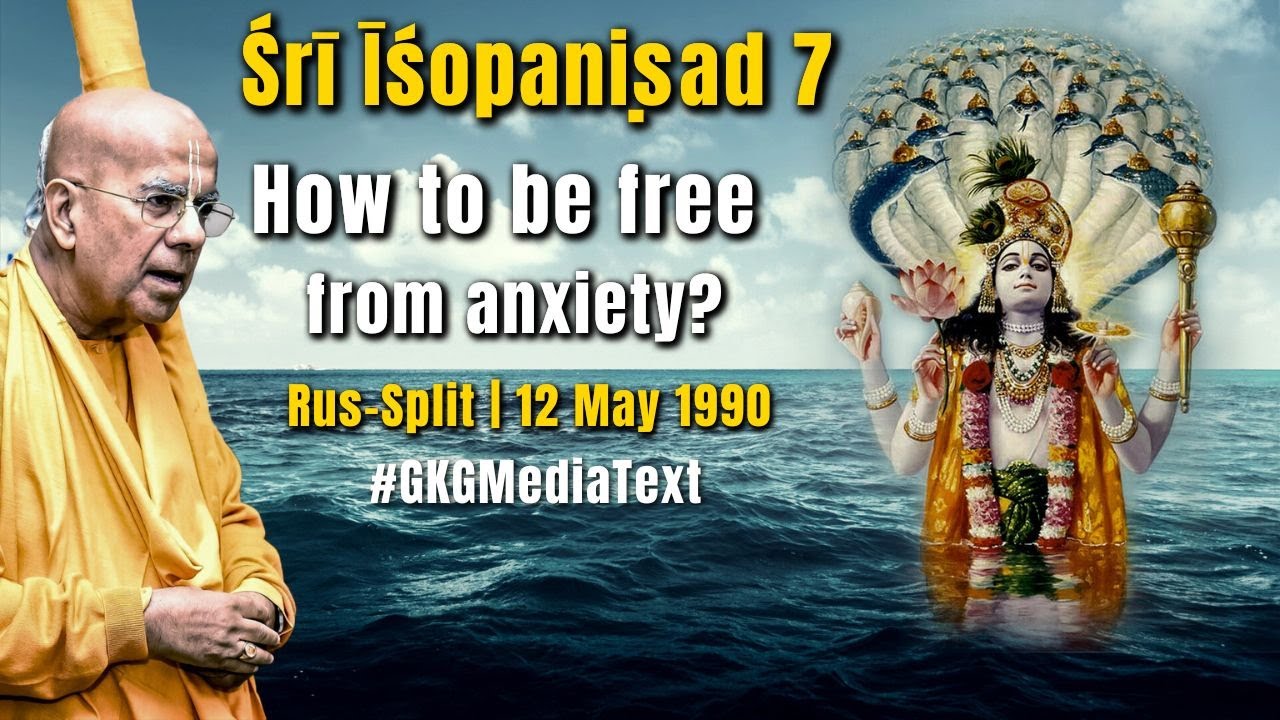
In this extensive lecture, Srila Gopal Krishna Goswami (with audience interaction) examines verse 7 of the Īśopaniṣad, linking it to the Nectar of Instruction and the Bhagavad‑gītā. He explains the three categories of devotees—kaniṣṭha‑adhikārī (lowest), madhyam‑adhikārī (intermediate), and uttama‑adhikārī (pure)—and how only the higher levels can see all living entities as spiritual sparks, thereby eliminating illusion and anxiety. The talk emphasizes that the soul is identical in quality with the Supreme Lord but differs in quantity, and that identification with the body creates anxiety. To transcend this, one must relinquish sense‑gratification, practice regular chanting (japa), associate with devotees, and cultivate humility. Numerous scriptural analogies (sparks of fire, drop of water) and vivid examples of animal weaknesses illustrate how sense‑driven desires lead to death. The lecture contrasts material happiness (temporary) with spiritual happiness (permanent and ever‑increasing, as described by Rūpa Gosvāmī and Caitanya Mahāprabhu). Practical Q&A covers topics such as dealing with insects, feeling detached from the body, dress code, inter‑faith views on animal souls, and the distinction between eternally liberated (nitya‑siddha) and eternally conditioned (nitya‑baddha) souls. The overall message is that true knowledge of one’s spiritual identity removes both material and devotional anxiety, guiding devotees toward self‑realization and service to Krishna.
Chapters
Today I will lecture on Īśopaniṣad, Nectar of Instruction, and Bhagavad-gītā. I, in Moscow, I started the lecture series on Śrī Īśopaniṣad, which I would like to continue. I think you also have the Russian edition of Śrī Īśopaniṣad. And then at about 3 o'clock We will take a break for 1 hour, huh? No spiritual program is complete without prasad. And then after that I will lecture on Śrī Udayaśrīmita. So this is a book that was compiled by Rūpa Gosvāmī and translated by Prabhupāda under the name of Nectar of Instruction. In this book Rūpa Gosvāmī talks about the basic guidelines for spiritual advancement. And after the nectar of instruction, if possible, in the evening we'll take on a little discussion from Bhagavad-gītā. Since all of you are devotees of Caitanya Mahāprabhu, I was thinking that tomorrow we'll do Caitanya-carṭamṛta discussion and discuss Caitanya-līlā. Caitanya-līlā means pastimes of Caitanya Mahāprabhu. And of course we will continue our discussion on nectar of instruction and Īśopaniṣad. Om namo bhagavate vāsudevāya. Om namo nārāyaṇa. Om namah bhagavate vasudevaya. Om namah bhagavate vasudevaya. Om namah bhagavate vasudevaya. So as we had announced, we will first discuss the Śrī Īśopaniṣad. How many devotees in this audience have read the Russian edition of the Śrī Īśopaniṣad? So then you will be able to follow me. So In the mantras that we have covered so far, the following points have been made by Vyāsadeva. One, he establishes that the Lord is complete in all respects. Because the Lord is pūṇaṁ, His creation is also complete. And His creation being complete means within this creation there is complete facility for us to develop love of God. Then it was established That the Lord is the proprietor of everything. And since the Lord is the proprietor of everything, everything should be used in service of God, and one should only accept for himself as much as he needs for his own survival. You may remember that Śrīla Prabhupāda, when he first came to your country, he used this verse of the Śrī Īśopaniṣad as the theme of his discussion with Professor Katarski. And this verse is: Isha Vashayidam Sarvam Yad Kinccha Jagadyan Jagat. And then the Isha Upanishad states that if you accept this understanding, then everything belongs to God, and you should only accept what you need for your survival, then you may live for hundreds of years, but you will get no sinful reaction. And after that, the Isha Upanishad has stated that if one does not accept that point And when he becomes an asura, a demonic person, then he will be sent to the hellish planets. And then the Isha Upanishad points out the supreme nature of the Lord by presenting that he is omniscient and that he walks and he doesn't walk, he moves, he doesn't move, he's within everything and outside everything. Because the Isha Upanishad has also stated that the Supreme Lord is in one place, but he can overcome everyone, and even the demigods are under him. And then the Isha Upanishad talks about that perfect devotee who sees everything with the proper angle of vision. So with this background, we will now proceed with text 7. So in all our ISKCON temples around the world, the person who's giving the class first chants the Sanskrit words And then the devotees respond. They chant after him. So we would like all of you to chant after me. You don't have to feel shy even if you make any mistakes. Yāsmen. Yāsmen. Sarvāni. Sarvāni. Bhūtāni. Bhūtāni. Ātmāivābhod. Ātmāivābhod. Vijānataḥ. Vijānataḥ. Tat Tvam, Tat Tvam, Om, Om, Moha, Moha, Karaha, Karaha, Shoka, Shoka, Ekadvā, Ekadvā, Anupāsyataḥ, Anupāsyataḥ. Now we will chant the same words but in a faster melody. And after I chant few times, I'm going to ask all of you to chant. Yasmin Sarwani Bhutani. Yasmin Sarwani Bhutani. Atmai Vabudh Vijanataha. Atmai Vabudh Vijanataha. Jatra ko mohaka shoka. Jatra ko mohaka shoka. Ekathvam Anupashyataha. Ekathvam Anupashyataha. Yasmin Sarwani Bhutani. Yasmin Sarwani Bhutani. Hare Kṛṣṇa! Hare Kṛṣṇa! Kṛṣṇa! Kṛṣṇa! Hare! Hare! Hare Rama, Hare Rama, Rama Rama Hare Hare. In order to understand this text 7, we are going to read the translation of text 6 also, because text 6 and text 7 are very similar in meaning. So in this verse, the position of the Madhyam Adhikari and Uttama Adhikari is being described. Essentially In society, there are three classes of devotees. One is the uttama-adhikārī, next is the madhyam-adhikārī, and below that is the kaniṣṭha-adhikārī. The kaniṣṭha-adhikārī is the lowest of the three types of devotees. The kaniṣṭha-adhikārī, he thinks that God is only in the place of worship, and he does not have complete faith in God, but he recognizes that there is some supreme controller. Such a devotee considers God to be present only in the place of worship. It may be a mosque or a church or a temple. And such a devotee is always thinking, my style of worship is better than your style of worship. So my religion is better than your religion. Just like in your country and in so many other countries, there's so many religious conflicts today. In some parts, the Muslims are fighting the Christians, and in some parts, the Hindus are fighting the Muslims, and in some parts, the Christians are fighting the Protestants, some parts the Jews are fighting the Arabs. So sometimes the average person says, why should I come to religion? There's so many religious conflicts all over the world just because of religion, so I don't want any religion. So unfortunately, people do not know what is real religion. In the new real religion, there would be no such conflict. So the next few days we shall define real religion as explained in the Śrīmad-Bhāgavatam. Now beyond the kanishta-adhikārī, you have the second level of devotee known as the madhyam-adhikārī. The madhyam-adhikārī devotee is aware of four— the madhyam-adhikārī has four principles. One is he sees the presence of God everywhere. Then he sees Those who are innocent and are not aware of God, but who, if they are preached to, they will take to God consciousness. And then he sees those who are openly atheistic and agnostic to God and who have no desire to understand God. Beyond the Madhyamādhikārī is the Uttamādhikārī or the pure devotee. So the Uttamādhikārī is also known as Mahā-bhāgavata. The previous verse has explained how the uttama-adhikārī sees everything in relationship to the Supreme Lord. Now in this verse, the author of the Īśāpaniṣad, Śrī Vyāsadeva, is saying, "One who always sees all living entities as spiritual spark in quality, one with the Lord, becomes the true knower of things." This verse is establishing that in quality we are one with the Lord. But does this mean that we have become bhoga?
No.
We are one in quality but not in quantity. Just like— and Prabhupāda gives a nice example— sparks of a fire. You understand sparks of a fire? So one spark of fire is the same in quality as a big fire, but the potency of that one spark is not the same as the potency of the fire. Or A drop of water from the ocean. So suppose you take a drop of water from an ocean, a drop of water from the ocean in taste is the same as the whole ocean. So you can say in quality is the same, but in quantity, a drop of water and the vast ocean, there's a big difference. So there is no doubt that we are one in quality with Lord. The Lord is Nitya and we are also Nitya. Nitya means eternal, but There's a big difference. Nityo nityanam cetanam cetananam eko bhavnam vedati kāmaṁ. That singular living entity who is also eternal like us, he is responsible for maintaining all other living entities. So that singular entity is maintaining all other entities. You are also a citizen of Soviet Union and Mr. Gorbachev is also a citizen of Soviet Union. But there's a big difference. He is the president and you're an ordinary citizen. So the living entity in quality is one with the Lord. But not in quantity. This point must be very clearly understood. This verse is saying that if you see everyone as spiritual sparks, then you cannot be under any illusion or anxiety. The illusion that the living entity is affected by is due to identification with his body. As long as you are, as long as you are identifying with this body, you will have anxiety. But the moment you give up this bodily identification, the moment you understand, jīvēra-sūru-pāya kṛṣṇa-nitya-dāsa, I am the eternal servitor of the Lord, your anxiety will go away. In the Śrīmad-Bhāgavatam, there's a nice story of a prostitute by the name of Pingala. This prostitute had decorated herself very nicely, and she was standing in front of the door looking for a customer. Every man who was passing by She was thinking, "Oh, maybe this next man is going to be my customer." The evening came and there was no customer. Then finally the prostitute Pingala threw her jewelry away and everything, and she became an ordinary woman. And when she threw her jewelry away and gave up the desire to get any more customers for money, then anxiety went away. So once you give up this illusion that you are this body, then you also give up all your so-called material desires that the different senses are begging you to satisfy. The senses are always begging for satisfaction. Does not matter which part of the world you may go to. In your country they have a socialist type of government, and in some countries they have capitalist government. But doesn't matter whether it's communist, socialist, capitalist, basically everybody is hankering for sense enjoyment. I travel all over the world preaching this Bhagavad-dharma philosophy. Everywhere I see Basically, the Bhāgavatam is 100% right. People are just interested in aha-nidra-biddha-bhaya-maithuni-āca. They are just interested in eating, sleeping, defending, mating. So the correct understanding, that is everyone is part and parcel of God, can only be obtained if at least you come to the madhyam-adhikārī level. Because even if you are at the kaniṣṭha-adhikārī level, you cannot give up your propensity for sense enjoyment. And as long as you accept sense enjoyment as the goal of life, doesn't matter whether you go to the place of worship or not, you cannot give up your anxiety and you cannot give up over-endeavouring just to satisfy your material needs. So the point is that sense enjoyment must be given up, and that is the purpose of the entire Vedic scriptures. In the Srimad Bhagavatam, it is said, for example, Ka māsa nendriyā pṛthi labho jīvita yāvada jīvasya tatva-jijyāsa. Now you've got this human life. Jīvasya tatvajjigyāsa. Inquire the purpose of life. Don't use it for sense enjoyment. The animals, they only think of sense enjoyment, and the animals meet their destruction also through the process of sense enjoyment. For example, you have the fish. The fish has one big weakness, that is the weakness of the tongue. The fish always likes to eat anytime. You give the fish something to eat now, half an hour later something more to eat, the fish is ready to eat. So when the person wants to go fishing, what does he do? He puts a type of food on the bait. The fish sees that bait underneath the water and the fish is thinking, "Oh, now is chance for me to have another feast." So the fish goes to eat that bait and it gets caught in the fisherman's trap. Then you have The deer. The deer is an animal that is very difficult to capture, but the deer has one weakness, and that is it is fond of a particular melody. So when the deer— when the hunter wants to capture the deer, he plays a particular melody. Have any of you seen a deer running? Dhaaniyat. The deer runs so fast that nobody can catch the deer. So what the hunters do, the hunter knows the weakness of the deer, so the hunter plays a particular melody, and then the deer stops. It says, "Oh, where is this melody coming from?" And while the deer is trying to find out where the melody is coming from, the hunter shoots him. So here's an example of a deer that meets its death through— because of the weakness of the ears. And a fish meets its death, why? Because of the weakness of the tongue. Then you have the bee. The bee, the cello's weakness is the nose. So the cello is all day looking for something nice to smell. So the cello eventually finds a lotus flower. And when it finds a lotus flower, it just goes into complete trance in samadhi. Says, "This is the fragrance that I was looking for all my life." Just like in material life, when you get something, you think, "Oh, this is exactly the relationship you were looking for." So today it's a relationship that you're looking for, and tomorrow is the relationship that you hate, so it becomes a divorce. So the bee sits down in that lotus flower And in the evening, by the law of nature, whether the lotus flower is in Soviet Union or India or America, it closes. And when the lotus flower closes in the evening, by the laws of nature, the bee gets trapped to death. So here is the bee that dies because of the desire to satisfy its nose. Then you have another animal called— it's like an insect that is attracted to light. They call it the moth in English. M-O-T-H, moth. So that moth is all day waiting for light. Usually you find the moth in tropical countries like India. Maybe they find it in the Asia segment of Soviet Union, not in Ukraine. I don't think there are any moths that are citizens of Ukraine. So the moth is looking for light, and in the evening, by the arrangement of the— when the lights are put on, the moth is very, very happy. And it says, "Oh, I was waiting for this light." So the moth goes and sits down on that light. And when the moth goes and sits on the light, what happens? The heat of the light destroys the moth. And then you have the elephant. The elephant also is an animal who is very difficult to capture, but the elephant's weakness is sex desire. So the hunter trains up the she elephant in such a way that the he elephant follows the she elephant. And by this process, the he-elephant falls in a ditch. The hunter digs a ditch and he covers it with grass. So the he-elephant, the moment he steps on that well, on the ditch covered by grass, he falls in the ditch. So we have given you just these 5 examples which are from the Vedic scriptures to point out that as long as we identify with this body, we will always be in anxiety because The eyes are saying, "Show me some beautiful person." The ears are saying, "Give me some modern music to hear." The tongue is saying, "Give me something to, without discrimination, to eat." The nose is saying, "Give me something nice to smell." And the genitals are saying, "Give me satisfaction." So because as long as we are identifying with the body, these senses will push us for more and more, more and more. Well, Rūpa Gosvāmī has said, "Kāmadīna palita dūrṇī-deśa." He says, "I have been trying to satisfy my senses since time immemorial, but there is absolutely no satisfaction." So one who has spiritual understanding, he understands that we are all pure spirit souls, part and parcel of the Lord. Like we all know, and all over the world today, one community members are fighting with another community, one religious group is fighting with another group. But you do not find anywhere in ISKCON, anywhere, one community fighting with another community, or one, one so-called, uh, one Indian fighting with American, or one European fighting with somebody else, or some devotee from Ukraine fighting with another devotee from another republic because on the, on the basis of bodily platform. Because we know that this body is not our real identity. Spiritual life means to understand your identity in the first place. Just like when you travel abroad, when you travel abroad, what do they ask you? They ask you 3 basic questions. First question they ask is, who are you? So you say, I'm Mr. Alexander. Then they ask you, where are you coming from? And you say, I'm coming from Kyiv. And then they'll say, where are you going? So you tell them, I'm going to my brother's house. So the point is, just like in order to be allowed to enter into any country, you have to answer these 3 questions: who are you, where are you coming from, where are you going to go? Similarly, for spiritual advancement, we also have to know the answers to these 3 questions, because unless you know the answers to these 3 questions, you will not be able to see everyone as spiritual spark and parcel, spiritual sparks, parts and parcels of God. Therefore, we see that the Bhagavad Gita starts with the philosophy on who you are. The first chapter of the Bhagavad Gita is simply a description of the 2 armies. The real philosophy starts from the second chapter. So the philosophy of the second chapter is very much related to the verse that we are discussing in the Isha Upanishad today, because the philosophy of the second chapter establishes that you are not this body. If you are not this body, then who are you? Pure spirit soul. And what is the nature of this soul? Na jayate mriyate vā kadācena yabhūtabhāvitabhānavhūya. Ajñānityaśāśuḥ vajñāṁ puraṇaḥ naḥ anyate hanyamāne śarīre. The Bhāgavad-gītā states the nature of the soul is na jāyate mṛyate, never takes birth, never dies. It is the oldest living entity. So the Bhāgavad-gītā says that one who is a dīrā, dīrā means a self-controlled person. In society today, people don't believe in self-control. But we say without self-control you cannot understand bhoga. So self-control must be there. So Bhagavad-gītā says, dheno'smeṇ yathā deh kāmaraṁ yam naṁ jaraḥ yathā dehṇ prapit tathā dhiranda-pūyati. That one who self-realized, he understands that just like this body is changing, the soul eventually leaves the body and enters into another body. So the body, however, is made of 5 gross and 3 subtle elements.
Whether it's Russian body or Indian Indian body, American body, or Ukrainian body.
Everybody's body is composed of these 8 elements: humi, rapo, nana, vayu, kam, manabuddhi, eva, cha. Earth, water, fire, air, ether, and mind, intelligence, and false ego. So this body, which is composed of 8 elements, goes through 6 different stages of development. First stage of development is called birth. So everybody comes out of the mother's womb. Whether it's a human being or an animal. Then growth. Just you come out of the mother's womb, then the children grow. Just like there's some children in this room there now. At one time, you and I were also like those young children. Then a certain age will come when the children will stop growing. Like at a certain age, 14, 15, 18, we stall. We all stop growing in height. Then we produce byproducts. A man and woman get married and they have children. When the body is beginning to get old, we try our best to avoid, we try our best to hide it. Next time you meet an old man and you want to make him happy, you just have to say one statement. Tell him how young he looks. If he's 60, tell him you look like 40, and he'll be so happy. Because nobody wants to look old. And next time you want to insult a young man, you just tell him how old he looks. So when old age is coming, We try our best to hide it. When your hair is beginning to turn white, they want to dye it. When your hair is beginning to fall and you're becoming bald, they want to grow artificial hair. They want to grow hair by artificial means. When your cheeks begin to get wrinkled, they want to do plastic surgery to make the wrinkles hidden. And when your eyes are getting bad, now they have in the Western world what they call contact lenses. So you don't even have to wear glasses. It's a small lenses you put inside your eyes, and nobody even knows that you're wearing glasses. And when you— if you cannot hear, they'll give you a hearing aid, and the hearing aid is small, small, so small you can put it on the back of your ears next to your glasses, and nobody will even see it. And if your teeth are falling, no problem, they'll give you artificial teeth. In, in these Western world, if you go to a dentist, they have about 32 different shades of white teeth. So it doesn't matter what your teeth color is, they will give a teeth to match it. So the point is that every attempt is being made by materialist to hide the appearance of old age, but they cannot hide it. And ultimately there is last stage, 6th stage, what? Death. So the body goes through 6 stages of transformation, but the soul is eternal. There was one very The man is still alive. There's one very famous heart surgeon who works in the Toronto General Hospital in Canada called Dr. Bigelow. So this Dr. Bigelow has seen people die for 32 years. So after seeing people die for 32 years, because he's a heart specialist, he said he's definitely convinced that there's a soul in the body. So nobody can deny the existence of the soul, but the problem is that the gross materialists do not acknowledge it and the spiritualist acknowledges it. So the madhyam-adhikārī and the uttama-adhikārī, they know that if I— this body that everyone has is temporary and according to past karma. Therefore they see everyone as pure spirit souls. Just like Lord Kāpiladeva was asked by Devādhūti, what are the qualities of a saintly personality? So Devādhūti, Lord Kāpiladeva said, teteśśeva-karu-nikāha-sūrdha-sarva-dhēyinam ajātāśātravaśāntā sādhvā sādhu-bhuśanāḥ. That a saintly person, he has no enemies. He is a friend of everyone. Why is a saintly person a friend of everyone, including the animals? Because he sees all living entities as spiritual sparks. He doesn't think only human beings are spiritual sparks and the animals are meant for butchering. When you go on Hare-Nāma or when you are out on book distribution, Members of the Russian Orthodox Church or the Christian groups may criticize you, but the point is, let them understand the philosophy of God properly first. We do not agree with the Christian theology that animals have, or can be killed because they have no soul in them. I was once talking to the head of the Christian Church in India, and I started asking him, 'Why is it that you people eat animals when Jesus Christ said thou shall not kill?' He said animals don't have a soul. I said, of course they have a soul. The animals eat, sleep, defend, and mate just like any human being. If you see an X-ray picture of an animal in the womb of his mother and compare it to an X-ray picture of a human being in the womb of his mother, the picture looks exactly alike. You cannot say from the picture the difference so easily. So I told him, of course the animal has a soul. Then the Christian Archbishop said, oh, the animals don't have thinking power. I said, of course they have thinking power. If a cat wants to steal milk from your kitchen, the cat will only go to the kitchen to steal milk in the night when everybody is sleeping. The cat will not go to the kitchen in the daytime when the housewife is in the kitchen. Can you refute that? He said no. So in the end he had no answer. So in this verse of Isha Upanishad it is said all living entities, not just human beings, are spiritual sparks. So when you see a dog or a cat or even an ant on the road, you must understand that the real identity is pure spirit soul and this body of the ant is just a temporary covering. And just like we change our dresses, The ant is also going to change the dress eventually. So from the angle of the scriptures, we have to understand the position of all living entities. And when we understand the position of that all living entities are part and parcel of God, then that is proper understanding. In the Bhāgavad-gītā, Kṛṣṇa guāṛḍha, He says, ahaṁ bija-pradāpitaḥ, "I am the seed-giving father of all living entities." Sarva-yo nīśyakāntya-murtaya sambhavanti yāhaḥ, tāsāṁ brahmā mahadyo nīraḥṁ vijñāpradāpitā. He says, "I am the seed-giving father of all living entities, whether they be human beings or animals, everyone." So if you have this Vedic knowledge, then you can see that all living entities are part and parcels of God, and He is a real person in knowledge. We don't accept as qualified or knowledgeable person a person who may have PhD degrees but he doesn't know who he is. It is better, someone may have no material degree, but if he understands the essence of the Bhagavad-gītā, then he is really knowledgeable. Because Kṛṣṇa states in the Bhagavad-gītā: Rāja-vidya-rāja-gūyam. This knowledge is the king of education. This is real knowledge because it helps you to understand who you are in relationship with the Lord and the creation of the Lord. So once you have the proper spiritual understanding, Then you are not in illusion that you are this body. And if you have the spiritual understanding, then you engage in service to the Lord. Jvera surupaya kṛṣṇa-nitya-dāsa. And then we can realize the real happiness. Sometimes people have a false understanding that if you take the spiritual life, there will not be any happiness. Brahman-bhūta-prasannātmān asocetīna-kankṣati. One who is spiritually situated, Kṛṣṇa says, One who is spiritually situated, he is always prasannātmā. Prasannātmā means joyful. In order to come to spiritual life, a devotee sacrifices the animalistic tendencies, such as sense gratification. But as a result of the sacrifices that he makes, one should not think that there is no gain in the end. Just like a student, he studies very hard. His friends are saying, "Come on, let's go and play soccer." He says, "No, no, I'll study hard. I want to get good grades in school." So he sacrifices the propensity to play, and in the end he gets good grades in school. So similarly, when you sacrifice the tendency for eating, sleeping, defending, mating in favor of spiritual life, there is some gain also. There is profit, and that profit is spiritual happiness. So Spiritual happiness cannot be compared to material happiness. Rūpa Gosvāmī has talked about three types of happiness in Bhakti-rasāmṛta-sindhu. One is called material happiness. Just like today, it's a very pleasant day. It is pleasant day, why? Due to bhoga. All of you have come here to hear lectures on divine philosophy, but many, most of the people of Kyiv and Ukraine, they are probably out on the beaches or in the parks or taking advantage of this nice weather, isn't it? So the point is that When we sacrifice the so-called tendency for sense enjoyment in favor of something higher, then we get spiritual happiness. So Rūpa Gosvāmī says material happiness can end at any moment. You may have a very handsome body, you may have a very beautiful wife and children, but anytime death can knock you out. So Rūpa Gosvāmī says, yes, there may be some happiness, but it can end at any moment. Once Prabhupāda in America saw somebody surfing, you know, surfing on the boat, they go. So he said, yes, there is some ananda in material life, but that ananda can end at any moment. Then Rūpa Gosvāmī talks about happiness from impersonal realization. Just like a drop of water cannot be compared to the whole ocean, so similarly Rūpa Gosvāmī says that even if the happiness of impersonal realization is multiplied a trillionfold, still it cannot compare to the happiness you can get in spiritual life. He says that even if you multiply the happiness of impersonal realization trillion-fold, still it cannot compare to even a drop of water, a drop of the happiness you get in spiritual life. So Rūpa Gosvāmī's conclusion is that happiness through the process of devotional service is permanent. And Caitanya Mahāprabhu's explanation is that this spiritual happiness is always increasing. So if you ever go and stand next to the beach, sometimes you may see that the waves, when it is very windy, the waves of the ocean are getting higher and higher. So even though the waves of the ocean may get higher and higher, but there's a limit to the height of the waves of this ocean, isn't it? Caitanya Mahāprabhu says there is no limit to the high waves of the spiritual ocean. These, or the waves, are getting higher and higher. Therefore Caitanya Mahāprabhu says: ananda-bhūdi-vardhanam prati-padham pūmṇaṁ rātasvādam sarvat-maṣnapaṁ param vijayete śrī-kṛṣṇa-saṁ-kīrtanam. He says that the waves of the ocean are getting higher and higher, the waves of the spiritual ocean. One who has correct understanding, he sees everything in the right perspective, and because he sees in the right perspective, he is considered to be the real knowledgeable person. And therefore he is in no illusion or anxiety. You may say that devotees are also in anxiety. So why do you say there is no anxiety? So the anxiety of the devotee and the anxiety of the materialist is different. The anxiety of the devotee is to serve Kṛṣṇa more and more, and the anxiety of the materialist is more and more sense gratification. So the priyādhana is always thinking how to distribute more books, Or how do you give Kṛṣṇa consciousness to more people? So spiritual anxiety is healthy and material anxiety is destructive. If you are thinking, "I have wasted so many lifetimes independent of Kṛṣṇa. Now I must take the Kṛṣṇa consciousness seriously," then that is good anxiety. But if you are thinking, "Oh, I'll take the Kṛṣṇa consciousness and after 1 year I'll take a break and go back to 50% māyā, then I'm again come back slowly, slowly."— then that anxiety, that is not, that is wrong thinking. Chanakya Pandit has said, "Ayeesh ka shana ek upina labaya swarna kothi bhi." He says, "A minute lost cannot be obtained back with the wealth of the whole world." Suppose you waste 1 hour in talking Maya with your friends. Now even if you told somebody, "Okay, here are 1 billion roubles, please give me that 1 hour back." Can anybody bring it back to you? Therefore we should remember The story of King Katwanga. King Katwanga was a God-conscious king. He had helped the demigods in fighting with the asuras. So the demigods said, King Katwanga, due to your help we won the battle. Now what can we do for you in return? So King Katwanga said, please demigods, calculate and tell me how much more time I have left to live on this planet. And the demigods said, One minute, that's all. So then Maharaj Kadvanga said, "Please send me down to the earth planet so that I can meditate at the lotus feet of the Lord by leaving this body." So a devotee should always be thinking, "I only have one minute left in my life." If the priyadhana is thinking that in Soviet Union the average lifespan is 70 years, now I'm only 30 years, so at least I'll live for 40 years more. 'Oh, so let me fool around for 20 more years, then I'll come back.' Then that is not correct. So Thakura Bhaktivedanta said, 'A devotee is always pessimistic and the materialist is always optimistic.' Isn't it? Even when you take the old man in the hospital and somebody sends him flowers, he will show that in one week he's coming back home like a young man. Just like the scientists are always making us believe. Don't worry, one day you will become deathless. Prabhupāda used to say that this is giving post-dated check. Post-dated check, I don't know if in your country it is. That means I'll give you the check now, but on the check I've written the date of 5 years from now. You cannot cash it for 5 years. So we don't give post-dated checks, we don't accept post-dated checks. Just like now the scientists in America are saying that in another, in another 10 years we are going to be setting up pharmaceutical laboratories in outer space, and the medicines produced in outer space will cure all the diseases, will cure diseases that the medicines produced on this earth planet cannot cure. So we will end our discussion on text 7 of the Isha Upanishad, and the theme of this verse and discussion was that one who has proper spiritual vision He sees all spiritual parts as part and parcel of the Lord. Therefore there is no illusion or anxiety for him. And this is the position of the Madhyamādhikārī and Uttamādhikārī. Hare Kṛṣṇa. It is said that all animals have a soul.
But how should we relate to, for example, some mosquitoes and other animals who trouble us?
Mosquitoes and cockroaches. Cockroaches will not come if you live clean. Cleanliness is next to godliness, Prabhupāda used to say. So if you live clean, then the cockroaches will not bother you. And the mosquitoes, well, what can you do? Try avoid killing as much as you can.
How can we in practice feel that we are not this body?
How can you in practice feel that you are not this body? Because even Arjuna said the same thing. Kṛṣṇa was giving Arjuna the philosophy that you are not this body. Arjuna said, "I know I am not this body." So in order to apply this, you have to keep yourself spiritually healthy all the time. If you are spiritually healthy, then you will never lose your vision. But if you are not spiritually healthy, then you will lose the vision that you are not this body. So to be spiritually healthy, You must have very attentively, regularly, śrī-nāma-kīrtanam vīśnu-smār-nāma. I'll give you a simple example. Just like, you see, you may have seen, sometimes devotees are chanting 16 rounds, reading Prabhupāda's books, and spiritually they are all very healthy. They know, they avoid sinful life. But the same devotee, when he stops to chant the 16 rounds, and when he stops to read and associate with devotees, he'll get attracted into sinful activities.
In the Bhagavad-gītā it is said that the soul is unlimited. And in the next commentary, in the commentary to the next, maybe even worse, it is said that soul has some limits, some size, very, you know, small.
It doesn't say the soul is unlimited. It says the soul is eternal. And the measurement is 1/10,000 of the tip of your hair. So you have not understood the full way. It says the soul is eternal, not unlimited.
Sometimes devotee do something and he says, "It was wanted by Kṛṣṇa and Kṛṣṇa likes it," and so on. And how can I understand?
Is it true or not? The Christians also say, "God put animals on earth for our enjoyment." So if you want to know what Kṛṣṇa wants, He doesn't want, You must get your action approved by the guru and senior sadhus. Just like the young child. When the young child wants to know, "What I am doing is right?" It goes to the mother and says, "Mother, am I doing this right?" So for spiritual life also you need verification. If you make the mind your guru, then your spiritual life will be ruined.
And the question is, what to do if one devotee all the time says, to another devotee, that you are in māyā, you are in dōṇa, and so on.
Before we say that others are in māyā, we must make sure that I'm not in māyā. Because when one is in māyā, he loves to criticize others. In English, there's a saying, "Misery loves company." When a person is blind, he's very happy when he finds that everybody in the room is blind. So of course, sometimes we may be in real māyā and somebody is in māyā, but he can pointed out to us. So what you do if somebody tells you that you're doing something wrong, you tell him in a humble attitude, thank you very much for correcting me. Chaitanya Mahāprabhu said, by becoming humble, nobody will be a loser.
Yeah, the question is, is it so important for Russian women to dress themselves like Indians, to wear sarees and so on? What is the need?
You don't have to dress up, wear a sari if you don't want to, but chant 16 rounds, follow 4 collective principles, read the Gītā, and associate with devotees. Kṛṣṇa consciousness is a change of consciousness, not a change of dress. But the reason the ladies wear saris is— there's no compulsion that they have to wear saris, but if they like to wear saris, then nobody stops them.
Kṛṣṇa knows everything that was, is, going on, that will be. And what is our freedom? It looks like, you know, like in cinema.
Kṛṣṇa knows everything, but Kṛṣṇa has still given everyone freedom. Just like in your country or in any other country, the laws are made, but now you as citizen have the freedom. If you follow the law, then the government won't tell you anything, but if you disobey the law, then you become liable for punishment. So similarly we have God's laws. If we follow these laws, then there is no punishment. If we don't follow, then we become liable for punishment.
In the verse discussed today, it is said that for devotees there is no any reason for anxiety and trouble. So, does it mean that devotee can, devotee should not think very much about his death?
A devotee doesn't worry about his death because he knows That whatever he does, Kṛṣṇa will protect him. Wherever he is, Kṛṣṇa will protect him. But anxiety a devotee has for serving Kṛṣṇa and for his spiritual advancement. We should have anxiety that I'm doing my japa properly. We should be in anxiety that I'm not associating with māyā.
How to avoid pride if things are going nicely?
It's a very intelligent approach. Because this is a problem for everyone, pride. So in the Caitanya-caritāmṛta there is a nice story of one devotee of Caitanya Mahāprabhu who was suffering from leprosy. Caitanya Mahāprabhu embraced him and Vasudeva Vipra's leprosy went away. This Vasudeva Vipra was a great devotee, but he was suffering from leprosy and pus was coming out of his body. So after Caitanya Mahāprabhu embraced him, his whole body became very healthy. And the ugliness had completely disappeared. So he said, "Previously nobody was even coming next to me because I was suffering from leprosy, but now I've become such a handsome man." So he told Caitanya Mahāprabhu that, "I may become very proud now because now I'm so handsome by Your mercy. What should I do to keep my pride away?" Caitanya Mahāprabhu said, "If you want to remain humble, then—" Chant Hare Kṛṣṇa and tell others of the glories of chanting, and this way you will always remain humble. So if you want to avoid pride, chant attentively and preach the glories of Holy Name.
Do all of the 400,000 species, species of human beings realize God to at least to some extent? Not necessarily. At least understand that he is simply—
There are many people who don't believe in God. If you were to do a survey in your country, how many people believe in Bhoga?
At least 50% will say, "Niyath." Christian believes that after death man goes to some place where purifies his sins and so on. And if he don't chant the mantra, will Kṛṣṇa protect him?
If you don't pay the premium for the insurance, can you get insurance coverage? If you don't go to school, can you get a degree from that college? So, so just saying I'm a Christian and not paying the price is not going to give you protection. If you follow Lord Jesus Christ's instructions, then you'll get protection. And if you follow Kṛṣṇa's instructions, then you'll get supreme protection. But if you follow your material mind, then certainly you'll get no protection.
In Bhagavad-gītā, there is a verse saying about eternally conditioned souls and eternally liberated souls. Maybe you will explain a little bit more about it.
Two types of entities, nitya-siddha, nitya-baddha. Nitya-siddha, eternally liberated. Nitya-baddha, eternally conditioned. Conditioned. The nitya-siddhas, they appeared on this planet just to give Kṛṣṇa consciousness, like the uttama-adhikārī. And we are nitya-baddhas, eternally conditioned. But nitya-baddha can also become siddha, nitya-siddha, if he uses his independence correctly.
In which species of life living entity can get new karma besides human forms of life?
Only in human form. This verse also says that if you have the proper understanding, then something you have now you will not have. Who knows? Let's see how smart the Ukrainian devotees are. You will not have any anxiety then. You remember I said that it is stated in the verse that one who has this knowledge, he has no illusion and no anxiety. Hare Krishna! Hare Krishna! Krishna Krishna hallehaleh— Hallehalahele— Lama lama halehaleh—
More from PRASAD

Rare Pastimes & Timeless Lessons of Guru Mahārāja | Stories Every Disciple Should Hear

ISKCON Legends- pure devotees meet-HH Jayapataka Swami, HH Gopal Krishna Goswami, HH Radhanath Swami



Jagannātha Ratha-yātrā Through Śrīla Prabhupāda's Mercy | 29 April 2006 | Nairobi, Kenya

Lord Jagannātha's Appearance Pastime | 21.07.2019 | ISKCON Calgary | Śrīla Gopāla Kṛṣṇa Gosvāmī

The Ācārya Teaches by His Own ExampleGuṇḍicā Mārjana by Guru Mahārāja #shorts

Guṇḍicā Mārjana – Lord Jagannātha's Pastime | 21.7.2019 | ISKCON Calgary |Śrīla Gopāla Kṛṣṇa Gosvāmī

H.H. Gopāla Kṛṣṇa Gosvāmī Mahārāja - Exemplary Sādhana and Deity Worship # shorts

भगवान की कृपा कैसे प्राप्त होगी ? | 11 Jan 2014 | Punjabi Bagh | Srila Gopal Krishna Goswami

Material Education vs Spiritual Education | Srila Gopal Krishna Goswami #shorts