Śrī Īśopaniṣad 9: The Result of being in Ignorance | Rus-Split | 17 May 1990 | Gopal Krishna Goswami
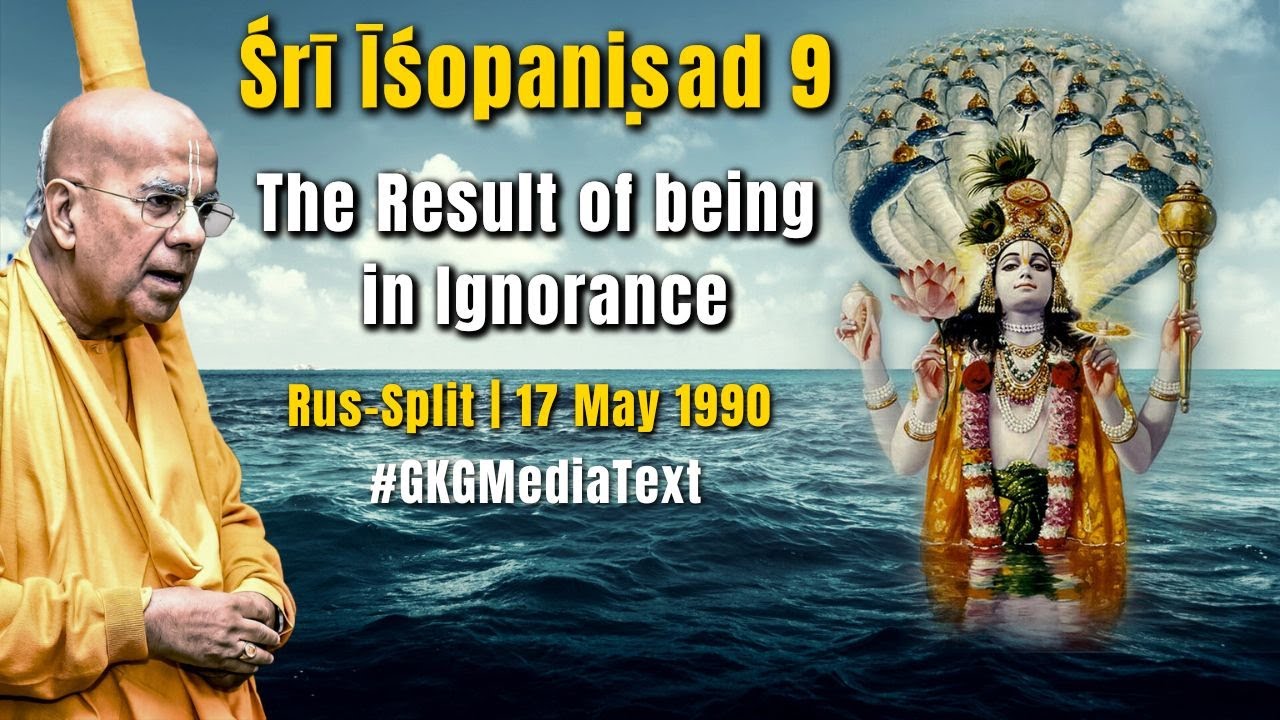
In this recorded lecture, Gopal Krishna Goswami expounds verse 9 of the Śrī Īśopaniṣad, contrasting true knowledge (vidyā) – defined as devotional recognition of the Supreme Lord – with ignorance (avidyā). He argues that modern society’s definition of "knowledge" (degrees, scientific progress, material achievement) is actually a form of avidyā because it neglects the Supreme as the proprietor of all. The lecture systematically classifies four categories of misguided people who, despite outward learning, remain spiritually dangerous: (1) Veda‑vāda‑rātas – scholars who boast Vedic knowledge but deny Krishna’s supremacy; (2) Mayā‑pārtha‑jñānās – self‑appointed gods who claim divinity and pursue material power; (3) Asuram‑bhāvan‑āśrithas – open atheists who reject any notion of a Supreme Controller; (4) Nānā‑dāmās – high‑status individuals (professors, politicians, etc.) whose understanding is child‑like and who misuse their influence. Through numerous anecdotes (the cobbler vs. the Brahmin, Rajneesh, Satya Sai Baba, Prabhupāda’s encounter with a hostile Indian audience member, and the story of Caitanya Mahāprabhu’s criticism by Rāmchandrapūrī) he illustrates how false knowledge leads to spiritual ruin, while sincere bhakti yields peace (śānta). He stresses the necessity of surrender to a bona‑fide spiritual master rather than to one’s own mind (the “om” master), and explains that true education serves the soul and leads to self‑realization. The lecture also contains interactive chanting, audience questions about Russian cultural traits, the meaning of śrīdhvās vs. mleśvās, and practical guidance on tasting the sweetness of the Holy Name. The overall message is that ignorance brings the darkest punishment, whereas authentic devotion, guided by Krishna‑conscious teachers, is the only path to liberation.
Chapters
Prasad Raval. Now we will start the Śrī Īśa Pañcāt because every day I start, I lecture on one verse of Īśa Pañcāt and one verse of Uddhaya Śrīmad. But yesterday I think I did the Bhagavad-gītā and Śrī Uddhaya Śrīmad. So the Śrī Īśa Pañcāt was also compiled by Vyāsadeva. This is the ancient law book for humanity. So in the Īśāpaniṣad, there are 18 mantras, and in these mantras Vyāsadeva is pointing out the supreme nature of God. So in the 8 verses that we have discussed so far, the supreme position of God as a proprietor has been discussed, and additional transcendental qualities of Bhoga have also been discussed. And it has been described that the pure devotee sees the presence of the Lord everywhere. Today, we are going to discuss text 9. In this text 9, there is a discussion of the result that is obtained if one is in the mode of ignorance. And it is also pointed out that those who cultivate knowledge and deny the supremacy of God, They are in a very dangerous position. So first we will read this Sanskrit shloka and you can do responsive chanting with me. Andam, andam, tamaham, tamaham, praveshante, praveshante, ye, ye, vidyam, vidyam, pavasate, pavasate, rato, rato, bhuyam, bhuyam, ivam, ivam. Eva, Eva, tamor, tamor, ya, ya, yu, yu, vidyaya, vidyaya, rataha, rataha, andam tamaha pravishante, andam tamaha pravishante, e vidyāno pasate, e vidyāno pasate, katabhūya ivā te tamor, Even if you don't understand, you still get the benefit. Okay. So all of you want to try, now you can try. Finish this discussion in 1 hour and then take some questions. Om Ajñāna-tivinandaśya jñānanjanāśalakya. Jākṣmaṇmṛtaṇyinātāsmāi Śrī-gurave namāḥ. Śrī-ketanya-māṇo-bhastam sthapitām yena bhūtele. Swayam rūpaka-dāmayāṁ dadāti svāpadaṇḥ tikaṁ. Bandeham Śrī-guru Śrī-yutāpāda-kamlaṁ Śrī-guruṇvaiṣṇam Hare Rāma, Hare Rāma, Rāma Rāma, Hare Hare. Is there anybody in this assembly who is coming to a Hare Kṛṣṇa conscious lecture for the first time? My point is, I want to speak a language that all of you will be able to understand. So if I know the spiritual maturity of the audience, then I can adjust my language. Andāntamāha pravīśanti. "E vidyāmo pāśatek tatho bhūyā ivate tamau yāyu vidyayam ratahā." So the author of the Śrī Śrīpañeśada is saying that those who engage in ignorant activities will enter into the darkest region of ignorance for punishment, while those who are cultivating knowledge but actually as a result of that knowledge are making people godless, are going to be in a worse position. This verse is telling you the difference between avidya and vidya, knowledge and ignorance. What is being accepted as vidya or knowledge in society is actually not knowledge. It is the opposite. Modern civilization is advanced very much, but the result is the society has become godless. The first principle of vidya or knowledge is to accept God as the supreme proprietor of everything. But in modern society, knowledge means having a PhD degree or engineering degree or medical degree. In the Bhagavad-gītā, 9th chapter, Kṛṣṇa says, rāja vidyā rāja guhyam, this knowledge is the king of education. So this is real knowledge, understanding the position of Bhogai and the position of the living entity. If we forget our relationship with the Supreme, then this is avidyā, not vidyā. Today in society, you have the karmīs, the jñānīs, the yogīs, and the bhaktas. Now Caitanya-caritāmṛta states that of these different individuals, it is only the devotee who is peaceful and not the karmīs or the jñānīs or the yogīs. "Krishna-bhakta niskāma atā eva śānta." Bhakti, mukti, siddhi, kāmi, sakāli, asānta. This is a statement from the Caitanya-caritāmṛta where Kṛṣṇa's Kavirāja is saying, the devotees of the Lord, they are śānta. Śānta means peaceful. Why? Because they are niskāma. Niskāma means without material desires. And the yogis and the bhaktis and the jnanis, they are all motivated. They all want some material facility. Therefore they are asyanta. Asyanta means not peaceful. So the yogis, the yogis perform great austerities. They sit down, do yoga for a long time, meditate on the Lord in the heart, but they want to gain control. They want to have the different yogic siddhis. There are 8 types of yogic siddhis that one can obtain. You can become bigger than the biggest, smaller than the smallest. Sitting in one place in Riga, you can stretch your hand to the, to the banks in Switzerland and take all the dollars out of the banks. Imagine if you got that. There's one siddhi where you can stretch your hand anywhere you want and take anything from anywhere. So you can stretch your hand to the rich man in Moscow and take everything out from his coat. So the yogis, they want one of these siddhis. Jnanis, what do they want? They want to become one with the Lord. Imagine if you are running a big company and the man under you is just waiting when he can sit on your seat. How will you feel? So the jnanis, they are always aspiring to become God. They say, you are God, I am God. Why do you worship Bhoga? So we tell them, you are God and I am God. Yes, karaśo. But He is the Supreme Bhoga, which you and I are not. That one Bhoga is maintaining all other Bhogas. Nityo nityanām cetaṇa cetaṇānām eko bhāvanām vidāti kāmām. Nityo means eternal. So the Vedas are saying that the Supreme is eternal. And we are also in eternals, but that eternal is maintaining all other eternals. Just like you may know what is in your house, but you do not know what is in my house. But the government knows what is in everyone's house. So Kṛṣṇa is the Supreme Bhoga. We are what you call mini-gods. Īśvara-parma-kṛṣṇa-sac-cid-ananda-vigrahaḥ. Anādir-ādir-govindā-sarvakaṇa-kāraṇaṁ. The Brahma-samhita is saying that there are many gods, but Supreme God, Parameshvara, is only one, and that is Kṛṣṇa. God means one who is a controller. Just like in every country there is one president or king or prime minister. So He is like a mini-bhoga. You can say in a, in the kitchen, in a house, The husband is usually the boga. And in the kitchen, the housewife is a boga. And, and if you go on this planet, there are some countries that are more stronger than other countries. Like your country and America are considered the superpowers on this planet. So these two countries are like the bogas on this planet. And then if you go beyond this planet, you have the demigods who are the bogas. But supreme boga is only one. So the jñānīs, they want to become one with God, but they only end up emerging into the Brahmajyoti effulgence of the Lord. So, and the bhaktis, the bhaktis are those who perform big, big yajñas, but they want to get some material benefit in return. They will do some sacrifice, they will call some sadhu, give him some donation, but in the end they want some material benediction. Because they have motives, they are all considered unpeaceful. So what is being accepted as knowledge is actually ignorance, and what is being accepted as ignorance— so what is being accepted as knowledge in society is from a spiritual perspective ignorance. So Veda shastra kaisammanda abhidaya prayojana. The Vedic shastras give us real knowledge. What is that? How to establish your sambandha, relationship with the Lord. Just like when you buy a big television, along with that television you get a manual that tells you how to use the television and how not to use it, isn't it? So with this human birth you also get a manual. That is the Vedas. It tells you what to do and what not to do. So in the Bhagavad-gītā it is said that those who are engaged in sense gratification are simply like mūḍhas. Mūḍha means asses. Prabhupāda says the ass is a symbol of stupidity. So those who are using all this so-called material development, just like society today thinks that the so-called discovery of science and advancement of science is contributing to peace in society, or they're thinking they're making progress, big progress. But actually with all this technological advancement, all that they are doing is forgetting God. This is just like a cobra decorated with a valuable jewel. It is said a cobra with a jewel on the head is more dangerous than a cobra without a jewel on the head. Thakur Bhaktinath says that if a man is getting drowned with a heavy turban, then he will get drowned faster than one who is without a heavy turban. So this so-called material knowledge is like a heavy turban. And in Kali Yuga, the turban is getting heavier and heavier. So the important point to understand is human life is not for sense enjoyment. Activities of sense gratification can be controlled with the help of intelligence, spiritual intelligence. Above the senses is the mind. Above the mind is the intelligence. Above the intelligence is the soul. Thus the aim of education should be to serve the soul. That is known as Self-Realization. And any education that does not achieve that is simply shrama evahik evam, waste of time. So the Isha Upanishad is clearly stating that those who engage in activities of ignorance, they are definitely going to be punished. It is not that anything you do, the end result is going to be the same. Just like the Bible says, "As you sow, you shall reap." So as you do, you'll get the result. So based on how we act, our future is going to be. So if we act according to the laws of God and control sense enjoyment, then we can make spiritual progress. So Prabhupāda in the purport explains that so-called modern educators fall into four groupings. Veda-vāda-rāta, then māyā-yapartha-jñānāt, aśram-bhāvan-āśritah, and lastly nīrādhama. So who are the Veda-vāda-rātas? They are those who are very proud of the Vedic knowledge but who are speculating on the nature of the Supreme. You will be amazed how many people there are in India who claim they know the Vedas and who are giving their own viewpoint. Veda-vāda-rātas are simply doing what is known as word jugglery. They will translate the Bhagavad-gītā but not accept Kṛṣṇa as the Supreme. I think yesterday I gave you that story of the miserly man who was taking care of the chickens and he was saying, "Why do I have to feed these chickens every day? Let me cut their necks." But he, that fool, didn't realize if he cut the neck then the chickens won't lay the eggs. So similarly, these veda-vāda-rātas, they will write very big, big commentary on Bhāgavad-gītā and all, but they will be missing the real point. Just like I remember when I first came to your country in May 1976, 14 years ago today, I had met many scholars from your country who had written commentaries on Ramayana, Mahābhārata, Kṛṣṇa. I had discussion for days with one person who had written commentary on the Ramayana, and this was in '76. None of them accepted Ram or Krishna as Supreme. Those days the Soviet government had published a Ramayana, but it was more for academic intellectual interest. So these are the Veda-vata-ratas, men who are proud of their academic learning but who don't accept the Supreme as God. So such Veda-vata-ratas misguide people by interpreting Vedic literature according to their own viewpoint. One so-called Vedic scholar has said Kṛṣṇa is a doctor, Arjuna is a patient. One, recently I was giving a lecture series on the Bhāgavad-gītā in Bombay. I, for 5 months, I was lecturing on the whole Gītā, few chapters every month, at a very big hall in the center of the city. So at the same time, there was one very famous Māyāvādī speaker, Partha Sarthi, giving a lecture series on Bhāgavad-gītā also. And another famous speaker, Chinnamayānanda was also lecturing at that time in Bombay. So some of our devotees went to attend these two lectures by Chinnamayānanda and Partha Sāthi to see what they are talking about the Gītā. In the whole two-hour lecture, Partha Sāthi was always saying, "Him, Him, Him, Him, Him." Not once did he utter the word "Kṛṣṇa." And Chinnamayānanda in his lecture, Only once indirectly refer to Kṛṣṇa, never use the word Kṛṣṇa. So these people are very expert in confusing society. So these Vedāvāda vratas are actually like duṣkṛtinas. They are miscreants because they are misusing their knowledge to misguide society. Such Vedāvāda vratas are accustomed to giving their own interpretation to every word in the scriptures. Every page of Bhāgavad-gītā Kṛṣṇa says: "Ma, ma, ma, ma, ma." What does "ma" mean? "Unto me, me, me." Every page it is written: "Sri Bhāgavānupācā." The Supreme Lord speaks. Still they say there is no God. So the impersonalist, they have a very low estimation of God. They are trying to understand Bhoga with their own material senses, and therefore they can never be successful. Like Prabhupāda used to give the example of Dr. Frog in the ocean. So Dr. Frog was trying to measure the length and breadth of the Indian Ocean. So he was pumping his belly very deeply saying, "Is the Indian Ocean 10 times of the size of my belly?" And he was just pumping, and then he bulged himself to death. So you cannot understand God through the medium of speculation. You can accept God only through the medium of seva, bhakti. Athāśrikṛṣṇa-namaḍī-nāḥ bahed-grahendri-āhi sevomukhehi jīvā-do. Kṛṣṇa says in the scriptures, you cannot understand God with the material senses, but by serving God you can understand God. So once you understand the scriptures with the assistance of a bona fide spiritual master, Prabhupāda explains in the purport, So Kṛṣṇa is unlimited and He can do the impossible. Prabhupāda used to give us a story of this veda-vāda-rātas. Like I said the story earlier in Leningrad, but I'll repeat it, that once there was a very learned Brahmin man who knew the scriptures inside out. So one day Nārada Muni, after finishing his duties on the earthly planet, was getting ready to go back to Godhead. Go back to the Supreme Lord. So on the way he met two individuals. One was a cobbler and one was a Brahmin. The cobbler was an uneducated individual but who had firm faith in God. The Brahmin was very educated but he was always speculating on the nature of God. But both of them told him, "Please find out from the Lord how much more time will I have to suffer birth and death in the material world." So when the Brahmin and the cobbler's questions were asked to the Lord, The Lord told Narada Muni to say, "The cobbler will go back to Godhead in this life, and the Brahman will have to take many more lifetimes." The Brahman, when he was informed that now Lord Narayana has said he will have to take many, many more births and deaths in the material world, Brahman said, "How is this possible?" From morning to night I'm just reading the scriptures. "I'll have to take many more lifetimes birth. I'm sure Narada Muni is pulling my leg." So sometimes when you are in doubt of what somebody is telling you, you try to confirm whether he's telling you the truth or not by cross-examining him. So Brahmana, in order to cross-examine whether Narada Muni really saw Lord Narayana, or he was speculating the answer, he said, "Okay, tell me what was Lord Narayana doing when you saw Him?" Lord Narayana had told Narada Muni, You please tell them if they ask you what was I doing when you saw me, that I was passing an elephant through the eye of a needle. So as soon as the Brahmin heard that the Lord was passing an elephant through the eye of a needle, he said, "I knew you were bluffing. How can anybody pass an elephant through the eye of a needle? You didn't see Lord Narayana." And then when the cobbler heard that he was passing an elephant through the eye of a needle, The cobbler said, "How great my Lord is! He is passing an elephant through the eye of a needle. Just see this huge banyan tree in which you and I are sitting. This banyan tree, the Lord had put in the small seed, and from the seed it has become such a big tree. See how great my Lord is." This is the difference between a veda-vātarāṭha and a bhakta. The bhakta was a cobbler, uneducated, and the veda-vāda-rāṭha was a well-educated Brahmin, expert Sanskrit scholar, but a speculator. There was a devotee of Caitanya Mahāprabhu called Kholāvec Śrīdhara. This Kholāvec Śrīdhara used to live on the side of the Ganges, and he would make leaf cups from banana leaves. And he was earning hardly 1 kopek a month. And even from this 1 kopek, he was spending 50% on worshipping Mother Ganges. So Caitanya Mahāprabhu was so pleased by his devotion that He showed him His transcendental form. So, you need to be a devotee. You don't have to be necessarily a scholar. When Prabhupāda went to India with his Western devotees in the early '70s for the first time, these Indians used to— some of the Indians used to tell Prabhupāda, "Oh, your disciples can't pronounce Sanskrit properly, they don't pronounce Hare Krishna mantra properly." Prabhupada did not pay any attention to all this. So the Vedāvātavrātas, they say, "God, You are great, but You have no eyes, no ears, no legs, no hands, no tongue, nothing. You are void, impersonal." So they don't accept the supreme position of God. Kṛṣṇa said, janma-karma-cāme divyāme vāma-ivedy-tāk-bhutāha tektā dehām panaḥ janma-netimāmiti sarva-arjuna. "One who understands the transcendental nature of My appearance and disappearance becomes free from the cycle of birth and death." So we must understand that Kṛṣṇa is always Supreme. Kṛṣṇa told Arjuna: "I am imparting this knowledge to you." Because you are my most confidential friend and devotee, therefore you can understand the transcendental secrets of this great science. Just like milk touched by serpent becomes poisonous, the words of God, when they are touched upon by these so-called speculators, they become poisonous. At least in your country, I think there is only one prominent edition of Bhāgavad-gītā in your language, that is the Bhāgavad-gītā by Prabhupāda. But in countries like India, you have hundreds of translations of the Bhāgavad-gītā in the market. So very often when our devotees are out on book distribution, people say, "Oh, why should I read your gītā? Why don't I write this gītā, that gītā? What is the difference?" I tell them, "Show one gītā that has produced as many children as this edition of Bhāgavad-gītā as it is has." Prabhupāda used to say, If a man is potent and he has sex life, there will be procreation. So similarly, there must be potency. It is the Bhāgavad-gītā as it is by Prabhupāda has made millions of people into devotees of Kṛṣṇa. Here is the potency. Show any other book that has done Gītā edition anywhere near it. Like, "Yā Bhāgavad-gītā kā anā īs." Yes. Kā anā yēs. Tāk anā yēs. So why is the Bhāgavad-gītā called Kaakana Yast? Who knows the answer? I want to test your book distributors. Why did Prabhupāda say Kaakana Yast? Why? Yes, because Prabhupāda has presented it in the same spirit that Arjuna accepted it from Kṛṣṇa. Because so many people had translated the Gītā and given their own viewpoint. Prabhupāda wanted to show a difference between his presentation and the other presentations. So he called it Bhāgavad-gītā as it is. So the point is that the Veda-vāda-rātas are speculators. They are just doing word jugglery. Caitanya Mahāprabhu was the biggest Sanskrit scholar who lived on the planet 500 years ago. And when Caitanya Mahāprabhu went to Benaras, all the Māyāvādī philosophers were having a meeting. He's like a crazy Hare Kṛṣṇa. Come and sit down with us and study the Vedānta. And Caitanya Mahāprabhu says, "My spiritual master considered me to be a fool, so he said, 'Just chant Hare Kṛṣṇa.'" Then you have mayāyā-pārtha-jñānās. Mayāyā-pārtha-jñānās, as Prabhupāda says, class of men who are like self-made gods. Such men are thinking that they are gods, so no need to worship somebody else. They may give respect to some rich man also. And think he is like, almost like God, but they won't go directly to God. They are very proud of their so-called Vedic understanding. Just like in your country also, there are many Sanskrit scholars. One Dr. Kalyano, who is a good friend of mine, he has given a very nice review of Prabhupāda's Gītā. But the other so-called Sanskrit scholars, I've been told, they don't like the bhakti emphasis in Prabhupāda's books. It is Kṛṣṇa who says, bhaktyam am abhijñānti, I can only be known by the path of devotional service. Prabhupāda just presented Kṛṣṇa's views exactly as Kṛṣṇa spoke. The line of service is drawn by Kṛṣṇa and the guru, and the disciple just traces on that. Just like when you are teaching your children drawing, what do you do? You do a drawing, then on the top of that is a tracing paper. It's a very thin paper. So with a tracing paper, the children can see the drawing below, and they draw exactly on the top of the tracing paper from the lines that are below the tracing paper. So that is exactly what the devotee should do. Kṛṣṇa has already drawn the line. The Guru has already approved the line. Now we just have to trace on that, and then we'll understand bhoga. So the māyā-pārtā-jñānas They are speculators and as a result they can never understand God. Then there are the asuram bahavan ashrithaha. Asuram bahavan ashrithaha means those people who are openly atheistic. They don't believe in God. And when you ask them, who is the creator? They will say, nature. Who is behind nature? Do not know, niyat. So these are those who are openly atheistic. You ask them what happens after death and they will say, has anybody come back after death to ask you this? They don't want to believe in life after death.
Why?
Because they know they are sinful and then they are worried there may be some punishment. So they have the owl philosophy. You know, when the owl is about to be eaten, it closes eyes and thinks nothing's going to happen to me now. So the Maya, Ashram Bhavan Ashritas, are they openly atheistic. They don't believe in God. They don't believe there's a Supreme Controller. They think this world has come into existence just by chance, and this, the whole purpose in this world is just sex life and sense enjoyment. Fourth category is nānā-dāmās. These are those— nāmaṁ duṣkṛtṇa-mūḍha prapadyante nānā-dāmāmayāya partha-jñāna-āśrama-vān-āśṛtaha. So narādhamaḥ, those in society, they have very important positions. They may be professors, intellectuals, doctors, heads of department, heads of country, but their understanding is like that of a child. If a grown-up man started walking on the street with his thumb inside, what will everyone do? They will laugh, isn't it? So when a grown-up man in an important position He's talking like an animal. He's in another mark. So these so-called self-appointed gods, they cannot answer the real purpose of life and they cannot direct society. Just like there was one very famous self-appointed god. His name was Rajneesh. Have you heard of him in Riga, in Latvia? So Rajneesh was calling himself God, Bhagwan Rajneesh. So this Bhagavan, he had many thousands of disciples because naturally he was telling people, I'll make you sannyāsini, but you can have free sex, wear saffron clothes and take drugs, everything. I went to Rajneesh Ashram to see how they live because I'm the G.B.C. for Pune where their world headquarters are. It's in my zone, his headquarters. So here was God But he was so sensitive, he could not even smell an incense. Everybody who would go to his lecture, he would be screened at the door to make sure that he was not carrying any incense or flower in his pocket, because if he smelled incense or flowers, he would faint. Last 2 years of his life, he was in so much pain. So this is example of one God. This is example of one very famous man who was calling himself God, self-appointed God. If you go to India, you will find thousands of gods in Haridwar and Rishikesh. Everyone calls himself boga there. But Kṛṣṇa is not that cheap boga. Yesterday somebody asked me a question of Satya Sai Baba, isn't it? So Satya Sai Baba also calls himself boga. But when you ask him, why do you call yourself God? I don't call myself God. These disciples are calling me God. Prabhupāda said anybody calls himself G-O-D, God, is actually D-O-G, dog. So the Īśopaniṣad is saying that those who are under the influence of avidyā, ignorance, they will definitely go to the darkest region of ignorance. But worse is the position of those Who claim that they have this so-called knowledge and they are misleading people. I will explain this point with another example. Suppose you read in the papers tomorrow that some mafia man has committed a murder. You are not surprised at all because mafia, low-class gangster men, they do murders, stealing. It is very common all over the world. Suppose you read in the papers tomorrow "That is very famous Dr. Alexander Polsky, some gold Nobel Prize winner, he has murdered somebody." Then you read in the paper, "Oh, such a famous man is murdered." You understand? Punyātṇa. So Iṣād-Paniṣad is making exactly this point in this verse. Those who are acting in ignorance are going to go to the region of ignorance. But those who are pretending that they are so-called educated people and they're misguiding the people, they are going to be in the worst position. Just like the Iṣopaniṣad, just like the 5th Canto of the Bhāgavatam describes, how if somebody gets elected to a position of responsibility or to running the government and he does not use his due position to guide people about God consciousness, Then after death he's sent through a machine where he's squeezed just like a sugarcane is squeezed through a machine to take juice out, and then the person faints. So I may become the president of my country, the king of this planet, the head of the republic, but if I don't guide people on the spiritual path, then after death serious punishment is waiting for me. So anyone who assumes a position and does not rise up to it spiritually is liable for punishment. Hare Kṛṣṇa. Hare Kṛṣṇa.
She is asking which quality you consider the best in Russian people.
I think by and large the Russian people are quite simple. Therefore when they are being presented with this Kṛṣṇa conscious philosophy, they are accepting it. The Soviet people have already some experience to austerity. I have— my analysis is, because I have been preaching in your country for 14 years now, almost longer than any of you, and my experience is that the people of this country, they have not been spoiled like the people of America and Western Europe. Therefore, this background is pochinkarasho for spiritual life.
What is the difference between śrīdhvās and mleśvās?
Sudras and Mlecchas, they are almost the same. Well, Mlecchas are very fallen people. No, no, I am sorry, there is a difference. Sudra is fallen, but Sudra can also be somebody who is less intelligent and who is just serving the other three varnas. But Mleccha means meat eater, beef eater, who hates the Vedic scriptures. You can be a Sudra but not be a Mleccha. People who don't want worship for God— I want listen about folkless people who won't come? Chatur veda bhajanti mam e jnana-rājuna-rājuna-ārtha-puṣikyaḥ śrī-ārthā-ti-gyā-dhī-cā-bhartar-sabhaḥ Krishna says 4 types of people don't come to Me; 4 types of people come to Me! The ones that don't come we have discussed. The one comes are One is who's in distress, one is who's inquisitive, one is the genuine seeker of knowledge, one is who wants rubles or currency. So Kṛṣṇa says, even if you want currency, come to Me. If you are in distress, come to Me. Whatever you want, come to Me. Don't go to demigod, don't go anywhere else.
It is about such a sūtra, and it was one devotee who was killed in prison from Armenia. And Harikeś Mahārāja says that he is actually eternal associate of Lord Caitanya. But she's asking, before he joined to Krishna consciousness, you know, he was connected with material life, maybe did something, you know, bad, and how to understand it?
Does it mean, I don't know, He may have had a bad background, but then he got reformed and he started acting as a dedicated, loyal servant of Lord Caitanya.
It is said that material world is a reflection of the spiritual world. And then can we know what the souls are doing in spiritual world? What is the service?
Spiritual world? Everybody serving Kṛṣṇa. There is only one dharma there, and that is serve Kṛṣṇa. You want to go to the spiritual world? Prabhupāda used to say, asking questions is a sign of intelligence.
Because of our attachment to material things, we cannot at once surrender to Kṛṣṇa. Therefore we must surrender to spiritual master. And what is the beginning of surrendering to spiritual master?
Surrendering to spiritual master means listening to him instead of listening to your oṁ. If you don't surrender, if you don't surrender to guru, you have to surrender to oṁ. The difference is the oṁ is the cheating master and the guru is the correct master. So surrendering to guru means following what the guru says. That's all. It's not a big thing. You have to surrender to someone or the other. Just like when I came to your country in 1976, I noticed one thing that I will say now. I saw that in every corner there were no temples. Like in India, you go in every corner, there's a temple. But in every corner they had a statue of Lenin or somebody, and they had flowers at his feet. So it's not that because people were not worshipping Krishna, they were not worshipping anybody else. So if you don't follow spiritual master, you'll have to make the mind your spiritual master. So Caitanya Mahāprabhu, even though Rāmcandapuri was criticizing him, Caitanya Mahāprabhu was still very respectful to Rāmcandapuri. When Rāmcandapuri heard that Caitanya Mahāprabhu has reduced his eating, and Caitanya Mahāprabhu, when he reduced his eating, his secretary Govinda also reduced it. And the disciples of Caitanya Mahāprabhu were so upset that because of Rāmcandapuri's false criticism Caitanya Mahāprabhu virtually was starving himself. Then Rāmcandapuri said, Caitanya Mahāprabhu, I have heard that you have reduced your eating. This is not good. This is dry renunciation. A sannyāsi should not become very skinny. A sannyāsi, he must eat. He cannot keep his belly hungry. Because in the 6th chapter, Kṛṣṇa tells Arjuna: "One is the perfect yogī who does not eat more than necessary or less, and who sleeps everything in a regulated manner." But Caitanya Mahāprabhu was playing the role of a perfect humble devotee. Caitanya Mahāprabhu told him: "I am like your disciple." And I'm very fortunate that you're instructing me. So please keep instructing me. This reminds me of a story. I met Prabhupāda on June 1st, 1968 in Montreal, Canada. And I remember, sir, I remember we went to a program at a Christian school in Montreal. And after the question, Prabhupāda would ask for— after the lecture, Prabhupāda would ask for questions.. And there was one Bengali man in the audience, Mr. Mukherjee, who insulted Prabhupāda very, very badly. So this Mukherjee started insulting Prabhupāda very badly. He said, "Why are you preaching in these Christian countries that they have to chant Hare Kṛṣṇa? Why they cannot chant Jesus Christ?" And so many other things. Just like the disciples of Caitanya Mahāprabhu were very angry because Caitanya Mahāprabhu reduced his eating because of Rāmchandrapuri's criticism. All of us devotees in Montreal Temple were very angry because Prabhupāda was insulted so badly by this Indian man. So Prabhupāda, when he was leaving Montreal in August '68, he called me and said, "Gopal, go and call that Mr. Mukherjee." I told Prabhupāda that Mukherjee insulted you so badly, why do you want to see him? Prabhupāda said, "I must have done something to him in my last life for which he took revenge." And saying like this, he called Mukherjee and blessed him before leaving Montreal. So this incident reminded me about Prabhupāda's līlā because Caitanya Mahāprabhu was being criticized so much by Rāmchandrapūrī. But still Caitanya Mahāprabhu was saying, "You are my spiritual master. Please instruct me." So Pārmananda Pūrī and the others, they approached Caitanya Mahāprabhu and said, Ramchandra Puri's business is to criticize. If you stop eating because of his criticism, then how will things go on? So please don't reduce your eating. But they said Ramchandra Puri's style is, first he will give you prasāda and then fall behind. In the 11th canto of the Bhāgavatam, Kṛṣṇa tells Uddhava that one should neither praise others' activities nor criticize. But Ramchandra Puri, he would never praise anyone and he would just criticize others. Before you criticize others, you first have to see your own spiritual life, isn't it? Isn't it Jesus Christ who said, "Let that person throw the stone who has not sinned." And just like somebody may have so many good qualities, but if somebody wants to criticize you, he won't look at the good qualities, they'll just look at the bad. Somebody may have so many hundreds of good qualities, but if somebody wants to criticize you, he will not look at your good quality, just bad quality. Just like the Hare Krishna movement. There are thousands of good qualities in what we are doing, isn't it? Ever since Mr. Gorbachev came to power, he has been telling the people, "Drink less vodka." Because the government realizes that people are drinking too much vodka and their productivity in office is going down. Like in America, they take too much drugs, so the government is telling people, "Don't take drugs." But neither in America they are succeeding and people gave up drugs, nor in your country they are succeeding in making people drink less vodka. But the Hare Kṛṣṇa movement is making people give up vodka and drugs both. None of you take vodka now, isn't it? No chai also. So they won't recognize the good that we are doing for society. We are building young men of pure character. Who don't even take chai. So there's so many good things the Hare Kṛṣṇa movement is doing. But if somebody wants to find fault in us, they won't look at any of our good things. They'll say, "Oh, they are creating disturbance." So similarly, sometimes you may be very angry at another devotee. So then you're ready to fault-find him and not look at any good qualities. But a devotee should have the Vṛndāvana vision. Vṛndāvana vision means look at the good qualities of everyone. So Caitanya Mahāprabhu was being requested by all the devotees "Please don't listen to Ramchandrapuri's criticism. Please eat full prasad." But Caitanya Mahāprabhu was a strict sannyāsa. He said, "No." Finally, Ramchandrapuri left Jagannātha Puri and went away to another city. Finally, Haridas agreed. He said, "Okay, all my devotees are saying move to another cave. I will move." But before Haridas could move from the cave, the snake left the cave and went to another place. So then Chaitanya Mahāprabhu did not have to lead the kīrtana. So Chaitanya Mahāprabhu was not eating prasāda because Rāmchandrapurī was watching everything and criticizing. But finally when Rāmchandrapurī left Jagannātha Puri, then Chaitanya Mahāprabhu started eating regularly and leading kīrtana and dancing again. So meditate on this story and purify your mind. Just like in the, um, okay, Hare Kṛṣṇa. I'll ask them some questions now. What was the theme of the verse that we discussed this morning from Nectar of Instruction? Keen head of mine, you Latvians, your IQ is the last of the last. The holy names, pastimes, character of Kṛṣṇa.
Is sweet.
So this Caitanya Mahāprabhu līlā is also slātkit. Slātki. Slātki. So put this līlā in your own and taste the happiness. So I'm sorry to say, all of you have failed the test. What was the key point of the Isha Upanishad verse that I read? Yeah, how many types of miscreants there are? Not 2, 5, 8. What are the 4?
4.
Y'all can think about all the points we discussed today. I'll ask you the Vapors tomorrow. Did you all increase your spiritual knowledge with the lectures today? Or have you— you know, there's a saying: in from one ear, out from the other ear. There is an underground tunnel from this ear to this ear. So you, you have to block that tunnel.
There is another saying in Russian that I'm like, like a dog. Understand everything but cannot say.
Well, then I don't believe that.
She is asking, what should we do? You know, you will be able to speak tomorrow, for example. What to do?
So can we taste the sweetness of the Holy Name in the present condition? What did Rūpa Gosvāmī say? Can we taste the holy name sweetness in the holy— What did Rūpa Gosvāmī say in the verse that we discussed? Can you taste the sweetness, Hansadutta? No. Rūpa Gosvāmī says you cannot taste the sweetness. He says due to ignorance you are covered by avidyā, so you cannot taste it. Navajñāsva. So the thing is, Rūpa Gosvāmī says, and he gives example, what is that disease where you get sick and you cannot taste the sweetness of sugar? What disease? You people were saying that you can taste the sweetness of the Holy Name, but Rūpa Gosvāmī says, no, you cannot. It will take time. So you devotees have failed the test. So think about it. Tomorrow I will ask you question. Jātra, What prose!
Okay.
Hare Kṛṣṇa. Hare Kṛṣṇa. Key point of the story of Rāmacandrapuri. And if you criticize Vaiṣṇavas, one day you'll even criticize God, Kṛṣṇa. Especially if you criticize your guru. Okay? Hare Kṛṣṇa. Hare Kṛṣṇa. Hare Krishna, Hare Krishna, Krishna Krishna, Hare Hare, Hare Rama Hare, Rama Rama, Hare Hare.
More from PRASAD

Rare Pastimes & Timeless Lessons of Guru Mahārāja | Stories Every Disciple Should Hear

ISKCON Legends- pure devotees meet-HH Jayapataka Swami, HH Gopal Krishna Goswami, HH Radhanath Swami



Jagannātha Ratha-yātrā Through Śrīla Prabhupāda's Mercy | 29 April 2006 | Nairobi, Kenya

Lord Jagannātha's Appearance Pastime | 21.07.2019 | ISKCON Calgary | Śrīla Gopāla Kṛṣṇa Gosvāmī

The Ācārya Teaches by His Own ExampleGuṇḍicā Mārjana by Guru Mahārāja #shorts

Guṇḍicā Mārjana – Lord Jagannātha's Pastime | 21.7.2019 | ISKCON Calgary |Śrīla Gopāla Kṛṣṇa Gosvāmī

H.H. Gopāla Kṛṣṇa Gosvāmī Mahārāja - Exemplary Sādhana and Deity Worship # shorts

भगवान की कृपा कैसे प्राप्त होगी ? | 11 Jan 2014 | Punjabi Bagh | Srila Gopal Krishna Goswami

Material Education vs Spiritual Education | Srila Gopal Krishna Goswami #shorts