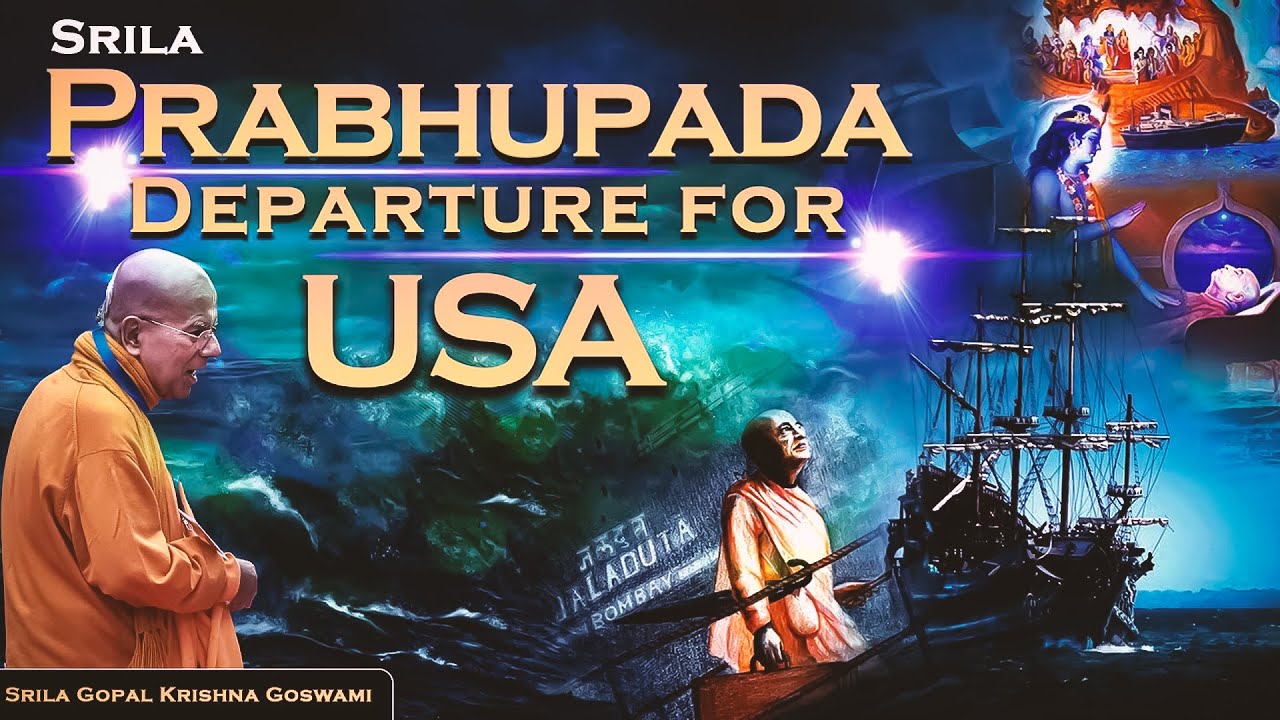
In this devotional lecture Srila Gopal Krishna Goswami Maharaj recounts A. C. Bhaktivedanta Swami Prabhupāda’s path from his early life in Bengal to his historic departure for the West in August 1965. The talk outlines Prabhupāda’s formative encounter with his spiritual master Bhaktisiddhānta Mahāprabhu in 1922, his commitment to spreading the Holy Name worldwide, and his intensive work translating and publishing the first canto of the Śrīmad‑Bhāgavatam as a “weapon” for preaching. It details the financial hardships and the network of supporters—especially Mrs Murariji, her secretary Mr Chokshi, and other devotees—who arranged a berth for Prabhupāda on the cargo ship Jaladūta. The lecture describes the logistical challenges of travel, the preparation of books (including the Bengali Caitanya‑caritāmṛta and 200 sets of the first canto), the departure from Calcutta on 13 August 1965, and the symbolic significance of this event for the establishment of Krishna‑consciousness worldwide. The speaker emphasizes Prabhupāda’s unwavering determination, humility, and devotion despite poverty and opposition.
Chapters
Today is a very special day. What's special today? Prabhupāda's seer for America. Before we start that, I want to congratulate Devī Śaktimātājī for having this International Book House. I think it is National Book House. Here Prabhupāda's books in almost every major language. I'm sure Prabhupāda will be very pleased. I hope we have enough customers to keep the shop busy. So today is a very special day. It's the day that Prabhupāda sailed from Calcutta to the West. Prabhupāda met his spiritual master in 1922. Prabhupāda's father, whose name was Gourmandei, was a very pious man. Prabhupāda said he was a middle-class businessman. Little higher, then have to bend. Okay. Prabhupāda said he was a business middle-class man, but he had great affection to serve sādhūs. And Prabhupāda said he did not discriminate. Whether someone was a genuine sadhu or a fake. So Prabhupāda had a lot of exposure to sadhus, and he wasn't so impressed by these sadhus. In 1922, Prabhupāda had a friend whose name was some Mr. Mukherjee. And that friend of Prabhupāda said, "I have already made a very special sadhu." Prabhupāda said, "I have met so many sadhus, but I am not impressed by any of them." But in Prabhupāda's words, Prabhupāda said, "He virtually dragged me to see Bhaktisiddhānta Mahāprabhu." And in the very first meeting, Bhaktisiddhānta Mahāprabhu could see Here is that devotee who will be able to fulfill Lord Caitanya's prediction that the Holy Name will be heard in every town and village of the world. Prior to Bhaktisiddhānta Mahāprabhu, no, later on, Bhaktisiddhānta Mahāprabhu had sent many sannyāsis to the West, but they didn't succeed. Prabhupāda at that point was in the Grihastha Ashram. He was intensively involved in Gandhi's freedom movement. So Prabhupāda said, "First we should make our country independent, and then we can think of this." But Bhaktisiddhānta explained what is real independence. Real independence is not political independence. But spiritual independence, independence from the cycle, was in that. So this thought was planted in Prabhupāda's heart. And then Prabhupāda was moving around in different cities to establish himself. He had a family to take care. And in 1932, met Bhaktisiddhānta Ji in Bombay. Bhaktisiddhānta Mahāprabhu had come to install the Deities and inaugurate the Gaurīya Mādh temple. And the Gaurīya Mādh sannyāsis took Prabhupāda with them to meet Bhaktisiddhānta Mahāprabhu. Of course, Prabhupāda had met him earlier too. And they said, "Rāmeśvara Chandra has done so much seva in getting this temple started." that you should make him the president of the local branch. And Bhaktisiddhānta Mahāprabhu said, "No, let him continue the way he is, and at the appropriate time he will do the needful." In 1936, 2 weeks before Bhaktisiddhānta Mahāprabhu departed, Prasādh RAVAL had written to him, saying that, "You have so many sannyāsis, disciples, Who are rendering such valuable service to you. I am not able to do much. So what is your instruction for me? And Bhagavan Śrīla Hādhūrājī responded by repeating the instruction He gave in 1922. So we take these, take this message to the Vaiṣṇava world. So this was planted in Prasāda's heart. And He continued to pursue and eventually took Vana Prasad and then later on Sunya. After he took Vana Prasad, who was still traveling in India, he established the League of Devotees. Recently we celebrated the anniversary on the inauguration of ISKCON. The 7 purposes that are mentioned in the memorandum were exactly the same that Prabhupāda gave to the devotees in Jhansi. And Prabhupāda was constantly meditating how to go to America. That was his prime goal. And at that time, India had just recovered from being a British colony, and most of the Indians, their first goal in life was to go to England. Prabhupāda wasn't thinking of England. He said, "First, let's go to America." And he explored different procedures, different routes, via Japan, via Europe. And it was a struggle. Prabhupāda wanted to get the first canto of the Bhāgavatam translated and printed before he took his trip to the West. Prabhupāda didn't want to go to America empty-handed. He wanted to take some books which could be used as weapons. To preach. So Prabhupāda printed Fourth Canto, Part 1, residing in Rādhā-Dāmnaṭha Temple, typing on a broken typewriter. If you ever saw that typewriter, you would throw it away. Typing on a broken typewriter, taking a third-class compartment train from Matsura to Delhi, then going to the printer, buying the paper. Prior to this, Prabhupāda had done the translation work, and plus collecting donations to print it. He didn't have the money to print. He was printing with small printers who gave him credit. And so this way Prabhupāda printed first Kṛṣṇa Pārthma. And after it was printed, he took the opportunity to present it to important dignitaries like the Prime Minister of India, Radha Krishna, Jagadguru Mahārāja, etc. And Prabhupāda had to also go and sell it. He was virtually a one-man army. And he sold some to the educational institutions. The American Embassy for about 16 sets for the Library of Congress. So Prabhupāda had with great difficulty done the Fourth Kṛṣṇa Part 1, 2, 3. And after the third one was done, he thought that now he has all the weapons necessary to defeat any argument. Prabhupāda had great faith in the Bhāgavatam. He had published a pamphlet in which Bhāgavatam was glorified. It was "My Mission." Isn't it? "My Mission." And he had— Prabhupāda's dream at that time was, there were 60-volume Bhāgavatam set. So Prabhupāda got a brochure printed Now the question was, how to travel? Plane travel was very expensive by economic standards of those, of that time. And he approached many people, they said, "No, it's too expensive. I can't do it." And then many sadhus said, "Sadhus should not go abroad." They were traditional Hindus. Anyway, Prabhupāda was determined. So Prabhupāda's search for support took him to Mrs. Murariji. Prior to this, Mrs. Murariji was a pious lady who resided by coincidence very near the Hare Kṛṣṇa temple in Juhu. Her house was just 2 blocks away. And when Prabhupāda would go to see her, he would often pass by the Hare Kṛṣṇa land, which was at that time a jungle. And Prabhupāda at that time didn't have money to live, money to eat, but still he meditated. That if Kṛṣṇa ever gave him that land, he would build a temple for Him. That was his desire and prediction. So Śrīmatī Mañjarājī had helped Prabhupāda print the first Kṛṣṇa-caripāda 3. One Prabhupāda had gone to her office, and the secretary said, "She's too busy. She doesn't have time." And Prabhupada, "Okay, I'll just sit in the staircase." Because he has to eventually go home by the staircase. So Prabhupada sat in the staircase doing japa for 5 hours. And then when she was going home in the evening, her secretary, his name was Mr. Chokshi, Prasada Chokshi. "Who is that sadhu sitting there?" He said, "He's the same sadhu you helped print the Bhāgavatam, and he wants to see you." So she called Prabhupāda home the next day. And Prabhupāda told her, "I want to go to America to take Achaitanya's message." She said, She said, "You are so old. At this age you may have a heart attack. You've never been abroad." Prabhupāda had never seen snow before. But Prabhupāda persisted. He said, "Don't worry, you will have to die." And when she saw that Prabhupāda was so determined, so determined to go, she finally gave in. And she said, "Okay, I can arrange a berth for you in a cargo ship." What was that cargo ship called? Jaladūta. If that Jaladūta was still there, The owners would have become millionaires. They could have broken it and sold a small piece as souvenir. But unfortunately they smashed it before ISKCON got established. Or maybe after. Because Jala Duta is a, what should I say, a household word in ISKCON all over the world. So she said, I gave you birth in a cargo ship. And she was a pious lady, so she took with her— she wanted the captain of the ship to be a pious person, and she told him to carry extra vegetables and grains for Prabhupāda. Prabhupāda had no money. He would walk from the Sindhi colony in Bombay where he was residing to the Andheri railway station. Walk! Not even take the bus. You know why? Because he didn't have any money. Let's see this example. We devotees in ISKCON get so spoiled. We can't move a step forward without having a car. Prabhupāda used to walk to save because he didn't have money. So jokes, Mrs. Muraji, she arranged for Prabhupāda's passage. Prabhupāda reached Calcutta 2 weeks before he was going to sail. And in the meantime, Prabhupāda had completed translating the Śrīmad-Bhāgavatam first canto. He had with him 200 sets of the First Canto that he was taking with him to America for book distribution. So Chokshi bought Prabhupāda clothes worth ₹500, and then Prabhupāda arrived in Calcutta 2 weeks before his departure. Prabhupāda, Originally stayed in Calcutta, but now he was returning to Calcutta as a sannyāsī. He didn't want to stay with any of his relatives, and he stayed in a dharmasāla, and he was preparing to go to the West. Prabhupāda had met one Mr. Bhattacharya in Lucknow. Prasad Raival was a professional singer and the governor of UP and met Prabhupāda at a program in Rādhā-Dāmodha Temple. Prabhupāda had invited him. And then later in Lucknow, there was a program in the governor's house. He was doing kīrtan and Prabhupāda gave the lecture. So when he arrived in Calcutta, Stayed in Dharamsala. He contacted this Mr. Bharata Parāchārya. And according to Parāchārya's version, they rented a taxi and they would go to different publishing houses, print like different newspapers. And Prabhupāda wanted his departure from India. To be a news item. You see. So Prabhupāda personally went to the newspapers with Mr. Bhattacharya. All of them were smiling when they met Prabhupāda. But none of them published anything. There was only one more Bengali journal that printed Prabhupāda's departure. So Prabhupāda came to Calcutta. His goal was to get his trip covered. Then he went to Māyāpur, offered obeisances to his guru Mahārāja Samādhī, and then came back to Kākāra. So Prabhupāda sailed on the Jaladūta, and the ship departed. At 9 AM in the morning. And according to the nowadays version, he took Prabhupāda to the port, and when Prabhupāda arrived at the ship harbor, no worker had even arrived. But Prabhupāda was so anxious to go, he arrived 2 hours before departure. And all the gates, everything was closed. And finally, on August 13th, 1965, at 9:00 AM, the ship departed. And Prabhupāda's books were sent directly to Sri Lanka. So this was Prabhupāda's dream to sail to America, which he finally did in 1965. And Pandeya and his wife took care of Prabhupāda. Next day was Janmasmi, and then Prabhupāda's vyāsa-pūja. And Prabhupāda took with him a Bengali version of the Caitanya-caritāmṛta. And he drew, and he read that Caitanya-caritāmṛta Bengali version on the way. Probably you often hear Prabhupāda had 40 rupees with him, isn't it? Yeah. But the story that we have is from Prabhupāda's son. This 40 rupees Prabhupāda did not take. As he was leaving, Kolkata port, his son Brahmande was there. He came to see him off. Prabhupāda said, "This money will not have any utility once I go abroad. You take it." So that in summary is our presentation today. So Prabhupāda's dream eventually became true. We know how Prabhupāda went to the West. Established Kṛṣṇa consciousness, which He took every corner of the globe. So, prabhat ki. Prabhat ki. Malama e are.