Srimad-Bhagavatam The Spotless Purana | SB 1.5.1| Moscow | 29.10.2004 | Śrīla Gopāl Kṛṣṇa Goswāmī
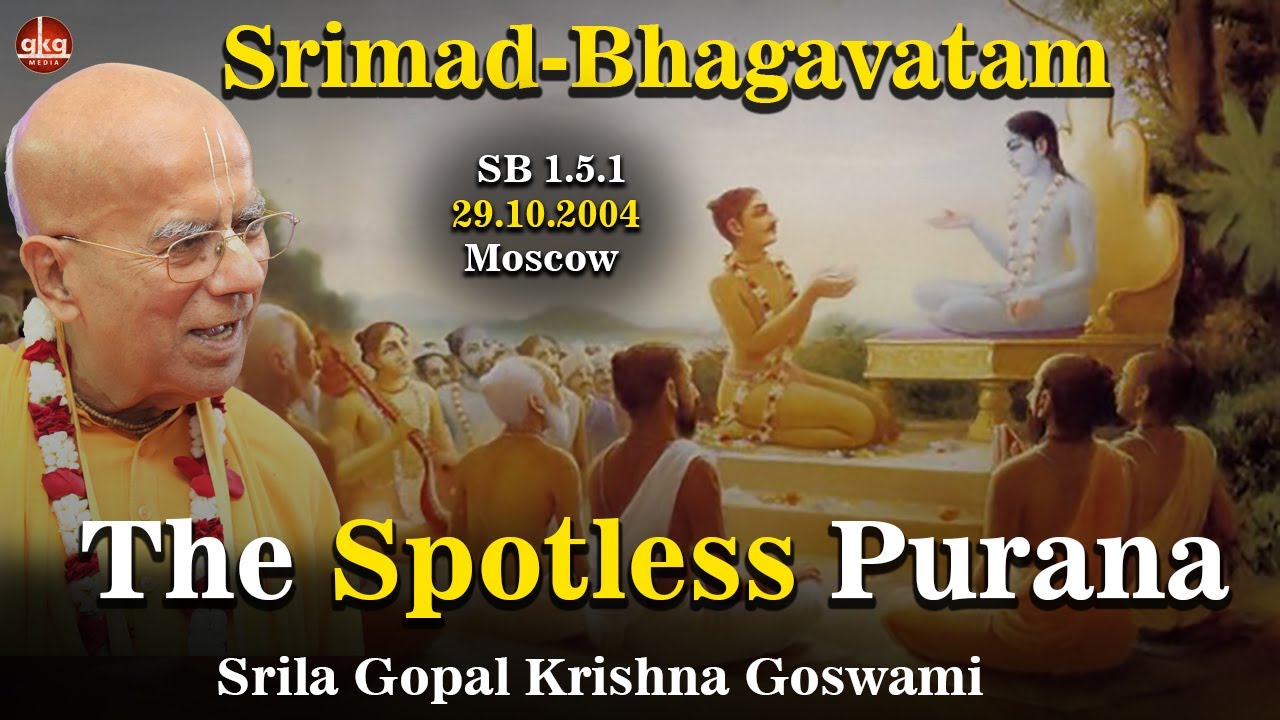
In this extended devotional lecture recorded in Moscow, the primary speaker (Śrīla Gopāl Kṛṣṇa Goswāmī) and an interlocutor explore the first chapter of Canto 1, verse 5.1 of the Śrīmad‑Bhāgavatam. The discussion begins with Vyasadeva’s sense of incompleteness after compiling the Vedas and Mahābhārata, and moves to Narada Muni’s appearance to give him direction toward pure devotional service (bhakti). The speaker explains the Bhagavatam’s designation as the “spotless Purāṇa,” its exclusive focus on bhakti, and the six broad categories of avatars, emphasizing the Shakti‑Vesha avatar. The lecture then shifts to a contemporary critique of modern society: people pursue material wealth (artha) and sense‑enjoyment, driven by a false sense of proprietorship, self‑deception, fear of death, and anger after frustration—obstacles that Brahma is said to have created. The remedy is the path of bhakti yoga (supported by Sankhya‑yoga) and the necessity of receiving teachings through an authentic disciplic succession, illustrated with examples from Prabhupāda, Caitanya Mahāprabhu, and other acharyas. Practical spiritual advice follows: avoid complacency, constantly evaluate one’s progress, use every moment for Krishna consciousness, and understand the consequences of karma through illustrative stories of a prince, a butcher, and a brahmachari. The lecture concludes with a reminder to continue the program and maintain diligent practice.
Chapters
Om Namah Shivaya. Canticle, Chapter 5, Text 1. Omegyaantimandartha hagana arithashri narkam uttasha ekri shakarum asimpro inavanto jagatpade gopisha gopinathanda rana kanda namasude. So Suddhaswami is the speaker of this verse, and he is speaking to these sages in Namaśvaranya. We see in the Bhāgavatam parallel dialogues going on. Sometimes you read Śukadeva Gosvāmī speaking to Parīkṣit Mahārāja. Sometimes you read that Suta Gosvāmī is speaking to the sages. So the explanation is that when Śrīkantadeva Gosvāmī was speaking the Bhāgavatam to Praśādhita Mahārāja, thousands of sages were present on that occasion. And among the sages present was a sage called Suta Gosvāmī. And Suta Gosvāmī was later requested by the sages in Namaśvaranya to give them direction. The sages in Navadvāsha Rāṇya were very compassionate and concerned about the future of humanity. That's the nature of a sādhī personality. He is concerned about the welfare of the suffering humanity. Sādhī personality is para-duḥkha-duḥkhi. That means seeing others in distress, he also becomes distressed or concerned. And as a result, He meditates as to how society can be elevated to the point of perfection. Like these sages in Namashwaranya, they were spiritual astrologers. Kakudaan astrologers find out what's going to happen tomorrow. So these spiritual astrologers could see thousands of years ahead, not just one or two days ahead. Like if you read the Bhagavatam's predictions of the age of Kali, and you minutely analyze every word in each of these shlokas, you see that everything that's happening today was already foreseen by the sages 5,000 years ago. I personally discussed this, the first canto, the Bhagavad Gita prediction of the age of Kali, eminent group of just friends of Krishna or academic scholars, and they say It looks like these verses were spoken yesterday, not 5,000 years ago, because the description is so authoritative.
So the sages could see that in Kali-yuga people's lives would be misguided, they would be quarrelsome, they would be spiritually lazy.
So the sages were concerned how society could be saved in future. And so they invited Suta Gosvāmī to give them direction. On meeting him, he repeated exactly the Mahābhāgavatam as he had heard from the lips of Śukadeva Gosvāmī. One who can memorize something by hearing once is called a śruti-dhala, and Suta Gosvāmī was a śruti prabhu. He was able to memorize 18,000 verses by hearing only once. No śruti prabhu. That's why Caitanya Mahāprabhu was once having a dialogue with Keśava Kṛṣṇa Mūrī. And Keśava Kṛṣṇa Mūrī was a prominent Sanskrit scholar who would come to Navadvīpa with the intention of meeting all the scholars, especially the Māyāpandits, was the foremost of them all. So at the request of Nimai, Kṛṣṇa Kṛṣṇa proposed 100 verses in glorification of Mother Kṛṣṇa. He recited them at the speed of the wind. Nimai, now a young boy, was able to repeat all of them, memorize them, just by hearing once. So Śrīla Prasada ṣaṁi is explaining here how Nārada Muni He appeared on the scene at the time when Vyāsaddev was meditating on the cause of his dissatisfaction. He said in Baharata, Krishna Yajnāvādhamāupāgāte, that the Śrīmādhvaīpātāma is as brilliant as the sun, and it has arisen just after the departure of the Lord to His abode. Persons who have lost their vision in Kali-yuga will get direction from the Śrīmatī Vaiṣṇava, known as the Spotless Parama. So the Lord has returned to His abode. But in a way, now the Lord has returned physically, he has left behind his instructions in the form of the Srimad Bhagavatams. And those who have lost their vision of life can get direction about the vision for life by hearing from the Bhagavatams. So Vyasadeva is considered one of the literary incarnations of the Lord. And Narada Muni here is being described as Devārṣī Narada. He is the sage amongst the gods. So as you know, in the Bhāgavad-gītā, Kṛṣṇa says, yadā yadā hitārmāṣa-kṛṇāya bhāvate bhārata, yujena-mādharmasya vidātmāṇam śrī-dāmaḥ. "I appear from time to time to establish principles of religion." Now the Lord appears Himself or He empowers someone While the Lord appears also in various incarnations, there are broadly speaking 6 broad categories of avatars of the Lord. There is the Purusha avatar category, that is the expansion of the Lord through which the process of creation takes place. Then there is the guna avatar, mahamantata avatar, vilava avatar, yuga avatar, and lastly The Shakti Vesh Avatar. Shakti Vesh Avatar is of two categories. It's further subdivided into two categories. One is direct and one is indirect. Direct is when the Lord himself descends, and indirect is when the Lord empowers a particular personality to perform a particular task to establish religion. So now the way it's called the best of gods But he is also a Shaktavesha avatar. Therefore he is called the sage amongst gods. Prasad Raaval was going to the forest to look for God, and who shows up to give him direction? Nārada Mūṇi.
There is a hunter who takes pleasure in half-killing animals, seeing them suffer, and then seeing them die.
Who showed up to save them? Narada Muni showed up just in the right time to save them. Narada Muni. Narada Muni.
So here we see that Vyāsa Deva is somewhat confused.
Confused in the sense that even though he had worked hard to compile this Vāsudha literature, still there was some element of dissatisfaction within himself. Gradually he has to compile one principal Veda, known as the Yajur Veda. Then he entrusted the task to his different advanced disciples, and they were required to create Sama and Atharva Vedas. Then he went ahead and compiled the Prānās, the Samhitas, the Mahābhārata, which are known as the Fifth Veda or the Supplementary Veda. So, we have to say, just like he compiled the Mahābhārata, Or even for those who are less intelligent, Mahābhārata is the greater history of the planet, and it has many stories. But these stories all have a moral purpose, and these are all true stories, not fiction or imagination, as some people, less intelligent people, think.
Actually, Vyāsadeva was working for the welfare of the people in general. He had nothing motivated Nothing personal.
As you explained earlier, that's the nature of a sage, that he works for the welfare of the people in general.
So now he compiled all this literature, still he was feeling there is something that is missing in his presentation.
What was the reason?
Now there is such detailed knowledge in the Vedas, Nevertheless, in this, in the Vedas, in what was compiled, there's also a little tinge of fruitive activities or scope of sense enjoyment mentioned. And then Prasad RAVAL limited, maybe I'm unhappy because I am not presented the path of pure devotional service which is inevitable.
So Vyasadeva was feeling that he was beginning to guess what could be the cause of his dissatisfaction. And as he was meditating on this, Nārada Muni appears on the scene to give him further enlightenment. So even a great personality like Vyasadeva, over here he is taking direction from his spiritual master, guru-pakṣali, for the path of Self-realization, has proposed the following: One should take shelter of a bona fide saint or spiritual master. One should then take initiation. One should then serve him. Then one should inquire, "How can I make spiritual advancement?" And then, if one has to give up something that's unfavorable for spiritual advancement, one should be willing to give that up. Just like in the material condition, if something is bad for health, we give it up. If something is good for health, we take it. So, Nārada Muni is being questioned, "Why?" He answered it. He said, "What is the cause of this?" Nārada Muni has a great fortune of getting transcendental knowledge from Lord Brahmā. And realize this knowledge in his heart. Brahma had performed many extensive sacrifices for austerity. He is the original student and professor of the Vedas. He meditated for 1,000 years. 1,000 celestial years. And time calculation varies from planet to planet. Our 6 months equal to 12 hours of the celestial time. So Brahmā, after performing this extensive meditation, he realized spiritual knowledge in his heart. Atene brahmā iti ādhi-kavaye. The Lord received— Brahmā received the spiritual knowledge in his heart.
So Brahmā understood the spiritual knowledge and then taught it to To whom?
To who? To Nārada Muni.
Nārada Muni.
Nārada Muni described to be the second Ācārya in the line of disciplic succession.
So Prasad RAVAL was meditating.
He more or less suspected the cause of his dissatisfaction, and as he was further meditating, Nārada Muni appeared on the scene. Smiling and began to give him direction. Nārada Muni knew the defect. So, same so, even in our personal spiritual life, we should constantly, we should constantly inquiring, are we on the right track? Am I doing the right thing? Is there something I need to correct? Nārada Muni in this chapter is going to describe Subyāsadeva the exact cause of his disappointment and the need to present literature that exclusively presents the process of pure devotional service as a medium. It is said, sarva punyam paro dharmo yadho bhakti yadhaushade, ahi prathakiya bhakti yadha yadma suprasiddhati.
The self can only be satisfied when we engage in paradharmo, or selfless devotional service to the Lord. The self cannot be satisfied by any other means. That has been made very clear in the opening chapters of the Śrīmad-Bhāgavata. If we engage in fruitive activities, even engage in dharma for the purpose of Ātā, Kāma, Mokṣa, then we can never be satisfied. Generally, why do people take dharma or religion? Doesn't matter where you reside.
Will you— why generally, why do people take dharma?
They want artha, economic wealth. And when they get economic wealth, then what do they want?
Just like you see in Moscow, a lot of people are getting economic wealth now.
So what do they want?
Last time we've gone to a program in someone's house, and it was really like a dream city. So, the point is, so when they get economic power, what do they want? They want to use the money for their sense enjoyment. But then they realize even this is not going to satisfy, and they shoot for something higher. Only shoot for higher if they are really lucky. Most people don't even shoot for Moksha. Most people just want to die with karma only. Even the concept of mokṣa only comes if you have some level of spiritual understanding. Most of the millionaires today probably don't even think of mokṣa. So generally, when people take the religion, they take it for any kind of, for a motivated reason.
Prabhupāda discusses this point in his long introduction to the Bhāgavatam.
As you may have noted, Prabhupada has given a very long introduction to the Śrīmad-Bhāgavatam in the Fourth Canto. And he says, generally people take up dharma for the purpose of Ārtha-Karma.
But he says, if Ārtha comes without dharma, then people don't even want dharma.
And Prabhupada gives the example of the churches in the Western countries.
He says, now that people are getting economic prosperity without dharma, so the churches all The places of worship are becoming empty places of worship. Sei vānyamā teśca dharmā, pradhipaṣvārārtha-kāma.
He only takes if he has some knowledge of scriptural, he has some scriptural knowledge, he has some faith in teaching of God. Otherwise people don't even take good dharma. So, however, Vyāsudeva had presented the Vedic knowledge obviously for those who were going to develop or who had faith in God. But since there was a tinge of mutual satisfaction, mutual satisfaction or fruitive activities in these scriptures, he felt that this is not really the ultimate solution. Therefore, on the advice of Vyāsa Deva, on the advice of Narada Muni, he later on gave us the Śrīmad Bhāgavatam. The Śrīmad Bhāgavatam is described as the spotless Purāṇa. It is described as the spotless Purāṇa in the sense that the entire Bhāgavatam is aimed at giving us only one knowledge, that is over the process of pure devotional service. Therefore, at the very beginning of the Bhāgavatam it is said, dharmā prorjitāḥ kaitvaḥ kārya-nirmatsarauṣataḥ. The Śrīmad-Bhāgavatam completely rejects utilization of dharma for ātakaṁ and mokṣa. Instead, it propounds the highest truth. And it says, digāma-kalpa-karor-karitāṁ param.
The Śrīmad-Bhāgavatam is the ripened fruit of all Vedic knowledge.
And it is the ripened fruit and is coming down Through the process of disciplic succession. Prabhupada gives an example in the purport. Just like if you were to pass a fruit from the top of the tree through different individuals sitting in different branches, then by the time that fruit reaches the ground, it will be intact. Prasada?
But if on the other hand, the fruit is thrown from the top of the tree Then by the time it hits the earth, it will be shattered into pieces.
We have the great fortune of receiving the Bhagavatam's knowledge directly from a gene of the suffix succession. Sometimes someone, sometimes people say, Prasad Raaval has the fortune of hearing directly from Śrī Kṛṣṇa Nityānanda Gosvāmī. The sages have the fortune of hearing directly from Śrī Kṛṣṇa Nityānanda Gosvāmī. Arjuna had the fortune of hearing directly from Kṛṣṇa.
But we don't have this fortune.
So how do we get transcendental knowledge? So what's the answer? What was it? The answer is given by Prabhupāda in one of the purports in the Fourth Canto. Prabhupāda says, if one is fortunate enough to receive this message from a representative of Śrī Kṛṣṇa, or Śrīla Prabhupāda, or Kṛṣṇa, then he'll get the same benefit The rājana got by hearing from Kṛṣṇa. Priṣṭhikā got, mahārāja got, from hearing from Caitanya Mahāprabhu. And the sages got from hearing from Śrīla Rūpa Gosvāmī. So we should receive this knowledge from an authentic source.
So the bryāsa-deva said, "Please describe to me the root cause of my dissatisfaction, because you are a saint of unlimited knowledge." Because you are the offspring of Lord Brahma, who is described to be self-born.
Lord Brahma, as we said, instructed this knowledge to Narayana. Brahma had this task of doing this creation. And who were the entities in his creation? Those who had a tendency to enjoy. Just like they said in the Prema Grihavarta, Krishna bhaya mukha hanca bhoga vanchakare. Ekātasa māyā tarayati bhaktā-sarvī. When a living entity in the spiritual world develops a desire to enjoy like the Lord, he has to leave the spiritual world and come to the material world. So Brahman had to create a situation where if somebody wanted to try and experiment and enjoy material life, he could have that facility. And so Brahman created certain principles of nonsense.
What are the principles of nonsense that Brahma created?
He created for us the principle of self-deception. Self-deception means not understanding you, who you are, or confusing, not understanding the nature of the eternal soul.
Then Brahma created the false sense of proprietorship.
So we all have this false sense of proprietorship. Just like I was saying that someone sent me an email message saying Moscow has the maximum number of young billionaires in the world now, even more than American cities. So they have all these youthful billionaires, but due to false sense of proprietorship, that they, "It's all mine, it's not yours." So we have this false sense of propriety. Different nations are thinking, "This is all for me. You can't share it." We just had a big tour of southern Russia for over 2 weeks.
And we were moving from one city to another going in cars.
Sometimes you drive for 4, 4, 5, 5 hours without seeing a single human being on the road.
It's so much jungla, so much land.
And there's nothing being done over there.
The real fault is the proprietorship.
There's so much land on this planet, but every different individual countries are thinking, this is ours, this is ours. The whole world is overpopulated through killing, abortion.
The earth can produce Far more grains than are being produced.
Silk can be produced, more milk, more fruits. But due to false sense of proprietorship, for fear that if you produce too much, the prices will come down, they don't even produce a fraction of what their potential is. Then they see there is starvation. Man-made, not God-made. God has given enough for everyone. The Isha Upanishad said, as Prabhupāda quoted to Dr. Kutarka when he came, 'Ishā vāshay dabh sarvām yātkintā tekadhyāntakadām.' One should keep as much as he needs, beyond that give it, share it with others.
Somebody is going to say, 'Hey, you are preaching communism. Isn't that what we just gave up?' No, we are preaching spiritual communism.
What we gave up was material communism. We are preaching the principle that everything belongs to Allah . So false sense of proprietorship is one of the aspects of nafsān. Then Brahmā created fear of death.
So everyone has a fear of death, isn't it?
Or the most of people do. So there is this fear of death. Fear of death is there especially with the matureless because they don't know what's going to happen. The devotees have no fear of death, especially if somebody has used his life in service of God.
He knows his body is going to end today, tomorrow, in any case.
So if one is You are prepared, then what's the fear? It's like that story in the scriptures of the sage who was traveling with his disciple.
The sage was traveling with his disciple and they came across a prince. The prince was very handsome, born in a rich family, good karma.
He was getting ready to go shooting. So the sage could see he was loading up his gun to go hunting. So the king, I mean, prince saw the sage. "Can you give me some blessings?" So the sage looked at him and said, "May you live forever." Going further, he passed by a butcher shop. The butcher came out and said, "Swami Ji, any blessings for me?" Swami saw what a cruel business this man is killing innocent animals. So the Swami said, Don't live, don't die. He said, "What a funny person. You can't live, you can't die, then where do you go?" So later, he came across a nice brahmachari. Maybe from Moscow.
So he came across a nice brahmachari who he noticed came from this book.
He was a Gurukul graduate. So we have many Gurukul graduates. It's not that they all fall in my hands. Some do, but not all.
So there's boy, one of his father's brahmachari, he never sinned from his birth.
He saw the sage, said, Swami, will you bless him? And the sage said, when you die, you will meet me. You are a disciple, you will live. He said, well, eh, it's so nice, but I'm dying.
And the sage blessed him, he never died.
So the disciple naturally was confused and he asked for clarification. He was certainly confused because the nice brahmachari was told he will die immediately. So the sage replied, he told the prince we will live forever. So the prince with good karma has taken birth in an aristocratic oligarch family, but now he is doing all sinful works. So for all these sins he is committing, he will have to pay the price. And when death comes, comes, the punishment process gets intensified. Told him, you live forever. Then he told the butcher, don't live, don't die.
The butcher is living and killing innocent animals.
For him to live is a liability. Karma. When you do negative karma, just like taking a loan, you borrow money from a bank or from a friend on interest. For some moments, your pocket becomes a little richer. You have money in your pocket now.
But then you have to pay. See, you take loan like business. So when they say, oh, but so many people take loans and don't pay, they go bankrupt, they hide, no one, the police can never catch them.
Some businessmen have a habit of starting business, borrowing money, then going bankrupt, then few years later starting another business in a different name, borrowing money again, going bankrupt. You have to— you can't escape punishment from Yāmraj's militia. So when you do some negative karma, you're just taking on that penalty.
You have to pay for that in any case. So he told Abhūṣaṭ, don't live, don't die. Living is to pay, and after death you'll have to pay for all this also.
Just like the laws of nature is so severe that even if you take a piece of cow's flesh, you have to take your birth equal to the number of hairs in the cow's body and get slaughtered that many times. So he said, "Oh, live, don't die." So the law of nature is so severe. The law of nature is so severe.
So he said, "No, let him go and die, because when he dies, all these innocent animals he's killed, they're all going to take revenge." He told the nice brahmachari, he died yesterday.
Why? That brahmachari had not done any sin from birth. So he dies, he's guaranteed to go back to Godhead. What's higher than that? Tomorrow he can fall in Maya, but as of today he has achieved vraja-godhead.— He told him, "If you join living time, it makes 100%." So he engages in devotional service as a devotee, and when he dies, he continues devotional service.
You do 10% in this life, you start at 11% in the next life.
If you do 100% in this life, then you go back to God. So, Brahmanī created this principle of fear of death.
The one who doesn't have an understanding of the position of the soul, who doesn't know the difference between body and soul, is always fearful of death.
Therefore, you see, the immaturest never want to die. All these artificial equipment to keep people artificially alive now, and they do that even now. The person may be like a vegetable, they still keep him alive. So you cannot have this fear of death.
Then Prasad RAVAL created another aspect of illusion called Anger after frustration. Anger after frustration. You get frustrated, you don't get what you want, then you become angry.
When do people manifest anger? After frustration.
Child is okay as long as you give him what he wants.
Don't give him what he wants, he gets angry. So anger after frustration. So Brahmanī created— so there is, uh, Brahmanī created these different aspects of ignorance. Then he felt, "What have I done? If people are just going to be in their sense, then how are they going to get out of this entanglement?" Then he created a path of knowledge. He created a path of Bhakti Yoga, Sankhya Yoga. He created Sankhya Yoga also, which is the analytical study of matter and spirit, culminates in Bhakti Yoga as explained by Lord Kṛṣṇa Dev.
Then Brahmājī created the path of tapasya, or austerity, in the path of Yoga.
Because, so by creating both the path of innocence and the path of knowledge, the living entity has a free choice of choosing either and proceeding. So Prabhupāda, he became both, he was a choice-maker. So Vyāsadeva had got this knowledge from Nārada Muni, and he begs Nārada Muni for guidance, acknowledging Nārada Mūñin is in a superior position because he said, "You are worshiping the Supreme Lord who is the source of everything material and spiritual." Nārada Mūñin has a very exalted position as we said.
He is like a sun who can travel in all the three worlds.
For you to travel you need a passport, visa, dinghy, billet. Nārada Mūñin doesn't need either of this. And he can travel not only this planet, upper, lower. Jnanadāvuni, he can travel everywhere. He's like the air that can penetrate everywhere. Air can penetrate everywhere, isn't it? Jnanadāvuni can penetrate everywhere. We answered him. Got direction from this powerful personality. Nārada Mūṇi. And Nārada Mūṇi's advice was that he should exclusively pursue the path of pure devotional service, by which one dedicates one's body, mind, and senses in service to the Lord.
Because this is the only medium through which the self can really be satisfied.
So to summarize the verse, in this first chapter you will see Nārada Mūṇi responding to, um, Vyāsa Deva's enquiry. Yāsodā was lamenting, meditating on the cause of his dissatisfaction, and as he was sitting on the banks of the river Sārasvati, there walked in the great sage. In the past, next to these sacred rivers, people would have spiritual discussions. Today, next to rivers, what do people do? Robber senses. In Jagannāthpuri, there is this nice sacred river, Lord Caitanya used to take a bath every day where he took Hanumān Das Thakura's body and bathed it after he left his body. Today when he goes in, it's become like a prime spot of sense enjoyment for everyone. Pretty much all these hotels there. So Vyāsadeva, on the banks of the Saraswati, was just meditating. Now the Muni spiritual master appeared to give him firm guidance.
And now the Muni's instruction was, to describe the transcendental glories of the Supreme Personality of Godhead.
Main form, pastime of the unlimited God. The Lord is unlimited. His pastimes are unlimited. His glories are unlimited. Devotees take pleasure in having them. Hare Kṛṣṇa. Complacent. Devotee should never be complacent. Devotee never wants to waste one minute. Kṛṣṇa said the perfect yogi doesn't sleep too much, doesn't sleep too little. It's not that, it's not that as we advance in Kṛṣṇa consciousness, we love in Kṛṣṇa consciousness, we increase our sleep, we increase our eating, we increase our material involvement.
So we should never become complacent.
We should always remember every second belongs to Kṛṣṇa. We have to use it productively. In fact, your As you advance spiritually, your mood should be not to waste one second. Because if you become complacent, there is a danger of a relapse. It's like sometimes you are recovering from a disease. Stop taking your medicine.
Then you stop taking your medicine. You think, "I will recover now." Then you get a relapse.
So, yeah, that's what we don't need to be left. Understand how far have we advanced along the spiritual path and how much do we still have to finish. Because sometimes it appears that we are moving backwards, not forward. This is the Hare Krishna melody.
Well, every day we should constantly be thinking, evaluating, am I making advancement or not? That's why when you're sick You have high fever. Every day you will touch your forehead, you see the thermometer, you see the fever is coming down or not. So what's our test? How attached am I getting to the Holy Name? How attached am I getting to reading?
Attached am I getting to serving, associating? To take the help of Guru Sahibji Shastri to tell me that.
So I'll stop at this point.
We'll do the program again this evening, 5:30. Yes.
More from PRASAD

Rare Pastimes & Timeless Lessons of Guru Mahārāja | Stories Every Disciple Should Hear

ISKCON Legends- pure devotees meet-HH Jayapataka Swami, HH Gopal Krishna Goswami, HH Radhanath Swami



Jagannātha Ratha-yātrā Through Śrīla Prabhupāda's Mercy | 29 April 2006 | Nairobi, Kenya

Lord Jagannātha's Appearance Pastime | 21.07.2019 | ISKCON Calgary | Śrīla Gopāla Kṛṣṇa Gosvāmī

The Ācārya Teaches by His Own ExampleGuṇḍicā Mārjana by Guru Mahārāja #shorts

Guṇḍicā Mārjana – Lord Jagannātha's Pastime | 21.7.2019 | ISKCON Calgary |Śrīla Gopāla Kṛṣṇa Gosvāmī

H.H. Gopāla Kṛṣṇa Gosvāmī Mahārāja - Exemplary Sādhana and Deity Worship # shorts

भगवान की कृपा कैसे प्राप्त होगी ? | 11 Jan 2014 | Punjabi Bagh | Srila Gopal Krishna Goswami

Material Education vs Spiritual Education | Srila Gopal Krishna Goswami #shorts