Standards of spiritual happiness and distress | Srila Gopal Krishna Goswami | Calgary | 18 July 1983
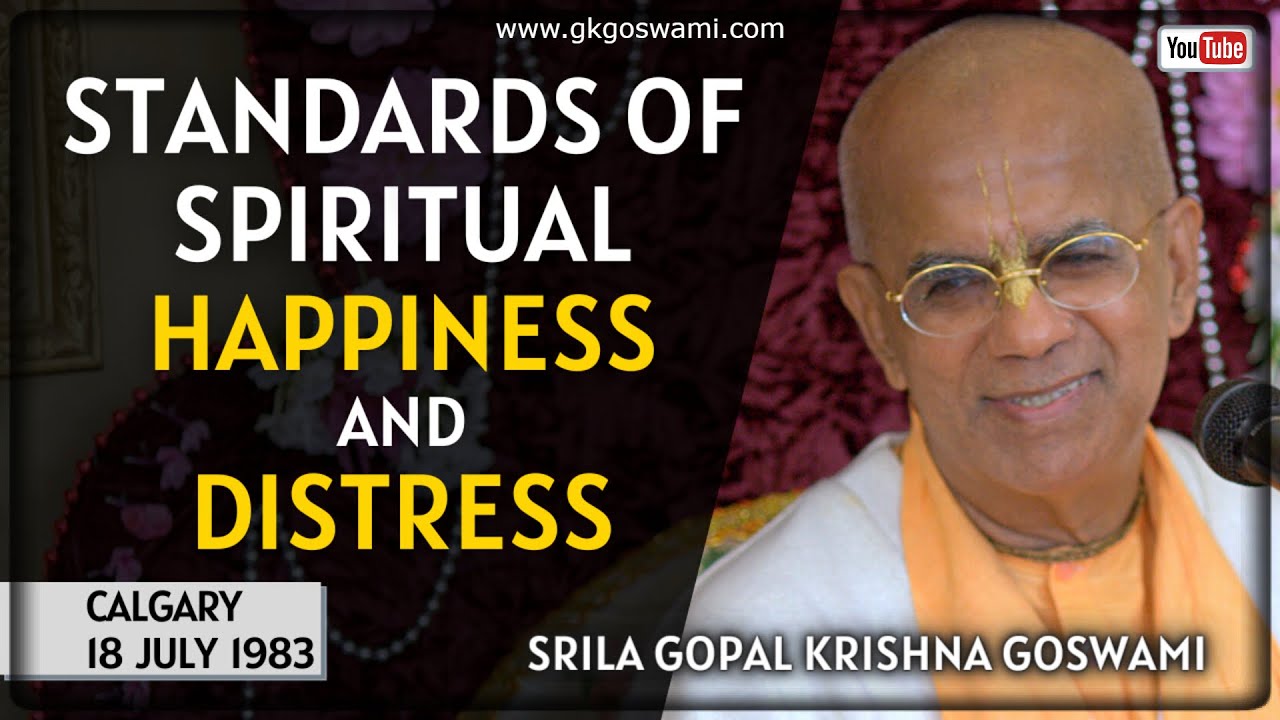
In this devotional lecture Srila Gopal Krishna Goswami explains the Bhagavata‑Mahāpurāṇa and Bhagavad‑gītā teachings on the dual nature of the material body as a tree that bears two fruits: happiness and distress. He describes the four "flavors" of material happiness—dharma, artha, kama, and moksha—experienced through the five senses, and outlines the six stages of life, the eight branches (five material elements and three subtle elements) and ten types of airs that compose the body. He introduces the two birds (ātma and paramātmā) residing in the heart, contrasting the materialist’s false friend (money, sense gratification) with the spiritualist’s true friend (the Supreme Lord). Using Prahlāda Mahārāja’s verses, he sets a spiritual standard: true happiness arises from Krishna‑consciousness and service, while distress comes from forgetting the Lord. He critiques materialist measures of happiness, emphasizes the need for a spiritual yardstick, and urges relentless propagation of Krishna consciousness (sankirtana) as the sole remedy for worldly distress. Historical examples (Advaita Acharya, Caitanya Mahāprabhu, Nityānanda, Haridās) illustrate the mission’s challenges and victories. The lecture concludes with a call for unity, perseverance, and lifelong dedication to devotional service, asserting that only through such service can humanity attain lasting happiness.
Chapters
Om Namo Bhagavate Vasudevaya. Om Namo Bhagavate Vasudevaya. Om Namo Bhagavate Vasudevaya. Om Namo Bhagavate Vasudevaya. This body, it is explained, releases two kinds of fruits. One fruit is known as happiness and the other fruit is known as distress. So as long as we have that body, there's bound to be happiness and distress. And Prahlad Maharaj also says in this connection, sukham indriyatkam detya deya yujina deynam. As long as you have this body, there's bound to be happiness and distress. So this body is compared to a tree, and there are two fruits in this tree. One is happiness and one is distress. Now, this fruit of happiness has four different mellows or tastes, just like when you eat prasad, you get different types of food items on the prasadam that have different types of taste, and they're all very pleasant. You may like the sweet, but at the same time you may also like fried rice. At the same time you may also like pakoras. So similarly, the Bhagavad-gītā explains that this fruit of happiness has 4 different flavors, and the 4 different flavors of this fruit of happiness are dharma, Ārtha, Kāma, Mokṣa. These are the 4 different flavors of this fruit of happiness. When one is religious, one is happy, isn't it? There is no denial that when somebody goes to the church or the synagogue or the temple regularly, he is happy. Another flavor is the desire for sense gratification. Generally one goes to a place of worship in order to realize artha, economic wealth. So when somebody is making money, he becomes very happy, isn't it? That's another common principle. Whether you're living in a communist country or a capitalist country or a socialist country, if you're making money, one becomes happy. So that is another fruit of this tree, of this fruit of happiness, another taste that it results in happiness when you're making some economic wealth. Then the third flavor of this fruit of happiness is sense gratification. When you have money, what do you want? He naturally wants sense gratification. Nobody wants to become a millionaire and at the same time control their senses. Only the devotee has a vision of let me become a millionaire and at the same time control my senses. But the materialist, he doesn't have this vision of let me become a millionaire and at the same time control my senses. So this is the third flavor of this fruit of happiness. That is the flavor of wanting sense gratification. And the fourth mellow of this fruit of happiness is moksha. After you've had enough sense gratification, then what do you want? Oh, let me become one with the Supreme. So these are known as the four tastes of this fruit of happiness. Now this fruit of happiness is being tasted So, 5 different tongues. We normally, when we want to taste something, how do you know whether it's pleasant or not? How do you know what the taste is? You have to put the food in your mouth, isn't it? And if your tongue has blisters, then you can't really judge whether the taste is good or not. When your tongue is diseased, you cannot know what the different tastes of the different food items are. So just like when you want to know how ple— pleasing the food is, you have to put it in your mouth and then the tongue can determine how pleasant it is, what the taste is. Similarly, this fruit of happiness is tasted through 5 senses. These are known as the knowledge-acquiring senses. And what are the knowledge-acquiring senses? The eyes, the ears, the nose, the tongue, and touch. These are the, um, these are the 5 tongues through which the 4 different types of fruits of happiness are tasted. Just like you go to the market and you see a variety of fruits in the shop. Similarly, there are 4 different types of material happiness that one can experience. And these are experienced through these 5 different senses. And this human body, it passes through 6 different stages. There is lamentation. One is lamenting for what he has lost. Then there is illusion. If you talk to the materialists, you will see that they are lamenting. What are they lamenting for? They are lamenting the good old days. When you talk to an old man, if you ever go to the old age houses, you will see that they are all talking, they are lamenting about the youthful days, isn't it? So that is one of the diseases, they are lamenting. And if you talk to an unemployed man, he is lamenting about the days when he was employed, isn't it? So that's one of these phases. Then there is illusion. The living entities are all in illusion as to what is the real identity and as to what is the false identity. The problem of material existence is that what is asat is accepted to be sat. Then there is death. Then there is hunger. Then there is old age. So these are the different stages through which the living entity has to pass through, or these are also known in the Bhāgavatam as the 6 circumstances through which this tree of material body has to exist. And this tree of material body has 8 branches. Just like you may go to any tree, the tree has branches. So similarly, This tree of material existence also has branches, and the total number of branches in this tree of material existence are 8. And these 8 branches are the 5 material elements and the 3 subtle elements which make up this body: earth, water, fire, air, earth, water, fire, air, ether. Bhumirapo na lo vayu. And 3 subtle: mind, intelligence, and false ego. These are the coverings of this tree. Oh, sorry, these are the branches. And just like within the tree, there are air. Therefore, even with this body, there are 10 different types of airs. Um, the materialists would not believe. We made the conclusion that the trees also have soul. But recently, uh, two major scientists in Washington conducted a study for 10 years, and they concluded that even the trees talk to each other. Just like within this body, we have 10 different types of air. So similarly, even within the trees, there are— there is air. And how do the trees talk? Every species— God's creation is so wonderful— every category of species speaks in a different manner. So the trees, when they are being attacked by the insects, they release a particular type of air warning the tree next door that be careful, the ants or the insects are attacking us. And this is the finding of Nadi Bhagavad Gita or the Bhagavatam, which the present-day so-called modern civilization would not want to believe. But these are the findings of these scientists in America, that the trees also talk and they pass messages to each other. The trees are always communicating with each other. In fact, they communicate even more than the human beings, but they communicate by releasing different types of air. So similarly, within this tree of human body also, There are 10 different types of air, and within this tree there are different types of coverings like the skin, blood, mucus, fat. These are the different coverings. And then there are 2 birds that are sitting on this tree. One bird is the Atma, the other bird is the Paramatma. And the Paramātmā is simply witnessing in which direction does the individual want to progress. So similarly, even in execution of devotional practice, we always have to keep remembering that the Lord is situated in the heart as the Paramātmā, and in that position He is guiding us, He is instructing us. Based upon our desire. So the reason we cited this analogy of the body and the tree, which is there in the Bhagavatam, is to point out that the Lord is constantly in the heart. At no point is the devotee alone. In fact, at no point is the individual alone. But the only difference is that the materialist doesn't know the secret. That his best friend is constantly accompanying him. The reality is that the materialist doesn't even know who his best friend is. The materialist thinks that his best friend is money, bank balance, sense gratification, family members, society, etc. Whereas the spiritualist recognizes that his best friend is the Supreme Personality of Godhead. And because he recognizes that the Supreme Personality of Godhead is the best friend, And he remembers that the Supreme Lord is in the heart of every devotee, is in the heart of everyone. He was always meditating and remembering the Lord in the heart. And when you always remember the Lord in the heart, then the Lord also reciprocates by injecting spiritual knowledge by which the illusory concepts of life can be destroyed. Just like when it's dark, when you put the switch on, you can at once put the lights on, by which the darkness gets removed. Similarly, we have to keep the spiritual switch on. That is, we always have to keep our connection with the Lord in the heart. And if we keep our connection with the Lord in the heart, then, uh, we will be able to fulfill the important mission of Kṛṣṇa consciousness. So in this tree there are also some holes. Just like when you go and see a tree, you may have noticed that in many trees there are different holes. So in this tree of material body also there are holes. And how many holes are they? 9. And the Bhāgavatam explains that when one is thinking of sense gratifications Bhaktivedanta, are you awake? Oh, okay. When the Bhāgavatam explains that when one is thinking of sense gratification, then these holes are simply emanating foul substance, foul smell. And when one is thinking of spiritual sense gratification, then it's a pleasant smell. And what are the 9 holes in the body? The 2 eyes, the nostrils, the ears, the mouth, the genitals, penis. These are the different, uh, holes in the body. And the Bhāgavatam explains that these different holes should all be illuminated with transcendental wisdom. In other words, constantly through these different holes, there may be pushes they may be in urge to satisfy them through sense gratification. But if we are constantly pushing the spiritual message through these holes, then the mature crop will not be allowed to fructify. So material thoughts are like foul smell, and as Duhu Amarad says in the Srimad Bhagavatam, that one falls a victim of sense gratification due to being captivated by the illusory energy. And this opportunity to engage in sense gratification, as Dvāmaraṣṭha says, is also available in the hellish planets. Even in the hellish planets, one has the opportunity to engage in sense gratification. Hence, to engage in sense gratification in the human form of life, especially after one has begun the process of devotional service, especially after one is initiated into the process of Kṛṣṇa consciousness, is a very shameful act. Therefore, we must always remember the statement of Prahlāda Mahārāja that one who attempts to fulfill or satisfy the itching sensation is simply actually wasting his time, because the real satisfaction which we are all looking for can only be found by engaging in the process of devotional service. Therefore, Prahlāda Mahārāja is giving us a standard over here. That we should be happy when we engage in Kṛṣṇa consciousness, and we should be unhappy when we do not engage in Kṛṣṇa consciousness, and we should be unhappy when we see the materialists who are blind to the purpose of human life. If this is our standard, then what is going to be our goal? Our goal is going to be to make those who are unhappy happy, to make those whose vision is clouded removed, to improve their eyesight. Just like when a person has a defective eyesight, he puts ointment, and as he puts ointment in the eyes, the eyesight, the eyes gradually improve, and correspondingly his vision also improves. So similarly, First of all, we have to improve our spiritual vision, and you can improve your spiritual vision by constantly being in touch with the Lord and the spiritual master through the process of devotional service. And then as we improve our spiritual vision, we will be able to experience spiritual happiness and spiritual distress. Right now, Our happiness and distress is on the basis of material feelings. The happiness and distress that we are experiencing in the neophyte stage of devotional service is strictly on material feelings, isn't it? When we, when we are honored, when we get what we want, we feel very, very happy. We're up in the air for a few days. But the cause of happiness or the result of a material yardstick and not a spiritual yardstick, the same happiness gets translated to unhappiness. As long as we apply a material yardstick to judge what is happiness and what is distress, we will always be tossed between happiness and distress. One moment you will be happy, the other moment you will be sad. But the moment we apply spiritual yardstick to what is happiness and what is distress, you will always be like Prahlad Mahārāja. That is, you will always be happy because you will always be remembering Kṛṣṇa, and your unhappiness will only be manifested when you see somebody who is trying to convert a position of distress into a position of happiness. The devotee recognizes that there will be duality in a material world. And hence he is prepared to face the duality. The devotee recognizes that if today I am healthy, tomorrow I may even fall sick. The devotee recognizes that if today there is some happiness, tomorrow there will also be unhappiness. If today the weather is good, tomorrow the weather will also be bad. And because he recognizes that happiness and unhappiness will both be there, he is not disturbed at all when he has to face a huge problem, because he has faith that by the mercy of Caitanya Mahāprabhu, the huge problem can be brought under control. So we have to apply the spiritual standard, and if we apply the spiritual standard, then we will never be unhappy. Because even when you see the conditioned souls who are trying to forget Kṛṣṇa, Because you have the spiritual understanding and the spiritual message in the forefront of your mind, you will always be spiritually happy. And spiritual happiness means no desire for material activities, no desire for sense gratification. There is no room for sense gratification in our body, in our mind, in our senses. We cannot overload this body. Just like some of you have gone to India may have seen that they really overload the buses, you know, and there's every danger when you overload the buses and the cars, and at any time it can fall. But we cannot overload this body of the senses. We can only maintain spiritual desires, and we cannot give any location, we cannot let Maya or material desires occupy any residence, any position in the body. Just like like Parikshit Maharaj when he saw Kali. He said, "Get out of my kingdom." So we have to have material desires leave our kingdom. That this kingdom is what? This body is also compared to a fort. And the analogy in the scriptures is that a person who has controlled his senses, his position is like that of a king who is living in a heavily guarded fort. If a king is living in a heavily guarded fort, then he's not worried that the enemy may come, but he— the enemy is not going to be able to touch him. And if we do not have control over this body and senses, then it is compared to a king who is living in an unguarded fort. So one who has conquered his mind and the senses, he's actually one who's living in a heavily guarded fort, and he's in no anxiety at all. But if we have not conquered, if we are not trying to control the mind and the senses, but rather if we are thinking or opting to follow the dictates of the mind and the senses, then our position is to a king who is living in an unguarded fort or an unguarded house. So one who is conquered is a true conqueror. Just like Prabhupada gave a lecture once in which he said, one may have conquered over the whole world, But if he has not conquered over the mind and the senses, he has conquered over nothing. So we have to conquer over the mind and the senses, and this is through the process of Krishna consciousness. Just like gold— in gold there are so many impurities, but when the gold is burned in fire, the impurities go away and the shine of the gold is manifested. So similarly, there are so many impurities in us. But if we burn these in the fire of material desire, in the fire of devotional service, then once again the illumination will manifest itself. Nanda Maharaj, when he saw that these different demons were trying to kill his son Krishna, Nanda Maharaj became very sad and he became very thoughtful. Nanda Maharaj was thinking That maybe my son has done something bad in his previous life for which the demons are now taking revenge. But then Nanda Maharaj realized that all these different demons are just like flies and Krishna is like fire. So then Nanda Maharaj said, oh, these different demons are just like flies and Krishna is like fire. So when the flies come to attack fire, what happens? Some of you may have even seen it. When the fire is blazing, the flies, they come, they think, oh, they can destroy the fire. And they actually come with the purpose of beating the fire, but actually they get beaten by the fire and they get roasted to death. So similarly, Krishna is like fire, and these material desires actually are totally insignificant. Therefore, we have to burn these material desires that are like moths or flies in the fire of devotional service. And if we are determined to burn these material desires in the fire of devotional service, then we will always be victorious. Just like Kṛṣṇa, He was always victorious. At times Kṛṣṇa was in the most difficult position. Just like Kaliya, when the Kaliya demon had Kṛṣṇa wrapped up in her coils. Kali had Krishna wrapped up in his coils, and even Krishna's parents were thinking, "Now Krishna is gone." They were giving up. As Kali's grip on Krishna was getting tighter, Krishna's mother was fainting. But only Balaram amongst all the Krishna's family members knew that in the end Krishna is going to be victorious, and he did not get nervous at all. So similarly, We have to be confident that if we are on the side of Kṛṣṇa, we will definitely be victorious. It is not difficult to defeat sense gratification. Defeating sense gratification is very easy because māyā is subordinate to Kṛṣṇa. It is not that māyā is Kṛṣṇa's boss. Kṛṣṇa is māyā's boss. So if you take shelter of the boss, you don't have to worry about the inferior energy. But it is only when we think that, no, maybe we should take shelter of the inferior energy instead of taking shelter of the superior energy, can you become a victim of the illusory energy. Kyanishakya shasthana. But if you are confident that Krishna is the superior and not Maya, and hence you decide to stick to the superior, we have to be determined to stick to superior association. Just like in mature life also, if you're determined to stick to something, like the materialists, they're determined to go on with sense gratification, isn't it? Therefore, though there may be so many diseases coming up, they still don't give up sense gratification. For example, they have— the scientists have recently released information that by indulging in illicit sex and all, you can get a disease which is as severe as AIDS. Which is 1,000 times more serious than cancer. But does this mean that people have got frightened from illicit sex? No! They are so determined, it doesn't matter come what disease, they still want to go on with their sense gratification, isn't it? So the spiritualist also has a standard, and his standard of determination is, come what may, but he's not going to give up his association with the spiritual master and the Supreme Lord. He's not going to give up his association with the process of devotional service. And because he is not going to give up his association with the prāsad raṣāda, the devotional service, in the end such a devotee is victorious in his battle. Just like the soldier may get attacked in a battle, but because he is determined to fight till the end, he emerges victorious. So we have to be determined to defeat sense gratification. And if you are determined to defeat sense gratification, then these spiritual standards of happiness and distress that Prahlāda Mahārāja is explaining in this verse will be our guide. So if we can just remember the standard that Prahlāda Mahārāja is establishing, then we will always be successful. And the standard is that not to be selfish like the karmī, not to be selfish like the jñāni, not to be selfish like the yogī, not to be selfish like the fruit of worker. But rather to work for the welfare of entire humanity. And Prahlad Maharaj also states that, my dear Lord, I do not want to be selfish like the transcendentalists who call themselves transcendentalists but who don't open their mouth, who call themselves transcendentalists but who want to go to the mountains because they are only worried about their own liberation. Rather, he says, Prahlad Maharaj, that I am worried about everyone. So we have to be worried about the entire humanity. In fact, we have to be worried about God's entire creation. And if that is our standard, and if you are judging happiness and distress based on that yardstick, then you are on the right path. But if we are judging happiness and distress on the standard that, oh, if I can get the service I want to do, if I I can get what I want, only then I will be happy. And if I don't get what I want, then I'll be unhappy. Then we are judging and viewing everything from a material angle of vision. And if we judge everything from a material angle of vision, then one day you'll be happy, tomorrow you'll be sad, just like the materialists. The materialists are also judging what is happiness and distress from the material angle of vision. If for one day they're happy, the other day they are in distress, isn't it? But the transcendentalist doesn't have the same standard. His standard is something else, and his standard is the spiritual wisdom, the spiritual instruction. We have to judge what is happiness and what is distress based upon the spiritual instruction of the scriptures. So the spiritual instruction of the scriptures is what we are discussing today. We are discussing today through the medium of 3 verses of Pralad Maharaja's instructions, and each of these verses is very important. So when we see that somebody else is not taking to Kṛṣṇa consciousness, we should get concerned for that. We know with the utmost confidence that there's no question of any level of happiness in the material world. And we know that these so-called plans and schemes and these new inventions that they're doing will all end up in the same result. Just like 2 years ago, there was big expectation that now they're going to have pocket-sized televisions, okay? And pocket-sized televisions have come out. Does this mean that people's distress has gone down any greater? Does this mean that the number of diseased people are less today? Does it mean that people are more happy than before? No. Even though the pocket TVs came out, they are still distressed. Now they are getting into a new era of introducing these what they call supercomputers. Does this mean that the distress of society will go down? No. They say that the computer has been the greatest invention. We admit that. But does it mean that people today are any less distressful than they were when the computers were not introduced? The miseries of life are still there. In fact, the miseries of life are getting worse each day because nobody is doing research in the right direction. So fortunately for us, all the research has been done by the great sages. Therefore, we don't do research just like Once when the Bhaktivedanta Institute was being formed, there were different head type names for this institute that came up. One name came up was Bhaktivedanta Research Institute. Another name came up, Vedic Research Institute. And Prabhupada said, "We don't want to use the word research. The research is already done by the great sages and vyāsadevas. We just have to follow them." We don't have to do any research. So he said, don't keep using the word research. So he said, just call it Bhakti Nanda Institute, not Bhakti Nanda Research Institute. So we don't have to research into the platform of happiness. We don't have to research into the platform of unhappiness. The research is already done by the great sages. All we have to do is with our intelligence follow them. And then the goods will be there. So the research that they have done and concluded is a transcendentalist is happy when he's remembering Kṛṣṇa, and a transcendentalist is unhappy when he forgets Kṛṣṇa and when he sees somebody else is forgetting Kṛṣṇa. And as long as the transcendentalist sees that people are forgetting Kṛṣṇa, he cannot be comfortable. It cannot rest. Just like Advaita Acharya. Advaita Acharya actually appeared on the planet before Caitanya Mahāprabhu appeared. And Advaita Acharya, when he saw the predominance of sinful activity in the activities of different individuals, he became very concerned. And Advaita Acharya began to pray that the Lord may incarnate to save the conditioned souls. And Advaita Acharya prayed for Lord Caitanya's appearance. And after Lord Caitanya appeared, what did He do? He instructed every one of His followers to be instruments in spreading Kṛṣṇa consciousness, isn't it? He sent Rūpa Gosvāmī and Sanātan Gosvāmī to Vṛndāvana to go and discover places where Kṛṣṇa had performed His pastimes. He sent Nityānanda with instructions to go to every household in Bengal to everyone. And he told the rest of his followers, whoever you see, give them Kṛṣṇa consciousness. Just like Caitanya Mahāprabhu was in southern India, and in southern India when he was touring the different places of pilgrimage, there was a Brahmin called Kurma. And this Brahmin was very attracted to Caitanya Mahāprabhu's philosophy. And this Brahmin wanted to give up his household life and just, uh, follow Caitanya Mahāprabhu. But Caitanya Mahāprabhu said, no, you stay where you are, but whoever you see, you instruct him about Kṛṣṇa consciousness. So Caitanya Mahāprabhu has given this mission of spreading Kṛṣṇa consciousness to every one of His followers. It is not that He gave this instruction only to His sannyāsī or brahmachari followers. No, He gave this instruction to everyone. Kurma was a Brahman in the Grihastha Ashram. But Caitanya Mahāprabhu told him, you can stay in that ashram, but whoever you see, you give him Kṛṣṇa consciousness. And those who were brahmacharis, Rūpa Gosvāmī and Sanātana Gosvāmī, were brahmacharis, but He gave them the same instruction: go and write books about Kṛṣṇa. So if we analyze the scriptures, we will see that the most important business is to execute devotional service and specially execute devotional service in the flavor or at the level of propagating Kṛṣṇa consciousness. Therefore, Prabhupāda used to say again and again, this Sankirtan movement is the only movement that can save humanity from going to hell. Just analyze and see how many people today are actually engaged in propagating Kṛṣṇa consciousness? How many? How many people today are giving up sinful activities? On Sunday, for example, if you listen to your TV, you will see so many different religious movements using the media, using the television to give home the message about God, isn't it? But how many of them are saying give up sinful activities? How many? Hardly anyone. Yesterday I was telling you all how the Plain Truth magazine in its latest issue has, has, is justifying meat eating. So how many of them even know what is religion? Hardly a handful even have the concept of what is religion and what is irreligion. In the name of religion, irreligion is being broadcasted today. So the point is that it is only the devotees of this Kṛṣṇa consciousness movement who have the understanding as to what is religion and what is irreligion. Do a survey. Call all the clergymen of Calgary. Let's do a telephone survey. Call all the clergymen and the priests in the different synagogues and ask them, do you consider the following to be sinful or not? Me reading. 99.9.9% will say no, it is not sinful. Illicit sex, sinful, unsinful? They'll say not sinful. Intoxication, sinful, unsinful? They'll say unsinful. If you analyze even the survey with the clergymen and the so-called religious leaders of society, they'll all say these are not sinful. In fact, therefore, they're all liberalizing the laws in the name of being modern and keeping up with the times, isn't it? In the name of keeping up with the times, they are liberalizing the spiritual laws. Like we just read, the Anglican Church now in England, you know, all this time, divorce, even though it was being tolerated, but at least it was not made legal. But now they've just made it legal. They said, yes, we have to keep up with the times. In the name of keeping with the times, the religious principles are getting watered down. And the Kṛṣṇa consciousness movement, which is based on the principles of purity, is not watering down the process. We have to keep the message intact and distribute this message. So we are concluding that except for the Kṛṣṇa consciousness movement, nobody is seriously attempting to correct the ills of society. Everybody is interested in having a relationship with the congregation only for the purpose of realizing some economic economic gain. But the vision of the devotee is to correct everyone's sinful activities. And these sinful activities can only be corrected if this Kṛṣṇa consciousness movement is propagated. Therefore, we have to propagate this Kṛṣṇa consciousness with the utmost seriousness. We have to take this sankirtana mission of Caitanya Mahāprabhu as our life and goal. The materialists have taken what as their life and goal? What? Sense gratification. Yes, they have taken sense gratification as their life and goal. And every member who enters into this Kṛṣṇa consciousness movement has to take on the mission of Prahlāda Mahārāja as his life and goal, the mission of Caitanya Mahāprabhu as his life and goal. This mission is not a part-time mission. Our mission is not like that of the Christians. When somebody enters into the Christian clergy, then they have what they call 3 years of overseas service, just like in the US Army. If you join, you first have to go out in the front or go overseas, and then they let you stay in the base. So they recruit their men and then they send them for 2 or 3 years overseas, like Africa, India, or these third world countries. And then bring them back to the base and then they can just operate out of the base. But that is not our mission. Our mission is not that we are going to go on preaching Kṛṣṇa consciousness only for 2 or 3 or 4 years. Our vision is that we have to go on distributing Kṛṣṇa consciousness all our life. Of course, in distributing Kṛṣṇa consciousness one has to experience some difficulty. But at the same time, we should recognize that you don't relish something till you go through difficulties, isn't it? You don't relish something that is easily available. You don't enjoy something that is commonly visible. When you're walking on the road and you see a latest Rolls-Royce, your eyes open up and you want to look at it. But when you see so many Hondas or ordinary cars, you don't bother to look at that. Because that is something rare. Similarly, devotional service is rare. And just like you have to pay a huge price to buy a Rolls-Royce, you have to pay a price for realizing the bliss of devotional service also. And the price is unalloyed, undeviated engagement in the process of devotional service. And if you are always engaged in devotional service, Then even if it is a giant task, it will appear very insignificant and easy. Krishnadas Kaviraj says that by the mercy of Caitanya Mahāprabhu, even a dog can swim across the ocean. Normally a dog, when it enters into the ocean waters, it swims, it walks for a few yards, and the dog runs back. It is not possible normally for a dog to swim across the ocean. But Caitanya Mahāprabhu's mercy, it is possible. So Sankirtan may be a difficult assignment. It is definitely difficult. There is no question about it. Just see the amount of difficulty that Prahlada Maharaja had to face in expanding the Sankirtan movement. Prahlada Maharaja, when he was trying to preach to his colleagues, he was severely chastised by his father, isn't it? And even Caitanya Mahāprabhu, when he was trying to propagate the Sankirtan movement, the Muslim ruler actually broke the drums. And Haridas Thakur, when he was trying to propagate Kṛṣṇa consciousness, he was whipped in different marketplaces. But because these stalwart devotees of the Lord had to go through these difficulties, they became glorious. So similarly, the devotees who are engaged in spreading Kṛṣṇa consciousness through the sankirtana process, because they are going through all these difficulties in spreading Kṛṣṇa consciousness, Their position is very glorious. And as we said, quoting from the fourth canto earlier in our discussion today, in the fourth canto it is clearly stated that one can only enter into the Vaikuntha planets if he has executed his life working for the welfare of others. So just chanting Hare Krishna will not take you back to Godhead, but chanting Hare Krishna and working to release the imprisoned conditioned souls will take you back to Godhead. Because this is the highest understanding of the philosophy. Understanding that unless one takes to Krishna consciousness, there cannot be happiness. So that should be our new standard of happiness and distress. That when you're chanting Hare Krishna, when you're remembering Krishna, you're happy. But the moment you see a materialist forgetting Krishna, you become sad. But what does it mean? You just become sad and that's it? Shed tears? We don't believe in shedding crocodile tears. We, when we, when we feel sad, we work towards understanding, towards fulfilling the confidential desires of the Lord, the inner desires of the Lord, and that is to bring everyone back to Godhead. So this is our mission. So through this sankirtan process, we are actually planting the seeds of devotional service. Sometimes it is a little hard to understand how are we planting the seeds of devotional service. Sometimes somebody may argue, but I'm only distributing paraphernalia, I'm only doing stickers or whatever. But you are planting the seeds. You're planting the seed because you're getting everyone to render ajñāna-sukruti. You're getting everyone to render devotional service unknowingly. And knowingly or unknowingly, whoever renders devotional service, gets purified. Isn't it? Om pavitrava pavitrava. Knowingly or unknowingly, anyone who does service, he gets purified. So knowingly or unknowingly, anybody who does some activity for the welfare, for the pleasure of Kṛṣṇa, he is benefiting. And everyone who is doing a jnāna-sukṛti or jnāna-sukṛti, he is going to be given further the opportunity to engage in devotional service. So this is a very important mission. Prabhupada had great hopes. Prabhupada's vision was that this movement will go down in history as a movement that has changed the direction of the world. Why are the materialists getting alarmed about us? We discussed this at length yesterday. Because this movement is changing the direction of the world. Already more and more people are joining this movement. More and more people are reading Prabhupada's books. More and more people are becoming vegetarians. Already this movement is changing the direction changing the direction of the world. And because it is changing the direction of the world, the materialists and the so-called false religionists, they're getting alarmed and they're trying to liquidate this movement. But they will not be able to liquidate this movement through the imposition of heavy fines, because the more they attack us, the more determined our devotees become. Prabhupāda used to say, united we are, divided we fall. When the different blades of grass are combined together, then those blades of grass become stronger than a rope. But a blade of grass in itself has no strength at all. So we have to get even more united in our determination to push on this movement. And Kṛṣṇa is just purifying us, just like the Pāṇḍavas. The Pāṇḍavas also got purified. How did they get purified? They had to go through all these inconveniences, and by going through all these inconveniences, their dependence on Kṛṣṇa increased. Increased. Just like when the battlefield of Kurukshetra started, on the first two days, first few days, the Pandavas were losing ground. And as they were losing, their dependence on Krishna increased further. They were— as they were beginning to lose the battle, they were all looking at Krishna for direction even more. Even though they were already— Krishna was in their midst, but as they were losing ground, they were looking at Krishna even more for direction and shelter. And by increasing their dependence on Kṛṣṇa, eventually they won the battle. So it may appear by mundane logic that we are losing ground because we have one or two court judgments against us. No, but in the end, with the, the team of Kṛṣṇa is bound to be victorious. So we have to think about executing the sankirtan process all our life. That has to be our mission, that this one life we have to sacrifice for the benefit of humanity. For the benefit of civilization, for the benefit of my spiritual master, for the benefit of the Lord. This actually, the Lord has nothing to benefit, but it gives him pleasure when he sees that the conditioned souls are being brought back to him. So if this one life can be sacrificed for the pleasure of the Lord, the entire humanity will eternally be indebted to us. You can analyze, there are so many Millionaires who have come and now they have gone. Nobody talks of them, isn't it? There are so many great soldiers who have come and gone. Nobody talks of them. Hare Krishna.
More from PRASAD

Rare Pastimes & Timeless Lessons of Guru Mahārāja | Stories Every Disciple Should Hear

ISKCON Legends- pure devotees meet-HH Jayapataka Swami, HH Gopal Krishna Goswami, HH Radhanath Swami



Jagannātha Ratha-yātrā Through Śrīla Prabhupāda's Mercy | 29 April 2006 | Nairobi, Kenya

Lord Jagannātha's Appearance Pastime | 21.07.2019 | ISKCON Calgary | Śrīla Gopāla Kṛṣṇa Gosvāmī

The Ācārya Teaches by His Own ExampleGuṇḍicā Mārjana by Guru Mahārāja #shorts

Guṇḍicā Mārjana – Lord Jagannātha's Pastime | 21.7.2019 | ISKCON Calgary |Śrīla Gopāla Kṛṣṇa Gosvāmī

H.H. Gopāla Kṛṣṇa Gosvāmī Mahārāja - Exemplary Sādhana and Deity Worship # shorts

भगवान की कृपा कैसे प्राप्त होगी ? | 11 Jan 2014 | Punjabi Bagh | Srila Gopal Krishna Goswami

Material Education vs Spiritual Education | Srila Gopal Krishna Goswami #shorts