Sweetness of Krishna | NOI 7 | 19 Jun 2007 | Washington | Gopal Krishna Goswami
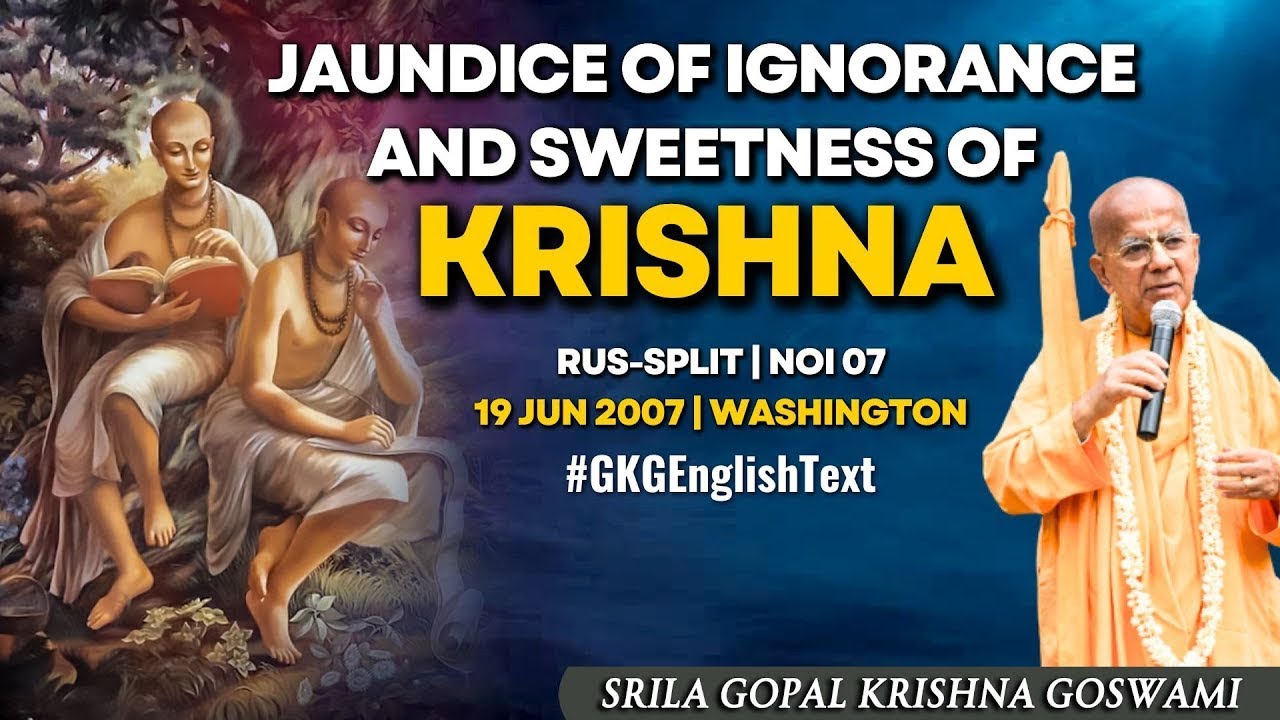
In this devotional lecture, the speaker (Gopal Krishna Goswami) expounds on verse 7 of the Nectar of Instruction (Uddiyā‑samhita) compiled by Rūpa Gosvāmī. He explains that the holy name, character, pastimes and activities of Kṛṣṇa are transcendently sweet, but the tongue of a person afflicted by avidyā (ignorance) cannot taste this sweetness. Avidyā manifests as the anarthas – lust, anger, greed, envy, hatred – which act as spiritual diseases. The remedy, as taught by Rūpa Gosvāmī and reinforced by A. C. Bhaktivedanta Swāmī Prabhupāda, is careful, attentive daily chanting (japa) of the holy names, supported by regular hearing of Śrīmad‑Bhāgavatam and cultivation of vairāgya (detachment). The lecture outlines the three stages of chanting (nama‑apārāda, nama‑bhāsa, śrī‑dhānāma), the four rasas (reveal mind to advanced devotees, give/receive charity, serve and honor prasāda), and the six rasas that the ISKCON society provides for spiritual advancement. Practical analogies (sweetness of food, disease‑cure metaphors, a stuck boat, and the burden of japa) illustrate why quality, not quantity, of chanting matters. The speaker urges devotees to examine their chanting quality, adopt attentive practice, and thereby cleanse the root of avidyā, develop detachment, and experience the inherent sweetness of Krishna’s name and pastimes.
Chapters
Om Namo Bhagavate Vasudevaya. Om Namo Bhagavate Vasudevaya. Om Namo Bhagavate Vasudevaya. Om Namo Bhagavate Vasudevaya. The audience today From what I can see, primarily composed of regular devotees. So I'm going to speak on a topic which should be of interest to all devotees. We're going to speak from a verse from Nectar of Instruction, originally published as Śrī Udaya-samhita, and Prabhupāda published it under the name of What name did Prabhupāda publish Uddhayasamhita under? What name did Prabhupāda publish Uddhayasamhita? Under what name? Huh? The Nectar of Instruction. This book was compiled by Rūpa Gosvāmī. We devotees are also known as rūpānugas. Why are we known as rūpānugas? Follow Rūpa Gosvāmī. Just like we're also— oh yeah, there are too many cameras. Too many cameras are distraction. And just like we're also known as Prabhupāda-dūgās, because we follow Śrīla Prabhupāda. So Rūpa Gosvāmī is considered the leader of the Gosvāmīs. What does Gosvāmī mean?
One who controls senses.
One who can control the mind and senses. In India today, we have the Gosvāmī as a caste. But you may have a Mr. Gosvāmī, he may have a cigarette in his— puffing a cigarette and having a drink in front of him. Swāmī, Gosvāmī, Mahājān, these have all become family. Titles. There's a caste, isn't it, in India? But Mahajan means one who has spiritual authority, and Gosvāmī means one who has control over mind and senses. So Rūpa Gosvāmī at one time was holding a very exalted position in the government of Nawab Husayn Shah, but He resigned his position and joined Caitanya Mahāprabhu, and Mahāprabhu gave him instructions and Sanatana Gosvāmī, which they presented in subsequent literature, including Hari-bhakti-vilāsa, so which contains the rules and regulations for the process of devotional service. So Uvāga Gosvāmī In this book, Śrī Ugrāśaṁhita, He only has 11 verses. How many? 11. But each of the verses is so important that I wish the devotees would take time to read it, follow it, meditate on it, and practice it. If you do that, your spiritual life will be a success. Now Rūpa Gosvāmī says the following in text 7 of Śrī Uddiyāśramaṇa. He says, sat-kṛṣṇa-nāma-caritādi-siddhāpavedya itto pāda-rāsena na roci-kāno kintābhadārād anudīnam karuksaiva jaiṣṭhaḥ svādhi-kramaḍ-āhorita-gūrā-mūla-haṇtri. Sri Prabhupāda, the translation of this verse is as follows: The holy name, character, pastimes, and activities of Kṛṣṇa are all transcendently sweet like sugar candy. Although the tongue of one afflicted by the jointures of avidyā ignorance cannot taste anything sweet, it is wonderful that Simply by carefully chanting these sweet names every day, a natural relish awakens within his tongue and his disease is gradually destroyed at the root. Now even though there are only 11 verses in this oblation, Prabhupāda has given very elaborate purpose to each of them. Each purpose runs from 7 to 11 pages. And this shows you how important each of these verses is. So Rūpa Gosvāmī here is saying, he's giving us very, very important message. He's saying the holy name of the Lord is sweet. Now, how many of you feel it is sweet? How many of you feel the Holy Name is sweet? Oh, almost everyone, okay.
So the Holy Name of the Lord is sweet like sugar candy.
Everybody loves to eat sweets. Doesn't matter which tradition you belong to, whether Indian or African or American or Canadian, everyone has a tradition of eating sweets, isn't it?
Only difference is Most people eat sweets after eating and the Gujaratis eat sweets before eating. Am I right?
That is the only difference.
I can't understand the difference in logic, but what I know, the Gujaratis eat sweets before eating and the rest of the world eats sweets after eating. But people love to eat sweets, isn't it?
That's why You have over 200 million people suffering from diabetes in the world today because people love to eat sweets.
So now Rūpa Gosvāmī here is saying— when Rūpa Gosvāmī knows that everybody likes to eat something sweet, so he is saying the Holy Name is very sweet like sugar candy.
And the character and paśyam of the Lord, are also sweet like sugar candy.
And the transcendental līlā of Kṛṣṇa is also sweet like sugar candy. Just like you have nice prasāda in front of you, you relish it. You never fall asleep in front of a plate of prasāda. So the holy name is sweet. We should be voluntarily chanting the Holy Name all the time because it is sweet. But what does Rūpa Gosvāmī say further? He says further—
everyone understands English, no?—
and he says further that because our tongue is afflicted with the disease of avidyā. What does avidyā mean? Ignorance. So because the tongue is afflicted with the disease of avidyā, we are unable to taste the sweetness of the Holy Name. Just like, of course, most of you sitting here come from India except one or two people. Those who come from India, you know about joint disease. Joint disease is by and large a tropical disease. But isn't it, doctors? It's by and large a tropical country disease. But sometimes few rare cases it may happen in America also. But those of you who come from India, you know that jaundice is a tropical disease. And one of the symptoms of jaundice is that even if somebody gives you gold, honey, sugarcane juice, you will not be able to appreciate the sweetness. It appears bitter. Then as you recover from the disease, it again becomes sweet.
So sometimes we have high temperature. So if you have high temperature, and if somebody gives you the best made dhokla and all that, or shrikhand and all, still you won't get the taste buds, isn't it? You won't be able to appreciate. Sometimes you have high fever. When you have high fever, doesn't matter what somebody gives you, you can't appreciate the taste. Now, Rūpa Gosvāmī says, just like a diseased person cannot appreciate the sweetness or the palatable taste of food, because our tongue is afflicted with the disease of avidyā, Avidyā means what? Ignorance. Avidyā means ignorance. So our tongue is afflicted by ignorance. Now how is this ignorance manifesting? You may say, "No, I'm not ignorant, I'm in knowledge." We are in ignorance. And how is this ignorance manifesting? It is manifesting through the agency of Lust, anger, greed, envy, hatred. These are the different anartha. What does anartha mean? Anartha means that which is not necessary for our spiritual survival. Just like when we tell people we don't smoke, drink, no illicit sex, no gambling, no intoxication. Many times people tell us, "Oh, so what's the value of living? Might as well die. You can't do this, you can't do that, you can't do that." Isn't it? But we are living without these things and we find that living is completely easy. You can easily live without meat, intoxication, and all that. So similarly, many of us may feel that you can't live without an earth house. In other words, somebody may say lust, anger, greed, envy, hatred, you know, all natural symptoms. Come on, what's strange about this? But the scriptures say that these anarthas can be controlled and defeated by the power of devotional service. Just like A disease can be conquered with medicine. This disease of avidyā can be conquered or cured or treated or tamed by the power of devotional service. Now in Vedic literature we find that The great sages of the past, they have identified the problem and they have also given the cure. In the church situation, many times problem is identified but cure is lacking.
Isn't it?
They may analyze, "Okay, you have AIDS. Okay, what's the cure?" "Sorry, no, there's no medicine." Of course we know what the cure for AIDS is. Once, a few months ago, they invited me to speak at a conference in Delhi on how to stop AIDS, on AIDS. So I said, "It's a very simple solution. Just follow the laws of God, then you'll have no AIDS." AIDS is the result of unrestricted sex life against the laws of God. So that is how then mature nature is punishing us. But if you follow the laws of God, then there will be no such thing as AIDS, isn't it? So rather than educate people how to avoid AIDS, people are busy spending billions of dollars, people are busy allocating billions of dollars to find a medicine to cure AIDS. Pharmaceutical companies are pumping billions of dollars to find a medicine that can cure AIDS. And they think whoever does find a medicine will make a fortune.
But there is a solution to AIDS, it's very simple.
You don't need medicine.
So the point is that we are all suffering from this disease of avidyā.
Because we are so influenced by ignorance, when it is time to hear the glories of the Lord, we fall asleep. Isn't it? You never fall asleep at prasādam time.
When it is time to do our japa, we have to force ourselves.
And when we finish our 16 rounds of japa, we think, "Oh! What a great burden! What a great burden is off my head!" Isn't it? Sometimes I ask devotees, "Where's your japa mālā?" They say, "Oh, it's in the car." Or, "I left it at home." I say, "Why?" "I finished my rounds." Even if you finish the rounds, Kṛṣṇa says, satya yantavaṁ, we should always be chanting His glories.
Now the point is that our tongue, our mind, our senses, our intelligence is all heavily polluted.
Just like in the third chapter of the Bhagavad-gītā, Kṛṣṇa declares that, "Lust is the all-devouring enemy of the living entity, and it is always burning like fire and is never satiated." Satiated means it is never satisfied.
So that's the nature of lust. Then Kṛṣṇa explains, Where there's enemy, it can be found. Just like these days, everyone is paranoid about terrorists, you know. Of course, in America you don't have too many terrorists because the Homeland Security is pretty tight.
They're doing a pretty good job.
But in many countries, they're looking for terrorists. So they may identify, "Okay, Al-Qaeda terrorist is there in Baltimore." Then the next question will be, Where in Baltimore is he?
Downtown, suburbs, which building?
Isn't it? So similarly, the great sages have identified the culprit, namely lust, and also gone on to establish where this lust can be located.
Where is it located?
Where? Senses. Mind and, and intelligence. So it says, "Last can be found, located in senses, mind, intelligence." What does this mean? We have intelligence. There's no question that people have intelligence. Look at the technology in cellular telephones. Look at the technology in these medical machines. Look at the technology in the aeroplanes. Look at the technology they have, they have. Space men go in outer space, they change clothes, they live on that. Definitely they have technology. They press a button here and they can communicate with people on space. You know, you're on the aeroplane 35,000 feet and now from 35,000 feet you can even speak on telephone. Every seat in the plane has a telephone. If you are ready to spend the money, you can talk when nobody talks. I've yet to see anybody talking on the plane. The telephones are there, but nobody uses it. But if you want, you can. And the pilots are always talking on the ground. So the point is, there's no question that people do have intelligence. But by and large, our intelligence gets misused. Isn't it? Because lust is there in the intelligence also. So we are thinking, "Oh, how can?" pornography within, telephones, internet, this, that. Then we have mind. The mind, instead of being engaged positively, is often engaged negatively. Then we have the senses. This morning I was giving the Bhāgavatam class, and the verse was about King Amṛta. So in the Bhāgavatam class I was explaining How King Amresh was using his senses constantly in serving the Lord. We have the example. He used his eyes to see the beautiful form of the Lord. He used his legs to walk to the temple of the Lord. He used his head to bow down before the Lord. He used his nose to smell tulsi offered to the Lord. He used his ears To hear the glories of the Lord, isn't it? So, if lust is there, then lust is the only thing. How through the eyes I can see pornography? How through the ears I should hear some song which has nothing but romance as a theme? If you hear these songs, hopefully you all don't hear these days, but if somebody does analyze the film songs or the western songs, you'll find The 99.9% have one theme: love, isn't it? So because everyone's mind is so obsessed with lust, it's all they can think of. So with the ears you want to hear something romantic, with the eyes you want to see something romantic. So because of the mind, intelligence, and senses, and we want to engage the senses in something negative, So the point is Kṛṣṇa says there's eternal enemy. You may say, "This man's my enemy. He's my enemy. He's my enemy." But nobody's your enemy. Your own mind is your enemy. Your own material habits are your enemy. Your lust, anger, greed, which you're all victims of. They are our enemies. No use to identify this devotee is your enemy or this devotee is your enemy. That's just superficial excuse. Actually, we become our own enemies. When we deviate from the spiritual path, we become our enemies. And when we stick to the spiritual path, we are the best of friends. That is the conclusion of the Vedas. So Kṛṣṇa says, "Mind, intelligence, or senses." are the sitting places of this enemy known as lust. Now Kṛṣṇa has identified the problem, okay?
What is the problem?
Lust. Second problem: Where the lust is located. Now what is the solution? Kṛṣṇa says: "With the weapon of knowledge." Destroy this layer of spiritual life. Destroy ignorance with what?
With the weapon of knowledge.
Just like you destroy darkness with light. Isn't it?
How do you destroy darkness? With light, Doctor? So you destroy ignorance with what? With knowledge. And how do you get knowledge? By studying. We should read, we should study the books and apply the philosophy in practice. Some of us study but don't apply. We should study and apply the books in practice. The books prescribe renunciation, we should practice renunciation. Doesn't matter whether you're grihastha, brahmachari, sannyasi. The theme is enunciation if you want to make spiritual advancement. Now Kṛṣṇa is saying, "With the sword of knowledge destroy this eternal enemy, identify this lust." Now as I said earlier, the Vedas identify the problem, the disease, and then prescribe a solution. Now you have the disease of avidyā. Hurting you, striking you, bothering you. Now what is the cure? What does Rūpa Gosvāmī say is the cure? He says, by constantly chanting the holy names of the Lord every day, this disease of avidyā will get cured.
What does he say?
By carefully chanting His names every day.. A natural relish awakens within the stomach. So what, how will this enemy be controlled? By, by, by? Chanting. Not just chanting. Carefully chanting. Careful chanting means attentive chanting. You can chant, but if you attentively chant, then it will be more potent. So Rūpa Gosvāmī says, Holy Name is sweet. But we are unable to taste the sweetness.
Why?
Because we are in avidyā, we are in māyā. Now how to cure māyā? He says: "Chant every day." But He says: "Carefully chant every day." Then He says: "The disease will get cured at the root." At the root we have to cure the disease. Not just superficially cure the disease. Just like a doctor, a doctor, if he wants to cure a patient, someone will superficially cure a patient, but somebody wants— else wants to go to the root, to the root and cure so that the disease doesn't happen again.
Isn't it?
So Rūpa Gosvāmī is telling us how to cure the disease of avidyā at the root. And he says what? By carefully chanting the holy names of the Lord every day. So we should carefully chant. There are 3 stages of chanting the Hare Kṛṣṇa Mahā-mantra. I'm sure if I ask you, especially the initiated devotees, you're all mature people, I ask them, "Do you chant your 16 rounds?" You'll all say, "Yes." But the question is, What is the quality of your chanting? Rūpa Gosvāmī here says, "A chanting of chanting." Bhāgavatam says, "śrī-nrtaḥ svākada-kṛṣṇa-puṇyaśravana-kīrtanā hetiyānda-stropanad rāni vidu-nodhi surāṭ-satām." The holy names of the Lord are so auspicious that anybody who hears a holy name will be able to cure the disease of sense enjoyment. Also it is said, nāstra-prāyeṣya-vadrāyeṣu nityam bhāgavata-sevaya bhāgavata-yatamaśloke bhakti-bhāgavatī-naiṣṭhikī. By regularly hearing the Śrīmad-Bhāgavatam, all that is inauspicious will be destroyed and loving devotional service will be established. So the point we are making is very simple. The point that Rūpa Gosvāmī is making is, if you want to cure the disease of avidyā, Then what do you have to do? You have to chant the holy names every day. You not only have to chant the holy names every day, you have to chant the holy names carefully, attentively every day. And if you chant attentively, then your anarthas will get eliminated fast. And if you keep chanting not attentively, then the anarthas will stay. Prabhupāda Bhaktisiddhānta Mahāprabhu was once asked by his disciple, "How is it that some devotees make faster spiritual advancement than others?" We see that in ISKCON also. Sometimes a new devotee joins, he makes very rapid advancement, and somebody's been around for a long time, he's not making so much advancement. So Bhaktisiddhānta Mahāprabhu gave the story— that there was a marriage party that wanted to go across the river for marriage. So they told the boatman, "Bhaisalo, in morning 10 o'clock is the wedding. We have to reach our destination." But in the morning when they got up, they found that the boat was still where it was, isn't it? So then they said, "What is this? You cheated us." "took money in advance and you cheated us. You didn't bring us to our destination." The boatman said, "Sir, I was working all night.
I don't know why the boat didn't move." So they started seeing why the boat is still stuck.
He was working, working, rowing all night. And what did they find? Anchor was still stuck to the harbor. So many times we come to spiritual life, we get initiated, But our anchor is still stuck to our material attachments, to our possessions, etc. So then even if you row, row, row, the boat doesn't move forward.
So the point is we should carefully, attentively chant the Holy Name.
And if you attentively chant the Holy Name, then you'll be able to make spiritual advancement. Now how do you attentively chant the Holy Name? Many times, because this is one of my favorite topics of presentation, attentive chanting, which I do present this all over the world. So devotees often ask me all over the world that what does attentive chanting really mean? So attentive chanting means that when you sit down to do your 16 rounds of japa, We should be 25 rounds in the kālasi on special days. We should do for the duration of our chanting, only concentrate on chanting and nothing else. Just take 2 hours off from your busy schedule. This is reserved for chanting. And no telephone calls, no nothing, just chanting. You say, "Oh, how is this possible? How can I live without my telephone?" "How can I live with people like—" But try and find time, try and find one hour. One hour, get up early in the morning, 10 in the morning. And in the morning most people won't disturb you. And the more attentive you are in chanting, the faster will be ceto-darpaṇa-mārjanam. This ceto-darpaṇa-mārjanam is guaranteed to take place. But the degree to which it will take place will be dependent upon how sincerely we are chanting. So getting initiated is just the beginning, but it's not the end. Prabhupāda said initiation is just the beginning, not the end. We have to gradually manifest vairāgya. We have to cultivate jnāna. We have to improve the quality of our chanting. We should get determined to manifest vairāgya. Doesn't matter whether you are brahmachari, grihastha, vanaprastha, sannyasi. We should manifest vairagya. In the story of Amrish Maharaj that I was lecturing today, in the previous verse yesterday, it was clearly stated how Amrish Maharaj manifested vairagya. So you may say, but I am not at Amrish Maharaj's level. We are Kali Yuga products living in modern-day America. So we know that. But the point is, The spirit should be there. We're not saying you start wearing loincloth like the Gosvāmīs and sleep under a different tree of Baltimore every night. We're not going to tell you that. We're not going to say, "Okay, only eat dry chapatis and salt like the Gosvāmīs would eat." No, you can eat as opulently as you want, but only eat Kṛṣṇa prasāda. So Rūpa Gosvāmī says, You will chant the holy names every day attentively, then that will cleanse the disease at the root. That means it will bring about a fundamental change in your heart. And the fundamental change is you will be able to develop vairāgya, or detachment. Sometimes the devotees say, "But I've been chanting for so many years. I've been an initiated for 20 years, but still 'But still, I still have these anarthas bothering me. Maybe I need some other mantras, some other guru, some other path.' So you may feel like that, but the problem is not in the mantra or the guru or the path. The problem is in the way we are consuming the medicine. Because we're not attentively chanting, because we are so used to chanting while driving, chanting while doing so many other things. So the quality of chanting is very weak. And the quality of chanting is weak, you will not get the taste for the Holy Name. Then you will think the Holy Name is just a burden on you. You will just feel, "This is such a heavy burden." But, but if you are chanting attentively, then you will not feel the burden. So our request is that I'm sure all of you here are chanting your rounds. But you should be constantly asking yourself, 'What is the quality of my chanting? Am I chanting my rounds properly? Am I chanting my rounds attentively? And am I hearing every mantra, word of the mantra I'm chanting? Am I making sure I chant 108 times when I chant one mala?' So these are the questions you should be asking. And you feel that your spiritual taste is not increasing. Then please reexamine. Rūpa Gosvāmī says there must be four types of rāsās amongst devotees. What are the four rāsās Rūpa Gosvāmī talks about? Reveal your mind to those who are more advanced. Take instructions from them. Give charity. Accept charity. Serve Prasād and honor Prasād. So we reveal our mind. We have so many things in our mind, but we don't reveal it. We just keep them in our mind. And because we keep it in our mind, these thoughts, they occupy a very dominant position, and then they overpower your intelligence. Therefore Rūpa Gosvāmī says, "Reveal your mind, but to whom?" To one who is more advanced. Just like when you want a disease cured, You just don't catch a man on the street and tell him, 'Come on here tonight, please operate on me.' You want to make sure you got the properly qualified doctor, isn't it? So you reveal your mind to those who are more advanced, the spiritual master, advanced sadhu, but reveal your mind with the intention of following the instruction. You may reveal the mind, you may get an instruction, but if you don't follow it, then what's the use? Is there any value? You go to the doctor, say, "My this pain, that pain, that pain." Then the medicine they prescribe you, you say, "I don't want that." So revealing your mind is only of value if you're going to take the instruction also to heart. And we should have no hesitation in revealing our minds. An advanced devotee does not capitalize on somebody's weakness. An advanced devotee tries to help everyone make spiritual advancement. An advanced devotee is not going to think, "Oh, this guy is having so many problems. I'm going to smash him now." No. Advanced devotee is ready to bend backwards to help everyone make spiritual advancement. Therefore, the prescribed system is to reveal your mind. Then offer, give in charity and accept charity. So those who can afford should give in charity money from their income. Those who are brahmacharis, sannyasis, We are giving charity, transcendental knowledge. We give our books. In exchange, we take donations to finance the printing. Then serve prasāda and honor, eat prasāda, honor prasāda. So it is a great privilege to serve prasāda. Prasādam is an integral part of our culture. Isn't it? We encourage people to eat. We eat only Kṛṣṇa prasāda. And if we eat Kṛṣṇa prasāda, and dance in kīrtans, then he won't become overweight. But if he eat Kṛṣṇa prasāda and don't dance in kīrtans, then he may become overweight like the other Americans. So if you want to avoid being overweight, then make sure you dance ecstatically in kīrtans. Sometimes the devotee says, "Oh, but I don't feel like dancing." Once somebody told Prabhupāda, "I don't feel like dancing." Prabhupāda said, "Still dance." So the point is, We dance for the pleasure of the Lord. So we serve prasāda and accept prasāda. So serving prasāda to Vaiṣṇavas is a great privilege. Sometimes devotees, if grihastha devotees, the wives complain, "Oh, don't have, you are having too many satsang." What's the problem? "Oh, we have to cook so much prasāda." So if you have to cook prasāda for Vaiṣṇavas, you should consider your house is being blessed. Not that you are being cursed. Sometimes we think we are being cursed. So serve Prasad and honour Prasad. It says, "Whenever the devotees of the Lord assemble and glorify the Lord, the Lord personally comes as a guest in that location." Actually, your devotee should be fighting, "Come on, I want satsang in my house." Because wherever the Lord is glorified, that place becomes a very auspicious place. So Rūpa Gosvāmī says we should honour the six rasas amongst devotees. And Prabhupada says in the purport that the ISKCON society was formulated to facilitate the six rasas. So we have all the ammunition we need for making spiritual advancement. Just like Maya has all the ammunition for keeping in Maya's kingdom, we have all the ammunition needed for going back to Godhead. All we need to know is utilize these facilities and then we'll be able to make progress on the journey back to Godhead. So you devotees are very fortunate in that you have taken to Kṛṣṇa consciousness. Please constantly endeavor to improve the quality of your chanting. The chanting of the Hare Kṛṣṇa mantra according to Caitanya-caritāmṛta can be done in 3 stages. The first stage is nama-aparāda, you're chanting and committing offenses. The second stage is nama-bhāsa, You're chanting and trying to avoid the 10 offenses. And the third stage is śrīdhānāma. So we must at least operate in the intermediate stage. That is the stage of nāma-bhāsa. And if you operate on this stage attentively, then you will be able to cleanse the heart of material misgivings and develop love of God. So I'll be really obliged. If you're devotees, improve the quality of your chanting. We've all heard it a thousand times, but unfortunately we don't endeavor. So the holy names of the Lord are sweet, the Bhāgavatam is sweet, the Gītā is sweet, the pastimes of the Lord is sweet, the character of the Lord is sweet. It's all sweet like sugar candy, but because of a contaminated condition, we are unable to appreciate the sweetness.
But this contaminated condition can be corrected, and it can be corrected by the attentive chanting of the holy names of Kṛṣṇa.
So please take to the attentive chanting of the Hare Kṛṣṇa mantra and perfect your life. Hare Kṛṣṇa.
More from PRASAD

Rare Pastimes & Timeless Lessons of Guru Mahārāja | Stories Every Disciple Should Hear

ISKCON Legends- pure devotees meet-HH Jayapataka Swami, HH Gopal Krishna Goswami, HH Radhanath Swami



Jagannātha Ratha-yātrā Through Śrīla Prabhupāda's Mercy | 29 April 2006 | Nairobi, Kenya

Lord Jagannātha's Appearance Pastime | 21.07.2019 | ISKCON Calgary | Śrīla Gopāla Kṛṣṇa Gosvāmī

The Ācārya Teaches by His Own ExampleGuṇḍicā Mārjana by Guru Mahārāja #shorts

Guṇḍicā Mārjana – Lord Jagannātha's Pastime | 21.7.2019 | ISKCON Calgary |Śrīla Gopāla Kṛṣṇa Gosvāmī

H.H. Gopāla Kṛṣṇa Gosvāmī Mahārāja - Exemplary Sādhana and Deity Worship # shorts

भगवान की कृपा कैसे प्राप्त होगी ? | 11 Jan 2014 | Punjabi Bagh | Srila Gopal Krishna Goswami

Material Education vs Spiritual Education | Srila Gopal Krishna Goswami #shorts