Symptoms Of Genuine Sadhu | SB 3.25.23 | Mauritius | 04 Jan 2020 | Srila Gopal Krishna Goswami
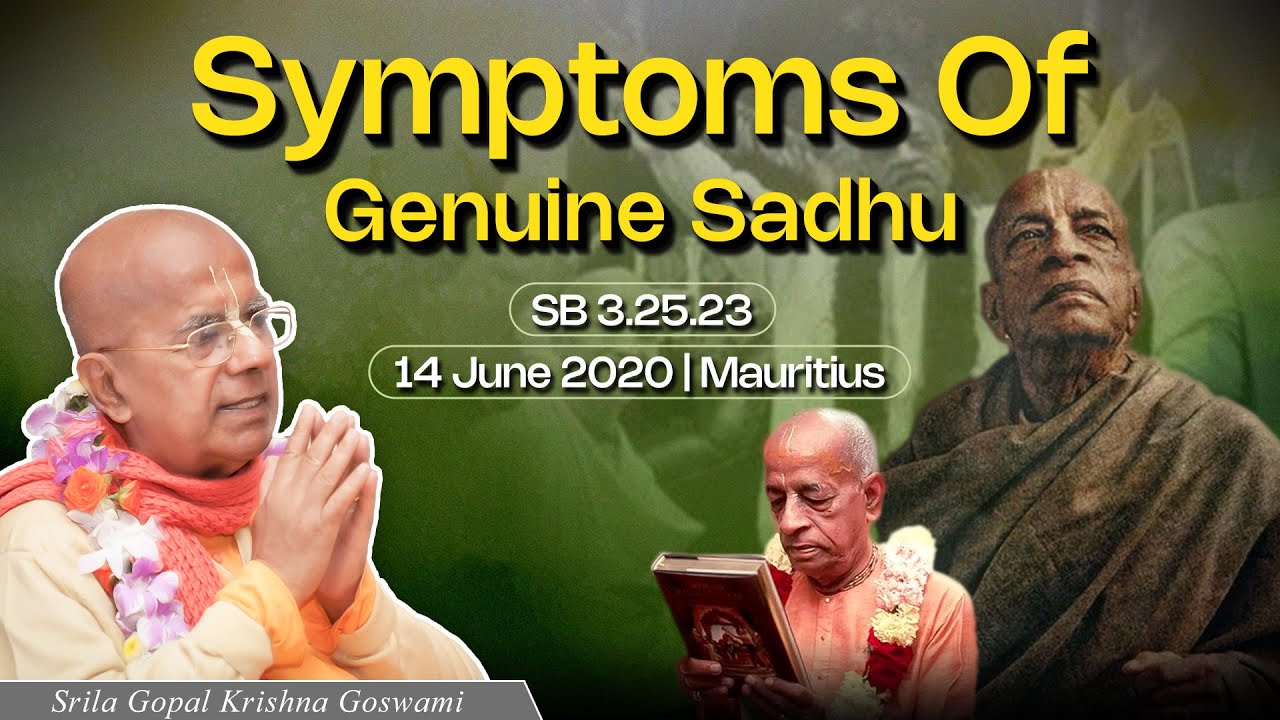
In this extended Bhāgavatam‑based lecture, Srila Gopal Krishna Goswami (Speaker A) explains the characteristics and practices of a genuine sadhu (spiritual practitioner). He repeatedly emphasizes the need to transfer attachment from material objects to the spiritual realm, to hear and chant the holy names of the Lord, and to follow the nine‑fold process of bhakti. The talk weaves scriptural citations (Kapila‑deva, Krishna‑caitanya, Prabhupāda) with practical advice: maintain regular chanting (16 rounds a day), read Prabhupāda’s books daily, associate with devotees, avoid offenses, and stay determined in sadhana. The speaker contrasts material miseries (the seven‑fold miseries, disease, old age, natural calamities, mental distress) with the satisfaction that arises from devotional service. He also discusses the role of a sadhu as a teacher, the importance of truthful yet compassionate speech, and the dangers of prajñāpa (useless talk). Audience questions explore how to free oneself from birth‑and‑death, the nature of the 9‑fold process, and how to strengthen sadhana. Throughout, the tone is instructional, enthusiastic, and at times conversational, aiming to motivate listeners to adopt a disciplined devotional lifestyle.
Chapters
Kapayanthi virat apa, naitan man gadachetas ha. So Lord Kripiladeva is the speaker of the verse. And in this verse, Lord Kripiladeva establishes that he is the Supreme Personality of Godhead. Is this clear? Is it equal? Tone it down a bit. I think there is an echo. Hare Krishna. Is it better now? Yes. Maybe a little louder. Hare Krishna. Now, Lord Kapila, make it a little louder. Hare Krishna. Lord Kṛṣṇa here establishes that He is the Supreme Viṣṇādhya of Godhead. And this point was established earlier in this section of the Bhāgavatam also. The genuine incarnations of the Lord are all listed in the scriptures. Lord Kṛṣṇa there is instructing His mother Through his mother, actually, he's instructing all of us. And in the words we discussed yesterday, the main theme was giving up our attachment for material objects and persons and transferring it to whom? The spiritualist. Transferring my attachment Material to spiritual. As Prabhupāda has said, you can't give up attachment.
Just like if we say, "Okay, when you are Kṛṣṇa conscious, don't perform any activity." Well, that's a fight.
You say, "Come on, I'm going to get bored. Nothing to do all day." Sometimes devotees come to our temple, they say, "I have nothing to do all day. I'm getting bored." So you need some engagement. You need some activity. Lord Kapila says, "Give up attachment to material objects. Transfer it to the spiritualist, Sadhu." Because if you transfer your attachment to genuine Sadhu, he'll give you the real message. And the real message is How to practice devotional service. So continuing on the same theme, Lord Kapiladeva is further elaborating on a point that he has already started discussing. And why did he discuss that? Because his mother had an enquiry. What was the mother's enquiry? Who remembers? Detachment from material world. Detachment from material world.
How can I free myself from the entanglement of birth and death?
This is a question we should all be asking. In the material world, we're always asking questions, isn't it? You look at any newspaper, full of questions and answers. The businessman is asking questions, "How can we make our business more profitable?" The politician is asking. In the material world, everyone is asking. But very few intelligent people pose questions on spiritual topics. Most people find spiritual topics boring. Am I right? Talk about movies, romances, movie stars, they wake up. Chagau is spiritual garbage, they will yawn and fall asleep. Because very few people have this interest. Kṛṣṇa says in the Bhāgavad-gītā, bhāvanam jñānmanam ante, out of many, many births and deaths, he is a fortunate soul. Who understands that I am the cause of all causes. So Kṛṣṇa is replying. He is saying, "What's the definition of asādhu?" And He says, "Kāsi-gīt, chanting about hearing about Me, the Supreme Lord." That is the first requisite.
Hearing and chanting about who?
So we are hearing chanting on many subject matters, but what the scriptures recommend, hearing chant about the personality of Godhead. What is the difference between material topics and spiritual topics? Who knows? What is the difference?
Spiritual topics are more interesting.
Okay. All the same, listen to what he said. Spiritual topics are boring. Spiritual topics are not enlightening. For example, let's take a popular— I don't know what's on top of the hit parade right now. I'm sure there's some song on the top of the hit parade. You can hear it once, twice, right? They get bored, isn't it? But a spiritual topic, you can discuss day and night and not get tired. Often the materialists wonder, "How can you people chant the same name and not get bored?" We can chant the same and not get bored because these are spiritual topics, spiritual names of the Lord. And as much as you chant, you'll be satisfied. In fact, the more you chant, the more satisfied you become. Hare Rādhā-Stākha, you could chant the holy name of the Lord 300,000 times a day. He never felt, "Oh, I've chanted enough." Bhaktisiddhānta Mahāprabhu, before he chanted his preaching mission, before he started his preaching mission, He vowed to chant a million names, and he chanted nonstop for 10 years without getting tired. So spiritual topics are increasingly fresh, increasingly fresh means what? The more you chant, the more you engage in these activities, the more enlivened you will be, the more enthusiastic. You feel. So, the definition of a sadhu is sadhu doesn't mean he has to be a sannyasi necessarily. Sadhu doesn't mean he has to be a brahmachari. Sadhu essentially means one who dedicates his life to the mission of the Lord. Doesn't matter whether you are in a male body or a female body. As long as you are dedicating your life to the mission of the Lord, you are a spiritualist. Kṛṣṇa doesn't discriminate. Kṛṣṇa, in the material world there, in the North America, they are saying equal opportunity employer. You know what that means? It means you apply for a job, doesn't matter whether you are black or white, male or female. You get a job based on qualification. But Kṛṣṇa is also an equal opportunity employer. Doesn't matter if you're black or brown or white, male or female. If you serve Kṛṣṇa, if you take to the path of devotional service, he simply protects you. So the definition of a spiritualist, the definition of a transcendentalist is that he's fully engrossed in glorifying the Supreme Lord, in hearing and chanting about the names of the Lord. And he talks about also spiritual subject matter. Now hearing and chanting is the foundation of our spiritual life.
Is that right?
Nothing, no success in real life without getting enchanted. And that is the recommendation of the scriptures. Prasad's father was very annoying, and Prasad had attraction to his enemy. Who is the enemy? The Quran's father was Syed Shahiduddin Sandal Marqa, the two teachers of the laws, two teachers of Quran. "Yarnad dekhne hi me bhavli." It appears that the sannyasis are coming in disguise and brainwashing my son. Very sad. The only clue was falsely, "We are Brahmins." PRASAD RAVALAD RAVALAD, we ask, others are bewildered, who is interrupting your father? Who is interrupting your son? But don't worry, we'll bring him over to you. So, the lad's father placed the young child on his lap, massages his hair, and says, dear son, what did you learn in school today? On the various subjects you learned. "Over the best of all." And the son said, "Sharanam kṛṣṇa viśvaṣvāmana-parasyevaṇa aja-mādaṁ vraṣṇaṣaḥ kāmaḥ." When he heard of the 9-fold process, he was so upset, he threw the baby on the ground. So, this 9-fold process, let me discuss whether preach was first spoken by Narada Muni when he was instructing Prahlad's mother. Prahlad's father was performing extreme austerities. If you had some idea of the austerities he performed, you will be surprised. For example, he stood on his toes with his hands raised towards the sky for 100,000 years. Some of you may be doing yoga, and we may have yoga experts. How long can you stand on your toes? Half an hour? Can anyone stand on their toes for 100 celestial years? No, no one can. He did. So Hiranyakashipu performed an austerity to become deathless. And the demigods headed by Indra thought, "There's a good chance that I'll drag Mrs. Hiranyakashipu to our protection, and when the child appears, we will kill him." But we don't want another like father like son. And then Prasad would appear on the scene and say, "No, the child in the womb of this lady is a great saint." So Prasad had the fortune of receiving instruction when he was in the womb of the mother. So life starts in the womb of the mother. Life doesn't start when you come out of the womb. Those who advocate abortion say, "Oh, life starts after you come out of the womb." A spiritualist knows life starts in the womb of the mother. So, Prasad was enlightened from a young age. So, this 9-fold process is beginning with Sharanam Keshanam, and with the— which is the The foundation of our spiritual life was first spoken by Ādamānī. So the definition of a transcendentalist is that he is absorbed in chanting and hearing. Now the nature of these spiritualists doesn't matter. It fully satisfies one. In the Bhāgavatam you see The Perks in my heart decided to fast unto death. The Perks in my heart were given a notice. What was the notice?
What was the notice?
To prepare for his departure.
How did he prepare? In a very glorious way.
Normally when a materialist is departing, He calls all his family members, they cry, he cries, and he decides how the property should be distributed. We have all that. But the spiritualist looks forward to the opportunity to hear and chant the holy names of the Lord by leaving his body. That is the desire of the spiritualist. So hearing and chanting is our foundation, and hearing and chanting is our most important thing. The Praśad RAVAL had received that knowledge. So he was hearing the Bhāgavatam.
He said, "I'm going to fast from water also." No food, nothing.
So in the 10th canto, Praśad RAVAL speaks as follows. He says, "I have been fasting for one week, but I am getting so much pleasure in hearing the transcendental glories of the Lord that my hunger and thirst have disappeared." His anger disappeared because he was so absorbed in hearing the holy name of the Lord, hearing about the pastimes of the Lord. In the Bhāgavatam, you read the famous story of Kṛṣṇa lifting the Gauḍāṇa Hill. So Kṛṣṇa was lifting the Gauḍāṇa Hill.
Why?
Because Indra was very angry when he saw that the— Indra was very angry when he saw that the Brāhmacāris stopped the annual Indrayāgya. And why did they stop? Well, the Lord told them to stop. Why? And then because sometimes you get proud. The Lord has His process of rectification. So, Indra retaliated by ordering the samudra, clouds. The samudra, clouds, have heavy thundering. You all have experienced the rain. In your country you have cyclones from time to time. One recently, but these cyclones are nothing compared to the thundering noise that the samudraga clouds make when they move. And the rain was falling, rain was dropping, and now each drop of water was as heavy as a pillar. Can you imagine? Each of the water jars is heavier than the other. So the bridge passes with a soft, heavy thundering lightning, raining.
They all looked up to Kṛṣṇa.
A devotee in pleasure and pain only has one remedy. They all looked up to Kṛṣṇa, "Please help us." What did Kṛṣṇa do? He lifted the gigantic Govindānanda on the strength of the nails of his smallest finger.
All the British Parsis were under the umbrella of Govindānanda, and that umbrella was very strong.
The British Parsis were worried. "Ah, He's a small child. The hill may fall off His finger." "No, no, He is not going to fall." And all the brahmacaris were just meditating at the beautiful lotus-like face of the Lord, and as a result, their hunger and thirst totally evaporated. They didn't feel any hunger and thirst, because they were totally satisfied in seeing the form of the Lord.
So what do we learn from all these examples?
We learn from these examples that if we get absorbed in hearing and chanting of our spiritual subject matter, we will also be totally one.
Satisfied.
Right now we are not satisfied. Am I right? No one is satisfied. Either the material— The spiritual life should be satisfied with whatever is provided by the will of the Lord. And about the material life, never satisfied. The millionaires of the planet, the trillionaires, getting richer day by day. Why? They think, "We don't have enough. We need some more, some more, some more." Is there a limit? Is there? They say sky is the limit. But some of these greedy people, they are dependent beyond the sky. Go above the sky also. Man's greed has no limitation. Which is the ground reality. So Kūpīnādeva is saying, the transcendentalist, because he is absorbed in hearing and chanting about spiritual subject matter, he's totally satisfied, non-religious. So that is the definition of a sadhu. —is interested in the relevant Kṛṣṇa. Now in the purport, we'll come back to this point later. In the purport, Prabhupāda made many significant points. First, Prabhupāda talks about the miseries in material existence. Do you think, you devotee, there is misery in material existence or not? Yes. Right. Yeah. There it is. It means mārīṣa. Someone said mārīṣa means misery-free. Is that true or false? False. Oh! I was wondering how it means misery-free. Okay. The Prabhupāda says in the purport that multiple miseries of material existence Those pertaining to the body and the mind, those imposed by other entities.
So as we know, there are 7-fold miseries of life. Is that right?
And Kṛṣṇa characterizes or summarizes them in 2 words: the kālayam, shaiva. The kālayam means? There is nothing but misery. And aśāryaṇa means everything is temporary. So, doesn't matter how solid an arrangement you may make, everything is temporary and there is nothing but misery. Now how do we experience this misery? How do we experience it? A very, very— of course, one understands birth as disease, always. Is birth an enjoyable experience? No, it's not. It's not an enjoyable experience. Very painful experience. Child in the mother's womb is in the most uncomfortable position. Prasad Raaval. If you want to sit down, with your head bowing down like a bow. A mother's womb, a little child, sit down with her head bent. You couldn't sit for one second. But sitting in that position for 9 months, you know, is not an enjoyable process. Then you see Does anybody like disease? No. I know some people like it. Doctors. I once asked a doctor, "How is business?" He said, "Very bad." I said, "Why?" How can doctor's business be bad? He said, "He has disease, people don't want sick." So I said, "Many people fall sick." They said, "The rainy season." So, dog is certainly happy to fall sick. Then we say, "Get well soon." But in their hearts they want you to fall sick. Because if you don't fall sick, then we are not doing this. Then you have the hospital owners. In New York City also you have Apollo. There is Dr. Reddy, the owner of Apollo. He has about 50 hospitals all over the world. And he's happy when people get diseased because otherwise he'll be out of business. And the pharmaceutical manufacturers, they're happy if we fall sick, otherwise we wouldn't buy any medicine. All the chemist shops in Mauritius are closed if you don't fall sick. So, this is disease. Then there's old age.
Does anyone like old age?
No.
No one likes old age. If you compliment a man by saying, you compliment an old man by saying, "How young he looks," and insult a young man by saying, "How old you look," then nobody likes old age. If there was a plan, I would— in the Bhagavad Gita, it's told you of King Hayati, how he exchanged his old age with youth, and still no satisfaction. Then there's disease, and ultimately there's death. But that's not the end of the story. If that was the end of the story, It wouldn't be so bad. To complement life, to complicate matters more, you have 3 other forms of misery. Am I right? What are they? What are they? Are they both in Adhyatmika?
Adhyatmika. Misery is caused by the mind. Mother has 2 minds.
Does the mind cause you misery? In many ways it may. You see your neighbor has something which you don't have, the mind haunts you. You don't get the honor you think you deserve, the mind haunts you. You see a product being promoted and you don't buy it, the mind haunts you. That's misery caused by the mind. Something happens to a beloved relative or friend, and the mind haunts you, and you keep on crying, crying, crying, crying, crying. Crying won't bring that person back. We should be crying when we see somebody who is not practicing Kṛṣṇa consciousness. But crying for someone when someone's already departed, It's not going to help you in any way. So, mind gives us misery in many ways. Then you have natural calamities, and cyclone is one of them, earthquake, drought, flood. Lately in the material world, the frequency of natural disasters has gone up 6 to 10 times. Previously there would be a major disaster once in 10, 15 years. Now it's very common. Even in countries like America, that supposedly have all the technology, the material miseries take place. What about Australia? So, this is called the material nature. Then, other living entities. Basically, material life is nothing but full of misery from beginning to end. In the middle, we see flashes of comfort. Just like Prabhupāda used to say, in the old days, The system of punishment was they would take a criminal, make— deep in the sea, duck his head under water just to make sure he doesn't die. Give him some temporary relief, again push his head under water. So that's what we see. Big Indian is accompanied by misery. But occasionally you see some flashes of comfort. And when you see those flashes of comfort, you think, "Oh, it's blissful." Where is the blissfulness? It is just propaganda of the father. So Prabhupāda is saying, the melodies imposed are very severe, and one Poor sadhu doesn't get disturbed when his senses are engaged in service to the Lord. Prabhupāda gives the example of Amritmaraṇa. How Amritmaraṇa engaged his senses constantly in service to the Lord.
Amritmaraṇa was a king.
And Yudhishthira King, Yudhishthira engaged himself, his senses in service of God. What is number 21? I'll do. Use his mind to think about the Lord. Use his legs to walk to the temple of the Lord. Use his hands to Clean the temple of the Lord. Use the tongue to— to do what? Chanta Hare Krishna and taste Krishna prasada. Tongue has two valuable functions. Both are important. Tongue, the belly, and the genitals. They are all in a straight line. If the tongue is controlled, then it will be easier to control the other senses. If the tongue is not in control, then it becomes difficult. The tongue should be used for war. In the Bhagavad Gita, you read about austerities of the mind, body, and the tongue. You know that. What does Krishna say on the austerities of the tongue? The point is standing here.
Speak the truth.
Speak, but speak the truth. And especially when it comes to spiritual life, pursue the truthful message of the Lord. That is what it means, speak the truth. The moral is the duty of the Lokahita. And then you get the target. Speak the truth, but speak it in a palatable way. For example, let's say you want to correct someone. Okay? That's not uncommon in a spiritual institution. When you correct someone, you have two alternatives.
You can say, "Hey, fool! Can't you see this mistake you make again and again?" That's a more crude way of dealing.
If we tell sweetly, "Kabhu, this could be improved in this manner," we get more positive response. So Krishna says in the Bhagavad Gita, "The sterility of the tongue is to speak the truth." Why? Because we are so used to speaking lies. Am I right? People lie in this country. Yeah. We are so used to speaking lies. When we have to speak the truth, it's painful because we're so used to lying. Well, that's not the end of the story. Speak the truth, but speak it in a palatable way. If you're dealing with palatable, you encourage a more harmonious atmosphere. More harmonious atmosphere in any community can be realized if you speak the truth. Speak it in a palatable way. Then speak, glorify the Supreme Lord. That's another austerity on the tongue. In the nectar of instruction prepared by Rūpa Gosvāmī, Rūpa Gosvāmī says, athyāhānapaiśyaśca vijjālpa-nimāraḥ.
Prajalpa is talk not related to the Lord.
Prajalpa is topics that are destructive on the spiritual path.
Now we are born in an environment where everyone is doing prajalpa.
Am I right? Yes? No? You're working in an office. All you hear is prajñāpa everywhere. You go to school, college, you hear prajñāpa everywhere, right? So that is misused all the time. But devotees understanding is, "Prajñāpa is not going to help me. Why should I engage in activities that are not going to help me?" Chaitanya Mahāprabhu, was instructing Sanatana Gosvāmī on the process of devotional service. And the first condition he gave was accept what is favorable and reject what is unfavorable. So prajāpa is an unfavorable activity. And what's the opposite of prajāpa? What is the opposite of prajāpa? Kṛṣṇa-kathā is constructive. So engage the tongue in positive activity. So Kapiladeva is saying, the genuine sadhu who is associated— Kapiladeva has recommended earlier— he must be engaged in transcendental seeing, chanting and dancing, chanting and hearing, dance and listen, it matters. And if you dissolve yourself spiritually, then the material miseries will not be an obstruction. Then even if the material miseries are there, you have the courage to face up to it. So Kapila Devi is saying, Do not suffer because— why do the spiritualists not experience the material misery? Because they are absorbed in something more positive. Just like if you have a job, they pay you a certain amount, and you get something with a higher amount, you go there. So spiritual activities give us higher pleasure. Spiritual activities are more pleasurable than material activities. Someone may say, "That's what you say, but we know we don't experience that happiness." Why is that? We don't experience spiritual happiness because we are taking If we take the spiritual medicine properly, then it's guaranteed to deliver the goods. For example, Caitanya Mahāprabhu, in the opening line of the Śrīmad-Bhāgavata-śrīmad-bhāgavatam, what did He say? What did He say? Chaitanya-deva Mahāprabhu, Bhāgavat-dvāgṇī. One of the benefits of chanting the holy name is It cleanses your heart. Our heart is, as Prabhupāda used to say, as black as coal. Coal is dark, isn't it? Can you imagine anything darker than that? Yes, your heart. As impure as a coal. Is our heart. Our heart has more material desires than ever. So to eliminate or to cleanse that dirt requires an effort. And what is that effort? Vishuddhi Yoga. Not only does it cleanse the heart, but it also does something else for you. What is that? Alone in the Budi Vardhana gives you unending spiritual pleasure. Gives you pleasure. Ramana Maharshi said, 'Na tabhidam sadhakatena vishnu.' People do not know how you have to receive God. So those of you who are sitting here, Connectedness gone. Now how the real happiness can be found? And his answer is this, no, if I want real happiness, if I want to escape the miseries of life, then what is the solution? Devotional service. Begin by chanting Hare Krishna. So a genuine sadhu, or kapila deva, has said, Transfer your attachment of the materialist to a saintly person. What does that mean and how do you recognize a saintly person? That has been explained in the words of Paul, in that famous verse, "Tikshakarunikaḥ śrūdha-sarva reṇām ajitava-sarva-saṅghaḥ aṇvasaṇghu bhūṣyur." This is a payment for it. And then you have this verse memorized.
How much?
So, almost everyone in every temple knows this. Anyway, Kṛṣṇa, Kṛṣṇa has explained the qualities of a sadhu. And now he's further elaborating. The genuine sadhu, genuine transcendentalist, is absorbed in chanting Hare Kṛṣṇa. Prabhupāda gave us this principle, chanting 16 rounds. When Prabhupāda started the Kṛṣṇa consciousness movement in America, he told the devotees, "Chant 64 rounds in the head." At that time, There were only Americans who were there. So, that was the first temple. We tried chanting 64 rounds. They couldn't. They came to Prabhupada and said, "Swami," those days they used to call Prabhupada Swami, "Swami, we can't chant 64 rounds." So Swami said, "Okay, do 32 rounds." We tried 32 rounds. Just couldn't do that. So we came back to Prabhupada and said, Swami, 30 rounds is also difficult.
Then Prabhupada said, 16 rounds and final, no more.
The son and the boy, they say, Prabhupada, reduce it from 64 to 16. Can't you reduce it from 16 to 4? So he said, no, whatever fine-tuning had to be done has been done by Prabhupada. He did shaia for the day. So, if we chant our 16 rounds and follow the regular principle, in the nearest letter of Prabhupāda's sayings, you can go back to Godhead.
So the trance is endless. You may not be totally absorbed.
You may say, "This is too high a goal for me to achieve." 24 hours of your channeling takes time. I'm not fit for that. I'm not ready for that. So you have a discount. What's the discount? Chant 16 rounds a day. At least chant 16 rounds a day, follow the principle, and that is guaranteed to take you back to Godhead. So Prabhupada says here in the purport, the one who is spiritually engaged is totally satisfied, and then the vichāramīsris generate. Vichāramīsris are there. Śrī Rūpa Gosvāmī and Sanātana Gosvāmī were holding very important positions in the government of Navadvipa Sena. At heart they were devotees of the Lord, but they were forced politically, they served their job. They secretly went in the night to meet Sri Dhanumartha Moo in where? Ramakiri. It is now in Ponnary. And what did they say? Ki ami, please set up a society Everyone thinks I'm a real learner, but even we don't even know who we are. Please tell us how we can free ourselves. We will be thrilled, maybe. So this process of chanting and hearing is main activity of a sadhu, and the main activity of a transcender is not only to chant, but also to preach. Preach the glories of chanting, to encourage others in chanting. And that is how you recognize a saintly person. A saintly person has a single-point agenda, that is, become Krishna conscious, make others Krishna conscious. There is a saying in our world, that Krishna reciprocates. Krishna says, Those who worship me with devotion, I preserve what they have and make out what they lack. So this word describes the qualities of Lord Transcendentalist, and we should draw inspiration from this. This is a guide for all of us. We shall think, "Oh, this definition is only for the Mahātmās." It's not for us. But this definition is for everyone. Yā vraucaḥ, yāsṭha, anupāṣad asmaṇyaḥ. This is for anyone who is interested in going back to Godhead, in freeing yourself from material existence. Of course, not everyone will be interested, but those of you who got connected to this one, are fortunate for which you take to this process seriously. And by associating with those who are chanting and hearing, by associating with those who are engaged in spiritual activities, we also get inspired. In this section of the Bhāgavatam, there is the utmost concentration on spiritual association. Spiritual association influences our lifestyle. Spiritual association wakes us up to the reality. Spiritual association guides us to the right path. We associate with Mahatma Gandhi. So we should associate with those especially inspired by this association. We can also benefit. But the most important thing is hearing and chanting. That is the foundation of our spiritual life. Everyone agrees? Yes. Hare Krishna. Hare Krishna. We can take up questions for some time if you want.
Swāmi, could you please describe Krishna consciousness in a nutshell?
You've come too late. In a nutshell is, Krishna is the Supreme, we are the imparted parcel. Our business is engaged, the body, mind, and senses is service to the Lord. Hey, yeah, it's not always in the class.
We sometimes find so many excuses to come to service, so many excuses that we can't come. Sometimes we go through this Buddhist initiation, and before, he's enthusiastic, and after, and they do some service, and then they make some excuses to not do service.
Yes, look at excuses to avoid service. We are the losers, not the gainer. If we gain in service, You are the gainer. If you chant your rounds, you are the gainer. If you don't chant, don't do service, you are the loser. The spiritual master or the sadhu or your associate is reminding you about the importance of puja, service. He is doing his job. But if you don't follow it, you are the loser. The doctor is giving you the medicine and the diet, but if you don't take it, you won't recover from the disease. Isn't it? So why do we become lax? We become lax in various factors. One is offenses, and then negative offenses. And bad association. In the beginning we are regular, coming to the temple, hearing classes, we are not really thinking, "Oh, now I know everything. They are going to say the same thing again and again. I don't need to associate." And then we gradually withdraw. We should constantly desire to Associate with devotees and stay in their association. Coming to Bhagavad-gītā class is very necessary. Very often we don't come to Bhagavad-gītā class. Only some senior devotee comes, we come. We should come to the class regardless, as long as the message that is being spoken is as it is. It's not that, you know, like you go to watch a movie, first you see who's acting in it, who's the star there, and if they're a famous star, then you go and watch the movie. It's not like that. If you come in here, is anyone giving you pure mercy from Lord?
Yes. Speak it aloud. Madam, this prajnāpatāya, wastefulness, is very common among devotees. So even after doing so much tapasya, they are not able to control it. Is there any reason for this? Because everyone—
It is a good question. The question is, Pujalpa is a weakness with all of us. Is that all right? What is the reason? The reason is we haven't developed the higher taste.
The lower taste is pujalpa.
The highest taste is the Holy Name. And in the initial stages, We shall attract it to the Lord. Rūpa Gosvāmī says, "The Holy Name of the Lord is sweet, but because our tongue is afflicted with avidyā, we can't experience the sweetness of the Holy Name." What's the cure? Is there a cure? Yes? No? What's the cure, Guru-nātha? Śrīla Bhāgavān Mahāprabhu says, "If you attentively chant the Holy Name, then the disease of avidyā will get cured." This disease can be cured. You know, Śrīla Bhāgavān Mahāprabhu says, "Mūsāne śrī-adārya adhākāma-pavacanā, sannityāgya sannityāgya." And this disease will not be cured If no, do pujaalpa. So if we do pujaalpa, it essentially means we are not endeavoring to dwell in the higher plane. So when somebody comes to you to do pujaalpa, tell him, "Prabhu, I am not so advanced." You will involve me. You, Pajapa, with the wall. When it takes two to tangle, they say in English, you know what it means? It takes two to tangle, the speaker and the listener. So somebody has to be a listener also. We don't give a patient hearing, the other person will stop. But you also have a taste of bhajana path. So the two click together. No, I mean, when I say you, I mean a plural you, not a singular you.
That's why hearing is important. Hearing the class is important.
Reading the books is important. One big weakness we have, we don't read Prabhupāda books enough. I can see that by the question. We should make a rule to read every day for at least 1 hour. If you read every day, then your mind will be engrossed in spiritual love. Because we don't read, our old habits stay alive and they keep influencing us. You follow? How many of you read Prabhupāda books every day? Some do, but it's a small percentage. We should all make a resolution, we all read Prabhupada's books for 1 hour a day. That will help a lot. Okay, any more questions?
To get rid of our comfort zone, as we practice, we get rid of the material desires, but the comfort zone is still here. So what should we do?
And why? Can you repeat?
As we practice, we get rid of material desires, but still the comfort zone is still here.
What should we Keep practicing. Don't think that, "I practiced for 2 years, now I can take a break." Don't have any spiritual holidays. Just like, you know, just like, just like in your country, January 1st, 2nd, New Year holiday. In the material life, we look forward to holidays. The school children jump up when they are on holiday, isn't it? And when they have to come back to school after holiday, they are so painful. Am I right? You work 5 days a week and you look forward to the weekend. If you are a rich man, on the weekend you go to a retreat. Why? Because you get bored. We never say, "Can I have a weekend off from chanting?" No. So what we need to do is constantly practice devotional process and constantly practice and be determined. Our determination is weak. It starts, it fades. We— that's why the scripture says determination is very important. Any more questions?
Yes. What is the secret of getting strong sadhana?
Well, as I just said, you need determination for everything during sadhana. And the process is satisfying. Sometimes people think, "Oh, there's too much austerity in this." We hear that. It's a fact. But Lord Rishidev says, tapo devyam putraka yena satva. If you practice austerity, in the end you will get unlimited happiness. So, the solution is very simple. The path given to us by the great sages is flawless. You just need to practice this meditation. Yes.
Sacred part.
You can eat— You can do it anywhere in the world. Mauritius can you feed? You just have to try. You just have to try. But there are many temples in Beghuda, Jivitimaya, Bombay, Pune. But the key is having faith in Prabhupada's words.
Prabhupāda said, "If you want to please me, what do you do?" What did Prabhupāda say?
So how many of you want to please Prabhupāda? Oh! I don't see that in your activity. How many of you took part in the book marathon in December? Right, you know. So all we don't want to read Prabhupāda. Prabhupāda said, "You want to please me, you should read my books." Why? Well, these books can be a transcendental medicine. They can help us. Just like if I was to ask each of you, "Are you going to come to the movement?" You will say, A, someone gave me a book. B, someone invited me. Isn't it? And how do we sustain our spiritual life? By reading these books, by listening to the books. So reading the books is very important if you want to make spiritual advancement. Okay. Any more questions? Yes, last question.
Prasad, I have a question for Prasad. Prasad, is it not that because of people open selves that we develop the higher taste and which as a result lead to Prajna?
Offenses should be avoided. That's why in every temple of ISKCON, every morning we chant 10 offenses. The offenses should be avoided. What was your question?
That is, because of offenses, one does not develop the higher consciousness. How to avoid this? And then as a result, you get indulged in that culture.
Well, the offenses we avoid is— there are different types of offenses. One is guru prāsa, vāiṣṇava prāsa. Then there is offenses in the śaṇikara-vrīdaya. Generally, we should avoid the offenses. And they are not definitely avoided. At least we should not Be motivated by envy, hatred, jealousy, etc. These are dangerous. I pointed out in an essay, just like a beautiful garden gets spoiled when a mad elephant comes in, the inner person is spoiled and hurt by it. Avoid offenses. This human offense is one thing.
Okay. Lama Lama Ale Ale.
More from PRASAD

Rare Pastimes & Timeless Lessons of Guru Mahārāja | Stories Every Disciple Should Hear

ISKCON Legends- pure devotees meet-HH Jayapataka Swami, HH Gopal Krishna Goswami, HH Radhanath Swami



Jagannātha Ratha-yātrā Through Śrīla Prabhupāda's Mercy | 29 April 2006 | Nairobi, Kenya

Lord Jagannātha's Appearance Pastime | 21.07.2019 | ISKCON Calgary | Śrīla Gopāla Kṛṣṇa Gosvāmī

The Ācārya Teaches by His Own ExampleGuṇḍicā Mārjana by Guru Mahārāja #shorts

Guṇḍicā Mārjana – Lord Jagannātha's Pastime | 21.7.2019 | ISKCON Calgary |Śrīla Gopāla Kṛṣṇa Gosvāmī

H.H. Gopāla Kṛṣṇa Gosvāmī Mahārāja - Exemplary Sādhana and Deity Worship # shorts

भगवान की कृपा कैसे प्राप्त होगी ? | 11 Jan 2014 | Punjabi Bagh | Srila Gopal Krishna Goswami

Material Education vs Spiritual Education | Srila Gopal Krishna Goswami #shorts