Take Shelter in True Devotees of Lord | SB 5.13.25 | 26.7.2020 | Delhi | Srila Gopal Krishna Goswami
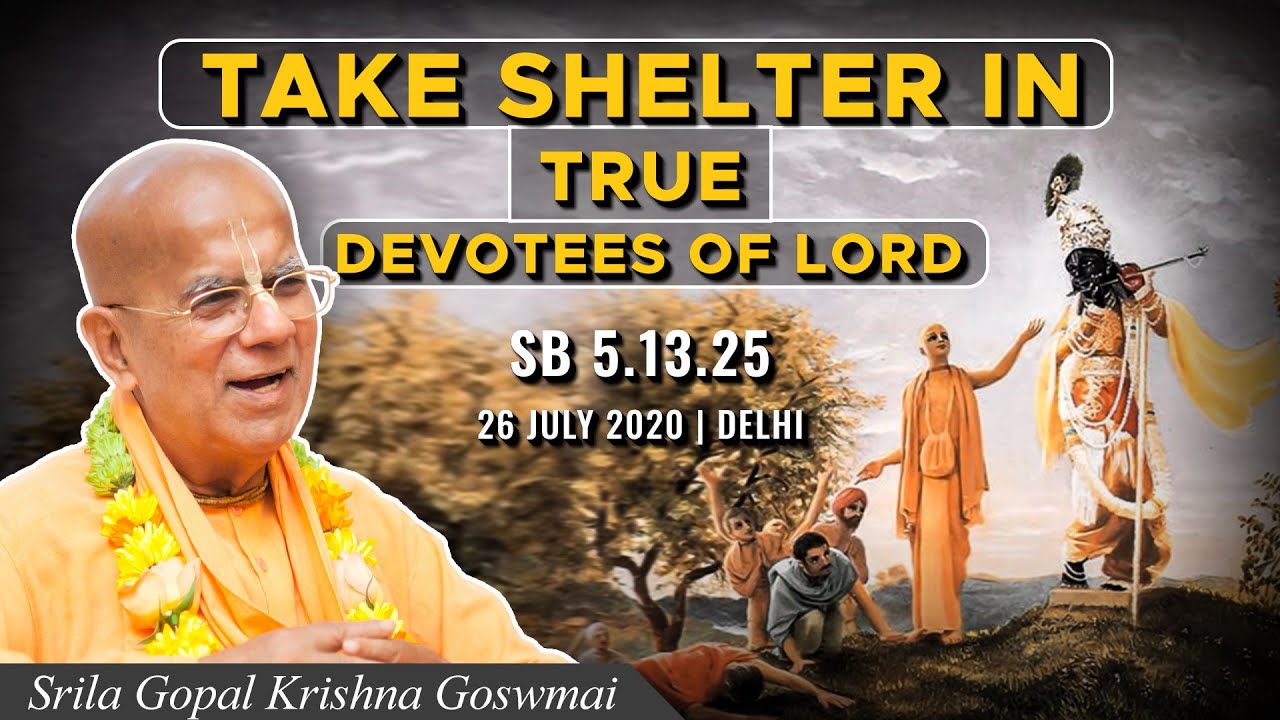
In this devotional lecture, Srila Gopal Krishna Goswami (Speaker A) expounds on Śrīmad Bhāgavatam 5.13.25, emphasizing the necessity of taking shelter of bona‑fide devotees (the "servant of the servant of the Lord") for spiritual advancement. He explains the verse word‑by‑word, provides translation, and offers purport that the material world is likened to a dense forest filled with plunderers—chief among them the senses (eyes, tongue, mind, etc.) that distract the soul. Through stories of kings such as Raghupāṇa, Ravana, and the deer, he illustrates how attachment to material enjoyment leads to bondage, while surrender to a true devotee leads to liberation from the bodily conception. The talk repeatedly stresses humility, the danger of pratishṭhā (desire for honor), and the importance of selfless service (seva) and taking responsibility within the movement. Practical Q&A follows, addressing how to assess the purity of one's chanting, how to seek guidance from advanced devotees, how to overcome pride, the proper handling of donations, and maintaining a service attitude amid worldly responsibilities. The lecture concludes with a call to spread Krishna consciousness worldwide, encouraging devotees to associate, chant, and serve with humility and devotion.
Chapters
Om namah bhagavate vasudevam. Om namah bhagavate vasudevam. Om namah bhagavate vasudevam. So we're going to do a different verse today. We're going to do 3:15-25. It's a long verse, so we'll just do the word meaning, translation, and purpose. Okay, to save my breath, I'm requesting Rishi Kumar to do the reading. Start. Word meaning. Sanitizing the mic. Oh, you sanitize the air. Okay. Go to the word meaning. Word by word meaning.
Translational properties. So I completely gave up. The consequence of Taking shelter of a devotee who has similarly taken shelter of a spiritual master in the Parampara system, one is sure to get out of the greatness and of the bodily concept of life.
Translation.
Translation. After receiving lessons from the great devotee Janapārtha, King Raghupāṇa of the state of Sauvira became completely aware of the constitutional position of the soul. He thus gave up the bodily conception completely. My dear king, whoever takes shelter of the servant of the servant of the Lord is certainly glorified because he can become difficultly give up economic conception for good. As stated in the Chaitanya Charitamrita, Madhya Līpa 22.54, 'Sādhu sādhūna sādhū sādhūna sādhū cha phalikāya navamāna kṛṣṇa vṛṣabhūtaḥ sādhuḥ śrīkṣīvānāya.' It is a fact that if one takes shelter of a pure devotee, one attains all perfection, even if the association is a short one. A sādhu is It's a pure devotee of the Lord. It has been our practical experience that the first instruction of our spiritual master infused us with Kṛṣṇa consciousness so that now we are at least on the path of Kṛṣṇa consciousness and can understand the philosophy. As a result, there are many devotees engaged in this Kṛṣṇa consciousness movement. The whole world is revolving under the bodily conception. Therefore, there must be devotees all over the world to deliver people from the false bodily conception and fully engage them in Krishna consciousness.
Omegyaante me nandasya jnananjanaśrakyā cha kṣudhaṁ me letānyena saṣma īśvī gurave namaḥ śrī-kṛṣṇa-niyāmaṇo vrajaḥ sāpidāme na bhūto le Prabodhite ranga śrī-advaita-kṛṣṇaṇa śivaśarī-gōrākṛṣṇa. You can repeat the translation after me. After receiving lessons from the great devotee Jādvarata, King Rahogana, the seed of Someria, became completely aware of the constitutional position of the soul. He thus gave up the bodily conception completely. My dear king, whoever takes shelter of the servant of the servant of the Lord is surely glorified because he can without difficulty give up the bodily conception. So, we have been hearing the wonderful pastime of Chet Bharat and King Ravana for the past few weeks. Chet Bharat, as you know, was in his previous birth the son of a— he was King Bharat. He ruled over the planet, and people were so comfortable. The whole planet was known as Bharatavarsha. He retired, he went to the forest, and in the forest he practiced, see what charity. But in the forest one day he saw a she lion chasing a pregnant deer, and the mother died leaving the offspring behind. He thought that this was the will of the Lord. So he started taking care of the baby deer. But unfortunately, he got so attracted that he would feed— he would never let the deer be out of sight even for a minute. And one day when he was out of sight searching for a deer, he died. In the Bhagavad-gītā it is explained, yam yam vāpi śrūraṇ-bhavām, wherever your mind is at the moment of death, that's the type of body you get. And the laws of nature are such that at the moment of death, your mind will generally be in the activity you have engaged in all your life. Say, for example, you engage all your life in playing sports, and at the moment of death you think you'll remember Kṛṣṇa. That won't happen. But if you have been practicing Kṛṣṇa consciousness, even though you may not have been perfect, you can still think about Kṛṣṇa at the moment of death. Therefore, in the Bhāgavad-gītā, Śrī Caitanya Mahāprabhu says, ante naranasmriti, mold your life in such a way that you can think of Krishna at the moment of death. So he became a deer, but he didn't have to stay for long in that body. He soon took his birth in a Brahmana's family. He was able to remember due to his pious karma In his previous life, he had made a mistake. He got excessively attached to a baby deer, as a result of which he just had a birth in the body of a deer. Now he got a human birth. So he said, "Now I'm not going to repeat the same mistake." In English, there's a saying, "Once burnt, twice shy." If you made a mistake once, then an intelligent man will make sure I don't repeat the mistake. So King Rahugana was also a pious man. He was a king of Sauravila, and he was going to hear a discourse, discourse in Kapila Ashram. But on the way, King Ravana ordered him, "Please help carry my palanquin." And he was forced to be taken into the law, the service of the king, and the palanquin, instead of moving faster, moved slower. In olden days, Pannakin was reserved only for royalty. So the king got very angry. "Why are you pulling the chariot and pannakin in such a foolish way?" And he got chastised. Initially, Jeth Bahadur accepted it, but then he spoke. And when He spoke, He spoke like a lion. Once a devotee asked Prabhupāda in America, "How can I be humble and distribute books at the same time?" Because when you preach, you have to be a little forceful, aggressive. And people understand humility to mean Speaking softly, saying namaste to everyone. So Prabhupāda said, when you are preaching, you should be like a lion. And when you are dealing with Vaiṣṇavas, then you be like a lamb. Lamb at home and a lion outside. But don't become a lion at home and lamb outside. So King Ravana, I reckon, 'Oh, what have I done? It's a big mistake. This man is a great sage. He is speaking such learned words.' So he got down from his palanquin and surrendered to—
who?
He surrendered to Jadbhadra. So in the last 3 chapters, Jadbhadra is explaining the philosophy of the soul. Jat Bharat made him realize, today you may be very proud because you are a king, but tomorrow the tables could turn and I could be the king, you could be the pannikin carrier. So, Jat Bharat spoke the philosophy and when King Rahumana heard the philosophy, he realized he has made a great mistake. So in the last 3 chapters, Jeth Bharat is explaining the philosophy. In the 12th chapter, Jeth Bharat said— Jeth Bharat was requested by the king to elaborate on the philosophy. He says, "I have heard, but I have not fully understood, so please elaborate." So, in the 12th chapter, King Janapada elaborates on the philosophy, and he's continuing to elaborate in the 13th chapter also. In the 13th chapter, In the 13th chapter, Jñānātmārata says, "This material world is like a wild forest. In this forest there are plunderers and there are jackals and owls and other types of animals." It has a result. Nobody can find any real happiness. He says the material world is like a forest, wild forest, in which there are plunderers. Some of you may have experienced, you go to a forest, you go, you walk on a secluded path, and You're always scared somebody may come and attack me, isn't it? So there are many plunderers. And Janapada says, "Who are the plunderers?" The eyes. The eyes is considered to be one of the plunderers. Why? The eyes are saying, "Give me something beautiful to see." 'Give me something obscene to see.' If you don't have spiritual culture, then you'll say, 'Give me pornography to see.' If you have spiritual culture, you'll say, 'Oh, I want to put all the Deity pictures in my cell phone.' So, the eyes are one of the plunderers. They plunder your intelligence. And even now you have intelligence, You get overshadowed. In the third chapter of the Bhagavad-gītā, Kṛṣṇa was questioned, "How is one impelled into sinful action with unwillingness?" You want to do something wrong. You want to be careful, but still the senses are so strong that they carry away even a man of intelligence. So, Kṛṣṇa said, "It is lust only, the all-devouring enemy of the living entity, which is always burning like fire and is never satiated." Satiated means it is never satisfied. Just like if you have a pot of butter and you keep putting more butter in it, then what will happen? Will it get higher? Or the fire will go off. What will happen? It will go higher and higher. So, Kṛṣṇa said, "Lust only is the all-devouring enemy of the living entity." Then Kṛṣṇa says, "Where is this enemy to be located?" Just like sometimes you read in the paper, "20 terrorists have reached Delhi." Read just that much information is not enough. You have to know where the Eṣhara is hiding. You cannot pray, "He is out there, he is there." So Kṛṣṇa says, "This eternal enemy, where is he sitting?" The mind and intelligence and the senses. So Kṛṣṇa has told you, Who is your enemy? Then he has told you where this enemy can be found. So what is the next step? What is the next step? How to cure this enemy? How to catch this enemy? So Kṛṣṇa says, mind, intelligence, and senses, curb this enemy with the weapon of knowledge. So knowledge, yaan, where do you get this knowledge? From the scriptures. So, Jat Bharat is giving knowledge, the result of which the king's attachment to the body, the king's realization, I'm the king, is ending with the body. Brings matter. So, one of the plunderers in a wild forest are the eyes, and the eyes should always be used for spiritual purposes. Then the tongue. Tongue is also one of the enemies. Actually, the tongue plays a very important role. "Vāsyavēgamanasa krodhavēgām nivavēgām udānapaṣpavēgām." If you want to progress spiritually, you must control the tongue. The tongue is one of the pandras. And generally, what does the tongue want? The tongue wants to speak without discrimination. The tongue wants to eat without discrimination. And in the Bhāgavatam, 11th canto, you read the example of the fish. How the fish is greedy to eat. And when the fish goes to eat, and when the fisherman wants to catch a fish, he puts food on the bait, and the fish gets captured. So the Bhāgavatam, in the 11th canto, says, You won't become like the fish. And then you have the deer. Deer is very attracted to a particular melody, and when he— when a hunter wants to capture a deer, he plays that melody, and the deer stands, stops running. "Oh, where is that melody coming from?" And he meets his death. So these are— then he had the elephant who was always trying to satisfy his sexual urges, and the moth. So these plunderers are always plundering. They are taking away our intelligence. And then Jeth Bahadur said, You also have jackals and other animals also hunting you. He compares the other animals to wife, children, and relatives. The wife is always saying, "Buy me something new. This is not a good one. I want my saree that are old. I want something new now." So, the poor husband, he doesn't have the money, but he says, "Beg, borrow, steal. I must make my wife happy." So, they are plundering. Then the children, they say, "Buy more, more, more." In the Bhagavad Gita, in the Chaitanya Charitamrita, Bhagavad Gita, I'm sorry, the original stories in the Bhagavad Gita, —both are right. So, in the story of Avanti Brahman, there's a mantra there, in the sannyāska and these things. So, this Avanti Brahman was very rich. He was a businessman, but very miserly, very conjures. He will not give one paisa to anybody. And he would not even spend on himself. He would let the money pile up. It would give him great pleasure. His relatives all became his enemy. Wife said, "What use is that money for me? They didn't give me a penny to spend." And the children said the same. And the relatives also said the same. And then by the will of Providence, this Brahman, he lost all his wealth. In the Bhāgavatam it is said that when you have wealth that you're not using in service of Kṛṣṇa, you make a lot of enemies. You want to know who the enemies are? The enemies are also the friends and relatives. They say, "You became rich by our mercy, but you're not giving us any money." The government says, "You become rich at our expense. Pay your tax." And the Bhagavad Gita says, "In Kali Yuga, every day the taxation is going to increase." The government will— government is one of the big plunderers. The government is also thinking, "How can we get more and more and more taxes?" Doesn't matter whether it's BJP or Congress. They are all thinking, "How can we extract more promises?" So, the government also becomes your enemy. The thieves become your enemy. Have you ever heard of a thief stealing from a jhāpati. No. Although here, thieves going to rich people. So the thieves also become your enemy. So you make a lot of enemies when you have wealth and you don't use it for Kṛṣṇa. But if you use it for Kṛṣṇa, bokṣarāmya ghetābhasaṁ sarva-loka-maheṣuraḥ, then You are safe. So, it is explained in this that this Brahman had so much money, he didn't use it, and by the will of Providence he lost everything. When he lost everything, initially he was in a state of shock. I lost all the wealth I had. Now what will I do? With that initial renunciation, that initial sorrow led to renunciation. And then he became a Brahmin, just travelled glorifying Mukunda, having taken shelter. And even when people would laugh at him, they would say, 'Oh, this man was a miser. Now he lost all his money.' We think bhajan. He was a minister. So, the point is, when you are— we have— Jat Bharat is saying, when you are in the forest, as we said, we compare the material world to a very dense forest. Forest, and in the forest you have plunderers. And who are the plunderers? The senses. The senses are plundering you. The eyes want satisfaction. The ears want satisfaction. The nose wants satisfaction. Uh-huh. The tongue wants satisfaction, and the ears want satisfaction. But all these senses want satisfaction at the same time. Bhāgavatam says, in the case of animals, it is one sense that is predominant. Just like a fish. A fish only has the tongue to satisfy mainly. The moth only has eyes to satisfy. But a human being wants to satisfy all the senses at the same time. That's a big challenge. And Jatapāda is saying the plunderers are there, and then the relatives who are also trying to extract as much as they can. But Janapada is pointing out how we should get out of the dense forest of illusion. The material world is a dense forest of illusion. It means we are born in ignorance, most of us live in ignorance, most of us die in ignorance. We offer this prayer, Om Agnyanam Trinandasyam. I was born in ignorance. But by the mercy of my spiritual teacher, I am now quite awakened to the real knowledge. So in today's verse, we see that King Ruhu, that Jatbarad, is concluding his instruction. Jatbarad has been giving instruction And as I said in the previous chapter, the whole focus was on turning to a bona fide servant of the Lord. In the Fifth Canto, you read about Lord Viśṇṇadeva's teachings. And these verses in the Fifth Canto, Chapter 5, are very important. Prabhupāda used to regularly lecture from Fifth Canto, Chapter 5, and Prabhupāda used to regularly quote these verses. So the first verse, Lord Rishideva says, nāyam dehad-eḥ vāyam nirokyaḥ. He says, don't waste the human life with the animals. But then he says, mahat-seva, Unless you take shelter of a bona fide devotee of the Lord, unless you take shelter of the lotus feet of the devotee of the Lord, you will not be able to make spiritual advancement. In other words, you must take shelter not only of a devotee, But a servant of the devotee. And sometimes people say, "Yes, I'll take shelter directly of Kṛṣṇa. I don't need any agents in the middle." But what does, what does Lord Viṣṇudeva say? He says, "No, unless you take shelter of the devotee of the Lord." In the third canto You read about Lord Kapiladeva and his mother. So the mother wanted to know, "How can I free myself from this entanglement?" That is the desire of every devotee. And what did the son say? By taking to the path of bhakti. But how do I get bhakti? Bhakti doesn't grow on a tree, you just go and pluck a flower and you get it. How do you get bhakti? How do you get bhakti? Who knows? Huh? By, Lord Kṛṣṇa said, taking shelter of a devotee of the Lord. And then there are 5 verses in 5th Canto, 3rd Canto, and 25th Chapter, which describe just one thing: take shelter of a devotee of the Lord. Serve a devotee of the Lord. Ask how I can make spiritual advancement. Then you'll be able to make spiritual advancement. So that same theme has continued in this chapter, in the previous chapter. And now, Jātavāda is summarizing the instructions that he has previously given. And in today's verse, what he is saying, the King Arjuna became completely aware of the constitutional position of the soul. What is the constitutional position of the soul? Jīvē sarupāya kṛṣṇa-nityadā. The eternal "I am the eternal servant of the Lord." As it is said in the Caitanya-caritāmṛta, ekalā īśvā kṛṣṇa arsabhūdaya. Kṛṣṇa is the only master. And all others are subordinate. What is the difference between a transcendentalist and a materialist? A materialist is thinking this body is meant for enjoyment. This body is meant for material sense enjoyment. Let me try and enjoy. What does Prasad RAVAL say? He says, nārtha-yajñaṁ svādha-gataḥ mārhaṣṇaṁ. People do not know how real happiness can be found. Most people are thinking, "What? By gambling, illicit sex, intoxication, I'll be happy." Is that making people happy? Yes, no? No. This is just illusion. They're hoping against hope. And they will find happiness. Just like if you look at the world today, the world today is in a more critical state than ever before. Even the biggest corporations, if you have a job, you know, the boss is saying, "Take half the salary or go home." People say, "Okay, Baba, allahu akbar." Did you ever dream of that would happen? You normally expect salary raise every year. But now, the discussion is how much the salary should be reduced to get increase. 10%, 20%, 30%, 40%, and 50%. Even the biggest corporations of India today have done that. So, what is material life teaching us? We right now are worried about this virus, and everyone is anxiously waiting for the vaccination, and they are thinking, This vaccination is going to come by September, October, and then by November everything will be business as usual. We'll take the vaccination, then we won't get sick, then we can go on with our enjoyment. Mithya-sa's enjoyment. But they may get vaccination, one virus may get controlled, but then tomorrow there may be another. If you look at history, they had the Berlin flu, no, the Spanish flu. Spanish flu, they've had so many viruses, so many earthquakes, so many disasters. So therefore Krishna says, mukhalayam ashkashotam, misery, everything is temporary. So, Bharat has explained to King Rahumana. King Rahumana is now fully convinced that, "Yes, I was in illusion. I was in illusion, and you have very kindly removed my illusion." So Maharaj Rahumana is very grateful to King Rahumana. Initially, Jeth Bharat was recruited by force. Initially, King Ravana was chastising Jeth Bharat, but after he heard the philosophy, after he heard the philosophy spoken by Jeth Bharat, King Ravana recognized, "I am an individual." Like many of us who are in the movement, initially we had so many wrong concepts. But then when you practice Kṛṣṇa consciousness, you understand what is the real thing. So, Jadbārat has been able to completely wake up King Rahūkṇa. And then King Rahūkṇa gave up his bodily conception. The bodily conception means identifying with the body and the senses. Constantly thinking, "I must take care of this body." Must take care of the body, sense enjoyment. But as we explained last Sunday, and as you can see from the Bhāgavatam, it doesn't matter how much you endeavor, you know, real miracle will happen. Someone may say, "Why does the Bhāgavatam repeat the same thing again and again?" This point that There's no happiness in the material world. It's come up so many times, isn't it? Oh, it is the first śloka. It comes up again. In this Fifth Canto alone, two chapters are devoted just to one theme: association, association, association. So Prabhupāda explains in the Bhāgavad-gītā, repetition is necessary. To drive the point home. If you hear again and again, that's why we should hear the Bhāgavatam again and again, read the Bhāgavatam again and again. So King Rahumana became completely enlightened. Now in the purva, what does Prabhupāda say? Prabhupāda quotes this famous verse from Madhyamidāya, sadhu sangha sadhu sangha, pravasādakaḥ. Then Prabhupāda gives the example in the purport of meeting his guru mahārāja. Prabhupāda's father, Gourmandei, was a very pious man. He would regularly invite the Vaiṣṇavānīs to his house. He would regularly take care of the Vaiṣṇavānīs, of the sādhūs. He did not discriminate. He was a real sadhu or a fake sadhu. He would just meet everyone. So Prabhupāda had a lot of exposure to sadhus. So when Prabhupāda's friend told Prabhupāda, "I want you to meet a very special sadhu. This sadhu is very pure. Come and meet him." What did Prabhupāda say? "I met so many sādhūs. I'm not impressed by either of them." But this friend said, "No, no, no. This man is very special." So in Prabhupāda's words, he virtually dragged me to meet Bhaktisiddhānta Sarasvatī ṣrīla Prabhupāda. And Bhaktisiddhānta Sarasvati in the very first meeting said, in the very first meeting he could recognize, this is that sadhu, this is that candidate who will take Kṛṣṇa consciousness to the whole world. Well, Lord Caitanya had predicted the Holy Name would spread to every town and village over the world. So when Bhaktisiddhānta Ji said, you are an educated young man, take Lord Caitanya's teachings to the Western world. And Prabhupāda said, "Now first we should make our country India independent." But in the end Prabhupāda was defeated by the British. So Prabhupāda in the purport is saying In our own practical experiences, that we met our spiritual master only for few minutes. Prabhupāda met his spiritual master 4 or 5 or 6 times in his whole life. That's all. But he took his bani to heart. And because he took his bani to heart, He meditated on his Vāṇi. The genuine saint manifests himself in two ways: vāpu and vāṇi. Vāpu means the form. Vāpu is temporary. Vāṇi is permanent. Spiritual masters come, sadhus come, and over time they disappear. But the one he remains. So, in the purva prapada saying, we met a great soul and we met him only a few times, but he planted in us the firm seed of Kṛṣṇa consciousness. So, meeting a sadhu, and in the previous verse it is explained, What is that sadhu? Sadhu doesn't mean just anybody who wears a spiritual uniform. Sadhu means one who has the qualities of a sadhu. Titekshvakarunikaḥ śrūdasarvā dhēre. Ajitaśatvaśantaḥ sādhva-sādhu-muḥjanaḥ. Lord Kṛṣṇa, they explained to the mother, a sadhu must be very tolerant. The things work. Tolerance is very necessary for spiritual advancement. That's why Lord Caitanya in his famous Ekshasa Gāṣṭroka, what did he say? Dṛṇāda piṣo ni caena, rūra piṣa ita, māni na māna dey na, ke te dṛṣāra. He said, "Be extremely tolerant." This is actually a big challenge for all of us. To be tolerant. Our egos are so strong, we can't remain tolerant. But Lord Chaitanya says, if you want to develop love of God, kitani sara hari, if you want to be in a position to chant the Holy Names all the time, then you must be tolerant. And more tolerant than a tree. Tree is so tolerant. 3, is there to protect you in all situations, but with more tolerance. What else? More tolerance. And don't— Amanina manalena. Offer respects without expecting anything in return. One of the biggest challenges for a spiritualist is to renounce pratishtha, to renounce the desire to be glorified. Sometimes we say, "I'm so renowned, I chant 30 rounds a day, but I want pratishtha." Ah, look at that, Prabhupada chaitanya, he chants 30 rounds a day. Then you want honor. I should be honored. If I was reading books, this should be the— if I don't get honored, I'm not going to do it anymore. So, in the scriptures it is said, pratishtha is like the stool of a hog. Nobody likes carrying stool. So, pratishtha, or the desire to be honored, which is very deep in everyone, is a major obstacle on the path of chanting the Holy Name. So we have to be immortal on a tree, devoid of all sense of false prestige, free of all respects to everyone, and also we need to give up prateśṭha. Prateśṭha is our enemy. That is the desire for recognition, the desire for fame, the desire for glorification. They all come in the category of pratishtha. And pratishtha is a stumbling block on the path of spiritual advancement. So we want to chant the Holy Name, which is the essence of all the scriptures. When Caitanya Mahāprabhu met Prakāśinanda Sarasvatī, He explained that the summary of the Vedas, The essence of the Vedic knowledge is what? Kaledho se nena rājena sthīkā mahā-guṇa. Kṛṣṇa-nādeva-kṛṣṇa-sya-mukta-saṅgāsa-paramuṇaḥ. The summary of all the scriptures is that in this age, the chanting of the Holy Name is the prime medium. And if you want to establish, if you want to take advantage of the Holy Name, Then you have to develop the mood of humility. And especially renounce pratishtha. This desire, that mine, I'm the best, I want everyone to be fully loyal to me, everyone should do only what I say. These are all different shades of pratishtha. And this pratishtha is your greatest enemy. And the scriptures say, prasāda is compared to the stool of a hog. So, prasāda has to be given up. And prasāda can only be given up by pure chanting of the Holy Name of the Lord. And if you have a desire, "I don't want name, I don't want fame, I don't want prasāda," then you will be able to make spiritual advancement. So in the purport, Prabhupāda makes another very important point. Want to hear that? I'll read Prabhupāda's purport. The whole world is revolving under the bodily conception. Therefore there must be devotees all over the world to deliver people from the false bodily conception of life and fully engage them in Kṛṣṇa consciousness. So Prabhupāda is saying, saying the purpose, the whole world is suffering. Papa is not talking just about India. He's saying the whole world is full of ignorant people. We need devotees all over the world who will go and preach. Devotees do that. Yesterday I was talking to Amritmohan. You know Amritmohan from Russia. And he's probably listening to the class, transmitting the class in Russia. So he told me that Russia, that Russia also had the exposure to virus and all that. But in Russia, southern Russia, which is like Kashmir, very good climate and very healthy climate as well. So now in the— because in Russia and like in every country, you can't travel abroad, you have to stay within your country. So all the Russians are going to South Russia. And our devotees have gone there and they are distributing 600, 700 books every day. And they are doing Hainanam in this atmosphere. They are doing Hainanam and they are doing book distribution. So Prabhupāda is saying in the purport that people are in illusion all over the world. So you need people all over the world to preach the Kṛṣṇa consciousness message. So we should not get defeated by the virus. Some of us may be thinking, "Oh, now what's the use? Our temple is fully open. We can't go on the streets for book distribution." So maybe time is preventing us to do some activities that we would normally love to do. So we have to be patient. We have to be patient because we don't want all of you to fall sick or any of you to fall sick. So we have to be careful. Prabhupāda is saying, "People are in illusion all over the world." Would you hear that again? Prabhupāda told us. The whole world is revolving under the bodily conception. Therefore, there must be devotees all over the world to deliver people from the false bodily conception, fully engage them in the Kṛṣṇa consciousness. So we need people all over the world. And by Prabhupāda's mercy, we have people all over the world. Iti vijñātijātana graḥ deghāṁ sarvaḥ paśyāho 'vamaraṇām. They have been chanting the holy name of the Lord. So we have to be enthusiastic to preach. We should not get discouraged. Some devotees may be thinking, "What's the use of staying in Delhi? We'll go and stay in Mayapur, Vrindavan, and chant Holy Name." No, there are opportunities for preaching. At least 1,000 people are coming to the temple every day. We should think how we can preach a little bit. Hare Krishna, Hare Krishna, please. And hopefully as the situation improves, We can expand the preaching everywhere. We should have this preaching mood. And we should have the mood, "I don't want pratishtha. I don't want honor. These are all like stool." And the great sages have condemned it. So that should be our mood. In other words, we should have the mood of humility. And that will help us to chant the Holy Name. So to summarize the word, To summarize the verse, King Rahukṛṣṇa in Jalabhadra is concluding his instructions and he is acknowledging, "O King Rāhuṣṇa, I got enlightened." Just like how King Rāhuṣṇa got enlightened, we have Prabhupāda enlightened so many. Through these books, so many people are getting enlightened. We should have the preaching spirit so that we can go on preaching and enlightening people. Just like Rūgānā got enlightened, we can enlighten many people. We need the enthusiasm to preach the Holy Name, chant the Holy Name. If you chant the Holy Name sincerely, attentively, then this chanting will help you remove, eliminate your anātman, including pratrishta, which is our biggest enemy. Hare Krishna. Hare Krishna. I can take on questions. Questions can be in English or Hindi, both. Any questions? Someone taking question online. Yeah, I have a question that how can we judge ourselves, uh, that our chanting is pure?
You mentioned that we should have pure chanting.
And one other question is that how can we judge ourselves that we may How can we judge ourselves? Let's go one by one. What was your first question? First question is, how can we judge ourselves that our chanting is pure chanting? You can see, are you getting attached to the Holy Name? You can see, you desire to chant all the time? You only can when somebody stands in the danda next to you. And take help of an advanced devotee. If you see, you can't judge everything yourself. One of the problems is we want to judge everything ourselves. Yourself, your mind will always cheat you. So take the help of some unmotivated advanced devotee. Rather, I am motivated and come to me for advice. And take help of Guru Sadhu Shastra. What was your second question? Second question is, how can we get the same? How can we also get the advanced devotee? See, by getting a taste for the Holy Name. See, you are like associating with Sadhu. See, you are like doing seva. Hare Krishna mantra, you're praying to the Lord, please engage me, please engage me, please engage me. So that desire to engage in service to be something spontaneous, not that when somebody's standing with a stick on your head, you'll do seva, otherwise you'll go to sleep. Can you please elaborate on how the Prasada is equivalent to the stool? Just like nobody likes carrying stool. Does anybody like carrying stool? Nobody likes to carry stool. So Prasada is a heavy burden. And this example is given by the sage, is not me, Raghunatha Das Goswami says, this patishta and the desire for name, fame is compared to stool of a hog. In other words, nobody likes to carry stool, nobody likes sitting next to stool, so this Desire for honor is a liability. It's not something that we can be proud of. I'm proud that I have protector. No, there's nothing to be proud of.
How to overcome the tendency to be proud?
We don't say don't respect senior devotees. We don't say don't respect even junior devotees. We should respect everyone. That is, we respect— it's not that somebody is new devotee, junior devotee, We shout at him, we make him work like a coolie. No, we don't say that. Respect everyone, junior and senior. What was the question?
While Vishuddha Guru would be respected, so how to hold on?
So if they are giving you respect, saying that I'm accepting this request on behalf of the Guru and the Parampara. Just like a spiritual master. A spiritual master sits on a seat, people come and give him garlands, people give him such fake glorification sometimes, but the spiritual master has to accept it. When he accepts it, just on behalf of his guru and the Parampara and the Lord, the spiritual master thinking, "Ah, sakshat-hari te asvata sattva. I am now equal to Kṛṣṇa. See, I've got promoted so far." Then he'll be in a difficulty. You must understand, just like people give us donation. When they give us donation, we should not think, 'Oh, this is dakshina because he liked my lecture.' Would you think that he is giving dakshina on behalf of— 'So let me accept it on behalf of the Lord and give it to the Lord.' But if I think I did some chamatka and I got this dakshina, then even the guru is in illusion. The guru should know. Bhaktisiddhanta Ji said, He never thinks, when we sit on the vyāsasana, you never think this vyāsasana is due to my effort. We should always think, I'm accepting this on behalf of Parampara and my spiritual master. Then you'll have no attachment.
Yeah? Yeah.
First question is, you talked about Prasada and Amaniya Marga and about visiting temples.
What is evil to occupy authority position and authority promise?
So, applying authority— okay, good question. Applying or wanting to become an authority doesn't mean you won't protest. Because to run the movement, you also need responsible people. Whenever Prabhupāda— when we were joining, Prabhupāda would see, he would give the devotees responsibility. If I say, "No, I don't want any responsibility," I am— because I'll get proud. That is not a good sign of surrender. We take the responsibility, temple president, G.B.C., or whatever, on behalf of Prabhupāda and the paramparā, in the mood of detachment. This is seva that I'm rendering to expand the movement. If nobody takes responsibility, then how will the movement spread? Isn't it? So we want the movement to spread. If you want the movement to spread, we need people to take responsibility. You know, when a child is young, he's sucking his thumb. You can't let the baby suck their thumb all their life. They have to grow up. Just like Krishna says, Mukti mukti siddhi kavi sukavi vashanta. It is very clearly stated in the scriptures. Niscaṁ bhāvase karau yasaḥ kāmbhāvase. Yes. Thanks, Shrimad Bhagavad Gītā.
Pramāj, when we work in a corporate world, there is a tendency that we have already defined schedules, these many classes today, security, etc. And when we come into spiritual life also, because of responsibilities, we try to plan things and get organized. But at the same time, often what happens is there are many critical services that come up all of a sudden. One thing is that it has to be done, it will be done. But when somebody comes in and gives us a service, how do we maintain the mode of service attitude rather than, oh no, not another distraction from my schedule?
I'm sorry.
Any clarifying question?
I was saying, Prasad, that we have a tendency when we used to work in the outside world, we tend to organize our schedules.
Yeah, we are better organized.
Yeah, and when we come in here, there is a lot of tasks that just blow up on your face all of a sudden. And when somebody tells you something, how does one maintain the mood of service attitude rather than saying, "I am too busy right now"?
Don't worry, I will reply in Hindi for everyone. Just keep that in mind. So if you get the chance to do more service, you are fortunate, not unfortunate. Okay, any more? Yes, one sec.
Question.
Hands up.
Yeah. Recently I've started serving in Vishwa Department. It sometimes happens that people come and give some donation. So Maharaj, just to be on the safer side, I want to know that what are the consequences that one faces when one keeps that money that has been given from the Lord for his own sense gratification and not giving to the temple? Because it might happen to me in future because I've just started this service. So I want to know.
Somebody gives you money, for the temple. And your question is, you keep the money yourself and don't give it to the temple, then what is the consequence? Is that your question? Yes, sir. Santosh and I tell you, you be smiling like that. You will be awestruck. Or it will be very hard to replace him. You want to say something? You want to say one more? You want to say something more? Yes, we have a few minutes here.
I just end up hearing one word in one mantra. So for me, it's very difficult to hear all the 16 words in one mantra. Very difficult. So now I am very hard-pressed. I have never been able to hear the mantra in one go.
Try and try again, you will succeed at last. Okay. You heard that before? Try and try again, you will succeed at last. You keep trying.
Okay. Yes, M.
Right, the question from Washington.
But we still take on more and more selfish thoughts. So what is the solution? Prasad Raaval. Hanzo hai, satyameva maya yamant. We can give up lots of our money, but we can't stop thinking.
Run. If you have wealth and you don't want to use it in the service of Kṛṣṇa, then you will take on all the karma that has gone in producing that wealth. Even when you drive your car for 1 minute on the road, you kill so many insects. So the wealth that we earn, we commit so many sins to earn that wealth. And just like you pay your income tax and you don't have to worry, if you give your lakshmi to Krishna, then you don't have to worry. But if you want to keep the Lakshmi in your pocket, okay, then Krishna says, "I'll charge you full tax." Then you have to pay tax. What is that tax? Janma-māra-kābandha. Take birth again as an ant or something else based on your activities. Nothing is karma-free. Oh, then it's sugar-free, yay free, whoa free. Absolutely, okay, karma-free. Nothing is karma-free. All our activities are being watched by Sun God, Moon God, stars, thousands of demigods. So you cannot escape. Okay, we'll have to stop soon. Yes, you.
Yes, please do.
I, I thought, I thought that was for Namdas.
He was so humble and down to earth and honestly, sincerely, was very hardworking person.
Old days, inspiration, help. The Vichara World, our principle is Everything used in Kṛṣṇa service is white, everything else is black. You might say, "Oh my God, like, okay, that is correct, it is white." You know the rules. Tell them what the rules are. We should wear a mask, everyone, huh? What else?
No, no, no.
Okay, we'll stop. Yeah. By hearing. Therefore you should come to class, read the books. By hearing, associating with the bodies, you get knowledge. How did King Ravana get knowledge? King Ravana ko gyan mila, jeth bala ki sangat se kala. We can also get knowledge by associating with others.
Do you find, this we are hearing also and reading the scriptures also, but I am not able to see any improvement in myself. I know that this is a very dangerous thing.
No, the very fact that you are interested in eliminating this shows your sincerity. So you are making advancement. Hare Krishna. Okay, Hare Krishna. Hare Rama. Lama, lama, hale hale.
Hare Krishna, Hare Krishna.
More from PRASAD

Rare Pastimes & Timeless Lessons of Guru Mahārāja | Stories Every Disciple Should Hear

ISKCON Legends- pure devotees meet-HH Jayapataka Swami, HH Gopal Krishna Goswami, HH Radhanath Swami



Jagannātha Ratha-yātrā Through Śrīla Prabhupāda's Mercy | 29 April 2006 | Nairobi, Kenya

Lord Jagannātha's Appearance Pastime | 21.07.2019 | ISKCON Calgary | Śrīla Gopāla Kṛṣṇa Gosvāmī

The Ācārya Teaches by His Own ExampleGuṇḍicā Mārjana by Guru Mahārāja #shorts

Guṇḍicā Mārjana – Lord Jagannātha's Pastime | 21.7.2019 | ISKCON Calgary |Śrīla Gopāla Kṛṣṇa Gosvāmī

H.H. Gopāla Kṛṣṇa Gosvāmī Mahārāja - Exemplary Sādhana and Deity Worship # shorts

भगवान की कृपा कैसे प्राप्त होगी ? | 11 Jan 2014 | Punjabi Bagh | Srila Gopal Krishna Goswami

Material Education vs Spiritual Education | Srila Gopal Krishna Goswami #shorts