The Day When Śrīla Prabhupāda Took Sannyāsa | BG 18.72-73 |20.9.2013 |Russia |Gopal Krishna Goswami
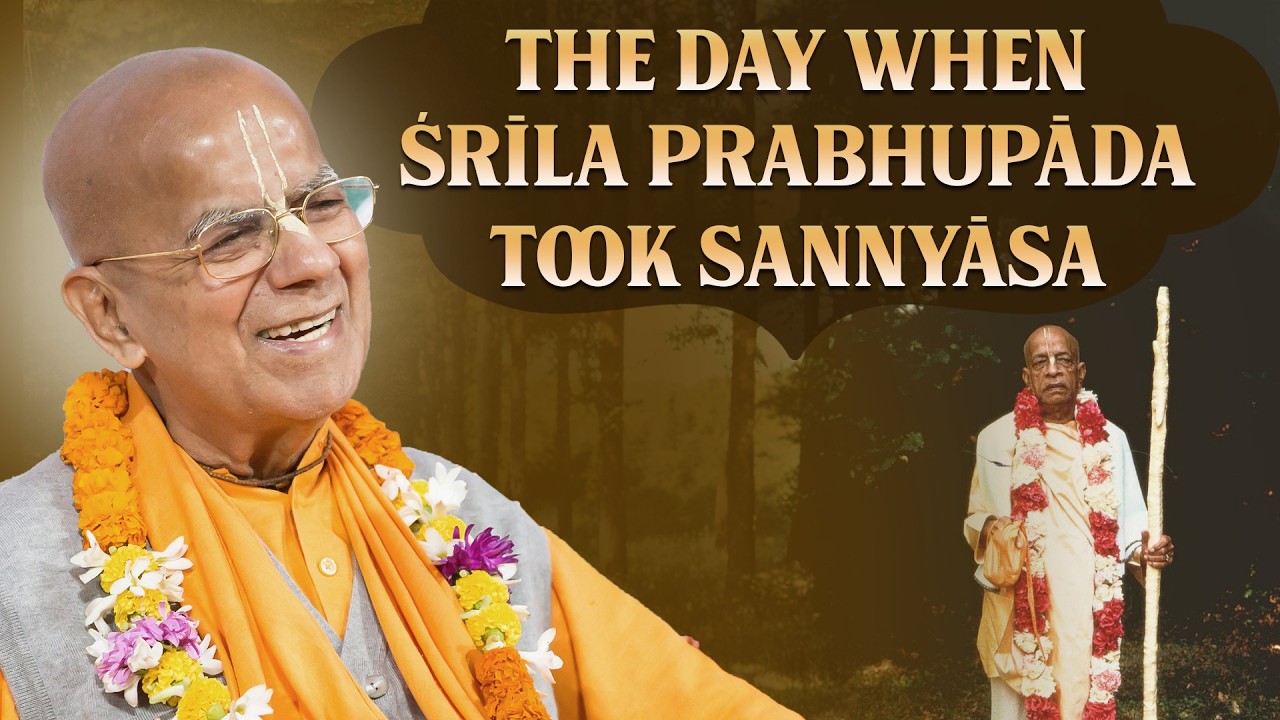
In this extended lecture, the speaker commemorates the day Śrīla A. C. Bhaktivedanta Swami Prabhupāda took sannyāsa (June 9 1952) and relates it to the broader tradition of renunciation exemplified by Lord Caitanya. The talk weaves together several devotional anecdotes – the miraculous appearance of Lord Vāmanadeva, the story of Uddhava seeking dust from the gopīs, the devotion of the Hare Kṛṣṇa nāma chāryā, and the early life of Prabhupāda – to illustrate the supreme activity of the Lord and the ideal of self‑surrender. The core teaching focuses on Bhagavad‑Gītā 18.72‑73, emphasizing that preaching makes one dear to Kṛṣṇa, that surrender and offering all actions to the Lord are the highest duty, and that attentive hearing of the scriptures destroys ignorance (avidyā). The speaker then offers practical guidance for devotees: cultivating humility, seeing the good in everyone, avoiding fault‑finding, maintaining discipline, handling criticism, and encouraging regular reading of the Gītā and Bhāgavatam. The latter part of the session consists of a Q&A covering topics such as self‑sincerity versus judging others, responding to anti‑cult accusations, the role of women (mātrijīs) in sankirtan, and dealing with “anti‑preaching.” The overall message is an enthusiastic call to deepen devotional practice, spread the holy name, and rely on Kṛṣṇa’s instructions to overcome material illusion.
Chapters
Everyone's okay?
Thank you.
Thank you. Take a lot of the morning class today for the festival. After the class, I can meet the Rippenskipolis. A little bit of time for class. How many of you were not in the class this morning? Om Namo Bhagavate Vasudevaya. Om Namo Bhagavate Vasudevaya. Om Namo Bhagavate Vasudevaya. Om Namo Bhagavate Vasudevaya. Om Namo Bhagavate Vasudevaya. Hare Krishna. Hare Krishna. As you probably know, today is also a special day. Actually, every day in devotional service is special, but some days are more special than others. And this week you had several special days. Few days ago you had the appearance of Lord Vāmanadeva. You know that? The Lord appeared as Vāmanadeva to and performed another miracle. With the first footstep, he covered everything in the three planets. And the second footstep, he covered everything with the earth and the sky. He waited to keep the third footstep. God, when he appears, he performs supreme activity. Then we had the appearance there of the great sage, as I explained yesterday. Prabhupada said he's virtually the founder of the Krishna conscious movement He was a great visionary. He is described to be the mercy incarnation of Caitanya Mahāprabhu. And he had predicted the Russians will come to Māyāpur along with the locals, chant and dance. Amongst the few countries he mentioned, one of them was Russia. And then yesterday we celebrated the appearance day of, appearance day of the Hare Kṛṣṇa Nāma Charya, the authority on the Holy Name. Who used to chant the Holy Name of Kṛṣṇa 1,000 times a day. Who was fully surrendered to the mission of the Lord. Who was determined to chant the Holy Name. Even when he was being dragged to different marketplaces, he still went on chanting. Who was extremely compassionate. He was worried about those who were trying to kill him. And today is the auspicious day when Śrīla Prabhupāda took sannyāsa. So we'll talk a little bit about this and then we'll discuss Two verses from the 18th chapter of Bhāgavad-gītā. So today is the day that Śrīla Prabhupāda took sannyāsa. So as you probably know, there were four varnās and four āśramas. Prumacāri, grihāsta, vānaprastha, bhātum. Sannyāsa. Sannyāsa. And the sannyāsa āśrama was the highest of the four āśramas. To be honest, Prabhupāda taking sannyāsa was like Lord Caitanya taking sannyāsa. Prabhupāda was fully renounced from the very time He took His birth. There are two types of living entities, nitya-siddha and nitya-bandha. Prabhupada was liberated from the beginning. Lord Caitanya took sannyāsa at the age of 24. And what inspired Him to take sannyāsa? He saw that people were being offensive to Him. Just like on one occasion, Lord Caitanya was appreciating the gopī-bhāva, the bhāva that the gopīs had for the Lord. Is unparalleled in history. What did you say? Krishna was in Dwarka. He had a headache. So he called Uddhava. Uddhava, I have a severe headache. So when you have a headache, it's sometimes called tiger mom. But Lord said, get me the dust from the feet of my devotee. When that dust touches my forehead, then only my headache will go. And Uddhava said, okay. Uddhava said, you have millions of devotees. They'll gladly give the dust from their feet for your Uddhava went to the queens of Kṛṣṇa. Sadevāma, Rukmini. "Is dust on my feet to touch the forehead of the Lord?" This is unacceptable. That's not good. Then Uddhava went to the jñānis, the yogis, and they all refused. Then Uddhava went back to the Lord and said, "I went everywhere, but they all refused to give the dust from their feet." Prasad Raaval said, "Did you go to Radharani and the gopis?" They were in Vraja. Kṛṣṇa was in Dvāraka. And Uddhava said, "No, I forgot. I didn't go there." So then Uddhava came to Vṛndāvana. He saw Radharani and the gopis. They were all sitting on the banks of the Yamuna, meditating, looking in the direction that Dvāraka was. And when they saw Uddhava, Now then, they got quiet. So, have you brought some news from Dwarka for us? We are suffering in separation. And Vadhu said, I have come with a special mission. I need the dust from the feet of the Lord's devotees. Because the Lord has a headache which will only be cured when the dust from the feet of His devotee touches the forehead. And it has allowed him to come here. That's Humara fee. Take, take, take as much as you want. How are you going to carry this dust all the way to Dwarka? In a ship of devotion. Then Uddhava came back to the Lord. He said, you were right. When he approached the gopis in Radhani, they didn't care what would happen to them. Their only mission was your welfare. So Uddhava could see how exalted these devotees were. When you do the parikrama of Govardhan, you come to a lake called Budhaukund. You remember that? How many of you have been there?
Okay.
So in Budhaukund, the priest there is my special friend. Buddha was so inspired by the strength and mood of the gopis that he prayed to the Lord, "Please, may I take my birth here." And he lives over there in the form of grass. So, Panchatanjali, On numerous occasions described that the love that the gopis had was unparalleled and the highest amongst all the devotees. And the topmost is Radharani. Her meditation 24 hours is to serve Kṛṣṇa. Lord Caitanya was singing, "Gopi, gopi, gopi, gopi, gopi, gopi, gopi." And there was a Sanskrit student there. Lord Caitanya was also a Sanskrit scholar. That's why He was known as Nimaipandit. Sanskrit student said, "What is this? Gopi, Gopi, Gopi! This is not your business. Chana re Krishna!" Chana was not in a position to chastise Lord Caitanya. So Lord Caitanya ran behind him with a stick. And when that student reached his other classmates, he ran into his class where the other classmates were studying Sanskrit. And they all came with their sticks to fight with Lord Chaitanya Mahaprabhu. "You think you are a big Sanskrit scholar? We will teach you a lesson." So Nimai could see how people were getting degraded. So he then took sannyas. And then at the age of 24 he took sannyas. And he showed how an ideal sannyasi should behave. He said, "A black dot on a white sheet can be seen from great distance. Similarly, in a sannyāsi's character, if there is any flaw, people notice it, highlight it, gossip over it, talk about it. But he took sannyāsa because he wanted to preach. And everyone, even if someone doesn't agree with the sannyāsi, he is respectful. Lord Caitanya had predicted that the chanting of the Holy Name which spread to every town and village of the world. So Śrīla Prabhupāda appeared to make this prediction come true. Prabhupāda's father's name was Gour Mohandei, very pious Vaiṣṇava. He would regularly serve saintly people who would come and stay in his house. And whenever a saint or a sadhu would be going, he would say, "Please bless my son so he becomes the great devotee of Rādhārāṇī." So externally Prabhupāda was not a sannyāsi in the beginning, but in his heart he was a sannyāsi. In 1921, he met his spiritual master. Bhaktisiddhānta Mahāprabhu, in the very first meeting, would see, "He is the man who Lord Caitanya has said will take the message all over the world." So there were many impediments, but Prabhupāda was determined to fulfill his guru's order. And Bhaktisiddhānta Mahāprabhu came to him in a dream twice. And told him, "Now you take sannyāsa." So Prabhupāda took formal sannyāsa in 1952. In 1952, in June 9th, and it's a truly auspicious day that he took sannyāsa. And then Prabhupāda stayed at Rādhā-Dāmba Temple in Vrindāvana. How many of you have been to Rādhā? And over there Prabhupāda was meditating constantly on the samādhi of Rūpa Gosvāmī and Jīvagosvāmī. He got the inspiration to write the books. Prabhupāda was a one-man army at that time. He would translate the books in Brindavan, and Prabhupāda had one old typewriter with which he would type himself. Then he would go by rickshaw or horse carriage to Mathura. When you, the woodies, want to travel, you travel in taxis. Prasad Raaval would travel in carriages, like a rickshaw. He would come to Delhi by train and then again take a rickshaw to go and buy paper for printing. Then he would approach people requesting donations for printing. Then after the books were printed, he would go and distribute. Prasad took sannyas in '59. And in 1965 he sailed for the West. Now sannyāsi is socially dead and he only has one mission, to serve the mission of the Lord. So today is the auspicious day that Śrī Prabhupāda took sannyāsa. So on this day we can pray to Prabhupāda that he may bless us so that we have unlimited strength to go on pushing the samkṛta movement of Lord Caitanya. But this movement is for the benefit of humanity. Humanity is in a very precarious condition. They need guidance. They need an alternative lifestyle. That comes by preaching. Sometimes we think no one's going to listen to our preaching. But if nobody would be listening to our preaching, we would not be here. I remember coming to Jerusalem about 20, 20, 22 years ago. It's a while. I think it was an old shack, old house, because he had at that time only one or two devotees. I'm not sure if Bhagavanidhara was there. So with this we'll proceed to the Bhagavad-gītā. So with this we are reading text 72 and 73, the 18th chapter of the Bhagavad-gītā. Bhagavad-gītā is meant to eliminate our illusion or ignorance. Kṛṣṇa has emphasized The importance of understanding and hearing Bhagavad-gītā. First, Kṛṣṇa explains in this chapter, "One who explains this saṁsrit Bhagavad-gītā is dear most to Me." And there's no one more dear than Him. How many of you would like to be dear to the Lord? Few. So, if you want to be dear to the Lord, if you want to become a dear servant of the Lord, you have to pay a price. What's the prize? Preach! Kṛṣṇa says, "Anyone who preaches becomes very dear to Me." Not only does He say, "He will become dear to Me," He says, "No one will be more dear than him." Then Kṛṣṇa says, "Anyone who studies this conversation between Us is worshiping Me by his intelligence." So we can worship Kṛṣṇa with our intelligence. And what does intelligence mean? To read the Bhagavad-gītā, to understand what Kṛṣṇa wants us to do. Intelligence today is being misused. Intelligence should be used to understand the dialogue between the Lord and His devotee. So Kṛṣṇa is encouraging us to study this conversation. And Kṛṣṇa encourages us to read the Gītā without envy. In the second chapter of the Bhagavad-gītā, Arjuna said, "Now I am confused about my duty, and therefore I'm requesting you, please instruct me." And then Krishna begins to explain the philosophy. So it's nothing unusual to get confused, nothing unusual to have doubts. Arjuna had so many doubts. Of course, we should recognize that Arjuna is an eternal companion of the Lord. What did Krishna say in the 4th chapter? Many, many times both you and I have appeared. But why was Arjuna put in illusion? There's no question of Arjuna getting bodily attached. So that the Bhagavad Gita could be spoken for the benefit of humanity. Especially that the worries of ribbons can hear as well. Arjuna was put in illusion. But we should not at any point think Arjuna was a conditioned entity like us. So Krishna is asking Arjuna, Have you heard this dialogue with an attentive mind? So we should, when we hear this dialogue, we should hear it with an attentive mind. What does it mean attentive mind? With concentration. Just like when you chant the Hare Krishna mantra, chanting Hare Krishna is beneficial in any situation. Once a movie producer in India made a movie called Hare Rama Hare Krishna. The good thing in the movie was The Hare Kṛṣṇa mantra was in the background. But the bad thing was, it completely misrepresented our philosophy. It showed that people take drugs and then chant Hare Kṛṣṇa. So I went to Prabhupāda. This was in 1973, before many of you were born. So I went to Prabhupāda and said, "This movie is going to give our movement a bad name, because it shows that people take drugs and then chant Hare Kṛṣṇa." Prabhupāda said, "No, nothing will be lost. They will hear the holy name and they will benefit." So that's one level. Hare Krishna, anyone knows what it is. Somebody says, "Look at those crazy Hare Krishnas, they're making my life miserable." But if you want to make spiritual advancement, then we should hear the Holy Name with attentive mind. When you're chanting, try and focus just on the chanting and nothing else. So here Krishna is questioning, did he hear this with an attentive mind? So what does this mean? When we hear the Bhāgavatam, when we hear the Gītā, we should hear with an attentive mind. Not that I use the Gītā and Bhāgavatam as a sleeping pill. When I'm half asleep, about to fall asleep, I start reading Bhāgavatam and I fall asleep with the book in my chest. When you hear, hear the Gītā and Bhāgavatam, you should be very attentive. The Bhāgavatam makes this point also. Nāsta praśyava vraja-nityam bhāgavata-sevaya bhāgavata-yatamaśrūkyaṁ bhakti-bhāvati nāisa-gī. By regularly attending, hearing the Bhāgavatam attentively, what is inauspicious in the heart will be destroyed. So Kṛṣṇa is questioning, did he hear everything with an attentive mind? And is your ignorance and illusion now destroyed? As Prabhupāda says in the puravaḍa, Kṛṣṇa was acting as a spiritual master over Jñāna. So He's enquiring, did he understand this from a proper perspective? If not, the Lord would explain it again. Oh, Bhāgavad-gītā could have been finished in few shlokas. But the Lord very elaborately explains because He wanted us to thoroughly understand the philosophy. So we are all influenced by ignorance and illusion. Prabhu da. What does— what are the different aspects of ignorance? This is explained in the third camp. Brahmaji has given the task of taking care of the creation. So Brahma has created different aspects of illusion. One is identification with the body. I think that this body is my real self. Then fear of death. We were so attached to the body. You don't want to give up the body. Even when you're suffering, you want to keep it. A devotee has no fear of death. When he uses life in service of Lord, he becomes fearless. Another aspect of ignorance is, another aspect is false sense of proprietorship. False sense of proprietorship. I am the proprietor of all this. That is, we think that Everything belongs to me. So these are different aspects of ignorance and illusion. Just like darkness gets destroyed with light, ignorance and illusion can also be destroyed. How can it be destroyed? How? With knowledge. Just like darkness gets destroyed with light. There is a nice statement in the Chaitanya Charitamṛta: Kṛṣṇa-sūrya-samā māyā-hayāṁ dikaraḥ. "Yahā kṛṣṇa-dāyini māyā-vikara." Where there is Kṛṣṇa, there is no room for māyā. Just like when there is sunlight, there is no room for darkness. So it's not embarrassing if we have some doubts. It's not embarrassing if we have some questions. But we should go to the right source to get our ignorance removed. So Prabhupāda is saying in the purport, You go to this one of my spiritual masters or his representative. So in reply, what does Arjuna say? My dear Kṛṣṇa, O infallible One. God is infallible. Are we infallible? We are fallible. Infallible means one never makes any mistake. Just like Kṛṣṇa said, I can remember all my previous births, but you cannot. So once you accept God to be infallible, You also accept the Lord's teachings to be infallible. So the Lord is infallible. He never makes any mistakes. He never gets illusioned. Sometimes, that's the time when people think God gets, becomes mature when He comes to the mature world. Avidyanti mahamūḍha. Who's deride Me when I descend? They don't understand My transcendental nature. So Arjuna says, now my illusion is now gone by Your mercy. And now I'm free to act, free from doubt, and prepared to act according to your instructions. So that should be our mood. We do act under the directions of the Lord. Bhagavad-gītā is meant to remove our ignorance. Lord Caitanya encouraged us to read the Bhagavad-gītā every day. When Lord Caitanya was traveling in southern India, he came to a historical temple the temple of Sri Ranga. There was an uneducated Brahmin holding a Gita, shedding tears from his eyes, and trying to recite the verses of the Gita. Lord Chaitanya Prasada, this man was displaying genuine symptoms of ecstasy. So he approached this Brahmin and said, "What is it in the Bhagavad Gita that's making you display these symptoms of pure ecstasy?" The Brahman said, I am maturely uneducated. My spiritual master ordered me read Bhagavad-gītā every day. And so I try to read it. Some shlokas are pronounced correctly, some incorrectly. But because of the guru's order, I do it every day. And when I see, but I can't understand the meaning of many verses. But when I see this picture of Kṛṣṇa becoming a chariot driver of His devotee Arjuna and serving his devotee would take place in the chariot in the midst of the two armies. My tears come to my eyes. The Supreme Lord, but he's so merciful. So then Lord Caitanya embraced that brahman and said, you are uneducated, you say, but you have really understood the meaning of the Gita. And then Lord Caitanya kept that brahman with him for 4 months and instructed him on the Bhagavad Gita. So we should all be in the mood of acting according to the direction of the Lord as revealed in the Bhagavad-gītā. Arjuna says, "Now I'm prepared to act according to your instructions." What are the two verses that describe Kṛṣṇa's instructions? Sarvā dharmām paritajya mām ekaṁ aṁ tvam sarvaḥ pāda-vihāmokṣaṇmi vācchvaḥ. Kṛṣṇa says, "Give up all varieties of religiousness and just surrender to me." 'And I will protect you.' 'Ma asujāha.' What does 'ma asujāha' mean? 'Do not worry. I will protect you. Surrender to Me.' Kṛṣṇa says, 'Yad karoṣi yad iṣnāsi, yad yaho 'ci dadāsi yad, yad tapasvāsi kāndhya tad karuṣo mādhārpānām.' 'Whatever you do, whatever action you perform, whatever charity you give, whatever foodstuff you eat, do it as an offering unto Me.' So real knowledge is to understand I am the eternal servitor of the Lord. Those guys are chidinamartha, who? You already saw Rupaya and Krishna Nagya. We are the eternal servants of the Lord. So Arjuna said, now I am free from doubt and I am prepared to act according to your instruction. So Krishna's instructions are very clear. Now what's the choice if we don't accept Krishna's instruction? Do we have a choice? What's the alternative? Being under, following Maya's instructions. But we've been trying to follow Maya's instructions for such a long time. Dakarbhakri Gyan says, you have been sleeping in the lap of this witch known as Maya. Now get up, wake up. Lord Caitanya has come to wake you up. Jīv-jāga-jīv-jāga-gurūcana. How does Lord Caitanya wake you up? He comes Himself or through His devotee. Lord Caitanya comes and wakes us up. The devotees of the Lord come to wake us up. So seeing devotee association is a great source of encouragement to stay on the devotional path. But in devotee association, we also have the habit of looking for faults in others. Is that a good habit? If you look at faults in others, then there's danger of getting into vaishnava prarabdha. So what's Prabhupāda's advice on this point? Who knows? He's like a bee. I don't know. Look at the good in everyone. Look at the good qualities in everyone. And if you look at the good in everyone, then you'll feel like respecting everyone. But if you're always looking at the, thinking of the bad in everyone, "He's so bad, he's so bad, he has this weakness, he has that weakness, he has this weakness. I have all goodness and he has all weakness." That's a very undesirable position to be in. Caitanya Mahāprabhu highlighted, 'tṛṇāḍa piśodhi-cena'— to cultivate the mood of humility. Humility means I'm ready to offer respects to everyone without expecting anything in return. Someone may say, 'But this is very difficult to follow and implement in real life.' Śrī Kṛṣṇa's Kavirāja says, 'By the mercy of Caitanya Mahāprabhu, difficult things become easy, and without His mercy, easy things become difficult.' And what does Kṛṣṇa say in the Gītā? 'Those who are worshiping Me with devotion I preserve what they have and I make up what they lack. Even if we have a heavy ego, but if the genuine desire is to cultivate humility, be respectful, and look at the good in everyone, Kṛṣṇa will help you if you make a sincere endeavor. Kṛṣṇa is ready to help us. We have to be ready to take His help. So humanity is one of the ornaments with which we decorate ourselves. In material life, People decorate themselves with jewelry, perfumes, etc. What does the devotee decorate himself with? With what? Transcendental quality. Devotee's asset is the Holy Name. Devotee's quality asset is the transcendental qualities. Lord Caitanya explained this in Adiṣṛṭaṁṇī, principles, qualities of a devotee. So many times devotees say, "How can I develop these qualities?" So all these qualities can develop if you're chanting and hearing with an attentive mind. So hearing and chanting with an attentive mind is most important. So you already know what is Kṛṣṇa's instruction. We should make it a point to read the Gītā every day. How many of you read the Bhāgavad-gītā? We should. It's a good habit. Lord Caitanya told the Kurma Brahman, "Chānta Hare Kṛṣṇa every day." Read Gītā and Bhāgavatam every day. And he said, if you do this, you will never be separated from me and I will never be separated from you. So we should make it a point to read the Gītā every day. Regular reading of the Gītā will keep us on the right track, will keep us connected to Kṛṣṇa and away from māyā. So Kṛṣṇa is asking Arjuna, did you hear all this with your attentive mind? Is your illusion and ignorance now gone? And Arjuna said, now my illusion is gone. 'Oh infallible Lord, now I'm ready to act according to your instructions.' And that should be our mood. And Kṛṣṇa is not going to tell you something that's not practical. What Kṛṣṇa wants us to do, we find out through the agency of the bona fide spiritual master, the bona fide devotees of the Lord. They're not going to give you any impractical instruction. They're not going to say, 'Leave your family, leave your job, leave your this, just stay home and move in the temple.' The instructions they get are very practical instructions. Says, staying in spiritual association gives us the strength to progress spiritually. So on this auspicious day, the day that Prabhupāda took sannyāsa, we should all be in the mood that our illusion and ignorance will be destroyed by accepting Kṛṣṇa's instructions. And the best way to remain enlightened is by regularly reading the Bhāgavad-gītā. You will really feel Kṛṣṇa's presence. Ārjuna was very sad when the Lord had departed from the planet, but then Ārjuna began to meditate on Kṛṣṇa's instructions from the Gītā, and he felt that Kṛṣṇa was right there. So you will feel Kṛṣṇa's presence when you read the Gītā. It's like you feel Kṛṣṇa's presence when you chant the holy name. If you didn't feel transcendental happiness, you would not chant again and again. So we should read these scriptures regularly for our enlightenment. And give them to others for their benefit. Hare Krishna. Hare Krishna. It's a little late, so we'll take up some questions. Yesterday we had a book display. Whose book display? Prasad? We couldn't do it yesterday, but we gave out prasads. Yes.
In one of your lectures you say that one should always consider himself to be not sincere and other devotees to be very sincere. And if one is not is not following nicely, if he is not chanting properly, if he is not following the regulative principle, it's easy for one to think that he is not sincere and all others are sincere. But if someone is doing everything nicely, is chanting, reading, going out for book distribution, carrying out, then it's hard for him to think that he is not sincere because he sees that others are not doing it. And he is doing it, so how in this case also?
I don't know in what context I said what I said. I have to hear the whole lecture. The point is, just like Krishna's Kaviraj, the embodiment of perfection, Nithyananda empowered him to write the Chaitanya Charitamrita. What was Krishna's Kaviraj's assessment of himself? He had good sadhana, he was perfect in everything. He said, "I have so many disqualifications, don't even take my name." If you take my name, all your good qualities will go. I am so poor. Our ācāryas, many of them did not leave behind any literature about themselves. Prabhupāda did so much to establish Kṛṣṇa consciousness. So whenever we would tell Prabhupāda, Prabhupāda, it is through your effort all this has happened. He would say, no, I have done nothing. My only qualification was I followed my guru Mahārāja sincerely. So it's nice that the devotee is following all their guidelines. So there's always room for improvement. Yes?
Prasad Raaval, what should be our attitude to the public statements of Dworkin, this orthodox anti-cult person who is blaspheming the devotees? What should we tell the people who heard his propaganda against Vishnu consciousness?
He is very active on TV and all that? So when people ask you, tell them these accusations are false. Tell them, "We are preaching, we are talking about love of God. We are simple people. What wrong are we doing?" In the name of God, follow the four regular principles. We give the message of peace and harmony. So if somebody is envious of us, what can we do? They are envious that people come to ISKCON and become so disciplined. They can't get people to become so disciplined. The discipline that devotees in ISKCON have, is unparalleled in religious history today. We're not saying that devotees have no faults. They have, they may have faults, they do have faults. But the commitment of sādhana and chanting, you don't find this. Our priests don't drink. But I saw, near Gurgaon, okay, a procession.
Can the mātrijīs go along for sankīrtan? And because they say that mātrijīs should not go along for sankīrtan. And some matajis are saying that this is not the nature of the matajis to go out for sankirtana.
Who is saying that? No one is saying that. Probably the one who is doing Christian preaching. Our matajis are some of the best preachers. Once, okay, you are going.
I want to say about working that Heetha, I don't know from where it is, but she says that I I heard that he was originally favorable to devotees, but then some devotees hurt him, and after that he became envious.
I don't know the exact answer. Is Śrīla Prabhupāda? Yes.
Could you say a few personal experiences with Śrīla Prabhupāda, your personal impressions of Śrīla Prabhupāda?
Personal impression? Prabhupāda was a very kind man. When somebody asked Prabhupāda, to speak on his guru. Prabhupāda said, "My guru was a Vaikunṭhāmān. What can I say?" Prabhupāda was really a Vaikunṭhāmān. He was very humble, but also very strict, very bold in his preaching, friendly. He desired everyone to be happy. So he endeavored in old age also to translate these books after establishing Kṛṣṇa consciousness in America, Canada, India, Europe. Prabhupāda was thinking, "What about the Soviet Union?" He wanted the people of Soviet Union to be saved also, and China. So it's because of Prabhupāda's purity the movement has continued to expand. When Prabhupāda left the planet, ISKCON had about 140 temples. Now there are more than 500. So Prabhupāda's books are now translated in over 70 languages of the world. People are reading these books. There's a lot to say. Isha Vapas.
Why other devotees in this story of Kṛṣṇa's having headache, besides Gopī, didn't give the dust?
Because generally, if the dust on your feet touches the forehead of the Lord, it's considered you can't really— it's not good. Not good for whose dust, whose feet's dust is touching the forehead. Yes.
What does it mean not to be attached to the fruits of one's actions?
Not to be attached to the fruits, it depends what fruits you're talking about. Let's say you're going on a book distribution and you like to distribute as many books as you can. That's okay. Kṛṣṇa encourages us to perform action, don't be attached to the results. Results are not in our hand. So, but if you are, if you want the fruits to go to Kṛṣṇa, That's the best. And now, when attachment is there, the advanced stage, we get no attachment at all. So dovetail your attachment. I'll do it for Kṛṣṇa. Yes.
How can we inspire devotees to hold Nama Hatha in their houses, to open the hearts for the devotees, to invite them? Yes.
Someone requested me to speak about Bhakti Vriksha. Who requested me? Bhakti Vriksha Nama Hatha are programs aimed at spreading the message of the Lord to newcomers. You are the Bhakti Vriksha coordinator?
I'm just studying for it.
So when your house is used to serve the mission of the Lord, it's very auspicious. It is said that in any house where the devotees of the Lord come and chant the names of the Lord, the house is blessed. Their house is blessed.
Why?
Kirtan and philosophy is discussed. Lord personally comes. As I told you all yesterday, as you know, Madhira Rāsa Prabhu is very sick. So I want to request you all to help and give association. As much as you can. You can sit in the room and do reading of the scriptures, do kīrtan, whatever in Prabhupāda's name, and serve in any way that you can. Okay? So I'll stop at this.
If someone is trying to preach, but say like 50% of his preaching is anti-preaching.
Anti?
Anti-preaching.
Anti?
It brings like opposite effect. Will Lord Nityānanda be still happy with this preacher?
What do you mean anti? You preach and the person gets against the movement. Yeah, but somebody is demonic and somebody is not. You are sincerely preaching, huh? They are not getting, they are not exhibiting the demonic tendencies because you are preaching. They are exhibiting this tendency just against anyone talking about God. Keep preaching. Don't get discouraged. Okay? I gave you the example yesterday. Oh, we are all witnesses right now, sir. Remember I gave the example? So, anything else? How many of you are going to the festival?
If the devotees live among the karmis and its family people, they live properly, they don't drink, they behave politely, and they don't preach to other people, but these other people still become negative against devotees, what's the reason and what should the devotees do?
I didn't quite understand that question.
The devotees live among the karmis and they behave properly, politely, etc. They don't preach to them, don't tell them anything about Kṛṣṇa, but still these karmis, they feel negative about the devotees. Why it happens and what should we do?
What can you do? Prabhupāda said. Prabhupāda once gave a lecture called "Who is Crazy?" Prabhupāda analyzed two groups of people in society, the devotee and the non-devotee. Devotees think non-devotees are crazy, wasting the valuable human life bringing poison. And the non-devotees think the Hare Krishnas are crazy. They're young, they chant, dance, follow regular principles, they're crazy. Once somebody in India told me, follow all these rules and regulations, What are you living? Might as well die. The Prophet proves person who is not a devotee is crazy. So there'll always be non-devotee class. We should be determined. Okay, I'll stop now. Hare Krishna, Hare Krishna, Krishna Krishna, Hare Hare. Alhamdulillah.
More from PRASAD

Rare Pastimes & Timeless Lessons of Guru Mahārāja | Stories Every Disciple Should Hear

ISKCON Legends- pure devotees meet-HH Jayapataka Swami, HH Gopal Krishna Goswami, HH Radhanath Swami



Jagannātha Ratha-yātrā Through Śrīla Prabhupāda's Mercy | 29 April 2006 | Nairobi, Kenya

Lord Jagannātha's Appearance Pastime | 21.07.2019 | ISKCON Calgary | Śrīla Gopāla Kṛṣṇa Gosvāmī

The Ācārya Teaches by His Own ExampleGuṇḍicā Mārjana by Guru Mahārāja #shorts

Guṇḍicā Mārjana – Lord Jagannātha's Pastime | 21.7.2019 | ISKCON Calgary |Śrīla Gopāla Kṛṣṇa Gosvāmī

H.H. Gopāla Kṛṣṇa Gosvāmī Mahārāja - Exemplary Sādhana and Deity Worship # shorts

भगवान की कृपा कैसे प्राप्त होगी ? | 11 Jan 2014 | Punjabi Bagh | Srila Gopal Krishna Goswami

Material Education vs Spiritual Education | Srila Gopal Krishna Goswami #shorts