The Devotee is Not Envious of anyone | SB 6.18.50 | 16 Dec 1994 | New Delhi | Gopāl Kṛṣṇa Goswāmī
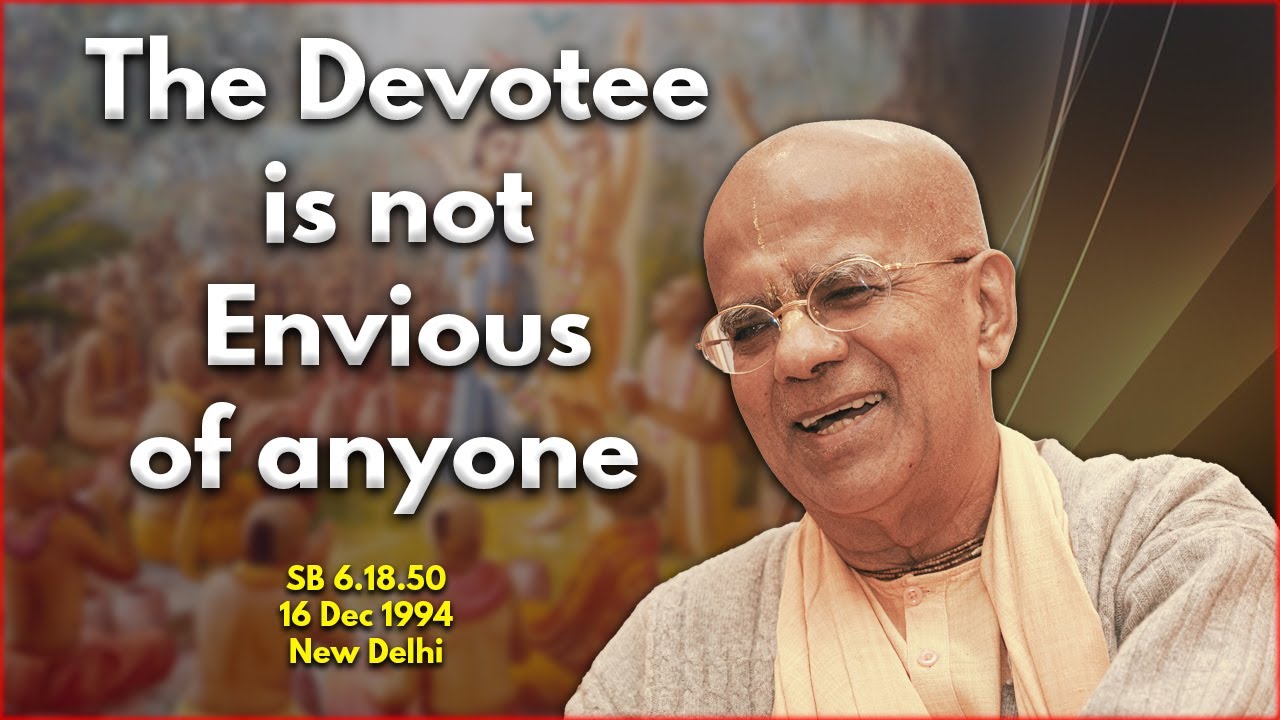
Gopāl Kṛṣṇa Goswāmī teaches that a true devotee must be free of envy, which blocks Krishna's presence in the heart. He uses stories of Prahlāda and Dīrghāsa Muni to show how envy destroys spiritual progress, while constructive competition inspires deeper surrender. Simple living, truthfulness, and active preaching are the path to transcendence.
Chapters
Om Namo Bhagavate Vasudevaya. Om Namo Bhagavate Vasudevaya. Om Namo Bhagavate Vasudevaya. Om Namo Bhagavate Vasudevaya. Srimad Bhagavatam, Canto 6, Chapter 18, Text 50. Nauteshtās prestaḥ salīlām. Nauteshtās prestaḥ salīlām. Sambhaya muktā mūḍhajā. Sambhaya muktā mūḍhajā. Aṁcitaḥ samyataḥ vā. Sāmyataḥ vā. Na sāmbhitā bhayhi śrīreḥ. Na sāmbhitā bhayhi śrīreḥ. After eating, You should not go out to the street without having washed your mouth, hands, and feet. You should not go out in the evening or with the hair loose, nor should you go out unless you are properly decorated with ornaments. You should not leave the home unless you are very grave and are sufficiently covered. Spoken by His Divine Grace A.C. Bhaktivedanta Swami Prabhupada. Kashyapa Muni advised his wife not to go out into the street unless she was well decorated and well dressed. He did not encourage the miniskirts that have now become fashionable. In Oriental civilization, when a woman goes into the street, she must be fully covered so that no man will recognize who she is. All these methods are to be accepted for purification. If one takes to Kṛṣṇa consciousness, one is fully purified, and thus one remains always transcendental to the contamination of the material world. Om agyānā te mṛṇḍasya jñānāñjanāśalakyā ca kṛṣṇa-mṛta-nīna-tasmai Śrī Brāhma-namaḥ. Śrī Caitanya-mana-vaiṣṇava-nāmad-bhūtale soyaṁ rūpaka-dāmayam dadāti svāpadaṁ bhikām. Bandeham Śrī Guru-śrī-yudhāpada-kamman Śrī Guru-vaīśṇava-nāsta. Śrīrūpāṇṣa grajatāṁ sahāgana-raghunātāṁ vidhaṁ tāṁ sadevam. Sadveitāṁ sa vaḍhūtam parijana-saikāṁ kṛṣṇa-cetanya-devaṁ. Śrī-rādhā-kṛṣṇa-pradāṇṣa-hāgana-dāmitāḥ śrī-viśākāṇa-tāṁ śāktaḥ. He Kṛṣṇa karunāten rodhina-bandhu-jagat-pateḥ. Toppesa topika-kantaḥ rādhā-kantaṇā-masti-peteḥ. Tāpta-kāñcana-gauraṅgi-rādhā-bhṛndāvana-eshvārī. asammita bahiṣcarah. So Kashiapa Muni is continuing to instruct his wife Diti. As we have read in this section, we've already discussed this, how Diti was very aggrieved because two of her sons were killed, and she had a desire to have a son who would be able to take revenge. Kashiapa Muni, however, was not really happy with this desire of his wife. So his wife was trying her best to please him. So Kṣaṣapa, when he told his wife that if she is able to follow the guidelines which he is giving her very strictly, then she would be able to have a son. Who would be able to kill Indra. But if she deviated from the vow, then she would have a friend, she would have a son who would become friendly to Indra. So we see in these verses that Kashiapa Muni is giving very valuable instruction regarding how one should become a Vaiṣṇava. For example, Kasyama Muni pointed out how she must become truthful and how she should not curse anyone at all. So Prabhupāda explains this tendency, tendency to curse others, a result of being envious in nature. Generally in the material world, Everyone is envious of everyone else. This is materialistic society. We divide society into friends and enemies. We identify certain group of individuals to be our friends and certain people to be our enemies. And we make all our plans how we can please our friends and harm our enemies. So in spiritual life, however, That is not our standard or guideline. Just like when Prahlāda Mahārāja's father, Niranikāśipūr, was instructing his teachers to train his son in the art of diplomacy. Diplomacy means divide and rule, friends and enemies. Prahlāda totally rejected that advice. Śrīdhava Sarvadhāhīna, a devotee of the Lord, is a friend of everyone. So Prahlāda said, "I really have no enemy. So I'm not really interested in this philosophy of being diplomatic, of having friends and enemies." Then a devotee is also not envious of anyone. Because as Lord Caitanya revealed to Amoga, the son-in-law of Sarvāma Bala-carīya, As long as you have envy in your heart, Kṛṣṇa will refuse to reside in your heart. Of course, Kṛṣṇa is residing in the heart of everyone, even the non-devotee. Even Kṛṣṇa is so kind that even when we take on the body of an animal, Kṛṣṇa still keeps us company by residing in the form of Paramātmā. But Kṛṣṇa, will not reciprocate with us unless we really surrender to His plans, to His instructions. So this Amoghak, he was the son-in-law of Sarvabhauma Bhattacharya. Sarvabhauma Bhattacharya was actually a very great Sanskrit scholar who originally hailed from Navadvipa. But because at that time there was a— Bengal had fallen under Muslim rule. Svāmāmadarācārya had to leave Bengal and then he came and took shelter of Jagannādh-puri. But he was, of course, a staunch impersonalist, very great Sanskrit scholar, but a māyāvādī. And his brother-in-law, Gopināda Ācārya, would always glorify Caitanya Mahāprabhu. But then Caitanya Mahāprabhu is non-different from Kṛṣṇa. Sarvāda Ārya had trouble in accepting Caitanya Mahāprabhu as God. However, Caitanya Mahāprabhu's mercy fell upon him in many ways. Caitanya Mahāprabhu, when He came to Jagannātha Puri, He saw Lord Jagannātha. And as soon as He saw Lord Jagannātha, He fainted in ecstasy. And the gatekeeper and the other attendants of the Jagannātha Puri temple They were not really sure if Caitanya Mahāprabhu was still alive. Then they could have caught him, and they saw that he was still breathing. Anyway, then he was carried to Sarvabhaumana Ācārya's house, and there he was finally, he came out of his ecstatic mood when Nityānanda came there and they did kīrtana. So Caitanya Mahāprabhu eventually revealed his transcendental form to Sarvabhaumana Ācārya. Sarvabhaumata Ācārya had asked Caitanya Mahāprabhu to listen to his commentary on the Vedānta. So Caitanya Mahāprabhu very patiently heard it, but He did not utter even one word. 8 days, 7 days, He did not utter one word. Then finally when Sarvabhaumata Ācārya asked Him, "Are you understanding something? Why are You not saying anything?" Then Caitanya Mahāprabhu spoke, and He pointed out how Sarvabhadra Ācārya was misrepresenting the message of the Vedānta. So Sarvabhadra Ācārya was fully convinced after Caitanya Mahāprabhu spoke and revealed His transcendental form that He is the Supreme Personality of Godhead. But he had one daughter. He only had one daughter, one child. And that daughter was married to Amoga, who was very envious of Caitanya Mahāprabhu's exalted position. It is not that even when the Lord appears, there are some people who are envious, isn't it? Just like when Kṛṣṇa was on the planet in the Rāja-sūrya sacrifice, when all the great sages were glorifying Kṛṣṇa, Ṛṣīpāla got up and started criticizing the Lord. So there are always people who are envious of the Lord. So Amarga, he had trouble in accepting Caitanya Mahāprabhu's supreme position. And on one occasion when Caitanya Mahāprabhu was in Jagannātha Puri, whenever Caitanya Mahāprabhu would travel and visit different places, He would be invited by different householders to come and have prasāda in their house. So Chaitanya Mahāprabhu was eating prasāda a few days in Sarvabhaumana Ācārya's house, and whenever his wife would be serving, Sarvabhaumana Prasāda Ācārya would stand at the gate of his house with a stick. Actually, there is a painting of this scene in the Chaitanya-caritāmṛta, where described How Sarvabhaumacharya is standing with a stick and his wife is serving Caitanya Mahāprabhu. He would stand with a stick because he did not want his son-in-law to come in and see the elaborate feast that was being served to Caitanya Mahāprabhu. However, on one occasion, Sarvabhaumacharya had to go to the kitchen to help his wife serve prasāda to Caitanya Mahāprabhu. So Amoga, he would always be standing with his ears against the wall. He would try and spy and see, "What are they talking?" So if he could find some evidence against Caitanya Mahāprabhu, then he could defame Him in society. So when he saw that for a minute there was no one at the gate, Amoga came in and he saw the various items of PRASAD RAVAL. That were cooked with love by Sarvabhauma Bharacarya's wife for the pleasure of Caitanya Mahāprabhu. "Sāmoga!" As soon as he came in, he said, "Look at this sannyāsī. He pretends to be renounced, but see how much prasāda he's eating." So Sarvabhauma Bharacarya then chased him out of the house. Actually ran behind him in the street, but he couldn't catch up to him. So anyway, He escaped. So a few days later, Amulka was afflicted with a very serious, severe disease. Cholera, isn't it? He was afflicted with a severe disease of cholera. And he was about to die. So Gopīnātha Ācārya, who was his uncle, had come to visit Caitanya Mahāprabhu. So Caitanya Mahāprabhu just casually asked him, "How is Sarvapramana Ācārya and how is Amoga?" So he was informed that Amoga was on his deathbed, very, very sick, about to die. So then Caitanya Mahāprabhu decided that he would go and see Amoga. Because Sarvapramana Ācārya had become very dear to Caitanya Mahāprabhu. And Caitanya Mahāprabhu reasoned that if his daughter becomes a widow, then he may not get affected, he may not get disturbed. So it was more out of love for Sarvabhauma Balacarya that Caitanya Mahāprabhu decided to visit Amarga on his deathbed. And when He visited Amarga on his deathbed, Lord kept His hand on the chest of Amarga and He said, Why do you have envy in your heart? He said, as long as you have envy in your heart, as long as your heart is dirty, Kṛṣṇa will not reside over there. So remove this envious nature, remove this dirt from your heart. And as soon as he said that, Amoga, was completely transformed. He jumped from his bed in ecstasy, fell at the feet of Caitanya Mahāprabhu and begged forgiveness for his offensive, envious attitude. So to be envious of other Vaiṣṇavas, spiritual master, Supreme Lord is very, very dangerous. For spiritual advancement. Therefore, we should completely uproot this envious tendency from our hearts. There's another story in this connection in the Caitanya-caritāmṛta about a brahman who was very envious of the exalted position of Śrī Vāṣṭaka. Because Lord Caitanya was doing kīrtana in his house, The others, the Brahmins, had become envious how much honor that Śrīvāsa was getting. So he made a plan by which he would defame Śrīvāsa. And what did he do? He kept all the paraphernalia for worshipping Goddess Durga in front of his house. So in the morning when Śrīvāsa got up and opened his door, he found a liquor bottle and all contaminated food that is normally offered to Goddess Durga. Of course, Śiva was a great devotee, so he had no problems. He said, "Look, everyone come and see that I am a devotee of Durga." But nobody would believe him. So later everyone took cow dung, cow's urine, and they cleaned that whole place. A little later, this brahman who was trying to defame this great devotee, so he got affected with leprosy. And he approached Caitanya Mahāprabhu, but Caitanya Mahāprabhu refused to pardon him. He said, "You should suffer even more." Then again, so he suffered, suffered, suffered. Again, then after Caitanya Mahāprabhu took sannyāsa, he fell at His feet. And Caitanya Mahāprabhu says, "I cannot forgive you, but if you go to my devotee." And then the devotee gladly forgave him. Now we see a similar pattern in the Śrīmad-Bhāgavatam also, in the famous encounter of Dīrghāsa Muni and Ambrish Maraj. Isn't it? Very similar pattern. Dīrghāsa Muni was also envious of the exalted position of Ambrish Maraj. And he was just waiting for an opportunity to strike at him. So when he thought he had the opportunity, actually he didn't have, but he thought he had, he tried his best to burn Amṛṣmarāja. And finally, Durvāsana, when he was able to even travel to the heavenly planets, he reached the Pakhunda planet, but the Lord refused to pardon him. And ultimately he had to come back and fall at the feet of Amṛṣmarāja, and then he was forgiven. I don't give it. So the point is this, that envy actually works against your endeavor to make spiritual advancement. So rather than being envious of each other, if you see that somebody is making spiritual advancement, we should gladly offer him obeisances and respects and ask him to please bless us. So that we can also make spiritual advancement. And if you see that someone's making spiritual advancement, you should analyze, "How he's making spiritual advancement?" And you will see that he's making spiritual advancement because of his strong determination and faith in the words of Guru Sadhu Shastra. And we should also get inspired by such examples so that we can also make spiritual advancement. Prabhupāda used to call this spiritual competition. And Prabhupāda used to give us the example of how spiritual competition exists in the spiritual world. Or you can call this spiritual envy. There is material envy which is destructive, and the spiritual envy which is constructive. So spiritual envy Inspires us to surrender more to the Lord. Whereas material envy destroys your devotional creeper. So Prabhupāda used to tell us how even amongst Lalitā and Viśākhā there is a spiritual competition. And even amongst, like, so most of all the devotees, like Rādhārāṇī and Chandra Vāli, there is a spiritual competition. So envy should be destroyed. Then Kāśyapa instructed his wife, To always speak the truth. So truthfulness is also very, very important. Without truthfulness, you can't have any principle of religion. So truthfulness is one of the four essential ingredients of religion, isn't it? We must be truthful. That is why Prabhupāda, when he published the Bhāgavad-gītā, he called it Bhāgavad-gītā As It Is. He wanted the truthful message of the Bhāgavad-gītā to be presented. Not the distorted version of the Bhāgavatī. So truthfulness is practiced at many levels. First level is accept Kṛṣṇa the way Kṛṣṇa wants you to understand Him. Don't take Kṛṣṇa and give your own interpretation of what Kṛṣṇa should be. Accept Kṛṣṇa the way Kṛṣṇa wants you to understand. Accept Kṛṣṇa the way exalted devotees like Parikṣita Mahārāja and Arjuna have accepted Krishna. Then next level of truthfulness is you be truthful to your vows of initiation. At the time of initiation, or at the time we enter into the process of devotional service, we take on certain vows. I'll chant 16 rounds a day, I'll follow 4 regulative principles, I'll do this, I'll do that. So be truthful to those vows. Don't think, yes, I took those vows, but now I've become more advanced, so I have a different standard I'm going to apply. At that time I was neophyte, I was more simple. Now I understand things better, so I know what to follow, what not to follow. So, you know, that is how Maya tricks you to become independent and destroy your spiritual creeper. So be truthful to this vow. And then be truthful in our dealings with each other. We should be truthful in our dealings. The truth should be spoken. But the truth should be spoken in a palatable way. This is the Vedic injunction. We don't compromise on the truth, but we present the truth in a palatable way. If you present the truth in a palatable way, Kṛṣṇa will be on your side. And if Kṛṣṇa is on your side, then you are guaranteed to be victorious, isn't it? Devotee doesn't rely on material strength. He relies on spiritual strength. Just like in the 9th Canto, where there's a discussion about Lord Rāmacandra's army and the attempt of Lord Rāmacandra's army, how it was equipped to go and defeat Rāvan's army. So Prabhupāda in the purport talks about two types of strength: material and spiritual. Materially, Rāvan's army was better equipped. But spiritually, Ram's army was stronger because they had Lord Ram on their side. All they had was, they knew how to throw stones and treetops. There were only two people in the army who knew how to shoot arrows, Ram and Lakshmana. And on the other side, they had everything, all the technology, all the soldiers, etc. But they did not have, they did not have the blessings of the Lord. So when you are truthful, you should know that Kṛṣṇa is on your side. And when you are untruthful, especially in dealing with Vaiṣṇavas, then you should know that Kṛṣṇa is not on your side. Whichever you may be saying, but it doesn't have Kṛṣṇa's stamp of approval. And if something doesn't have Kṛṣṇa's stamp of approval, then a devotee is not interested. Because one of the principles of surrender of the devotee is to only do what Kṛṣṇa wants you to do. Just like Caitanya Mahāprabhu explains the 6 principles of śrī-nāgati, or surrender. You accept everything favorable for spiritual advancement and you reject everything unfavorable for spiritual advancement. So truthfulness is a factor that will help you to develop love of God. And being untruthful will actually be a detrimental factor on the path of self-realization. So do not be scared of seeking the truth. Even if you have done a mistake, say, Prabhupāda gives an example, —when teaching the word "Kapila"—that once a teacher asked all the students in the class, "Go and find out who is your father and tell me who is your pītā." So the child came home, asked his mother. The mother said, "Son, if you want me to be honest, I do not know who your father is." So next day the child got up in the class and told the teacher, "My mother says she doesn't know who my father is." So Prabhupāda said, "This is what it means to be truthful." That is, speak the truth. Of course, when we go out preaching, we stick to the principle of truthfulness, but we present the truth in a more palatable, sophisticated way. We don't go on the streets and tell people, "Dear animals, please listen to me." But we tell them in a nice way how materialistic activities are very similar to the activities of the animals. Prabhupāda wrote an essay once before he went to America called "Truth and Beauty." So in that article "Truth and Beauty," Prabhupāda discusses this point. Truth has to be spoken. But how should it be spoken? And Prabhupāda advises the truth must be spoken, but spoken in a palatable way. So Kasyapa is telling his wife, "You must be non-envious and you must be truthful. Only then you will have a son that will be able to kill Indra." If you deviate a little bit also, "You are not gonna start. Okay, we'll kill him then." Then he told, then he told his wife what you should eat, what you should not eat. He did not want his wife to eat food that was contaminated, meant to be offered to demigods. So it is very clear, patraṁ puṣpa-phalaṁ toyam. This is what is offered to Kṛṣṇa. Then he tells his wife, How she should behave? Just like we are discussing over here. How should she dress up? Prabhupāda wrote this purport when the miniskirts were in fashion. Now the miniskirts have gone out of fashion. In the material world, the fashion industry is such, it changes every year. Because people are used to getting something new, isn't it? They change the fashion, put one button on the right instead of the left, they call it, "This is the latest Pierre Cardin." Now there's a Pierre Cardin store nearby. So that's one company that specializes, you know, in just changing fashion and making fool out of people. So Prabhupāda in the purport talks about how a woman should cover her body when she leaves home. These days in the material society, the tendency is you expose your body so that you can attract the opposite sex, you can attract other people's attention. But Kasyapa Muni is advising his wife how when she leaves home she should be dressed, how she should be very, very brave. And she must cover her body properly. So Prabhupāda in the purport, he talks about this point that Kāśyapa Muni very clearly told his wife how she should cover herself. And Prabhupāda gives the example of the oriental society, specifically the, the Muslim society. They're very strict, they cover their whole body. Just like it is said in the scriptures. So that's something good. You cannot get Pandits and you take gold even from stool. So there's some good things you can learn everywhere. The way the Muslims also do Namaz, even in the airports, even in the planes you see when it's Namaz time, they go and do Namaz. But our Hindus, they are so shy of chanting in the beads, you know, in public. You see, if you put your hands like that, like our devotee Rishi Keshava Phalā was telling me the other, recently. He said when he chants on the plane when he's traveling, people say, "Oh, what's wrong with your hand? You fracture your hand?" He puts his hand inside the bead bag. They say, "Oh, what happened? You fracture your hand?" Because the so-called concept of doing japa is dead in this country virtually. Isn't it? You only see some old people in Vṛndāvana doing japa. You may see a lot of young pilgrims in Vṛndāvana, but you don't see them with japa mālā. Isn't it? Whenever they do japa, they have one mālā hanging on their wall in their temple room. They probably touch it once a year. No bead bag. They don't keep it in a sanctified way. They don't keep it clean and such. So that sort of concept of being japa, etc., is almost dead. But among the Muslims, they don't feel embarrassed. I have flown with Muslims on the plane all over the world. I have been with them at the airports. When it's namāz time, crash out in front of everyone. They don't get scared. So that discipline is good. And even Prabhupāda appreciated. I heard a lecture from him in Montreal. Śrīla Prabhupāda very much praised this tendency that they had, the Muslims had. So Kaśyapa muni is advising how the womenfolk should get up, should dress themselves, and how they should dress themselves properly and cover their whole body. The Vedic system is not a system of sense enjoyment. Material society is a society of sense enjoyment. —when he is trying to attract she, she is trying to attract he. But Vedic society is a more civilized society. Therefore, Prabhupāda, in the concluding lines of the purport, says, "If one takes to Kṛṣṇa consciousness, one is fully purified, and thus one remains always transcendental to the contamination of the material world." So material world is actually a very contaminated place. Wherever you look, you see nothing but contamination, isn't it? Isn't that what Śukadeva Gosvāmī said? Kāle do te nitya rāja. He said, "My dear king, there is nothing but dōṣa everywhere." Isn't it? Till a certain point India was a little protected. But now India is as exposed to corrupt materialistic society as any Western country. In fact, I would say it's more exposed. You see more cigarette and liquor advertising in India than you see in the West. Isn't it? Much more. 50 times more. So, people, wherever you see, there is oṣa. There is an endeavor for sense enjoyment. So the only solution is Kṛṣṇa consciousness. Parīkṣit Mahārāja was advised, there is only one benediction in this age, in this age where everywhere there is nothing but contamination. And what is that benediction? The holy name of the Lord. So similarly, Prabhupāda is explaining how actually the material world is nothing but a big place of contamination. The only solution is Kṛṣṇa consciousness. Prabhupāda says, unless one takes to Kṛṣṇa consciousness, one will get contaminated. Bhāgavad-gītā gives us the example how the lotus flower is in water. When it doesn't get touched by the water. And Prabhupāda gives an example, the famous example of the rat and the mouse and the kitten. How the cat is holding the kitten very carefully and the kitten is feeling full protection in the mouth of the mother, isn't it? But the rat feels, feels sees death when he sees the mouth of the cat. So similarly for the devotee, because he knows how to use the material energy in service to Kṛṣṇa, because he's not making an independent decision of how to use the material energy, but rather going by guru, sadhu, and śāstra, material energy doesn't protect him, doesn't touch him. Just like Kṛṣṇa says in the Bhāgavad-gītā, lotus flowers in water Where the water doesn't touch, the lotus flowers. Where are the materialists? He has no one guiding him. The guru is not guiding him, the sadhu is not guiding him, the shastras are not guiding him. And who is guiding him? His uncontrolled senses, mind, and intelligence. And because the uncontrolled senses, mind, and intelligence are guiding him, His intelligence is directed just to achieve his one target, which is more and more sense enjoyment. That's all. Nothing beyond that. So we have to become Kṛṣṇa conscious and we have to make others Kṛṣṇa conscious. Prabhupāda used to say, a devotee must understand beyond doubt That this material world is no place for a gentleman. If you want to be a gentleman or gentlewoman, then you must understand that this material world is no place to make a permanent arrangement. Therefore, we should accept only what is necessary to keep body and soul together. We should endeavor only to earn as much as is necessary to keep body and soul together. And rest of the time should be used for what? For practicing Kṛṣṇa consciousness. This is known as simple living, high thinking. We should take advantage of this rare opportunity that has been realized after millions of births and deaths to become Kṛṣṇa conscious. Now when you're trying to become Kṛṣṇa conscious, it is a natural desire that you also want to make others Kṛṣṇa conscious. Because as we have explained many times, a devotee is not selfish in nature. A devotee is magnanimous in nature. And the magnanimity of a devotee is revealed in the devotee's endeavor to make others Kṛṣṇa conscious also. We can't be Kṛṣṇa conscious and say, "Let everyone else go to hell. I have the Formula. Material society means you become rich, let everyone remain poor, you don't care. But spiritual consciousness means you are becoming spiritually rich and you want others to also become spiritually rich. You want to give the secret to everyone. Did the ācāryas hide anything from us? They have paṭṭhikārtha, declared everything in their purports. Did Prabhupāda hide anything from us? No. He wrote everything in His purpose. Therefore, the endeavor of every devotee should be how he can become Kṛṣṇa conscious and how he can make others Kṛṣṇa conscious. Therefore we have this program of preaching. Therefore we have this program of book distribution so that we can make others Kṛṣṇa conscious also. Like few days ago when I gave the class, I read to you devotees the two verses from the 18th chapter of the Bhāgavad-gītā. In those two verses, what does Kṛṣṇa say? Vāṇu preaches My glories. Devotional service is guaranteed. And he becomes very dear to Me. So now we are all engaged in this Prabhupāda marathon, huh? Hare Kṛṣṇa. Hare Krishna, Hare Krishna, Krishna Krishna, Hare Hare, Hare Rama, Hare Rama, Rama Rama, Hare Hare.
More from PRASAD

Rare Pastimes & Timeless Lessons of Guru Mahārāja | Stories Every Disciple Should Hear

ISKCON Legends- pure devotees meet-HH Jayapataka Swami, HH Gopal Krishna Goswami, HH Radhanath Swami



Jagannātha Ratha-yātrā Through Śrīla Prabhupāda's Mercy | 29 April 2006 | Nairobi, Kenya

Lord Jagannātha's Appearance Pastime | 21.07.2019 | ISKCON Calgary | Śrīla Gopāla Kṛṣṇa Gosvāmī

The Ācārya Teaches by His Own ExampleGuṇḍicā Mārjana by Guru Mahārāja #shorts

Guṇḍicā Mārjana – Lord Jagannātha's Pastime | 21.7.2019 | ISKCON Calgary |Śrīla Gopāla Kṛṣṇa Gosvāmī

H.H. Gopāla Kṛṣṇa Gosvāmī Mahārāja - Exemplary Sādhana and Deity Worship # shorts

भगवान की कृपा कैसे प्राप्त होगी ? | 11 Jan 2014 | Punjabi Bagh | Srila Gopal Krishna Goswami

Material Education vs Spiritual Education | Srila Gopal Krishna Goswami #shorts