The Divine Appearance Day of Lord Narasimha | 20 May 2016 | Mayapur | Srila Gopal Krishna Goswami
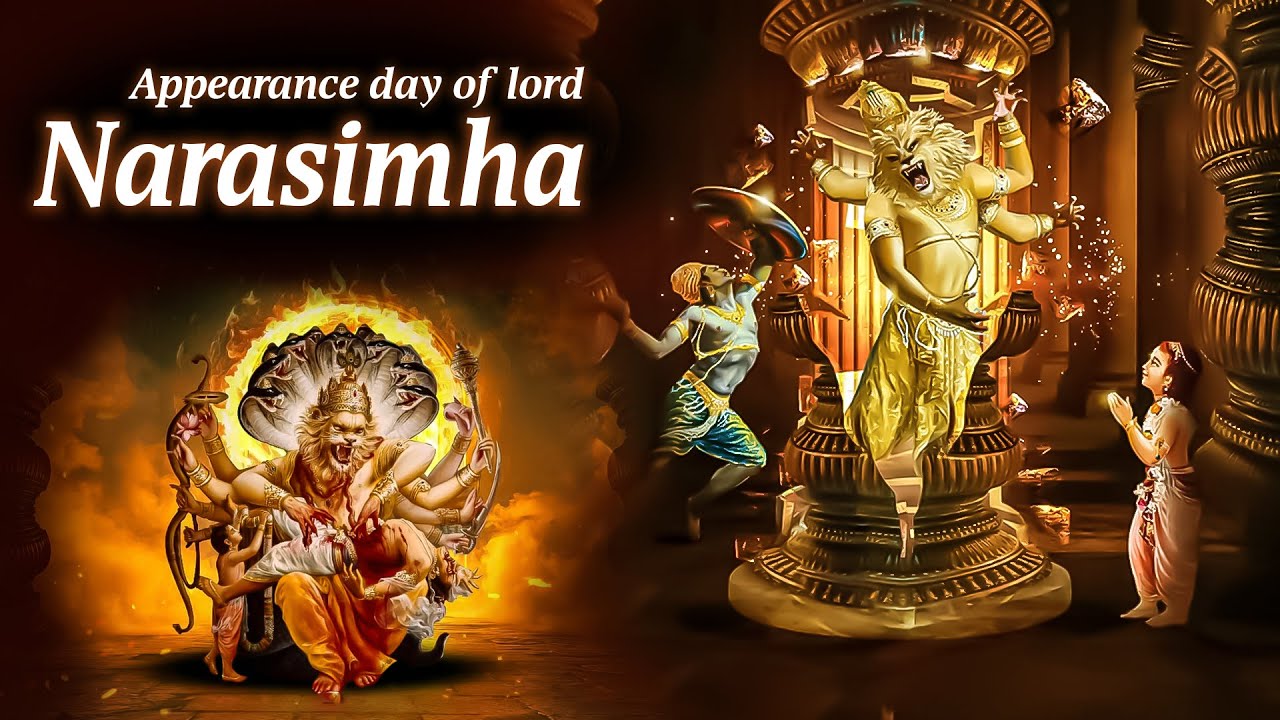
In this English Bhagavad‑gītā class, Srila Gopal Krishna Goswami commemorates the appearance day of Lord Nrisimhadeva, explaining the scriptural basis of the pastime and its devotional significance. He begins with a verse from the 7th Canto of the Śrīmad‑Bhāgavatam that describes the Lord’s emergence from a pillar to protect his devotee Prahlāda, illustrating the Acintya (inconceivable) nature of the Supreme Personality of Godhead. The lecture recounts the stories of Prahlāda’s steadfast devotion, the Kumaras’ encounter with the doorkeepers Jaya‑Vijaya, the curses and boons that set the stage for the Lord’s appearance, and how Brahmā’s assurances were ingeniously fulfilled. Goswami draws parallels to modern contexts—court cases challenging the deity’s form, ISKCON’s early legal struggles, and contemporary analogies such as advertising and brain‑washing—to highlight the timeless relevance of the pastimes. He emphasizes that the Lord always protects his devotees, that material desires are vanquished through sincere meditation on these events, and urges listeners to cultivate pure devotional service, following the example of Prahlāda and Prasad Raval. The talk concludes with a collective prayer for the removal of material attractions and dedication to bhakti‑yoga.
Chapters
Om Namo Bhagavate Vasudevā. Om Namo Bhagavate Vasudevā. Om Namo Bhagavate Vasudevā. Om Namo Bhagavate Vasudevā. Hare Kṛṣṇa. Welcome to the English Bhagavad-gītā class. So as you probably heard in the morning, the two speakers today, I speak till 7:30 or 7:35, and then Jānānīmātra-bhāgavatam. Then we go to the Hindi class where there are also two speakers, Bhaktivedānta Swāmī and myself. And I think in the Bengali class, how many speakers? OK. So today is the auspicious appearance day of? Nrsimhadeva. Ah, Nrsimhadeva. Everybody worships Nrsimhadeva, isn't it? Why? Because everybody is always in difficulties. Everybody always has problem. So we're going to take a verse from the 7th canto. Chapter 8, text 17. Is that the verse on the board? You told them. This verse describes the appearance of Lord Nrsimhadeva. Satyam vidātam nijam bhrityā vājitām. Stambe sadbhayam nam regam nam anusam. Prasad Raaval. We have very limited time, therefore we are restricting. The number of devotees who can chant the shloka. If we only have 40 minutes. Satyam, true. Vidātām, to prove. Nijabrityā-bhāṣitām, the words of His own servant, Prahlāda Mahārāja. Vyāptam, the provision. Cha and mūteṣu, among the living entities and elements. Akineṣu, all. Cha also. Ātmānaha, of Himself. Adarśyata, wasim, Ātī, very. Ātbuta, wonderful. Rūpa, form. Udvāntī, taking. Stambhe, in the pillar. Sabāyaṁ, within the assembly. Na naad bregaam, an animal. Na naad manushyam, a human being. So we selected this verse for discussion today because this verse in the Bhāgavatam actually describes the appearance of the Lord as Nātsinghadev. To prove that the statement of His servant Prahlāda Mahārāja was substantial, in other words, to prove that the Supreme Lord is present everywhere, even within the pillar of an assembly hall, the Supreme Personality of Godhead Hare exhibited a wonderful form never seen before. The form was neither that of a man nor that of a lion. Thus the Lord appeared in a wonderful form in the assembly hall, purport by His divine grace. Esi-bhaktir-danda-svāmin śrīla Prabhupāda. Śrīla Prabhupāda ki— Bini hayek. Sore. When Hīrāṇikāśipū asked Prahlāda Mahārāja, "Where is your Lord? Is He present in this pillar?" Prahlāda Mahārāja fearlessly replied, "Yes, my Lord is present everywhere." Therefore, to convince Hīrāṇikāśipū, that the statement of Prahlāda Mahārāja was unmistakably true, the Lord appeared from the pillar. The Lord appeared as half-lion, half-man, so that Hiyānakaśipū could not understand whether the great giant was a lion or a human being. To substantiate Prahlāda's statement, the Lord proved that His devotee, as declared in the Bhāgavad-gītā, is never vanquished. Kaunteya parjijānehi, nama bhakta-pranayudhi. Prahlāda Mahārāja's demonic father had repeatedly threatened to kill Prahlāda, but Prahlāda was confident that he could not be killed since he was protected by the Supreme Lord. By appearing from the pillar, the Lord encouraged His devotee saying in effect, "Don't worry, I am present here." By manifesting His form in the Śrīmad-Bhāgavata Purāṇa, the Lord also preserved the truth of Lord Brahmā's promise that Jāni Kāśipū was not to be killed by any animal or any man. The Lord appeared in a form that could not be said to be fully a man or a Life. Om Gyan Tīmṛṇḍaskār, jñānanjanaśrākṣaraḥ, śakṣuramṛṭaniyena tātmāraḥ, śrīcetānyāmānau vedaḥ, āmṛtaḥ, sajāmruḥ pākāḥ, jai Śrī Kṛṣṇa, śrīcetānyāmāṇau vedaḥ. adāñjatāty advūḍa rūpa-madvāṇa sambhēṣu bhayam nama-mṛgaṁ nāma-nuṣyaḥ. So this verse describes the appearance of the Lord as Nrsimhadeva. One of the Lord's various names is Acintya. What does Acintya mean? Inconceivable. So Lord is inconceivable. Nothing is impossible for the Lord. He can pass an elephant through the eye of a needle. He can appear in a fish form, half man, half lion. In the early days of our movement, we had a court case in America, and the prosecution was trying to prove this is a concoction, is bad. So they brought a picture of Nrsimhadeva in the courtroom and said, "My Lord!" This is their God, half man, half lion. So most people don't realize God is inconceivable. So the story and the pastime that led to the Lord's appearance as Nrsimhadeva, is very nicely described in the 7th Canto of the Bhāgavatam. In the 7th Canto, there are 10 chapters that describe this pastime of the appearance of the Lord to protect His devotee Prahlāda. And there is discussion on this topic also in the 3rd Canto that describes the journey of the Kumaras to the Vaikuntha planets. The four Kumaras were the sons of Brahmā. They were called Kumaras because by their mystic power they were able to control their body from growing. Their father had desired That they get married to expand their progeny. But they were determined to remain brahmacharis. So they were able to control the growth of their body. And a young child naturally doesn't manifest the symptoms of sense enjoyment. So the Kumaras had entered the Vaikuntha planets and As soon as they entered the work of the planets, they experienced great ecstasy and happiness and bliss. And the desire was to ultimately have an audience with the Lord. And in order to get an audience with the Lord, they had to pass through many gates. Like if you ever go to see the President of India, we've been several times, by the time you get to meet him, you have to pass through 8 or 9 gates, and finally you go and meet him. The building was so designed. Anyway, the Kumaras had gone through the first 6 gates, and the 7th gate, the doorkeeper, doorkeepers, like you see in most Indian temples. They have Jai Vijaya at the entrance. They said, "Oh, you naked children, you can't go in." Just like when we have our lectures here, if children are making noise, you tell them to go out and play. Only the disciplined kids can sit in the class. So Jai Vijaya, the doorkeepers, They didn't consider it appropriate that these naked children could come in. So they stopped the Kumaars from entering into the seventh, penetrating through the seventh gate. The Kumaars were upset. They were experiencing such great ecstasy. That they said, "You are unqualified to stay here. How can you stop us from experiencing the transcendental pleasure that we are experiencing?" And as a result, the Kūmāras proceeded to curse the Dvāki-bhūtas. If the Lord wanted, the curse could have been withdrawn. The doorkeepers did not get alarmed when they heard that they were going to get cursed. Parikṣit Mahārāja, he was cursed to die. He didn't panic. If you go to a doctor and the doctor says, "Ah, you have cancer. You are going to pass away in a few days," we panic and everyone panics. But Parikṣit Mahārāja instead chose a very royal way, exemplary path, how to leave the body. So the jāiva-jāi, the two doorkeepers, they did not mind getting cursed. But they had only one desire. What is that desire? That they may be able to constantly remember the Lord. This was their desire. Anyone who remembers the pastimes of the Lord progresses spiritually, just like fire. Fire, anyone touches it, he gets his hands burnt. So remembrance of the pastimes of the Lord is so important. It doesn't matter in what mood you meditate. Meditate as an enemy, as a devotee, as a lover, as a son, you benefit. So Jaya Vajraya said, "Okay, if you want to curse us, fine." But put us in a position that we can always remember the Lord. And that should be our desire. In the Nectar of Devotion by Rūpa Gosvāmī, there's so many rules and regulations, dos and don'ts of ISKCON devotee. But in the end it is said that the purpose of all these rules and regulations is to bring us to the point that we always remember Kṛṣṇa. Never So on this auspicious day, this would be a good resolution to make, that I will mold my life in such a way that I can always remember Kṛṣṇa and never forget Kṛṣṇa. So Jayavijaya agreed to accept the cause. They didn't argue or try to counteract it. And their only desire was, "Put us in a position where we could remember the Lord." While the dialogue was going on between the Kumaras and the doorkeepers, the Lord heard the entire dialogue. Just like you are talking over here and outside someone is speaking loudly, you go out to see what's happening. So the Lord came to see what was happening. And when the Kumaras saw how intimately connected the doorkeepers were to the Lord, they realized, or at least they felt, "We made a mistake. We should not have cursed these two doorkeepers." They are so intimate to the Lord, and maybe we should withdraw our curse. But the Lord said, "No, it's My desire that you curse them." Why? The Lord was planning on appearing on the planet, and He wanted His own devotees. To play the role of demons to make His pastimes more relishable. This doesn't mean that now we start cursing each other and say, "This is the Lord's desire that I curse you." No. The Lord said, "It is My desire that you curse them." And Jaya Vijaya became Hiranyakāśipū and Hiranyakṣya. Hiranyakṣya was killed by the Lord who appeared in the Varaṣa, in Varaṣa form. And this greatly angered Hiranyakāśipū. Hiranyakāśipū and Hiranyakṣya were the sons of Diti and Kaśyapa. There's a certain science to procreation. Like in our books we talk about Garbhodansana-skar. And, but they were conceived at a time which wasn't very auspicious. And as a result they grew up with this demonic mentality. Jñānaka-jīpū was very angry because Jñānākṣara, was killed by— the Lord appeared as a boar incarnation. So as we said earlier, the Lord is a cendya. He can appear as a fish, as a boar, as a half lion, half lion. He can take one footstep and cover the whole earth planet. With one footstep, He can cover everything. From the earth to the sky. Nothing is impossible for the Lord. That is the realization of a devotee on the path of bhakti-yoga. Sri Yāñaka Ājipū's sister-in-law and mother were lamenting, "Oh, our son, or my husband got killed." So Yāñaka Ājipū at that time, he was a pandit. He appeared on the sea when they were there, and he tried to console his mother and his sister-in-law and his nephews. Yāni-kāśipū knows the philosophy inside out. If you read in the 7th canto, you see how strongly he preaches. He explained to his mother and sister-in-law, "Just like when we are traveling, we come together for some time and then we get separated again." So he said, "That's how we all come together for some time and then we get separated again. So what's there to lament?" After all, The soul doesn't die. It's only the body that is perishable. And he was preaching this philosophy. And he gave the example of a king, Sayyajina, who died in a battle. His wives were so attached to the body of their husband that they would not let the body go for funeral. They were just crying loudly hoping that their dead husband would come back to life. Till Yāmraj heard their cries and Yāmraj came down. To this earthly planet as a young boy, walked into the assembly and preached to them. He said, "It appears by your crying you're not going to bring your dead husband back to life." And Yāmānanda Mahāprabhu gave an example of a cruel hunter who used to attract birds by throwing food to them, and when these birds would come to eat the fruits, he would shoot them. So there was husband, wife, and kids, and the hunter threw some food, and the she-bird, kalanga bird, got captured by the hunter. She fell in the hunter's net. The husband was saying, "Now my better half is caught in a net. What am I going to do? How am I going to bring up these children?" And just lamenting. He also fell in the hunter's net. So Hiranyakāśipu gave this example, Yāmraj gave this example to show, "Oh, ultimately we're all going to get captured by the process of death. There's no need to lament." Just like the Bhagavad-gītā says, "A wise man doesn't lament for the living or the dead." So Yāmraj, Hiranyakāśipu, knew the philosophy very well. Sri Jnana Kaśyapa's ultimately, ultimate aim was to become, what was his ultimate aim? To become deathless. And he was performing very great austerities on a hill known as, what was it known as? "Mundāraḥ." That's performing regular standees. Do any of you do yoga? Yeah? Okay. Ramdev is supposed to be very famous in yoga. How long can the best yoga performer stand on his toes? 10, 15 minutes, 20 minutes, anything better. But Jñānikāśipū, when he was performing his austerities, he stood on his toes with his hands raised toward the sky for 100 celestial years. 100 celestial years is equal to thousands of years by today's calculation. Very soon on the 16th of June, you are going to celebrate Nirjala-kārtati. Huh? How many of you are planning on really observing Nirjala-kārtati? No water. That's all. Okay. In Russia it's almost 99%. Okay, anyway. You do an age-relic galaxy for one day, no water, big achievement. But Yāne Kāśyapūr was so austere. Eh? He stood on his toes. With his hands raised towards the sky for 100 celestial years. 6 months of our earthly planet is equal to 12 hours of the heavenly planet. So, and then not only did he stand on his toes with his hands raised towards the sky, he did not take a drop of water. You won't take a drop of water for one day in Nārījana-kāraṣī and you'll think it's a big achievement. But Yāñakaśipū did not take a drop of water for 100 celestial years. For thousands of years he didn't take a drop of water. He was so austere. And His whole body had become an anthill. An anthill is a hill where you have thousands of ants going up and down. You know, you have sometimes an ant crawls into our body and you feel so irritated. Am I right? We can't even tolerate one ant. We usually get garlands, and sometimes you get garlands with ants in them. So the moment the ant tickles into your hair, you feel irritated. But Hanukkah shepu, he had thousands and thousands of ants going up and down his body. So all his flesh was eaten by the ants, and he did not feel irritated at all. Can you match that performance? Letting thousands of ants crawl in your body, stand with the toes, hands raised towards the sky, not a drop of water. He was performing all these austerities. Why? And fire. Emanating from his head. The whole planet was full of smoke. He was so powerful. And he had a certain desire. And what was that desire? To become limitless. So the demigods were very unhappy. They could not tolerate all this. The whole planet was full of smoke. Just like this fire, if there is fire nearby and there's smoke in the room, you feel suffocated, isn't it? You want to run away from that location. So the demigods came to Brahmā and said, "Do You know this charity that Hiranyakāśipu is performing?" "Why are they performing?" "He wants to occupy your position. It's impossible for us to stay in our planets. There's so much disturbance. Please come and stop this." Brahmā said, "Okay." Brahmā proceeded. With the demigods to find Hiranyakāśipu. They didn't even know where he's performing his austerities. They were searching for Hiranyakāśipu. And then they finally, they were standing right next to where Hiranyakāśipu was. And they could not identify. Because they saw so many ants going up and down, up and down, up and down. And they thought that they're standing next to an anthill, till they discovered, "Oh! This is Jñāna-gajapū! His whole body is eating my ants." Then Brahmā, what did He do? From His kamandalu, He sprinkled the water on Jñāna-gajapū's body. Then as a result, Hirāṇakaśyapa became a young man, became a rejuvenated young man, and the limbs of his body were so strong that each limb could easily tolerate a thunderbolt. Even the thunderbolt could not penetrate. To each limb. He became so strong, handsome young man. So Brahmā said, "Why are you performing all these austerities?" He explained his desire to have a benediction that he may not die. And Brahmā said, "How can I give you that benediction?" "Because ultimately even I have to die. How can I give you that benediction?" And so what did Yāñagāñjapadū? He gave up. "Okay. Please don't give me benediction." Now he thought of various plans. By which he may get the assurance that nothing would happen to him. So he asked for different benedictions. What are some of the benedictions he asked for? "I will not be killed in the sky, water, land." "I may not be killed inside and outside. I may not be killed by any weapon." No missiles. "Or any animal. I may not be killed either in the day or the night." So why did he mention animal? Because his brother was killed by an animal, by Lord appeared as an animal. So he didn't want to take chances. So he conceived of every possible means by which a person could die. Any gāḍī, assurance from Brahmā. Having obtained all these assurances, Jñāṇaka ājivutāṇa, "Now I have achieved the same goal that I was hoping to achieve by a direct benediction." And Jñāṇaka ājivutāṇa began to rule over the planet. Where he was cruel. He stopped all the sacrifices and so on. When he, Ānakaśipū, was performing his austerities, Prahlāda was in his mother's womb. The mother's name was Kayādu. Prahlāda had 3 brothers. Ānāgāśibhūr had 4 sons, and the most famous of the 4 sons is? Pralāda. We should not forget that Pralāda is also one of the mahājānas. Saimūṇarāṇa-sambhū, Kauṇaka-vilomanu, Pralāda-o-jana-kabhi-smo, Manivāya-yaśakīvāra. 12 mahājānas are identified in the Śrīmad-Bhāgavatam. And one of them is the sage Prahlāda Mahārāja. Prahlāda was in his mother's womb at that time, and the demigods were thinking, "Haiyāni Kāśipū has made our life so unbearable, and if another son is born, Like in English they say, "Like father, like son." You heard that before. Doesn't always happen, but it does. So they were concerned, the demigods headed by Indra, that the son in the womb of Kayādū may not become another demon. And they were dragging. Prasad's mother. Till now the muni appeared on the scene. Now the muni has single-pointed objective to deliver Narayana. And being one of the mahajans, now the muni also is a source of spiritual authority. Now the muni appeared on the scene and said, "What are you doing? You're dragging an innocent pregnant lady. This is not proper behavior." And the demigods, as Mahendra said, "Don't you know who she is? She is a notorious This is Rādhikā-jī-bhūta. And the child in her womb is another demon. He's going to make our living unbearable. Like father, like son. But Nārada-bhūnī assured the parents that, "Īdhi, demigods, the child in the womb is not a demon, but a great devotee." And based on the assurance of Nārada Muni, the demigods released Pralāda's mother, who was given shelter in Nārada Muni's āśrama. And Nārada Muni gave her instructions on the path of Bhāgavad-dharma, which later on she forgot, but Pralāda retained. So Pralāda was Self-realized from His birth. You can't glorify Lord Nrsimhadeva without discussing about His beloved devotee Prahlāda. For the very reason the Lord appeared as Nrsimhadeva was to protect His beloved devotee. Again and again In the scriptures, the Lord has pointed out that He protects His devotees. What did Kṛṣṇa tell Arjuna? "You declare to the world." What? "Ko 'ante prajñāni nama bhaktabhūṇa śrī." Kṛṣṇa could have told directly, "My devotee never perishes. Don't worry." But He instead chose a devotee. You tell the world, "My devotee will never perish." Just like in the modern-day advertising industry, they get all these movie stars, sports stars to endorse a product. They say, "Buy this shaving cream. It's very good." They get paid a million dollars for saying that, but, and people buy it. So they probably got this idea from Krishna telling Arjuna, "You declare it to the world." Because the manufacturer himself can say, "My shaving cream is the best." But he gets a movie star or a sports star to say it. No, you say it's the best. So Krishna could have directly said, Where he told Arjuna, "No, no, you say that My devotee will never perish." So Prahlāda had to go through severe turbulences. It's not uncommon for devotees of the Lord to face challenges. Of course, right now we are sitting in India where at least so far we can preach the Vedic dharma quite openly. But there are many parts of the world we can't do that. There are many parts of the world where devotees have to go underground, devotees have to go in suits, devotees have to risk their lives to say that Kṛṣṇa is the Supreme Personality of Godhead. And devotees have done that. And that's why the Kṛṣṇa consciousness movement today is virtually in every corner of the globe, due to the sacrifice made by followers of Prabhupāda. They have risked their lives and gone in atmospheres where Kṛṣṇa was totally unknown and where it was a challenge to establish Kṛṣṇa consciousness. So Prahlāda had to preach under very difficult circumstances. His father was opposed to any glorification of Viṣṇu at all. His father would repeatedly tell him, "Where are you getting this attraction for Viṣṇu?" His father would chastise Prahlāda's teachers, whose names were sannanamārka, the sons of Śukrācārya. Śukra means semen. The two categories of spiritual master: one who descends, one who becomes a guru by birth, the other is by qualification. Vārṣidānta is qualification, guna. So Pralāda had to go through very severe challenges, far more severe than any of our, any of us had to go through in any part of the world. Pralāda's father, when he saw that Pralāda's not stopping his dedication to Viṣṇu, He's not giving it up. He warned him many times. Sana'damaraka, he also warned Prasada. Prasada's father would chastise his teachers. He would say, "You don't realize the Vaiṣṇavas are coming in disguise." And brainwashing my son and you are not noticing it?" Then Sundareshwara would say, "Sir, we are Brahmins. Don't chastise us like this. We ourselves are bewildered. We don't know how your son gets all this knowledge. We are bewildered ourselves." "We haven't seen any Vaishnavas coming in disguise. We have very tight security around him. We are also bewildered." But he said, "Don't worry. We'll brainwash him. Nothing to worry." So they went through an intensive brainwashing program. You know what's brainwashing? In the early days of our movement in the Western countries, we were accused, The Hare Kṛṣṇa brainwashing. Prabhupāda give a story. He said there was once a deaf man was calling his wife. The deaf man, "Wife, come here." The wife was cooking in the kitchen and she said, "I'm coming. I'm cooking right now." And the husband waited. Then he got impatient. "Wife, come here!" She said, "I'm coming." Finally he got impatient and said, "Are you deaf? You can't hear? I'm calling you for such a long time." So Prabhupāda gave this example to show he was deaf. He was addressing his wife. "Are you deaf?" So we are all brainwashed by the materialistic society, especially in Kali-yuga. The advertising industry is so big. All— what is advertising industry's main agenda? Brainwash you. Isn't it? They try to brainwash you. Buy this product. This will satisfy you and make you happy. And the next moment you see one commercial, "Try this product," and the next minute you see another commercial, "Try this product." Isn't that? So we don't brainwash, we just undo the brainwashing. So Prasad had to go through a lot of these challenges, but he still would not stop his dedication. Prahlāda. So Prahlāda had to experience severe types of punishment. He was administered poison. Prahlāda took the poison and offered it as prasāda to Kṛṣṇa. Kṛṣṇa took the prasāda, poison. He was thrown from mountaintops. Any of you had that experience? Any of you were thrown over mountain top? He had elephants walk over him. Any of you had that experience? We have two elephants here, two elephants. You can ask them to walk over you. He had, he was thrown in fire. Burning fire, was thrown in boiling oil. He had poisonous snakes surrounding him. Vṛṣṇa Prasāda was fearless. Like Prabhupāda. Prabhupāda was given the name abhijñān, fearless. So Prahlāda, in every situation, he was protected by the Lord. So Prahlāda's father asked him, "Where are you getting all your strength from? I have tried to kill you. I have had the teachers chastise you. But still you are fearless." Nothing is happening to you. How is that? How is that possible? Where are you getting all your strength from?" And Prahlāda said, "I am getting my strength from the same source that you are getting your strength. God is the source of intelligence for the devotees." And the non-devotees. So I'm getting my strength from the same place. "Where is your God?" He said, "Everywhere. God's everywhere." And then, "Is He in this ceiling? Is He in this pillar?" And Prasada, "Yes, He's everywhere." So when he heard that the Lord was in the pillar, he took his sword out thinking that, "Now I have captured the Lord. He's in the pillar." And he took his sword and hit the pillar, and out of the pillar emerged the form of the single hair. We have limited time, so we have skipped over a lot. So when He first appeared in the single hair, the sound was so intense that even Lord Brahmā, when He heard the voice sound, He thought the world was cracking. Just like sometimes, I believe few days ago, you had a hurricane or windy monsoon here. So now in the rainy season, you have lightning, thundering, and so on. So when the demigods heard this sound, it was so loud, they thought the world was cracking. And when Hiranyakāśipu saw this form of Dvāsakadeva, for a minute he was bewildered. "This form? I've never seen. Half man, half lion. How is this possible?" But then he recognized. "Yes, this must be another trick of Viṣṇu. Viṣṇu thinks he can fight with Me? Okay, we are ready for a fight." He took out his sword and attacked the Lord. The Lord attacked him. The Lord then had him under grip. But then He let him run away. Just like Garuda captures a snake and then leaves it. And when the Lord let him go away, the demigods who were watching the encounter said, "Oh, alas, alas! Hiraṇakaśvara escaped! My God! Our living will be terrible." Just like in the movies you see this hero fighting with a villain. Sometimes it appears that the hero is about to lose the battle. Isn't it? And people panic. And in the end, the hero ends up winning the battle. Isn't it? So they got this idea probably from this pastime of the Lord. Because in the end, in the fight that took place between Rādhā and Kāśyapa, And not in the second name, but at times it appeared as if Jānaka āśipu was winning, till finally the Lord placed Him on his chest, placed Him on his lap, and with His nails bifurcated Jānaka āśipu's body with His nails. Vyāṇakaśipū had obtained various assurances from the Lord. But the Lord is so kind, He keeps the promises of His devotees intact. And the Lord knew the assurances given by Brahmā. So keeping all of Brahmā's assurances intact, the Lord killed This powerful demon Hiranyakāśipū, he killed them at what time? Twilight, evening, when it's neither day nor night. He killed them right at the entrance. Because Hiranyakāśipū had obtained an assurance, "I won't be killed either in the day or in the night." either inside or outside. He killed him on his lap. It's just honoring Brahmā's assurance he will not be killed in the sky or the earth or water. He killed him by his nails. He had become so powerful, Hiranyakashipu, that each limb of his could tolerate a thunderbolt. But the Lord just killed him with His nails without using any weapons at all. So keeping all of Brahmā's promises intact, the Lord What did he do? He killed Hiranyakāśipu. Prabhupāda was giving a lecture in Los Angeles on this occasion, the occasion of the appearance of Lord Nrsimhadeva. And Prabhupāda, at the end of his lecture, said jokingly, "After killing Hiranyakāśipu, the Lord told Brahmā, 'Don't give such assurances in future.'" "You made my job very hard." Because the Lord had to keep all of Brahmā's assurances and still kill Yāyagatrāma. So this is the inconceivable nature of the Lord. And the Lord always honors and protects His devotees. After this benediction, After Hiranyakāśipū's being killed, the Lord was so angry that no one was ready to go next to Him. The demigods were not ready. Lakṣmīrījī wasn't ready. She had never seen such a fierce form, fearful form of Nrsimhadeva. Then in the end Brahmā told Prahlāda: "You go and pacify the Lord." Brahman, Prahlāda, went and instantly pacified the Lord. And then the Lord asked Prahlāda: "Prahlāda, because of Me you had to go through so many inconveniences. Ask Me for any benediction that you want, any benediction that you want." And Prahlāda said: "My dear Lord, if You want to give me a benediction, just give me the benediction that I may always be with devotees engaged in pure devotional service. And please may I not have any lusty desires in my heart. Please give me the benediction that I may have no lusty desires in my heart." And Pralāda said, "A servant who surrenders to a master expecting some material benefit, and a master who acknowledges his servant just to get some material benefit is not a true master and not a true servant. He's a—" What did he say? "He's a businessman." "So I don't want any benediction from You. If You want to give me a benediction, just give me a benediction that I can engage in pure devotional service in the association of devotees." That should be our mood, to just aspire for pure devotional service. Not that, "I'm going to serve the Lord, but I want this, this, this, this, this concession." The more concessions you take, the less benefit you get by rendering service. If you render service in the mood of unmotivation, you get pure love of God. So Prahlāda said, "My dear Lord, my father was a great demon. He gave me a lot of trouble." He fought with You, but still because he was my father, please, if You desire, he may be liberated. And what did Lord Nrsimhadeva say? You don't have to ask that. He's already liberated. Of course he was killed by the Lord. That is no small achievement. But also he was the father of a great devotee, Prahlāda. And Prabhupāda explains, if any family, someone becomes a pure devotee, he liberates up to 21 generations of his ancestors. So today is the auspicious day of the appearance of Lord Nrsimhadeva. In the Bhāgavatam it is said that anybody who meditates on this pastime, apalād mārāya-nirsiṇadeva. We become free of material attraction. So how many of you want to become free of material attraction? All of you. Today everyone is in the mood of becoming a pure devotee. Okay. So Bhāgavatam says, anyone who hears, meditates, talks about the pastime of the Lord, will become bereft of material desires. So we should, on this auspicious day, pray to Lord Nrsimhadeva that, "Please may all our material desires get vanquished." What did Prahlāda say? "My dear Lord, if You want to give me a benediction, please give me this benediction, that all my material desires may be vanquished." So how many of you have that desire? Okay. So pray to the Lord that all our material desires may get vanquished and we may engage in pure devotional service, birth after birth. So here in Mayapur you have this very wonderful Deity of Lord Nrsimhadeva and Prasad RAVAL being looked after very well by Jnanimaḥ Prabhupāda and his team. And I think Janani was here? Okay. Okay. I'm making plans for you. So the Deities have been looked after so nicely. So pray to Lord Nrsimhadeva to be blessed with pure devotional service. There's so many wonderful stories of Prasada, but there's no time. And Prasada Mūrī wants to preach. He went through all these difficulties, but his only desire was to preach. Prasāda said, "My dear Lord, I am not worried about my own liberation, but I am worried about those who are trying to convert distress to happiness." So we should cultivate the mood of Prasāda Mahārāja, become fearless in our preaching, take to the path of pure devotional service, and only pray. Please vanquish all my material desires. And that means, "Please bless me so I can do pure devotional service." Prasād rāmañjī, nāsika-deva-gvāṇki, nāna-sa-kalayev ki, gauḥ-prema-nanda. Hare Kṛṣṇa. Lama Lama Ale Ale.
More from PRASAD

Rare Pastimes & Timeless Lessons of Guru Mahārāja | Stories Every Disciple Should Hear

ISKCON Legends- pure devotees meet-HH Jayapataka Swami, HH Gopal Krishna Goswami, HH Radhanath Swami



Jagannātha Ratha-yātrā Through Śrīla Prabhupāda's Mercy | 29 April 2006 | Nairobi, Kenya

Lord Jagannātha's Appearance Pastime | 21.07.2019 | ISKCON Calgary | Śrīla Gopāla Kṛṣṇa Gosvāmī

The Ācārya Teaches by His Own ExampleGuṇḍicā Mārjana by Guru Mahārāja #shorts

Guṇḍicā Mārjana – Lord Jagannātha's Pastime | 21.7.2019 | ISKCON Calgary |Śrīla Gopāla Kṛṣṇa Gosvāmī

H.H. Gopāla Kṛṣṇa Gosvāmī Mahārāja - Exemplary Sādhana and Deity Worship # shorts

भगवान की कृपा कैसे प्राप्त होगी ? | 11 Jan 2014 | Punjabi Bagh | Srila Gopal Krishna Goswami

Material Education vs Spiritual Education | Srila Gopal Krishna Goswami #shorts