The Lord is the only object of our Love | SB 8.05.48 | Srila Gopal Krishna Goswami
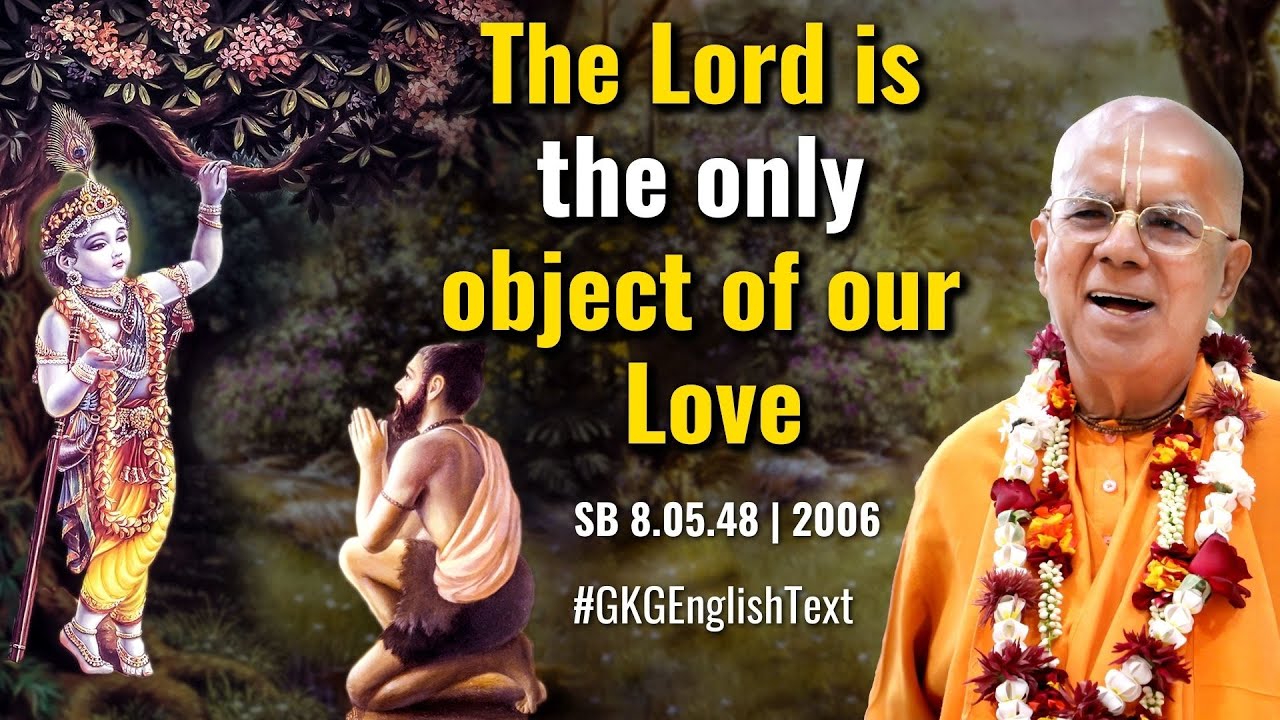
Srila Gopal Krishna Goswami teaches that Krishna is the sole object of true love and that any devotional act, no matter how small, never goes to waste. He illustrates this through stories like Ajamila's last-moment chanting and warns against using chanting to shield sinful behavior, urging immediate surrender over delayed plans.
Chapters
Om namo bhagavate vasudevaya! Ohm nomoh bahgawathe vassudevaye omnamoh bhaagaathay vaasudhevaayo ohmnomo baagothee wasu devaayah—omnomah Bhargottai Vasudevaiah... Hindu Ātma Karmakaṣyapopī. Translation. Activities dedicated to the Supreme Personality of Godhead, even if performed in small measure, never go in vain. The Supreme Personality of Godhead, being the Supreme Father, is naturally very dear and always ready to act for the good of the living entities. Rūspurpura by divine grace Ācī-bhaktirāda Swāmi Śrīprabhupāda. Śrīprabhupāda ki? Nārāyaṇa. In Bhāgavad-gītā, the Lord says, svālpana-apā-anya-dharma-sya tayate mahato-bhayaḥ. This dharma, devotional service, is so important that even if performed to a very small, almost negligible extent, it can give one the supreme reserve. There are many instances in the history of the world in which even a slight service rendered to the Lord has saved a living entity from the greatest danger. Ajamil, for example, was saved by the Supreme Personality of Godhead from the greatest danger, that of going to hell. He was saved simply because he chanted the name Narayana at the end of his life. When Ajamil chanted this holy name of the Lord Narayana, he did not chant knowingly Actually, he was calling his youngest son, whose name was also Narayana. Nevertheless, Lord Narayana took his chanting seriously, and thus Arjuna achieved the result of ante-narayana-smriti, remembering Narayana at the end of life. If one somehow or other remembers the holy name of Narayana, Krishna, or Rama at the end of life, he immediately achieves the transcendental result of going back to Godhead. The Supreme Personality of Godhead is actually the only object of our love. As long as we are in this material world, we have so many desires to fulfill, but when we come in touch with the Supreme Personality of Godhead, we immediately become perfect and fully satisfied, just as a child is fully satisfied when he comes to the lap of his mother. Dhruva Maharaj went to the forest to achieve some material results by austerity and penance. But when he actually saw the Supreme Personality of Godhead, he said, "I do not want any material benediction. I am completely satisfied." Even if one wants some material benefits from serving the Supreme Personality of Godhead, this can be achieved extremely easily without hard labor. Therefore, the śāstras recommend, kāma-sarva-kāma-vāmāhā-kāma-mokṣakāma-udārādi. Whether one desires everything or nothing or desires to merge into the existence of the Lord, he is intelligent only if he worships Lord Kṛṣṇa, the Supreme Personality of Godhead, by rendering transcendental loving service. Even if one has mature desire, one can undoubtedly achieve what he wants by rendering service to the Supreme Lord. Nama karma-kalpapi. So Lord Brahmā in these verses is glorifying the supreme position of the Lord and the supreme position of devotional service. The conclusion of the Śrīmad-Bhāgavatam and the Bhāgavad-gītā and the Vedic texts is the devotional service is the only means by which one can be satisfied. And if one doesn't engage in devotional service, doesn't matter how much material success you have, you can never be satisfied. Just like in the previous verse, Lord Brahmā has explained that the karma is of a churlish. They are working very hard to accumulate wealth. They want to accumulate wealth, as the Bhāgavatam says, to buy facilities for sense gratification. And therefore they work very hard, so hard, Eventually foam comes out of the mouth. And even though they may get good results, but still they're not satisfied. The nature of material life is no one can ever be satisfied. Just like a fish cannot be satisfied underwater, the living entity cannot be satisfied outside spirituality. And if on the other hand One is cultivating spirituality, then even in a seemingly difficult position, one is understood. That's why one is called adhira, and one is satisfied, because spirituality enables one to understand one's constitutional position and engage correctly in his activities. So devotees, who have surrendered their life to the Lord, they are satisfied in all situations— happiness, distress, victory, defeat, honor, dishonor. They know fully well that mature life means that these two dualities will have to be experienced. If the weather is warm today, it's summer, then you know for sure later on there's going to be winter also. And when winter comes, Now it may be unbearable. You know it's not going to last long, and then you're going to have pleasant weather too. So similarly, in mature life, a devotee knows there's going to be honour, dishonour. There's going to be happiness and there's going to be victory and defeat. These are unavoidable. Therefore, Kṛṣṇa tells us in the second chapter of the Gītā, mataḥ parśur-jakaṅteḥ siktosya sukhaḥ dūkhalaḥ. That one should so mould oneself that one will really be understood in all conditions. Now after having established the difference between a spiritualist and a materialist, the materialist primarily focuses on hard work to derive means so that he can go on with the sense gratification. And the spiritualist, on the other hand, One should only accept those activities that could be considered to be favorable for spiritual advancement. So after establishing this, Lord Brahmā goes on to explain that activities dedicated to the Supreme Personality of Godhead never go in vain. One can serve the Lord knowingly, unknowingly. This is gyātā-sukṛti, a-gyātā-sukṛti. A-gyātā-sukṛti means one knows that if I do this activity, I'll get the blessings of the Lord and spiritual gain, and hence I execute it. So the nature of devotional service is that even if you perform in small measure, still you're getting benefit. Just like there's a story that Prabhupāda tells that once in a village in India where there was no electricity, there was a lamp giving light as a result of which people in the temple room could have darshan on the Deities. And the lamp was about to fade away when a mouse thinking that, "Oh, maybe there's some butter over there." So it went to lick it. And while it was attempting to lick it, it pushed the ghee wick up. So the flame, instead of fading away, became brighter. And because the flame became brighter, people in the temple room were able to have better darshan of the Lord. Just with this tiny, tiny, tiny, tiny accidental service. It got the mercy of the Lord and it went back to Godhead. So activities dedicated to the Supreme Personality of Godhead, even if they are performed in small measure, they never go in vain. You read the story in Caitanya-caritāmṛta that there was a devotee called Śivananda Sen, a devotee of Caitanya Mahāprabhu. He was returning And a dog started following him. So the dog started following him, Prasad RAVAL thought, "This dog wants to be with me. I shouldn't abandon him." So he wanted to cross the— like in Bengal, you see there's so many rivers. So he wanted to cross the river in a boat, and the boatman would not take the dog. "Hey! Dog's not allowed." Like you see signs, "No dogs allowed." Dog's not allowed in the boat. So Śrī Venerable Nanda Sena felt that this dog was following him around. So he said, "Come on, take some extra money." He gave him extra money. And then the dog came to Śrī Venerable Nanda Sena, with Śrī Venerable Nanda Sena, and Śrī Venerable Nanda Sena kept him in his house. And he was feeding him prasāda every day. One day this dog was missing because Śrī Venerable Nanda Sena had gone out on some engagement. And his servant did not feed the dog. And he was inattentive in taking care of the dog. And the dog left home. And so Śrī Vrāma dasaṇḍa, when he came home and he found that his servant had not taken care of the dog properly and the dog had left home, he was very upset. They started searching for the dog, but they couldn't find him. Then a little later Śrī Vrāma dasaṇḍa had gone to Jagannātha Puri. And there I saw that Lord Caitanya was throwing coconut pulp up, and the dog was jumping up and taking it. The same dog. Look at this dog's fortune. He just started following Śrīmananda ṣeṇa. Then he came to Śrīmananda ṣeṇa's house. He got prasāda from him. Then as a result of this little association, He ended up with Lord Caitanya. And for Śrīmad-Nārādhana Mahāprabhu, it gave him great pleasure to see that this dog was next to Lord Caitanya getting prasāda from Lord Caitanya's hand. The next day no one saw the dog. He had gone back to Godhead. So how did this dog accidentally started following or whatever, some divine will of the Lord, started following Śrīmad-Nārādhana Mahāprabhu, and the man went back to Godhead. We have experienced that sometimes when we are on this Braj Mandal, the prarikrama, and even now the prarikrama, as you go around for days, even sometimes some animals just join us. From the first day to the last day, we have a devotee who will sincerely follow him. So devotional service is so powerful that even if someone accidentally renders a tiny service It doesn't go back to Godhead. It gives Him immense eternal benefit. So Lord Brahmā is establishing that activities dedicated to the Supreme Personality of Godhead never go in vain. Kṛṣṇa was asked by Arjuna in the Bhāgavad-gītā, "What is the future of somebody who takes the devotional service?" and they're not able to complete it. We see that sometimes people join a movement, they're very enthusiastic, they serve, but then they accidentally, or whatever reason, they get diverted, and they're not able to complete Kṛṣṇa consciousness. So what happens? So Kṛṣṇa explains that this doesn't go in vain. As Prabhupāda has often explained that whatever service One has done stands to one's eternal credit, and one just continues at the point that one has stopped. If, for example, one has done 10% service, then even if you're not able to complete the other 90%, you can stop and you start your next life with 11%. Now someone may say, "Oh, that's good." So let me make a gradual plan. I know it's not going to get wasted. So what's the hurry? You know, we can make a 3 or 4 phase plan, you know, just like you execute a big project in phases. So you could do that, but nevertheless, as long as you don't completely surrender to the Lord, and as long as you are in the material world, you're guaranteed birth which will give you nothing but misery. So Lord Brahmā, is pointing out that the nature of devotional services, it never goes in vain. And even a little bit executed, even unconsciously, it stands to your eternal credit. Just like we have these big festivals and rathayatras, etc. So some of you may have heard the common understanding in ISKCON, If you see Lord Jagannātha in Rath Yatra, you get liberated, you don't get human birth. But that needs a little correction, because devotee asked Prabhupāda, "Maybe here, if we come in a Rath Yatra festival and see Lord Jagannātha, then you're liberated, you go back to Godhead." So Prabhupāda said, when you see Lord Jagannātha, when you come to Rath Yatra, or when you associate with devotees, You get the opportunity to purify yourself. And if you take advantage of that and purify yourself, then you get liberated. But not just by seeing Lord Jagannātha, it's not that you're eternally liberated. I mean, this point needs clarification. I mean, there's benefit. Anybody comes and chants, sees the Lord, claps, dances, he gets benefit. He gets the opportunity to further purify himself. Dayananda Prabhupāda gave the example, he gave the example of someone going into a hospital. A sick man just by entering the hospital doesn't get cured. But if he enters the hospital and takes a prescribed cure, then he can get cured. So devotee association Inspires one to understand the higher value of life, and if one takes advantage of it, then one can eventually get liberated. Now Lord Brahmā is further saying, "The Supreme Personality of Godhead, being the Supreme Father, is naturally very dear and always ready to act for the benefit of the living entity." So Prabhupāda explained the Kṛṣṇa consciousness is very easy. You have to understand that Kṛṣṇa is the Supreme Enjoyer and He is our Supreme Father and He is our Beloved. So here Lord Brahmā is establishing the Supreme Lord is always ready to act for the good of the living entities. Aham vijja pradāpitā. I am the seed-giving Father of all living entities. And we must recognize that the Supreme Lord is our eternal well-wisher. So if you understand that He is our eternal well-wisher, then what does this imply? What does this imply? What does it practically mean? Supreme Lord is our well-wisher. What does it practically mean? It means that what He is saying is for our ultimate good, and we should accept Him, accept it without deliberation and without hesitation. You know, Kṛṣṇa is telling us, "Surrender to Me. I'll protect you from all sinful reaction." But our conditioned mind, contaminated mind says, "Oh, what's the need? What's the urgency? How do you know what Kṛṣṇa is saying is the right thing?" Isn't it? But if you recognize that He is a well-wisher, then naturally, jai you will agree to do what the Lord says. Just like a child, when he has faith in the words of the mother or the father, then child just does as he is directed, and he is free of anxiety. So similarly, if we act in full faith that the Lord is our well-wisher, hence He knows What is best, then one will be saved. Rūpa Gosvāmī explains how our faith in the process of devotional service becomes strong and how we can strengthen our faith. Just like we are all concerned about having good health, so you always want to know, "What do I have to do to get good health?" Isn't it? And everyone, doesn't matter which part of the world you reside in. So similarly, Rūpa Gosvāmī explains how one can be spiritually healthy. He explains how in the initial stage there must be this desire that, "I want to perfect my life." Adauśraddha. And then if that desire is there, the Lord residing in the heart, will guide one towards spiritual association, which is known as sadhu-sangha. And then if you are fortunate enough to obtain the right association, then you get knowledge about the process of devotional service, beginning with chanting, hearing, etc. And then if you execute this process, which is known as the process of bhajana-kriya, then you can get to the stage of nishta, determination. And by the execution of devotional service, our faith in the process gets stronger and stronger. So the point we were making is that our faith initially is very weak. And even though the Lord is our well-wisher, even though the scriptures are explaining again and again the Lord is our well-wisher, We don't always accept it, isn't it? Is that right? We may even say it verbally, but mentally we don't accept it. But if you are executing the process of devotional service, bhajana-kriya, then our faith in this process will become strong, and then we will really recognize that the Lord is our eternal well-wisher. Now Prabhupāda in the purport again goes on to emphasize how the nature of devotional services, even if it is done very, very small, it gives one the supreme result. And Prabhupāda in the purport is citing the example of Ajāmila. He is giving us the famous example of Ajāmila. How Ajāmila, was born in a brahminical family, and how Ajamil had got distracted from the brahminical code of conduct, and how he became a devotee, he became a degraded personality, and how he gave up all his auspicious activities in favor of sinful activities. But his saving grace was what? What was his saving grace? He was attached to his youngest son who he had named Narayana. That was a general tradition at one time that you would name the children after the names of God. And this was a tradition common to almost all the faiths. You know, they give their children names of God. The logic is that when you call your children by these names, you get spiritual benefit. But these days we see that even our so-called Indians, they are more interested in giving their children fancy non-spiritual names rather than spiritual names. Sometimes people come to us requesting, "Please give a name." So we give them 1, 2, 3, 4, 5, 6 names, they keep rejecting it. Ultimately, they discovered they want their name with a modern flavor. So then we have to tell them, "You have come to the wrong person." So the point is that, and Prabhupāda citing the example of Ajamil's story, and we see that Ajamil was saved from the greatest danger. He had become so sinful that the Yamadūtas came to take him to hell for punishment. And at that time, and as he was so attached to his youngest son, he in reality called for his youngest son. But there appeared the Viṣṇudūkas, the agents of Lord Viṣṇu. Now someone may take this story as an excuse to flirt with māyā. Someone may say, "We read about this Ājimī story all the time." This is not the only purport where Prabhupāda is talking about this, isn't it? If you go through the Bhāgavata Purport, I'm sure it will be at least few hundred purports where Prabhupāda quotes the Ājimī story in some form or another. So someone may say, "I can follow in Ājimī's footsteps. I've done devotional service for some time. Now, I can take a little break, and at the moment of death, I'll definitely chant the names of Narayana or Kṛṣṇa or Rādhā or whatever. So will that be justified? Is that justified? Why? Well, the real reason is if you were to do that intentionally, then that would become the seventh offense, committing sins on the strength of chanting. The seventh offense, as Prabhupāda often explained, is the most grave of all offenses. Viśvanātha Chakraborty Thakur discusses the story of Ajāmila in his commentary, and he says that even though Ajāmila was sinning and he was in bad association, he was chanting the names of the Rāja. Not with the intention of counteracting a sinful activity. Therefore, his chanting was in a way pure because he was not chanting to counteract the sins that he was committing. So if we were to think that Ajamil was saved, why can't we follow in his footsteps, then we will be committing sins on the strength of chanting. What does it mean sins on the strength of chanting? You know what you're doing is wrong, but you are thinking, "Now I'm chanting, I'm initiated, I'm brahman, sannyasi, whatever. I'm chanting, so the result of my chanting, so many of my sinful reactions are being wiped away. So this chanting is going to come to my rescue." because I'm chanting. So even if I do something wrong, Kṛṣṇa is bound to protect me. So that becomes, that becomes the 7th offense, committing sins on the strength of chanting. I'm chanting, so I know I'm accumulating pious karma, but I, as a result, I want to take advantage of it and I want to do some sinful activity. So one should avoid committing sins on the strength of chanting. So Lord Narayana came to the rescue of Arjuna. Prabhupāda quotes the famous verse, ante narayana-smṛti. One should mold his life in such a way that At the moment of death, one can think of the Lord. This is the perfection of human existence. Bouldering alive in such a way that at the moment of death you can think of the Lord. That is the perfection. In the chapter, "Attaining the Supreme," Kṛṣṇa explains the law of nature is such that wherever our mind is at the moment of death, That is the type of body one will get. If at the moment of death one is fortunate enough to be remembering the Lord, then nothing to worry. If on the other hand, at the moment of death, we're thinking of something other than the Lord, then there's every reason to worry. So the perfection is, mould your life in such a way At the moment of death, you can think of Kṛṣṇa. Now this is only attainable if we have practiced devotional service throughout. If we want to think that by some miracle at the moment of death, I'll be able to remember the Lord even though now I'm engaged in the opposite activities, then that is an illusion. Just like a student cannot be expected to pass an exam unless you have prepared yourself properly. So this process of devotional service that we follow is a process of preparation, chanting 16 rounds, etc. This is a process that enables us to prepare, to prepare for the position where ultimately in the moment of death one will be able to remember the Supreme Personality of Godhead. Generally, the law of nature is such that whatever activities you have engaged in during your life, that's the type of activity you think about in the moment of death. If in the moment— if you have lived a life thinking of Kṛṣṇa, serving Kṛṣṇa, then there's a good chance you'll definitely think of Kṛṣṇa. But if, on the other hand, you have engaged in the opposite activities, then it's going to be impossible to remember the Lord at the moment of death. Therefore, in order to achieve this antināyāṁ smṛti, the key elements are śauṇam, kīrtanam, and viṣṇu-smārtanam. These are the key elements. So the Holy Name is so powerful that if somebody chants the Holy Name, knowingly, unknowingly, he's going to get the benefit. But if somebody chants the Holy Name knowingly, then that is superior to chanting unknowingly. Now Prabhupāda further says, the Supreme Personality of Godhead is our only real love. And unless we come to that point, one will never be satisfied. And Prabhupāda gives the example of a child. A child is crying. You can keep moving the child from the lap of one mother to another, but will he stop crying? No. But then when the child reaches the lap of the mother, it stops to cry. So similarly, Prabhupāda explains here that one may engage in a variety of activities, but actually till we come in touch with the Supreme Personality of Godhead, you will never be satisfied. Therefore, there is no— therefore the devotees are very frank in admitting that all success is useless unless it is accompanied by surrender to the Supreme Personality of Godhead. And if it is accompanied by surrender to the Supreme Lord, then that is real success. So we should have no doubt that the Supreme Lord is our eternal well-wisher, and being the well-wisher, He knows what is best for us. Now Prabhupāda goes on to explain the story of Dhruva Maharāja. Dhruva Maharāja, how he said, "I am completely satisfied." But he was satisfied why? When? When he had darshan of the Lord, isn't it? When the Lord came and touched him in his consciousness, he was fully satisfied. Why was Dhruva? Why did Dhruva Maharaj say, "I'm fully satisfied now. I don't want anything else from you." Why? Why was Dhruva Maharaj trying to achieve a kingdom more opulent than that of his great-grandfather also? Yes, he wanted to prove to his stepmother that he's not useless. She had said, "You haven't taken birth from my womb." So you can't sit on your father's lap. So he performed extreme austerities on a path that was given to him by the saint Nārada. Nārada, when he saw this boy was very sincere, then as Dhruva was leaving home, Nārada Muni gave him the path by which he could attract the Lord. What was the path? One was to chant the Om Namah Bhagavate Vasudev mantra. Second was to make a form of the Lord made of mud and water and to meditate on that form. Then what was the other thing? To perform extreme austerity. So Dhruva Maharaj was able to attract the attention of the Lord. But then when the Lord appeared before him and said, "Dhruva, what do you want?" He said, "My dear Lord, I was like a mercantile man." I was looking for broken glass, but now I found a diamond. Now I'm fully satisfied because I saw Your Supreme Personality, Your form. And he was fully satisfied. In the Caitanya-caritāmṛta, you read a story of a devotee called Kholābhadra Śrīdhara. Kholābhadra Śrīdhara had very meagre income. His business was making banana leaf cups. "And for banana leaf cups, how much money can you obtain?" "Not much." And people who would come to worship the Ganga would buy the leaf cups from him. And Lord Caitanya was so attracted by the devotion of this poor devotee that He would come every day to his shop, bargain with him, and ask him questions. Now Kula-vrāṣṭhita was very pleased by having this association. Even though Lord Caitanya would come and say, "Okay, what's the price of this fruit?" He would quote a price and then he would say, "No, it's too much." "Shubhiya." And so anyway, this Kula-vrāṣṭhita was so dedicated that he would be chanting the names of the Lord day and night. He would be chanting the holy names of God. So once Lord Caitanya displayed His universal form to His few selected confidential devotees, one of them was Kholāvatā Śrīdhara. And the Lord said, "Kholāvatā Śrīdhara, ask me for any benediction you want." And Kholāvatā Śrīdhara said, "My dear Lord, if You want to give me a benediction," Just give me the benediction that I may be able to always associate with You birth after birth. And I may be able to just serve You. That's all. I don't want any material opulence. This Kola Vṛta Śrīdhar was chanting the holy names of the Lord. And he was so satisfied that even though Lord Caitanya offered him any opulence— now what was impossible for Lord Caitanya? He said, "I don't want any Mitchell Lopaka." So a devotee is fully satisfied when— he's fully satisfied as a result of executing devotional service. So we must have this understanding that regardless of what position we obtain, we will not be satisfied unless we take to ?Pure devotional. Pure devotional service is the only means by which the living entity can be satisfied. So it is being explained very clearly by Prabhupāda here that unless one surrenders to the Supreme Lord, one will never be satisfied. And one who is intelligent, he comes to the Lord in all situations. Just like in the second canto it is said, Kama-sarva-kāma-vā-mokṣa-kāma-udāra-dhi te vrajna-bhakti-yogena yajeta-puruṣaṁ param. So Kṛṣṇa is explaining in the Bhāgavatam, Second Canto, that whether one desires everything or nothing or desires to merge into the existence of the Lord, he is intelligent only if he worships the Supreme Personality of Godhead. And how do you worship the Lord? By rendering Transcendental devotional service. So that is the medium through which the Supreme Personality of Godhead can be pleased. So Lord Brahmā, we hear in these verses, is glorifying the supreme position of the Lord. And Lord Brahmā is pointing out the nature of devotional service as such, that even if we do 1% That one person stands to your eternal credit. And nature of devotional service is so powerful that even if someone jokingly utters the name of Kṛṣṇa, he gets benefit. Just like I told you the story before, I think, that once, yeah, in India, after Prabhupāda went back to India in 1972, it was a big hit. Prabhupāda was in India with his Western disciples, and this is the first time in recorded history that Westerners had taken to the path of Vaishnavism. And that is true Vaishnavism, not pseudo or concocted. So Prabhupada, when he went to India after that, he would be holding pandals in Bombay, Calcutta, and there would be 70,000 people, 60,000. The whole stadium would be packed because it was such a sensation. So at that time there was a movie star who made a movie called Hare Rama, Hare Krishna. And in that movie, he completely misunderstood the ISKCON philosophy. And he tried to show that ISKCON devotees take drugs and then turn to Hare Rama, Hare Krishna. Completely wrong. But there was one good thing in the movie. The Hare Kṛṣṇa mantra was in the background of the movie, the whole movie. So I went up to Prabhupāda. This was in '73, I think, in Bombay. At that time I had gone to India for 2 weeks. So I went to Prabhupāda and said, "This movie is going to give our movement a bad name." And at that time our movement was new in India, you know. We were just getting established. Prabhupāda said, "No, nothing to worry. People will hear the holy name and benefit." So Prabhupāda wasn't a little bit concerned that the movie was misrepresenting our philosophy and presenting our devotees in bad light. See, the Holy Name is so powerful that somebody hears it, he's going to get benefit. So Holy Name, this Lord Brahmā is pointing out in this verse about the supreme nature of devotional service. Lord Brahmā is pointing out that actually dedicated supreme prasāda to Godhead is so powerful that it never goes in vain. But here Kṛṣṇa, Brahmā is talking only about the Supreme Lord. Don't equate this with worship of demigods. Just like when we use the word kīrtana, we say, "Kīrtana di sadāhāri." This kīrtana refers to glorification of the Supreme Lord. Glorification of demigods is not kīrtana di sadāhāri. So devotional service to Lord Śrī Kṛṣṇa is so powerful That way you execute it. Even accidentally, you stand to benefit. So, but the question is, why should we do it accidentally? Better we do it knowingly. And one who is serious about spiritual advancement, he wants to follow the path given by the Shāstras, Guru, and Sadhu. If you follow the path given by the great Achāryas, then actually you will never be a loser. If on the other hand you follow a concocted path, then you will never be a gainer. So to summarize, Lord Brahmā is in these verses glorifying the Supreme Personality of Godhead, and he has explained how the Lord appears in different incarnations in different millenniums. And why does Kṛṣṇa appear? Why does he appear? He appears— Vaidyaśvarṇanām bhīne śraddhad dṛṣkṛtām. Dharma-saṁṣapanaṁ tayā sama-vam-yo gacchet. To establish dharma. Just like Lord Caitanya appeared to establish the dharma of chanting Hare Kṛṣṇa. The Hare Kṛṣṇa mantra's importance was pre-told in the scriptures. But Lord Caitanya appeared to practically establish it. And today we can see all over the world people are chanting Hare Kṛṣṇa. It's not that We are not saying that everybody in the world is becoming Kṛṣṇa conscious. No. All we are saying is now people are chanting Hare Kṛṣṇa. Even the most remote of areas, people are chanting Hare Kṛṣṇa. Of course, we would be happiest if the whole world chanted. Unfortunately, everyone is not so fortunate. We have to make them fortunate. And who is the fortunate being? The fortunate being is not one who has a fancy house in Potomac. He's not the one who has a huge bank balance. The most fortunate person is one who takes the prāsa, the devotional service, and surrenders to the Supreme Lord. That person is considered to be most fortunate. And one who doesn't surrender to the Lord in the shastra, he's called an anāt. What's anāt? Orphan. No father, no mother. So, one who doesn't surrender to the Lord is actually more unfortunate because his rare human birth will not be realized again for millions and millions of years. So, we know that devotional service is all-powerful. We know that even having done 2%, this 2% will not go in vain. It will stay in your eternal bank account. But one who is intelligent, He wants to surrender right away to the Lord. He doesn't want to make a plan, a phased-out plan. Just like when Kṛṣṇa says, sarva-dharmān parityajya, Kṛṣṇa is meaning, "You surrender to Me now." Kṛṣṇa is not saying, "You surrender to Me tomorrow." He's saying, "Surrender to Me today, now, instantly." And this is the theme of the verse, that one should take shelter of the Supreme Personality of Godhead. Who is the ultimate cause and our benefactor, and the Supreme Lord, can be pleased only through the medium of pure devotional service. What does Kṛṣṇa say in that famous verse in Bhāgavad-gītā? Bhakti-yamām vijñāna-kāraṇa. Bhakti is the only medium through which I can be understood or satisfied. Hare Kṛṣṇa.
More from PRASAD

Rare Pastimes & Timeless Lessons of Guru Mahārāja | Stories Every Disciple Should Hear

ISKCON Legends- pure devotees meet-HH Jayapataka Swami, HH Gopal Krishna Goswami, HH Radhanath Swami



Jagannātha Ratha-yātrā Through Śrīla Prabhupāda's Mercy | 29 April 2006 | Nairobi, Kenya

Lord Jagannātha's Appearance Pastime | 21.07.2019 | ISKCON Calgary | Śrīla Gopāla Kṛṣṇa Gosvāmī

The Ācārya Teaches by His Own ExampleGuṇḍicā Mārjana by Guru Mahārāja #shorts

Guṇḍicā Mārjana – Lord Jagannātha's Pastime | 21.7.2019 | ISKCON Calgary |Śrīla Gopāla Kṛṣṇa Gosvāmī

H.H. Gopāla Kṛṣṇa Gosvāmī Mahārāja - Exemplary Sādhana and Deity Worship # shorts

भगवान की कृपा कैसे प्राप्त होगी ? | 11 Jan 2014 | Punjabi Bagh | Srila Gopal Krishna Goswami

Material Education vs Spiritual Education | Srila Gopal Krishna Goswami #shorts