The Lord is the Super Soul of Everyone | SB 01.17.34 | 02 May 2004 | Srila Gopal Krishna Goswami
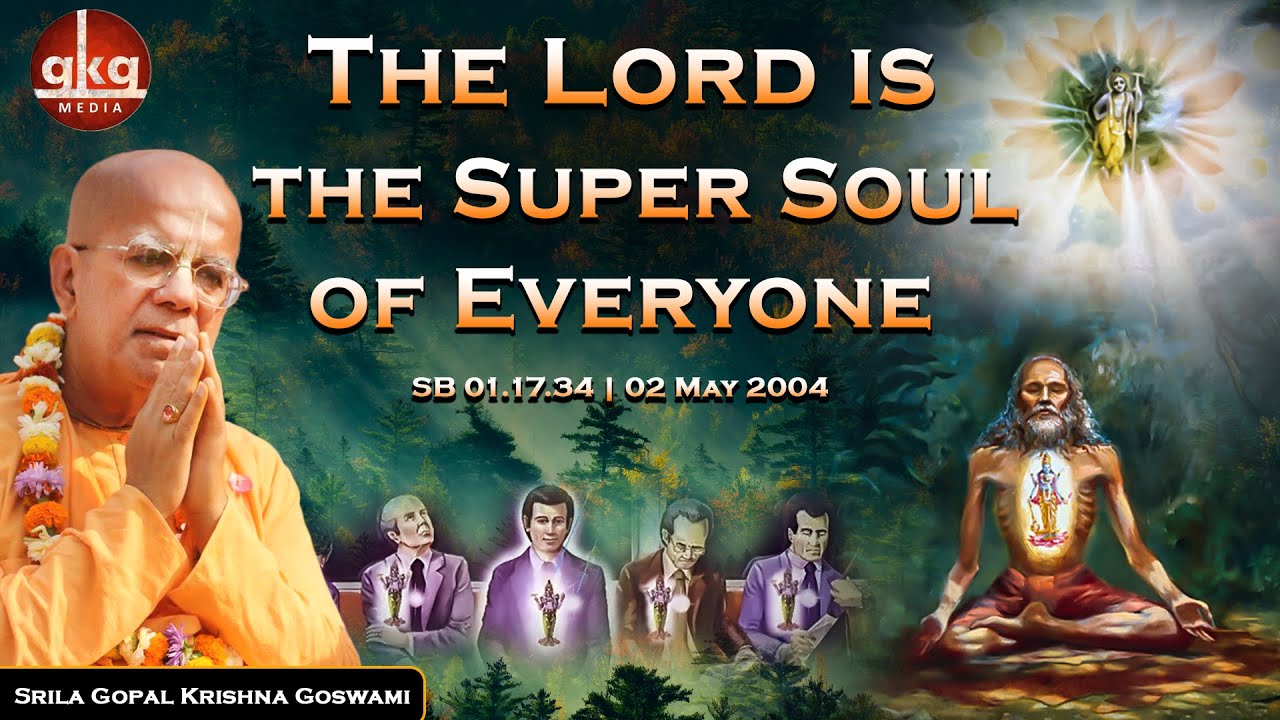
In this devotional lecture Srila Gopal Krishna Goswami expounds on the nature of the Supreme Lord as the Supersoul (Paramātmā) who pervades all beings and is the ultimate source of all blessings, even those seemingly offered by demigods. He narrates the story of King Parikṣit, whose mother was protected from a Brahmastra by the Lord, leading the king to seek the Divine from birth. The talk connects this ancient narrative to contemporary issues such as weak governance, animal cruelty, and food crises, emphasizing that a God‑conscious head of state can protect society. Goswami outlines the four essential ingredients of any true religion— austerity, cleanliness, truthfulness, and mercifulness— and illustrates each with modern analogies. He further explains the functions of the Paramātmā: guiding desires, acting as the ultimate sanctioning authority, and witnessing all actions, thereby underscoring the importance of direct devotion to Krishna rather than indirect worship of demigods. The lecture repeatedly cites verses from the Śrīmad‑Bhāgavatam and Bhagavad‑gītā, critiques the worship of demigods as ignorance, and urges listeners to adopt Krishna‑centric devotion for spiritual advancement.
Chapters
Om namo bhagavate vasudevaya! Om namo prasad raavalayam! Om namo bhagavate vasudevaya! Prasad raavalayam! Om namo bhagavate wasudevaya! Namah Shivayasurabhava devayasura! iva śīśa ātmaṁ. Antaḥ vādhiḥ vādhiḥ vāśaṣāḥ. In all sacrificial ceremonies, although sometimes a demigod is worshiped, the Supreme Personality of Godhead is worshiped because He is the Super Soul of everyone and exists both inside and outside like the air. Thus it is He only Who awards all welfare to the worshipper. Vairabhadra is divine grace. Eisi bhaktirananda Swami Śrīla Prabhupāda. Śrīla Prabhupāda ki jai. It is even sometimes seen, though demigods like Indra and Chandra are worshipped and offered sacrificial awards, yet the rewards of all such sacrifices are awarded to the worshipper by the Supreme Lord. And it is the Lord only who can offer all welfare to the worshipper. The demigods, although worshipped, cannot do anything without the sanction of the Lord because the Lord is the Super Soul of everyone, both moving and non-moving. In Bhagavad-gītā, the Lord Himself confirms this in the following śloka from the 9th chapter: Whatever a man may sacrifice to other gods, O son of Kuntī, is really meant for Me alone, but it is offered without real understanding, without true understanding. The fact is that the Supreme Lord is one without a second. There is no God other than the Lord Himself. Thus the Supreme Lord is eternally transcendental to the material creation. But there are others, but there are many who worship the demigods like the sun, the moon, and Indra. Who are only material representatives of the Supreme Lord. These demigods are indirect qualitative representations of the Supreme Lord. A learned scholar or devotee, however, knows who's who. Therefore, he directly worships the Supreme Lord and is not diverted by the material qualitative representations. Those who are not so learned worship such qualitative material representation, but their worship is unceremonious because it is irregular. Om yānta-vrāndasya yānaṁ venaśrākyaḥ jākṣaraṁ itaṇyena tat svāyaśrī-bhūrāveṇaṁ śrī-cetanya-mālo-bhūtiṣaṁ saḥṇā-viena-bhūtane sa yaṁ guḥ-paṅkha-dāmaṇaṁ devāḍī-svābdaṇadi-kam Bande ham Shri Guru, Shri Laapada Brahman, Shri Guru Meishavamsa, Shri Upamsara Gitaṁ, Sahagra Laguna Tattvitam Tanto Deivam, Sahmetam Svadhūtam, Rijana Saitam, Krishna Chaitanya Deivam, Shri Laapada, Krishna Avalaṇa, Hare Rāma, Hare Rāma, Rāma Rāma, Rāma Rāma, Hare Rāma. Yasmīn haribhagavānī-jamānaḥ tamurthī yajatāṁ sampranotiḥ kāmaṁ mokṣantīya-janṣamanam antivavyāyur iva-īśā-atmaḥ. So we are reading from the chapter entitled Punishment.— and reward of Kali. And this is a verse from the first canto. And over here we see that Parikṣit Mahārāja, Parikṣit Mahārāja was the emperor of the whole world. These days you have so many countries, isn't it? And every day the flags go on increasing because People keep— countries keep breaking up, but at one time the whole planet had one emperor, and that was King Parikshit. And of course, there were many junior kings, but they all owed their allegiance to the main king. So Parikshit Maharaj was the emperor of the planet. The word Parikshit means examiner. Why is he called Parīkṣit? Because when he was in the womb of his mother, a brahmastra weapon was released by Asvatthama. The brahmastra weapon is such a sophisticated weapon that it hits only the target and nothing else. It has such precision. For example, you can have a crowd of 10,000 people, and if your target was a man, 5th man from the right, the Brahmāstra would only hit that man and nobody else. Amazing, isn't it? These days they have these bombs, and they drop these bombs, and half the time the bombs end up falling in the wrong place and killing the innocent people. But the brahmāstra was a very sophisticated weapon, and this weapon used to be released by the chanting of mantras. You did not need missile launchers. So Amāśvatāma had released a brahmāstra, and the Supreme Lord protected him. The Pariksit Maharaj's mother's name was Uttara. So when she saw that deadly weapon coming towards her embryo, she prayed to the Supreme Lord, and the Supreme Lord expanded himself, and he protected Uttara's embryo from this deadly weapon. And for a fraction of a second, Prasadam Maharaj had the opportunity when he was in the mother's womb to see the beautiful form of the Lord, and he was so attracted to the transcendental form of the Lord that any person he ever saw in his life, he would examine, does he look like what I saw in my mother's womb? In other words, He was searching for Kṛṣṇa. In every person he saw, he was trying to compare if it resembles the image that he saw when he was in his mother's womb. So Parikṣit Mahāj from his birth was a great devotee of the Lord. And that is why Parikṣit Mahīṇa examiner, he was always searching for God. So Parikṣit Mahāj Prasad RAVAL and he was traveling in his kingdom. That's normal for the head of state to travel in his area of jurisdiction. And as he was traveling in his area of jurisdiction, he saw that there was a degraded personality Who had disguised himself as a king, a sudra, full of bad habits, and he was hurting the legs of cow and the bull. Cow and bull are very important for the protection of society. The cow gives us milk, the most wonderful food, and milk nourishes us right from the time we take our birth. Therefore, the cow is described to be one of our mothers. We have the mother who gives us birth, then we have the wife of the spiritual master, then we have the earth, that's one of our mothers, we have the nurse, that is one of our mothers, and then you also have, um, Mother cow, that's considered to be one of your mothers because the cow gives us milk that gives us the strength to grow and sustain. So cow must be protected. And unfortunately, even in countries like India today, they give only lip service to the concept of protecting the cow. So this personality of Kali was actually hurting the legs of a cow and a bull. Bull provides agriculture. The bull helps you to take care of the soil, and then you have production. These days, for example, as some of you may know, the world is headed for a big food crisis. Even the food grains are running short, even in countries like America where food used to be so cheap. Now it's skyrocketing. Now why is all this happening? In the Bhagavad-gītā, Kṛṣṇa says, "Food grains come from rainfall, rainfall comes from sacrifice." Sacrifice means performing yajña. And when you don't perform yajña, then material nature retaliates and withholds supplies. So Prahlāda Mahārāja saw this personality who had dressed himself falsely as a king. Just like these days all over the world we see that people get elected to positions of responsibility. They may become the Prime Minister, the King, or the President, or whichever. But they don't have the required qualification. The required qualification for a head of state is to take care of the population just like a father nourishes a child. Is there any head of state who does that anywhere in the world today? Take care of the population like a father would take care of the child. 'Lāurāma-chandra'— During his reign, he would walk in disguise, go and stand in front of people's houses just to see if they have any complaints or any unhappiness or cause of distress, etc. That is what the head of state would do when they were God-conscious. So Praśad RAVAL saw that an imposter was acting like a king, and Parikṣit Mahājāja very rightfully wanted to drive that personality out of his kingdom. Now, he also saw that the cow was standing on one leg. The other three had been broken by this personality. There are 4 principles of religion. In other words, any religious process, it doesn't matter whether Hindu or Christian or Muslim or Jewish, must have 4 essential ingredients. Unless the 4 essential ingredients are there, it's not religion. And what are the 4 essential ingredients? Who knows? Austerity. What else? Cleanliness. What else? Truthfulness. And what else? Mercifulness. So these 4 ingredients must be there. Austerity, truthfulness, cleanliness, and mercifulness. What does austerity mean? Austerity means We voluntarily abandon what's detrimental for spiritual advancement in favor of what is conducive for spiritual advancement. Just like these days, for example, people are quite health-conscious, at least in many parts of the world. And before they eat something, they want to know what the ingredients are, etc. And suppose you may be very fond of rasgullas and gulab jamuns. That's it. And you get hit with diabetes. Now then, if you have to survive, will you give up your rasgullas and gulab jamuns or keep taking it? You keep taking, you'll get more disease. And if you take the precautions, You can hope to cure yourself, isn't it? So similarly, we may have so many addictions, we may have so many attractions, but once you come to spiritual life, you recognize what is conducive and what is detrimental. And when you voluntarily give up what is detrimental For spiritual advancement. And that is austerity. Tāpo devyam puṭhaka jīnasa tvām. Yes, Lord Rāja Dev said, "My dear sons, perform austerity." For whom? For the pleasure of the Supreme God. Immature life today is full of austerity. You see people living in slums. That's austerity. Even people living in big cities, Even if you live in a big city like Bombay, Delhi, London, there's such heavy pollution. That's also a type of austerity. But especially over here, it is said that austerity means performing activities for the pleasure— for undergoing difficulties and sacrifices for the pleasure of the Lord. Then there must be cleanliness. Cleanliness is of two categories. Internal and external. Internal cleanliness refers to the cleansing of the heart. External cleanliness refers to our living in a clean environment. In material society they say, "Cleanliness is next to—" Godliness. Godliness must be there, but then there must be cleanliness also. So for external cleanliness, We should keep our temples very clean. We should keep our bodies clean. We should have at least 2 baths a day. And we should wear clean clothes, look clean. And then we should chant the holy names because this is the principal vehicle for cleansing of the heart. Then there should be mercifulness. What does mercifulness mean? Mercifulness means understanding the laws of God and also displaying compassion. Like our Vaiṣṇava is described to be para-duḥkha-duḥkī, which means that seeing others in distress, he also gets concerned and then endeavors to enlighten them. On the path of God consciousness. Sarvaishyava must be— a devotee must be merciful. Jesus, you see, people are so-called religious and they sacrifice animals, isn't it? Whether you are Christians, the Hindus do. I was in Orissa recently. Someone told me, there was a famous cricket star. He came there and he sacrificed so many goats so that he can hit, he can get good runs in his cricket. So the point is, to think that we can sacrifice human and animals just to get the blessings of Durga actually is sinful. So you can't have a religious process that on the one hand tells you how to love God and serve God and then kill his innocent children. So one must be merciful. And then what is the fourth principle of religion? Truthfulness. Truthfulness means that we should be truthful to the teachings of the Lord, truthful to the teachings of Kṛṣṇa, truthful to the teachings of spiritual master, truthful in dealing with each other, truthful in dealing with Vaiṣṇavas. In the Bhāgavad-gītā, Kṛṣṇa describes The austerity of the tongue. So what does he say is the austerity of the tongue? First he says, first austerity of the tongue is to be truthful. Because we are so used to being a liar, isn't it? To be truthful in Kali Yuga is a rare commodity. If you are so used to lying, lying, lying, you sign a legal agreement, you know you are going to break it tomorrow. So one of the ascertainties of the tongue is to be truthful, at least in terms of practicing Vaiṣṇava culture. A businessman, for example, may say, "From you I make no profit." But that is not so much of a lie. Obviously everyone knows that Prabhupāda says in the Gītā, unless you make profit, how will you live? But we should not be a liar It comes to following spiritual instructions, when dealing with Vaiṣṇavas, etc. And then I was telling you, the tongue is to speak the truth, but speak it in a palatable manner. The truth must be spoken, but the truth can be spoken crudely or gentlemanly. If you want to correct someone, you can say, "Hey, you idiot!" Johnny, no, this is not the way to do it. Or you can be sweeter and say, "This is how it should be done." So the point is truth must be spoken, but it should be spoken in a palatable manner. This is the instruction of the Bhagavad-gītā, speak the truth. Then another austerity of the tongue is, "Kṛṣṇa." To regularly recite Vedic literature. So these 4 ingredients must be there. Truthfulness, cleanliness, mercifulness, and— it doesn't matter whether you're practicing Christianity or Islam or whatever, these 4 ingredients must be there. And if you have a religious process where this basis is not there, then you cannot have religion. Just like these days it is very common for people to argue "My religion is better than your religion. I'm on the right path." But actually, the real meaning of religion is phalena prasāda, to help you develop love of God. And bona fide religion must have these four ingredients. Now, Praśad RAVAL is speaking to this personality, who was degraded but had disguised himself as a king. And when he saw Parikshit displaying his anger at what he was trying to do, then he threw off his clothes of a king and revealed his real identity and begged the king, "Please forgive me." and give me a place where I can reside. So the point is, if the head of state is strong, then crime can also be corrected. And if the head of state is weak, then you see thieves, etc., flourishing. In these Middle East countries, they have very heavy punishment. If they catch you stealing and so on. So it is said that in Dubai, in Abu Dhabi, in these places, you can leave your house open and nothing gets lost or stolen. Because they have— people have such great fear that if they get caught, they'll get their hands cut or whatever. So the point is, if the head of state is God conscious and vigilant and strict, then there will also be protection of the citizens. And if the head of state is weak, then thieves will flourish, and then there will be nothing but anarchy in society, what you see today. Now, Parikṣit Mahārāja is over here in the verse we are discussing today saying, in sacrificial ceremonies, sometimes a demigod may be worshipped. But actually, Parikṣit Mahārāja is explaining here, even though the ben— the demigod may be giving you a benediction, actually the benediction is coming from none else but the Supreme Personality of Godhead. This concept of Supreme Lord and demigods was unknown to most of us before we came to Kṛṣṇa consciousness. Am I right? Because we are brought up in the belief all gods are one, doesn't matter what path you take, the end result is the same. Whereas, ekāra Īśvā Kṛṣṇa artha-bṛhṭayaḥ. The scriptures establish There is one Supreme Lord and there are many subordinates. So they are demigods. The demigods are empowered administrators. Just like in any cabinet, you may have the head of the Prime Minister or the President and various ministers or secretaries of state, etc. So similarly, the demigods are empowered administrators who have responsibility in different areas. Just like here in this verse, the reference is made to Indra and Chandra. What is Indra in charge of? Huh? Rain. What's Chandra in charge of? Moon. Moon. Chandra gives you the moon, the rays of the moon, and Vivasvan gives you the sun rays. Indra gives you water. Can you live without the rays of the sun or the moon? No. You use electricity for a few hours a day, and then you complain how high your electricity bill is. Imagine if you had to pay Chandra in, uh, su, Vivasvan. For their sunlight and moonlight, you'll go bankrupt, isn't it? So the demigods are empowered administrators, and the less intelligent individual thinks, "Oh, I got this benediction from this demigod." But Krishna says in the Bhagavad-gītā, actually, the benediction given by demigods is actually coming from whom? It's coming from me, Krishna. In the Bhagavad-gītā, Kṛṣṇa explains, "Men of small intelligence worship the demigods. The benedictions are given by Me." So the Bhāgavatam and the Gītā clearly establish that just like when you pour water in the root of the tree, all the branches get nourished. Or when you are hungry, when you put food in the stomach, the entire body is nourished. Similarly, just by serving Kṛṣṇa, you are able to take care of your obligations with all the demigods. There are 33 crore demigods, and we have a debt to all of them. They are all supplying us some aspect of our necessities of life that we are getting. Just like you pay separately water bill, electricity bill, this bill, that bill, sales tax, isn't it? So we have a debt to all these demigods, and to try to pay them off individually is impossible. So Kṛṣṇa says, "Surrender to Me, and I'll protect you." And Kṛṣṇa says in the Gītā, "Whatever benediction the demigods are giving is actually coming from whom? It's coming from Me." So therefore He says, "One who is more intelligent should take shelter of Me." You worship Kṛṣṇa and you automatically discharge your obligation towards the innumerable demigods. Now, in this verse, Parīkṣit Mahārāja is also establishing that the Supreme Lord is the super soul of everyone. The Supreme Lord is present in everyone's heart as the super soul. And hence He's also known as Paramātmā. He's also known as Paramātmā when He resides in everyone's heart. Now, as the Paramātmā, what is the Lord doing? Just like we work, the Lord is also working. The Lord has innumerable activities to look after. Just like you see the creation. Every day the sun rises and sets, etc. Everything is moving so perfect. Do you ever hear of planets colliding? You hear of the best aeroplanes crashing. But do you ever hear of the planets crashing? Have you ever heard in history there was a day when the sun did not rise? Even in the best of countries like America, they have power failure, utility failure, and so on. Have you ever heard of that? No. So obviously, somebody is working to ensure that material nature works perfectly, and that someone is the Supreme Lord. So the Supreme Lord as a Supersoul or Paramātmā, is also doing many other functions. One function the Supreme Lord does, He guides us according to our desire. Just like it is said, "Īśvara-sarva-bhūtanam hṛdaye rājṇo tiṣṭhati." This is a very famous verse from the Bhagavad-gītā where Kṛṣṇa says that, "I reside in everyone's heart." So Kṛṣṇa is residing in everyone's heart. Now your next question would be, "Okay, He's in my heart, but what's He doing?" What's the Lord doing? He's guiding us. Sārvacetaḥ hṛdaya-sādhvīṣṭho mataḥ aśmita-jñānam apahānam ca. He's guiding us according to our desire. Just like when you pass through a garden, you can smell the flower and identify the fragrance, isn't it? Your country produces very nice flowers. So you can just pass through a garden and an expert person will smell the flower and say, "Oh, this is a gardenia, this is a rose, this is a jasmine," isn't it? So similarly, just like we have smelling power, the Lord can smell all our desires, and based on the desires we manifest, He guides us accordingly. When the Lord says, "Here is someone who wants to serve Me," then He creates the necessary environment. Gives you the association of a devotee or a book, and thereby that helps you to make spiritual advancement. And when the Lord sees, "Here is someone who wants to forget Me. He wants to get totally obsessed with material life," then the Lord gives him a facility by which he can just associate with worldly-minded people, demonic people, and thereby Forget the law. So one duty that the Supersoul does, He guides us according to our desires. Now sometimes people say, they question, "Is God biased?" You understand? "Is God biased? Is He prejudiced? Why is it?" Some people are enjoying and some people are suffering. Why is it that child has been born handicapped and that child has been born with a silver spoon? Is there any logic or just by accident? Like they pull lottery numbers, you know, the computer pulls the numbers. Is it a lottery number that gets pulled and A gets a silver spoon, B gets a— No, there is certain law, and law of karma. And the Lord is not biased towards anyone. The Lord is just witnessing, just like a judge in a court witnesses, and he judges, sentences people according to the extent of their crime. So similarly, the Lord is unbiased. And He just ensures that the laws of nature run properly and guides us according to our desires. Another activity the Lord as the Paramātmā does, He is the ultimate sanctioning authority. What does this mean? You must have heard this famous phrase, "Man proposes, God disposes." Isn't it? Actually it is, "Man proposes and Paramātmā disposes." How does Paramātmā dispose? You have your wish list. "I want this, this, this, this, this." Paramātmā is the ultimate sanctioning authority. Just like you may write a cheque for any amount you want, but then before the amount is really sanctioned, the clerk in the bank sees what your balance is and only releases that much. So similarly, the Lord is the ultimate sanctioning authority. You may have A desire that I shall have a Ferrari car, nice seaside residence, this, that, and you can manifest it. But then the Lord says, "What's your balance of karma?" And instead of Ferrari car, you're just entitled to a broke secondhand Maruti. That's what you end up getting. Now also, in mature life, there's suffering and happiness both that you experience. So sometimes when you're suffering, you get desperate, depressed, and when you are so-called enjoying, you seem to have low blood pressure and seem to be in a happy mood. It doesn't happen. Now how is it that this karma is working? Of course, we get a quota of happiness and distress based on our activities. Prasad RAVAL in the 7th Canto says, "Do not over-endeavour because you're not going to get a drop more than what's your destiny." Sometimes people just endeavour, endeavour, endeavour to make material struggle. Life success. But Prasād RAVALAD says, "Doesn't matter how hard you work, you're not going to get one drop more than what is your destiny." So Prasād RAVALAD says, "Better use your valuable human life for spiritual cultivation." So Bhāgavad-gītā explains in the 6th chapter that one who has controlled his mind, He is peaceful in all situations, happiness and distress. Just like we have to go through distress. Now when you go through distress, nobody likes it, is it? Am I right? But if you look at it from a spiritual angle, distress also is welcome. Why? Because distress means you're wiping out your debts. You're diminishing the results. Of your negative karma. You may have some disease or something, you undergo. So you're just wiping out. Then on the other hand, you may be in a position where you're reaping the results of your pious karma. That because you're reaping the results doesn't mean that these results are going to last eternally. They're also going to get exhausted. Just like you may inherit a big fortune, but if you don't use it correctly, then it's going to get exhausted. So we may inherit some pious karma, but if we don't use it properly, then it gets exhausted. So the point to understand is that the Lord as a Super Soul is also the ultimate sanctioning authority of everyone. Now, he's a Super Soul, and exists both inside and outside like the air. Sometimes people say, "If God is all-pervasive, how can God retain his original form?" In other words, if God is present everywhere, isn't that what they say? God is present everywhere, then how can God retain his original form? Now for God, This is not difficult because He is a Chintya, inconceivable. For the Lord, nothing is impossible. You see the sun disc. The sun disc is located in the sun planet. Its rays are everywhere, but it still has its original identity. So God is all-pervasive. And He awards all welfare to the worshiper, as it is being said here. In other words, the Lord reciprocates according to the degree of surrender. Just like Bhagavad-gītā says, "ye yatha mām prapadante," "All of them, as they surrender unto Me, I will reward them accordingly." Svāmya. So one who is more intelligent, he understands that the demigods are subordinate to the Supreme Lord. There are 10 offenses that we should be aware of in chanting the holy names of the Lord. The holy names of the Lord are beneficial regardless of how you chant, but if you want to take full benefit Then of course you should chant attentively and avoid the 10 offenses. And what is one of the 10 offenses? You consider demigods to be equal to or independent of the holy name of Lord Vṛṣṇa. So to think that the demigods are equal to the Lord or they are independent of the Lord is actually a great offense. So the Supreme Lord is one without a second. There's no other Supreme Lord, but there's only one. And Īśvara-parma-kṛṣṇa-saḍhī-dharaṇa-vigraha-nādirādhiko 'vandhaḥ sarva-kārṇa-karmaḥ. And who are the demigods? Empowered administrators. In the Śrīmad-Bhāgavatam, 10th canto, you read about so many stories. How the Supreme Lord came to the rescue of Śiva. Which is that famous story? We came to the rescue of Śiva. Vrīkṣuṣura. Lord Śiva had given a benediction to demon Vrīkṣuṣura. That Vrīkṣuṣura was gone to meet Lord Śiva in Mount Kailāśa. And not seeing the Lord, He started offering flesh from his body in the sacrifice. Shiva came and said, "Hey, what are you doing? Why are you offering flesh from your body? It's sinful, harmful." "But I wanted a benediction from you." So Lord Shiva is āśūtoṣa. āśūtoṣa means easily pleased and easily displeased. So Lord Shiva said, "I'll give you a benediction, don't worry." You know, and he restored the flesh into his body. He was compassionate. And then he said, "Okay, what's the benediction you want?" "I want the benediction, wherever I place my hand, everything underneath that will burst." Lord Siva said, "This is a very destructive benediction. How can I give you that? I can't let you destroy the universe." "But here you already promised me." So hesitatingly the Lord gave him this benediction. And this Brikhasura, like other demons, had an evil eye. He, so he, as soon as he got the benediction, he spread his hand. He wanted to place his hand on the head of Lord Śiva because he had his eyes on Parvati. And then Lord Shiva had to flee. And ultimately, who rescued the Lord? Lord Shiva finally reached the spiritual planet and where the Lord had disguised himself as a Pramachari. So when Rekhasura came running behind, he said, "Rekhasura, why are you running?" He said, "I'm chasing Shiva." "Why are you chasing Shiva?" "He gave me a benediction that wherever I place my hand, everything on it will burst, and I want to place my hand on his head." So Lord Shiva, the Lord said, 'But don't you know ever since Lord Shiva had a fight with his father-in-law Daksha, his benedictions have no potency. So if you really want to make sure that his benediction is not working, first test it out. And then if it doesn't work, then you have reason, he lied, so you are going to take action. But if without any cause You do it, you'll have to take on the sinful reaction. So Rekhasura thought, "Good idea." So he kept his hand, where? On his own head. And on his own head he kept it to test it, how potent the benediction was. He had burst and died. So there's so many stories. This is just one example from the Bhagavad-gītā. So the demigods all acknowledged, "Boom!" that Kṛṣṇa is the Supreme Personality of Godhead. Lord Śiva gave the pretender as a song to glorify the Lord, which was nothing but a song glorifying the Supreme Lord Śrī Kṛṣṇa. So the Bhāgavata verse is saying that Kṛṣṇa rewards according to the degree of surrender of the devotee. You surrender 1%, you pay 1% premium, you get 1% coverage. You pay 20% premium, you get 20% coverage. Kṛṣṇa, no, Kṛṣṇa makes it very clear. "All of them is surrendered to Me. I reward them accordingly." So in this verse, it has been clearly established that Kṛṣṇa is the Supreme Lord, the demigods are empowered administrators, and one who is intelligent worships the Supreme Lord who is the cause of all causes, and the Supreme Lord As a cause for all causes, it's also available in His Paramātmā feature, where He guides us. He is the ultimate sanctioning authority and a witness to all our activities. Sometimes people say, "Who is witnessing all my activities, ah?" Just like in a mature court of law, you can murder somebody, but if you cannot produce witness that this man murdered, you escape, isn't it? That's what these professional criminals do in such a way there's no witness. So sometimes one may say that, "Who is witnessing all my activities?" So all our activities are being witnessed by whom? Paramātmā. The Paramātmā is the witness to everything. Therefore, one should take shelter of the Supreme Lord through the process of devotional service. And the devotees understand that whatever benediction the demigods are offering is actually coming from whom? From the Supreme Lord. Therefore, we go directly to the Supreme Lord. Just like if you want to touch the tip of your nose, you can touch it straight or try to stretch your hand around your back to reach your nose. Which is easier? To touch it straight. Better take the direct route to Kṛṣṇa rather than the indirect route. Hare Kṛṣṇa, Hare Kṛṣṇa, Kṛṣṇa, Kṛṣṇa, Hare, Hare, Hare, Hare Rāma, Hare Rāma. Lama Lama Ale Ale. Hare Krishna Hare Krishna.
More from PRASAD

Rare Pastimes & Timeless Lessons of Guru Mahārāja | Stories Every Disciple Should Hear

ISKCON Legends- pure devotees meet-HH Jayapataka Swami, HH Gopal Krishna Goswami, HH Radhanath Swami



Jagannātha Ratha-yātrā Through Śrīla Prabhupāda's Mercy | 29 April 2006 | Nairobi, Kenya

Lord Jagannātha's Appearance Pastime | 21.07.2019 | ISKCON Calgary | Śrīla Gopāla Kṛṣṇa Gosvāmī

The Ācārya Teaches by His Own ExampleGuṇḍicā Mārjana by Guru Mahārāja #shorts

Guṇḍicā Mārjana – Lord Jagannātha's Pastime | 21.7.2019 | ISKCON Calgary |Śrīla Gopāla Kṛṣṇa Gosvāmī

H.H. Gopāla Kṛṣṇa Gosvāmī Mahārāja - Exemplary Sādhana and Deity Worship # shorts

भगवान की कृपा कैसे प्राप्त होगी ? | 11 Jan 2014 | Punjabi Bagh | Srila Gopal Krishna Goswami

Material Education vs Spiritual Education | Srila Gopal Krishna Goswami #shorts