The Qualities of a Spiritual Leader | GBC College | 28 Feb 2021| Pune |Gopāla Kṛṣṇa Goswāmī Maharaja
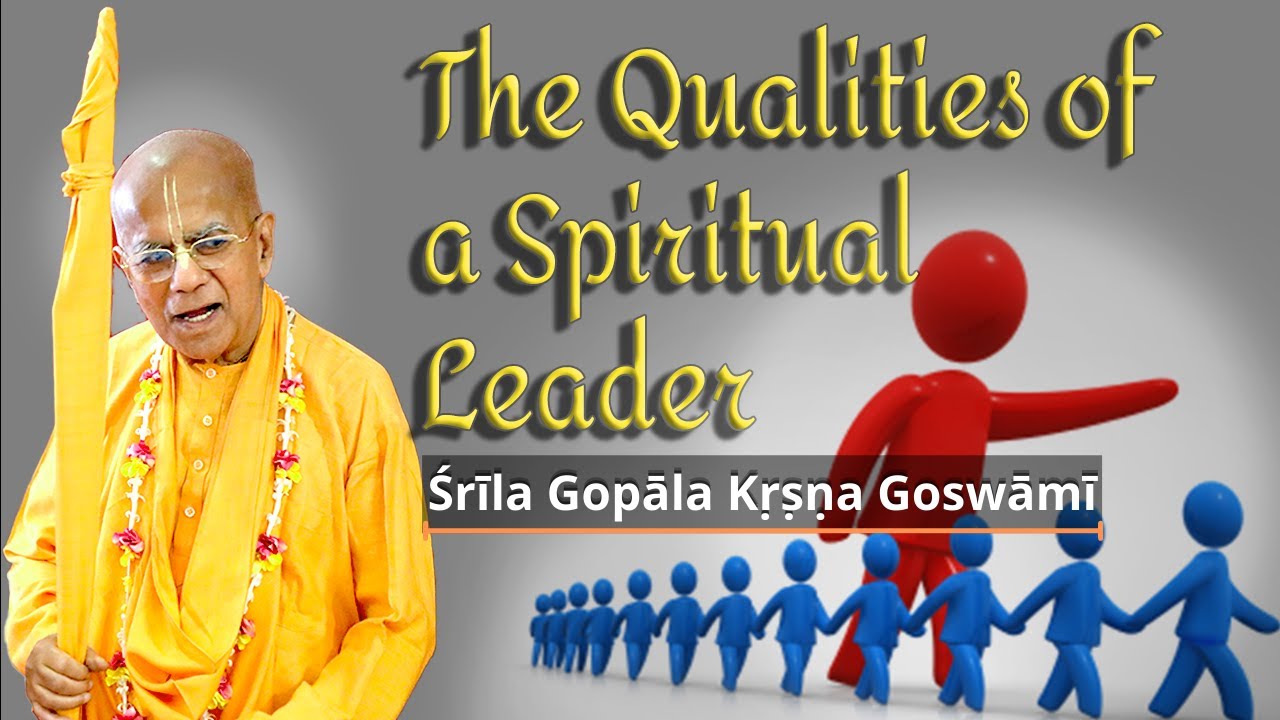
In this lecture delivered by Gopāla Kṛṣṇa Goswāmī Maharaja at GBC College, Pune, the speaker discusses the essential qualities of spiritual leaders within ISKCON, emphasizing unity, humility, and the integration of spiritual and professional management. Using analogies such as the blade‑of‑grass and stick, he illustrates how collective strength prevents fragility. He cites A. C. Bhaktivedanta Swāmī Prabhupāda’s meticulous administrative habits—detailed bookkeeping, disciplined guard schedules, and rigorous cleanliness standards—as models for modern temple governance. The talk stresses that false ego is the chief obstacle to unity, urging leaders to practice humility, tolerance, and “practice what we preach.” The speaker advocates open, democratic discussion (including on sensitive topics like the female‑guru issue) and transparent decision‑making through GBC structures, while also highlighting the need for coordinated assignment of duties to avoid conflict. Devotional care for brahmacharis, protection of junior devotees, and the role of the GBC College in training leaders are also addressed. Throughout, the message is that spiritual excellence must be paired with professional management to sustain the movement in Kali Yuga.
Chapters
All of you will over time take on more and more responsibility. Either as non-official advisors or governing body commissioners or whatever. And I think Colin is doing a very good job exposing you all to the problems and the need to be cautious of being a working dog. Prasad RAVAL, he's given an example. If you have a blade of grass by itself, it is easy to break. But if you mix the different blades of grasses, then it becomes strong, as strong as a rope. If you have a stick by itself, easy to bend. But it will All the sticks are grouped together and they are not prepared. So we need to be united. In the verse we read, the Lord was pleased by the Prasadas when they were all engaged in devotional service. They all had one common goal, glorify the Supreme Personality of Godhead. A chandimal mantra, give it to me. And the Lord said, give me all benedictions. I ask you for any benediction you want. So Prabhupāda also told us purity is a force. And Prabhupāda also told us Kṛṣṇa is not a poor man. If you remain sincere to Kṛṣṇa's teachings, Kṛṣṇa will take care of what is needed. So in ISKCON we need good management also. It's not that Prabhupāda didn't believe in good professional management. Of course the basis Or the real goal is to practice spirituality. But Prabhupāda by his own example showed how he was very, very strict and professional in managing. I have his book here. I'm sure you have seen this book, The Beginning, you know. So in this book and in the other book, in the other diary, You see that Prabhupāda would write down every penny that he would spend. You can read it. Every penny he would spend before he went to India, before he left India, and after he arrived in the West. He would write down everything. But what did this show? It shows that Prasad RAVAL took the right professional approach. He told us, "Whichever money comes in, deposit in the bank, and whichever you want to withdraw, withdraw by cheque, and that will be— the bank will do your bookkeeping." The point I'm trying to make is, Prabhupāda emphasized spirituality. And we can talk about management, but the most important management for ourselves, for this institution and its members is spiritual management. But at the same time, we also have to have professionalism in our management. Prabhupāda said it was a good organization. And Prabhupāda was a very practical man. Once he got up at 12, 1 o'clock in the night in Vrindavan, he saw the guard was sleeping. So the guard was sleeping, but how do you ensure The Godhead has the— Prabhupāda instituted a very unique system. He said every hour on the hour, the God moves the bell. If it's 1 o'clock, it rings the bell once. If it's 2 o'clock, it rings the bell twice. If it's 3 o'clock, it rings the bell thrice. So, it's a very simple thing. Which just shows you Prabhupāda's approach to management. He, his goal was to ensure that the guard didn't sleep in the night. And he saw for 2 or 3 days in a row, every night Prabhupāda would get up on his veranda, through the transom you can see the guard is sleeping. So he wanted to ensure that doesn't happen. So after this system was instituted, the cowards naturally could not sleep. They had to sleep away, but they were instructed that they would chant Hare Kṛṣṇa during the bell every hour. And Prabhupāda's example was also very strict in terms of cleanliness. Prabhupāda would visit a temple You would often see, what is the cleanliness standard? I remember once we were in Vṛndāvana, sitting in front of the room in the front, and Prabhupāda was asking, "So is everything clean in the temple?" And the president and myself, we said, "Yes, Prabhupāda, everything is clean." And he looked up on the fan, and on the fan was a small nest. And then the next day was for Meghna. This is what he called clean. So he had very, very sharp eye and he was very, very particular about good things. You know, we opened the Pradhanam Temple in March '55 and that time I was in TVC actually, Nanda Swami was the president. But still Prabhupāda wasn't very satisfied with so many activities. There was a devotee called Rāma Kriṣṇa who came to see Prabhupāda. He was a businessman in Chennai. Prabhupāda kept him over there. He had a good management. He wanted everything to be very kalaḥ, not a very good way. And Prabhupāda, as we know, was very concerned about seeing Kṛṣṇa as money. Prabhupāda went to the West. Even he had a small room. At that time, the emails were not there. People would write letters. And Prabhupāda would open. The aum aum aum would open inside. Normally people throw away aum aum aum. This is tikāṇa. So Prabhupāda would open it and write inside and use that envelope which would normally be thrown out Just to show this is Kṛṣṇa's wealth, don't waste it. So we have to realize that everything belongs to Kṛṣṇa. Bokhara megha tapo sa. And as managers, Prabhupāda wanted us to be very, very careful in managing his resources. At least here in India, Kṛṣṇa has given us, by Prabhupāda's mercy, a lot of resources. We have so many big temples in India now, and we have properties worth millions and millions of dollars. The challenge is going to be to manage these big institutions so professionally that we don't waste a penny and we utilize everything in service of God. So, we need to work together. We need to remain united in our goals. We need to be united in our activities. In our Kṛṣṇa consciousness movement, we have people of all walks of life. This is purely an international movement with branches all over the world and with people of virtually every background. They are under the same roof. In Kali Yuga, even for mature families to stay together, is that an easy job? Yes, ma'am. In India, there's a big family called the Ambadi family. Just two brothers, that's all. The father left them with a lot of wealth, and they worked hard and expanded it. But such a huge fortune was not enough for two brothers. They had to fight, go to court, and eventually settle. So in Kali Yoga, to remain united is a real challenge. And from my experience, even in managing temples, one of the biggest obstacles and challenges is getting everyone to work together, especially in temples where you have many department heads, many chiefs. It becomes a real challenge. Why? Every leader, every department head wants to think, "My way is the best way." But we have to understand that humility and tolerance are necessary for spiritual success also. If we analyze Caitanya Mahāprabhu's Sikṣāstra, which only has 8 verses, you will find the essence of the Vedic literature. Naisekṇaṁ te. In the third verse of this Upanishad, what does Mātṛtāṇyavasaya say? Tolerance, humility, isn't it? More harmony in the state of life, more tranquility. Avoid of all sense of false modesty. These are the big obstacles to unity, isn't it? It is important that as leaders we ensure that all the leaders are working on the same wavelength. The bodies today are very sharp. I have seen situations where people join When they first come to our movement, they think everybody in this country is awakened, they're all pure devotees. And they have a very high expectation from the leaders that they're going to work with them. But then after they see this for some time, see the environment, They say, "Oh!" They are not by themselves. They are also fighting here. You have leaders and ambitions. And leader A says, "I am your counselor. Follow me." And leader B says, "Follow me." And there is desire. For fulfilling our goals, Kṛṣṇa's preference, or what's good for Kṛṣṇa. So we as leaders have to understand our real goal is to please Kṛṣṇa. And to please Kṛṣṇa, we do what's right for Kṛṣṇa. Doesn't matter what I think, what you think. You have to see what's good for Krishna. And as leaders, the best way to attract others, in my opinion, is also practicing humility. In the material world, humility is seen as a negative factor, am I right? People think, "Oh, if I'm humble, I'll be exploited. They're going to misuse it, they're going to trample me. Everyone's going to walk over me." So we don't want to practice humility. But in spiritual life, humility is an asset. And humility doesn't mean just very sweet smiling. Other people think humility means offer 10 to 100 dandavats a day and just smile. In my opinion, humility means ready to be corrected, ready to be directed, and ready to do what's right for the institution, what's right for achieving our goal, which is to make the environment Krishna conscious and make every being Krishna conscious. If that is our paramount concern,— that there will help in the atmosphere of being Kṛṣṇa conscious, there will help in the temple of making spiritual progress. So it is very important that in every temple the leaders work together. Sometimes we see someone, the leader, They get threatened, "Oh, this boy is so sharp, I'm not going to do my job." And we don't encourage the individual, many people, sure. So my observation is, in situations where the leaders are Kṛṣṇa conscious, Leaders want to work together, practice humility, and sacrifice for the personal ambition. The temple will make good progress. The temple remains united, and as Prabhupāda often said, the famous British phrase, "United we stand and—" That's really true. And as I said earlier, Prabhupāda said, real challenge is not from outside but inside. That's why in our differences with the rittviks and by the pandits, the real difference arose from inside. Not the Maasai. So it's very important that we as leaders train ourselves to understand, I'm not in this movement to realize my personal goals. I haven't come to this movement to use the movement as an opportunity for me to control people's lives. I've come here to serve. And be a servant of the servant of the servant of the servant. And if that is our mentality, that will help us in making spiritual progress, that will help us in being focused. In Ashoka, we see about all the big devotees, he was so humble. In fact, if you go and do research, If you like the Vinayama Vaisnava Acharyas, you will find, you can't find anything about their life. And one reason you can't find anything about their life is they did not want to be glorified. They didn't want to be famous. But they didn't leave much literature behind. On their background. Krishnanath Avarad gives us a good example. He says that, "You won't even take my name. You won't even take my name, and you're a good fortune, all your good qualities will disappear." So humanity and tolerance are very helpful in covering up all of these evils. And it is nice that in the DVC College you're getting exposed to different management techniques, how to manage the temple better. Sometimes devotees think that, "Oh, there's too much of mundane philosophy, ours is a spiritual movement." That's a fact. Ours is a spiritual movement. It doesn't matter. How much material education you have, unless you have a strong spiritual foundation, it's not going to work. Just like in any building, if the foundation is strong, the building will hold. If the foundation is weak, the building will collapse. Prasad RAVAL. We have to be exemplary in our sadhana. And being exemplary in our sadhana inspires the juniors to also follow your example. And Lord Chaitanya several times emphasized, 'We will practice what we preach.' Some practice but do not preach, some preach but do not practice. But you are simultaneously doing both. Therefore, you are the perfect master. So as leaders, this verse is very applicable to us. We have to practice what we preach. And then I said, "You won't enjoy in that moment, especially those who are educated, very sharp. They can see through. This leader talks big philosophy in the classes, quotes so many verses, but he doesn't practice." I've had so many situations where I've had people come and tell me that. So we have to be When we stick to this point, we practice what we preach, and in practice what we preach is going to make the management job a lot easier. People are going to be— have faith. Yes, let's meet up, practice what he preaches, and then you go forward. One of the reasons why Prabhupāda was so successful. Of course, maybe he's known as purity, and he was empowered at Śrīdhara to spread the Holy Name and Kali-yoga. But also that people could see in practice what he preached. He cared for everyone. And of course, no one can match Prabhupāda. But the basic element, the basic point that I'm trying to make is, we have to be seen as managers of practice of this preach. If we're not seen as managers of practice of this preach, it's going to make the job of management a lot harder. And you're going to have a disempathetic group. Externally may appear to be united, but internally will not make much progress. Whereas if we, if the leaders especially, a lot of burden is on our leaders. As the Bhagavad Gita says, whatever great men do, others will perform. So being a leader means whether you are temple president, GBC, or vice president, department head, you have to understand you're carrying a heavy burden on your head. And the burden on your head is you have to be exemplary. And if you are spiritually exemplary, transparent, then people will work with you. Then they'll make sacrifices. It's not that people don't want to make sacrifices, but people want to make sacrifices in the right environment. And the right environment means in a, in a correct spiritual environment. So, you devotees have a great responsibility and We should use the best of management techniques. Bhaktisiddhānta Dī, when the Pūrṣa Chariya denied his abdication, whoever sat in the vehicle? He was the first ācārya who sat in the car and explained the philosophy of Yuga-kṛṣṇa-rādhya. So Prabhupāda took advantage of this philosophy of Yuga-kṛṣṇa-rādhya. Prabhupāda used the ship, the airplane, the cars, everything to spread Kṛṣṇa consciousness. But we have to be careful. Use it for Kṛṣṇa, not for yourself. Sometimes we have the tendency to dovetail. You know, "I like this, I'll start dovetailing." But a higher realization is generally using everything in service of the Lord. So we should encourage devotees. And if you want to encourage devotees, the best example is to lead by example. Give the devotees the understanding If we care for them. If we're just going to— Devoting field. My leader just wants to use me, then he's going to discard me. You're not going to get the best out of that. I think devoting care, this is a branch that has been— the G.B.C. body has been devoting a lot of time to discuss this topic, devoting care. I think it's very, very important. Every temple leader must make the devotees, especially the brahmacharis in the temple, feel protected. Many of them have given their— they come from educated backgrounds, they come and join the temple, and then they don't see that environment Then they get inspired. So, devotional care, giving up a false ego, always keeping Kṛṣṇa in the center. We should never think, "What's good for me? What's good so that I get a better position?" We should see what's good for Kṛṣṇa, what's good to spread This Krishna consciousness movement. And we are so fortunate that Prabhupāda has virtually given us everything. Prabhupāda gave us everything we need to go back to Godhead. Wonderful books, and now with technology you have a folio, virtually on any topic you can get so many quotes of Prabhupāda. Beautiful temples, beautiful Deities. He gave us everything we need to make spiritual progress and to manage professionally in this world. Even now Prabhupāda is on the planet for a short time, but even in a short time he gave us the idol of free will. There was enough quotes and instructions that virtually answered all our questions. I find that everything we need to know, any research we need on any topic, you can get an answer by going to those quotes. So we had everything, but unfortunately Kali Yuga is there, Maya also working. Maya tries to bewilder us, and the powerful influence of Maya prevents us from totally surrendering, prevents us from crushing our false ego. We need to crush our false ego, for our false ego is the greatest enemy of our spiritual progress. And false ego causes disunity in the temple. So they say that talk is cheap. You have heard the quote, easy to talk, difficult to practice. That's the fact. It's easy to talk, easy to say you're not this body, purely spiritual, and you're not. But to practice, "I am not this body," pure spiritual soul, requires a lot of endeavor. But as you say, God has not only helped himself, the Christians really do help us. Just like in the verse you read, the Lord was telling the betrayer, 'Now ask me for any benediction you want, I am pleased by your devotion.' So he sincerely tried to help Kṛṣṇa Mūla. Prasāda, as we know, came with only 48 rupees, which is virtually nothing, $6 at the time. But he had the strong determination to carry out His guru's order. And because it's sincerely endeavored, Kṛṣṇa gave him success. And I've seen those leaders who are strictly going to Kṛṣṇa's plan as Prabhupāda's instructions, they also get success as Prabhupāda's instructions, Prabhupāda's mercy. So I think at this point I can talk and take on some questions. I'll be happy to answer any questions you have. And there always be a future. Go on, take a breath in. All right, Krishna. How many of you would like to ask questions? Please raise your hand just to have a sense. 1, 2, 3, 4, 5. So we start the first pile. Thank you very much, dear Darshan, for wonderful discourse. So, where are you from? From Nepal. Prabhu Shri Gaur Das from Nepal. Prasad Raaval. So, you have explained very nicely that how Śrīla Prabhupāda wanted us to have a nice sadhana as well as professionalism in management. So, my question is, isn't it like in ISKCON we are having lots of problem, conflict? Because we are still not pure, that our false ego is the biggest disturbance. And our seniors' authority or management authority, they are giving more than 2 devotees the same job, same service. Isn't that also creating a conflict? So if we can— Maybe I can answer your question in parts. So what was the first part of the question? Like when the management authority gives more than 1 person the same job. Oh, yeah, I get that. Positive. Yeah, I mean, because we have like, we still have faults, we are not pure. Isn't it that way? We all recognize that we are not pure. But the good news for all of us is we know the path how to become pure. That's why Krishna says, deviṣaḥ pinamayā mamāya adhūrati. The world of the worldly energies, very difficult. Someone may say, "Oh, Kṛṣṇa siddha is so difficult, what the hell?" "Kṛṣṇa is a political criminal to me." And he gets it. So false ego is no doubt our enemy. We have enough ammunition that tells us how to overcome this false ego. It's not that we're going to shout. Now your other question was, the one authority— one authority giving to two or more devotees the same job. What is authority giving? The same job. Or, I mean, the responsibilities are not very well defined. Well, the fact of the matter is, our, our managers are not professionally trained. We have leaders in positions who haven't really undergone that much training. And I believe that one of the goals of the G.B.C. College and Education Committee between managers also. So, you're talking about one manager giving different instructions to different devotees. Same thing. Same instruction to different devotees. Isn't that also one of the cause why we are creating conflict? Will you be more specific? One manager tells two devotees. Same job. Same job. Yeah, like let's say the manager says like, okay, you go and preach in this area, make lots of devotees. And he tells also another devotee. So since the devotees come up with different, different ideas, varieties of— He sends both the devotees to the same area. Same area to preach. Once you do that, He should get the two together and say, "I'm sending both of you to that area. Please cooperate." There's no harm. You can send 10 people to one area. As long as everything is coordinated. It should not be, "Okay, I'm sending you to that area. I don't need anyone." And then I'll send somebody else to that area. I don't need anyone. But if everything is coordinated, I said, "No, no, I didn't ask you to be kind, but then I have a different opinion." In our management, I find being straightforward is the best example. If you're straightforward and you tell the worry exactly what you want them to do, and what you're telling the other, then they put you through corporate. Or if they feel that they're saying one thing on one person's back and another thing on his back, and that could give rise to misunderstanding. We stay forward but sweet. In the Bhagavad Gita, Krishna talks about the austerity of the tongue, of the nose. And one of the austerities is say, "Speak the truth with biggest patience." We speak the truth with biggest patience. Okay, more questions?
Thank you very much. So I am interested in your opinion as a GPC of this balance between accommodating a society, accommodating a group of people, and then, maybe say, the truth of a matter. I mean, we just discussed yesterday the female gurus. There is a book editing issue, there is the big mix, and there might be a truth about it. Prabhupada said something, but it's not possible to implement it because it would create social unrest, disunity. So could you elaborate a little bit about that balance? I mean, we might know something is true and we should follow, but it's not possible due to social considerations or unity issues.
Are you talking specifically about the female guru issue? No, I'm not thinking— Or anything in general?
No, I'm balancing this kind of like, you know, balancing, you know, the truth with keeping an organization together at the same time.
Well, if we take you to the truth, the organization would stay together. Whether female or diksha guru or any other issue. People may have different opinions, but we discuss openly. This country is a very open society, and to a great extent is also quite democratic. Like, even in the TBC party, different issues are discussed. We discuss very, very openly, and members are allowed to express their feelings and thoughts. And in many other organizations, if it is a scandalous subject, it gets hidden under the carpet. Prasad RAVAL is so democratic, there's no secrets in this group, which I think is a blessing. You discuss something that keeps you busy and you're worried about it in the evening. But there are no secrets. So the point is, there may be so many issues that need discussion, and in this fundamental process, of open discussion and on YouTube discussion, things can settle. One thing is, in this country you have a lot of educated devotees, educated leaders, and they may have different— they may have slightly different viewpoint than we. That's normal. That's to be expected. Even in Prabhupāda's time that existed. Unity in diversity. But we still discussed and come to a settlement based on the teachings of Prabhupāda. As long as we remain committed to Prabhupāda's teachings, as long as we settle our basis, everything that Prabhupāda gave us. Prabhupāda said this movement will go on for the next 10,000 years. As long as we have Prabhupāda's teachings as a basis, we can have as many discussions as we want, then come to a mutual settlement. As far as I can remember, there hasn't been any issue for the past 50 years where everyone did not like me, so we had a big fight or something. Eventually everything gets settled. Sometimes some issues take longer time to settle, but the process of discussion is very much encouraged in ISKCON. And it's but natural that in a big society you will have people with different viewpoints. Even in a temple you have people with different viewpoints. But the process is mutual discussion. And according to what G.B.C. Bariyam, for example, comes to a conclusion by taking a vote. Prabhupada came with that system. He came with a system of management— President, Vice President, etc. He also came with the system where we discuss and based on how people vote, come to a conclusion. We should never have the system that my way or the highway, as they say. And then you think, "Well, I'm good with this." That is not actually anything. And in this class there's plenty of opportunity for this question. Plenty of questions. More questions? Yes, sir. Hare Krishna, Maharaj. I am Vikram Govindadas from Kanyakumari.
Happy to hear your lecture.
I am very happy to meet you. Ah, we have met you two times.
And in line with this, I have one small feeling, like when there is a differences in the higher level, they can understand there is a common thing, we solve problem. But in lower levels, this small, uh, gap is seen as a huge thing. And as it moves to the lower and lower level, it is seen as a big differences. For example, the case of female group, and also of recent, the initiation, first initiation is not at all initiation promoted. So it is seen like in a lower level as a big gap.
What do you define as a lower level?
Means like GDC level, then next there are so many senior or mature level, and then As we go down to the new bhaktas and the just new initiated, that's like me, on a lower level, we see so many differences. So is it necessary for the GBC to be open with their differences to all? Normally, which we don't do it in a family, the female, they should grow.
Not only female, any gender. Because in my travels in India, I meet hundreds of devotees a day regularly. No one has ever discussed with me the female devoṣṭhakuru issue. I mean, that's more of an issue to be taken up. I haven't seen anyone in India, any brahmacari come up to me and discuss it. I'm a liberal, I'm in favor. I'm just saying, what I haven't had. Now regarding— so your basic thing is, low— people in the lower level see some difference. Well, management should be very open. GBC discusses things very much in the open, and there will be weekly resolutions. Are read out. It is the duty of the G.B.C. man to make sure that in his zone the G.B.C. resolutions are read out to the devotees in Hindi, English, and explained. And if any devotee has any question, he can ask the local president who is reading out the resolutions, and the president can answer And the president may turn to the local G.B.C. for guidance. The point is, by and large, things are discussed in ISKCON. Nothing is pushed on people's throat. I have never seen that. There's no strong authority in ISKCON that says, "This has to be done, no discussion." There's no such thing. We have national councils, regional councils, divisional councils, and at every level there's discussion. For all of them. And for anyone to expect in such a big society We have thousands of devotees, different backgrounds, good education. There are going to be some differences. You can't— this is not the tradition. ISKCON is not like a traditional Hindu movement where the guru lives with his disciples and that's all. That's not the case. Prabhupāda said, International. We have people from all walks of life, and any decision we make has to be analyzed not only in terms of how it will be applied locally, how it will be applied internationally. We have to look at the international world. That is— Yeah. Prasad Raaval, can you throw some light from your experience how to harmonize the lines of authority, spiritual and managerial, especially for the leaders when both authority are the same, spiritual and managerial authority? Think about it. If the authority is not spiritual and material, then you can ask one and move to the other. He said, "There is a tongue distinction." For those who are reading two castes or three castes, Some people wear 2 or 3 caps. One is the cap of BBC, one is the cap of BBC, one is the cap of being a guru. BBC means the managerial cap, guru means the spiritual cap. They also have to be careful that people don't feel the importance of the Guru. And that makes their job tougher. But at the same time, one should not think, "Oh, because he is born as Guru, in my authority I have to follow him." No, no, no, no, no, no. So, One is a G.B.C. and a Guru, and they have many things that is called 'Vahin' in that position. We also proceed very consciously. We are not playing rivals, we don't, you know, we see what the other person wants to do. If he doesn't want to do, try to explain it to him, and if he still doesn't want to do, then what can you do? I don't think Any authority that I know forcibly tries to get someone to do something. And if he does, that's not correct. But at the same time, we also have to surrender to, like, Parampara in our management. Parampara in our management means every temple has a local head. Every temple may have a council. So, and then above the local head president, there is G.B.C. or zonal secretary or whatever. So we also should respect the parampara system of management in Prabhupada's case. One of the weak points in Kali Yuga is everyone thinks, "I'm God's greatest gift to humanity." There's no one sharper than me. I know exactly what's right. Isn't it? We have our egos so heavy. Your physical weight may be 60 kg, but your ego weighs 120 kg. And our egos are so proud and strong that we don't feel we need any direction. One of the essential ingredients of humility is I am ready to be corrected, ready to be directed, ready to be guided. That is yogi. Yogi doesn't mean just bhāvana rāpa, nana bhā, and talk to people. As long as anyone asks, "Why you chant the Holy Name like a madman? You should sit down on the dust and study the Vedānta." Lord has given these friends. The spiritual master thought, "I was a fool." He said, "This is all you are capable of doing." So that should be our mentality. I am a fool. I need direction. That will solve 99% of the problems in every one of the temples. Look at any temple leader. 90% of his time goes away slowly into devotee consciousness. Am I right? The same 90% of the time could be used for preaching, but it is used for, "Oh, there's this view, there's this view, there's this view." Am I right? Or you got temple, maybe, etc. Why are we sending this views? The bottom line of almost is because of the ego. I agree. So we need to— Yes, I'm getting another thing. Let's move there. Raj, would you like to take the dietary break? We are very close to the solar noon. It will take 5-6 minutes if you like, and then we continue. What do you say? We take a break at what time? Right now is a good time to change the Gayatri Mantra. For 5 minutes, we could just do the Gayatri and then we take a break. We take a break at 12 o'clock, you mean? Why do we take a break at 12 o'clock? We generally go by solar noon, when the sun is at its zenith.
More from PRASAD

Rare Pastimes & Timeless Lessons of Guru Mahārāja | Stories Every Disciple Should Hear

ISKCON Legends- pure devotees meet-HH Jayapataka Swami, HH Gopal Krishna Goswami, HH Radhanath Swami



Jagannātha Ratha-yātrā Through Śrīla Prabhupāda's Mercy | 29 April 2006 | Nairobi, Kenya

Lord Jagannātha's Appearance Pastime | 21.07.2019 | ISKCON Calgary | Śrīla Gopāla Kṛṣṇa Gosvāmī

The Ācārya Teaches by His Own ExampleGuṇḍicā Mārjana by Guru Mahārāja #shorts

Guṇḍicā Mārjana – Lord Jagannātha's Pastime | 21.7.2019 | ISKCON Calgary |Śrīla Gopāla Kṛṣṇa Gosvāmī

H.H. Gopāla Kṛṣṇa Gosvāmī Mahārāja - Exemplary Sādhana and Deity Worship # shorts

भगवान की कृपा कैसे प्राप्त होगी ? | 11 Jan 2014 | Punjabi Bagh | Srila Gopal Krishna Goswami

Material Education vs Spiritual Education | Srila Gopal Krishna Goswami #shorts