Three Types of happiness | BG 18.37 | 07 May 1995 | Toronto | Śrīla Gopāl Kṛṣṇa Goswāmī
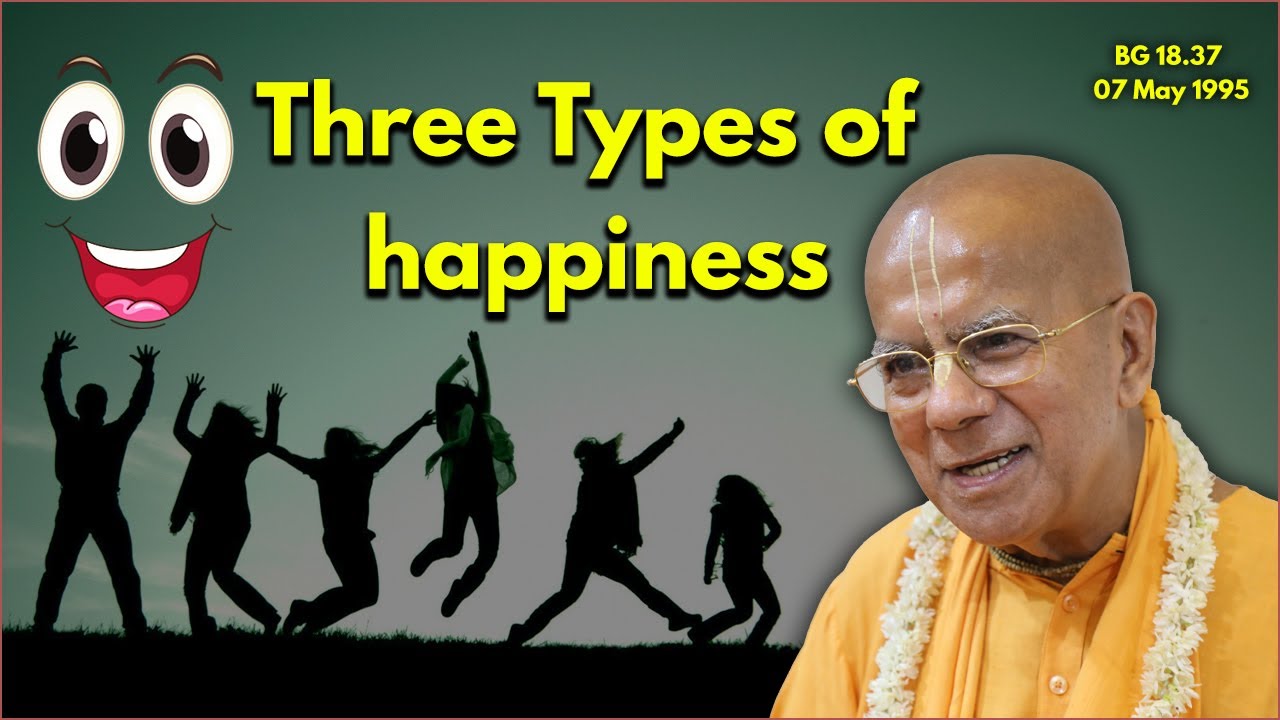
In this devotional lecture, Śrīla Gopāl Kṛṣṇa Goswāmī interprets Bhagavad‑gītā chapter 18 verses that describe three kinds of happiness corresponding to the three material modes: goodness (sattva), passion (rajas) and ignorance (tamas). He explains how happiness in the mode of goodness begins like poison but ends like nectar, awakening self‑realization; happiness in the mode of passion appears sweet at first but becomes poisonous; and happiness in the mode of ignorance is blind, delusional, and rooted in laziness. Using everyday analogies (e.g., department‑store pricing, childhood study habits), he illustrates why spiritual disciplines—chanting Hare Krishna, associating with devotees, observing regulative principles—may feel like poison initially but ultimately become nectar when they lead to self‑realization. He critiques modern material pursuits that chase instant sense gratification, linking them to disease and spiritual suffering, and describes the ignorance mode as prevalent in Kali Yuga. The lecture then broadens to Vedic education, emphasizing that the Vedas provide both spiritual and material knowledge, and that true education includes understanding one’s origin, purpose, and destiny. He outlines the practical process of developing love and devotion: cultivating desire, meeting a spiritual teacher, progressive chanting (bhajana‑kriya), and the cleansing of material desires. The speaker highlights the universal efficacy of chanting holy names, recounting stories of Caitanya Mahāprabhu and even a chanting dog, and urges listeners to adopt a simple lifestyle, high thinking, and immediate commitment to devotional service as the most reliable “touchstone” for lasting happiness.
Chapters
Om Namo Bhagavate Vasudevaya! Om Namo Bhagavate Vasudevaya! Om Namo Bhagavate Vasudevaya! Shani Vāma prīnāmem ritvopāmam tatsukam sattvikam proktaḥ āṇjanaḍharaḥ. Ātmā-buddhi-prasād vrajaṁ śrīyaḥ. The beginning may be just like poison, but in the end just like nectar, and which awakens one to Self-realization, is said to be happiness in the mode of goodness. That happiness which is derived from contact of the senses with their objects, and which appears like nectar at first but poison in the end, is said to be of the nature of passion. And now the next verse: And that happiness which is blind to self-realization, which is delusion from beginning to end, and which arises from sleep, laziness, and illusion, is said to be of the nature of ignorance. So Kṛṣṇa is describing that there are three different types of happiness or sources of happiness. Just like you go to a department store and you see there is the same commodity but in different price ranges. You can buy a shirt for $100, you can buy it for $5. So similarly, happiness is also of 3 types. Actually, it's of 4 types, but we'll just discuss 3 as discussed in these verses. So happiness is also three types: that which is in the mode of goodness, that which is in the mode of passion, and that which is in the mode of ignorance. Now Kṛṣṇa describes to us the characteristics of each of these three different categories of happiness. For example, with regards to happiness in the mode of goodness, Kṛṣṇa explains that in the beginning it is like poison, but at the end it is like nectar, and it wakes one up to Self-realization, is happiness in the mode of goodness. Now we would like to explain what Kṛṣṇa means by saying what He has said. Now, there are many activities that appear like poison in the beginning, For example, even a child who is studying, he would like to just play all the time, isn't it? But his parents compel him, "No, no, no, you must not play so much. You must restrict your playing time. You must study." Isn't it? So somebody may ask, is this something in the mode of goodness? Just like if you want to become a medical doctor or something, of that type, you really have to make a lot of sacrifice and work very, very hard. So the question is, is this also considered happiness in a mode of goodness? So the answer is no, because Kṛṣṇa explains that this must wake one up to self-realization. The activity may be in the beginning like poison, but in the end it becomes like nectar, and provided it is waking one up to Self-realization, is said to be happiness in a mode of goodness. Now to explain this further, just like when you come here every Sunday, and I can see by your faces most of you come here regularly. So when you come here or when you meet a saintly personality, You hear from him about the importance of chanting Hare Kṛṣṇa, associating with devotees, following certain guidelines like not eating meat, fish, and eggs, not taking intoxication, gambling, etc. And since we are so accustomed to all these activities, when we come to spiritual life, these activities in the beginning appear like poison. "Oh, Swamiji wants me to chant Hare Kṛṣṇa? I am so young. Where will I find the time to chant Hare Kṛṣṇa? Because if I have to chant Hare Kṛṣṇa, that means I have less time for the TV program. And I don't want the TV programs to go bankrupt. Because if I don't watch them, their rating may go down and they may have to declare bankruptcy." So I have to be compassionate to the TV producers. I have to be compassionate to all my friends who love to talk with me on the phone all the time. So obviously you have to make some sacrifice. In the 3rd chapter of the Bhagavad-gītā, Kṛṣṇa explains, aha yajña-prajāśṛṣṭvā purova ca prajāpati, that in the very beginning, at the time of creation, the Lord said, "Be thou happy by the performance of sacrifices." In other words, we must perform sacrifice after realizing this human form of body. If after realizing the human form of body we don't engage in sacrifices, then from the revealed scriptures we understand, dharmena hīna paśyubhiḥ samānaḥ, that this life is no better than that of the animals. We in the Kṛṣṇa consciousness movement derive all our knowledge from the Vedas. The word Veda is actually a Sanskrit word which in reality means knowledge. So normally we all operate under the understanding that knowledge, knowledge is only to be obtained in schools and colleges, and the Vedas only contain religious knowledge. Or religious information. But that understanding is actually incorrect. The Vedas actually contain knowledge that we should all cultivate. This is real education. In the Śrī Īśopaniṣad, it is explained that one must cultivate spiritual knowledge and material knowledge side by side. And if we cultivate spiritual knowledge, material knowledge side by side, then human life will be successful. Today we see society, everyone is engaged in a variety of activities, so many educational institutions, but nobody teaches you what happens after death. In fact, today all over the world, education has become one of the best commercial businesses. Because everybody is hankering to get 1 degree, 2 degree, they just go on adding degrees. And when they've added these degrees, they get it framed nicely and flash it in the sitting room. "Look at all these degrees that I've accumulated due to hard work." So the Vedas actually offer us education. You may have a cage,, and the cage may be very beautifully decorated. In fact, it can be ornamented with gold and silver, and there's a bird inside the cage. But if you don't feed the bird inside the cage, what good is the bird going to do living in a good environment, isn't it? Suppose somebody gives you a very nice house to live, a nice sannava garland to wear, but he says you can't have any food. Would you settle for that? You will not settle for that. So similarly, one aspect of education is what you may be learning in schools and colleges, and we are not opposed to that at all. But another aspect of education which is of paramount importance is understanding who you are. Understanding, where are you coming from? Understanding, where are you headed for? How? For different types of activities, there's going to be different types of punishment. Just like all of you know, if you don't follow, for example, the speed limit on the highway, you'll get a ticket. Or if you don't put the seatbelt on, you can get a ticket, etc. So similarly, from this Vedas, especially the Śrīmad-Bhāgavatam, from the 5th Canto, we understand how for different types of sinful activities one engages, one receives different types of punishment. So we must cultivate the Vedic knowledge also. And when we cultivate the human Vedic knowledge, we understand "Kāmāsa nendriyā pṛthī-lavau jīvata yāvata jīvasya tatva-jagyaḥ." That is, do not waste this valuable human life like the cats and dogs, but rather utilize the rare human body for a happy purpose, for a happy ending, or for serving the Supreme Personality of Godhead. So when you come in contact with a saintly personality, who is presenting the teachings of the great Ācāryas and the Supreme Lord, then you naturally hear about the importance of chanting, the importance of leading a disciplined life, the importance of avoiding activities against the scriptures, etc. And when you first have to hear about these instructions, it's painful. Because you naturally have to sacrifice something that the senses may be accustomed to. But if one is intelligent enough to recognize that by exchanging the inferior activities for a higher set of superior activities, one will only be a gainer and not a loser, then actually one is considered to be really intelligent. So Kṛṣṇa is telling us that if you have to sacrifice some of your nonsense activities in favor of finding time for Self-realization, then don't worry. It may be like poison in the beginning, but this poison is going to become nectar in the end. Naturally, even when you, even when you impose some discipline on your children, It's little painful to them. But when they grow up and they have a successful career, then they thank you for being disciplined, for disciplining them. So similarly, that activity which may be like poison in the beginning, but which wakes one up to Self-realization, is said to be happiness in the mode of goodness. Then Kṛṣṇa explains what is happiness in the mode of passion. Kṛṣṇa has explained, as we read earlier, that the nature of happiness in the mode of passion is, it is derived from contact of the senses with their objects. And it appears like nectar in the beginning, but in the end it becomes poison. So happiness in the mode of goodness was poison in the beginning and nectar in the end. And happiness in the mode of passion is nectar in the beginning and poison in the end. Now if you analyze the traditional sources of sense enjoyment that people are accustomed to, people are crazy about, people are promoting actively. You will see that both spiritually and materially these are painful. For example, everybody today is worried about so many severe diseases like cancer, AIDS, and so on. So what are these diseases a result of? These diseases are essentially the result of leaning a sinful, undisciplined life, when you act against the laws of God, when you engage in activities which are against the laws of God, then you experience material suffering and spiritual suffering. Material suffering you experience in the form of diseases, etc. And spiritual suffering you experience in the form of becoming liable for punishment that awaits us for engaging in a variety of sinful activities. So Kṛṣṇa is educating us to understand what is happiness in the mode of passion. So by and large today, 99.9% of the population, they are only interested in pursuing a path of happiness in the mode of passion. Everybody wants instant sense gratification. Just like you have instant tea, coffee, they want instant sense gratification. Come on, I've come in contact, now I want to give immediate pleasure to my senses, and immediate pleasure to my eyes, nose, tongue, and so on. And in attempting to have the sense gratification, we engage in unlimited types of sense, unlimited types of sense enjoyment. Just like in order to fulfill our unlimited desires, we had to be greedy, run after wealth, isn't it? And when we run after wealth, we spared no attempt. Any activity that gives us profit, we engage in. During my preaching all over the world, we've had numerous occasions to see Some people who are strictly vegetarian, but they're running restaurants that serve liquor and meat. So, you tell them, "But sir, this what you are doing is sinful." "But oh, what to do, Swamiji, to make some money." So, the point is that we engage in so many, I can go on with an unlimited list, of sinful activity just so that we can make some money. And why do we want all this money? Because money is the medium through which you can satisfy your unlimited sense desires. Spiritual life is simple living and high thinking. That is, you maintain a simple lifestyle, minimize your bodily needs so that you can also find time for self-realization. So Kṛṣṇa is explaining that that happiness which is derived of contact of the senses with sense objects is actually happiness in the mode of passion. Kṛṣṇa further explains happiness in the mode of ignorance. Kṛṣṇa says, that happiness which is blind to self-realization, which is delusion from beginning to end, and which is a result of sleep, laziness, and illusion is said to be in the mode of ignorance. So, in Kali Yuga, people are materially lazy and spiritually lazy. In Kali Yuga, ah, very few people really take interest in the higher values of life. So Kṛṣṇa explains that if one engages in activity in which there is no attempt to find Self-realization, in which there is no attempt to understand one's relationship with God, that is happiness in the mode of ignorance. In the mode of passion, there may be some attempt to understand God. But I want to— but the person wants to understand God in the mode of passion, just through those activities that will further give him facility for sense enjoyment. But in the mode of ignorance, there is no desire for Self-realization. There is no understanding of God or how God works. There is no desire to understand the workings of God and the position of the Lord. That is happiness in the mode of ignorance. Now we have, very briefly, because we have very limited time, We have very briefly explained these three different types of happiness. In the 18th chapter, where Kṛṣṇa summarizes the Bhāgavad-gītā, Kṛṣṇa explains different types of happiness, different types of determination, different types of knowledge, etc. Why is Kṛṣṇa explaining all this? So that we can be educated and then we can make a decision. Just like we are living in a free society. In one angle, the society is not completely free, because you have to follow so many rules and regulations, isn't it? You have to close your shop at the particular time. You have to drive your car within certain speed limits. You have to drive your car on certain side of the road. You want to walk on the street, you have to dress yourself. Yourself in some covering the different parts of your body. So though we are in a free society, we do have some element of— not— we don't have total freedom in all areas. And the freedom we have is we have the capacity to decide whether you want to follow the laws of the state or you do not want to follow the laws of the state. Am I right? So similarly, By receiving this knowledge from the Vedas, as we said earlier, the Vedas are presenting educational knowledge. By receiving this knowledge, we can then decide what angle to take, in what direction to go to. Should we go after spiritual activities or should we go after material activities? And Kṛṣṇa explains what happens if we adopt either of the two paths. For example, Kṛṣṇa says in the 18th chapter, sarva-dharmā-praritaja mām ekaṁ śrī-nām rāja, aṁ tvāṁ sarva-pāpebhyo mokṣāmi māsutaḥ. He says, give up all varieties of religiousness and just surrender unto Me. So if we surrender unto Kṛṣṇa, Kṛṣṇa promises us that we will be able to come back to Him. If we surrender unto Kṛṣṇa and serve Kṛṣṇa with love and devotion, Kṛṣṇa will accept whatever we can do but with love and devotion. In the Bhāgavad-gītā, Kṛṣṇa says, patraṁ puṣpaṁ phalaṁ toyam yo me bhaktvā prayocati. That is, if one offers Me with love and devotion a leaf, a flower, water, I will is accepted, provided it is offered with love and devotion. So Kṛṣṇa wants us to cultivate love and devotion towards Him. At present, our loving tendency and our devotion is to everything except Kṛṣṇa. Now the next question is, if Kṛṣṇa wants us to surrender to Him, if Kṛṣṇa wants us to lead a disciplined life, If Kṛṣṇa wants us to develop love and devotion, how do we develop that love and devotion? How? Just like if you decide you want to become a doctor. So then if you decide you want to become a doctor, you go to a medical school, then after you finish your education you have to go to a certain practical training, and in the end you become a doctor. Am I right? So the question ahead of us is, How to get to the stage where I can develop love and devotion, where I can surrender, etc. So a great sage, Rūpa Gosvāmī, has explained this process very nicely. He explains that at the very first stage, the individual must have the desire, the desire that I want to establish my relationship with God and I want to serve God. Kṛṣṇa is in everyone's heart, and residing in everyone's heart, He becomes aware of our desires. So when Kṛṣṇa understands that this is your desire to really understand God, then Kṛṣṇa will arrange a situation where you come in contact with a spiritualist who is known as a sadhu. So you may come in contact with the ISKCON movement or one of Prabhupāda's various books. That described to you the importance of chanting, etc. When after coming in contact with the spiritual personality, you receive this knowledge about how to establish one's relationship with God, then you begin to chant. You chant one round, two rounds. We've seen all over the world, people used to come to the temple on Sundays. They started associating, they started chanting one round, they started following one regulative principle, then they started chanting two rounds, and they slowly, slowly started chanting more and more. So as a result of this chanting, which is known as the process of bhajana-kriya, the result is that the various unlimited material desires that were stopping us from coming to God, they begin to get eliminated. This is known as anartha nivritti, or the destruction of the unlimited different anarthas in the heart. Point is, just like when you take the medicine, you take a medicine, the medicine cures you of your different germs in your body. So similarly, When you take this spiritual medicine, when you take this spiritual medicine, this spiritual medicine cures you of your desire for trying to be happy without the relationship with God. So Kṛṣṇa consciousness is presenting a very sublime philosophy. Just like when the children are over— suppose a child leaves home, the father and mother become very distressed. So similarly, we should not forget that the Supreme Lord is very unhappy seeing his parts and parcels, namely us, trying to be happy without God. So the Kṛṣṇa consciousness movement is presenting the conclusion of the Vedas, which is that somehow or the other we must engage in service to the Supreme Lord. And if we don't engage in service to the Supreme Lord, then this human life is no better than that of the animals. And service to the Lord starts with the process of chanting the holy names of the Lord. You have a name, I have a name, God also has a name. But the difference is the Lord's name is absolute. And when you chant the names of the Lord, by this chanting of the name of the Lord, You experience full satisfaction and the cleansing of the heart. The chanting of the holy names of the Lord is a very ancient system of self-realization. It is not something new. It is being practiced since times immemorial. It is recommended in the Vedic texts. It is recommended in the Bhagavad Gītā, in the Quran. It is recommended in the Bible. It is recommended in all all the authorized religious texts. That is practicing the process of chanting the holy names of the Lord as a means of self-realization. It is said that in the present age in which we are passing through, people are not too interested in self-realization. They are misguided. They are unfortunate. At one time, namely in Sathya Yuga, people had the capacity to sit down and meditate for 60,000 years. Today you can't even meditate for 5 minutes, isn't it? Many times devotees come to me and say, "Swamiji, I chant but my mind is going all over." So, mind is a big problem in Kali Yuga. And Kṛṣṇa confirms us by saying, "Everyone is struggling with the mind and the 6 senses." So realizing that the other systems of self-realization such as meditation or performing sacrifices, etc., is not practical in this age, the Lord has presented a very sublime process. That is the chanting of the holy names of Kṛṣṇa. Kṛṣṇa and Rāma are the names of the Supreme Lord, and when we chant the holy names of the Lord, we are actually praying to the Lord. To some or the other, please be engaged in devotional service. A very great sage, Thakura Bhaktinoda, has said, "It doesn't matter whether you are a householder or a sannyāsī or a brāhmachari, please some or the other take to the chanting of the holy names of Kṛṣṇa." And he further says, "Doesn't matter whether you are in happiness or distress, Take to the chanting of the Holy Name. Not that you only chant the Holy Name when you are happy. Even if you are happy, recognize that everything is coming from Kṛṣṇa and chant the Holy Name. So Thakura Vākunoda, in this very wonderful offering, he says, gāy gor madhur-smaraye, caitanya-maha-prabhu. It's in a melodious manner. Chanting the names of Kṛṣṇa. And Tākura Bhaktinātha begs all of us to somehow or the other take to the chanting of the Holy Name. So the chanting of the Holy Name is something very easy. The chanting of the Holy Name can virtually be practiced by anyone. When Caitanya Mahāprabhu was on this planet, He even made a dog chant and dance. When Caitanya Mahāprabhu was on the planet, He even made the elephants chant in Dham. There's a story that I'll tell you very fast. Once when Caitanya Mahāprabhu was a young child, he— there was a puppy dog that he took home and he started bringing up that puppy dog. So Caitanya Mahāprabhu, when he was a young child, he was known as Nimai. So all his friends got angry and they said, "Oh, Nimai, you have taken the most beautiful A little puppy dog. Anyway, it's a long story, I'll just give you. So that puppy dog one day left home and everyone in Nabadwīpa started searching where was that puppy dog. And finally they found that puppy dog in the center of Nabadwīpa. And what was he doing? He was chanting Hare Kṛṣṇa and dancing in ecstasy. Ecstasy. So when the news gradually spread all over Navadvipa that this puppy dog that was being nourished by Caitanya Mahāprabhu is now chanting and dancing, and he was displaying the symptoms of ecstasy, tears were coming from his eyes, he was rolling on the ground, his body was shivering, all of Navadvipa, everyone left their homes and they ran to the center of Navadvipa to see this dog chanting and dancing. And then they all saw how there was a special chariot that came from the spiritual world and took this dog back to Godhead. So this was Caitanya Mahāprabhu's potency. When He passed through the forest of Jhārakānda in central India, He even made the trees and the plants chant. Of course, you and I are not as— are nowhere near Lord Caitanya, who is the incarnation of Lord Śrī Kṛṣṇa. But at least as human beings, we can take to the chanting. It's our experience that all over the world, I've never met someone who has said, "Oh, this pronunciation of the Hare Kṛṣṇa mantra words are difficult." It's very easy, very practical. So our humble plea, with a straw in our mouth, our humble plea to all of you, as I said earlier, Most of you look very familiar, you all come here pretty regularly. Is some or the other, please take to the chanting of the Hare Kṛṣṇa mantra. This is the only touchstone, the only real asset. Hare Nāma Cintāmani. Everybody wants a cintāmani, a touchstone, huh? So this is the real touchstone. This is the real asset. This is the only thing that's going to accompany you. Your beautiful house, your Mercedes, your Rolls-Royces, your bank balances, etc., all going to be enjoyed by your children and grandchildren who will forget you after 13 or 14 days. But the only thing that's going to stay with you is His Holy Name. Knowing the reality, knowing the truth, unfortunately we still get so bewildered that we fail to realize the real mission of life. Just like 5,000 years ago, Maharaj Yudhishthira asked— Yāmraj asked Maharaj Yudhishthira a very simple question. Yāmraj is the superintendent of death. Just like you have a police commissioner in Toronto that may control the traffic in Toronto, Yāmraj as a superintendent of death keeps an eye on everyone's activity. So Yudhishthira Maharaj was always very philosophical, the eldest of the Pandavas. So Yāmraj asked Yudhishthira, he said, "Yudhishthira, you are very philosophical and everybody respects you. What do you think is the most amazing thing on this planet?" So Yudhishthira thought very, very deeply. Finally, Yudhishthira replied and said, "The most amazing thing is that now everybody sees that everybody else before him has died. Father, grandfather, friends, his et cetera, somehow or the other he thinks that I will not have to die. Or even if he thinks I'm going to die, normally people think I will choose my moment of death. And then there's no problem if I do nonsense today. I know I'm not going to die before at least 70, 75. So I will surrender to Kṛṣṇa before I die. So we may think that we are the controllers of our destiny. We are not the controllers of our destiny. Therefore, Tākṛvākīṇoda says, don't be so foolish. This human life, it can get end at any time. So take to spiritual life now, now, now. Just like if any of you get an opportunity to make a big fast buck or to become a millionaire, you don't say, "Okay, I'll become a millionaire 20 years later." You jump at the opportunity, isn't it? So jump at the opportunity to become spiritually happy. Path is very simple. Caitanya Mahāprabhu has made it even easy. It was easy, but now He's made it even easier. What is the simple recommendation? Chānta Hare Kṛṣṇa, read the Bhāgavad-gītā, Śrīmad-Bhāgavatam, associate with devotees, and worship the Deities, and thereby you'll be happy. So this is our humble plea. Sorry, I've gone a little bit over time. Please take advantage of this very sublime philosophy, and that will give you happiness. And try it. If you, you're already doing it, then fine. If you aren't doing it, then please try. You have nothing to lose and everything to gain. Hare Krishna. Hale hale. Hale lama hale. Lama lama hale hale.
More from PRASAD

Rare Pastimes & Timeless Lessons of Guru Mahārāja | Stories Every Disciple Should Hear

ISKCON Legends- pure devotees meet-HH Jayapataka Swami, HH Gopal Krishna Goswami, HH Radhanath Swami



Jagannātha Ratha-yātrā Through Śrīla Prabhupāda's Mercy | 29 April 2006 | Nairobi, Kenya

Lord Jagannātha's Appearance Pastime | 21.07.2019 | ISKCON Calgary | Śrīla Gopāla Kṛṣṇa Gosvāmī

The Ācārya Teaches by His Own ExampleGuṇḍicā Mārjana by Guru Mahārāja #shorts

Guṇḍicā Mārjana – Lord Jagannātha's Pastime | 21.7.2019 | ISKCON Calgary |Śrīla Gopāla Kṛṣṇa Gosvāmī

H.H. Gopāla Kṛṣṇa Gosvāmī Mahārāja - Exemplary Sādhana and Deity Worship # shorts

भगवान की कृपा कैसे प्राप्त होगी ? | 11 Jan 2014 | Punjabi Bagh | Srila Gopal Krishna Goswami

Material Education vs Spiritual Education | Srila Gopal Krishna Goswami #shorts