To serve Krishna to one’s Best ability | SB 04.30.08 | 14 June 2007 | USA | Gopal Krishna Goswami
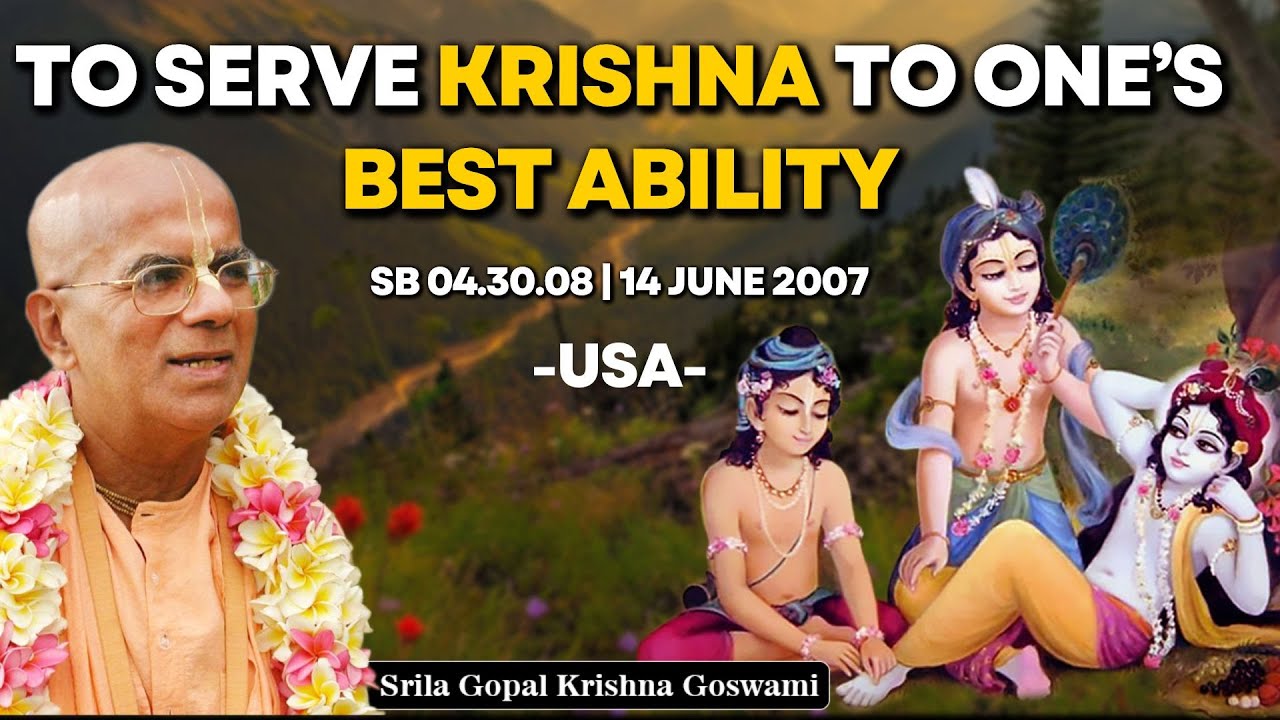
In this devotional lecture, Gopal Krishna Goswami expounds on the Bhagavata‑purana episode of the Prachetas brothers, highlighting their extreme austerities, the mantra bestowed by Lord Śiva, and the Lord’s personal appearance to reward their united service. He uses this narrative to illustrate the principle that true unity among souls arises only when all are engaged in the single occupation of devotional service to Krishna, contrasting it with the superficial or self‑serving unity of material institutions such as the United Nations. The talk explains the progressive reduction of human lifespan across the four yugas—Satya (100,000 years), Treta (10,000 years), Dvāpara (1,000 years), and Kali (100 years)—and relates these scriptural timelines to contemporary concerns about declining life expectancy, artificial life‑support, and the looming hardships of Kali‑yuga. Modern crises, especially global warming and rising loneliness, are presented as fulfillments of scriptural predictions, reinforcing the urgency of Krishna‑conscious living. The speaker stresses the indispensable role of austerity (tapas) and sincere service, citing examples from both ancient saints (Prahlāda, Dhruva) and modern practitioners, while critiquing contemporary preachers who neglect austerity. He affirms Lord Śiva as the greatest Vaishnava among the twelve spiritual authorities, and underscores that devotional service, not material occupation, is the true ‘business’ of a Krishna‑conscious devotee. The lecture concludes with practical advice: cultivate friendship among devotees, focus on the singular goal of serving Krishna, and remember the Prachetas pastimes to receive the Lord’s blessings.
Chapters
Om Namo Bhagavate Vasudevaya. Om Namo Bhagavate Vasudevaya. Om Namo Bhagavate Vasudevaya. Shri Bhagavan, wacha. Shri Bhagavan, wacha. Wanam brindvam badram bo. Wanam brindvam badram bo. Yuyame nirpananda nam. Yuyame nirpananda nam. Sordinah pratag dharmas. Sordinah pratag dharmas. Tusto ham sordinah vaha. Tusto ham sordinah vaha. The purpose is even sweeter. Purpose by His Divine Grace A.C. Bhaktivedanta Swami Śrī Prabhupāda. Śrī Prabhupāda ki— Jāna! Since the sons of King Prajñābharata were all united in Kṛṣṇa consciousness, the Lord was very pleased with them. Each and every one of the sons of King Prajñābharata was an individual soul, but they were united in offering transcendental service to the Lord. The unity of the individual souls attempting to satisfy the Supreme Lord or rendering service to the Lord is real unity. In the material world, such unity is not possible. Even though people may officially unite, they all have different interests. In the United Nations, for example, all the nations have their particular national ambitions, and consequently they cannot be united. —This unity between individual souls is so strong within this material world, and even in a society of Kṛṣṇa consciousness, members sometimes appear disunited due to their having different opinions and leaning towards material things. Actually, in Kṛṣṇa consciousness, there cannot be two options. There is only one goal: to serve Kṛṣṇa to one's best ability. If there is some disagreement over service, such disagreement is to be taken as spiritual. Those who are actually engaged in the service of the Supreme Personality of Godhead cannot be disunited in any circumstance. This makes the Supreme Personality of Godhead very happy and willing to award all kinds of benediction to His devotees, as indicated in this verse. We can see that the Lord is immediately prepared to award all benediction to the sons of King Praśināvarṣa. The verse in the purport are very sweet. Actually, the entire Bhāgavatam is very sweet. The Bhāgavatam is like a sugar candy. Sugar candy or sugar cane, whether you bite in the middle or the top or the bottom, the taste is always sweet. So similarly, the Bhāgavatam is always sweet, but some verses are more nectarian than others. Therefore, devotees have a habit of memorizing certain key verses that are very useful in preaching and in fixing up oneself on the path of Kṛṣṇa consciousness. So here we are reading about the activities of the prasādhas. Which is the 30th verse of the 4th canto. Who were the prachetas? The prachetas were the sons of a king. The name of the king was King Prachinabharisha. Based on the father's instructions, they performed extreme austerities. In the previous ages, the kings also would send their children to perform austerities and get trained in spiritual life before entering the grihastha, ashram, or before taking on the responsibilities of monarchy. They will be trained in spiritual life. And if one is trained in spiritual life, then doesn't matter in which ashram one is, doesn't matter in which situation one is, one can achieve the goal of life. So the prachetas went to perform austerities, and there, by the will of the Providence, they met Lord Śiva. Lord Śiva is one of the mahajans or spiritual authorities. Saimbuna āda-sambhu-kavara-kapilomanu-palado-janaka-bheshmāu-baliḥ-vāya-sakēr-vāyaṁ. So there are 12 established identi— authorities on spirituality. Just like in any profession, we sometimes say, 'Oh, this man is an authority on computers. This man is an authority on science. This man is an authority on physics.' Don't we say that in the material world? The man, if he's written several books, so if this man has done— in the material world we have Authorities in different subjects, isn't it? So we also have spiritual authorities. 12 personalities are identified in the scriptures as spiritual authorities, and one of the 12 is Lord Śiva. And Lord Śiva, when he saw the prachetas, he was very pleased. He could see they are very sincere. So he gave them a chant that glorifies the Supreme Personality of Godhead, Lord Śrī Kṛṣṇa. And then the pracetas, for 10,000 years, they stood in water and they performed this austerities of chanting this mantra glorifying Lord Kṛṣṇa. For 10,000 years. Now, if you were to make this statement to the present-day materialists, they would say, 'Mycology! It's absurd. How can somebody live for 10,000 years?' Isn't it? I mean, what's the lifespan today? The lifespan in America is about 80, 78 years for a man or something, and about 80 average 82 for a female. In Russia, because they drink so much, the lifespan, the average lifespan of a male Russian is only 58 years. So I'm saying the lifespan in today's environment may be 80 years, and someone may say, 'If the lifespan is only 80 years, how on earth did the prasād rāval meditate for 10,000 years?' Isn't it? They lived longer, but they meditated alone for 10,000 years. So the answer is that this pastime took place in Satya Yuga, and in Satya Yuga, the lifespan was 100,000 years. So to have meditated for 10,000 years is not difficult. There are certain so-called scholars and philosophers who made a serious attempt to discredit the Vedic scriptures. During the Mohammedan rule of India, the Mohammedans were very crude, brutal. They just destroyed the temples. They said, "Go and destroy these temples," and like a runt, they destroyed so many temples. The Britishers came throwing the Mohammedans out of India. They were more civilized and they stopped the breaking of temples. Thakur Bhaktinath has given a great debt to the Britishers because he says that they stopped the breaking of temples. But they had their own agenda which is a little bit more subtle. They had scholars come from England who became expert in the Sanskrit language. Then they started studying the Vedas. And then they started writing books presenting, "Oh, this is all mythology. This is not reality." And then a certain class, even the so-called educated people said, "Oh, this is all mythology. We don't have faith in the Vedas." The fourth offense in chanting the Holy Name is— what is the fourth offense in chanting the Holy Name? The Bhāgavad-gītā literature or literature in pursuance of the Vedic version. To think that the Vedas were not compiled by God, to think that the Vedas don't contain eternal wisdom, to think that the Vedas do not have relevance in today's society is also an offense. For the Vedic knowledge emanated from where? From the Supersonality of Godhead. So as we understand from the scriptures, In Satya Yuga, the lifespan was 100,000 years. In Treta Yuga, the lifespan got reduced 10 times to 10,000 years. In Dwapara Yuga, to 1,000 years. And Kali Yuga to a maximum of 100 years. But if you analyze it correctly, in today's society, how many people even live for 100 years? I mean, if you— I don't know what the statistics are in America. But I'm sure it'd be a small percentage of people live 400. And even if they live beyond 85, now living, they're virtually dead. I mean, you know, I mean, you need— it's such an artificial living. Isn't it just like they have— I mean, now they've reduced it. Just like until about 20 years ago, they would try and keep people artificially alive. In hospitals, you know, because now they have all these instruments to keep pumping your heart, keep your organs moving. But then the cost of keeping people artificially alive was medically so high that the insurance companies didn't want to pay. They said, "We don't want to— better pull the plug out earlier. We don't want to pay." So then there's a whole controversy in the Western world, and it's still going on, that at what point should a person be allowed to die, and at what point do you stop using artificial devices to keep people alive. So the lifespan these days, now in principle is 100 years, but you can see it's gradually going down, and as Kali Yuga advances, A day will come when a 30-year-old man will be considered an old man. You may laugh it off today, but that is, that is predicted in the scriptures. And a 3-foot man will be considered a tall man. So make plans to get out of mature world. So the answer is, We make plans to get out of the material world because the material world is going to get more and more terrible with the passage of each day. This is not something that is spiritual propaganda. If you follow what the materialists, if you follow what the scientists, adhishtha is talking, they're all talking about global warming. It's all talking about the effects of global warming on society and the predictions are that the situation is going to be so terrible that it's going to be almost unbearable. There was recently a United Nations report on the effects of global warming around the world, and it was published in a leading magazine in India, the effects it would have on the world and India. And it's disastrous. You know, the ice glaciers are melting, and as a result, they are predicting that a lot of the cities next to the rivers are going to get drowned, the water levels are going to rise, the scarcity of water, etc. So the point is, all this is happening, why? America releases 22% of the pollution emissions that go on in the world. The highest comes from America, 22%. So that we are all kind of— what is causing this global warming? Mankind's greed. Our greed to have more and more facilities, our greed to defy the laws of nature, which is simple living and high thinking, is what has contributed to global warming. The temperatures around the world are getting warmer year by year, isn't it? They predict that in another 30 to 40 years England's temperature is going to be like, like India. So we can see that what the Bhāgavatam has to say about developments in Kali-yuga are coming true. The Bhāgavatam says that in Kali-yuga people will be so oppressed that they'll run to the forest and the mountains for peace of mind. You know, people will be so unhappy, and we can see that happening all over the world. I recently read a survey that was done in America that showed that Americans are 30% more lonely today than they were 20 years ago. And the average American, 30-year-old, is far worse off than his father was at his time. So you can see how the prediction of the scriptures is bearing fruit in today's environment. So we have to have faith, and you can use all this for preaching in today's environment. So the Bhāgavatam gives us information about the lifespan in different ages. And in Satyuga, the lifespan was 100,000 years. Now the prachetas very sincerely chanted the song, the mantra that was given to them by Lord Śiva. Now this proves another point that we should know, which is The Lord Śiva is the greatest of the Vaishnavas. Vaishnava yathā-sambhu. He is the greatest of Vaishnavas. And if you read the 10th Canto, you will see stories how Lord Śiva glorifies Kṛṣṇa as the Supreme Personality of Godhead. In the Bhāgavatam you see Śiva, Brahmā, Indra, Indra, all glorifying the Supreme Personality of Godhead. Now the prasādhakas performed austerities, and because they performed austerities, the Supreme Lord was very pleased. How can you please the Lord with your bank balance? Can you? No. Can you please the Lord with your beauty? No. Can you please the Lord with scholarly achievements? No. Then what can you please the Lord with? Devotional service. With devotional service. So, but in this case, the Lord was pleased by their austerities. Just like Lord Brahmā says in the third canto, "Tapa sevā param jyotir bhāgavatā madhaukṣajām." Lord Brahmā says, "One of the various names of the Lord, that is Adhaukṣaja." What does Adhaukṣaja mean? Adhaukṣaja means what? Who cannot be easily understood. The Lord cannot be easily captured or understood. But the Lord can be captured or understood Through the medium of tapasya. Tapasya means austerity. Tapasya means voluntarily accepting some inconveniences for a higher cause. Now in the material world, don't we voluntarily experience inconveniences for a higher cause? Let's say somebody wants to enter university. You really have to work hard, isn't it? Study, study, study. I know in India they have these board exams, and when they have these board exams, boy, it's almost like these students for day and night they do nothing but just study, study, study. Especially these days, unless you get some top 95% grades, you can't even get into university. So they just study, study, study, isn't it? They sacrifice the opportunity to watch movies, this, that, so that. They can get good grades to get to a good school. Then sometimes businessmen, etc., he works hard to make a profit, establish a business, and so on. Even these musicians and sportsmen, before they really become big, they really have to practice 20 hours a day before they become— they make it big. It's not that it happens instantly. So the point is, in material life also, We do sacrifice opportunities to achieve a higher goal. And if you don't sacrifice opportunities to achieve a higher goal, then you end up as an uneducated man. So in mature life also we do see, like those who become doctors, lawyers, you know, they do have to make a lot of sacrifice to achieve the material success. So in spiritual life also, we do have to achieve, we do have to make some sacrifices to achieve a higher goal, and we have to voluntarily accept inconveniences for achieving a higher goal. But fortunately, our austerities are not as severe as those performed by the prasād rāvalas. Or they are not as severe as those performed by Prahlāda Mahārāja or Dhruva Mahārāja, isn't it? Prahlāda Mahārāja, for example, had poisonous snakes around him. He had elephants walk on him. He was thrown from mountain tops, so it's a lot. And by Lord Caitanya's mercy, the austerities in the stage of Godhead so simplified. Just chant, eat as much prasāda as you want. "Mareet Krishna prasāda." Chant, dance, and feast. So the Lord was very pleased by the austerity that the prachetas had performed, and as a result, the Lord manifested Himself in front of the prachetas. And in the previous verses, including the verse that was actually scheduled for today, That was text 7. It is described how the Lord appeared in front of the prasādhas, how the Lord was decorated. Like in the neck of the Personality of Godhead hung a flower garland that reached His knees. His 8 stout and elongated arms were decorated with a garland which challenged the beauty of the Goddess of Fortune. So the Lord, when He appeared, He appeared so beautiful. This is one of the 6 characteristics of the Lord. Eśvarācya-samāgrasya vīryaśāyaśaśāśraya yānaveragyāvāśayavasannabhāgā iten gināḥ. Prasādamuni says that the Supreme Lord is one who has 6 characteristics in unlimited degree. And one of the 6 is no one can compare to the Lord's beauty. Not only is the Lord's beauty, Lord the most beautiful, the Lord's opulences are increasing every second. By the time you finish the class, Kṛṣṇa's opulences would have gone up. They are increasing every second. In mature life, our opulence, our beauty goes down as we age, isn't it? As people get older, they become more and more ugly, isn't it? They're sweetest when they're kids, and then as they grow older, the beauty gets lesser and lesser. They'll finally become so ugly. While the Lord's beauty increases every second, and Lord's opulence is always increasing. So the previous word describes that Lord's beauty was so powerful that even the— it was more beautiful than the Goddess of Fortune. And the Supreme Lord was so pleased with the prachetas that He appeared there and He addressed them. So the Supreme Lord is pleased by the austerities of His devotees. When you perform austerities, then the Supreme Lord will get pleased. And without austerities, you can't capture the Lord. These days you have a lot of religious preachers in India, in America, all over the world. And if you examine the teachings of these so-called preachers, they'll talk of everything but austerity. Everything but austerity. Why? First of all, the preachers themselves don't practice austerity. To begin with, they are hypocrites, but they want to— don't want to be very big hypocrites. So they— and then they are scared if they talk of austerity, people will go away. No one will come. Just like when Prabhupāda came to America. When Prabhupāda came to America in '65, '66, at that time America was very involved in the Vietnam War. And there were a lot of anti-government protests. Like you see anti-Iraq protests now, you see the anti-government protests. And there were a lot of hippies, you know, those are the hippie generation. So a lot of sannyās swamis had come from India. Those were the days of the Swami boom. So when these swamis saw Prabhupāda and what he was teaching. They approached Prabhupāda and said, "Swāmiji, you are new to this country. We have been here for such a long time and no one's going to follow no meat, no fish, no sex life. You should wear suits like us." Prabhupāda was wearing the traditional dress and You should learn to eat with fork and knife, the rest of it. But Prabhupāda was not interested in a compromise or watering down of the philosophy. He had come to give the genuine product. So he did not compromise. So austerity is not emphasized. And even if it is emphasized, they'll say, "Okay, be a vegetarian." There's a good deal, but nothing beyond that. But austerity is the wealth of the Brahmana. Just like a materialist decorates oneself with ornaments, a spiritualist decorates oneself with austerity. Austerity is his decoration, not jewelry, fancy clothes, and so on. The Supreme Lord was very pleased by the prachetas. Now what is the Supreme Lord saying in this verse? He's saying, my dear sons of the king, I'm very much pleased by the friendly relationship amongst you. He said, I'm very pleased by the friendly relationship. Prachetas were several brothers. So these, these brothers were all united in their service to the Supreme Lord. So here the Lord is, here this verse is spoken by the Lord Himself. He is saying, "I am very much pleased by the friendly relationship amongst you." Why? Why is the Lord pleased by the friendly relationship amongst the prasadas? Because they all had one occupation. All the brothers were engaged in worshipping the Lord. So the Lord said, "All of you have one occupation." So similarly, in a Kṛṣṇa conscious movement, we have individuals. Individuals make up the movement, isn't it? We have somebody may be a brahmachari, somebody may be sannyāsī, somebody may be kriyāsa, somebody may be a housewife, somebody may be a student, doesn't matter. We may have, even in terms of occupations, we may have people with different occupations. Somebody may be an accountant, somebody may be a lawyer, somebody may be an engineer, somebody may be a simple sweet sweeper. Doesn't matter. We don't care what one's profession is. What we care for, if he understands the higher profession, that is devotional service. So Supreme Lord is saying, All of you have one occupation, and that is devotional service. So our real business is devotional service. That is our real business. Now, since we are living in the material world and we need funds to maintain, we need funds to run a temple, we may take on different jobs, businesses, etc. That we've gone to the material world. But Kṛṣṇa advises in the Bhāgavad-gītā, we should work in the spirit of detachment, just like a lotus sleeps within water but not touched by the water. Now we all have one occupation, devotional service. So our real business— someone may say, "Oh, what's your business?" So you may say, "I'm a foreman or an engineer." But real business is devotional service. So the Supreme Lord was pleased, pleased by the prasād rāvalas because they were all engaged in one occupation, devotional service. And further the Lord says, "I am so pleased with your mutual friendship that I wish you all good fortune." So the Supreme Lord is very pleased. When He sees individuals engaged on the devotional path. And the Lord is saying that, "I am very pleased by your devotion and mutual friendship that I want to bless you that you may get all good fortune." So the point is that even if you are living in a community of devotees, Our real business is to engage in devotional service. And the Supreme Lord is very pleased when He sees that we are united to serve Him. Prabhupāda used to say, "United we stand, divided we fall." You heard that in English? United we stand, divided we fall. So if we are united, we can please the Lord. If we're united in serving the Lord, then the Lord is very pleased, and then the Lord is able, willing to give us any benediction that we may want. And if we're not united, if we're not running devotional service, then there's no question of being united. And Prabhupāda in the purport gives the example of the United Nations. It's United Nations, but in reality it is This United Nations, and it's United Nations, but as Prabhupāda said in the purport, actually everybody is pushing his own agenda. Every nation is thinking, "What can I get? What benefit can I get from this?" So that, so the material world, there's no unity. Is there any unity? No. Even amongst People of one political party, are they united? No. They may get united temporarily with a gain, but inside they all have their own agendas. But on a devotional path, we get united because our goal is to serve Kṛṣṇa. If our goal is to serve Kṛṣṇa, then one can get united. Prabhupada was once taking part in a so-called spiritual conference with certain other spiritual leaders. One of them was the late Yogi Bhajan and so on. So they were talking about unity, how to bring about unity in religions. So Prabhupada said, unity in religion is possible. One God, Krishna. One scripture, Bhagavad-gītā. One mantra, Hare Kṛṣṇa. The point is you can have unity if you're focused on the Supreme Lord. Otherwise, where is the question of unity? Otherwise, the question of I scratch your back, you scratch my back. You help, I help you to cheat, and you help me to cheat. That's why Bhagavad-gītā, Śrīla Nārādhana Mahāprabhu used to say, "It's the world of the cheaters and the cheated." So over here it is being said that in the material world there is disunity between individual souls. But if we, if we are serving Kṛṣṇa, if our goal is to serve Kṛṣṇa, and you are working in friendship with unity with one another, Then the Supreme Lord will be very pleased. And if the Supreme Lord is pleased, then we achieve the goal of life. And if the Supreme Lord is not pleased, then everything is shama evahikīram, simply a waste of time. So our goal should be to please the Lord. Lord desires that we work in friendship. Prabhupāda used to say, that we should not be like the bee but be like the ha— and we should not be like the fly but be like the bee. The fly has a tendency to look for dirt, isn't it? Look for dirt and go wherever something is dirty. And the bee has a tendency to look for honey. And it goes to a flower. The swan lives in a clean environment, where the crows live in garbage. Even though both are birds of the same feather. So similarly, Prabhupāda said that devotee, he should be willing, he should be willing to see other Vaishnavas' good points. And appreciate the good point, and rather than just talking about the weak point. And that will help promote friendship amongst devotees. So this friendship amongst devotees can be achieved if there is one focal point. And if our focal point is Kṛṣṇa, then there will be friendship amongst devotees. And if there is friendship amongst devotees, then the Supreme Lord is pleased. And one way to achieve friendship amongst devotees is to look at the good points in others. And if we are looking at the good points in others, then that will help us to create a positive mood. And a positive mood will help in uniting devotees. So those who are actually engaged in service of the Supreme Personality of Godhead cannot be disunited in any circumstances. If you are, if you are focusing on serving the Supreme Lord, then that will actually bring about unity. There may be some difference of views, but if you are engaged in serving the Supreme Lord, that will actually bring about real unity. And over here Prabhupāda says that if one is working in friendship, Then the Supreme Personality of Godhead is very happy and is willing to award all benedictions to devotees. So what's the benediction a devotee wants? What's the benediction a devotee wants? More service, the opportunity to serve the Lord, liberation also. But a devotee's desire is I will just have the opportunity to serve. Just like Caitanya Mahāprabhu, He instructed His followers to write volumes of books, but Caitanya Mahāprabhu left behind only 8 verses identified as the Śrīkṣāstra. So in one of the verses Caitanya Mahāprabhu says, nandanam na janam na sundarem kamitām vajra-grihikam aye. Mama janmani janmishre bhaktat bhaktir eitukītyāya. My dear Lord, I don't want materialistic followers or beautiful women or wealth. I just want the opportunity to serve You birth after birth. So the Supreme Lord reciprocates with our surrender. Kṛṣṇa makes this very clear in the Bhāgavad-gītā. Ye yathā mām prapadeante.. All of them, as they surrendered to Me, I rewarded them accordingly. So Kṛṣṇa reciprocates according to our surrender. And when Kṛṣṇa sees that we have a genuine desire to surrender, then He reciprocates and guides us accordingly. So the Supreme Lord was very pleased by the prachetas because they were all, all the brothers were engaged in devotional service of the Supreme Lord. And when we serve the Lord in friendship, the Lord is pleased. And we serve the Lord in the opposite, then He is not so pleased. So Supreme Lord wants us to serve Him in friendship. And we are all engaged in devotional service, then automatically there will be friendship. Our binding is based on the principle of serving, not on the basis of nationalities or whatever. It's on the basis of serving. And if we all engage in service, then we'll be united and the Lord will be pleased by our efforts. And the Lord will reciprocate accordingly. So what is most important is that we constantly engage in devotional service. And what is the medium for engaging in devotional service? How do we engage in devotional service? Through the process of? Śrāvanaṁ keṇḍanaṁ. Our unity has to be based on śāstra. It cannot be just sentimental unity. Our unity is based on the instruction of the spiritual master. To what degree are we following the path that Prabhupāda has given us? And if we are all engaged in devotional service, then there will be friendship, then the Supreme Lord will "Lesus," you may say, "Is the Supreme Lord going to come and appear before us just like He appeared in front of the prachetas?" The Supreme Lord is already manifesting Himself in front of us through the medium of the Holy Name, through the medium of the Deity. That's Kṛṣṇa. Non-different from the Lord. The Holy Name is not different from the Lord. The scriptures, are not different from the Lord. Just like here it is said that anyone who remembers in the morning and evening this pastime of the Prasada will get unlimited blessings of the Lord. So you can see how much more powerful is devotional service of the Lord. The Lord says anyone, anyone remembers How in the morning and evening if you remember this pastime, how the Prachetas performed much charity and how the Lord became pleased with them, just by remembering this pastime you will get unlimited blessings of the Lord. And if you were to do the pastime, then you can imagine how pleased the Lord will be. Even by remembering about these pastimes, we will get great benediction from the Lord. So to summarize, the Lord was very pleased by the prasadas because they were all united in serving the Supreme Lord. They served the Supreme Lord on the basis of a mantra chant given to them by Lord Śiva. And the Supreme Lord was so pleased that He eventually came and gave them benediction. And not only the Supreme Lord, in the next chapter we'll read Narada Muni. He also gave the pacetas valuable practical instruction, the process of devotional service. So we should serve the Lord in friendship, but this is a medium through which the Lord can be pleased. Hare Krishna.
More from PRASAD

Rare Pastimes & Timeless Lessons of Guru Mahārāja | Stories Every Disciple Should Hear

ISKCON Legends- pure devotees meet-HH Jayapataka Swami, HH Gopal Krishna Goswami, HH Radhanath Swami



Jagannātha Ratha-yātrā Through Śrīla Prabhupāda's Mercy | 29 April 2006 | Nairobi, Kenya

Lord Jagannātha's Appearance Pastime | 21.07.2019 | ISKCON Calgary | Śrīla Gopāla Kṛṣṇa Gosvāmī

The Ācārya Teaches by His Own ExampleGuṇḍicā Mārjana by Guru Mahārāja #shorts

Guṇḍicā Mārjana – Lord Jagannātha's Pastime | 21.7.2019 | ISKCON Calgary |Śrīla Gopāla Kṛṣṇa Gosvāmī

H.H. Gopāla Kṛṣṇa Gosvāmī Mahārāja - Exemplary Sādhana and Deity Worship # shorts

भगवान की कृपा कैसे प्राप्त होगी ? | 11 Jan 2014 | Punjabi Bagh | Srila Gopal Krishna Goswami

Material Education vs Spiritual Education | Srila Gopal Krishna Goswami #shorts