Upadeśāmṛta NOI 2: How Devotional Service be Destroyed | Rus-Split | 9.5.90 | Gopal Krishna Goswami
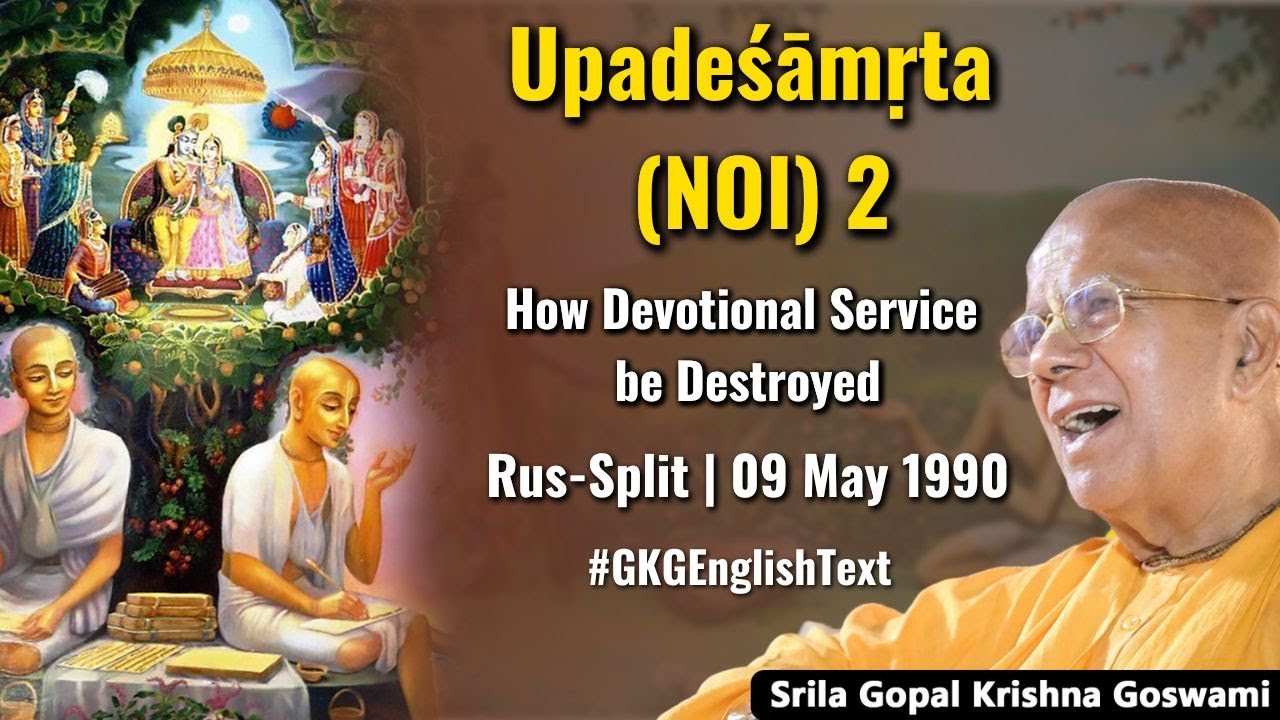
In this 90‑minute lecture, senior devotee Gopal Krishna Goswami (Speaker A) expounds on verse 2 of Śrī Upadeśāmṛta, outlining the six activities that can destroy devotional service: atyāhāra (overeating/over‑endeavouring), payāśa (excessive striving for material goals), prajalpa (mundane talk), niyamāgraha (mis‑application of rules), janasaṅga (association with non‑devotees beyond necessity), and loliya (greed). He explains each fault with scriptural citations (Rūpa Gosvāmī, Bhagavad‑gītā, Prabhupāda) and illustrates how they lead to loss of spiritual focus. The talk then shifts to practical guidance: the importance of chanting, hearing, reading, and meditating on Krishna; strict yet practical observance of regulative principles; cultivating appropriate association (with more advanced, equal, or less‑advanced devotees); and the role of harināma (congregational chanting) especially in the Soviet context. Throughout, Speaker A addresses questions from a Russian attendee (Speaker B) about lack of attraction to Krishna, language barriers, the meaning of fanaticism, handling difficulty in chanting, and the missionary mandate to spread Krishna consciousness to every village in the Soviet Union. The lecture emphasizes a disciplined, enthusiastic approach to devotional life, warning against materialist tendencies and encouraging relentless, rule‑based service while remaining compassionate and practical.
Chapters
Prasad RAVAL. So should I do this verse from Upadeśamit now or no? Do we have time for it? So you may remember the day before yesterday we had read a verse which described the important point for making spiritual advancement, how to control the senses. So text 2 describes how devotional service can be destroyed. So this text We will discuss in the next half an hour, okay? Atyāhārāprāyaśāśca prajalpō niya-māgraha jān-saṅgaśca lo-liyaṁ ca sād-bhir-bhaktir-vināśyati. In this verse, Rūpa Gosvāmī is giving us advice so that we may succeed spiritually. You may remember that I had said the other day that nectar of instruction is nothing but Śrī Upadeśāmitra compiled by Rūpa Gosvāmī. There are 11 verses in this text. In the first verse, the importance of mind and sense control was emphasized. In this second verse, Rūpa Gosvāmī is giving us information so that we may not fall from spiritual path. Just like when there is some road construction going on, then before your car reaches that site, They have signs in the far which say, "Careful, be careful, drive carefully," isn't it? So when you see that sign, then you drive carefully. And also, if there's a school nearby, they put signs, "Be careful, children at play." So then you drive carefully so you don't have an accident with any of the children. So similarly, Rupa Goswami is giving us advice to make sure that we succeed in our spiritual mission. Rupa Goswami has said, that our devotional service will be spoiled due to 6 activities. One is atyāhārā. Atyāhārā means overeating or overendeavouring. When we have these feasts, we encourage people to overeat, eat as much prasāda as they want. But we should not make a habit of overeating every day, otherwise you will get diseased. You remember in our discussion of Text 1, We explain how the tongue, the belly, and the genitals, they are all in a straight line. And because if we overeat, you will get diseases. And also we should not over-collect. We should not collect more than necessary. By God's arrangement, everybody is getting what he needs for his maintenance. So there is no need to be greedy and accumulate. Prabhupāda says, by God's arrangement, man can be happy with a little bit of kṛṣṇa land, cow, and milk. So there's no need to over-endeavor to have a big income. We should avoid overeating and over-collecting. We should never forget that human life is meant for self-realization. The Supreme Personality of Godhead has three principal energies: antiranga shakti, bahiranga shakti, tattva-shakti—internal energy, external energy, marginal energy. The living entities belong to the tattvaśtar śakti, or the marginal energy, because they can either go to the spiritual path or the material path. When the living entity is under the control of the internal energy of the Lord, then he is rightly situated. But when the living entity is under the influence of the external energy or māyā, he is wrongly situated. So Kṛṣṇa is giving us this information so that We may remain under the internal energy and not the external energy. Another thing that He mentions we should avoid is payāśa. Payāśa means over-endeavouring for mundane things that are difficult to obtain. Those who believe in the mission of human life should not have to over-endeavour to make their two ends meet. Dharmasya pavargasya nartur atāyaḥ kālpate, nārtasya dharmaikā nātasya kāmaḥ lobaḥ hi smṛtaha. The Bhāgavad-gītā says that all occupational engagements are meant to serve the Supreme Personality of Godhead, and one should only engage in such service by which the goal of life can be realized. So atyāhāla, as we said, meant over-collecting, and payāśyaṣṭha means over-endeavouring. Now the materialists, they want to over-endeavour and over-collect. And because of over-endeavouring and over-collecting, they have no time for spiritual life. Like I was explaining to you the other day, the spiritual motto is simple living, high thinking. So if your principle is simple living, high thinking, there is no question of over-endeavouring. Another factor that Rūpa Gosvāmī says we should avoid is prajālpa. Prajālpa means mundane talk. A devotee is only interested in Kṛṣṇa-katha. Sometimes people say that Kṛṣṇa appears in order to kill the demons. But if Kṛṣṇa wants to kill the demons, He does not have to descend. He can easily arrange some natural disaster like earthquake, or people can have heart attacks. But one reason why Kṛṣṇa appears is to create Kṛṣṇa-katha. So Kṛṣṇa-katha means talking about Kṛṣṇa. If the tongue is not gavarai about Kṛṣṇa, then it will be gavarai about Maya. So prajalpa means talking about things which have nothing to do with devotional service. And if you engage in prajalpa, then in the night you will also dream about prajalpa. I think you know this very simple rule. Whatever you talk, that is what you dream in the night. And whatever you talk, that is what you will think. So if you're talking about book distribution, then you will think about book distribution. If you're talking about Kṛṣṇa, you'll think about Kṛṣṇa. And if you're talking about Maya, you'll think about Maya. The tongue and the mind have a very deep connection. Whatever comes out of your tongue is registered in the mind. So don't think that mentally you will think of Kṛṣṇa, but with the tongue you'll talk about Maya. That is not possible. So it is very important that we engage in Kṛṣṇa-katha. Then niyamāgraha. Niyamāgraha means following the rules and regulations just for the sake of following them and not for the sake of spiritual advancement. In Sanskrit, there are two words. One is niyama agraha. Niyama agraha means neglecting the rules and regulations of the scriptures. Niyama agraha. Agraha without accent means rejecting the rules and regulations. And niyama agraha. Agraha with accent means accepting the rules and regulations for spiritual advancement. So niyama agraha, it has two meanings. One is you accept the rules and regulations for spiritual advancement. The other is you reject the rules and regulations for spiritual advancement. In other words, the rules and regulations which are there, they must be accepted for spiritual advancement. Sometimes devotees have a habit to underestimate the importance of rules and regulations. They don't think these rules and regulations are important, but these rules and regulations are important. Rules and regulations are for everyone. So the devotee, he does not reject the rules and regulations of the guru, sadhu, and shastra. Jan sanghas. Jan sanghas means worldly association. We should give up the association of non-devotees. So a man is known by the company he keeps. By the company we keep, we develop good or bad habits. A devotee can have three types of association. One is associating with those who are more advanced. The other is associating with those who are equally advanced. The other is associating with those who are less advanced. When you associate with more advanced, the devotee is very happy. Just like, you know, when the clouds come out, the peacocks— of course here you don't have peacocks, but in Vrindavan and all you have peacocks. So when the clouds come out, the peacocks see the clouds and they come out and they begin to dance. So similarly, a devotee, when he has the chance of associating with somebody more advanced, he's very happy. Then the other association is associating with those who are equally advanced. So when you have the opportunity of associating with equally advanced, then you are happy. Why you are happy? Because you get the chance to talk about Kṛṣṇa-katha. And when you associate with people who are less advanced, a Vaiṣṇava is very compassionate because He thinks that here is somebody who has no knowledge of God, so due to His compassion He says, "Now let Me give him knowledge of God." So we associate with the non-devotees, but we associate with them to give them our influence, not to be influenced by them. Just like some of you may say, "It says don't have worldly association, then why do you tell us to go out and do book distribution?" Because you do book distribution with karmis on the street all day. So the point is that we associate with non-devotees, but we don't associate with non-devotees for social purposes. Just like you don't go on the streets, book distribution, give someone a Bhāgītā, and then shake hands and start talking about Perestroika and Glasnost for 1 hour. The point is we go out, associate with non-devotees, but we associate with non-devotees only to give them our spiritual knowledge. We should cut down our non-devotee association to the extent that it is necessary for preaching. Then loliya. Loliya means, who knows, greed. So Prabhupada says in the purport, one should not be greedy. If we are greedy for more and more possessions, then our valuable time will be wasted for material reasons. Prabhupada says, presently there is a big struggle going on between the capitalists and the communists, but doesn't matter whether the wealth is in the hands of the communists or the capitalists. Unless the wealth is used in service to Kṛṣṇa, it is just like poison. Whether the wealth is in Mr. A's hand or Mr. B's hand, it makes no difference unless wealth is going to be used in service to Kṛṣṇa. So the important thing is that everything be used in service to the Lord. So our greed can only be controlled once we understand the spiritual philosophy. And if we don't understand this philosophy, Then we will always be greedy and we will always be hankering. Material life has two diseases. One is the disease of hankering, the other is the disease of lamenting. Hankering means I don't have something what my friend has and now I must have it. And lamenting means I have lost what I had. The old man is lamenting that his youthful days are gone. When you cross the teens and the people lament, "Oh, my teenage days are over." So hankering and lamenting, this is common for everyone in material existence. So by these 6 factors which Rūpa Gosvāmī has listed here, if we don't stay away from them, then our devotional service will be vināśrati. Vināśrati means destroyed. Just like where in order to be healthy, the doctor gives you certain recommendations, and if you follow those recommendations, you can be healthy. Similarly, Rūpa Gosvāmī is giving us recommendations in this book. In the verse that we discussed today, he says how devotional service is destroyed. In the verse that we will discuss tomorrow, Rūpa Gosvāmī will explain how devotional service can be increased. Hare Kṛṣṇa.
Hare Kṛṣṇa. I don't know many of Kṛṣṇa's līlās because we have, we have not all Śrīla Prabhupāda's books in Russian. —And we have no attraction to Kṛṣṇa, to His līlās. And what is for us Kṛṣṇa-kāṭhā? How?
Even if you had all the books in Russian, still we would have no attraction. Therefore Caitanya Mahāprabhu said, "My dear Lord, You are so kind. You have invested all Your transcendental energies in Your holy name." —"But I have no attraction for Your Holy Name." So even when all the books are available in rooski, you will still have no attraction. So the question is how to develop that attraction? So that attraction is developed by following the advice that we have been giving for the last few days: chanting, hearing, reading, meditating, meditating on the pastimes of Kṛṣṇa, the instructions of Kṛṣṇa, The mission of the Lord.
And how should we perform now Kṛṣṇa-katha?
You perform Kṛṣṇa-katha at the moment by reciting the verses of the Bhāgavad-gītā, remembering the points from Prabhupāda's purports in the Gītā, remembering the Kṛṣṇa point. The Kṛṣṇa book is already translated in Russian. If you can just read, remember the pastimes of that one-volume Kṛṣṇa book. That's enough. And think about what Prahlāda Mahāj wanted. He wanted to save all the conditioned souls.
The question is, what does it mean to follow some regulative principles for the principles themselves, not for the spiritual program? Does it mean the fanaticism? Is it the same? And is—
If you are fanatic for spiritual principles, then that is good. But don't be a fanatic for bad things. But don't be a fanatic for bad things. The materialists are fanatic for sense gratification. So we can become fanatic for Kṛṣṇa. But fanatic means within it is all according to rules and regulations. But one should not become fanatical like it says, "Okay, don't overeat." So now I won't eat any prasāda for 2 days. Or you say, "Okay, I won't sleep. I won't sleep for 2 days." Or if you go out and book distribution, And somebody says, "What is inside this book?" You don't reply. You just say, "Hare Kṛṣṇa, Hare Kṛṣṇa, Kṛṣṇa, Kṛṣṇa, Kṛṣṇa, Kṛṣṇa, Kṛṣṇa, Kṛṣṇa, Kṛṣṇa." You should be a fanatic for the rules and regulations, but at the same time you have to be practical. A Vaiṣṇava should not act in such a manner that it disturbs somebody else's spiritual life. Like sometimes in the temple room, one day what he will do is japa so loud that nobody else can listen to his japa. So, We should be strict in the rules and regulations, but still we have to act properly.
Is there any good, any use if someone follows the rules and regulations like this, for the rules themselves?
Well, just like a child. The child doesn't want to take the medicine, but the mother is forcing the child to take medicine. The mother says, "Open your mouth, take that." The child is crying, but it still takes the medicine. So even if the child takes the medicine by force, the medicine will work. So similarly, if you follow the rules and regulations— because at the present moment, because of our contaminated state, we don't understand the value of rules and regulations. But by following them, gradually you will understand. Once Prabhupāda was in San Francisco and one lady asked Prabhupāda, she said, "Why is it that every time you walk, the disciples bow down?" So Prabhupāda said, First you bow down, then you will understand the value. So similarly, you don't understand the value of rules and regulations till you start following them. Just like what do we tell the karmis? You can't understand the value of Hare Kṛṣṇa chanting till you start chanting, isn't it? In order to appreciate the sweetness of honey, you can't lick the bottle. You have to put your finger inside and take the honey out.
How should we accept if something is difficult to perform in devotional service. Not if in doing something we cannot get good results at once, for example. If we want to do something and we cannot get result, how should we?
Don't be attached to the results. Don't just be attached to the effort. Kṛṣṇa says don't be attached to the results.
You do chanting, japa, sometimes It's difficult to chant all the words— pronounce them in the right way. What does it mean?
You cannot pronounce Hare Krishna, Hare Krishna, Krishna, Krishna... So if it takes more than 7 minutes, Niyaz problem that it takes one hour! No, but you must chant, pronounce all the words.
What is the role of harināma in the Western temples? How much time do devotees use for making harināma?
I will tell you what the Russian standard should be. I won't tell you what the Western standard. I'll tell you the Soviet standard. Kīrtirāja told me to encourage devotees to do as much harināma as possible. Harināma is very important. When Lord Caitanya was doing harināma, When Lord Caitanya and His associates went to South India, people from great, very great distance would come to watch Caitanya Mahāprabhu. And just by watching Caitanya Mahāprabhu's party do harināma, they would also begin to chant and run back and do harināma. And other people would watch them doing harināma, and by watching them doing harināma, they would also begin to do harināma. When you go on harināma, all the human entities are benefiting. All the trees and the plants are benefiting. The thousands of entities that you cannot see with your eyes, they are benefiting. And the devotees are benefiting. Even those people who say, "Look at those crazy Hare Krishnas," they are benefiting.
Lord Caitanya leaves this material world by jumping into the ocean. How should we understand it?
Because he was quite young. Don't worry about understanding this. Understand what Caitanya Mahāprabhu's instructions are. Just understand what Caitanya Mahāprabhu's līlā was and what He asked you to do.
Does it mean that after finishing His mission He simply go back to spiritual world?
Yes, Caitanya Mahāprabhu came, He did His mission and then He went back. And today His mission is being carried out. Prabhupāda took His mission and took it all over the world. And now all of you are taking on Lord Caitanya's mission and spreading it in Soviet Union. All of you have been sent by Caitanya Mahāprabhu to fulfill one prediction. Prithī-vrta-ācarya-jata-nagarādhigām sarvata-prachārao ibhām auronām. Caitanya Mahāprabhu said, "In every town and village of the world, I will be known by My name." In Soviet Union, how many villages there are? How many villages and towns? Who knows? How many? 10,000? 20,000? 30,000? So you have to take Kṛṣṇa consciousness to 30,000 villages. This year, I think 60 Gauṇitai Deities were brought from India to Soviet Union, isn't it? Caitanya Mahāprabhu said, in every town and village of the world. So every town and village, like in every town and village they know about Lenin, so in every town and village they must also know about Kṛṣṇa. Why not? Any objection to that? So we have to take this to every town and village. So all your devotees have to work overtime day and night for the rest of your life. Just like, you know, a Vaiṣṇava is always thinking that there's no time left for anything. Just like when there's a war. So in a war, nobody has time to rest. Everybody is running, everybody is doing his work. So we are also at war. But our Nāvāñidāya is against Maya. So we are at war against Maya. Maya is taking its victims every minute. So we have to run round the clock and save people from falling in Maya. We have to work round the clock, 24 hours.
May devotee be attached to each other and how it will be influence on the devotional service, on the spiritual life?
If one devotee is attached to another devotee, if you're attached to a good devotee, that is very good. But if you're attached to that devotee who's in maya or half-maya, then it is bad. So you have to make sure you're attached to the right devotee. So I want to thank all your devotees. Today was the fourth day of my program here. Tomorrow is going to be my last day. I'm very pleased to see the enthusiasm of all the Soviet devotees. Your enthusiasm is second to none all over the world. Your enthusiasm is as good as any other devotee on this planet today. My only frustration is I can't understand Russian, and most of you cannot understand English. So I'm going to try hard to overcome that difficulty. It's not going to be easy, but I'll try. Hare Krishna, Hare Krishna, Krishna Krishna, Hare Hare, Hare Rama, Hare Rama. Lama Lama Ale Ale.
More from PRASAD

Rare Pastimes & Timeless Lessons of Guru Mahārāja | Stories Every Disciple Should Hear

ISKCON Legends- pure devotees meet-HH Jayapataka Swami, HH Gopal Krishna Goswami, HH Radhanath Swami



Jagannātha Ratha-yātrā Through Śrīla Prabhupāda's Mercy | 29 April 2006 | Nairobi, Kenya

Lord Jagannātha's Appearance Pastime | 21.07.2019 | ISKCON Calgary | Śrīla Gopāla Kṛṣṇa Gosvāmī

The Ācārya Teaches by His Own ExampleGuṇḍicā Mārjana by Guru Mahārāja #shorts

Guṇḍicā Mārjana – Lord Jagannātha's Pastime | 21.7.2019 | ISKCON Calgary |Śrīla Gopāla Kṛṣṇa Gosvāmī

H.H. Gopāla Kṛṣṇa Gosvāmī Mahārāja - Exemplary Sādhana and Deity Worship # shorts

भगवान की कृपा कैसे प्राप्त होगी ? | 11 Jan 2014 | Punjabi Bagh | Srila Gopal Krishna Goswami

Material Education vs Spiritual Education | Srila Gopal Krishna Goswami #shorts