Upadeśāmṛta NOI 5: How to associate with devotees? | Rus-Split | 13.5.90 | Gopal Krishna Goswami
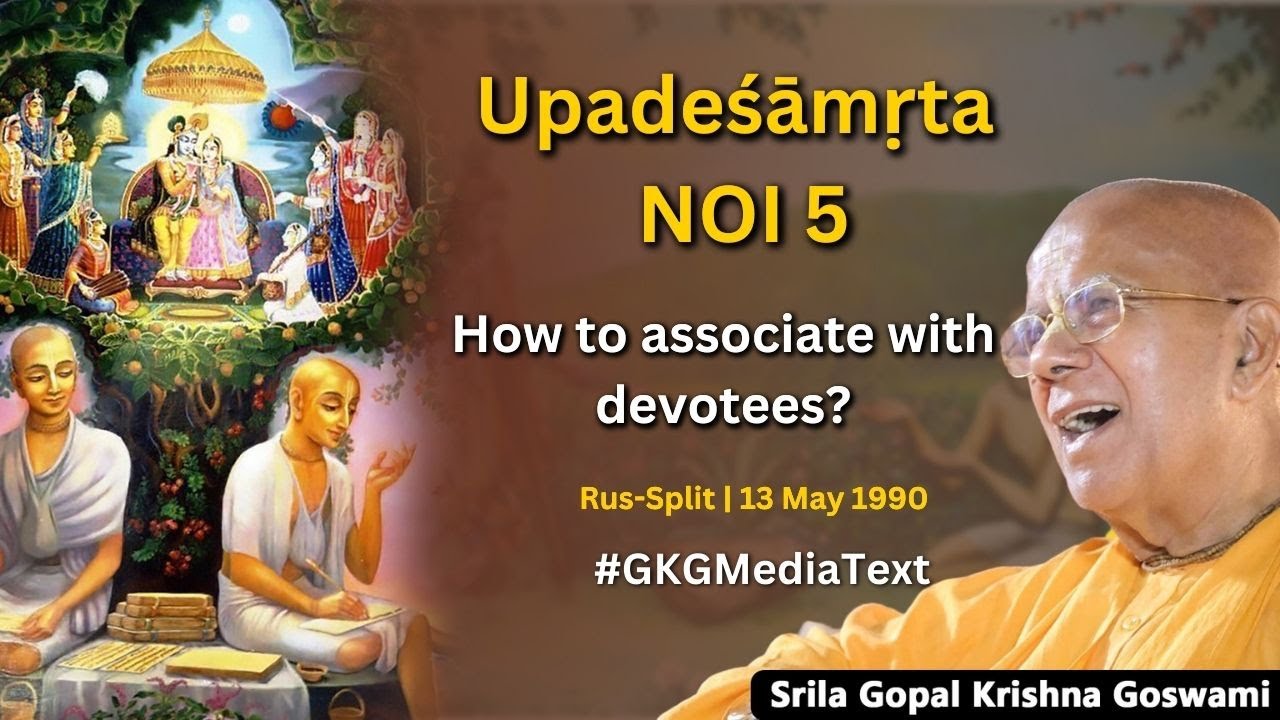
In this devotional lecture, the teacher explains how to purify the heart by removing "anarthas" (spiritual weaknesses) and nurture the seed of devotional service through chanting the Holy Name. He recounts scriptural stories such as the dialogue between Parikṣit and Śukadeva, the tragic life of Arjuna, and the intervention of Vishnu’s agents, illustrating the power of the holy name even for sinners. The talk then outlines the proper way to associate with different categories of Vaishnavas—those less advanced, equally advanced, and more advanced—emphasizing compassion, humility, and service. Practical guidance follows on meditation (absorbing the mind in Krishna), serving senior devotees, respectful book distribution, handling donations, answering inter‑religious questions, gender roles in spiritual life, predictions about societal change, and the appropriate use of anger in service. Throughout, scriptural citations from the Srimad‑Bhagavatam, Caitanya‑caritāmṛta, and other Vedic texts are used to support the teachings, and the speaker repeatedly stresses that sincere chanting of the holy name is the supreme means of purification and advancement.
Chapters
So as we purify ourselves of these anarthas, anarthas means spiritual weaknesses, we can make spiritual advancement. Caitanya Mahāprabhu was instructing Rūpa Gosvāmī about the process of devotional service for 10 days. And Caitanya Mahāprabhu told Rūpa that The seed of devotional service, bhakti-latā-dī, brahmānda-brahmita-kona-bhāgavanā-jī-guru-kṛṣṇa-kṛpāpāya-bhakti-latā-dī. The seed of devotional service is planted in the heart after many, many millions of birth and death. So this seed of devotional service, Caitanya Mahāprabhu explained, can be grown by the watering process of śrīmad-nāma-kṛtānām. So Caitanya Mahāprabhu says that When we see these anarthas growing, then we should take out the anarthas. Anartha means spiritual weaknesses. In the 6th canto of the Śrīmad-Bhāgavatam, there is a very nice dialogue between Parikṣit Mahārāja and Śukadeva Gosvāmī. Parikṣit Mahārāja had heard from Śukadeva Gosvāmī the description of the hellish planets which was reported in the 5th canto. So Parikṣit Mahārāja said, "how will people be saved from going to hell?" He said, "Just like people go to the church and they apologize, which is known in English as atone, and then they come out and start sinning again." So he says, "What is the value of sinning and atoning?" He said, "This is just like an elephant that goes in the river to have a bath, and as soon as the elephant comes out of the water, it goes and sits in the mud." and makes his body dirty again. So Praśad Mahārāja stated that a tree may get burnt, but as long as the roots of the tree are there below the earth, the tree is going to grow again. So we may stop sinning, but unless the desire doesn't go from the heart, we will start sinning again. So Praśad Mahārāja was saying what we have to do is cleanse the dirt from the heart. And then the sinful taste will go away. So Paṛkṣit Mahārāja said, "He is not interested in temporary atonement." That is, I apologize for my sins today and tomorrow I start sinning again. Just like in front of the judge, if you apologize for the crime today and the judge may forgive you, but if you repeat the crime tomorrow, he's not going to forgive you. So Paṛkṣit Mahārāja prescribed The cleansing of the heart, and the cleansing of the heart comes from the process of chanting the Holy Name. And Śrīkadeva Gosvāmī reveals to Praśad RAVAL a very wonderful story of the life of Arjuna. You may have heard this story before, but we will discuss it from some angles which you may not have been aware of. So I assume that everyone here is familiar with Arjuna. So Arjuna, as we know, was born in a Brahmin family, but he very soon, he fell in bad association. One day he was coming from the forest where he had gone to pick up some flowers, and on the way he saw a prostitute making love with a man. So Arjuna just started meditating on that incident, and because he was meditating on that incident of the prostitute with her Without clients, he just got very attached to the prostitute, and he gave up his wife, parents, everything, and he hired this prostitute as a maidservant in his house. And slowly, slowly, he even married her. So one lesson you can learn from the story so far is that on whatever activity your mind will get absorbed, you will eventually execute that activity. Here it shows that Om is thinking about lusty things. Sooner or later, you will translate it into action. How did Arjuna's downfall start? He saw that prostitute with her boyfriend, with her customer, but he started meditating on that act. And because he was meditating on that prostitute's act, therefore he got more attached to her. So similarly, he meditate on Krishna all the time, then he will get attached to Krishna. And if you meditate on Maya, then you'll get attached to Maya. So Arjuna, he had given up his Brahminical culture, and because his wife was from a low background, he had to engage in a variety of undesirable activities like stealing, murder, etc., to make money to support his family. So Arjuna had become so sinful, and also now he had become old. Because he had Vedic upbringing, at one time he had named his youngest son after Narayana, and Arjuna was very, very fond of this son. That is why, as I was explaining yesterday, it is a Vedic custom for parents to name their children after the names of Krishna and Radha. Yāmraj decided that now it is time to bring Arjuna to hell for punishment. So Arjuna saw, now Yāmraṣṭha sent 3 fearful-looking individuals, representatives, yāmadūtas, to bring Arjuna to hell. Why did Yāmraṣṭha send 3 and not 4 or 10 or 1 or 2? Anybody knows the answer? Because the living entity can commit sins through 3 outlets. One is through the mind, the other is through the tongue, and the third is through the actions. So there are 3 sources of 3 spiritual crimes: mind, tongue, and body. In Kali-yuga there is one concession, that is sin of the mind is not considered sin, but we cannot take advantage of this concession. You cannot take advantage of this concession because if the mind begins to contemplate sinful activities, then slowly, slowly it will come into the tongue, and from the tongue it will come into physical action. So, arjuna, When he saw the three fearful-looking Yamadūtas coming to take him, he got very scared and he shouted, "Narayana!" And as soon as he shouted Narayana, the Viṣṇudūtas, the agents of Lord Viṣṇu, appeared on the scene. Actually, Arjuna had called for his younger son, but the agents of Lord Viṣṇu appeared on the scene. So the agents of Lord Viṣṇu told the Yamadūtas, "What are you doing over here?" The Yamadūtas said, "We have come to carry out the order of our master, but you please tell us what are you doing over here?" Now Ajāmila was unconscious when this dialogue was taking place, but he was able to hear it. So the Viṣṇudūtas They stopped the yama-dūtas from taking Arjuna into hell. When he came to consciousness, he realized how foolish he was in giving up his Vedic culture and having associated himself with a prostitute and become a degraded man. So Viśvanātha Cakravartī ṭhākura is a great Vaiṣṇava Ācārya. So Viśvanātha Cakravartī ṭhākura has said, that the Viṣṇudūtas appeared on the scene to protect Arjuna because even when Arjuna was in bad association, he was still chanting the names of Nārāyaṇa. In other words, one may chant the names of Nārāyaṇa or Kṛṣṇa and on the strength of the holy name commit sins. So you may think, "I'm chanting Hare Kṛṣṇa, so now I have a license for committing fresh sins." And on the other hand, one may be in bad association, but he may still chant the Holy Name, but not with the intention that this chanting will nullify the sinful reactions. So Viśrīmad-Cakravartī ṛṣṭhākura explains that Arjuna was saved because even when in bad company, he kept his association with the Holy Name. Now the yāmadūtas, they became completely confused. They became confused because This was the first time that they were sent to execute a command and somebody had stopped them from executing the command of their master, Yamraj. So the Yamadūtas went up to Lord Yamraj. They said, "We have a question today because we are confused. Is there anyone more superior than You?" Yamraj, of course, is not a bluffer, a pure devotee of Kṛṣṇa. He said, "Yes." "Krishna!" Then the Yamadutas told Yamraj everything that happened. Then Lord Yamraj said, he said, "Don't touch anyone who has chanted the holy names of Krishna. Don't touch anyone whose head has bowed down before the Deity of the Lord." So you can see how powerful the chanting of the holy name is. Now Arjuna, as I told you, he was hearing the whole dialogue between the Vishnudutas and the Yamadutas. Dodi, to Ajimir. He realized that he indeed had committed a great mistake, and then he decided that now he's going— he was repentant, and he decided that now he's going to be very serious about spiritual life. And then he went to Hardwar where he chanted the Holy Name. So from this we learned that we as devotees who have come to Kṛṣṇa consciousness movement, now that we have realized the sins that we were committing. Now we must become very serious that we do not sin again. Once in Paris, Prabhupāda was initiating a devotee who at one time was a butcher. So Prabhupāda said, "Now no more sinning." So whatever sinful activities we may have committed, but after coming to Kṛṣṇa consciousness, we should not do it. So a devotee Even though he may be at a very low stage, but the Kṛṣṇa consciousness process is so powerful and so purifying that anybody who takes advantage of it will go right to the top. Just like anybody who touches fire will get the hand burnt, anybody who takes advantage of this process will be able to realize Kṛṣṇa-prema. So in this verse Rūpa Gosvāmī is telling us How to behave with different categories of Vaiṣṇavas. We are not talking about this prakata-sahajiyās who just make a show of chanting and who do everything sinful. These individuals, we just mentally respect them, but we don't associate with them at all. And one who is initiated into the chanting of the holy name, one offers obeisances to one who is initiated and one who is engaged in full-time service. And one should associate and faithfully serve the pure devotee who is advanced in undeviated devotional service. In the Vedic scriptures it is explained that a moment's association with a pure devotee is more revealing than all the Vedic scriptures. Why? Because in a moment's association with a pure devotee you can understand the purpose of the Vedic scriptures. And what is the purpose of the Vedic scriptures? Veday sva-svarihem meva veda-yavidadhukid veda-videvachaham. By all the Vedas I am to be known. So in a minute's association one can get the whole purpose understood. sadhu-sanga-sadhu-sanga sarva-shāstra-kaya. Caitanya Caitanya Mahāprabhu states that all Vedic scriptures say take advantage of saintly personalities. asat-sangatyāgai vaiṣṇava-caras tri-sangeka sadhu-kṛṣṇa-bhāṣya-āraḥ. Viṣṇu-chaturmṛta, for their faith, gave up the association of non-devotees who are just interested in female association and material sense enjoyment. So a man is known by the company he keeps. This is a British saying which Prabhupāda used to very often quote. Just like if somebody hangs out with drunkards, then he'll end up becoming a drunkard. And if you hang out with those who gamble, you'll become a gambler. And if you hang out with Hare Krishnas, then you may become Hare Krishna. So similarly, devotees, they have to have the right association. If we associate with devotees who are also serious, then we'll become serious. And if we associate with those who are not serious, then we'll also get affected. So the Vaishnava, according to Narada Muni— this morning I told you the story of Dhruva Maharaj. So Narada Muni has explained that there are three different types of association that one can obtain. Nārada Muni says, "One is association with those who are less advanced, the other is association with those who are equally advanced, the other is association with those who are more advanced." So when you associate with those who are less advanced, the Vaiṣṇava becomes compassionate. So even when you meet a devotee who is less advanced, you should manifest your compassion. And how do you manifest your compassion? By giving Kṛṣṇa consciousness. We give our compassion to the conditioned souls by preaching Kṛṣṇa consciousness. Therefore we believe in book distribution. Why do we do book distribution? This is not a means to make money. Our devotees can make money by better ways if that was the goal. But we engage in book distribution because book distribution is a transcendental activity by which we can wake up the sleeping souls. When we distribute these books, we give the whole disciplic succession and Prabhupāda an opportunity to enter into the contaminated hearts of the conditioned souls and allow them to preach. So it is because of the feeling of compassion that we do book distribution. So when we meet somebody who is less advanced, we display compassion. When we, when we meet somebody who's equally advanced, we engage in Krishna-katha. And when we meet somebody who is more advanced, then we serve humbly, and by that service we make advancement. So we must choose the right association So that we do not waste our valuable human life and don't get distracted from the spiritual path. Thakur Bhaktivedanta Mahāprabhu has very nicely stated, ami bhinna bandhu nahi ke acha ito māra. "O conditioned souls, except for Me you have no other friend in society." Śrī Vaiṣṇava is the only friend of the conditioned souls because Śrī Vaiṣṇava has a vision of eternity. Vision of eternity means understanding I'm not this body and the soul is eternal. Therefore, Thakur Bhaktinath, a very great Vaiṣṇava, has said, "Jīv-jāgo jīv-jāgo, gaura-candra-bhole, kota-nidra-jāo, māyā-pīṣā-kīra-kole." "O conditioned soul, please get up, please get up, please get up, and stop sleeping on the lap of this witch known as Māyā Devī." So this is very right. Basically, everybody is sleeping on the lap of this witch known as Māyā. Thinking that Maya is very sweet. But the devotee has to do, "Wake up! Sabai, sabai! Wake up, wake up!" Just like on Saturday, Sunday the children don't have school, so they sleep very late. So the parents have to go and wake up the child, "Get up, get up! It's late now." So Thakur King Renu says, "O conditioned soul, when you were sleeping, when you were in the womb of your mother," You promised that when I come out of the womb, I will worship Kṛṣṇa. But now that you have come out of the mother's womb, you have forgotten your promise and you have been engaged in sense enjoyment. In the Third Canto of the Śrīmad-Bhāgavatam, there is an explanation of how miserable the child is in the mother's womb. So Thakura Bhaktinoda ṣays, you, you promised that you will take the spiritual life, But now you have forgotten that promise. Just like we all have practical experience, sometimes we may be in difficulty, and when we are in difficulty, we promise that we will rectify ourselves. But when that misery goes away, then we break our promise. So Thakur Bhaktinath says, "I have brought a very special gift for you. Please take this gift and you will be able to develop love of God. This special gift is coming from the spiritual world, from Vaikuntha." And what is that gift? Bihari-nama, the holy name. So Thakura Bakhtinath says, "I am falling at the feet of my spiritual master, Gauranga Mahaprabhu, and praying to please give me this holy name. Please give me the holy name. Please give me the holy name." So similarly, we have to beg for the holy name. Do not take it for granted that the holy name is in your pocket. Anytime you can use it and anytime you can put it in cold storage. Just like the child that cries gets the mother's attention, So similarly, when the devotee cries through the chanting of the Holy Name, then he gets Kṛṣṇa and Rādhārāṇī's attention. When you chant the Holy Name, what are you doing? You are praying to Śrīmatī Rādhārāṇī, haré, the energy of Kṛṣṇa, "Please Kṛṣṇa, engage me in devotional service and take me out of this cycle of birth and death." So the point that we are making is this. That through the chanting of the holy names one can develop love of God. A person may be in the lowest order, even below the kamisadvikāri. Caitanya-caritāmṛta states, yahārakaumāyaśraddhā sei kaniṣṭhad-dhāna-kame-kame teṇo bhaktā haivey uttama. That is, when one devotee's faith is soft, he's called a neophyte. But the same devotee, if he follows the process, he will rise to the platform of becoming a first-class devotee. So the process is very simple. Prabhupāda used to say, "Kṛṣṇa consciousness is simple for the straightforward and difficult for the crooked." Those who are straightforward and simple, they find chanting of the Hare Kṛṣṇa and the four regulative principles very, very easy. And those who are tricky, they will just find— try to find fault with the system. So the devotee must choose his association properly. And if we choose our association properly, then we have the opportunity of rising from the lowest state to the highest state. So mentally we honor anyone, anyone who chants Hare Kṛṣṇa. Even if somebody is chanting Hare Kṛṣṇa and drinking vodka, mentally we honor him. But we associate with those who are fully engaged in service and those who are serving without any deviation. So this is what Rūpa Gosvāmī is telling us in this 5th verse of the Uddhayāśrama is how we can associate with Vaiṣṇavas in different orders or classifications. Hare Kṛṣṇa.
We often say that about meditation, meditation on Kṛṣṇa, meditation on something we read in books, you know, many things, like a sloka. But What does it mean exactly, meditation? How can we feel? What does it mean?
Meditation really means absorbing the mind in something spiritual. The practitioners of yoga today think that meditation means you close your eyes and not think about anything worldly. But actually what happens when they close their eyes is they just fall asleep. So they're in complete nassansa. Them. Meditation is generally considered an extension of your sleeping hours of night. So our meditation means meditate on Kṛṣṇa and meditate on the service given by the spiritual merchant Kṛṣṇa.
The question is, how can we serve the senior devotees?
Follow their instructions. Don't flirt with māyā. And if you can do some personal service, you can do personal service.
Can we advise the senior devotees If she makes something wrong, maybe, may I say?
Yes, but you should advise in a submissive manner and respectful manner. You can say, Prabhuji, I know I'm much junior than you, so I'm fool number one, but I see this weakness. If you don't mind, you can try correcting this weakness. I've just done my duty in presenting this to you, but I don't mean to fault-find you.
He's asking about, you know, about asking the donation. Where is the limit of real asking donation, or, you know, forcing people to give some money?
Where? In the streets or in the temple?
No, on the street, on the marketplace.
On the street, you should not— you should act in such a way that you don't displease people. You should not displease people. If you are going to distribute books and displease people, and that is not good. So when we distribute books, we must be very respectful and very pure so that Kṛṣṇa's mercy will flow.
Why did the, you know, Soul Books not present?
Why? We would gladly give the book free if you can arrange for us to get free paper and free printing. So you arrange free paper and free printing. Printing through your influence and will give out free books.
Often during the preaching, people ask if you are, you know, from God, if you are God's people. Yeah, where you mentioned, mentioned in, in the Bible.
Tell them that there are different scriptures that were written at different times of the— at different times. All of you can listen to this answer because all of you can use as answer in your preaching. So you explain to them that just like the Bible was compiled 2000, about 2000 years ago, the Vedic scriptures which we follow were compiled 2 million years ago, but only it was put in recording, writing, 5000 years ago. Kṛṣṇa says that this knowledge was first given to the Sankarīvasaṇa. So Prabhupāda explains in the purport of the 4th chapter, This knowledge was first given 2 million years ago on this Earth planet. Not spiritual planet, Earth planet. So this Bhagavad-gītā is the oldest known scripture available to mankind. Now 2 and 2 is 4, whether you're studying mathematics in grade 1 or in college. But you still have higher and lower level of mathematics. In college you study trigonometry and so on, and in grade 1 of school whom you study very basic mathematics. So similarly, all scriptures talk about God, but they give different degrees of knowledge about Bhoga. For example, when the Bible was spoken, it was necessary to give an instruction such as, "Thou shall not kill," because people were so fallen, they were engaging, indulging in killing also. When the Quran was spoken, the instruction given was, "Thou shall not be with anyone but Thy wife, because people were so fallen that they were sleeping with their mothers, sisters, and daughters. But when the Gītā was spoken, no such statement was ever made, because the Gītā was spoken to a very enlightened entity, namely Arjuna. So all these different scriptures talk about God, but there are different degrees of knowledge about God. Like, which religious movement on this planet has scriptures such as the Vedic scriptures? Which religious movement in the world has scriptures like the Śrīmad-Bhāgavatam that gives you so much information about God? Then somebody will say, "But how come I never heard about the Bhāgavad-gītā before?" They'll say, "The Bible I heard, the Gītā I heard, but the Bhāgavad-gītā and Kṛṣṇa I never heard. I only started hearing in the last 1 year. So if it was really that old, why did I not hear about that when I was young?" So then you tell them, That if you did not hear of it, that's not my fault. That's the fault of your educational system. Just because your educational system didn't tell you about the oldest source of knowledge, that doesn't mean that knowledge is not existent.
Okay?
I gave you a complete answer.
The Christians are very much afraid of, you know, false prophets, and they usually say that you are like this.
They are not afraid of false prophets. They are afraid of the real truth being exposed. So when you preach, you're exposing their weakness. It's just like in English, there's a saying, a bad workman will blame his tools. You have a phrase like this in Ruski also. So that is their problem.
Yeah, the question is that in the Vedas it is said that the woman should be under control in the childhood. He— she's under control of her her father, you know, in the youth, and the husband in old age, and the elder son.
Yeah.
But now the, you know, the man has no such ability to control the woman, and ladies don't like, doesn't like to be controlled. And what to do? Because it is a reason of many disagreements in family life.
Are you asking this question with reference to ladies Ladies in Kṛṣṇa consciousness or ladies in material life?
In Kṛṣṇa consciousness.
Oh, he's asking with reference to ladies in spiritual life. So ladies in spiritual life are under the protection of Kṛṣṇa. Generally in the Vedic concept, a woman is never independent. First stage, she's under the father, then husband, and then son. So Prabhupāda said that if somebody surrendered to Kṛṣṇa, then Kṛṣṇa is going to protect his devotee. In other words, A woman may be unmarried, a woman may have no son, but if she surrendered to spiritual master and Kṛṣṇa, she's completely protected spiritually from all angles.
There are, you know, many astrologers in our country, and they predicted that maybe few next years will be very difficult. There will be many accidents, many bad things. And after few years, and the question is, is there something like this in Vedic scriptures?
So my prediction is that in your country things will brighten up now because more and more people of your country are taking to Kṛṣṇa consciousness. You should tell this to the Soviet government. We are chanting Hare Kṛṣṇa so the whole country becomes prosperous. It is true. I am not saying a false thing. The fact of chanting Hare Kṛṣṇa is felt all around by everyone.
His goal is not to go to the spiritual world, but to develop love for Godhead.
Is it a—? Very good. It says in the Śrīmad-Bhāgavatam, nārāyaṇa-prasād-vaiṇā-ketacana-bhavyati svāraya-prarāraka api nārkeṣa api tulyāsa-dāśinā, that the devotees of Kṛṣṇa, they don't care They don't care whether they go to hell or heaven, because wherever they go, they just want to remember Kṛṣṇa. Nāḍamāni travels even to the hellish planets. Can jivātmās living entity at any time feel the same feelings to Kṛṣṇa as Rādhārāṇī? No, because Rādhārāṇī's love is so advanced and so pure that for us to aspire to become like her is almost impossible. Even Kṛṣṇa cannot understand the intensity of Rādhārāṇī's pure love for Him. So Kṛṣṇa had to descend in the form of Caitanya Mahāprabhu to understand the degree of Rādhārāṇī's love.
It is said that all our qualities we can use in service of God. And it is said that Hanumān used even his anger. And how can we use anger in service to Kṛṣṇa? For example, anger, yes. Now in our quality, and difficult to get rid of.
Yes, yes, it's a good question because anger is one of our weaknesses. Caitanya Mahāprabhu also exhibited anger. When did He exhibit anger? Who knows? Jagai-Mādhāi. Yes. So when Caitanya Mahāprabhu saw that Jagai-Mādhāi had attacked Lord Nityānanda, who was out preaching the glories of the Holy Name, Caitanya Mahāprabhu was so angry that He was ready to release His sudarśana-cakra. Then Lord Nityānanda told Him: "Caitanya Mahāprabhu, in Kali-yuga everyone's going to be like Jagāya-mādhāya, so please don't use Your sudarśana-cakra." And then by the mercy of Nityānanda Prabhu, Jagāya-mādhāya was saved. Hanumān was angry. Because he discovered that Sita was kidnapped by Ravana. So anger can be used only when Kṛṣṇa is being blasphemed or Kṛṣṇa's pure devotees are being blasphemed. But anger cannot be used when you don't get your quota of sense enjoyment. Normally in material life, people become angry when they don't get their quota of sense enjoyment. So if you want to be angry, you should be angry when you see that somebody is not letting you do harināma or not letting you distribute books, or somebody is trying to spoil your devotional service. But do not become angry if you don't get what you want. In the second chapter of the Gītā, Kṛṣṇa says, matraḥ parśate kāntyaḥ sītoṣṇaḥ sukhaḥ dūkhaḥ daḥ agraṁ apaiṇo nityaḥ stamtaḥ te śakṣva-bhārataḥ. That is, one should become a dhīra. Dhīra means equipoised in all situations. Happiness and distress, victory, defeat, in all situations we must be equal.
Lama Lama Ale Ale.
More from PRASAD

Rare Pastimes & Timeless Lessons of Guru Mahārāja | Stories Every Disciple Should Hear

ISKCON Legends- pure devotees meet-HH Jayapataka Swami, HH Gopal Krishna Goswami, HH Radhanath Swami



Jagannātha Ratha-yātrā Through Śrīla Prabhupāda's Mercy | 29 April 2006 | Nairobi, Kenya

Lord Jagannātha's Appearance Pastime | 21.07.2019 | ISKCON Calgary | Śrīla Gopāla Kṛṣṇa Gosvāmī

The Ācārya Teaches by His Own ExampleGuṇḍicā Mārjana by Guru Mahārāja #shorts

Guṇḍicā Mārjana – Lord Jagannātha's Pastime | 21.7.2019 | ISKCON Calgary |Śrīla Gopāla Kṛṣṇa Gosvāmī

H.H. Gopāla Kṛṣṇa Gosvāmī Mahārāja - Exemplary Sādhana and Deity Worship # shorts

भगवान की कृपा कैसे प्राप्त होगी ? | 11 Jan 2014 | Punjabi Bagh | Srila Gopal Krishna Goswami

Material Education vs Spiritual Education | Srila Gopal Krishna Goswami #shorts