Vishnu should be center of one’s life | Srila Gopal Krishna Goswami | SB 4.8.26 | Toronto | May 1983
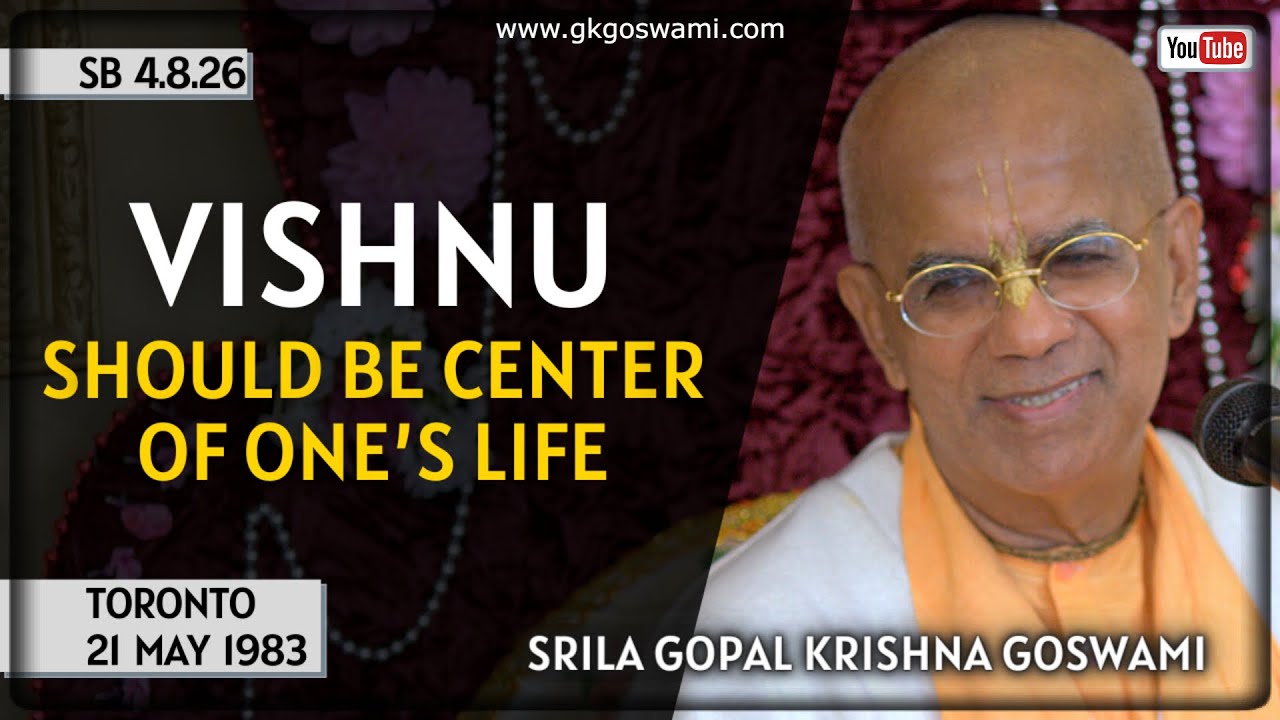
In this devotional lecture Srila Gopal Krishna Goswami expounds the Vedic vision that Vishnu must be the focal point of every human life, regardless of social class or stage of life. He explains the traditional varṇāśrama system—Brahmins, Kṣatriyas, Vaiśyas, Śūdras and the four ashramas—showing how each has a specific function that ultimately supports devotion to the Supreme Lord. The talk highlights the historic role of Kṣatriyas as protectors of the weak and laments the modern erosion of true warrior training, linking this decline to societal disorder. Drawing on Narada Muni’s teachings, Goswami uses the metaphor of an ocean to describe material existence, urging practitioners to cultivate austerity (vairāgya) and knowledge (jñāna) to swim toward the “bank” of spiritual liberation. He stresses the necessity of chanting the Hare Krishna mantra and actively spreading Krishna‑consciousness as the primary reformative activity, likening devotees to Viṣṇu‑dūtas who must master logic and persuasive discourse. The lecture also stresses that sincere devotion must be coupled with spiritual intelligence; mere sincerity without knowledge leads to vulnerability to Maya. Throughout, Goswami employs vivid analogies—swans separating clean from dirty water, clear blue skies, and the sharp weapon of eternal time—to illustrate the need for clear mind, discernment, and determined effort in the current age of materialism.
Chapters
Om namo bhagavate vasudevayaam! Om namah bahguruteh vassudevayam! Om namah bahguruteh vastu devayaham! Om namah bahguruteh vastu devayaham! Om namah bahguruteh vastu devayaham! Om namaha Bhagwatai Vasudewaiahum! Aho tejaśātriya na mana bhangam amarśitam, balopriyayam heṣad apeyāt samatūr asadvacah. So Narada Muni is giving us a glimpse of the mentality of the Kṣatriya. Normally, a 5-year-old boy would not feel very offended if he was prevented from sitting on the father's lap. But because Dhruva Maharaj had the Kshatriya blood within the body, he became very, very offended. And as explained in the Bhagavad Gītā, the word Kshatriya is divided into two parts: Kṣaṭ-riya. Śātrīya means one who gives protection. So the business of the śātrīya is to give protection. The Bhāgavatam says that the śātrīya eti sabhāva, that the śātrīyas are coming, are the arms of the Lord. And poṣaya-mukha brahman, and the brahman represent the different, the mouth of the Lord. So according to the Vedic system, there is a division of the society into different classes, social and spiritual orders. But the purpose of all this division is to concentrate on the Personality of Godhead. Varnāśrama-cetavadā-puruṣīṇa para-pūrmaṇ viṣṇu-ārādhapē. That is, Viṣṇu, according to the Viṣṇu Purāṇa, has to be the center of one's life. Whether one is a Brahmin or a Kshatriya or a Vaiṣya or a Sudra, whether one is a brahmachari or a grihasta or a vanaprastha or a sannyāsa, the real goal is only one, that is to concentrate upon the Supreme Lord. So the Kshatriyas are these descendants of the sun god, and the Kshatriyas are interested in protecting the weaker sections of society. In the Vedic days, the rulers were all sathyas, and they were concerned about protecting the weaker sections of society, such as old people, children, women. In Vedic society, there must be the existence of the Brahmanas. There shall be the existence of the Kshatriyas, the Vaishyas, and the Shudras. Each of them has a certain role to play. Just like a human body without a head is considered to be imperfect or incomplete, similarly the body, the society, without the Brahmins is incomplete. In fact, the human body cannot survive without the head. So similarly, the society cannot survive without the existence of the Brahmanas. And the Brahmanas' business is to guide the rulers, namely the chatriyas, on the religious path. The Brahmanas' business is to help ensure that the people practice religious principles, guide them on the religious path. The Vaishyas' business is to take care of the business, the cows, and the agricultural production.. And the Sudra's business is to serve the other three classes, that is the Brahmins, the Kshatriyas, and the Vaishyas. And similarly, there are the spiritual orders of life. There is the Brahmachari, the Grihāstra, the Vānaprastha, the Sannyāsa. The Brahmachari's business is to beg, to go preaching from house to house. At a certain age, according to the Vedic system, one is allowed to enter into the grihastha ashram. But even in the grihastha ashram, one should not lose sight of his real goal. And then at the age of 50, one begins the vānaprastha process, and then at the age of 60, one takes sannyāsa. So, uh, the Vedic concept of the division of the society into the four social and spiritual orders is very complete. And because this system is not being followed today, we see a very turbulent situation in society. Everyone is trying to do the work of the other person. It's just like if you're trying to wear the wrong shoe, a shoe that's not your size. So these subjects And the Vaishyas are acting like the Brahmins and the Kshatriyas. And hence we see that even in, for example, in the modern warfare, great emphasis is being placed now on sophisticated technologies. Previously, during wars, the Kshatriyas would fight, and right in the front would be the rulers. The king. It's not like today where the heads of state sit in a very comfortable, closely guarded situation and the soldiers are sent in the front. And besides that, uh, so many other nuclear weapons are used. So the reason is the Kshatriyas are not being trained. Nobody is being trained in the art of warfare. Nobody is being trained in this Vedic culture.. And that is the big problem in society. So therefore, as Prabhupāda says, that unless the Vedic culture is followed, there cannot be happiness. So this is what this Kṛṣṇa consciousness movement is doing, to spread the knowledge. Just like in the purport, Prabhupāda says that unless the reformatory system is maintained, They cannot be perfected. So the process of reforming is the chanting of the Hare Kṛṣṇa mantra in this age. But people have to be made aware of this simple message. Even though this is a very simple message, the reality is that people are not aware of it. People are not aware about the real purpose of human life. They are forgetting to realize the sharp edge of time. Narādhamaṇi explains to the son of Prajāpati Dakṣinārāyaṇa, that is, eternal time is a very sharp weapon which has sharp razors and thunderbolts on either side. That is, this time is very valuable. Just like if you have an arrow or a piece which has a sharp blade, on one side and the thunderbolt on the other. If you touch it or if you misuse it, then you can cut yourself. So similarly, Nārada Muni explains that in this human form of life, if we do not utilize this side for the purpose of Self-realization, then one is just cutting himself constantly. By and large, we see the majority of the people are interested on the path of sense gratification. And one who's interested on the path of sense gratification is called the husband of the prostitute. Just like if one's wife is a prostitute, any sane man doesn't feel comfortable. So similarly, those on the path of sense gratification are called husbands of the prostitute, prostitute, because the senses are like prostitutes. And when one becomes a victim of these different sense desires, then one is considered to be a husband of the prostitute. So Narada Muni advises that in this human form of life, one should not become a husband of the prostitute. Rather, we have to learn how to swim out of the ocean. Just like when one has drowned himself in the ocean, then what does he aim for? He aims to swim towards the bank of the ocean. So similarly, Narada Muni explains that the human beings, they're all drowning in this ocean. And they have to swim towards the bank of the ocean. But naturally, as you're swimming towards the bank of the ocean, the current gets very strong. Those of you who swam in the river, in the ocean, can testify that as you aim to go towards the bank of the ocean, the currents get very strong. So we have to swim out of this ocean towards the bank. And the bank of the ocean is described to be the process of renunciation, vairāgya, and jñāna, austerity. That is the bank. So we have to swim out of this ocean and get to the bank. That is, we have to take to the process of austerity and vairāgya. Then we will be able to get You have crossed the swift currents also. Just like when somebody is taking to spiritual life, Maya is still beginning to attack, is still continuing the attack. The tug of war with Maya doesn't end when one takes to spiritual life. Maya is still hoping that even though such an individual has taken to spiritual life, let me still try to reclaim him. Therefore, even when we make the determination to take to the process of devotional service, to take to the process of austerity, to take to the process of vairagya, the swift current of the ocean of Maya moves very, very fast. The swift current is trying to pull us back, so we have to become expert swimmers. So that we can reach the bank of austerity and vairagya. Otherwise, we will continue to be tossed by the waves of this ocean. So Narada Muni was instructing the sons of Prajapati Daksha that through the medium of austerity and knowledge and vairagya, they should cross over this ocean, and they should be able to resist the swift current which approaches them as they get to the banks of the river. So we have to cultivate the principles of knowledge. We have to cultivate what is real vairagya. We have to cultivate what is real detachment or austerity. Just like, for example, when the Vishnu Dutas and the Yama Dutas were face to face. The Viṣṇudūtas were preventing the Yāmadūtas from claiming Ajāmila's soul. And then the Viṣṇudūtas challenged the Yāmadūtas. The Viṣṇudūtas said that, "If you claim to be the representative of Yāmraṣṭha, then please explain The difference between what is religion and irreligion. And then Prabhupada explains in this purport that those who are representing the master must know what the master wants. So the Viṣṇudūtas challenge the yāmadūtas to explain what is Yāma Rāja's desire, what is the difference between religion and irreligion. So similarly, Prabhupada explains that the members of this Kṛṣṇa conscious movement They must understand the difference between what is religion and irreligion. They must be able to convince others. Just like whenever, whenever the class was in, everyone came to see Caitanya Mahāprabhu. Caitanya Mahāprabhu was able to convince them with sweet words and logic about the value of devotional service. So similarly, we members of this Kṛṣṇa conscious society also, They should become so expert in this transcendental knowledge that with sweet words and logic they can explain the difference between religion and irreligion. With sweet words of logic they can explain the glory of devotional service. So this is possible if we become expert like the yama-dutas. The yama-dutas were expert. They were able to say what Sri Amṛta stands for. And the Viṣṇudūtas also knew the whole philosophy. So we have to become like the Viṣṇudūtas, expert in logic, expert in presenting this Kṛṣṇa conscious philosophy. So even the most demonic person can be enlightened. Our mind has to be completely clear. Just like on a clear blue sky we can see the sun very clearly. So similarly, Narada Muni explains that the mind has to be like the clear blue sky. We cannot let the mind be clouded with the fog of illusory sense desires. If the mind is clouded with this fog, then we will not be able to see the sun clearly. Just like when a fog is there, you can't see the sun. The sun represents the process of devotional service. The sun represents the personality of Godhead. So this personality of Godhead can only be clearly visible if the mind is kept clear like a blue sky, clear blue sky. That means we have to learn what is desirable and what is not desirable. This is the next instruction that Narada Muni made. Narada Muni said that The transcendentalist has to become like a swan. And what's the characteristic of a swan? The swan can separate, uh, the clear water from the dirty water. The swan knows where to stay. So similarly, the transcendentalist has to become like a swan. The transcendentalist should be able to discriminate between modern religious principles and what are irreligious principles. And if something is irreligious, then the transcendentalist avoids it. Just like one never sees a swan in the dirty environment, but one can see the crow always next to garbage. Even though they are both of the, of the bird category, still one lives in garbage, one lives in a dirty environment, and the other one always lives in a clean environment. So Narada Muni's instruction that he transcendently become like swan is very important. We must always associate with spiritually inclined people. Our entire thought should be in one direction. Just like the Bhagavad-gītā says, those who are vebhulūk, their intelligence is in one direction. And those who are irrevolute, their mind is wandering in 100 directions. So the devotees, they are in one direction, the path of Kṛṣṇa consciousness. So their mind, their intelligence is also just in one direction, whereas those who are thinking of so many material desires. Those who are not willing to accept Kṛṣṇa as the real director, their intelligence is stolen. They do not know what to do. Constantly they are in anxiety. The materialists would like to believe that they are happy, but the reality is that they are full of anxiety. So The transcendentalist must become an expert physician. Just like an expert physician can diagnose the symptoms of a disease, we should be able to diagnose the, the influences of Maya. That is, when we see that Maya is beginning to penetrate, when we see that material thoughts are beginning to enter into the mind, then we should be able to smash them right away. So we all have to become swans, and we can become swans if we equip ourselves with this transcendental knowledge. So it is very important that we develop a higher taste, and the higher taste is attachment to the chanting of the Holy Name, attachment to the plasma of hearing Prasada Sahib. Attachment to glorifying the Lord, and anything besides that is a lower taste. So we have to become transcendental swan, and if we become transcendental swan, then the effect of eternal time will be positive. Otherwise, it is going to be negative. The vision of eternity is always in front of the devotee. Whereas the materialist does not have this vision of eternity. The materialist vision is that this body is meant for enjoying, and that is it. Whereas the devotee recognizes that he is an eternal part and parcel of the Lord. So the vision of eternity motivates us to execute devotional service, and the identification with this body motivates us to further the desires of the body. So the point is that the, the bank of austerity and knowledge that Narada Muni has recommended, this should be very, very carefully cultivated. It is a fact that the process of Krishna consciousness means practicing austerity. Again and again, this point is made, that austerity is the ornament by which we transcendental candidate decorates himself. So austerity is there, but the devotee does not mind undergoing this austerity because the result of spiritual austerity is happiness, and the result of material austerity is distress. So if one is undergoing this spiritual austerity for the pleasure of the Supreme Lord, Then one will always be happy and joyful. So we are caught in this ocean, and we are constantly being tossed, and we have to learn to swim out of this ocean. And we can learn how to swim out of this ocean if we take advantage of the transcendental instructions that are being presented, if we take advantage of this transcendental knowledge that is there. If we try to cultivate this knowledge very carefully, then not only will we be able to save ourselves, but we will also be able to save others. This is the real mood of the mentality of the Vaishnava. Just like the yama-dutas, the yama-dutas clearly knew what is Yama Rāja's desire. The Viṣṇu-dutas clearly knew what is Lord Viṣṇu's desire. Similarly, we, the Viṣṇu-dutas, the members of this Kṛṣṇa consciousness movement, We clearly know what is Viṣṇu's desire, and His desire is to reclaim all the conditioned souls. So we have to become expert in logic. If we become expert in logic, if we become expert in presenting this Kṛṣṇa conscious philosophy very patiently. Actually, whenever these Mayāvādī philosophers came to Caitanya Mahāprabhu, He was able to defeat them very patiently. So we have to very patiently defeat these mature concepts that are being presented by the materialists and the so-called scholars. In the Kali Yuga, there's no shortage of asuras. In fact, almost everywhere you turn, you see asuras. But these asuras— the asuras are defined as the devotees of the Supreme Lord— the asuras' responsibility is to help distribute this science of God. The living entities, they are all suffering. Just like in a desert, one can never claim that he is happy. In the desert, one can never claim that he found some water. And if somebody ever claims, then no sane man would take him seriously. Similarly, the suras, they are considered to be these same people of society. They do not take these so-called claims of the different products or of the society that any product or any activity can satisfy the living entity. That conviction is there, that except for the process of devotional service, there is no question of any happiness at all. So having this firm conviction The sūras have to take it upon themselves that this Kṛṣṇa conscious message is distributed to the entire humanity. So that is our principal concern, to help propagate this philosophy. Because if one doesn't take to this Kṛṣṇa conscious process, there is no assurance when one may again get an opportunity for meeting a devotee. Several kalpas may pass before one gets the opportunity for again coming in contact with a devotee. So the point is that we have to take this Kṛṣṇa consciousness very, very seriously. And we not only have to take it seriously always keeping ourselves in mind, but also we desire to distribute this Kṛṣṇa consciousness. Caitanya Mahāprabhu has exemplified this mood, and all the great ācāryas have exemplified this mood. That this Kṛṣṇa consciousness has to be distributed. Caitanya Mahāprabhu, when he was traveling, people would see him just from a great distance and they would begin to chant Hare Kṛṣṇa. But the present members are not so powerful. So we have to endeavor to approach each and every person and try and inject the desire to serve the Kṛṣṇa consciousness. The sovereignty of Godhead. So even though people may not appreciate, but if we are sincere in our approach, then people will appreciate. So the point is that with determination, this Kṛṣṇa conscious movement has to be pushed on. The people have to be guided on the path by which they can become really happy, and that is a path of devotional service. So we have to be determined to push on this Kṛṣṇa consciousness movement. We have to be determined to follow the instructions of the śāstras and the spiritual master. And if we are determined to follow these instructions, then spiritual advancement will be there, and then everyone will be happy. So we should not be a husband of the prostitute. Rather, we should become spiritual forms. We must understand how sharp this eternal, the weapon of eternal time is, and we must learn to swim to the banks of this ocean through the medium of knowledge and detachment. Hare Krishna. We should go early today. I think you have a very short class, Prasad RAVALI. So I think you have a really short class. What's the time now? Okay, so I'll maintain. Good to leave at 8 o'clock. So 8 o'clock, any questions? Yeah. The king is actually the most expert fighter. Just like a diamond is protected, we don't leave it lying around. Seemingly the king shouldn't be actually protected, because if he's killed, he's the top man, then everything else will fall apart. Well, the kings were the best trained warriors, and the king would take the first blow. In fact, if the king would return from a battleground without being hurt, he would be laughed at. These are the wars going on for years and years in the kingdoms. Doesn't bleed. But in the Vedic days, the king would take the blow. In other words, the leader has to be the example, the pace-setter. Yes, Swāmi. You were mentioning how we have to develop vairāgya-vijñāna, and I was reading in the Nectar of Devotion that even it would say— Rūpa Gosvāmī was saying that even though Vairāgya and vidyā, they're, they're, uh, nice to have, but they're not absolutely necessary. That all you need is sincerity. All you need is what? Sincerity. Sincerity must be there and intelligence must be there, because unless we develop knowledge vidya, how will they develop vairāgya? So sincerity by itself also is not enough. Prabhupāda has explained this point. Sincerity has to be coupled with intelligence. Just like to produce fire, you need a matchstick and the matchbox. If you just have the matchstick, then you can't produce fire by itself. So similarly, to develop vairāgya and vidya Vairāgya is a result of vidya. If you don't have knowledge, then there cannot be renunciation. There must be sincerity and intelligence. Like, very often we hear, but this person is very sincere, but he's just temporarily becoming a victim of Maya. Because what's the— sincerity has to be married to intelligence. And if the sincerity is coupled with intelligence, then there no question of even temporarily becoming a victim of the illusory energy. So Prabhupāda often said that sincerity by itself is not enough. A person may be sincere and may be sentimental. So we have to be sincere and intelligent.
More from PRASAD

Rare Pastimes & Timeless Lessons of Guru Mahārāja | Stories Every Disciple Should Hear

ISKCON Legends- pure devotees meet-HH Jayapataka Swami, HH Gopal Krishna Goswami, HH Radhanath Swami



Jagannātha Ratha-yātrā Through Śrīla Prabhupāda's Mercy | 29 April 2006 | Nairobi, Kenya

Lord Jagannātha's Appearance Pastime | 21.07.2019 | ISKCON Calgary | Śrīla Gopāla Kṛṣṇa Gosvāmī

The Ācārya Teaches by His Own ExampleGuṇḍicā Mārjana by Guru Mahārāja #shorts

Guṇḍicā Mārjana – Lord Jagannātha's Pastime | 21.7.2019 | ISKCON Calgary |Śrīla Gopāla Kṛṣṇa Gosvāmī

H.H. Gopāla Kṛṣṇa Gosvāmī Mahārāja - Exemplary Sādhana and Deity Worship # shorts

भगवान की कृपा कैसे प्राप्त होगी ? | 11 Jan 2014 | Punjabi Bagh | Srila Gopal Krishna Goswami

Material Education vs Spiritual Education | Srila Gopal Krishna Goswami #shorts