Wake up and Surrender to Krishna | Rus-Split | 28 Dec 1988 | Srila Gopal Krishna Goswami
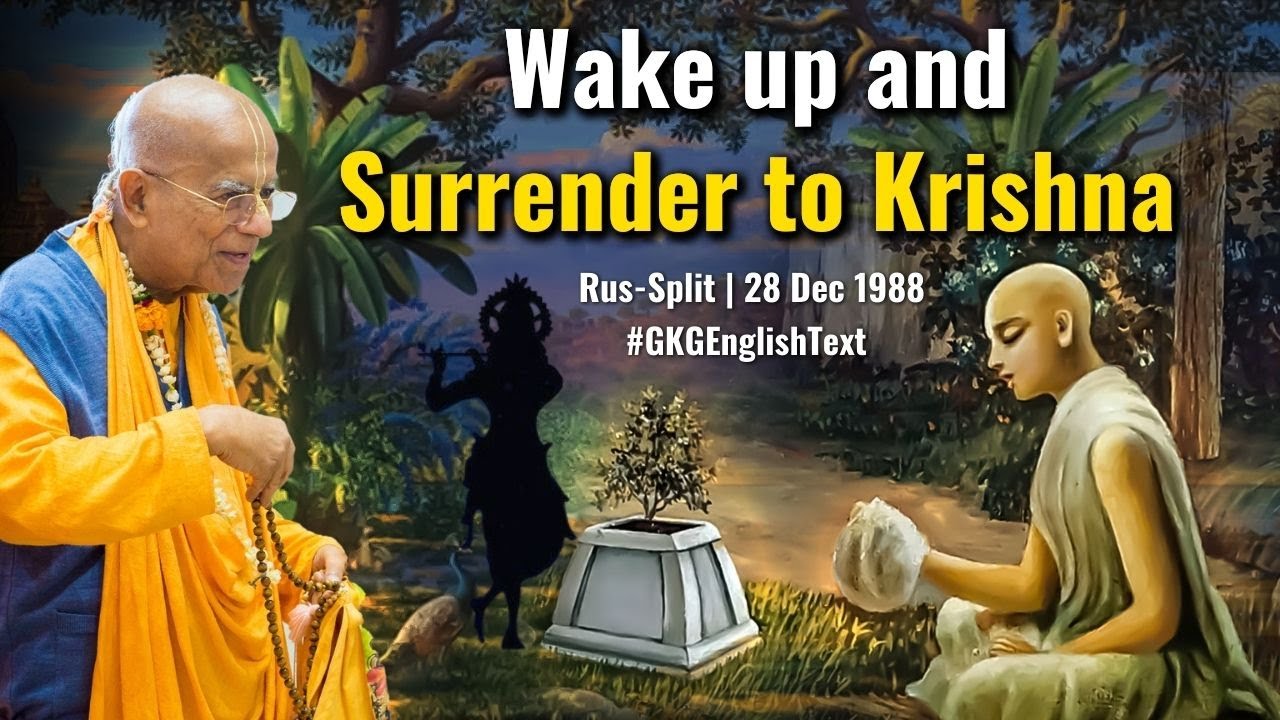
Srila Gopal Krishna Goswami teaches that the Hare Krishna mantra is the only cure for Maya's illusion, using the story of Jadbharta to show how humility and compassion lead to devotion. He compares materialists to dogs and hogs trapped in comfort, and urges immediate surrender to Krishna, citing Maharaja Khatvanga's one-minute lifespan as proof that time is always running out.
Chapters
Om namo bhagavate vasudevaya! Oh no more Bhagavad Deva Sudevaiahya... om namoh bhagavate vasudevayaham—
oh na mo bahgat devah sudevayyahm—
om namoh bhagavate wasu devayyham—
oom nah moh ba-gad de-va suh-dee-vai-yhaam...
Omm na moh bahgat devah soodeevayyahm... So today we will discuss two very famous prayers composed by Thakura Bhaktivedanta Gosvāmī Mahāprabhu.
Thakura Bhaktivedanta Gosvāmī Mahāprabhu, as most of you may know, was the father of Śrīla Bhaktisiddhānta ṣaḥasvādī. He is considered to be the special mercy also of Śrīmatī Rādhārāṇī. Is transcendental energy of Caitanya Mahāprabhu. Namo bhakti-vinodaḥ sat-cid-ānanda-nāmīne gauraśakti-suruṣpāya rūpa-nuga-vrāyate. I offer my respectful obeisances unto Sācidānanda Bhakti-vinoda, who is the transcendental energy of Caitanya Mahāprabhu. He is a strict follower of the Gauḍḍvāmīs headed by Śrīla Rūpa. Thakura Bhakti-vinoda was working as a magistrate. And besides working as a magistrate, he was regularly writing and preaching. He wrote nearly 100 books and prayers. It is said that he used to come from work in the evening at 5 or 6, then by 8 o'clock in the evening he would take rest, then he would get up at 12 o'clock, then write till the morning. It was— the credit for the expansion of the Kṛṣṇa consciousness movement goes to a great degree to Ṛkṛṣṇa Mahāprabhu. Ṛkṛṣṇa Mahāprabhu had this great vision that Kṛṣṇa consciousness will spread all over the world. He had predicted that in the birth site of Caitanya Mahāprabhu, people from all over the world will come glorifying Caitanya Mahāprabhu. So today we shall discuss some of his prayers. The Vaiṣṇava sings the songs composed by self-realized souls. In the Western countries, we all have the habit of writing songs, but actually we should repeat the songs of the self-realized. Jeev Jagat, Jeev Jagat, Gaura Chanda Bhole, Kothanidra Jau Maya Pisha Tira Kole. Thakur Bhakti Vinod is saying that Lord Gauranga, Lord Gauranga means Chaitanya Mahāprabhu, He is saying, "Wake up, sleeping souls," because the living entity is sleeping in the lap of the witch known as Maya. Just like the mother tries to wake up the child, the mother tells the child, "Get up, it's time to go to school." So Thakur Bhaktivedanta is saying, "Oh, conditioned soul, please get up." This doesn't mean that he should physically get up. But it means that one should spiritually wake up. One should spiritually wake up to understand his spiritual position. Thakur Bhaktinath says, "Wake up, wake up. You have slept for so long in the lap of this witch known as Maya Devi." Thakur Bhaktinath calls Maya Devi a witch. So the living entity is sleeping on the lap of Maya Devi. Thinking that he's very comfortable in Maya's Devi's lap. The living entity thinks that my bank balance, my children, and my country, they will all protect me. But he does not realize that all of them are known as fallible soldiers. At any time, those soldiers can also fall. So Thakur Bhaktivedanta is saying, please do not sleep on the lap of this witch known as Maya. In the Śrīmad-Bhāgavatam, Second Canto, there is the following verse: Śva-ved-varahosa-karai-saṁṣuṣā-puruṣā-paśu. The translation of the verse is that the materialistic man is like the dog and the hog and the camel and the ass. And those individuals who are like dogs, hogs, camels, and asses, in them the spiritual, the desire for spiritual awakening doesn't develop. And those who are like dogs, hogs, camels, and asses, they're busy glorifying others who are also like dogs, hogs, camels, and asses. So now you may say, some materialist may say, "How dare you call me like a dog or a hog or a camel or an ass?" He may say, "Don't you see that I look like a human being? Why are you comparing me to a dog?" So do you want to know why the Bhagavatam calls or compares the materialist to dogs, hogs, camels, and asses? So the materialist is compared to a dog. What is the characteristic of a dog? He will serve anybody who gives him some shelter. Even the mafia uses the dog and the police uses the dog because the dog cannot discriminate who is right, who is wrong. Whoever serves him, he serves the master. So the materialist today, they will serve anyone who gives them some money. Money is the name of the game today. So as long as they're getting some money, they're happy. So like the dog is loyal to whoever gives him shelter, the materialist will serve whoever gives him money. Then the comparison is made to the ass. Anyway, in your country you don't see the donkeys on the road. The donkey carries a heavy burden of load. And what does the donkey take? Little bit of grass, that's all. That without carrying this heavy burden of load, I'm not going to get my grass to eat. So similarly, the materialist is busy carrying heavy burdens of responsibility. When you meet the materialist and tell him, "Sir, why don't you cultivate spiritual life?" He says, "Sorry, I don't have time. I have so many duties to take care of." For his living, he just needs 2 chapatis and a little bit of sabji. So the materialist is like the donkey. Then the materialist is compared to the camel. Camel is another animal I don't think you see in your country except in the zoos. But in India, you see the camels at work all the time. See cars on the main road, but you also see camels and other animals side by side. So now the camel is very fond of biting on thorns, and when it bites on thorns, what happens? The tongue bleeds. And when the tongue bleeds, what does the foolish camel think? So whenever the camel sees some thorn, he goes and bites on it. But actually, that foolish animal doesn't realize that that taste is coming by, by destroying his own tongue. Similarly, we see that everybody today is after sex life. I was told that in Moscow, the divorce rate is 80%. I think the divorce rate is as high as Hollywood is. The divorce rate is so high because people want to keep changing partners so they can get more satisfaction. So these foolish materialists do not realize that behind every drop of semen that is lost, there are so many ounces of blood that is lost also. So the Bhagavatam compares such an individual to a camel. The camel is happy enjoying the thorns even though the thorns come by discharging its own blood. So everybody is busy pursuing unrestricted sex enjoyment even though this is all coming by discharging their own blood. Then the Bhagavad-gītā compares the materialist to the hog. So what is the characteristic of the hog? Two things. One, it eats without restriction. No, one, it mates without restriction and it eats only stool. If you go to, if you go to the hog and say, "Mr. Hog, here I have some nice rasgullas for you, please take it." He'll say, "No," and he'll go to the stool. When you come to India, you'll see in Vrindavan and everywhere, the dogs are only eating stool, nothing else. And the other thing is that they want to mate without restriction, whether it's mother, daughter, sister to the hog, it's all the same. So similarly, the materialists also, they want to eat dirt. That is, eating animal flesh is compared to eating stool, and also they want to mate without restriction. So the materialist is compared to the dog and a hog and a camel and an ass. This is for your information, but this doesn't mean that you go on the street and say, "Mr. Dog, please take a Bhagavad-gītā." But at least you should know the reality. Then Tākura Bhaktinātha says, Bājibo boliye īśye samsarabhitaraye, uliyā rohitne tumi avidyāra bhāre. Śrīla Dhākura Bhaktinoda ṣeṣa says, "You came in this world saying, 'Oh my Lord, I will certainly worship You,' but having forgotten this promise, You have remained in great ignorance." So the living entity, when he is in the womb of his mother, he is in a very uncomfortable position. Modern science cannot tell you Why the child begins to kick in the mother's womb. The child finds itself in a very uncomfortable situation. Does not matter how handsome or beautiful you may look from outside. You may be a Miss, Mr. Universe or Miss World. Inside our body, it is nothing but a bag containing stool, urine, blood, mucus, etc. So that is all that is inside. But we do not want to ever think about this reality. Do all of you know the story of Liquid Beauty? Everybody knows it or some people?
Yes.
Okay.
When we are in difficulty, who do we remember? God. So when the child is in the mother's womb, it prays to the Lord, "Please release me from this difficult situation, and when I get out of the womb, I'll definitely worship You." But after he comes out of the mother's womb, he completely forgets his promise. And he gets involved with sense gratification again. I'm sure all of you have had experience when you're in difficulty, you make all the promises to Krishna. But when the difficulty goes away, you forget your promise. Is it not a fact? So similarly, when we are in difficulty in the mother's womb, we all promise, but then we forget the promise. So Thakur Bhaktivedanta Swami Prasada is making the same point. Tamare loite aimi aino avatara ami bina bandhuara ke acchetumara. Thakur Bhaktivedanta Goswami Mahasaya is a top-class Vaiṣṇava. So Thakur Bhaktivedanta is saying, "I have descended just to save you. Other than me, you have no other friend." In the material world, everybody is thinking that he is my friend. We are thinking that, "Oh, this friend is my best friend. He will save me." Our parents are telling us that we are your well-wishers, so just do what we say. And we say, don't chant Hare Krishna, but just get material education. Actually, the only real friend of everyone is the Vaishnava because the Vaishnava cares for the benefit of everyone. He does not even want to step over an ant. This is the Vaishnava's mentality. Everybody is created by the Lord. And we all belong to the same family. It is not that the human beings belong to God's family and the animals belong to our tongue's family. Do you know that story of Jadbharta? Jadbharta, I'll tell you very briefly. This story is very, very important for spiritual devotees. So Jadbharta in one of his previous lives was the king of the planet. He was known as King Bharat. Another name for India is Bharat, but at that time the whole planet was called Bharatvarsha. Anyway, at a very young age, King Bharat gave up his wife, children, palace, kingdom, everything, and he went to the forest to practice meditation. So in the forest he got attached to a deer, but in his next life he had to become a deer. But because he had done devotional service in his previous life, He did not have to stay for long as a deer, and very soon he took his birth in a Brahmin family. There is a saying in English, "Once born, twice shy." Material at all.
So he was behaving in society as if he was deaf and dumb. If somebody would come to talk to him anything material, he would say, "Uh, I cannot hear and speak." So that should be our approach also. When it comes to material talk, we have no tongue. And when it comes to hearing material sound, our ears are dumb. So this is how Jadbārata was behaving with all the karmīs. Every day people were teasing him, taunting him, throwing stones at him, but still he was determined not to associate with anything material. So Jadbārata was very handsome and tall. Once there was a king called Ahu-gana. And that King Rahugana was being carried in a chariot, in a palanquin. Those who were carrying the palanquin, they needed some more help. So they saw that handsome man over there, standing over there. They said, "Please come here, help us carry the king." So Jadbharta of course could not say no to the king. But the Jadbharta, before he would keep his feet on the floor, he would make sure that in the next 3 feet there was no ant. And the other palanquin carriers who were sudras, they did not care whether there was an ant or not. So the king got very upset because Jadbārata was so slow that because he was— if one man is slow, the whole speed of the palanquin became slow. So here was a brahmana, Jadbārata. He did not even want to harm an ant. This is the mentality of a devotee. And the other palanquin carriers who were sudras They were, they did not care whether they were stepping over an ant or not. So the king got very angry at Jadbharta. He said, "You fool, you don't realize you're carrying the king. Why are you going so slow?" So when Jadbharta heard that the king was chastising him, in the beginning he kept quiet, but then he began to speak the philosophy. He told the king, "Today you are shouting at me because you are the king and I am your carrier." But tomorrow the tables can turn. I can become the king and you can be the palanquin carrier. So Jadbhārata gave him very strongly the philosophy of bhakti, and in the end the king surrendered at the feet of Jadbhārata and became his disciple. So this story is important from this, from two angles. As I said earlier, when Jadbhārata, when it came to material sound and talk, Jadbharta pretended that he was deaf and dumb, but when it came to preaching King Rāhu-ganā and making him a devotee and stopping him from committing offenses, then Jadbharta did not keep quiet. So as devotees we have no tongue and no ears, but when it comes to preaching Kṛṣṇa consciousness, like Jadbharta preached to the king, then we have our tongue and we have our ears. And the other point you learn from this story is that the devotee does not even want to harm an ant. So therefore the devotee is the only real friend of every living entity. The devotee knows that unless one becomes Krishna consciousness, Krishna conscious, there cannot be any happiness. So even though we may be put in jail, even though people may not give us permission, but by doing our Hare Kṛṣṇa Nāma and book distribution, we are the only real friends of everyone. Then Thakur Bhaktinath says, "Eche esudi maya nasi bara lagi, Hare Namaha mantra lao tumi madi." "I have brought the medicine for destroying the illusion of Maya. Now pray for this Hare Namaha mantra and take it." So what is the disease that everybody is suffering from? Some people may say, "I am very healthy, I only have cancer." Some may say, "I am very healthy, I only have tuberculosis." But everybody has one disease, that is Maya. So Thakur Bhaktinath says, I have the medicine for destroying this disease. So the only way we can destroy Maya is by chanting Hare Krishna.
Yeah, so much, a lot of those children.
Um, sometimes people think that by meditating I will be able to destroy Maya, but actually by meditation they just fall asleep. Something by jnana process they can understand, they can defeat Maya. But actually you can only defeat Maya by bhaktiya mām abhijñānti. Kṛṣṇa in the Bhāgavad-gītā, He discusses sankhya yoga, karma yoga, jnana yoga, dhyāna yoga, but in the end He says, "It is only bhakti by which I can be known." So Maya cannot be defeated by any other means but by the holy name. But Thakur Bhakti Mahārāja is saying, "Now you please pray that you may get the Hare Kṛṣṇa mantra." So we have to always pray that His holy name may not go away from us. Just like when you have a diamond, you keep it in such a way that it may not get stolen. So similarly, we have to value this holy name. We should keep it and we should be so careful that His holy name may never go away from us. Therefore we should chant the holy name sincerely and avoid the 10 offenses that we discussed about yesterday. And if we beg Kṛṣṇa to please let us have the holy name, then Kṛṣṇa will let us have the holy name. Otherwise you will chant the holy name for some time and then later on one day you will stop. There's no guarantee how long we will chant the holy name begging the Lord to give us the holy name. Bhaktivedānta Prabhupāda charane pariyā. "Hare Nama Mantra loyo magiya." Thakur Bhaktinath fell at the lotus feet of Lord Gauranga and after begging for the Holy Name he received that mahamantra. So we have to beg at the feet of the spiritual Vāsanakṛṣṇa for the Holy Name. And then you will get the Holy Name. Don't take it for granted that the Holy Name will always be after you.
So, did you like this brief discussion of Thakur Bhaktinath's prayer?
This This one song is over. Now there's another song of Thakur Bhakti Vinod which talks about mind control. The first lecture I gave in Moscow when I came was on controlling the mind. So this prayer, Thakur Bhakti Vinod is talking about the mind. If all of you surrender in the same mood that Bhakti Vinod ji surrendered, then you'll have no problems at all. So he said, this is called Manasa Deha Geha. And it is taken from another famous prayer offered by Thakur Bhaktinath called Shan-nagati. Mānasā deyā jeho, o kichor moro, arpilam tuyā padey nanda-kishor. Mind, body, and family, whatever may be mine, I have surrendered at Your lotus feet, O youthful son of Nanda. So actually nothing belongs to us. This mind doesn't belong to us. So when your mind is thinking of sense gratification, you are stealing the mind from Kṛṣṇa. Therefore the mind must be used in thinking of Kṛṣṇa. And this body that you have, this also should be used in Kṛṣṇa's service. And family. Thakura Bhaktinoda says, "I surrender everything at His lotus feet." Bhāgavad-gītā says, sarva-dharmā-pārata-jamām ekaṁ śrī-nāma-jām tvāṁ sarva-pāpebhyā mokṣasyāmi māso caḥ. "Give up everything and surrender unto Me, and in return I will protect you. Do not worry." So by surrendering to the Lord, one is never a loser. If you don't surrender to the Lord, you will have to surrender to your senses, and by surrendering to your senses, you will only be a loser. So Thakura Bhakti Noord says, Sampade vipade jīvānāmarāne, dēyānāma gīlā tuva upadāparāne. In good fortune or in bad, "In life or in death, all my difficulties have disappeared by choosing those feet of Yours as my only shelter." So to the devotee, heaven and hell are all the same because in every situation he is associated with Kṛṣṇa. The most painful situation for a devotee is when he cannot remember Kṛṣṇa. When Lord Caitanya Mahāprabhu asked Rāmānanda Rāya, "What is the biggest distress that one can feel?" He said to forget Kṛṣṇa. So even when one is in difficulty, when he's remembering Kṛṣṇa, he does not feel the difficulty. And when you're not remembering Kṛṣṇa— you know how so many great devotees of the Lord, Parīkṣit Mahārāja, Prahlāda Mahārāja, Pāṇḍuvas and so many others, Prabhupāda, they had to go through so much difficulty, but they were able to save themselves because they were constantly thinking of Kṛṣṇa. So Thakura Vāttinātha says, my difficulties have disappeared. "Because I have selected Your feet as my only shelter." So all the problems will be over once the mind and the senses are in control. So the devotee's difficulties end once he takes shelter of Kṛṣṇa. So the devotee is completely undisturbed when he is under the protection of Kṛṣṇa. It is just like a small child. If a small child is standing next to his father, Then even if a dog or any animal comes in the front, he's totally unmoved. He knows that my Lord will protect me. So the devotee, um, what the devotee constantly meditates at the feet of the Lord, and by this process he is always protected and safe. Slay me or protect me as You wish, for You are the master of Your eternal servant. So Thakura Bhakti Vinod is saying that I am Your eternal servant. Jire, jivera surupaya kṛṣṇa-nityadāt. We are the eternal servants of the Supreme Lord. I think you know that if we don't serve Kṛṣṇa, we'll have to serve somebody else. If you don't serve Kṛṣṇa, you'll have to serve your senses, serve your mind. Serve your country or somebody or serve some other material person. We have to serve somebody or the other. So why not serve God? So the devotee, we are— our process of bhakti-yoga is known as unconditional devotional service. We do not make any business contract with Kṛṣṇa. Whether we are in difficulty or in comfort, Kṛṣṇa remains our real master. So we will always be devotees of Kṛṣṇa whether we are in comfort or in difficulties. So the devotee, when he is remembering Kṛṣṇa, he is comfortable, and if he is forgetting Kṛṣṇa, then he is in distress. Janmoh bhi mōye ichā jādi tor bhakta grehe jāni janmohoe mōr. If it is Your will that I be born again, then may it be in the home of Your devotees. So the devotee doesn't tell Kṛṣṇa that I must go back to Godhead at the end of this life. Of course Kṛṣṇa promises that His devotee will not perish, but to the devotee heaven and hell are the same. Wherever he remembers Kṛṣṇa, he is in heaven, and whenever he forgets Kṛṣṇa, he is in hell. So Thakura Bhaktinātha is saying that if You want me to be born again, I have no objection, but I have one request, that I may take my birth in the home of a devotee. Then he will automatically hear the holy names of Kṛṣṇa And as long as you're associated with Kṛṣṇa, you are in Kṛṣṇa-loka. Kiṭha janmāho'hoi jātā tuvāḍās bahayin mukha-brahmē janmī na hi ās. May I be born again as a worm so long as I may remain Your devotee. I have no desire to be born as Brahmā, averse to You. This is very nice. So, ṛkārṇabhakti Vinodha is saying, Then, "My dear Lord, if You want me to take birth again, I'm ready. No problem." But, "May." He says that, "Please, if You want me to take my birth again, my only request is give me a birth in the house of a devotee. And in the house of a devotee, I don't even mind if I take birth as a worm." Because the devotee, as long as he can associate with the holy name, he is comfortable. He says, "Tākṣa-bhakti-nau," that, "I do not want to become Lord Brahmā if it means that by becoming Brahmā I will not be able to remember You." So the devotee is not after riches or some position if by getting that high material position he cannot remember Kṛṣṇa. Generally when you have a lot of material prosperity you tend to forget God. Jesus Christ said, Just like you cannot pass an elephant through the eye of a needle, it is very difficult for a rich man to go back to the kingdom of God. So best is to lead a simple life and be happy with whatever the Lord provides. When you become a pure devotee, then you can handle millions of rupees and not be affected by it. Like Prabhupāda was given so much of donation, but he did not spend one penny on himself. He built all these big temples in India like Vrindavan, Mayapur, Bombay from these donations. So the devotee of the Lord knows that unless he's very strict, material prosperity will ruin him. One very good thing that I have noted in your country is that unlike the Americans, the opportunity for material riches is less. And because of this, you are— you have been forced to lead a simple life. And now when Kṛṣṇa consciousness is being sold, All of you are running, you are jumping at it. And in the Western countries where we have seen where material prosperity is very easy to get, then people don't surrender easily. Then they say, oh, I'm getting money and sense enjoyment so easily, why should I surrender to somebody else? So you people are in a very fortunate position. "I yearn for the company of that devotee who is completely devoid of all desire for worldly enjoyment or liberation." See? So, tākṛ-bhakti, you know this thing, that I am praying for the association of the devotee or the pure devotee. Narada Muni explains in the Śrīmad-Bhāgavatam that there are three types of association you can get. One is associating with those who are more advanced. Like a pure devotee, then when you associate with somebody who is more advanced, you become very joyful. Just like if you're suffering from a big disease and there's a world-famous specialist coming to your town, world-famous specialist of that disease coming to your town, then you feel very happy because you can get your disease checked. So when you have, when you have the opportunity of associating with an exalted devotee, then a devotee is very happy because he can get his material desires destroyed. Then the other type of association is associating with somebody who is equally advanced. When you associate with somebody who is equally advanced, then the devotee is happy because, because he can discuss Kṛṣṇa-katha. Just like when you are traveling on the metro with karmīs, you cannot make the karmīs sit down and say, "Come on, let us talk about Kṛṣṇa." But when you are, when you are traveling with devotees, you can discuss Kṛṣṇa-kathā. Third type of association is when you are associating with somebody who is less advanced. When you are associating with somebody who is less advanced, then you don't laugh at him, but actually you display compassion. When you are in the association of karmīs who are addicted to sense enjoyment, but whenever you get a chance, you must display your compassion by enlightening them about devotional service. So 3 types of association, huh? Everyone, okay. Janaka, Jani, Daita, Tanai, Prabhu, Guru, Pati, Tuhis, Sarva, Moe. Father, mother, lover, son, Lord, preceptor, and husband. You are everything to me. So someone may say, in Krishna consciousness, you people don't have any lovers? Because in the material world, everyone says without love there's no life. So we say without lust there is life. But with, without lust there is real life. We give our love to Kṛṣṇa. He is everything to us. And if Kṛṣṇa is everything to us, then one will never be lost. Kṛṣṇa, ye yeṣas ye yeṭhamām prapadeyante, all of them as they surrender to Me, I reward them accordingly. Just like a mother may have many children, but her attention is always on the youngest child, because the youngest child is most dependent on the mother. So Kṛṣṇa's attention is always on His devotee. Because His devotee is completely dependent upon Him. So to be a devotee of Kṛṣṇa is a great privilege. Bhakti-vinod-kauhi suno Kānārādhā-nātha tui hamārā parāṇa. Thakura Bhakti-vinod says, "Oh Kānā, please hear me. Oh Lord of Rādhā, You are my life and soul." So to the devotee, the Lord is the life and soul. So life and soul, this is actually an English expression. Which means that except for the Lord, I have no other interest. In the material world, people have so many interests, but the devotee only has one interest: Kṛṣṇa-seva. Eka-lai īśvār-kṛṣṇa-āsa-bhṛtaya. Kṛṣṇa is the only master and we are all His servants. So, so if that is our only motive, then one will succeed on this devotional path. Hare Kṛṣṇa. Hare Kṛṣṇa. So very often in the classes that I give, I ask people questions also. So should I ask you all questions based on the lectures that I give? Yes. So far you were asking the book process to me just for about 15-20 minutes. So should I? What is the second offense? The 10 offenses, what is the second offense? Prabhupāda? Are the holy names of the Lord different from the Lord? When I was lecturing on the sikṣāṣṭaka, I mentioned one verse which Prabhupāda said is the formula for developing love of God. No one should speak till he's asked, okay? In this sikṣāṣṭaka prayers, Caitanya Mahāprabhu say— How many sikṣāṣṭaka verses are there? 8. Now in the sikṣāṣṭaka, in the first verse, What are the key points that Caitanya Mahāprabhu is making? I am saying in the first verse of the six śāstra-kārtas. Caitanya Mahāprabhu has made several points, but you can just mention one or two. You don't have to do all. Yes. Sankīta. Sankīta and what?
Huh?
Sankīta.
Okay. But what does he say about sankīta and what? What does Caitanya Mahāprabhu say in the first verse of the six śāstra-kārtas? One point that Caitanya— I'll tell you how to answer this question. One point that Caitanya Mahāprabhu makes is that the standing will cleanse the heart. This is the, what I call, the spiritual IQ test that is going on.
In that story of the brahman and the cobbler, the brahman did not believe that the Lord was passing an elephant through the eye of a needle.
Why?
Because he accepted by mental.
But what is the quality of an impersonalist?
There's one reason.
He compares the Lord to himself. No, he measures the Lord with his own mind.
Yes, he was trying to measure the Lord with his own mind.
You want more questions, or now should I answer your questions? Okay, so I've been asked the question, what is the punishment for illicit sex? So the Bhagavatam in the 5th Canto describes the hellish planets. So it is explained that all those who indulge in illicit sex, after death they have to embrace a naked burning form of the opposite sex. It is like a burning rod, and they have to embrace this burning rod.
Certainly nobody likes to kiss a burning rod-like form of the opposite sex.
It is so hot that as soon as you embrace it, you faint. So now I'll take on some questions from all of you.
On the Vaikuntha Planet, is there any distinction between the body and the soul?
No. In Vaikuntha Planet, you take on a spiritual body. So the spirit, the soul is still there, but the soul is spiritual and the body is spiritual. It is not that when you go to the Vaikuntha planets you lose your spiritual identity.
We heard and we know that in Vaikuntha, on Vaikuntha planets, there are some kinds of rickshaws and there are some nice apples or something. If we have, if there the persons have Spiritual bodies, and they needn't eat, uh, what for? There are such plants.
In spiritual body also you eat.
Doesn't Krishna eat? Don't you, don't you offer your prasad to Krishna?
Okay, so the answer is, in spiritual planet also you eat.
From any tree you can get mango, apple, grapes, whatever you want.
Okay, very good question.
The question in the, in the Vaikuntha planet, the man, the woman have husbands and the husbands have wives. But even though they're both handsome and beautiful, they are not at all attracted to each other. Both husband and wife are serving Kṛṣṇa. So just like in the Vaikuntha planets the husband and wife get together to serve Kṛṣṇa, even on this planet the purpose of marriage should be to please Kṛṣṇa.
Child is this, one child is in the womb, the consciousness only develops after 6 months. Why?
Because for the 6 months the child is asleep. The child, different parts of the body are developed, are developing.
That is nothing but, that is nothing but sleep for a long period. Just like on weekends, sometimes people go to sleep on Friday night and get up on Monday morning. In Russia also it must be happening. So anyway, sleep is nothing but long— or death is nothing but long-term sleep.
Does the rāsa change of different persons? Does it change? Does it change actually?
What do you mean that the rāsa has changed?
It is fixed.
Everybody is engaged in the rāsa of seva, but you can have different dealings with the Lord.
Sometimes you can be the Lord's father, mother, Wife, you know, you can have different dealings, but the point is that wherever you are, you're engaged in serving.
The position of a person is in the spiritual world, does it change? Can it change like from one to another?
As long— he can change as long as the goal is to serve Kṛṣṇa. Just like as a Russian citizen, you can live in Moscow or Leningrad, wherever, as long as you're going to follow the laws of the state. If he wants to, but Arjuna is very happy in serving the Lord.
The real rasa is the rasa of service.
Anymore?
How to fight with false ego?
This is the question.
Where is that bhakta? How do you fight with false ego?
Where is the Luthien bhakta who asked that question? How do you fight with false ego is the question.
Cock.
Actually, our Luthien Bhakta is very kala-kain.
He's asking this question for everyone's benefit because this is a problem that hits everyone. So how do you fight with false ego? What should I knock false ego down? Give it a big punch and throw it down?
You can fight false ego by chanting the holy names of the Lord and thinking yourself to be lower than the straw in the street. By—
if you try, try, try, then you will succeed.
Sometimes it's asked that, we're asked that, would the devotee go to hell if he stops spiritual service? And if he is continuing his devotional service but at the same time carrying on some sinful activities, some maya?
Then in his next life he will take his birth again where he will have the opportunity for doing devotional service. But the question is, why should you prolong your stay in the material world when you have the opportunity for getting out now? Why should you delay it?
When you have a serious toothache or some other serious pain in your body, I'm sure all of you have had experience of this, you don't go to the doctor and tell him, "Please give me a medicine by which my pain will go away slowly, slowly." You tell the doctor, "Give me medicine by which my pain will go away instantly," isn't it? So if you don't—
so if you want your pain to go away immediately, you should also want your material pain to go away immediately.
Is that clear to everyone? When you have 105 degrees temperature, you don't tell the doctor, "Please bring my temperature down slowly, slowly." When you're very, very hungry, you don't tell the person, "Give me one spoon, Prasad RAVAL RAVAL, at a time." When you're very thirsty, you don't say, "Give me one drop of water at a time." You say, "Give me a whole glass of water." So when you have to get Kṛṣṇa-bhakti, you should ask everything, not a little bit.
After getting away from māyā, the soul goes under the control of yoga-māyā. Can it be possible for a soul to exist in outside māyā, without no māyā at all, no illusion? No yoga, no mahā. No, no, no.
After the soul gets out of illusion, it gets— it goes to the constitutional position of service to the Lord. We have false ego and real ego. False ego means to forget the Lord. Real ego means to remember the Lord. Okay, just 2 or 3 more questions.
From Śrīla Prabhupāda's books, we know that the American astronauts, they have not been to the moon. If people ask us, we must somehow tell them what's the real thing.
If people ask you, you tell them that the Moon planet comes after the Sun planet. Monday comes after Sunday. If you haven't been to the Sun planet, how can you go to the Moon planet? If you haven't traveled to the second floor, how can you travel to the third floor? Anyway, not too many people are talking about these things these days.
Yesterday you said that we shouldn't have material desires or chanting Holy Name. But if you— how is it not to have desires if we have them? How is it?
You keep your desires, but if you go on chanting, then those desires will get purified.
Uh, when offering prasadam to a spiritual master, can it— bhoga— if you just offer bhoga to spiritual master, will it become prasadam?
You must offer to the spiritual master Just like you offer on the altar with the prayers to the spiritual master, and then if it's offered in the right way, then the spiritual master will accept it. The standard will change as you're depending upon your worship.
Yeah, some devotees, they had problems with cows.
Which problem?
Cows. Cow.
Cow.
Yeah. Can it be sold to Karmi? Cows.
You live on the farm?
You mean that they had too many cows and, uh, cows are not milking?
Yeah.
This is a very big problem facing our society. I have the same problem in Vrindavan. We have 170 animals in Vrindavan and only 30 give milk. So the thing is, if you sell it to a karmi, there's a good chance that he will slaughter it. So try your best not to do it.
Ah, the question is about the— is it the same cow and the cub?
Cow.
Cow.
Cow. Yes, same principle.
So shall we stop now?
Yeah, once the— she wants to know about the chanting of women. Can they chant in the temple and in the association of the brahmacharis and sannyasis? Can they sing kirtana?
You're saying generally the men lead kirtan because for sannyasis and brahmacharis It is not good to hear female voice. This is Caitanya Mahāprabhu's philosophy. But the lady— I'm laughing on something else, it is, it's not on this question. Tell them. They— so what the ladies can do, they can have, they can have— so the ladies can have a get-together of all the ladies and they can sing. No, I'm saying the ladies, instead of singing with the brahmacharis and sannyasis, are They can have a get-together of the ladies and we have some men there. They can sing.
Uh, you have given some special names to children. Can you give spiritual names to children?
I gave just some. I'm not giving spiritual name to anyone. There were a few boys who were playing with me. I just gave them. We can talk later.
Okay, I have 3 questions that I'm going to take.
If the husband is not right, then what should the wife do?
That's the question.
Okay, so the So whether it's the husband or the wife, if the instruction being given is different from the instruction of guru and Kṛṣṇa, then you can reject it. For spiritual advancement, you can reject some instruction if it is going to— if it's going to reduce your advancement.
Just like in the Bhāgavatam, there's a story of Lord Brahmā and the Kumaras.
The Kumaras were the sons of Brahmā. Kṛṣṇa or Brahmā told them, "Please get married and expand the population." But the Kumaras said no, and they stopped growing in height because they did not want to get involved in marriage. Okay, next.
Uh, should the wife always obey the husband? Should the wife always obey the husband?
Give up the bad husband. So if the husband is bad from a spiritual angle, then he should not be followed. Next question.
Uh, what is the woman's, um, humbleness? Uh, what is the How is it in the family? How is it should be?
A female should be very chaste.
In this modern society, there's no concern for female chastity. But in a Vedic society, this is very important. So a woman should be humble just like a man should be humble. The man should not say, "I'm the husband, so I'm the īśvara, do exactly as my slave." Both have to realize they're servants of Kṛṣṇa. Okay, so I want to thank all of you for giving me the opportunity to preach on behalf of Prabhupada. I have been— I have enjoyed my preaching assignment in Russia for the past one week, and it is very encouraging to see that people of all walks of Russian society are taking to this very ancient Vedic philosophy. All of you should be enthusiastic, and you must cooperate with each other and cooperate with your local leaders. And by working cooperatively, you will be able to defeat all opposing forces. Prabhupada used to give the example that the blade of rice— a blade of grass— a blade of grass by itself has no, has no strength. But when that blade of grass is tied with other blades of grasses No. With other blades of grasses, then it becomes stronger than a rope. So if all of you work together, then you will be the strongest army in the country. I will. In the material world, everybody is trying to make a strong army. So you should make Kṛṣṇa's army the strongest. When Kṛṣṇa wants to create, He just desires and the creation takes place. And when He wants to annihilate, He just desires and everything is destroyed. So by surrendering to Kṛṣṇa, you will always be a gainer and never a loser. So whether you are a brahmacharini or grihastha or brahmachari or sannyasi or whatever, whatever Chaitanya Mahāprabhu said, "I'm not a grihastha, I'm not a sannyasi, I'm not anything." What are you? I'm simply a servant of Kṛṣṇa. Today you may be in the body of a male and somebody else may be in the body of a female. So whether you're a male or a female doesn't matter. The important thing is you're servants of Kṛṣṇa. In the Bhāgavad-gītā it is explained That is prakṛti, and prakṛti also means female. So whether we are in a male body or a female body, we are both prakṛti. And the only puruṣa, or male, is— the only mūṣina is Kṛṣṇa. So whether it's male or female, the only mūṣina is Kṛṣṇa. So the gents, the gents have to serve the mūṣinas. Yes. So with these words, I would like to conclude our session. I'm going to be here for 2 more hours.
I'm going to be here till 7:15, but I'm going to leave tonight for India.
And Krishna willing, I'll be back again to continue the dialogue with all of you. Nothing happens without Krishna's permission. Not a blade of grass moves without his approval. Of course, this doesn't mean that that you can fall in Maya and say this is Kṛṣṇa's desire. You cannot say it is Kṛṣṇa's desire that I remain in Maya for a few more years and surrender it later on. Kṛṣṇa's desire is that you surrender now. Don't delay it by one minute because you never know when the whole show will end. You know that story of Maharaja— You know that story of Maharaja Khatvanga? So, you know, like the demon, The demons and the devotees and the demigods, they very often fight. So Maharaj Khatwanga was a very, very, very God-conscious king. He helped the demigods in defeating the demons. So the demigods were very obliged to King Khatwanga. They said, "What can we do for you?" And Maharaj Khatwanga said, "Tell me how much more time I have left to live." So the demigods were able to calculate and they said only 1 minute left. So Mahārāja Kātvanga was in the planet of the demigods. In the demigod planet, the facility for sense enjoyment is more. Just like on this planet, in America there's more facility for sense enjoyment than any other country. And in Europe also, the facility is almost as good as America. But in your country, the facility for sense enjoyment is less. There are no nightclubs in your country. There are no, there are no go-go clubs. And there are no nightclubs in that. So, and, uh, in India there's less facility for sense enjoyment than even compared to Russia, for example. And in Africa there's less than India. So, so in the demigod planet, the facility for sense enjoyment is more than the Earth planet. So when Maharaj Khandavacatvanga was told he only had 1 minute left, he said, please send me quickly to the Earth planet so that I can meditate on Krishna. So we should all be like Maharaj Khatwan. We should only think, I have 1 minute left in my life. But the problem is that we are thinking, oh, I have 60, 70 years left. And because we are thinking we have 60, 70 years left, we are making a very slow plan for spiritual advancement.
You should be eager to race your way back to Godhead.
Once you get a serious disease, you don't desire that I may get this disease again and again. So this material disease body, why should you desire you get it again and again? Today you may have a body of 25 years and you may think, oh, where is the paint. It's so comfortable, so beautiful. Everyone admires my beauty. But at the same time, this body is going to become old.
Actually, we are all old.
Even a 2-year-old boy is old. Like, once Prabhupada had given sannyāsa to an American devotee who was only 25 years of age. You know, in our sannyāsa, there's no association with women. Our sannyāsa is not like the Vaiṣṇī sannyāsa. In their sannyāsa, after sannyāsa, you do nothing but associate with women. So, and in our sannyāsa, it is the opposite. So in that audience there was one Indian gentleman sitting. So that Indian gentleman told Prabhupada, Prabhupada, it is said in the shastras you should only give sannyāsa to old people. So at that time Prabhupada was around 75 and this man was about 30, 35. So Prabhupada said, he said no. So Prabhupada said, told the man, can you guarantee that you will not die before me? And the man said, "No, I can also die before you." The Prophet said, "You are also old then." Did you understand the words? So the thing is, we are all old. Even a 1-year-old child is old. Old means one who is about to die. And frankly, everybody is about to die. So we are all old people. Some may be walking with walking sticks and some may be walking on their legs. But we should not think, "I have a young body." We are all actually old. Did you all understand this story?
Okay.
So also I must thank Sadhananda Prabhu for having taken care of the Vaiṣṇavas so nicely. Of all the temples we have in Moscow and Leningrad, this is definitely the best. But very soon we should have something bigger than this also. And I don't doubt that with your sincerity it will happen very fast. So now I'll go in and I'll see some people and speak.
Okay?
Anything?
More from PRASAD

Rare Pastimes & Timeless Lessons of Guru Mahārāja | Stories Every Disciple Should Hear

ISKCON Legends- pure devotees meet-HH Jayapataka Swami, HH Gopal Krishna Goswami, HH Radhanath Swami



Jagannātha Ratha-yātrā Through Śrīla Prabhupāda's Mercy | 29 April 2006 | Nairobi, Kenya

Lord Jagannātha's Appearance Pastime | 21.07.2019 | ISKCON Calgary | Śrīla Gopāla Kṛṣṇa Gosvāmī

The Ācārya Teaches by His Own ExampleGuṇḍicā Mārjana by Guru Mahārāja #shorts

Guṇḍicā Mārjana – Lord Jagannātha's Pastime | 21.7.2019 | ISKCON Calgary |Śrīla Gopāla Kṛṣṇa Gosvāmī

H.H. Gopāla Kṛṣṇa Gosvāmī Mahārāja - Exemplary Sādhana and Deity Worship # shorts

भगवान की कृपा कैसे प्राप्त होगी ? | 11 Jan 2014 | Punjabi Bagh | Srila Gopal Krishna Goswami

Material Education vs Spiritual Education | Srila Gopal Krishna Goswami #shorts