What is Real Sanatan Dharma? | SB 1.2.8 | Rus Split | 31.5.92 | Gopāl Kṛṣṇa Goswāmī Mahārājā
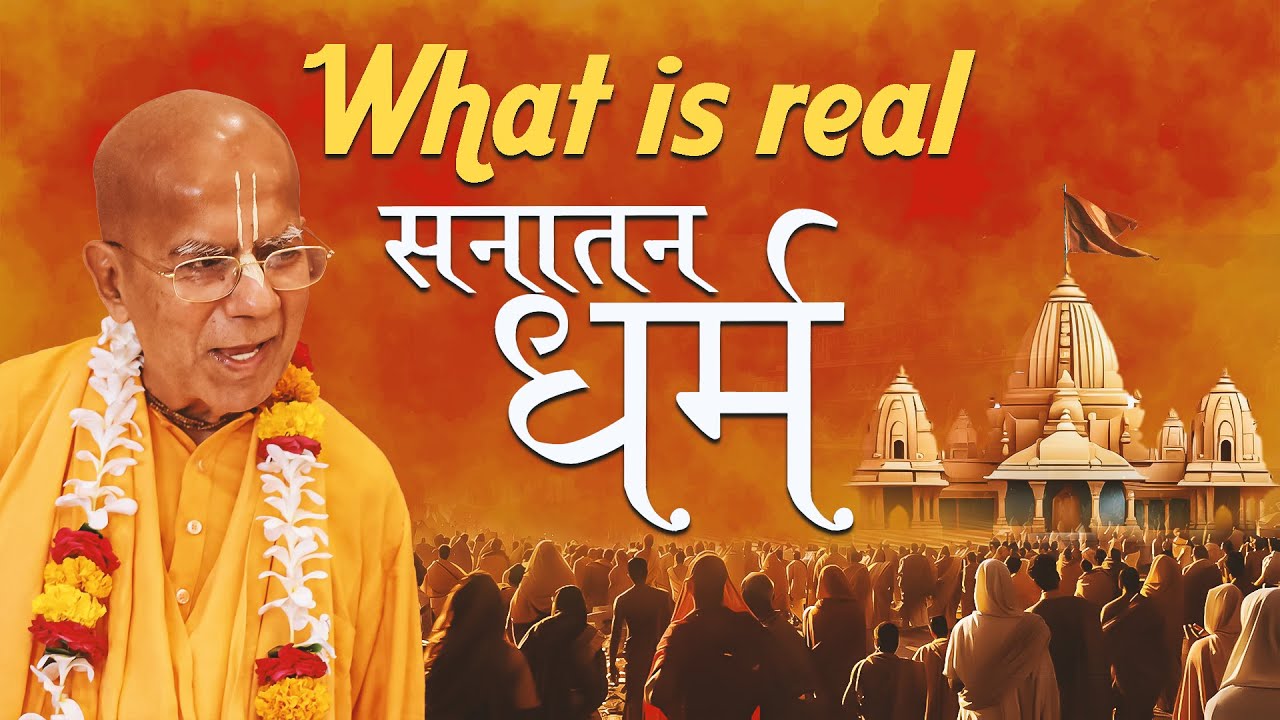
Gopāl Kṛṣṇa Goswāmī Mahārājā explains that true Sanātana Dharma is cultivating love of God through bhakti, not through rituals for material gain. He contrasts karma-kāṇḍa with pure devotional service, using stories of King Katvanga and Śukadeva Gosvāmī to show how material pursuits lead to suffering while bhakti purifies the heart.
Chapters
This is a very significant verse of the Śrīmad-Bhāgavatam. First, I will give you devotees a little introduction to the Śrīmad-Bhāgavatam, the history of the Bhāgavatam. You must know that this Bhāgavatam is completely distinct from any other scripture on this planet. The Bhāgavatam contains stories not only of incidents that took place on this planet, but also incidents that took place in other planets.
The Śrīmad-Bhāgavatam is the topmost scripture on the planet.
It was compiled 5,000 years ago by Vyāsadeva. This was compiled or presented by Vyāsadeva at the prime of his maturity. Don't worry about the mosquitoes. If those— if there are some devotees who are so worried about the mosquitoes, they can just stand outside the class instead of disturbing the class. If you concentrate on the Bhāgavatam, then the mosquitoes won't bother you. When Hiranyakāśipu was performing his austerities, he had a million ants walking all over his body and he did not notice any of them. So if one mosquito comes and sits on your head for one minute, don't get so concerned. So the Bhāgavatam was compiled by Vyāsadeva at the prime of his maturity. As you know, Vyāsadeva had compiled the vast Vedic literature and he had summarized the Vedic literature in the Vedānta Sūtra. First there was only one Veda, then there was one Veda got divided into 4 parts. Then he compiled the Upanishads, 108 in total. Then he summarized everything in the Vedanta Sutra. Still Vyāsadeva was feeling very, very unhappy. Just like sometimes you do something, but there's something in your heart that keeps telling you, you didn't do it right, or something more has to be done. So Vyāsadeva was having that same feeling. So what did he do? He approached his spiritual master. In spiritual life, one doesn't speculate on anything. Because he realizes his mind is defective. That means our mind is incapable of determining what is right, what is wrong. Mind being defective doesn't necessarily mean you have to be a madman. Of course, everybody is crazy to some extent. Prabhupada used to tell us a story that once a murderer was being convicted by a judge and the counsel for that convicted man said, "My, uh, this client was crazy and because he became crazy, he committed the murder." So the judge said, "Everybody is crazy to some degree." So Prabhupāda used to say that actually everyone in the material world is crazy to some extent. So Vyāsadeva, to get his doubts clarified, he approached a spiritual master, Nārada Muni, on the banks of the river Sarasvati. And Nārada Muni at once understood why Vyāsadeva was unhappy, because he had not exclusively glorified the process of pure bhakti. Hence came the Śrīmad-Bhāgavatam, which is nothing but a description of the transcendental process of serving the Supreme Personality of Godhead. So Vyāsadeva was instructed by Nārada Muni to compile the Śrīmad-Bhāgavatam. So that Śrīmad-Bhāgavatam was spoken on 3 separate occasions, and every time it was spoken, it became sweeter. That is the difference between spiritual knowledge and material knowledge. Material knowledge, first time you enjoy it, second time less, third time less, fourth time less, and then you say, okay, no more. Spiritual knowledge and spiritual chanting is the other way around. The more you chant, the more you hear, the more you serve, the more you feel like chanting and hearing. So Śukadeva Gosvāmī first heard the Bhāgavatam from his father Vyasadeva. Vyasadeva's son was Śukadeva Gosvāmī. Śukadeva Gosvāmī was liberated from the very beginning. And Vyasadeva is considered a literary incarnation of the Supreme Lord. So Śukadeva Gosvāmī was in his mother's womb not for 9 months like you and I were, but for 16 years. Just like Bhismadeva. Bhismadeva had the benediction that he could choose his moment of death. So Śukadeva Gosvāmī had the benediction he could choose his moment of birth. So for 16 years he refused to come out of his mother's womb. Why? Because he did not want to be affected by the illusory energy.
So several times his father said, "Please come out, come out." Son said, "No, no, I am not coming out.
I don't want to be touched by Maya." Then Vyāsadeva went to Lord Śrī Kṛṣṇa. Then Lord Śrī Kṛṣṇa personally came and promised Śukadeva Gosvāmī that he will not be touched by māyā at all. Then he came out of the mother's womb, and as soon as he came out, he left home. So when Śukadeva Gosvāmī left home, his father was very sad. He said, "I waited for 16 years for you to take birth. Now where are you going?" So Śukadeva Gosvāmī continued to travel. He did not return home. But by his mystic power, he created a double, another Śukadeva Gosvāmī who looked just like him. So the other Śukadeva Gosvāmī came home, but the real Śukadeva Gosvāmī just went on travel. So Śukadeva Gosvāmī heard the Bhāgavatam from his father Vyasadeva. On another occasion, this Bhāgavatam was spoken by Śukadeva Gosvāmī to the dying King Parīkṣit. Parīkṣit Mahārāja, as you know, was cursed to die within 7 days, at the end of 7-day period.
Parīkṣit Mahārāja was very fortunate.
He had received 7 days' notice. But you and I won't even receive 7 minutes' notice. Forget 7 minutes, even 7 seconds. So he got 7 days notice, and in 7 days you're going to die. So Parikṣit Mahārāja prepared for his death by inviting all the great sages for advice. Because he was the king of the planet, so when he was getting ready to die, all the great sages at once came at his bedside. And he asked all the great sages, what should a man do who is about to die? Different people gave different advice, but Śukadeva Gosvāmī, the son of Vyāsadeva, said, you should hear about Kṛṣṇa.. And so he recited the Srimad Bhagavatam. While the Bhagavatam was being spoken to Pariksit Maharaj, there was a very great sage sitting in the audience. And what was the name of the great sage? Soznaet? Sutagosa Swami. So Sutagosa Swami heard the whole Bhagavatam word by word and he had everything memorized. Just see the power of the great sages. He could hear the Bhagavatam once and have it memorized in his mind. These days our memory is so defective. Everything we have to write down. When is your appointment? When are people's birthdays? When do you have to greet somebody? But Śrīla Gosvāmī had everything in Him. He had everything recorded in His mind. The nature of a devotee of the Lord is he's concerned about everyone's welfare, not just his welfare. So a little later, after the Bhāgavatam was spoken to Parīkṣit Mahārāja, there was a fire sacrifice going on in which 60,000 great sages had assembled together. Namashrani is in Northern India. And what were these 60,000 sages discussing? How will people in Kali Yuga be saved?
They could predict exactly what the symptoms are going to be in Kali Yuga.
The Bhagavatam has very accurately predicted the symptoms of Kali Yuga because these great sages are like spiritual astrologers. So they could see exactly how people in Kali Yuga will suffer. They would say in Kali Yuga, they saw that people would have no interest in self-realization. And they could see how people's sinful activities will just increase. So they were very concerned, how will people be saved? This is the difference between a materialist and a devotee. The devotee is concerned about everyone's welfare, not just his own welfare. What would happen to people in Kali Yuga? So they were having this big discussion. And they selected Sutakoswami, who was also present there, to be the leader of their delegation. So Sutakoswami was asked by 60,000 sages, "Please tell us, how will people in Kali Yuga be saved?" And Śrīdhagavat Swāmī, he said, "By hearing the Bhāgavatam." And he recited the whole Bhāgavatam word by word, the way he had heard it from Śrīkṛṣṇadeva Gosvāmī. Therefore when you read the Bhāgavatam, you will see, you only have the first canto in Russian, but you will see that there are two separate dialogues going on at the same time. One is between Śrīkṛṣṇadeva Gosvāmī and Parīkṣita Mahārāja, and the other is between Sutagosaami and the sages in Narmishwaranya. Both are going on simultaneously. The word Shuka in Sanskrit means parrot. Do you have parrots in your country? You probably have it in the zoo. But do you know what a parrot is? A parrot can repeat everything you say. I have a friend in Canada. He is a friend of our temple. So every time I go to Montreal, I go to his house. So in his house he has a parrot. So whenever I go there, he makes the parrot sing. Hare Kṛṣṇa. The parrot sings Hare Kṛṣṇa more than the person who is the owner of the parrot sings every day. The parrot can repeat anything you teach him, and the parrot is purely vegetarian. But don't stop, start keeping parrots now. It's not a Vaiṣṇava hobby to keep parrot. So the word śuka in Sanskrit means parrot. So the Vedic injunction is that when a parrot bites a fruit, the fruit becomes even sweeter. Śuka, śuka means Lips of the parrot. So the Bhāgavatam was recited by Śukadeva Gosvāmī. So because it was recited by Śukadeva Gosvāmī, it became even more sweeter than when it was spoken by Śukadeva Gosvāmī to Parīkṣitma. Spoken by Vyāsadeva to Śukadeva Gosvāmī. Now with this background of the Bhāgavatam, I'll explain the present verse. So in this verse it is being explained, dharmā sannuṭhita purnaṁ viṣkhusiṇāḥ kathācya naḥ padaḥ yajñātir athim śrama eva kevanam. Śrama evahi kevam is a very important line. Prabhupāda has quoted this line in many of his lectures. śrama evahi kevam means simply waste of time. So this verse is saying dharma svanus teeta. Dharma, dharma actually means religious duty, means duty, duty towards God, because we are all part and parcel of God and subordinate to God. Many people do not utilize dharma for developing love of God. Many realize dharma for economic gain. They want economic benefit.
So it says, dharmā svanasthita punsambhishkasyena kathāso yaha naḥ padaḥ yādyati rātmṣramaḥ kīkevallam. So it is being explained that dharma, when it is utilized just for realizing economic gains and sense pleasure, it is simply a waste of time.
In other words, dharma should be utilized to develop love of God.
Now I told you earlier that when Vyāsadeva had approached his spiritual master Nārada Muni As to why he was unhappy even though he had compiled the vast Vedic literature. Vyāsadeva told him, because in the Vedas there's no doubt you have mentioned the position of God Krishna, but you've also mentioned karma-kanda activities.
The karma-kanda activities are not the ultimate goal in life. Vijnāyate sto karma-kanda. You know what is karma-kanda activities?
Karma-kanda activity mean—
everyone may not know— the karma-kanda activity means It's a type of sacrifice, but the goal of sacrifice is to get some material benefit.
You want some benefit in exchange for your sacrifice.
So the different types of karma-kanda activities people perform: they go to a place of worship, they call brahmins and feed them prasadam, give charitable, give charity, so many other things. Now what is the 8th offense in the chanting of the Hare Krishna mantra? 8, who knows? Who will say? So to consider it, to consider it attending in the Karmakanda, one of the auspicious activities.
No, no, he said something different.
Yeah, like this.
What's the 8th offense?
To consider the chanting of Mahā-mantra one of the auspicious activities of Karmakanda.
So if you think that I'm chanting Hare Kṛṣṇa mantra and I'm chanting Hare Kṛṣṇa mantra because in exchange for this chanting I want these material benefits,, then that is not the best use of the chanting of the Hare Kṛṣṇa mantra.
So when you perform karma-kanda activities, you may get some material benefit, but material benefits only last you for some time. Just like the plane that flies in the sky, the plane can remain in the sky only as long as it has enough fuel. Before the fuel runs out, it has to come down. So karma-kanda activities allow you elevation to comfortable positions, but after some time again you have to descend into the cycle of birth and death. Kṛṣṇa says, "A brahma-bhuvaṇa-loka-pṇaṇa." Even if you go to the topmost planet, Brahmaroka, you still have to go through the cycle of birth and death. Only one who returns to my abode can free himself from this miseries of life. So the point that we are making is this: karmakanda activities are not the ultimate end, and karmakanda activities can also get you in trouble if it is wrongly performed. Whereas devotional service, even if you perform it, even if you don't complete it, you still have nothing to lose. In the Bhagavad Gita, Krishna was asked by Arjuna, what is the What is the position of one who starts the process of devotional service but is not able to complete it? Kṛṣṇa said nothing is lost. One just continues in his next life at the point you leave. Once upon a time there was a king. He was very fond of karma-kanda activity. So he gave lots of cows in charity.
Thousands of cows!
And the cows that he gave in charity were not ordinary cows. They all had gold on their horns and on their feet they had silver. Plated shoes. Even human beings don't have this opulence today. So he gave hundreds of thousands of cows to all the brahmanas in his kingdom. Once he gave again, one brahman who was given a lot of cows by him, by mistake the cow came back to him and by mistake it was given to another brahman. Because the king had so many hundreds of thousands of cows, so one cow that we gave to another brahman came back into his, you know, his courtyard, and by mistake he gave it to another brahman. He didn't do it intentionally, but the brahman whose cow was went back and was given to another Brahmin was furious. He came back, he started arguing with the king.
You are low class, you gave me a cow and now you have taken it back and you have given it to somebody else.
In the Veda it is said if you steal a Brahmin's property then you have to go to hell. So the two Brahmins were fighting. One whose cow came back by mistake and the other Brahmin, the man who got the cow by mistake. So the king was very disturbed by their fighting. He said, "Don't fight due to my mistake. I will give both of you, each of you, 100,000 cows each. So please settle it." The king said, "Please stop fighting, otherwise I will have to go to hell because a Brahmin's cow has been taken by me by mistake." But the Brahmin still didn't stop fighting. They both went on fighting and they were both accusing the king. So then when the king died, he was taken to Yāmraj. If one is engaged in pure devotional service, then after death he doesn't have to go to Yām-rāja.
But if you are not engaged in pure devotional service, then you have to go to Yām-rāja to get your report card.
Just like you go to school, you get your report card. You get report cards in school. So when the king was taken to Yām-rāja, Yām-rāja said, King, you are very magnanimous, you have done lot of charitable activities, but you have also done some impious activities.
So tell me, what do you want to suffer first?
Do you want to first enjoy the results of your pious activities, or do you want to suffer the results of your impious activity? The king said, first let me suffer the results of my impious activities. Because then the king wanted to enjoy the results of his pious activities. So Yamraj cursed him to become a lizard. So he became a lizard in a well.
So one day Krishna's son Samba and others had gone on a picnic.
And they were feeling thirsty. So they went to a well to get some water. So when they went to that well, they saw such a big lizard in that well.
And the lizard was very heavy.
4 or 5 of Kṛṣṇa's sons tried to lift it, but they could not lift it. Then when they went home, they told Kṛṣṇa that they saw such a heavy lizard. Oh, Kṛṣṇa, don't touch, don't play with the mosquitoes. So when they— so when they went home, they told Kṛṣṇa, They saw a lizard who was very special, so heavy that they tried to lift him, get him out of the well. They couldn't. So then Krishna, they said, "Daddy, why don't you get that lizard out?" Just like sometimes child can't do it. So they said, "Ātīya, you please help out." So Krishna, when he descends on this early planet, he plays the role like a human being. So Krishna said, "Okay, I'll go." So Krishna went to the well and saw the lizard. He just touched it with the left hand and the lizard came out and became a beautiful handsome king again. The lizard once again assumed the form of the king that it was before he died. Kṛṣṇa of course knows everything. So Kṛṣṇa asked him, "Who are you? You look like a demigod." But the lizard who became a king said, "You are the Supreme Personality of Godhead.
You know everything.
Still you are asking me to tell you who I was." Then he gave a story that I was a king and I was engaged in karma-kanda activities. And he said how he got trapped because he made a mistake in performing the karma-kanda activities. And he said how he was foolish that instead of dwelling pure love of God, he was engaged in karma-kanda activities because he wanted to enjoy the results of his pious activity. So the moral of this story is that karma-kanda activities are dangerous. You make a little mistake and you'll get caught. Therefore, one great devotee, Narottama Das Thakura, has prayed that the karma-kanda activities is just like drinking poison from a golden cup. Whether you drink poison from an ordinary cup or golden cup, it's going to have the same effect.
So Śrīmad-Bhāgavatam does not talk about karma-kanda activity. Kṛṣṇa consciousness movement does not preach about karma-kanda. Therefore the 8th offense is to consider chanting of Hare Kṛṣṇa as one of the karma-kanda activities.
We don't chant Hare Kṛṣṇa so that we may get a ticket to America or some other metropolis. You chant Hare Kṛṣṇa because you're praying to the Lord, please engage me in pure devotional service. In today's society, when you talk about pure devotional service, very few can understand what you are talking. Because the word pure today exists only in dictionaries. There is nothing pure left in the world. Is there anything pure left? The air you breathe, is that pure? Maybe Vāṣa-gorad, but niya-druyā-gorad. The water you drink, is that pure? The relationship that exists between people, is that pure? Everyone is trying to cheat everyone. Father tries to cheat the son, son tries to cheat the father. Leaders try to cheat the citizens. They just want their votes. And the citizens are always trying to cheat the government, don't pay taxes. Husband cheats the wife, wife cheats the husband. So they have so many divorces. So everyone is cheating everyone. Therefore Bhaktisiddhānta Sarasvati said it's a world of cheaters and cheated. Some people are ready to be cheated, others are ready to cheat. Just like there are so many so-called bogus gurus today. They'll preach so many nonsense philosophies. But will not tell you to give up sense enjoyment. Even those who say surrender to Jesus Christ but don't emphasize Jesus Christ's teachings are cheating gurus. So what is lacking in society is honesty and purity. The food you eat is not pure anymore, it's full of chemicals. So in this contaminated, impure environment, when you talk about pure devotional service, it goes over— above the head of many people. And even after people come to the Krishna Consciousness movement, And when they hear about pure devotional service, they just can't understand what it means. I don't believe all of you, even if you are chanting 16 rounds, you understand what is pure devotional service. To understand pure devotional service, it takes time. Then you can understand what it really means.
So Bhāgavatam is saying in this verse, dharmā svanasthita-pūṁ ca, that this dharma, religion, should be used for developing love of God, not for anything else.
In other words, if you develop love of God, then the living entity derives real satisfaction.
The living entity cannot be satisfied by any material arrangements.
Just like if somebody gave you a very nice costume to wear and a very nice sandalwood garland to wear and told you no eating, no drinking, will you be satisfied? You may even have a nice palace to live in, a nice Volga car to drive, but nothing to— they don't let you eat. Will you be happy? If you have a parrot in a cage, bird in a cage, you polish the cage, make it silver, golden, but don't give the bird any food. Will the bird survive?
No.
So the point is that unless we try to establish our relationship with God, the living entity can never be satisfied. Real satisfaction will be derived once we engage in service to the Supreme Personality of Godhead. Therefore, those who are engaged on the devotional path, they are experiencing a kind of spiritual happiness. And because they are experiencing spiritual happiness, happiness, they are content. In the material world, nobody is content. Everybody is complaining. He wants more, more, more. Bolshoi, bolshoi. Don't think that only in your country people are complaining. People were complaining when they had communism. People were complaining when Soviet Union was one country. Now they have capitalism, they are complaining. You go to India, people are complaining there. You go to Africa, people are complaining there. In India, in America, I know a lot of rich people, and they're also always complaining. So no one is happy except one who has taken shelter of the lotus feet of Lord Sri Krishna. This is exactly what the Vedic scriptures are saying. Veda shastra ke samandha arvidhya prayojana. That is, unless the living entity can establish his relationship with the Supreme Father, he can never really be happy. So it doesn't matter how much material success you may have, you must realize material success is short-term. Just like in your country, so many famous politicians have come and gone, so many philosophies have come and gone. At one time those who are heroes, now you have told them, 'Dasridanya.' That's why you people also change the name of your gorath. Previously your name was Gorki, but now you've told, 'Bye-bye Gorki, we don't want your philosophy.' So that is material world philosophies keep changing. What do you like today, you don't like tomorrow. But this Bhagavatam which you people are hearing today, friends, this philosophy is thousands of years old and it looks as if it was spoken only yesterday just for you. I'm sure all of you read the Bhagavad Gita. When you read the Bhagavad Gita, do you ever realize that this book was spoken 2 million years ago? Tell me honestly. No, it looks like it was spoken yesterday just for you because this is eternal wisdom. In Sanskrit, you call it Sanatana Dharma.
Sanatana Dharma means the eternal duty of the living entity.
And what is the eternal duty of the living entity? To develop love of God. So this Krishna Consciousness movement, through the help of the Bhāgavatam and Gītā, is helping people to help develop love of God. Because unless you develop love of God, nothing will satisfy you. Now, how do you develop love of God? Some of you may say, you're not the only one talking about this. When I go to the church, they're also talking about this. When I go to the Jewish synagogue, they're also talking same.
So wherever I go, they're talking about this. So what's different?
What are you people saying something that's different from the other We are explaining what are some of the symptoms of development of love of God.
The loving propensity is there in everyone. Just like within wood there is fire.
Because within wood there is fire, the moment you, in a yagya, you light a match to the wood, it at once lights up. In a small child there is the ability to walk. Therefore, even when the child is crawling, the mother knows that after 8 months the child is, then he can start being trained how to start walking. So because the child has the capacity to walk, he is trained how to walk and he learns how to walk.
So that loving propensity is in everyone.
In the mature world, we are all searching for that loving propensity. All over the world, when you listen to these mundane songs, all 99% of these songs are based on the theme of love. I am sure you devotees don't listen to it now anymore. But it's all based on love. Actually, the scriptures explain, it's in last chapter and not love.
But all these relationships are frustrating because people can't find any satisfaction in human relationships.
They turn their loving propensity to cats and dogs. Why are they turning their loving propensity to cats and dogs? They're dissatisfied with all the human relationships. Everyone has rebelled against everyone. The children are obedient when they are young, but when they grow up, they become independent. But people think, oh, at least the dog and cat will never say dasvidaniya to me. So they give the loving propensity to cats and dogs. In your country, you don't see as many cats and dogs as you see in the Western countries like America. It's very common cats and dogs sit on the dining table with the family members, even eat out of the same tariyalka, same spoon. They call this progress. So this type of loving propensity will not satisfy anyone. The real loving propensity, when it is targeted towards God, can satisfy the individuals. But at the present moment, we are so contaminated that, that we are even unable to understand God. We can't understand God because God is all pure and we are impure.
Therefore, we have the process of devotional service.
Why do we have the process of devotional service? Because it helps us to go from impurity to purity.
Just like a drunk man cannot be expected to speak in a sane manner, similarly, one who is intoxicated with material desires cannot act properly.
Therefore we have the process of devotional service. Why are we hearing the Bhāgavatam? Because by hearing the Bhāgavatam, the impurities will get destroyed. Just like when you take a medicine, the germs get destroyed. So, and then we also chant, attend Mangala-ārti, class, Guru-pūja, and then we engage in service during the daytime. Why are all these activities executed? To chēy tudarpan mārjanam bhāvā māḍ-dvārṇinirvāpanam. To cleanse the heart of all the dust. So the heart is full of dust, the mind is full of contaminated desires, all the senses are dying for sense enjoyment. So the living entity is very unhappy. So through this process of devotional service, we are able to cleanse the heart and the senses. And as we get purified, spiritual life becomes sweeter and sweeter, just like sugar. Sugar, when it is being cleaned— sugar in the very beginning, it's where when it's like a sugarcane seed, you put it in your mouth, it will taste bitter, but as sugar gets cleansed, it becomes sweeter and sweeter.
So we have to cleanse the heart, the eyes, ears, nose, tongue, genitals. At the present moment, the eyes just want to see something vulgar and nothing else.
That is why pornography has become such a big business in Kali Yuga, because the eyes have just want to see something obscene and vulgar. The ears just want to hear some mundane sound. Just like we were coming in the train from Moscow last night, early in the morning at 6 o'clock, they started playing that music on the sound system early in the morning and late in the night they'll play. They get up with the radio and play and sleep with the radio. And then in the Western society they say that everybody is glued to the tube. And what is the tube, you know? It's a short form for television. So people just keep watching TV from morning to night. They don't study, nothing, just TV. In America you can even attend mass in the church on television.
On Sunday they have about 8, 9 television stations doing mass on television.
So what people do, they are sitting down in their bed on Sunday at 10 o'clock and they are watching television and attending the mass. And they say, "Yes, we attended mass today." So this is people's concept of religion today.
So developing love of God means giving up your love for so-called sinful activities.
Nama evahikhev lam. We should not waste even one minute of time because a minute lost cannot be obtained back with the wealth of the entire world. The entire world. Suppose you waste 10 minutes in idle talk, prajalpa, or extra sleep, or overeating. Then you go to somebody and say, "Here are 1 million rubles. Please bring those 10 minutes back to me." Somebody bring it back?
No.
Therefore, Chanakya Pandit said, "Ayusha kashana ekopina labhayasvanna kotibi." A minute lost cannot be obtained back with the wealth of the entire planet.
So for a devotee, he does not want to waste even 1 minute.
Because he knows I won't get this chance again. But non-devotees have no value of time, so to them it doesn't matter. But devotee, time is very, very valuable. They say in English, time and tide wait for no one. There's a story of a king called King Katvanga. King Katvanga had once helped the demigods in a battle with the Supreme Lord, and the demigods had defeated the demons. So the demigods said, what can we do for you in exchange? You helped us win the battle with the demons. He said, "Just calculate and tell me how much time is left for me." They said, "Only one more minute." So Maharaj Caitanya said, "Please let me descend to the earthly planet so that I can meditate at the lotus feet of Lord Śrī Kṛṣṇa." So devotee should always be thinking, "I only have one more minute left in my life." Don't think I have lot of time left. Bhāgavatam says, "padam padam yākṣvī padam na teṣām." There is danger at every step.
At every step there is danger.
Don't misuse your valuable human life.
Take to spiritual life now, as soon as possible.
Just like if somebody gave you a chance to make a million dollars or make a lot, make money, you don't say, "Not now, I'll take use of the chance later." You want it right now. When somebody offers you devotees nice prasad like samosas or rasgullas, you don't say, "I'll take it later." You say, "Now, now, now." So similarly, the opportunity to advance in devotional service when it is presented, we must avail of it right away. And you will avail of it right away if you are convinced in your heart that devotional service is the most glorious activity and the most desirable activity.
That conviction must be there in the heart.
How will that conviction come? If I asked all of you, "Are you completely convinced 100% about Kṛṣṇa consciousness?" and all of you raised your hand and said, "Yes," I would not believe it. Our conviction is very weak, very weak. You want some evidence? You want some evidence? You're chanting your rounds, the moment somebody comes to talk to you, you gladly participate. You're chanting your rounds and you fall asleep. Hearing the Bhāgavatam class, you fall asleep. But you never fall asleep by eating the Sunday feast. Because you have a natural attraction for the Sunday feast.
So our attraction for Kṛṣṇa has to develop.
But how will that attraction develop unless you take the medicine as the doctor has prescribed it? Therefore, we tell everyone to chant 16 rounds. Therefore, we tell everyone to avoid the 4 offenses, follow the 4 regulatory principles, avoid the 10 offenses, read the books, and engage in service.
Because by taking part in these activities, the impurities will come to be destroyed.
And as the impurities get destroyed, you'll once again regain your constitutional position. Just like when the clouds cover the sun, you can't see the sun, but when the clouds go away, the sun becomes visible. So similarly, due to the impurities in our heart, we can't appreciate the glories of bhakti. So these impurities have to be destroyed, and the process is this process of devotional service which your people are being introduced to. This is not a new process. It's not that Prabhupada invented this process and brought it to your country in 1971.
All that Prabhupada did was repeat what he heard from his guru, Maharaj, and by his purity he conveyed the meaning of religious principles. So this is a proven method of Self-realization.
Just like in your country also you can see so many people are chanting Hare Krishna, following regular principles and engaged in so many different walks of life, but they are happy. So this is an eternal time, it is an eternal religion, very old process. Just like when you feel, when you go out of your room and breathe the fresh air, you feel very satisfied. Similarly, the Bhagavad Gita explains You feel the freshness of devotional service every time you execute it. You don't feel like saying, "Oh, I chanted Hare Kṛṣṇa yesterday. Today why should I chant?" "I read the Bhāgavad-gītā yesterday.
Why should I read it today?" The more you chant, the more you read, the more you serve.
Caitanya Mahāprabhu said, Ānanda-buddhi-vārdhanam pradīpādam pūmṇām vraja-svādhanam sarvatma-snapaṁ param vijayate Śrī Kṛṣṇa sankirtana. There is going to be spiritual happiness. And the nature of the spiritual happiness is it is always increasing, increasing, increasing. So a devotee, when he performs austerities to please the spiritual master and Kṛṣṇa, he in exchange for those austerities realizes spiritual happiness. And the nature of the spiritual happiness is it never ends. So please realize this happiness and be really happy. Don't give up this valuable opportunity to become Kṛṣṇa conscious. Rūpa Gosvāmī has said, to become Kṛṣṇa conscious, you don't need any material qualification. You don't have to be a beautiful man, an educated man. All you need is desire and greed. So you must have the desire.
I want to perfect my existence.
I want real happiness and not false happiness. Just like if somebody gives you a 100 ruble note, you want to make sure it's a real note, it's not a fake note. When you buy something in the market, you want to make sure it's real food and not imitation.
So when you want happiness also, you should search for real happiness.
Why do you want to search for false happiness? In 18th chapter, Krishna talks about 3 types of happiness: goodness, passion, ignorance. What is the symptom of happiness in goodness? It wakes you up to Self-realization. But in the beginning it is bitter and then becomes sweet.
So when you practice 4 regulative principles, chennare Krishna, in the beginning it is bitter but then it becomes sweet.
When you are sick, you go to a doctor for operation. It pains the body, but the operation is for your benefit. Happiness in the mode of passion Frustration is what? In the beginning it is sweet, in the end it becomes bitter. Just like you take a bubble gum, in the beginning it is sweet, but in 1 minute it becomes so bitter, then you ultimately have to throw it out of the mouth. And happens with the mode of ignorance is that from beginning to end is based on laziness. So we should take the Kṛṣṇa consciousness seriously and thereby be happy. Don't waste this valuable human life.
Hare Kṛṣṇa.
Hare Kṛṣṇa. Hare Kṛṣṇa. The devotees have questions? Prasada, don't you all have questions based on the class? In the class we covered so many points. Shall I ask you a question? So what is the verse of this shloka describing? Vijnanate, say it again.
In whatever activity one is engaged, if it doesn't lead one to the love of God, then it's just a waste of time.
What is the symptom of love of God?
One doesn't want to be engaged in anything but service of Krishna.
Is that state easy to achieve? Okay, I'll ask. You devotees ask questions, I'll wait for you. There are no questions? I'm surprised. Usually Russian devotees have so many questions.
Krishna says give up everything and just surrender unto me. And what should we do with our children?
Surrender along with them. Basically, when Krishna says give up everything, doesn't mean you give up your wife, children, and just come and live in the temple. It means you train them up in devotional service also.
And if they don't have a desire to be trained, if you have a question, or, or either they don't have, yeah, if they don't want, if they bring up the question either Oh, well, then you have to decide either.
Rūpa Gosvāmī said, accept everything favorable for devotional service and reject everything unfavorable. So now you make up your own mind.
In which way, what is the fastest way to achieve the pure chanting of Hare Kṛṣṇa mantra?
Pure chanting of Hare Kṛṣṇa mantra will develop once you're chanting by avoiding the 10 offenses. If you avoid the 10 offenses, then gradually it will develop. But if you're not avoiding the 10 offenses, then it will be difficult to develop pure chanting. Therefore, when we chant, we should very attentively listen.
Why Śrī Rūpaḍa stressed spirit soul? Which can the soul be? What kind of soul can be? Maybe something different, I bet.
There's only one type of soul. It's not that spirit soul means our soul is spiritual in nature. Only what is spiritual doesn't die with the end of the body. What is material dies. So soul is called spiritual. That means it doesn't die with the termination of the body. You understand?
How can one develop submissiveness, humility?
Humility will come by realizing first of all that you are fool number one. And when you realize you are fool number one, then you will be ready to listen to others and be ready to offer all respects to others. But if you are thinking, oh, I am so I am smart, everybody else is a fool, then how will you listen to others? So once a girl devotee asked Prabhupada how should she preach, how should she distribute books. She said, when I go out to preach, if I remain very, very humble and don't— I'm not a little aggressive in book distribution, nobody will buy my books. So Prabhupada said a devotee should be a lion outside and a lamb at home. So outside, a lion. When you see the lion roaring, everyone runs away. Even the animals run away. So you should preach like a lion. And a lamb is a harmless animal. Therefore, at home you should behave like a lamb. So humility will come once you are ready to offer all respects to others.
Don't think you know everything.
Recognize you are fool number one. And when you are ready to offer respects to others, then there will be advancement.
You said that everything in the spiritual world is conscious. Also the chairs are conscious and everything is conscious. How is it possible?
Well, you don't have sofa sets and divans in the spiritual world. You don't need stool, divan, trees, grass. Nah! You have trees, grass, everything natural, and they all have life. There's no bulk electricity there because all the planets are self-illuminated. You don't have benzines there or machines. Everyone in the spiritual world has a private aeroplane, samalot. And that samalot is made of gold and emerald, and it doesn't need benzine to fly. You don't have to stand in line to get benzene like you have to here. And those planes never crash. And you have cows in the spiritual world.
They give you unlimited milk, surabhi cows.
And you have desire trees. The moment you touch those trees, any of your desires can be satisfied. But there is no problem because everybody there, their desires, how can I serve Krishna more?
Can, for instance, I accept the spiritual form as a plane or as a tree in the spiritual world?
Yes, if you desire, you can become a tree and Kṛṣṇa may come and play his flute underneath you. Kṛṣṇa may come and sit on the branches and play with his friends. Or you could become a grass and Kṛṣṇa will walk on your head.
You're saying that it is according to our individuality.
Based on your desire and qualification.
Just like human desire to become the chief engineer of your zavod. But if you don't have the qualification, you won't become. You may desire to become a millionaire, cock Rockefeller, but if your karma doesn't allow it, even if your desire is there, you won't become.
Understand? In which manner should we preach to the ignorant people?
Preach to them the way Prabhupāda preached. If you read Prabhupāda's lectures, and I'm sure you've read in Russian books, they're very, very simple. He told them, you're not this body. Who are you? You are spirit soul. There is God in control. He's the cause of all causes. And there's something known as the scriptures, words of God. So I'll preach today afternoon, you can listen to the preaching.
Is there any relationship between Christ and Krishna?
Yeah, what kind of relationship? Jesus Christ, etta sin, Krishna, etta atyath. Jesus Christ, warrior.
Yes, what is the spirit soul? The Holy, Holy Spirit, like that, in Christian tradition.
Christian tradition?
Yeah, this triple, Son, Father, and Holy Spirit, like that.
Father is Krishna, Son is Christ, and what's the—
Holy Spirit, I don't know, like that.
I don't know, the Holy Spirit. Christian, Christian is Son.
There is some specific Christian term, I don't know it.
I am not an expert on the Bible. I can, I'm trying, I have some knowledge of the Vedic scriptures, not of Bible's terminology.
He says that maybe it's like Brahman, Paramātmān, Bhagavān.
No, not exactly.
Do we give applause?
No other question? No other question. So now we do Vaiṣṇava bhajan. And which bhajan they all want to? Which bhajan they all know nicely? You want bhajan? You have songbooks here? So Govinda Dāsa is saying how to control the mind, how to make the mind fearless. At the present moment, everybody's mind is is fearful. So many different types of fear everybody has. Externally we may be smiling, but from inside we are fearful. You are fearful what you have may go away. You may get diseased, you may die. You are scared that somebody may come in your house and steal everything, therefore you lock the house. You are scared somebody may steal from your car, so you lock the car and you double lock your car so nobody can steal. The nations are scared somebody may attack them, They must have nuclear weapons. So, so many different types of fear are there. A devotee has no fear. Why? Because he's taken shelter of the Sannam Maharajnanda. So he says, dolo amar abhayacharna ravindare. You can become fearless, free of anxiety, if you take shelter of the lotus feet of Sannam Maharajnanda. So if you want to become free of anxiety, devotees, there's only one alternative. Give up this bodily identification, because as long as you're on the bodily platform, you'll identify with the mind and the senses.
Senses.
And as long as you are on this platform, you'll always be worried about what I have and what I don't have. This much I have now, but this much I must have by tomorrow. That is the root cause of all unhappiness and confusion of the mind.
Why should he avail of this human body by taking shelter of the Sannamaharaj Danda?
Because this human birth is very rare. Durlava manava janama satsange ochinretko. Human life Very rare. So you're not going to get this human life again. Therefore the Vaishnava is very unhappy when he sees the materialists are trying to enjoy. The Vaishnava feels very sorry when he sees materialists are trying to convert a position of distress to a position of comfort.
Old age is hidden by makeup.
You dye your hair. If you are bald, you get artificial hair. If you have false teeth, if your teeth are falling, you put false teeth. Every attempt is being made to convert distress to happiness. They want people to think, yes, there is no distress. So devotee is very sorry for this false understanding. Therefore, there was a great devotee called Vasudeva Datta of Caitanya Mahāprabhu. He one day told Caitanya Mahāprabhu, please grant me a favor. Caitanya Mahāprabhu said, what is the favor you want? Please take everyone back to Godhead and transfer their sinful reaction to my account, and I will suffer. There was once a Vedic king called King Rāntideva. He had fasted for 48 days. So he was about to break his fast with foodstuff made of milk, sugar, and water when a hungry Brahmin ran into his palace.
The hungry Brahmin said, "King!" He said, "You need to feed us. I'm hungry.
Give me something to eat." King gave him a little bit of food that he had. Then another hungry man walked in. Just see, the king and his wife had fasted for 48 days. So when the other hungry man walked, they also said, "We are hungry. Give us something to eat." So slowly, slowly, the king finished everything. Then there was a thirsty man who walked in. He said, "I want some water to drink. Give me something to drink." So the king also gave him the water to drink. One day. Then he had nothing left. Then the king offered a very nice prayer to the Lord. He said, "Na kaamaye ham gatim ishrat param asthar di yuktam apunar bahavan bhai." He said, "My dear Lord, I don't want any of these mystic perfections. What I want only is that I may take on the suffering of everyone." and everyone else may be taken back to You, and I will take on and experience all the distress. This is the mentality of a Vaiṣṇava. That is why we do book distribution. Why do we go out and preach? Because we know that unless people take shelter of God, no material arrangement will make them happy. Because the Vaiṣṇavas are compassionate, therefore they display this compassion by preaching. Therefore, preaching is the most important service for any devotee. Preaching means making people aware of God. Making people aware who they are. So Vāsudeva Datta said, my dear Lord, take everyone back to Godhead. I will stay and suffer the suffering due to everyone. Prabhupāda says this position is even more magnanimous than the position taken by Jesus Christ, because Jesus Christ said he'll only take his own disciples back. And Krishna also said he'll only take back those who will surrender to him. But Vāsudeva Datta said, I'll take back— take everyone back, even if someone's 'Not yet devotee, transfer their sins to my account. I will suffer.' So devotee is anxious to bring everyone on the devotional path. So Govinda Das explaining how in the material world everybody is suffering. People are really suffering. They can't stay awake, they can't sleep. In America, the number one medicine is the medicine that puts people to sleep. If people just can't sleep, so they need pills to go to sleep, they need pills to stay awake, they need pills to do everything. So they're so dependent upon these medicines. But the devotee falls asleep in one second, provided he was working for Krishna all day. Govinda Das is saying, I have wasted my time, days and nights, uselessly. I was thinking my family members will give me happiness, but none of them can give me happiness. And he compares human life to a drop of water on a lotus leaf. If you have a drop of water on a lotus leaf, at any time the drop of water can fall off the lotus leaf. So he says, at any time this life can end. So Govind Das gives the alternative: engage in the ninefold process of devotional service. These are the ninefold processes explained by Prasad Mahārāja. Prasad's father asked him, son, what have you learned in school? He was thinking son will say that you, father, are the Supreme. But Prasad said, So father got very angry, threw the son away. So the materialists don't like to hear about the Ninefold Process of Bhakti. The devotees only want to talk about the Ninefold Process of Bhakti.
So we have 9 avenues through which we can cultivate devotional service.
Shāvanam, kīrtanam, chanting and hearing. Viṣṇu-smāranam, means to remember the Lord. And, paṭhasēvanam, worshiping the lotus feet of the Lord. Ārḍhanam, worshiping the form of the Lord in the Deity. One day you will have a big temple in Gauraki and then you'll have big deities. Then vandanam, to offer prayers to the Lord. Then prayers mean you repeat the prayers offered by great sages. Dasyam, to serve the Lord as a servant, like Hanuman served Lord Rama. Sakhyam, to serve the Lord as a friend, like Arjuna served Krishna. Arjuna did not want to fight, but when he saw what his friend Krishna was saying, he agreed to fight. And atmanvedam, to give everything to the Lord. And the example is Bali Maharaj. I'll tell you the story in the afternoon lecture. Hare Krishna. Hare Krishna. Any questions?
The question is, why after taking birth in this material, in this new body, we forget our previous body? And the second question, will we remember our births and deaths in material world when we are in the spiritual world after?
Can you upgrade for other collection of auras?
"It is a great fortune that you forget everything what you experienced before you came to this birth." Prabhupāda explained that even for one minute if you had to experience the pain you had to undergo in your mother's birth, today you would die. In your mother's womb you had to sit with your head bent down like this, like a bow, with stool, urine, blood, mucus all on top of it. It was a horrible experience. Just like sometimes you may see an accident when a man has been run over by a car or You don't want to ever think of that incident again. So your past, your birth was horrible. Okay, kokoito gavat.
We will remember how much you were alive in the spiritual world after we return there.
In the spiritual world you are too absorbed in thinking of Kṛṣṇa. So you don't think about anything else. It's not in the spiritual world you go then you begin to think, "Did I make a mistake in coming here?"
More from PRASAD

Rare Pastimes & Timeless Lessons of Guru Mahārāja | Stories Every Disciple Should Hear

ISKCON Legends- pure devotees meet-HH Jayapataka Swami, HH Gopal Krishna Goswami, HH Radhanath Swami



Jagannātha Ratha-yātrā Through Śrīla Prabhupāda's Mercy | 29 April 2006 | Nairobi, Kenya

Lord Jagannātha's Appearance Pastime | 21.07.2019 | ISKCON Calgary | Śrīla Gopāla Kṛṣṇa Gosvāmī

The Ācārya Teaches by His Own ExampleGuṇḍicā Mārjana by Guru Mahārāja #shorts

Guṇḍicā Mārjana – Lord Jagannātha's Pastime | 21.7.2019 | ISKCON Calgary |Śrīla Gopāla Kṛṣṇa Gosvāmī

H.H. Gopāla Kṛṣṇa Gosvāmī Mahārāja - Exemplary Sādhana and Deity Worship # shorts

भगवान की कृपा कैसे प्राप्त होगी ? | 11 Jan 2014 | Punjabi Bagh | Srila Gopal Krishna Goswami

Material Education vs Spiritual Education | Srila Gopal Krishna Goswami #shorts