What is the Goal of Life🤔 | SB 7.6.16 | 07 Feb 1997 | Śrīla Gopāl Kṛṣṇa Goswāmī Maharaja
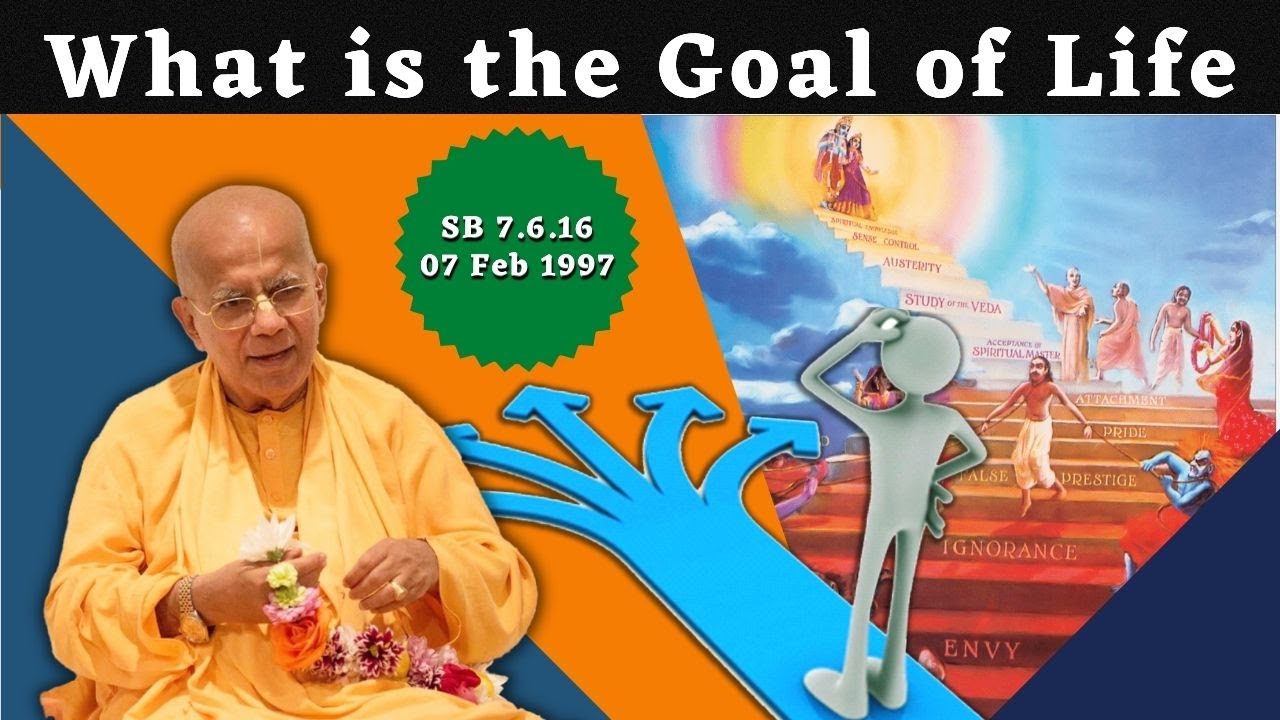
In this lecture, Śrīla Gopāl Kṛṣṇa Goswāmī Maharaja expounds on Śrīmad‑Bhāgavatam Canto 7, Chapter 6, Text 16, emphasizing that the fundamental problem of material existence is the false sense of proprietorship—“this is mine, that is yours.” He argues that even those who possess advanced secular education are spiritually ignorant, likening them to cats and dogs. The talk contrasts material knowledge (vidyā) with true spiritual vidyā, illustrating the point with stories of Prahlāda, Narada Muni, Haridās Thākura, Sanātana Gosvāmī, and other devotional exemplars. The speaker critiques modern societal structures—politics, war, population control policies, taxation, and the United Nations—showing how they stem from the same proprietorial mindset. He stresses the necessity of renunciation (varṇāśrama‑dharma) and the practice of bhakti‑kriyā as the spiritual medicine that cures the disease of body‑identification. The ultimate goal is the cultivation of Kṛṣṇa‑prema, the supreme wealth, achieved through sincere devotional service, surrender, and the guidance of a spiritual master. The lecture concludes with practical advice for devotees to prioritize spiritual education over material pursuits and to recognize the transient nature of wealth and life.
Chapters
Om namo bhagavate vasudevaya! Oh my God— oh no more Bhagavad Gita was divine? Śrīmad-Bhāgavatam, Canto 7, Chapter 6, Text 16. Vedvānapitāṁ dhanujākutumbāṁ puṣṇāṁ sa-lokāya na-kalpa-tevāya yāḥ asvīyā parākya-vibhinna-bhāvasa tamāprapadyeta yathāvimūraṇa. Translation: O my friends, sons of demons, in this material world even those who are apparently advanced in education have the propensity to consider, "This is mine and that is for others." Thus they are always engaged in providing the necessities of life to their families in a limited conception of family life. Just like uneducated cats and dogs. They are unable to take to spiritual knowledge. Instead, they are bewildered and overcome by ignorance. He purport by joining this, "Esi bhakti-danda-svāmi Śrīla Prabhupāda." Śrīla Prabhupāda ke, in human society there are attempts to educate the human being, but for animal society there is no such system, nor are animals able to be educated. Therefore, animals and unintelligent men are called vimūḍha, or ignorant, bewildered, whereas an educated person is called vidvān. The real vidvān is one who tries to understand his own position within the material world. For example, when Sanatana Gosvāmī submitted to the lotus feet of Śrī Caitanya Mahāprabhu, his first question was: Ke āmi kene amāya jarā tapātraya? In other words, he wanted to know his constitutional position and why he was suffering from the threefold miseries of material existence. This is the process of education. What is the use of this education? As discussed in the previous verse, a living being is entrapped by his fruitive activities exactly like a silkworm trapped in its own cocoon. Polish persons are generally engaged by their fruitive actions, karma, because of a strong desire to enjoy this material world. Such attracted persons become involved in society, community, and nation and waste their time, not having profited from having obtained human form. Especially in this age, Kali-yuga, great leaders, politicians, philosophers, and scientists are all engaged in foolish activities thinking, "This is mine and this is yours." The scientists invent nuclear weapons and collaborate with the big leaders to protect the interests of their own nation or society. In this verse, however, it is clearly stated that despite their so-called advanced knowledge, they actually have the same mentality as cats and dogs. As cats, dogs, and other animals, not knowing their true interest in life, become increasingly involved in ignorance, The so-called educated person who does not know his own self-interest or the true goal of life becomes increasingly involved in materialism. Therefore, Prasād RAVALAJ advises everyone to follow the principles of varnāśrama-dharma. Especially at a certain point, one must give up family life and take to the renounced order of life to cultivate spiritual knowledge and thus become liberated. Liberated. This is further discussed in the following verses. Om agyānta mānandaasya jñānānjanāśalakya jakṣūraṇmṛtañyeṇa tasmāśrīgurave namah śrīcetānyā māno vistam sapitāmyeṇa bhūtale svayāmlūpa-kadāmayā Radāti svāpādanti-kam bandeham Śrī-guru Śrī-utāpāda-kamlaṁ Śrī-guruṇavaīśṇavaṁ śaḥ Śrī-lopāṁ sa-grājatāṁ sahā-ganā-laguna-tanvitāṁ tam sajevāṁ sadve-tāṁ sa-vadhūtaṁ prijana-saītaṁ Kṛṣṇa-cetanya-devaṁ Shri Radha Krishna Padan Sahajan Lalita Shri Vishakhan Vithamscha. Hey Krishna, karuna sendho, dina bandhu jagat pate. Gopesa Gopika canta, Radha canta namastute. Tapta kanchana gorangi, Radhe Vrindavaneshwari. Hare Krishna, Hare Krishna, Krishna Krishna, Hare Hare. Vidvan api tam danujākutam vām puṣṇāṣa lokaḥ na kalpate vāya yahaḥ svyāparākya-bhinnabhāvas tamāprapadieta yitābhi mūḍha. Now continuing to listen to the nectarian instruction of Prahlāda Mahārāja. Prahlāda Mahārāja had the great fortune of receiving these instructions or understanding the goal of life when he was in the womb of his mother. Most of us don't have that fortune and we don't have that ability, but Prahlāda Mahārāja had the great fortune of hearing transcendental wisdom from Nārada Muni when he was in the womb of his mother. Prahlāda's father had gone to perform great austerities, and the demigods were already greatly troubled by Hiranyakashipu. So when they had the opportunity, they kidnapped Prasad's mother when Prasad was in the womb. And their fear was that the son would be exactly like the father, as they say, like father, like son. So, um, they were keeping Prasad's mother in custody, and the plan was that as soon as the child would be born, they would kill the child. However, Nārada Muni appeared on the scene. Nārada Muni assured the demigods headed by Indra that the child in the womb is not going to be a demon. The child in the womb is going to be a great sage. He is sinless. You have, you should have no fear of Him. So the demigods at once released Prasada's mother, who was then given protection by the great sage Narada Muni. Then someone may question, "Why did Narada Muni, great, give shelter to a woman?" You know, the scriptures give us injunction that you aren't even supposed to sit with a woman alone, even if it's your own mother, own sister, I'm sorry. And here we have Narada Muni giving shelter to a lady, to a pregnant lady. So Prabhupāda discusses this point, and Prabhupāda says that we should not compare ourselves to Nārada Muni's exalted status. And Prabhupāda gives the example of Haridas Thakura, how a prostitute has arrived at his hut in the middle of night with the goal of trying to seduce him. But Haridas did not get affected by the prostitute, rather by his pure purva-chanting The prostitute got purified to become an exalted devotee. So the point we're making is that we can't compare ourselves to exalted personalities like Nārada Muni and Haridas Thakura. So Pralāda was able to retain the instruction that he had received from Nārada Muni, whereas his mother gradually forgot. So Pralāda over here is pointing out that in this material world Even those who may have this so-called mature education have the concept of "This is mine and this is for others." In other words, one who is on the bodily platform of life is actually selfish, is a selfish animal. And everyone has— one who is on the bodily concept of life has a false sense of has this false sense of proprietorship. Brahmaji, when he created this material world, he created certain aspects of nescience, and he also created certain aspects of knowledge. And one of the, uh, aspects of nescience that were created by Brahmaji were— is this false sense of proprietorship. Everyone on the bodily platform of life is suffering from this false sense of proprietorship. This is mine, this is yours. It begins with the individual, extends to the family, further extends to the community, further extends to the nation, and then a group of nations, and so on. For example, you know, people in India, in another, um, parts of the world, they're very much— there's a big war now to control population growth. Why? They say the earth can only support, our country can only support X number. No, we can't have too many people there. Of course, if you want to control population, wonderful. Then the spiritual process is abstaining from sex life. However, the demons, because they have very little understanding or desire to understand the laws of God, they promote sex. Sinful activities like abortion. Like even if you go to any major city in India or any city in India, you see big, big posters, billboards encouraging people to go for abortion. They even get subsidized, they even get leave with full pay if you're going for abortion. If you want to go to a religious ceremony, then you get leave with no pay. And if you want to go for a sinful activity as abortion, then you get leave with full pay from government service. So they're promoting all this, but actually by God's law there is enough food grains for the whole world. By God's law, this earth can provide unlimited food. This earth can provide enough food to feed double or triple the population. There are such vast tracts of land all over the world which are completely unutilized. But because people are operating on this concept of "This is mine and this is yours," therefore they will not share their wealth with everyone. The Śrī Śrīpaniṣad says, Īśā vāśayidāṁ sarvaṁ yātkend ca ājagatyāñjaka teena taktena bunjitām mārga-dhāhaka-saśviddaṇaṁ. One should only claim as much as he needs and not beyond that. But to come to that understanding, you need spiritual awareness, spiritual understanding of the laws of God. As long as you're on the bodily platform, this principle of mine and thine will continue, and there will be so many wars, so much crime, etc. Prabhupāda used to give the example of the United Nations, a society that was formed with the purpose of trying to achieve peace on the planet. The United Nations has totally failed in bringing peace on the planet because they operate on the principle of, "This is your border, this is their border." And because it is on the bodily platform, we still see there's so many wars are going on. So Brahmaji ishtha created this concept of false sense of proprietorship. This principle of mine, this is mine, this is yours, is there because we have this false sense of proprietorship that this is mine. But actually nothing is ours. The spiritualist understands that everything comes from God, everything belongs to God, hence God is the supreme enjoyer. And when I serve the senses of the Lord, I will automatically be satisfied. So besides this concept of false sense of proprietorship, the other aspect of nescience which Brahmājī created were the principle of self-deception. Then the fear of death, principle of self-deception is there because of intense bodily attachment. And when you are attached to the body, then there is this great fear of death. Like on the material platform, nobody wants to die because of many reasons. One is they don't want to give up their sense gratification. They want to hold on to it as long as they want. Second is the uncertainty. Of what happens after death. So there is this fear of death and anger after frustration. When do people get angry? They get angry when they can't get their different material desires satisfied. And then of course there's a false sense of, uh, in the previous verses Prasad Raaval has been dwelling on one theme, and that theme is do not misuse this human form of life. Beginning with the opening verse of this chapter, the famous verse, kamarā-accat prāgya-dharmāṁ bhāgavatāmya dhurlavam ānam sam-jñāṇmā tad api adruvā-mārtada, very famous verse. Prasād RAVALAJ is focusing on one point, that is, after millions of births and deaths, rather one should utilize this human form of life for higher purpose, that is for self-realization. So those who may have even the so-called material education, they may pride themselves as very learned in society, but actually they know better than cats and dogs. In the Bhāgavad-gītā, Kṛṣṇa explains that there are four categories of miscreants who do not try to understand Me or who do not understand Me. What are they? Na mām duṣkṛtana-mūḍha. Prapadyante nārādhama māyāya-paṭṭhā-jñāna-āśrama-vavān-āśraya-dhāha. So he says, those are very māyāya-paṭṭhā-jñāna, those are very proud of their mundane knowledge, learning, etc. They have fancy degrees attached to their names. Like in India, you see, people, when they publish their visiting cards and all, they always publish their degree, if they have degrees. They always publish the degrees next to it. So they want to claim, they want to advertise that I'm so learned. But they may be so learned, but what's the use of this mundane learning? That's exactly what Prasad RAVAL is saying, that these people may be apparently educated, apparently they may have these so-called degrees, etc., but as even if they have these so-called degrees, they're still on the bodily concept of life. Identifying certain proposition to be theirs and certain possession to be belonging to somebody else. Still, God is out of the picture. So those who are very proud of their mundane learning, they do not accept the words of God and, and interpret the words of God, or they don't accept the position of God as the supreme proprietor. Just like in those famous conversations between Śrīla Prabhupāda and Dr. Kachowsky, when Śrīla Prabhupāda went to the former Soviet Union in 1972. Prabhupāda was explaining to them the concept of spiritual communism. Prabhupāda was explaining to them how this concept of communism, as everything belonging to the state, is not going to succeed. And Prabhupāda proved to be right. We saw that communism, which goes on the principle that nothing is yours, everything belongs to the state, failed because God was kept out of the picture. So this principle, "This is mine, this is yours," is a result of strong bodily identification. Śrīmad-Bhāgavatam in the Second Canto states: Swāvedvāra-hoṣa-karaye, saṁṣṭhutā puruṣā-paśyū, nāyat-karna-patopeto jātu-nāma. Gadagrajaha, that those who are like dogs, hogs, camels, and asses are busy glorifying others who have no attraction to the Supreme Personality of Godhead. So we can see how strong the Bhāgavatam is. The Bhāgavatam doesn't spare any words in describing the gross materialists who are very attached to the bodily concept of life, the false sense of proprietorship. You may have this false sense of proprietorship, but how long are you going to be able to hold on to it? Even if, let's say, if you have wealth, the Bhāgavad-gītā explains that when you have wealth, you make so many enemies. A rich man has unlimited enemies. The government becomes his enemy. The government says, "Hey, you made this wealth because of us. We're running the country so smoothly, so give us your taxation. We want 80% tax." And in many countries of the world, besides wealth tax, besides income tax, they have what they call a death tax. In India they have a death tax. So when you die, let's say leaving 1 crore in the bank, And the government says, "Oh, now you are dead, so we must tax your dead body." Okay, 80% tax. So there is death tax also. I don't know if the Western countries have it, but India certainly has it. So anyway, the government always thinks how we should plunder your money. Then when the government fails to plunder, the thieves are also keeping an eye on you, isn't it? The thieves don't spy on the poor people, do they? They spy on the movements of the rich people. 'Ah, when does this man go to office? When do his children go to school? What route do they take?' And then what do they do? Huh? Kidnap. This is a booming business in India right now. In some states of India like UP, Bihar, it's a very booming business. You kidnap rich people or rich people's children, take them away, demand a huge ransom, and then release them. So the poor man doesn't have to worry. The rich man, that's where you go to a rich man's house, he has such tall boundary walls and dogs and security guards because he's in anxiety, something's going to happen to me. So the relatives, so the thieves are enemies of the rich people, huh? You're thinking this is your wealth? Okay. The thieves are saying this is not your wealth, share it with us. You don't want to share it with us? Okay, we'll do it by a crooked method. Then the relatives become your enemy. The relatives say, "Oh, you become rich. Come on, why you forgetting us? We gave you our blessings. So give us the money." So the rich man has so many, one who is claiming proprietorship has so many enemies. And ultimately, if you still manage to save your property from the government, save your property from the tax people, Save your property from the thieves, save your property from the crooks. Ultimately, Kṛṣṇa comes as death and takes everything away. So ultimately, you're not going to be holding on to anything. So one who's on the false concept of life, bodily identification of life, eventually loses everything. And the Bhāgavatam explains this point with the help of straightforward philosophy. And with the help of very wonderful allegorical stories that make us understand the foolishness of identifying with the body and the foolishness of claiming proprietorship over something that ultimately belongs to Kṛṣṇa, the Supreme Personality of Godhead. Like in the 11th Canto, you read the story of Pingala, the prostitute, how she was anxiously waiting for customers all day, how she was hoping to attract people with her makeup, beauty, But ultimately she failed to get a customer and she got disgusted. But that disgust led to detachment, and that detachment led to her depending on the Supreme Personality of Godhead and surrendering everything to the Supreme Personality of Godhead. Also in the Bhāgavatam you read the story of the foolish pigeon who was very attached to his wife. How the husband would always praise the wife and the wife would praise the husband. How they both thought they were a perfect match for each other. How one day the husband and wife went to the forest to get some food for the children. And the children had grown up and they were walking out of the nest. You know, everybody gets tired living in the room. So they went for an outing in front of their nest. And as they went for an outing, the cruel hunter that was passing by saw them as ideal candidates for his pleasure, and he trapped them in his net. And when the father and mother came back, they saw their loved ones for whom they labored so hard to bring food were right in front of them in the hunter's net, and they could do nothing. And the mother lamenting, she also fell in the hunter's net. And a little later, the father lamenting that he had wasted His valuable life and not glorify the Lord, he also fell in the hunter's net. So there's so many stories like that. Shikin in the 7th canto, the story— there's so many stories that point out at the single-pointed message, which is do not get artificially attached to this body. Do not get artificially attached to your possessions. Rather, utilize this rare privilege that you have of having a human body to establish a relationship with the Lord. So in the purport of this verse, Prabhupāda quotes Śrī Caitanya Mahāprabhu's dialogue with Caitanya Mahāprabhu. Prabhupāda explains that it's not that Śrī Caitanya Mahāprabhu was bereft of spiritual knowledge. He was fully realized. But that's the nature of a devotee of the Lord. He's always inquiring. Just like we see that even Yudhishthira Maharaja asked Bhishma Deva about the meaning of human life, the principles of Bhagavad-dharma. We see that Yudhishthira Maharaja is asking Narada Muni questions that will be discussed further in the 7th canto of the Śrīmad-Bhāgavatam. So it's the nature of a devotee to inquire. But he inquires, just like we see Arjuna constantly inquiring in the Bhāgavad-gītā from Kṛṣṇa. But the nature of the inquiry is all for the benefit of entire humanity. So Sanatana Gosvāmī inquired, as Prabhupāda quotes in the purport, ki ami kinemāya-jarata-pātraḥ? Why am I suffering the threefold miseries of life? Adidevi-kādi-bhautika-dyātmikleśa. Kleśa. Kleśa means misery. So everyone is suffering these miseries. Mām evāṁ sa jīva-loka-jīva-bhūtasanaṭhānā. Krishna explains how all the living entities are suffering, struggling with the mind and the senses. So the three kleshas that Sanatana Gosvāmī refers to, the disturbance caused by the mind, the disturbance caused by other living entities, and the disturbance caused by material nature. Why do I have to undergo these miseries of life? So Caitanya Mahāprabhu explained to Sanatana Gosvāmī the importance of devotional service. Caitanya Mahāprabhu said, vedaśāstraka it-sammanḍha abhidaya prayojana. That is, the Vedic scriptures explain, sammanḍha, what should be our relationship with the Supreme Personality of Godhead. And the Vedic scriptures further explain How that relationship can be established. Abhidaya. So they explain sambandha. Then they explain abhidaya. When you work to establish that relationship. Many people may have theoretical knowledge about our relationship with the Lord, but they don't work to apply that knowledge. Just like in India, it's not uncommon to meet a lot of people who may have Even the whole Bhagavad-gītā, memorized. But when you examine their character, it's very different from what the Gītā is advocating. So just having theoretical knowledge and not applying the knowledge is not of much value. So vedāśāstra-ket samandā abhidhaya-prayojana. We must utilize this knowledge and understanding that the goal of life is developing love of God, is prayojana. So vedāśāstra-ket samandha abhidaya prayojana. Śrī Śrīla Caitanya Mahāprabhu emphasized the importance of focusing on this process of devotional service. And abhidaya-nāma-bhakti-prema-prayojana. Puruṣata śrīrōmani-prema-mahādhāna. Āvidēvā na mā bhakti-prema-prayojana. That the topmost wealth, the greatest wealth that one can cultivate, one can accumulate, or one should aspire to have is this prema-mahā-dhana. This prema, love of God, this is the highest wealth. That one should actually try and cultivate this prema-mādhana. And Caitanya Mahāprabhu explained, Kṛṣṇa, Kṛṣṇa's service, and Kṛṣṇa's love of Kṛṣṇa, these are the three riches that one should try and possess. In the material world, everybody is after riches, but people do not have a proper understanding aborders the meaning of proper riches. But Caitanya Mahāprabhu explained to Sanatana Gosvāmī that Kṛṣṇa, Kṛṣṇa's seva and love of Kṛṣṇa. First you must recognize Kṛṣṇa as the Supreme Personality of Godhead, the cause of all causes, sarva-kāraṇa-kāraṇa, the Supreme Proprietor of everything. Then Understanding that the Krishna is the proprietor, and once you come in association with sadhu sangha, you actually begin to execute the prāsāda bhajana-kriyā, which also, which also leads to rendering practical service. So bhajana-kriyā and service, just like Prabhupāda explains, a sick man to recover, he has to take the medicine and the diet. So we also, in order to recover from this severe disease of sense enjoyment, false sense of proprietorship that we have, we have to take the medicine, that is the spiritual medicine. So when you execute bhajana-kriyā and you do service, then you begin to get purified, and then ultimately you obtain love of Kṛṣṇa. In the Caitanya-caritāmṛta There's this very wonderful dialogue between Caitanya Mahāprabhu and Rāmānanda Rāya. And Caitanya Mahāprabhu asked Rāmānanda Rāya a series of questions, and Rāmānanda Rāya gave the answers. So one of the questions that Caitanya Mahāprabhu had inquired was, what is the great— who is the greatest capitalist? So in the material world, people have a very false concept and understanding of who is a capitalist, huh? They think a capitalist is one who has a big bank balance. But Ramana Maharshi replied that the real capitalist is one who has love of God, love of Radha and Kṛṣṇa. So Caitanya Mahāprabhu is also making a similar point. Kṛṣṇa, Kṛṣṇa service, and love of Kṛṣṇa, these are the riches that one should try and develop. These are the riches that we should be hankering for. In material life, everyone is hankering and lamenting. Hankering for more and more sense enjoyment and lamenting for something which they lose. So our hankering and lamenting should be for a spiritual cause. Our hankering should be to become more and more Kṛṣṇa conscious. And our lamenting, our lamentation should be when we are not Kṛṣṇa conscious, when we waste our time in idle talk, when we waste our time in idle activities, etc. Āyūṣa-kāśanā-e kaupīna-labhaya-svaṇa-koti-bhi. That a minute lost cannot be made up with the wealth of the entire world. So that is the devotee's understanding, that a minute lost cannot be made up with the wealth of the entire world. Therefore the devotee is anxious to engage in devotional service. Now in the concluding lines of the purport, Prabhupāda talks about the importance of— and Prabhupāda talks about the importance of giving up one's life at a certain stage. So one who is on the bodily concept never thinks of giving up his, giving up his family situation, isn't it? People today hold on to businesses, hold on to positions, hold on to political power till death. Or a bullet kicks them out. But the Vedic process is that you automatically at a certain point recognize that now it's time to get more immersed in spiritual activities. And then you get detached from family responsibilities and focus exclusively on spiritual life. Prabhupada specifically mentioned the word varnāśrama-dharma. So, chaṭhara-vārna-māyaśṣeṣṭham guna-karma-vibhāgasah. This principle of prāsāda varnāśrama is scientific because it is created by Kṛṣṇa. That's why it is scientific. If it was man-made, then it will be subject to the four inherent effects that every material knowledge has. But because it is coming from Kṛṣṇa, it is transcendental. And we in Kṛṣṇa consciousness take shelter of the prāsāda daiva varnāśrama. Because in varnāśrama, still there's a concept or there is room or leverage or facility for some type of sense enjoyment. But dhaivāvar-nāśram is a situation where regardless of whether one is brahmachari, grihastha, vānaprastha, sannyāsa, regardless of whether one is a brahmin, kṣatriya, vāiṣya, śudra, the focus is Kṛṣṇa, Kṛṣṇa's service and love of Kṛṣṇa. The three riches that Caitanya Mahāprabhu talks about, that one should try and develop. And in the Bhāgavatam again, you read stories how people were attached, but still by association they got detached and they left their family situation. Like in the first canto, you read about Dhritarāstra, how even after the battle of Kuruksetra was over, Even after all his sons, grandsons had died, that Tarāṣṭra was still so attached to a royal position that when his nephew Yudhiṣṭhira offered him a very huge palace to live in, he took full advantage and he was thinking, "Oh, at last I have become a king." But then Viḍūra came over there and Viḍūra enlightened him. He said, "You are a fool. You are blind by birth. You are also spiritually blind. The symptoms of old age are all, have already appeared, and you are still living over here attached to this wonderful palace. Get out." Then on Vidura's advice, Dhritarashtra left the comfortable palace that was given to him by Yudhishthira after the battle of Kurukshetra. You also read in the Bhāgavatam in the 4th canto about King Prajinabāhuri, how he was so attached to sense enjoyment. But then by Nārada Muni's association, King Prajinabāhuri got so enlightened that he, even though his sons were away performing austerities, instructed his ministers and left home. He didn't even wait for his sons to come back. He left a message for his sons that they should rule. And protect the citizens, and he left home to practice self-realization. So this principle of varnasrama is very scientific. The varnasrama, of course, starts with Prahlada Maharaja's first verse of this chapter, kamara-acharya-pragyaya. That is, you begin to receive spiritual training from a young age, from the age of 5 onwards, and this Now in ISKCON there's a lot of talk going on, and then this year in the G.B.C. meeting there's going to be a major topic of discussion, this whole process of dai-baba-nāśram and social development, how to establish this so that, um, devotees can progress and at the same time keep their strong Kṛṣṇa consciousness. So to summarize the verse, we are continuing to hear Prasāda's nectarian instructions. Actually, these instructions have been given to his demonic schoolmates. They are for all of us. And these instructions are for all of us. And Pralad Maharaj is pointing out how if one is on the bodily concept of life, how he identifies with his false sense of proprietorship and he holds on to this body. So our process is to receive spiritual education. Over here the word used is vidvān. So vidvān generally means knowledge, but here vidvān means material knowledge. Raja vidya raja guhyam. This knowledge is the king of education. So real education is that which enables you to understand your transcendental position. This is also confirmed in the dialogue between Caitanya Mahāprabhu and Rāmānanda Rāyaṇa. When Caitanya Mahāprabhu asked Rāmānanda Raj, what is real education, and Ramana Maharshi explained. So this is real education, but those who have the so-called material degrees, though they may pretend to be very learned, they are narādhamaṣa, lowest of mankind. They may be president of the country, vice chancellor of a university, but the man doesn't even know what's the basic ABC of spiritual life. So Prasad Maharshi is lamenting for these gross materialists And he says they're living just like a cocoon that gets imprisoned in its own by weaving. So similarly, the materialists, they make so many big, big plans and they get so trapped in their plans till the end of life. They're working so hard to try and solve their problems and there's no time for spiritual life. So the solution is to take to Kṛṣṇa consciousness, to recognize Kṛṣṇa as the cause of all causes, the Supreme Proprietor, the Supreme Enjoyer. To engage in Kṛṣṇa's service. And by engaging in the process of bhajana-kriyā and practical service, one will begin to develop Kṛṣṇa-prema. And these are the riches that devotees are anxious to accumulate. And by executing the process, Kṛṣṇa guarantees that one will be able to develop these riches. Hare Kṛṣṇa. Hare Krishna, Hare Krishna, Krishna Krishna, Hare Hare, Hare Rama, Hare Rama, Lama Lama, Hare Hare.
More from PRASAD

Rare Pastimes & Timeless Lessons of Guru Mahārāja | Stories Every Disciple Should Hear

ISKCON Legends- pure devotees meet-HH Jayapataka Swami, HH Gopal Krishna Goswami, HH Radhanath Swami



Jagannātha Ratha-yātrā Through Śrīla Prabhupāda's Mercy | 29 April 2006 | Nairobi, Kenya

Lord Jagannātha's Appearance Pastime | 21.07.2019 | ISKCON Calgary | Śrīla Gopāla Kṛṣṇa Gosvāmī

The Ācārya Teaches by His Own ExampleGuṇḍicā Mārjana by Guru Mahārāja #shorts

Guṇḍicā Mārjana – Lord Jagannātha's Pastime | 21.7.2019 | ISKCON Calgary |Śrīla Gopāla Kṛṣṇa Gosvāmī

H.H. Gopāla Kṛṣṇa Gosvāmī Mahārāja - Exemplary Sādhana and Deity Worship # shorts

भगवान की कृपा कैसे प्राप्त होगी ? | 11 Jan 2014 | Punjabi Bagh | Srila Gopal Krishna Goswami

Material Education vs Spiritual Education | Srila Gopal Krishna Goswami #shorts