When does the Lord give pure devotion | BG 10.10 | Rus-Split | 14 Sep 1998 | | Gopāl Kṛṣṇa Goswāmī
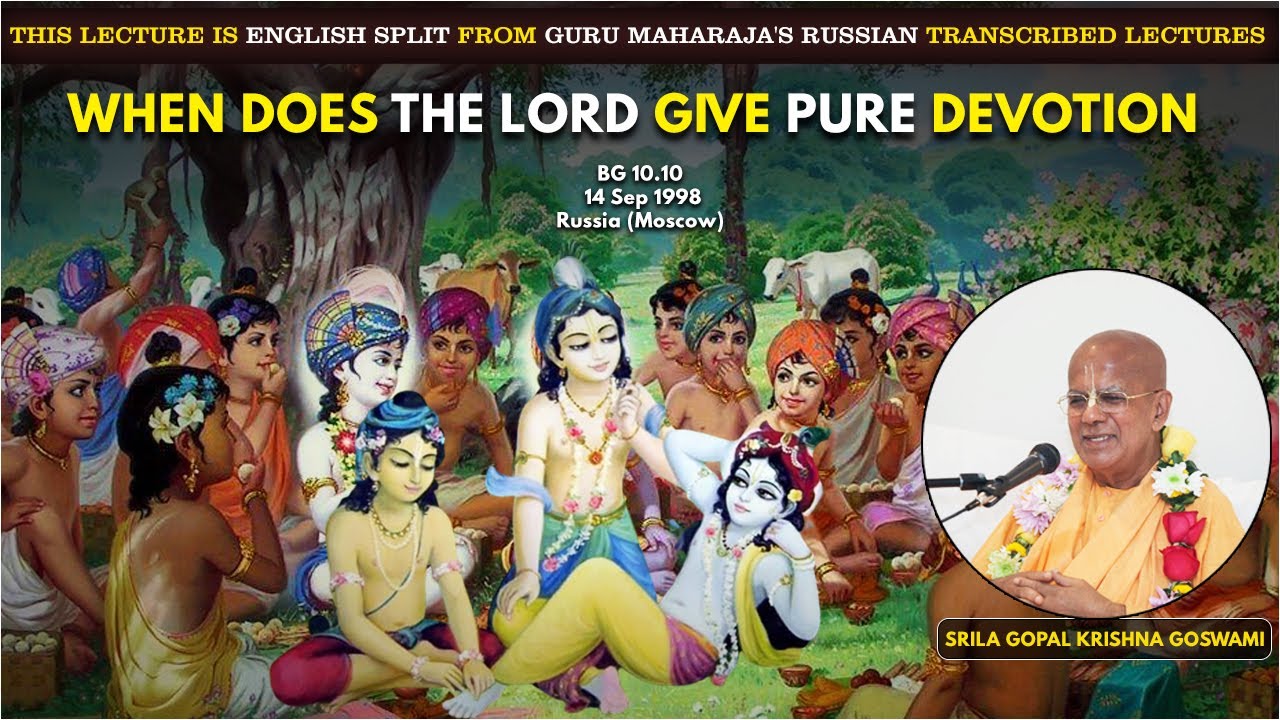
Gopāl Kṛṣṇa Goswāmī teaches that Krishna reveals himself through bhakti-yoga, disciplined devotion, not speculation or yoga. True devotion requires following a spiritual master's rules, chanting the Hare Krishna Mahā-mantra with attention, and removing spiritual obstructions through systematic practice. Genuine devotion tastes bitter at first but leads to Krishna-prema.
Chapters
Shreemad Bhagavad Gita, chapter 10, verse 10. This is actually such a famous verse of the Gita that I'm sure most of you would be knowing it. I was in Saint Petersburg and they didn't have a dashka, so I took on two very famous verses for discussion on two different days, and many of our pundits were able to chant without the help of the board. I'm sure there are some Pandits and Panditis even over here. So we'll see how many Pandits and Panditis there are in this event. This is one of the most famous verses of the Bhagavad Gita, one of the most quoted verses of the Bhagavad Gita. In the Bhagavad Gita, there are 4 verses which are known as the Chatur Sloka that have, that are considered to contain the essence of the Bhagavad Gita, and this is one of those verses. The other verses that are significant are Read. 8, 8. The other verses are 8, 10, Chapter 8, Text 8, 9, 10, and 11. These are the 4 key verses. Now the whole purpose of studying the Bhagavad-gītā is to bring us to the point of surrendering to Kṛṣṇa. So Kṛṣṇa is giving us a formula in this verse how we can understand Him. Some try to understand Kṛṣṇa through the speculative process. Some try to understand Kṛṣṇa through the yogic process, but we try to understand Kṛṣṇa through the process of devotion. Bhakti-yoga is nothing but a path of devotion. Now Kṛṣṇa says, "Those who are constantly devoted to serving Me with love, I give the understanding by which they can come to Me." Now some of you may say, "You are all farsighted," but we don't really think we are in a position that we are serving Kṛṣṇa with love. Do any of you think you are serving Kṛṣṇa with full love? Anyone here? Please, please. So Krishna says, serve me with love and engage in my service constantly, all the time. Now, to get to the stage of serving Krishna with love, we have to undergo a certain process. Just like if you want to become a medical doctor, for example, you have to go through a certain educational process. So similarly, There is a certain process through which we can go up the ladder of bhakti yoga. The goal is to get to the stage of understanding Kṛṣṇa. And on the path of karma yoga, you may follow the rituals, vedas, but your goal is also sense pleasure. And in the process of jnāna yoga, we speculate. Now, the goal of the devot— the activities of devotional service consisting of the various rules and regulations that we follow, are meant to bring us to the point that we begin to love Kṛṣṇa. The sahajiyas make a show that they have developed love of God. And what are some of the symptoms that falsely display? Tears coming out of the eyes, rolling on the ground, they try to show as if their hair is standing up, they begin to show as if they are trembling, shivering. I think it's just good actors. A pure devotee doesn't like to display these symptoms in public. On some occasions, devotees have noticed that tears would begin to come out of Prabhupada's eyes when he was reading Kīrtan. So Prabhupada would at once stop those tears coming out because he didn't want to make this process a cheap process where his followers would just imitate this process to claim some following. So initially we have no love, we should be honest about it. Therefore Kṛṣṇa says, the great sages say, follow certain rules and regulations. Just like Rūpa Gosvāmī explains in Bhaktiratnam Prasādam with Vasindu, the process of vaidhi-bhakti. What's the meaning of vaidhi? Vaidhi means rules. So these rules and regulations are they given by Kṛṣṇa. So that we may become pure. So if somebody says, "No, no, no, I don't like these rules and regulations," he's just saying politely, "I don't want to do what Krishna and the great acharyas have said." Just like, for example, we are advised to follow a certain schedule, such as in the Mangala arthi we will greet the Lord with some prayers, we sing prayers and glorification of the spiritual masters, then we chant our aums, Then we greet the Deities, then we have Guru Puja, then we have class, and before that we've had Tulsi Aarti. All these are there to serve a purpose. It's such a privilege, for example, to have the facility to greet the Lord in the morning. So we should not think that these rules and regulations are there without any purpose. So if you're living at home, if you're living in the temple, then you're expected to follow a temple schedule. But what do you do when you're living at home, huh? Miss the program completely? No, it doesn't matter where you live, the process should be followed. It may be adjusted a bit. Like in the temple, for example, you may have a big ecstatic kirtan. But at home, you may not be able to do that, you may have to do the kirtan softly. But the process should not be circumvalated. The process should not be avoided. Just like Rūpa Gosvāmī explains in the very famous process of spiritual advancement, How by executing the class of the bhajana kriya, the anarthas in the heart get destroyed. These anarthas do not leave you till the end of life. Even in old age, they are trying to rob your spiritual intelligence. So we should not think that there is an easy way out of getting over the anarthas, of controlling the anarthas. Therefore, Rupa Goswami says, The Vajra Kriya process. The Vajra Kriya process is nothing but calling of the process of Vaidhī-bhakti. A key element in this process of Vaidhī-bhakti or Vajra Kriya is the chanting of the Hare Krishna Mahamantra. This is one of the key things I wanted to talk in the Gīsadgōrṣī today. This chanting attentively of the Hare Krishna Mahamantra is a must for anyone who wants to get to the stage of eventually loving Kṛṣṇa. We chant attentively, hearing the Maha Mantra attentively and carefully and concentrating on the chanting, then you will find that the chanting will work wonders. Of course, in the initial stage, we just tell people to chant. We don't tell them about any rules, regulations, guidelines. But as they advance spiritually, as they become more serious about spiritual advancement, They themselves want to know what are the guidelines. They come here. For example, they follow certain regulative principles. Are they very rigidly? They become the pillars of sinful life when you indulge in, and when you abstain, they become the pillars of spiritual life. The process is guaranteed to succeed because the process is coming from the Supreme Lord Himself. The process can rectify and purify the greatest of sinners. So this process of Vaidhī Bhakti is a must. Many times devotees want to know, how do I develop determination? Rūpa Gosvāmī advises us, the certain qualifications must be cultivated. One of them is, purṣahā-nishteya-dhaliya-tattva-karma-pravartanāt sanyasyā ye satobhete sat-vīrṇa-kīrtva-cidrati. So how do you develop determination? So Rūpa Gosvāmī explains, thereby the execution of Bhagavad-gītā, Not only will your anarthas begin to get weak and eventually destroyed, but also you will develop neshtha, firm faith. This neshtha is a result of the concentrated effort a devotee makes, and eventually this will culminate in Kṛṣṇa-prema. But the key is the execution of bhajana. Now, another important element in this process of bhajana-kriya is the cultivation of spiritual knowledge. Cultivation of spiritual knowledge means reading the words of the Supreme Lord, which have been further explained by the Acharya. Prabhupada wanted ISKCON to be an educational institution. He did not want us to accept anything sentimentally. If we sentimentally accept something, then also sentimentally you will give it up. And if you scientifically, logically accept something, then you won't give it up easily. Just like the scriptures talk about accepting a bona fide spiritual master and following a bona fide spiritual master. Srila Prabhupada Swami explains this process in some detail in Nectar of Devotion. He says, "Take shelter of a spiritual master. Accept initiation. Serve him. Inquire from him." What do you inquire? How can I make spiritual advancement? Prabhupada Swami also gives the qualifications of a spiritual master. He gives the qualification in the very first verse of the Nectar of Instructions, Om Tejānanda. Who knows that famous verse? Vācchuvēyam manaḥ saccroḍavēyam jīvavēyam adārapaṣavēyam. Rūpa Gosvāmī says, one who has control over the different pushings of the body, he is qualified to make disciples. Vācara. What does vācara mean? Speech. You must have control over your speech. You can't talk mundane things and then say, "Ah, I have control over my speech." Unnecessary talking is compared to the croaking of a frog. The frog croaks and invites the snake. So, we say the genuine spiritual personality should only talk about Kṛṣṇa, topics related to Kṛṣṇa. Manasa, mind control, control the mind. Kodaha, anger. Then jīva, your eating habit. Vegam, vegam means pushing. These senses are constantly pushing for agitation. So since these senses are always pushing for agitation, one who is self-realized, one who is serious about devotional service, learns the art of controlling them. What's the difference between a Goswami and a Goudāsa? Goudāsa is a slave of his senses and Goswami is controller of the senses. So spiritual master must be a Goswami. Doesn't matter which Ārṣani, but he must have control over his senses. So jīvāveṇo mudānapaṣyadeva. He must have control over his eating habits and belly and genitals. So if you have control over these 6 purified, then you are qualified to make disciples and you can guide them back to Godhead. Kṛṣṇa consciousness movement runs on the principles of purity. It doesn't run on the principle of mass following. Prabhupāda, he said, "One moon is better than thousands of stars." Prabhupāda wanted purity, therefore he struggled, but he did not compromise. Prabhupāda wanted purity at all costs, so he struggled but did not compromise. Just like we know how he Prasada in India for 25 years established Kṛṣṇa consciousness of the pure principles. If he was interested in the mass following, Prabhu could have watered down the process and attracted so many people. Once away from his spiritual master, Aśrādhana spiritual master in India, he listed about 10, 20 very big businessmen in India and said, "Oh, they are all my disciples." Then he gave me the names. Sai said, "Very good, these big people have become your disciples. I hope you gave them some rules and regulations to follow, like chanting 16 Naam, following a principle." "Oh, that I could not do." Sai said, "What's the use of making them disciples? Unless they follow the principle of purity, how will they become pure and eventually feel the love of God?" They are not interested in becoming shukracharyas. Shukracharyas dinanwad Rama and Devi to surrender to the Lord. He was worried about his own income. So we believe in purity, we practice purity, and we preach purity, and we live by the principles of purity. God is pure, and we have to endeavor to become pure. God is the purest of all. So Krishna is guaranteeing us that if we serve him with love, then we will get to the point where we can understand him. Just like Krishna also says in Bhagavad Gita, patraṁ poṣpaṁ phalaṁ toyam yojanaḥ kriyājyati. Offer me with love and devotion leaf, flower, water. I will accept it. But he says with love and devotion. So we have to endeavor to develop love and devotion. Again and again the Bhāgavatam and the scriptures use the word love and devotion. Devotion, love and devotion. So this love and devotion that the scriptures are talking about is not mundane love, but genuine spiritual love. Jayadevacharya Veda says, "The difference between love and lust is like the difference between a gold bar and an iron bar." So this is spiritual love. Determination, nishtha, is the result of experience. The process of life. There is no shortcut around this. Now, in the 18th chapter of Bhagavad-gītā, Kṛṣṇa discusses 3 types of happiness. Are you aware of that? Happiness in the mode of goodness, happiness in the mode of passion, happiness in the mode of egoism. Kṛṣṇa says happiness in the mode of goodness is which in the beginning may be bitter, but in the end becomes sweet and which wakes you up to Self-realization. So in the beginning it's bitter, because nobody likes to follow rules and regulations. But Kṛṣṇa says it will become sweet later. Just like initially if you go for an operation, it's painful. Why do people go for operation? You tell the doctor, "Please cut me open. Plus I'll give you some money." Not some, good doctors charge a fortune. Why are you ready to go through all this? Because somehow or the other, think in the end, I'm going to bed. So the point is happiness in the mode of goodness is that in the beginning may be bitter, in the end takes you up to self-realization. Bitter in the beginning and sweet in the end. I once had this in the mode of passion. Sweet in the beginning, bitter in the end. And which is derived from contact with the senses, with sense objects. So we can have our choice. Do you want happiness in the mode of passion or goodness. And then you want ignorance? He's sleeping, being lazy. So it is not that Kṛṣṇa says, "Whatever you do, the result will be the same." He clearly says, "All of them as they surrender to Me, I will reward them accordingly." And Guru Gosvāmī says, "My dear friend, whatever price you have to pay, please pay that price." But become Krishna conscious. You heard that verse before? Krishna bhaktirādhā bahārvida-māti kriyātām idhi kṛṭhopi lāvate. He says, my dear friend, please don't bargain. Whatever price is needed to be paid, but become Krishna conscious in this lifetime. So if you pay a watered-down price, you'll get a watered-down product. And if you pay a genuine price, you'll get a genuine product. Lord Viṣṇudeva clearly tells us that in exchange for performing spiritual austerities, There is unending happiness. So this process is guaranteed to succeed. It's so powerful that even if you run with both your eyes closed, you're not going to fall. So let us all resolve that we're going to endeavor to develop love for the Supreme Lord. And we can endeavor to develop love if we strictly follow the process given to us by the great Acharyas and summarized by Śrīla Prabhupāda. We all came to this movement because of Śrīla Prabhupāda's books and teachings. And if you live with those guiding principles, then success is guaranteed. You may say, "I have so many shortcomings, inabilities. How will I advance?" Kṛṣṇa says, "Don't worry." He says, "Those who worship Me with devotion, I give them what they lack and I preserve what they have." Even if you have no qualifications, don't worry. See them with hatha, devotional service. You don't need any material qualifications. You need spiritual qualifications. So please follow the process and along with chanting and reading, do service also. Service gives you an opportunity to cleanse your heart. We should be eager for service, anxious for service, hungry for service. And if you combine this, sadhana, active service, then you are on the highway taking you at high speed back to Godhead. Hare Krishna. Hare Krishna.
More from PRASAD

Rare Pastimes & Timeless Lessons of Guru Mahārāja | Stories Every Disciple Should Hear

ISKCON Legends- pure devotees meet-HH Jayapataka Swami, HH Gopal Krishna Goswami, HH Radhanath Swami



Jagannātha Ratha-yātrā Through Śrīla Prabhupāda's Mercy | 29 April 2006 | Nairobi, Kenya

Lord Jagannātha's Appearance Pastime | 21.07.2019 | ISKCON Calgary | Śrīla Gopāla Kṛṣṇa Gosvāmī

The Ācārya Teaches by His Own ExampleGuṇḍicā Mārjana by Guru Mahārāja #shorts

Guṇḍicā Mārjana – Lord Jagannātha's Pastime | 21.7.2019 | ISKCON Calgary |Śrīla Gopāla Kṛṣṇa Gosvāmī

H.H. Gopāla Kṛṣṇa Gosvāmī Mahārāja - Exemplary Sādhana and Deity Worship # shorts

भगवान की कृपा कैसे प्राप्त होगी ? | 11 Jan 2014 | Punjabi Bagh | Srila Gopal Krishna Goswami

Material Education vs Spiritual Education | Srila Gopal Krishna Goswami #shorts