Who decide our next body ? |BG 13.31 |20.06.2002 | ISKCON Moscow |Śrīla Gopāl Kṛṣṇa Goswāmī Maharaja
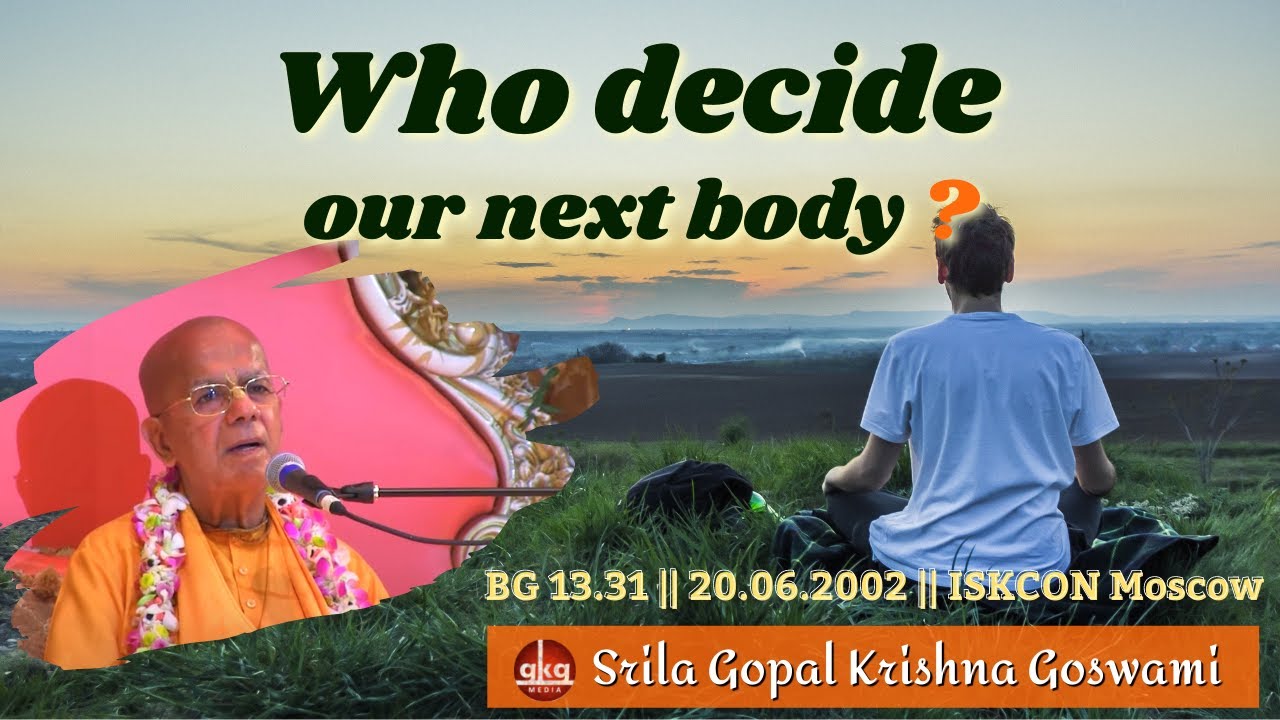
The recording captures a devotional lecture delivered at an ISKCON Moscow gathering, led by Śrīla Gopāl Kṛṣṇa Goswāmī Maharaja and interspersed with audience participation. The speaker interprets Bhagavad‑Gītā 13.31 and related passages from the Śrīmad‑Bhāgavatam to explain the distinction between the eternal soul (ātman) and the perishable material body, emphasizing that the body one receives in the next life is determined by one’s past desires, actions (karma) and the state of mind at death. The talk stresses the importance of studying Vedic scriptures—especially the Gītā—to learn how to act with detachment for the pleasure of the Supreme Lord. It outlines the three progressive stages of chanting the Holy Name (nāma‑prāya, nāma‑pāsa, sukhad‑nāma) and the role of rules and regulations in deepening devotional practice, illustrated with anecdotes about A. C. Bhaktivedanta Swāmī Prabhupāda’s teachings and early ISKCON activities. The speaker repeatedly contrasts materialist pursuits, which bring temporary pleasure and later pain, with spiritual advancement achieved through hearing, chanting, and remembering Krishna, thereby purifying the mind, body, and senses. Practical advice is offered on how to apply scriptural principles in daily life, the need for mercy (kṛpālu) in preaching, and the value of community support in overcoming spiritual difficulties.
Chapters
Hare Krishna. Hare Krishna. So I'm just thinking there's only 5 minutes for arati, so I was just wondering what to do. Better to start the shloka now or do it after the arati. Okay, we'll do it now. Prakriti hai vachha kalmani. Priyamanali sarvashah. Aaposhanti tatatma ham. Akhil taantu pashati. Prakriti hai vachha kalmani. Prakriti hai vachcha kalmani. Priyamanali sarvashah. In this prayer book, Prabhupāda made many significant points. These purports are very important to understanding the verses. When Prabhupada would be dictating these purports, he would first read the purports by the previous Ācāryas. He would take the essence of the commentaries of the Ācāryas and then add what was relevant to make it possible for us to understand. Stand for the translation. Once Prabhupada was dictating the purport and he was dictating very, very slowly. So his secretary asked him, Prabhupada, why are you dictating so slowly? Prabhupada said, every word that I put in these books will be read for the next 10,000 years. I have to be very careful what is in these books. So Krishna is pointing out the these verses how the Self does not mix with anything, and how it's all-pervading in the body. The sky is all-pervading, but it does not mix with anything. The air may enter into stool, mud, water, etc., but still it is separate from this. So Kṛṣṇa is explaining that this material body that we have, this body is created by material nature, and the self is distinct from the body. Prasad Raaval, continue after our conclusion. Hare Krishna. Hare Krishna. Om Namo Bhagavate Vasudevaya. Om Namo Bhagavate Vasudevaya. Om Namo Bhagavate Vasudevaya. Om Namo Bhagavate Vasudevaya. So we'll continue discussing the verse that we read from the Gītā before the Ārati. I hope you devotees haven't forgotten the translation, the paraphrase that we read before the Ārati. So we just continue with the discussion. So Prabhupāda's saying that this body is made of material nature, and the body we obtain is influenced by the type of activity that we have performed in the past, according to our past desires. So the important point to recognize is that the Lord has given every individual freedom. That is the freedom to accept the Lord or the freedom to reject the Lord. And the body is given so that we can fulfill our different desires. Just like it is said, Krishna bhāimukhākām mokāmānchākarai dikātā samāya tare japa te adhāre, that the moment the living entity develops a desire, to become an enjoyer of the Lord, he should leave the spiritual world and come to the material world. And based on our past karma, based on our desires, based on where the mind is at the moment of death, one obtains a suitable body. This is actually a great science to understand how the soul transmigrates from one body to another body. Once Prabhupada was giving a lecture at the Massachusetts Institute of Technology, one of the most famous institutions in America. It's one of the most prestigious high-tech institutes of learning in America. So Prabhupada opened his lecture at the institute by asking, "Is there any department in this great university which tells you what happens after death? Is there any department in Moscow University that tells you what happens after death?" Institute in Moscow. There's no, there's no Institute. So Lord Kapiladeva's teachings can be studied in the third canto of the Śrīmad-Bhāgavatam. And Lord Kapiladeva was asked a very similar question by his mother Devahūrī. She said, My dear son, you are very knowledgeable. Please tell me, how will it ascertain whichever body one is going to get? The son said, "Karma deva naitreṇā jantu deho papate sīrā pravaiṣyudhāram puṁsoreta kānashrayaḥ." The translation of this verse of Sanskrit is as follows. First he said, Karmana deva-netrāna. Karmana means your actions. Deva means the eyes of the demigods. Deva means demigods. Netrāna means eyes of the demigods. So Lord Kṛṣṇa, they have explained that all the actions that we perform are being witnessed by several, by the eyes of several demigods. And And all these demigods who are witnessing every action that we perform, then based on that, the soul enters through the semen of the male into the womb of the female. So Prabhupāda is making this important point in the purport that this body is given, is made by material nature. This body is given to us according to our desires. And when the soul The self is distinct from the body. The Bhagavad-gītā instructs us how to act so that one can be elevated to a higher position. Why do we study the Bhagavad-gītā? Why do we study the Vedic texts? For the simple reason that if we study them, You take that guidance, you will know how to act. Just like the 3rd and 5th chapters of the Bhagavad-gītā are devoted to the theme of action in Kṛṣṇa consciousness. Bhagavad-gītā does not in any way preach inaction. Rather, Bhagavad-gītā preaches action, but action for the pleasure of the Supreme Lord. And the Bhagavad-gītā teaches us how we should act in The spirit of detachment. The Bhagavad Gītā gives a very beautiful example of a lotus leaf that is in water but not touched by the water. I think you don't have lotus leaves in Russia, do you? Yes? Okay, we have maspā. So you won't see lotus leaf in either Prasādh Raṣṭha or Central Asia or India. But you can visualize it. Lotus leaf stays in He can make water but doesn't touch the water. So Kṛṣṇa is also instructing us that we should act, but act in the spirit of detachment. Just like, what did Kṛṣṇa tell Arjuna? Tasma sarveśu kaleśvaṁ manuṣvāya yudhi ca. This is a very famous verse that according to Prabhupāda summarizes the philosophy of the Bhagavad-gītā. Kṛṣṇa is saying, "Hey Arjuna!" With your mind and intelligence dedicated to Me, act for My pleasure. Kṛṣṇa did not support Arjuna's initial desire of inaction in the battlefield. Unlike the present-day wars, like, you know, there were rumors about India-Pakistan war taking place, and so many other political wars that take place, the battle of Kurukṣetra was a spiritual war and not a material war. The Panduas had a father whose name was King Pandu and had an uncle whose name was Dhritarashtra. They both had a father called Vichitraveerya. So when the father died, the elder son shall have become the king. Spiritual monarchy is a perfect form of government for society. It's far superior to the present concept of democracy or political democracy. So, Datta Rāja could not become the king because he was blind. As a result, his younger brother became the king. But his younger brother died at a young age, leaving behind 5 young children. So the uncle became the caretaker of the empire with the understanding that when the children would come of age, they would be given the kingdom. However, when they came of age, their uncle, Emperor Bhārata's son, had changed his mind, and he didn't want to return the kingdom. Instead, he devised various plans of which his brothers may die. The tribulations that the Pandavas had to go through are almost unmatched in history. And they say, "Rākhi Kṛṣṇa mārī ke, mārī Kṛṣṇa rākhi ke." If Kṛṣṇa wants to protect, no one can annihilate. And if Kṛṣṇa wants to annihilate, no one can protect. So the Pāṇḍavas were very unanimous. They were entitled to the vast kingdom, but they were ready to settle for 5 villages. Can you imagine that?
Most of the—
someone that tied up the whole kingdom, whole planet, he said, okay, give me only 5 villages. It's amazing, isn't it? Just shows you how detached the Pandavas were. And what did Dhritarashtra say? What did the son saying, we'll give you 5 villages. No, we won't even give you enough land to penetrate a needle. Krishna also went as a messenger, and they laughed it off.
They laughed it off.
So the point is, we gave this to explain that since the body we obtain is a result of our desires, our actions, and our thoughts at the moment of death, one is intelligent, must learn to act for the pleasure of Kṛṣṇa, as directed by Kṛṣṇa, In the Vedic scriptures. By studying the Bhāgavad-gītā, one will become wise. You may say, "But I am already wise. I don't need to become any wiser." We all love to think that we are wise. Once you become wise, you don't want to take part in activities that will give you temporary happiness. Kṛṣṇa says in the Bhāgavad-gītā, 5th chapter, One who is wise does not take pleasure in the sources of misery. He does not take part in the sources of misery which are derived of contact with the material senses. Why?
Puchimoh.
Why does an intelligent man not take part with Śrīla Caitanya Mahāprabhu.
Maṣala-kanyaṣṭhava.
Maṣala-kanyaṣṭhava. Maṣala-kanyaṣṭhava. Kṛṣṇa says, "Such activities have a beginning and an end, and therefore the wise man does not delight in them." The maṣala was unaware of this knowledge and truly grossed in sense enjoyment. He doesn't think, he doesn't understand That these so-called pleasures is temporary. They have a beginning and an end. So one who is wise does not take pleasure in activities that are ultimately sources of misery. Therefore Kṛṣṇa says, before giving up his body, one must learn the art of tolerating the mind and the senses. One should tolerate the urges of the mind and the senses. And if we are able to tolerate the urges of the mind and the senses as a result of higher cultivation of knowledge, then we can progress spiritually. Now it is not that the Kṛṣṇa conscious person has no desires. A Kṛṣṇa conscious person has mind, intelligence, and senses, and a non-Kṛṣṇa conscious person has the same facilities also. So what's the difference? Because they presently have a body which is giving them nothing but trouble.
Totally.
And by engaging in activities independent of the scriptures, they will again have a body which will give them nothing but trouble. The intelligent person recognizes that this material body is nothing but a source of trouble. He realizes Prasad RAVAL says that any pleasure derived of contact of the senses with sense objects is temporary and will tomorrow become the cause of pain. Therefore, the intelligent person uses the mind, intelligence, and senses in service of the Lord. We should not overlook the fact that our actions will influence the type of body we will get in future. The happiness and the stress rest of the experience is a result of our actions also. Of course, those who come to Kṛṣṇa consciousness are most fortunate. They have done mass past activities to take any opportunity to come to Kṛṣṇa consciousness. But one thing you must recognize, the material body is always a source of trouble. So the The solution is not that you terminate your material body because it is the source of trouble, but you purify the utilization of the material body, mind, and senses. In the Bhāgavatam it is said, the very activity that causes you bondage can become the source of liberation when applied properly. Just like milk gives you a bad stomach, but the same milk when it is consumed in the form of yogurt, it cures your bad stomach. So the actual seer— Prabhupada talks about this in the purport— the actual seer is one who can understand this material body I have is a result of my past actions, and then I must purify my desires so that I can achieve the goal of life. A spiritualist had the vision of eternity. What does it mean to have the vision of eternity? A dead snake on the father's lap. He could understand because it was the word of the king. So the king actually invited all the great sages of the planet and asked them a very simple question. The question was, what should one do who is about to die? So the second canto of the Bhāgavatam And the third chapter, the third chapter of the second canto opens by Śrīla Yagūrṣvāmī telling the King that I have already described to you how, I have already given you the answer to your question, what you are going to do, who is about to die. And he gave the answer in the two verses, try to, in the last two verses of the second chapter of the second canto. And what did he say in these two verses? It was said that by hearing, chanting, and meditating on the Lord, one can purify one's existence. So this represents the process of śrīmad-kṛṣṇa-nāma and viṣṇu-svarṇa. And by utilizing this process, śrīmad-kṛṣṇa-nāma, viṣṇu-svarṇa, one can cleanse their heart and develop spiritual desires rather than— and replace material desires with spiritual desires. Desires have to be there, action has to be there, but the difference between spiritualist and materialist is the spiritualist's desire is to use the mind, body, and senses in service to the Lord versus using it for sense enjoyment. So we've all heard about the importance of these three things: Ātmāna-kṛṭṇaṁ and Viṣṇu-smārṇa. It's not that you are hearing the importance of the Holy Sacrament. When you keep hearing again and again, if you read the Bhāgavatam, from the first canto to the twelfth canto, this importance comes up again and again and again in different sections of the Bhāgavatam. For example, in the first canto, Kṛṣṇa says, śravana-sākata-kṛṣṇa-puṇyaśraddha-kṛṣṇa. By hearing the pious names of the Lord, All that is inauspicious in the heart gets destroyed. The same point is again repeated in the second canto. And it goes on getting repeated right till the end of the Bhāgavatam. Because we need to be reminded about its importance. Caitanya Mahāprabhu in His Ekāsaṣṭhāsaṣṭhaka said, "How the Lord is so kind that He has invested all His transcendental energies in His holy name." He says, as the Lord was playing with all of a devotee. He said, "I am so unfortunate, I have no attraction for them." So we have no strong attraction, but by practicing the process of devotional service, we are aiming to develop attraction. With regards to the chanting of the Holy Name, the Caitanya-caritāmṛta describes that there are 3 different stages of chanting the Holy Name. First is nama-prāya, then nama-pāsa, and then Sūdhānāma. So Nāma Prāda means you're chanting the Holy Name and committing offenses at the same time. You're chanting the Holy Name and not following the regulative principles, for example. Nevertheless, you're chanting. If you keep chanting, even if that was Nāma Prāda, and you stay in the association of devotees, then you get exposed to spiritual Knowledge. And as a result, you understand what are the aprāyaṣṭhas to follow, what are the rules and regulations to follow. When Prabhupāda opened the first Kṛṣṇa conscious āśrama in New York, he didn't give the āśramites any rules and regulations. Only told them to just chant Hare Kṛṣṇa. Some of you may be wondering, I wish we had the same standard today. Life would be a lot easier. Just chant Hare Kṛṣṇa and don't worry about anything else. Recently, about 3 weeks ago, I was in Kenya, which is in East Africa. So there was a Swami who had come there from Vṛndāvana. So he was giving lectures aimed at primarily pulling ISKCON's congregation into this camp. You know, we have a certain congregation that comes to our temple. He was trying to, you know, get them attracted towards him. So he was saying Chandra Hari Krishna, he was talking about Caitanya Mahāprabhu, talking of pretty much what we talk. But he was giving instant initiation, instant, in 1 minute. So some people were thinking, oh boy, this is so easy. You don't have to pass an exam, you don't have to wait one year and it's coming to pass so many exams and wait. But then they realized that he doesn't give any rules and regulations. So then they were intelligent, they could see, "Yes, no rules and regulations doesn't mean you are not going to make the same spiritual advancement." They said, "Yes, yes, we want the real thing, we don't want imitation." So Prabhupada, when he opened the first ashram, He told people, just chant Hare Kṛṣṇa. But after they chanted for some time, the exempts came up to Prabhupāda. Those days they used to call him Swāmiji. They said, Swāmiji, don't you want us to follow some rules and regulations? And Prabhupāda said, this is the day I was waiting for, when you would come yourself and ask. And then Prabhupāda introduced all these rules and regulations. So when you come in contact with the devotees, you get exposed to knowledge as to what are the rationales of God, what are the spiritual standards, what are the rules and regulations, etc. So this is known as the stage of nama-bhāsa. That's the stage where you are endeavoring to chant and avoid the offense. And then, if you keep chanting, chanting, chanting, trying hard to avoid the offenses, you'll get to the state of purified chanting. This can also be compared to the different stages in the development of sugar, for example. First there is just a seed of the sugarcane. Then when the seed is planted, the sugarcane grows. Then the juice is extracted from the cane. Then when the juice is boiled, there is liquid molasses, then the solid molasses, and then sugar cane.
Candies.
So similarly, the chanting of the Holy Name, it becomes sweeter and sweeter as the dirt gets eliminated. Just like a diseased man, if he's diseased— there's a disease called jaundice. In that disease, even if you're given the sweetest of things to taste, you can't appreciate the sweetness. They have joined us in Russia. There are some devīs that are strong in some countries and not exist in another country. So, so in joining this, even if you're given chilokī juice, you won't appreciate its sweetness. Some people preach and do not practice, and some practice and do not preach. But you are simultaneously doing both, practice and preach. So Prabhupada says in the purport, this is what the Kṛṣṇa conscious devotee should be doing, developing an ideal character and at the same time preaching Kṛṣṇa consciousness. So as we purify the quality of our chanting, we should also be able to develop transcendental qualities and also try to develop a sound spiritual character. And as we If you're going to develop these qualities, one of the first qualities you develop is the quality of kripālu.
And what is kripālu?
Preach merciful. And being merciful means what? Preaching.
Propagate.
Propagate. Having the desire to preach. And Caitanya Mahāprabhu was explaining 26 qualities of an Ātmānubhāumī. The first quality eventual. So each of us has to come up to the standard, the chaitanya. That's what the Swami said regarding Hare Kṛṣṇa. We've been endeavoring for improving our purity. It comes by chanting, hearing, and remembering. So to summarize the verse of the Gītā that we read today, Kṛṣṇa is pointing out that the body is created by material nature. This body is made by material nature. Type of body you get is determined by your desires or actions. Desires influence actions. Let's say you decide to go back to Godhead. Your actions have to be consistent with the desires and actions, both have to be consistent with the Lord's instructions. Then you can make spiritual advancement. And one who has a vision of eternity, he knows the imperishable nature of the soul. He knows that just as the sky, which is all-pervasive, does not mix with anything. Similarly, the soul does not mix with anything, but it retains its identity.
So we must—
in other words, we must understand the difference between the body and the self. Body is, uh, body is perishable, soul is imperishable. Hare Krishna.
Hare Krishna.
So any questions? I thought it's 9 o'clock.
That cake is only for show.
It's going to be distributed tomorrow.
No, great question.
Even if you desire, say, you're doing devotional service, but your desire is to get some pleasure for yourself, still you get some element of benefit, sure. But that doesn't mean you remain satisfied and think, "Oh, I'm getting some benefit, so I'll just stay at this standard and not progress further." The chanting is so powerful. For example, When we go on a harinam, even the plants, the trees, the animals on the road, they all benefit when they hear the Holy Name.
In the initial stages, everyone's service is motivated.
Just like when Prabhupada first started the first temple in New York, he introduced the Sunday feast program.
And Prabhupada would make, along with his disciples, special feast that would have sweet rice, rasgulla, halwa.
So many, so many people would come to the temple just for the Sunday feast. Yes.
Well, maybe I can do that tomorrow, the 6 principles, because it's a long discussion.
Reveal your mind, take instructions. You don't want to wheel your mind to the wrong person. Very often what you see is someone's having spiritual trouble, they wheel their mind to the others who are also in Maya.
We remind each other more advanced.
Giving charity, accept charity. So, Kṛṣṇa, we need Kṛṣṇa. Hare Krishna, Hare Krishna.
More from PRASAD

Rare Pastimes & Timeless Lessons of Guru Mahārāja | Stories Every Disciple Should Hear

ISKCON Legends- pure devotees meet-HH Jayapataka Swami, HH Gopal Krishna Goswami, HH Radhanath Swami



Jagannātha Ratha-yātrā Through Śrīla Prabhupāda's Mercy | 29 April 2006 | Nairobi, Kenya

Lord Jagannātha's Appearance Pastime | 21.07.2019 | ISKCON Calgary | Śrīla Gopāla Kṛṣṇa Gosvāmī

The Ācārya Teaches by His Own ExampleGuṇḍicā Mārjana by Guru Mahārāja #shorts

Guṇḍicā Mārjana – Lord Jagannātha's Pastime | 21.7.2019 | ISKCON Calgary |Śrīla Gopāla Kṛṣṇa Gosvāmī

H.H. Gopāla Kṛṣṇa Gosvāmī Mahārāja - Exemplary Sādhana and Deity Worship # shorts

भगवान की कृपा कैसे प्राप्त होगी ? | 11 Jan 2014 | Punjabi Bagh | Srila Gopal Krishna Goswami

Material Education vs Spiritual Education | Srila Gopal Krishna Goswami #shorts