Woman in Krishna Consciousness - Q & A | Rus-Split | 09 May 1990 | Srila Gopal Krishna Goswami
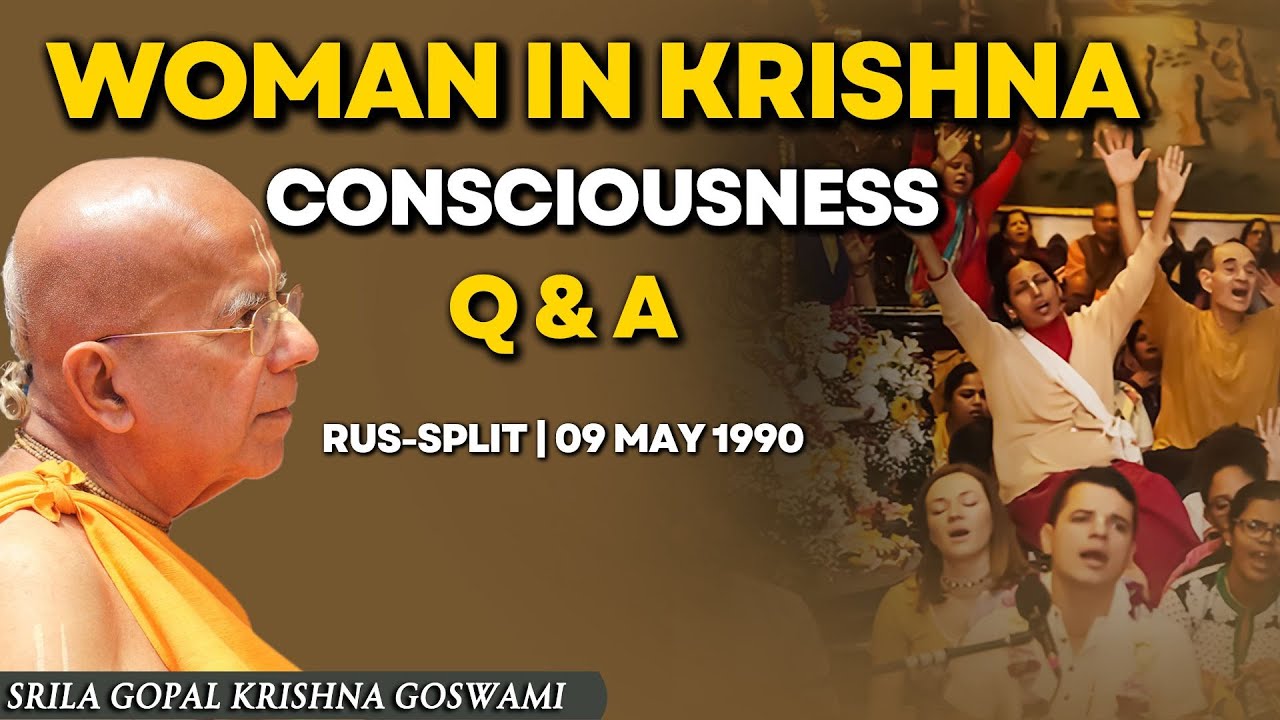
In this 1990 Q&A session, Srila Gopal Krishna Goswami addresses a wide range of practical and doctrinal questions raised by female devotees (matajis) concerning the role of women in Krishna consciousness, especially within the Soviet context. He explains that spiritual advancement is equally available to men and women, citing scriptural examples of advanced female devotees such as Queen Kunti and Gandhari. He advises on education (sending children to regular schools while providing extra devotional association), the use of ashram life versus home life, handling parental opposition, and the permissibility of cooking prasadam during menstruation. He contrasts Vedic standards of chastity and modesty with modern notions of independence, clarifying that modern technology can be used but excessive liberal attitudes conflict with Vedic conduct. He discusses practical matters like child‑rearing ages, guru‑disciple service assignment, the role of astrology, marriage procedures, gender interaction norms in ashrams and households, and the importance of motivation in devotional activities such as book distribution. Throughout, his tone is instructional and compassionate, emphasizing practicality, scriptural authority, and the need for sincere surrender to Krishna.
Chapters
So I'll answer any questions that your matajis may have.
Well, one of the matajis asks all of the prabhus to leave.
All of the prabhus to leave?
Yes.
Okay, but Vāsudama has to be here. He is the local president.
So the question is about children. There are no gurukulas here, and, well, should mothers Should they send their children to the normal schools or they shouldn't?
It's compulsory to send children to school in this country, isn't it? So as we do not have gurukuls, the best is you send children to the regular school and you also give your children extra association so that they get trained up in spiritual life also.
But what about the preschools?
You have no choice. You have to send them to karmi school because we don't have the gurukul project developed as yet.
Is it harder for a soul in a female body to get some spiritual advancement compared to this? Yes, sure.
Krishna says in the Bhagavad-gītā, anyone who surrenders to me, he comes back to me, whether it's a female or a sudra or anyone at all. So in Kṛṣṇa consciousness, it does not matter whether you're in a male body or a female body, because actually From a spiritual angle, we are both females, whether it's male or female. The only real male is Kṛṣṇa. In the Śrīmad-Bhāgavatam, there have been so many, there are so many cases of very advanced female devotees. Have you heard of Queen Kuntī? So Queen Kuntī, yesterday was Lord Nrsimhadeva's birthday. So I was reading to all of you the life of Prahlāda Mahārāja. But Queen Kunti also had to go through a lot of difficulties like Prahlāda Mahārāja. Queen Kunti had young children and her husband had died. So she was bringing up her young children, the Pāṇḍvas. But her brother-in-law, her husband's brother, he was just thinking, "How can these children be killed so the entire empire can come to him and his sons?" So, so many difficulties Queen Kunti had to undergo to protect her children. But because of her faith in Kṛṣṇa and her constant meditation on Kṛṣṇa, she was always saved by Kṛṣṇa. Another great devotee was Gandhari. So if you go to the temples in India, you find so many female devotees there. So no one should feel, "I have a female body, so it is not very conducive for spiritual advancement." Male or female, anybody who surrenders to instructions of guru and Kṛṣṇa can make spiritual advancement. The standard which Caitanya Mahāprabhu has given us is the same for everyone. Brahmachari, brahmacharī, grihastas, sannyās, everybody has the same rules and regulations to follow.
This lady's husband and herself are engaged in books distribution, but as they have got a small baby, she has to stay at home and she is not so frequent in distribution.
Yeah.
So, and there's the question about her mood here. Well, she travels that— well, she doesn't do her devotional service.
Well, she has to be practical. If a woman has a young child, the child has to be taken care, and taking care of the child is also devotional service. To have this type of feeling is very good, because if a devotee is thinking that he's not doing enough, then he will always try to improve. But if a devotee thinks that he is doing enough, then he will never improve. So even though you have a child, you should still try and do some book distribution whenever you can.
There are a lot of parents who are strictly against the devotional service, and the conflicts sometimes are up to living house. And, well, Mataji is asking, to do. You say one has to keep determination to the devotional service and at the same time to be humble with one's parents. How to combine these two things?
So her point is that her parents or relatives are against devotional service, so what should be done? Well, if it's very difficult to live at home, then you can live in the Brahmacharini Ashram with the other ladies. Now in Moscow they have a ladies' ashram also.
Well, this lady lives in this ashram, but she says that it's just a temporary one, and maybe it will be kept for an hour, well, a month long.
So yeah, well, I'm— in all our ISKCON temples all over the world, we have a brahmachari ashram and a brahmacharini ashram. And I'm very sure that even in Moscow, Leningrad, everywhere Very soon your devotees are going to have permanent women's ashram and men's ashram. It is just a matter of little time. And this is nothing unusual for parents to be opposed to Kṛṣṇa consciousness. Yesterday you saw in the reading on Prahlāda Mahārāja, how Prahlāda's father was completely opposed to his Kṛṣṇa consciousness.
So the lady is interested in on what terms How shall their relationships with her parents be done?
You should request the parents, you should tell them that, "I'm an adult now, I'm not doing anything bad, so please don't discourage my spiritual effort." You will always have some difficulty. Someone will always oppose if you want to serve Kṛṣṇa. You will never have a situation where your parents, friends, everyone will say, "Very good, very good, karaśau, very good, you are in Kṛṣṇa consciousness." You must understand that Maya is always testing us, and Kṛṣṇa is also testing us. Maya will give you something attractive and see whether you catch it or not. And Kṛṣṇa will put you into difficulty to see if you can overcome that difficulty or not.
Is it possible to cook prasādam and offer it to Śrī Kṛṣṇa for a woman when she has, well, a period of monthly cycle?
Yes, you can do that. In Krishna consciousness, we have to be practical.
So the lady is telling you that the modern European woman has to do much more than was prescribed to her by the Vedic standards. Well, is it in— well, is it very bad not to follow the Vedic standards?
Well, what do you mean by not following the Vedic standard?
She means that the way of life that is prescribed by Vedic standards is not the way of life of the modern woman who does—
But modern woman doesn't mean— if you, you can be a modern woman and still be Kṛṣṇa conscious. In other words, what does modern woman mean? Modern woman doesn't mean that you follow the karmī way of life, because if you want to follow the karmī way of life, then you cannot be Kṛṣṇa conscious. So you can still live in the modern society and use all the modern facilities to serve Kṛṣṇa.
Is there a great contradiction between the Vedic standard and between the modern way of life?
Vedic standard only gives guidance as to how a woman should conduct herself. Vedas don't say that you cannot use modern technology. Like you are using electricity, tape recorders, microphone. We use modern facilities. But modern woman generally would mean a woman who believes in so-called independence, liberation, and the fast way of life, which is against the Vedic way of life.
Well, another question about women's independence. Can one, well, I mean, can a woman be, well, free and independent without living in ashram? Nijagāvāśrami, that?
In other words, you want to be Kṛṣṇa conscious, but you don't want to live in the brahmacharṇī ashram. Yes, definitely. You can be Kṛṣṇa conscious in any situation. If you cannot adjust, if you cannot live in the brahmacharṇī ashram, you can live at home. And still practice Kṛṣṇa consciousness. But by staying in the temple, the atmosphere is better for spiritual advancement.
What is the Vedic standard for women conduct?
The Vedic standard, the Vedic advice for women is this, that a woman must be very chaste and shy. The modern society, of course, teaches us the opposite. A chaste woman is always respected.
Tanya says that the meditation of Karmi people, um, well, troubles her sometimes.
Meditation of Karmi people?
Yes, she means their thoughts.
Their thoughts?
Their thoughts, yes. The thoughts of Karmi that surround her. Well, these thoughts trouble her sometimes, and, uh, well, she's interested in the fact if there is any Well, mean to put a screen like, or something like that.
When she says thoughts of karmic people, you mean they live in the same house with her?
No, actually they don't live in the same house with her, but these are people whom she used to meet, some old friend of hers.
So then she should have, very simple, she should not meet them, she should just meet the devotees. You have such a big group, you have such a big community of female devotees, just mix with them. You're not, you're not in the Siberian desert where you don't have much association.
Tanya is asking about, well, some unwilling contacts in transport also.
Well, that is unavoidable. You cannot have a situation where the moment a devotee gets in the bus, all the passengers will leave the bus and say, just for you. Therefore, the best approach is To have the approach of a devotee, that is, everyone you meet you should try and give him Kṛṣṇa consciousness. So when you see those karmis, you give them a small book.
Well, the next question is like that. Can one ask Mrasimhadev— For protection. For protection and for help to suppress the demonic side of the nature?
The way to suppress the demonic side of nature is by advancing in devotional service. Just like when it's raining, you have to take the umbrella, otherwise you will get wet. But you can pray to Lord Nrsimhadeva for protection, for protection from Maya.
Well, it deals with the situation in Moscow ashram, female ashram she means. Well, the problem is that sometimes there are some conflicts between the inhabitants of the ashram, and there's not— sometimes there's no mataji in chief there. And, well, nobody can guide them.
So this is a management question. This can be discussed with the leaders of the Moscow Yatra. There will always be some conflict in the mature world. You can never have a situation which is completely sweet. The bee that is tasting honey is also being attacked by other bees. So you have to be prepared for everything. You must always think that I may have a little trouble in staying in the ashram or being with devotees, but if I am not with devotees, I will have 1,000 times more trouble. To be in the association of devotees is a very fortunate position. Nirguna-sthaka has said, "It is better to live in a cage with a lion rather than to live with non-devotees." Of course, as I said earlier, in the Soviet Union we have a slightly different situation where because we don't have proper temples and ashrams, most of your devotees are still living at home. So, and even though you're living at home, make the best use of a bad bargain. I said because we don't have ashrams everywhere, so many devotees have to end up living at home. So make the best use of a bad bargain.
So another question about children. If a child is not that small, about 13 or 14, but isn't affected very much to the devotional service because of the influence of the relatives with whom she stays, so what to do in this case?
She can only try her best, but what else can she do? Because the child is also listening to other people Therefore, you cannot be sure that the child will listen to you. So Pralāda Mahājja has given us a practical advice. He says, kāmara-ācāra-pragyod-dharmaṁ bhāgavatā me adhurlabha-mānusam janma. He says these children must be trained from the age of 5 onwards, because if the children are trained from a young age, then when they grow up, they will know their business. But if you try to educate them at 12, 13, 14, it is not so easy to influence them.
Well, the lady is asking about the case when your devotee is born in a kind of a demonic family. How to explain that?
Even if the devotees were born in demonic families, these devotees have all done devotional service in their past lives, and so now they're getting a chance to continue. And by the devotees engaging in devotional service, the so-called demonic parents, etc., they all get the spiritual benefit.
The lady is asking about the adult children who are interested in Kṛṣṇa consciousness and affected to it, but they are also attracted by some, well, maya activities.
So what should you do? Let them have both. Of course, having both is not the best, but if they are not ready to accept Kṛṣṇa consciousness 100%, let them accept to the extent that they can. But we should not be responsible for giving them bad habits. We should not tell our children, "Okay, go and watch movie, go out, go and do this and that." We should not be responsible for it.
The question concerns the life in ashram. When one feels an inclination to live in ashram, but at the same time one knows that leaving home will be a pain for the parents, what should one do?
You have to do what is best for spiritual advancement. You cannot make spiritual advancement if you are trying to please everyone at the same time. Obviously, when you chant Hare Kṛṣṇa, your parents will not be happy. In order to make them happy, you have to do sinful activities. But what we have to see is my real father is Kṛṣṇa. I have to do what will make Kṛṣṇa happy. So instead of worrying about what my father, mother, wife, husband, son, daughter want, I should be worried about what is Kṛṣṇa telling me to do.
The question is that Well, knowing the personal qualities of a disciple, can guru choose this or that kind of a devotional service of the activities in Kṛṣṇa consciousness?
In consultation with the disciple, the guru assigns devotional service. In other words, the guru sees what are the tendencies of the disciple, and based on the tendencies of the disciple, the guru engages him. In other words, the guru tries to find out what are the natural talents or skills of the disciple. For example, if somebody is a painter or a sculptor, then the guru will encourage him to become a good artist. If somebody is a good cook, he can encourage him to become a good cook for Kṛṣṇa. But the disciple has to let the guru know also what his skills are.
Well, the question is about astrology. What place does it take in Kṛṣṇa consciousness, if it takes any?
Prabhupāda said that when you come to Kṛṣṇa consciousness and you clap, All the lines of your hands go away. Now astrology, astrology, if it is done properly, it is bona fide. But today you don't have qualified astrologers. You only have astrologers who know how to make money in the name of astrology. Do you have lot of astrologers in your country? Anyway, if you come to Krishna consciousness, then we can tell you what your future is without going to any astrologer. Krishna has done your chart in the Bhagavad Gita.
He says, "Anybody who surrenders to Me, I take him back to Me." What are the regulations for forming a family if one wants to get married?
If one wants to get married, one should make that intention known to the spiritual authorities and the spiritual master, and then a proper marriage can be arranged. Or if— then, in other words, the whole system of marriage should be approved by senior Vaiṣṇavas. One should obtain the blessings of senior Vaiṣṇavas in a marriage engagement, in the marriage arrangement.
In case when a mataji doesn't want or doesn't have, well, a chance to get married, can Prabhupāda and mataji keep friends?
In Vedic life, female-male association is to be kept to a minimum. If you have If you have female-male association, then your spiritual determination will become weak. Even if you are married, one should minimize association.
Well, they are asking about the minimization of the communication between husband and wife.
I know what I meant is we must understand in spiritual life that too much association with the opposite sex is always bad, and therefore, especially in the Brahmacharya, brahmacharini ashram, one has to be very, very strict. Now this may come as a surprise to those who are under the influence of the modern society which believes in free mixing and so on, but we must understand that this philosophy of free mixing is for sense enjoyment, and spiritual life is based upon the principles of tapasya.
But in case when a devotional service needs their communication.
Yes, you may communicate when necessary, but when necessary, not that you go on creating necessary situations.
So the question is about the grihastha life. What are the standards for that? What are the standards for the communication between husband and wife?
Well, in spiritual life, grihastha laśrā means where you use the husband-wife situation but for the purpose of serving God. Grihamedhi life means where one uses the situation for sense enjoyment. So the rules and regulations to follow even in the grihastha ashram, and you can ask these rules and regulations from your local temple leader.
Well, the question about bringing up children, uh, in what kind of activities should a child be engaged Before 5 years.
Before 5, Prabhupāda said you give the child everything he wants. You can give him the sun and the moon also. But after 5, start disciplining him.
Okay. Well, what is the meaning of sikṣā-guru?
Sikṣā-guru means one who gives you instructions. And you can have many sikṣā-gurus. But the person who gives you initiation, he's also giving you sikṣā. So one can have one dikṣā-guru but many sikṣā-gurus.
So the lady is interested in the situation when devotee is distributing books in spite, not, well, just in spite with a, well, kind of competition with other devotees or sense enjoyment or some other not very favorable motives. How to Well, what to do in that case?
So it does not matter what your motive may be. If you engage in book distribution, you will get spiritual benefit. Just like anybody who touches fire will get his hand burnt. So even if you're doing book distribution for the heck of it or to be better than your friend, it is good. You'll get spiritual benefit.
Well, does it mean that one shouldn't think too much about the motivation?
It is better Pure devotional services, you don't think about the motivation, but you do your duty. But even if somebody is doing book distribution due to some motivation, there is no harm. It is not the best, but it is— there is no harm. So I'll end the discussion now. I just want to thank all of you. And you as matajis, you all should know that in Kṛṣṇa consciousness there is no discrimination. Anybody who takes to Kṛṣṇa conscious rules can make spiritual advancement. One should not feel, "Oh, I'm in a woman's body, so I can't make any spiritual advancement." Okay? Hare Kṛṣṇa, Hare Kṛṣṇa, Kṛṣṇa, Kṛṣṇa, Hare, Hare, Hare, Hare, Rāma, Hare. Lama Lama Ale Ale.
More from PRASAD

Rare Pastimes & Timeless Lessons of Guru Mahārāja | Stories Every Disciple Should Hear

ISKCON Legends- pure devotees meet-HH Jayapataka Swami, HH Gopal Krishna Goswami, HH Radhanath Swami



Jagannātha Ratha-yātrā Through Śrīla Prabhupāda's Mercy | 29 April 2006 | Nairobi, Kenya

Lord Jagannātha's Appearance Pastime | 21.07.2019 | ISKCON Calgary | Śrīla Gopāla Kṛṣṇa Gosvāmī

The Ācārya Teaches by His Own ExampleGuṇḍicā Mārjana by Guru Mahārāja #shorts

Guṇḍicā Mārjana – Lord Jagannātha's Pastime | 21.7.2019 | ISKCON Calgary |Śrīla Gopāla Kṛṣṇa Gosvāmī

H.H. Gopāla Kṛṣṇa Gosvāmī Mahārāja - Exemplary Sādhana and Deity Worship # shorts

भगवान की कृपा कैसे प्राप्त होगी ? | 11 Jan 2014 | Punjabi Bagh | Srila Gopal Krishna Goswami

Material Education vs Spiritual Education | Srila Gopal Krishna Goswami #shorts