Founder Stories - Ganesh Swami, CEO & Founder of Silota and Covalent
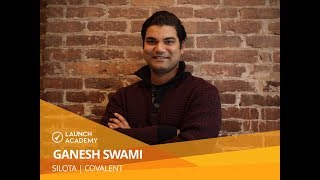
This is a recorded interview (Founder Stories) where Ganesh Swami recounts his path from studying physics/engineering to founding Saluda (a data-analysis/visualization platform) and later pivoting to build Covalent — a universal blockchain search/index and middleware. He describes winning a distributed-systems hackathon (late 2017), validating the Covalent idea by calling potential early adopters, explains Covalent’s positioning and simple tooling-first go-to-market, and outlines near-term plans including front-end demos and a public launch slated for mid-February.
Questions this video answers
March 5, 2018.
Engineering — specifically Physics.
Around late October or early November 2017.
Planned for mid-February (public launch announced during interview).
Chapters
My name is Sam, and I'm the head of programs at Launch Academy. And I'm joined today by Ganesh Swami, CEO of Covalent and Saluda. So thanks for being here, Ganesh.
Happy to be here, Sash.
So let's just start from the very beginning. Why don't you tell us a little bit about your story and how you got involved into building your own company. Where'd you go to school?
Oh, that's gonna be a long story. Studied engineering in school. Very technical engineering, Physics, to be specific. I've always wanted to work for a startup company or start one. Eventually had this great opportunity of working at a biotech company. Did that for a couple years, and then decided the best way to learn how to do a startup is to do a startup, and so quit my job and got on the entrepreneurial path.
And so I'm saying this because we're both of Asian descent, and I don't want to draw too much attention to that, but what was the family response? Like, I know growing up for myself, like, working in startups is something strange. It's something not the norm.
Yeah. I think my family comes from a very traditional background. So your options are either you become an engineer, doctor, or lawyer. And so I picked the engineering route. And when I decided to become an entrepreneur, my parents was like, they were supportive, of course. And then my mom said, yeah, you can try this for, like, six months, and then, you know, go get a real job.
And what were some of your early mentors? What are some of the early advice that you received?
It was all over the place. I think advice that you get is always contextual. And so if someone tells you you need to do this, then you. You can't really do that because it doesn't always apply. It depends on timing, it depends on the market situation. It depends on your stage of your company. So I think I quickly realized what my biggest weaknesses were. The engineering and the product side is pretty good at, but the distribution side, the sales and marketing, how do you promote something? How do you let people know about your service or offering is where I had the biggest challenges. So that's where I needed a lot of outside help. And then your.
Your first company was called Saluda, right?
Yes.
What's that about?
Saluda is a data analysis platform. So my entire life, I've been doing data analysis. Crunching, munching data, moving data back and forth. Think of it like the shipping industry. Your stuff is built in China and has to get to here in North America, so you need to package it onto containers and move it over. So Suluto was in that business, but with data instead of physical goods. So we built this really snazzy data visualization platform, and you can just plug to your database and go at it.
So you've been working on Suluta for about a year, year and a half, two years. Tell me about how you decided to start your second company, what the story behind that is.
You. Yeah, it's a really interesting story. Late last year, I think it was early November or late October, there was a hackathon here at Launch Academy. It was a distributed systems and database hackathon. And just on the whim, my team decided to participate, and we happened to win the hackathon and database data distributed systems is exactly what we do day in and day out. So it was a little surprise for us to win it, but, you know, it was cool. And that's when we realized that this idea, this hack project, could be used for other kinds of distributed ledgers and blockchains. And so I got really excited. So before you decide to make a pivot or change your business completely, you want to do some form of validation. So first thing I do is picked up the phone, call 50 people and figured out if they were excited about it and if this what the pain point was, if there was an actual market need. And the reception was pretty amazing.
So, I mean, at this point, and we're trying to kind of draw back to that moment of Ganeshin in November 2017.
Right.
You know, you're full time with Saluda, probably full time and a half, if we're being honest with ourselves. Where did you get the time to cold call 50 people? Because I'm assuming those 50 people aren't just the first 50 people that walk through the door. You flipped open yellow pages and then just randomly called. I'm assuming there's something related to covalence. So before the call in, there must have been research and analysis. Who are the right people that you think you should talk to? Describe, like, how you not only just need the time, but how you selected who to talk to.
Sure. So something I took back from the hackathon, besides the price money, of course, is how to pitch this idea. And I think one of the reasons we won the hackathon is because how confident we were able to pitch the idea to judges who were not necessarily technical. So connecting this to a real need. And so I realized just upon reading and understanding this space, that the market was really, really early. And so if you're familiar with Chris Stenson's, crossing the chasm kind of deal. You're always looking for those early adopters, people who raised their hands and said, I would really like this stuff. So very specific keywords, like solidity is an example of a keyword in the blockchain space. So there are probably really like maybe few hundred people in the world who know solidity. So you pick up the digital version of the yellow Pages, which is LinkedIn, in this case, search for those keywords, search outsource to getting their contact information and blast them with an email. Try to get them on a Skype call or their phone number if they're local.
How would you describe what covalent is to someone who's not familiar with blockchain or someone technical?
Sure. So covalent is a search index on top of your. On the top of the entire blockchain. So just like Google is a search index over the entire Internet, Coin's goal is to build a search index. So there are multiple blockchain networks out there. There's Bitcoin, which everyone is pretty crazy about, and Ethereum, but there are actually a dozen other blockchain networks. So with Covalent, it's a universal connector to all of these blockchains. So this provides a database like access to blockchains, which don't necessarily speak database terminology. So that's the business we are in. It's very cool.
So with Covalent, I know that previously and I've seen you walking through these doors day in, day out, working with Saluda and, you know, for the last few years, I don't think it's out of reach to say that was your baby for the last two years. So in some sense, I imagine that you're going full forward with Covalent now. What gave you the courage to actually put a pause or not pausing, but just autopilot Saluda and, you know, go full force on Covalent, I think the.
You know, if you think about the startup journey, there are multiple risk factors, right? There's a. The team risk. Maybe you're not the right team to execute an idea. There's a product risk, there's a market risk, and there's a timing risk. And certain ideas are only relevant at a certain time. You know, 15, 20 years ago, you had these smartphones but never caught on. And it's only until the iPhone came out that it really caught on. So the idea of Solota had its time. It's still a really good business, definitely solving a genuine business need. But the blockchain space is greenfield. There's so Much opportunity and so much mindshare we can capture in the next couple of months to a couple of years because no one is really, no one really knows what's going to happen. So I think, I think timing is a big, big deal. The problems are equally difficult. Startups are always difficult. The technical skills that you need to run these things are more or less the same. We're not doing a heavy science project, we're not building a quantum computer, it's a database. The marketing continues to be the same. I think the more and more new technology comes out, the more and more stuff stays the same. So how marketing is about how you talk to people. So that hasn't changed, sales hasn't changed. So I think it's time like the market, market is excited about covalent. Cool.
So I mean with excitement like one of my favorite phrases from 3:7 signal guys is the, this idea of signal versus noise. And I think obviously you can open any old fashioned newspaper right now and you'll hear things about bitcoin, you'll hear things about blockchain. And as a new startup with covalent, how are you rising above all the other noise that's going on?
So with covalent, what we're doing is we really want to filter out all the people who are interested in the space. So think of it as a funnel though I hate calling it a funnel. So people are interested in bitcoin prices because it's quick money. People are interested in doing ICOs, people are interested in the actual blockchain technology, people who just feel a part of the community. So the community is very fragmented. The bitcoin community is not, is distinct from the Ethereum community and so on and you're trying to attract their attention. So what you're trying to do is build these simple, easy to understand tools on top of the blockchain that anyone can go in and play with. So think of it as a baseball stats website. It only attracts people who are interested in baseball. Second, want to track the stats. Third, want to engage and play with those stats. So we're building tools like that which lets people play with our technology without having to install, without having to go through that onboarding process. So that's our go to market right now. And obviously every tool out there is a landing page. So we're going to be collecting emails and then we'll sit through those emails and figure out what companies are genuinely interested and have a need.
So I think for all the people that are going to be watching this and they're going to some degree try and recreate the level of success you've had thus far. And I mean, we're nowhere near the finish line by any means. What would you say to those people?
So I would say think holistically, right? So it's never like you can connect marketing. You can't just tap on or latch on sales, you can't just latch on product. So if you're truly passionate about solving a problem, think holistically from first principles. So our marketing strategy is built into our product. So we don't have like marketing that's separate from our product. Our product is our marketing. Right. And the sales comes from that. Each tool being a landing page and a sales tool. And so, you know, it needs to be holistic.
And then what? What's the next planner to tackle the next three to six months?
So we have the minimum level brand together, which is covalent, the company name. We have a logo, we have a basic marketing website, we have a positioning statement, target customer Persona. And we are coming out with our first mep. So our middleware is being built. It's going to take some time, but we're going to be releasing these front end tools. Think of it as a mini hackathons, right? Something you can build in a week or so, which showcases the power of our middleware. And we are putting the final touches on our first project, which should be the public launch of Covalent. Fingers crossed. It comes out mid February, so definitely.
Stay tuned for that.
So thank you for your time, Ganesh. Super excited. Check it out. Covalenthq.com Our first product is coming out in a few weeks. Cool, thanks.
More from Ray




A Founder's Story. Creating the World’s First Laundry Robot — Joshua Rabanne, Laundrx

Bits&Bytes with Sherry Li, Assistant Professor at Berklee, Co-Founder of ICTUS Audio

Why This Young Person Left Child and Youth Care To Work in Tech - Bits & Bytes with Samson Li




