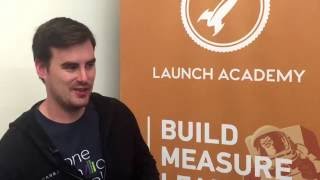
Collin Stewart (founder of CARB IO) describes merging with Predictable Revenue and the company journey: initial frustration that CRMs historically stopped serving salespeople, an early product pivot where an initial CRM product produced 18 months of flat/no growth, and hard lessons about lacking customer validation and product–market fit. He credits Aaron Ross’s book (Predictable Revenue) and the Launch Academy community for reshaping the company’s direction. He reports over $100,000/month in recurring revenue but still views product–market fit as an ongoing quest; emphasizes team cohesion and community support.
Questions this video answers
18 months of no growth
>$100,000 per month of recurring revenue
Chapters
So my name is Colin. I'm the founder of CARB IO, recently merged with a company called Predictable Revenue. The author of basically part of the Predictable Revenue group of families. The author wrote the book. He was part of Salesforce's early team and really helped grow them to grow their enterprise sales department. What really inspired me was, funny enough, Salesforce and the fact that Salesforce has never been, and most CRM has never been a tool for salespeople. Back in the early days, when you install APT or maximizer local company here on your, you know, your computer, it was a tool to help you do more as a sales rep, as a salesperson. Once you got into larger implementations, it became more of a managerial tool and the value for the salesperson sort of went away, disappeared. So that was really my. What really frustrated me and what sort of inspired me to start the company. Rocky. Crazy fun. Yeah, I mean, we. It was one idea. Our first implementation of that idea was a CRM system, which, as anybody at Launch Academy will tell you, turned out to be not a very good idea. And I mean, I think the problem was it was just an idea. It wasn't a validated customer pain. So took us 18 months to figure that out, but eventually we got to some more validated customer pain, let's put it that way. I mean, I think the most glaringly Obvious1 was 18 months of flat growth. Sorry, sorry. 18 months of no growth when we were doing the CRM system. And I think one of the hardest things there was to give up, not give up, but really put to bed the idea of the CRM system and come to the realization that these ideas that we thought we validated with customers, we actually hadn't validated with customers. I think that was the big challenge for me personally to give up on something that was like, hey, this is my idea. And then to come to that realization that, hey, people don't buy ideas. Starting a software company or a startup is not about your ideas. It's about helping customers, Getting a chance to work with some of the people. We've got a great team and just the opportunity to work with all of them and to watch them come together and really, you know, pick up the vision and care as much about the customer as I do. That's so rewarding. There's a whole lot, not a lot that fits in the scale or in the time frame that you probably want on the videotape year. But I think the, like, the biggest thing that I screwed up in the early days was customer validation and product market Fit. And we have, you know, we're doing over $100,000 a month of recurring revenue. And we still don't think of ourselves as having product market fit. So it's a. It's an ever. It's a long quest. And to start off in a direction that. We started off in a direction that was, hey, I think this would be a cool idea. And we validated that. Yes, a lot of people thought it was a cool idea. And that probably cost us 18 months. Now I don't look back on that time and regret it. It was like we learned so much, and you almost have to do it once to realize, holy shit, that was a bad idea. So try not to make. We're trying not to make the same mistake again. And yeah, that'd probably be the biggest thing that cost me the most time. Yeah, I mean, my initial reaction is really my team just having so many great people to come together to get something done. It's been a really cool experience. Predictable revenue. Because I was walking through the halls of Launch Academy, like, going down the stairs by the bikes, and another entrepreneur, James, was like, hey, man, have you heard of this book? No. Yeah, it's written by this Aaron Ross guy. He was there to lead Salesforce. You gotta read this book. Like, go read this book right now. And like, that interaction here at Launch Academy changed the course of where our company was heading headed. We immediately built a team around that trying to sell our crappy CRM product. And when we realized that, hey, the CRM product isn't working out, the one interesting thing that we were doing was actually what we learned from the book. So that literally changed the whole course of our company and it put us here today. And James will tell you that, and he'll also tell you he's asking for half the company. It's hard to name one person, but the community in general helps has been phenomenal. I met so many people here at Launch Academy, so many advisors. The investors here and the entrepreneurs really are probably who I learned the most from. When I came to Launch Academy, we were sitting over at the old space and I was like the only sales guy there. I was like the pariah. Everybody sort of looked like, avoided me. So I didn't have a tech background. I wasn't an engineer. I never built a software company before. And, you know, once they, you know, once I got to know them a little bit, they. The community just opened right up and everybody, like, I had so much to learn, and I think it'd be unfair to point to like one particular person because it was. It was a community effort to help us get here.