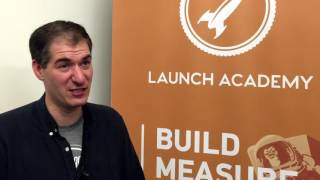
This is a transcript excerpt of a FounderStories interview with Craig Slagel about creating RunGo, a navigation app for runners. Craig describes combining his background in running and technology (worked at EA, Microsoft, visual effects firms), quitting his job to start a company, early experiments (a running game), and the pivot to RunGo inspired by his retired guide dog. He discusses major challenges—especially finding engineers with the niche skillset for running navigation—and recounts personal anecdotes (completing a 330 km ultra in the Italian Alps, Tour de Gents) and impact stories (a blind user and a hiker who avoided getting lost). He also recounts charity runs raising about $2,800 in the first year and nearly $7,000 the next, and offers advice stressing passion, persistence, customer discovery (lean methods), and continuous learning.
Chapters
Foreign. Okay, well, I'm Craig Slogel from Rungo and really two things I used to. I love running big Runner and I worked technology for many years. I worked companies like EA and worked at a couple of visual effects companies, worked at Microsoft, and I wanted to take my running passion and my technology experience, do something different and then actually quit my job, went back to school with the idea about I'm going to start a company. And I wanted to take those two passions together and try. Initially, I tried a running game and didn't work so well. That's the first experiment. And then I went eventually to Rungo and there's our current app and that's what inspired me. So. It's tough. I mean, I think, you know, you never realize when you start a company how hard and how much work it's going to be. It's also been really fun. I mean, there's lots of learning, lots of things like, okay, if I could go back in time, I'd do these like 10 things different or that. But, you know, I really enjoyed the whole journey. You know, starts with one idea and that sparked another idea. It sparked another idea. Had my dog down here and I was working on one running app and I got my dog, who's a retired guide dog, and he said, oh, you get lost all the time. You should have an app guide to you. And that was the inspiration behind it. So. And that's been really fun along the journey and then from there, kind of all the programs you go through. One thing that was great about Launch Academy was I was able to learn a lot about business. I didn't know about everything from like the lean entrepreneur and, you know, business model canvas, all these things to kind of help you with customer discovery. And I'm continuously discovering and learning more and using those tools and learning more tools. I'm not going to say there's one. There are ongoing challenges. Always. The first big challenge we had was a staffing challenge. I couldn't find people. We decided to do it again. Our app is a navigation app for runners. So I went with, hey, navigation, that's gonna be fun. And I didn't realize how big of a challenge that would be. And just finding, you know, engineers who understood running navigation systems, iOS, you know, all these things we had to figure out gave me a very, very limited talent pool. And it was a tremendous challenge just finding someone with those with that experience. I was actually really lucky. I actually found my engineer here at Launch Academy and he was working for another company part time as a Contractor and I was able to kind of, you know, talk to his boss and we agreed to transfer him over. And he works for me now and works still part time for the other company as well. So it's been really good. Can think of a couple, I mean, you know, in just general life, I did a race back in 2010 called Tour de Gents and I'm. I do what's called ultra marathons. So these are long distance marathons or long distance races. And this was the toughest race I've ever done. This race was in the Italian alps. It was 330km and it was really tough. And during that race I got told three times I wasn't going to make it to the next checkpoint in time. So. And it was like, well, I'm going to just keep on trying. And I've always been like, you know, unless someone tells me to stop or, you know, I'm going to keep on going. And I kept going. I finished that race. I was third from last. It took me six, almost six and a half days to finish it, but I finished it. And that was, you know, from one of my big things. And then, you know, now with the company again, just kind of how far I've got and how much I've done and you know, whenever I hear about people who are using our app. Recently had a blind person use the app. It was really exciting. And we had someone who said the app literally saved her life because she was going the wrong way. And the app told her she was going the wrong way on this trail in the mountains and she realized some turn around and went the right way, but she was going to be completely lost without it because I had no idea I was going the wrong way. I'm really inspired to help people and you know, so a couple of things we've done is, you know, with our company, we always try and do as much as we can for charity. So when we launched the app, it was inspired by my retired guide dog. Our first event was a run for B.C. guide dogs and we did that last year for the kind of official launch of the app. We had like 100 people running around Stanley park using our app. We had some blind people with their dogs using the app as well. And everyone made it back. And that one, we, we raised about just over $2,800 the first year. We did the event again this year and we raised almost $7,000. Yeah, don't go into the to make money. Find something you're really, really passionate about. Find a problem that you want to solve or find that you really want, and you 100% believe in it. Because if you don't believe in it 100%, there's a lot of people going to tell you your idea is stupid or your idea is good or bad, or, you know, I love it when people love our idea, but also people like, why would I use this? Yeah, what's the point? And you have to be so passionate that those things don't bother you and you kind of keep going through. You have to be willing to accept, you know, no, and then ask the next person. And there's going to be a lot of talking to people. But you have to be really, really passionate. You have to have a lot of energy. You have to be willing to put a lot in. You have to be willing to make sacrifices. You know, I, you know, do a lot less fun things. Luckily, I really enjoy what I do for my job, so that's okay. But if you're not having fun and not loving it and not passionate, I wouldn't do. Yeah, I love the learning part of it. I love that every day I go in to the office or I work on something, and I'm always learning something new. You know, when you run a company, you are a bit of everything. And, you know, at the moment, I'm learning about marketing and SEO and, you know, advertising, and, you know, I'm always learning about new engineering stuff and, you know, design concepts. I always learn about new things all the time. I'm also excited that I'm building something, a product that I use. I'm passionate about my friends, like, and just being. Having that kind of opportunity to kind of expand yourself within a company is really fun. There's no limits when you're an entrepreneur. When you're working for another company, you're limited by kind of where you can go. But there are no limits as entrepreneur. You can go wherever you want to go. It's what you put in, it's what you get out.