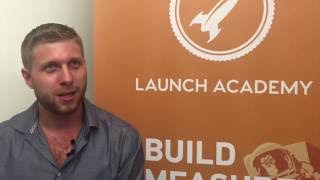
Interview transcript excerpt with James Clift (co-founder and CEO of Work Story/VisualCV) describing his entrepreneurial journey, evolution from web design to recruiting/product work, product-market pivots toward candidate-facing resume/portfolio tools, growth milestones (approaching one million users), reflections on failure and iterative learning, and the importance of peer networks and mindset for entrepreneurs.
Chapters
So currently I'm the co founder and CEO of a company called Work Story. We, I think we're the Internet's biggest online resume and portfolio creation tool. So we started up about two years ago, about to hit a million users the next month or so. And the inspiration for that company was actually kind of an evolution from my previous business. So we're building technology in the recruiting space more on the employer side. So like an applicant tracking system, like a recruitment marketing system. And we really found a lot of pain points on the job seeker side of that equation. So we kind of switched gears and wanted to focus more on how do we make that candidate experience better, help the people actually applying for the jobs and kind of evolve from there. I was actually reflecting on this recently. I'm about year five into this entrepreneurial world. So looking back, just the first decision to start the company was the biggest decision. And then from there it's been very large number of very bad ideas, most of them poorly executed on. And then eventually you start to see something that sticks and then you see some traction, reiterate, you build again, then it fails miserably, then you start something else. And then I think it's just been an overall process. The most interesting takeaway I've found from it though is that it's almost like a step function. So my first company was built like doing websites, web design, development, everyone's first Internet company basically. And with that success to me was if we made 100 grand a year, let's say designing websites for people. And then all of a sudden we built a product, we got into Grow Lab, which is now Highline. And then your, your world just changes, you're like, oh, why don't we build a billion dollar company? And just, you never go backwards from there. So I think just like your world gets bigger and bigger and bigger and even if you fail, you kind of just fail to back for the last step. You don't go all the way back to the bottom. So that's kind of been the most interesting takeaway from this strange journey. My friends really inspire me and I think just the weirdness of entrepreneurs really inspired me. And going back to your previous question, what I like most about this world, I think it is the people. So just going out for lunch or for beers with people, talking about their new ideas, helping each other, sharing stuff, that's really inspirational. And then you can look at the, of course the Elon Musk's of the world, but he's on a bit of a different level. So I Think it's people who just are making their own world the way they want it to be. And that doesn't necessarily have to be Tesla. It could be. Excuse me. It could be one guy with an app that lets him support his family. Right. And I think it's just making those decisions, being aware of those decisions is what's really inspiring to me. So the people that have the biggest influence on me are actually people I met in Launch Academy back when it started back, like, back in the Inception days. And it's just a group of four guys that I'm really good friends with now. And I think the whole mentorship thing doesn't really jive with me because it's not a really equitable relationship. It's like, hey, I need advice. I'm gonna give you advice. Whereas if your peer group is kind of on a close level to you. So, I mean, there's ebbs and flows. Some. Someone's got a huge company and then someone's. But you're all kind of. You can have the same conversation. So I think it's more important spending more time with people. That one that you really like is important. But also that every conversation you have, or not everyone, there's always beer and woman. But the good conversations you have actually do lead to you thinking about your business a little differently or your company a little differently. So, yeah, I'd say a lot of the buddies that I've made in the last couple years in this world that are really good friends and that I'd call for to hang out anytime, I think it's more important to me than meeting the big shots of the business world. And we'll be big shots soon enough anyway. So. I haven't really thought about that, and I don't know if there's an answer to it. I think it's just the reality of my life is I'm built this way, and I just. I know it's better than having a real job, that's for sure. And I think. I mean, I love building stuff. I really do love the honeymoon phase. When you come up with an idea and you start prototyping and you just have these visions of what could exist in the world, and to actually see a small percentage of those come into fruition and actually become successful, I think that's really exciting. And the other thing I love, actually, now that I'm thinking about it, is just the people in that world are awesome. So you get together with people who aren't entrepreneurs, and you have a good time. You get together with entrepreneurs, and you have a few drinks, and all of a sudden it's like, let's buy this building. Let's build this company. Let's start this. And I want to do this. Oh, sweet. Yeah, it's cool. It's just a crazy world where everything is actually possible, right? And it's a stupid world too, and it doesn't really make sense. We're like, oh, well, I'm raising 500 grand. Oh, only $500,000. Right. Where in the real world, that's an astronomical amount of money. Whereas our role is just the regular rules don't apply, or at least we don't think they apply. And I think that's just a really fun group to hang out with. And I mean, a lot of my closest friends are in the tech entrepreneurship world, so we have some. Some good nights just discussing these crazy ideas, which is definitely a lot of fun. So the way I look at business or starting a company, there's two outcomes for every action. One is it's successful, or two is it nothing happens. So there's no negative outcome of doing anything, basically, unless you're being. Being a complete jerk about something. But usually. So if it's like, oh, I'm not sure if I should launch this product, just launch the product. Like, odds are nothing will happen, but something might happen, or I don't know if I should talk to that person. Just try and talk to that person. Odds are they'll ignore your email, but they might not. So I think it's just like, just think of that life in that binary way where it's like, it might work, it probably won't, and then just keep going and going and going, and eventually something's gonna stick and something's gonna build and you'll do. Through that process, you become better. And when you're starting off, you really don't know anything. And, I mean, I still don't know anything, but I'm starting to understand things a little better. And I think when you're starting off, you really do need exposure and you need to build assets. Whether that assets are really good product, a really good skill, or yourself just being a really good person. I think really focusing on that as opposed to having these really grand ambitions and delusions. That's the quality, I would say, to stifle a little bit in young entrepreneurs is. I don't. It's pretty easy to see through a vision unless you have stuff to back it up. And I think a lot of the time, people overcompensate for lack of those things with a very aggressive approach to things, and you start to realize that entrepreneurs are people too. And like anyone you want to look up to, they want to help, but they want to help people that one are humble, modest, and can accept feedback, but also are going to be really successful. So just make them think you're all those things and then you'll be successful.