How this Nomadic Founder Landed in Vancouver | Raphael Titsworth-Morin, Éphémère Creative
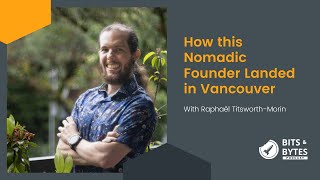
Raphael Titsworth-Morin grew up moving between countries and cities before landing in Vancouver to co-found Éphémère Creative, a tech studio for nonprofits and environmental organizations. He found his co-founder through an AngelList posting and ran early experiments at the Volta incubator in Nova Scotia before the city's impact startup scene drew him west.
Chapters
Hi everyone. Welcome to another episode of Bits and Bytes. From launch today we have a special guest here, Raphael from. I'm sorry, Rafael, you're going to have to correct me on this. Essimir Creative.
Yes.
Oh, I got it.
Okay.
Yeah. How do you pronounce creative? Or just give us a quick introduction of yourself.
Yeah. So I'm Raf and I'm the co founder of iFimar Creative. And yeah, we build. Build tech for companies with a social or environmental focus.
I think it's super embarrassing for basically BC Canadians to try and pronounce your name.
Yeah. Every once in a while I wonder if that was a good idea. But you know, we're both like, I'm bilingual, like half my family's francophone and half my family's anglophone and you know, Ava's francophone living in bc.
So I don't know, it's kind of cool.
Works out well.
That was definitely a unique name for sure. What does it stand for?
It basically just means ephemeral.
So ephemeral Creative.
Um, okay. Yeah, yeah. So let's just get started then. So what kind of motivated you to kind of start this company?
So the impetus was kind of like, so, okay, so a few years ago, I've been working in and around startups.
For, I don't know, like six years now. Ish.
And that's, that's either been sort of as a contractor, a co founder, a I don't know, just doing stuff advisor. And so after working on a couple different companies, I felt like I kind.
Of just needed to get back to.
I needed to just make money, you know, I needed to pay rent. And so I went back to freelancing and I found that the companies that.
I was working for when I was.
Freelancing that I felt or I had the most strongest connection with were those that really had like a social or environmental impact.
I just felt good working for them.
So yeah, I figured I would try to create this, this company that had.
This social or environmental impact focus. And I felt like I couldn't do.
It all on my own.
And so I put out a message on Angellist and most of the responses.
So it was a job posting on.
Angell and most of the responses were terrible.
They clearly did not read the job description. But Eva was the one person who's like, oh, actually that's really cool.
Like I love the mission focus and I love like what you're proposing as far as doing stuff with sort of a social environmental focus.
And so yeah, we met up and.
Then chatted for a while and slowly started working together. Roughly a year later, sort of officially started working on DC together.
So just because we get this question a lot, is that your recommendation for how to find a co founder for your company, product or service or otherwise?
I feel like that's so actually I was part. Part of why it worked that way was that one of the folks I'd met at a or who ran an.
Accelerator I'd been a part of previously.
I reached out to her for advice.
On sort of finding a co founder.
And essentially she, she said if you.
Can find some way to work together for a while and you see that you just, you do work together, well.
Then eventually, yeah, that's, that's.
That.
That is a person that you can, that you can probably then trust as a co founder. And so it was, it was basically that I realized that I needed like some help and Ava and I just.
Sort of slowly worked together like little.
Bits here and there.
And, and eventually we just realized like, yeah, we do work well together.
And yeah, I feel like it makes sense. With the previous company, it worked completely differently and I actually thought like it, it ended up working out fine, but I think it's just been lucky.
That's not an answer our listeners like to hear though.
Well, no, like everything. I feel like, yeah, anyone who thinks that their success comes with just from.
Themselves is, is kind of. Yeah, yeah, they're full of it.
Everyone has some luck.
I think it's always like we, we've touched on this topic a lot through the years through various, various different platforms. But like the idea of like a co founder, A, do you need one? B, how do I get one? Like, like we always, always equate it to dating, right? Like it's this. Yeah, it's this kind of like. Well, like, how are you supposed to find your wife? Like, there's, there's no formula, right? Like different things work for different people. But like if, if there was a way to kind of measure that out, I'm sure like there'd be a startup all. All over it already, right?
Well, isn't. I mean, there are startups trying to do that, right? Like there's. I feel like there, I remember there was one called like Founder Dating and there's.
Yeah, well, there's one. There should be one for every dating website there is out there, right? So I mean, like, it won't stop people from trying. But I think, I think the, the, the right and the crappy answer is it's a bit of luck. It's A bit of you opening up your mind to not just being able to work with yourselves in some cases, sometimes it's opening to work with people that bring different gifts than you. It's not just like, oh, this person agrees with me a lot. We should work together. Gene and I disagree all the time, and yet we show up on time for the podcast. That's part of what makes things work, right?
Yeah, I think so too. Like, you, you have to find someone.
Who sort of compliments you, not someone who is exactly the same as you.
I mean, I'm kind of curious. So, you know, you mentioned that some of the applications you originally got on Angelus was actually terrible. Like, how would you like, can you elaborate a little bit for those that you know, might be interested in, like, applying for jobs on AngelList, I was one of them. That's actually how I found Launch. Okay, but what would differentiate, like, let's say someone wanted to work for a company specifically. What are some of key things that you're looking for? Like, do you want them to have like a profile completely filled out on Angel List, or is it more of like the resume or just kind of like mix of everything?
Honestly, for me, like the. I think it's a little bit like if you're, if you're going to look.
For a co founder the way that.
I did and set it up as a job posting, you kind of have.
To do the stuff you would do with the job posting. Right?
Like, you have to figure out like when you post something, like I found, if you post on Indeed, for example, you'll get tons of candidates within like hours of posting. And most of them haven't read what you posted. Like, they just filtered by something. They're like, oh yeah, software developer, I.
Can write some code and they send their application.
They haven't read that.
Oh, you're in this field and looking for someone with this background and they are not the bot, that script application.
So yeah, so I think it's the same sort of thing. Like, you have to put information that sort of qualifies really what you're looking.
For, that sort of.
I don't know if you have things that are almost like calls to action in the posting and you see that people haven't like used those to get back in touch with you. I was talking to someone recently who likes to put at the bottom of her job postings. She always says, oh, respond with X in your. In your title to like in your, in your. In your title line for your email. And then something else so if it doesn't start with like X, whatever that.
Is, then she just ignores them all. An Easter egg system.
Yeah, yeah. And so there's ways of like qualifying that way. In my case it was really just that like I had said like I want to work on environmental and social stuff and like, let me know what you like. I don't know what, what sort of causes you feel strongly about or like what kind of things motivate you. And like the responses that I got were mostly like, hey, yeah, I build tech, I do these really cool projects. Hire me, please. I'm just like a. It's not, I'm not hiring.
Like it says it's a co founder.
Position and you didn't respond to any of the other things that I, that.
I talked about in the posting.
So what do you mean my 15 years in the oil industry aren't enough?
Right?
Yeah, so many of them were completely irrelevant. There's like one that was like unclear. But then once I dug into his profile, it looked like he was just doing like 20,000 different things. And when I tried to schedule a.
Call with him just to see if.
He was potentially interesting, he just kept putting it off.
So I was like, well, I'm just not that guy.
I mean that kind of reminds me of the screening process and call to action. Like that's actually how launch did it too. Like, or we still do it. We just have, hey, send us the five minute video of answering this and this question. And I remember when I first applied myself I was like, oh my God, like I don't know any of these answers. And like I had to like Google. And then I was like, well, I mean some of them looking at me like, well I mean, okay, like I did know how to answer some of them but you know, like I did need the help of my dev boyfriend to kind of like, you know, supplement my knowledge and a lot of help with Google. But hey, I still did it.
We need to reevaluate. Ate some things mid show, but no free plug for us. I mean at the time of recording we are looking for a new marketing manager. So you know, if any of what we're talking about is interesting to you, find out how to reach us.
Hey, also if Amount Creative is looking for a junior full stack developer.
There you go. I mean this is going to age well like two years from now. It's going to be interesting when people re listen. That's the thing, right? People re listen to podcasts.
Actually.
Huh?
Oh no, no, go ahead, go ahead.
I feel Like, I have, like, seen some podcasts where like, the hosts will say, like, oh, yeah, we're getting a lot of comments from people listening to the episode from back in like 2017. I'm like, who does that?
People in a pandemic do that.
Yeah.
Fair.
Yeah, yeah. I just want to say to help get a better understanding. So what kind of services exactly do you provide for companies that are striving for social and environmental change?
I mean, we do software development and I guess like software development and website design. So whether it's organizations who just want to like, the pitch is we use technology to help scale social environmental impact. So if your mission has to do with social environmental impact, whether we're helping.
You set up services or like deploy like a marketing site or that sort.
Of thing, or you want to build like an application, like you're building a.
Product to accomplish your goals or to accelerate your mission, then that's the shortest stuff we can help with.
So in many cases it might just.
Be building and deploying sort of custom WordPress sites.
But the projects that I prefer, the more exciting ones, are the ones where.
We'Re building like web apps.
I don't know in more technical terms. I've gotten really into building out processes to deploy Kubernetes clusters with Django, as I love Django and Python to manage.
Applications and going to be really good.
For our Google ratings. No, that's awesome. But what I was going to ask is, obviously I've known you for more than a couple years. You've been involved with Launch from I think pretty much 2015, I want to say, which is around the time I started with Launch.
Yeah.
So we've both been around for a while. Right. So you've seen everything there is to see, frankly in Vancouver, both from a clientele side, from a startup side. What, from your kind of unique vantage point, what are you seeing that's out there right now? Like, are more people building? Like, is that a sector, specifically social and environmental impact? Is that a sector that's. That's growing in Vancouver? Or are you still getting a lot of requests for, I don't want to say, like more traditional because we're still talking about tech at the end of the day, but like, maybe it's still like a lot of SaaS, a lot of, I don't know, E Commerce or whatever it is.
I mean, I think that there's more and more interest and demand in sort of doing good while.
With your business.
So, like, whether it's like B Corpse.
Like B Corps, are growing and growing. You're seeing more and more of them.
And you see like a lot more of, a lot more people sort of.
Venturing into like impact investors and these sort of impact accelerators.
Vancouver itself, like as an ecosystem for.
That.
I don't know, I feel like it, I find it complicated. You know, there's folks like Spring who are, who are focused on sort of impact.
They've sort of changed direction a little bit.
I've been involved with like a group call it called the Good Work Society which is just a really small group of people who come together as like service providers who provide, whether it's like.
Marketing, content creation, tech related services for companies or organizations with sort of social environmental impact.
That seems to like, they seem to be doing all right like the folks.
That I've met through there.
So I think it exists, it's out there, I think it's growing. I've been like involved with like one of the projects I'm working on at the moment is involved with the Social Innovation Academy. And I mean just seeing that those, those things exist in Vancouver and I mean that's associated with ubc. I know SFU has radius. Radius, yeah. So I feel like there's a pretty.
Decent ecosystem for organizations that are impact oriented and I think it is growing.
My understanding is that you've actually been to working and living in quite a number of cities. Right. You've been traveling around a lot before kind of settling in here.
Yeah.
What were some of the cities that you've gone through and have worked in or have you ever done kind of the remote working travel. I know some devs love to just get a car that just travel across like Canada or the U.S. and they're just like working along the way. Like what were some of your adventures experiences like?
I have not done that. I, I remember there's Shu Shu who was working on.
What did he call it? Shoeblue.
His shoe's done a number of things. She was one of our very early launch alumni. He, he was one of the product managers at Zynga. I don't know what his title is that say gets. It's almost 10 years old now. But he's a mentor of ours as well as alumni. So I think he actually has moved coast and then back and then again a couple of times now. So it seems to be a trend for launch alumni.
I remember him that like when he left to go down drive down.
The western coast and then he went back.
Up and then he went across Canada and he was doing all of that while working. And I was like, that sounds like so much fun. In my case, I have not done that. I have had the, like the privilege of growing up sort of around the world.
My parents worked in international development. My dad did some anti corruption work and my mom did a variety of things starting with like water and sanitation projects with the World bank and with the Canadian, Canadian International Development Agency before it was merged into, or sort of.
Shut down and merged into something else. But yeah, so I spent my early.
Childhood in Kenya, then my sort of.
Middle childhood in Washington D.C. and then like my teenage years in Tanzania before.
Graduating high school and going to Montreal for university and then down to the States for my master's and then over.
To Nova Scotia and then. And then here.
So that's been my, my path.
Yeah, you made that sound so casual.
Just.
Just went from Kenya to, to Tentril. No biggie.
Nova Scotia.
Yeah.
So where, yeah, where, where would you consider home then? Like, you know how people always say, like, oh man.
No, no, that's, that's, that's one of the. So the term that that's used for like kids who grow up around the world, like that is third culture kids. I don't know exactly what that means.
But does it sound great? I'm going to be honest with you, like, if that's how you introduce yourself, like, oh, I'm a third culture kid. Doesn't. It doesn't seem to have good connotations, although it doesn't. It doesn't seem to be bad at all, to be honest. But just the sound of it.
Yeah, it does sound a little weird. But yeah, I know like a lot of my friends who grew up in that sort of same environment, like, that question is really frustra, like, what is home? It's like, I don't know. I guess at the moment, like, I.
Just think of home as like either where my parents are or where Kristen is. So. Yeah, my fiance.
Oh, that's awesome. Yeah, I just wanted to ask them, like, I know that you've been working in some different cities. Like later on when you're working on companies and stuff. Like Nova Scotia, were you doing one of the incubator programs there, if I'm correct.
So in Nova Scotia, I was working sort of freelancing, but also. So initially I was, I got to Nova Scotia, I started looking for work and at the same time I was like, I want to build a product.
So I started working on this kind.
Of silly idea that was supposed to help you make decisions. I was like, I You know, it was. It was very silly, but it was like, you know, if you have, like, a bunch of stuff that you could do, like, I don't know, you're thinking about either watching a movie and you don't know which movie you want to watch, or you're planning on going out.
But you don't know where you want to go, like for dinner.
It was just like picking something out of a hat. It was literally just that, like, the visual on screen was like, it was a hat. You put in all of your ideas.
And then it gives you a random one.
I had some other ideas for, like, how it could actually become something. But anyway, it was. It was. It was a little silly, but I was kind of curious about, like, this.
Is my first sort of foray into, like, building. Building products and platforms.
And I found out that Halifax had.
A space called Volta for people building startups.
And they are.
I don't.
I don't know how they describe themselves. Sort of incubator. I think incubator is probably the best word. Like, they had essentially. I don't know if it's changed since then, but they used to have what was essentially like a community space. So anyone you had to get approved. But once you had had a chat with someone from Volta and they let you in, you could come just work from that office space. You have Internet, coffee, way too much Red Bull. I actually ended up having problems because of how much Red Bull I was drinking. But, yeah, so without paying, you had.
Access to, like, this. This shared sort of office space, which was pretty awesome.
And then if you had a startup.
That was sort of further along and you were just some random person working.
In this, like, shared space, but you actually had something up and running, you could apply and then you could get sort of this pretty solid office space that was discounted. So, yeah, it was really good rates. And you also had to go through these sort of.
I think it was like every three.
Months you would have a review with like, the. I don't know, I forget how they referred to them, but basically three of.
The people who started Volta, if I remember correctly.
And they would sort of go over, like, your metrics and figure.
Out where you're going, set some goals.
For you or together with you, and then, you know, three months later, you.
Check in and see where you're at, where you're going.
And in theory, that's that office space. You're only supposed to have it for a year. So it's supposed to be like, you get this, like, nice discounted office space and you get all kinds of resources, like you get your Amazon cloud credits.
And a bunch of other stuff. And in theory, that's supposed to help you get going.
In practice, it turned out like some companies like, grew a lot and just kind of took over a bunch of the offices and just kind of stayed there even after the year. But yeah, it was, it was a really interesting space.
So.
Yeah, and it was cool too, because it was really like a hub for.
The startup ecosystem in Halifax and I think probably more broadly in Nova Scotia, you'd see people from different startup ecosystems.
Near Halifax, at Volta, on a pretty regular basis. Yeah. And they've grown a lot, as I understand it there. They used to be just like two floors in this small, like, building. Now they're like, I think three or.
Four floors and like one of the bigger, like I think the biggest tower or one of the bigger towers in Halifax. So it's pretty cool.
Yeah. And just to give you guys some context from the launch side, like, this is, this is like what, 2013, 2014, right, that you were, you were Volta.
Yeah, 2014.
So.
So I really have a feeling that this was a like, kind of like a growth hacking stunt that Red Bull pulled. Because at the same time at launch, on the other side of the country, like, Red Bull would just randomly show up. There was no like, rhyme or reason to it.
They'd.
They'd have these. I guess we used to call them like the Red Bull mascots or whatever and come by with their, their Red Bull Mini Coopers and they just leave Red Bulls at our offices. And so, so like, like all the startups, like, it became kind of like synonymous. It was like, oh, you, you drink Red Bull. Like, and it kind of kind of worked right. Until we all realized that like, you know, our blood sugar was going to the crapper and like, we needed to see doctors every other week. But. But until then, it was kind of like, oh, you know, you're, you're a hustler. You got to do long hours, drink the Red Bull, eat ramen noodles and like that. That was the startup kit.
Yeah, yeah. It was literally the same thing at Bolton was. Yeah, the, the folks would arrive in.
Their little Red Bull branded Mini Cooper and drop off like a case of Red Bull.
Always a Mini Cooper.
It's very strange. Yeah.
I can't even see the image of it right now in my head because, you know, I was before this, I was working at a restaurant and they also did the same thing. They just like pulled up in an Old Mini Coopers had the little Red Bull, like, backpack on. And they like, come in, they're like, do you guys want Red Bulls? And just started passing it out. Like, wow.
Really?
Awesome.
Gotta be honest, did you hoard Red Bulls inside your desk? Yeah, complete right now. Me, at Volta or at Launch? I mean, you were at both places?
No, I. I did not. But I. I feel like they regularly had enough stocked that I just. I would have a couple Red Bulls.
Throughout the day sometimes.
Because what definitely what happened at launch is we would get like, say, 50 or some. Some number.
Right?
Yeah.
And then. And then within two days, they'd all be gone. Yeah, sometimes one day. And it became clear later on that people were just hiding them in their desk.
That's hilarious. Yeah. No, I feel like I remember grabbing some at launch, but, like, I don't. I definitely never hoarded them. Remember, like, I used to work. There's like that. Or I don't know if that still exists, but there was like that standing desk area.
I don't know if it exists now, but. But yes, I definitely remember it.
Yeah.
So I just used to work from there most of the time.
So you're more mobile to the kitchen.
Yeah, you would have. You would have seen my Red Bull. You would have caught me.
Yeah, I know. You were in the. In cubic. I mean, Sam always calls you kind of like the poster child of like, launch pad.
He's been to a lot of our.
Share of it with, like, you know, what you. I guess, like, you know, this is a really good time to give us, like, the feedback now you can be live on air.
Rhet.
I mean, like, you know, what worked for you? Like, what worked for you at the launch phase? What did you think was in a. Lacking. Like, you can be as brutal as us. This is what we want. We want the real answers here, right?
Yeah.
Yeah. I'll just bleep out what I don't like.
I. So I really enjoyed working at Launch. Like, I was missing. When I got to Vancouver, the thing that I was like, really looking for.
Is that sort of community space that.
I had found at Volta. And I feel like Launch was the.
Closest thing I could find to that.
I think there's.
There.
There definitely is a different vibe. And I think the sort of community.
At Volta sort of stuck around longer. Like, it's a stickier environment.
Sam and I have talked about this a lot. Like, I think it's in part because, like, Halifax is a smaller city, so it's kind of like the only place Vancouver has like a couple different sort.
Of startup related things.
So it's not necessarily, there's not an obvious, like, yeah, there's only one, like there's a couple.
So it's, it's a community that's a little more shifting.
But like, I feel like I like one of the companies that I do.
Some advising for right now, I met at Launch like, like three years ago and I'm still working with them. And of course I'm still.
More from Ray




A Founder's Story. Creating the World’s First Laundry Robot — Joshua Rabanne, Laundrx

Bits&Bytes with Sherry Li, Assistant Professor at Berklee, Co-Founder of ICTUS Audio

Why This Young Person Left Child and Youth Care To Work in Tech - Bits & Bytes with Samson Li




