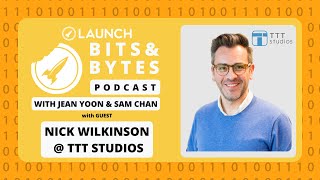
This YouTube episode (season two launch) features host(s) re-starting in-person shows and includes a food segment showcasing a Taiwanese beef roll from 'Uncle Skewers.' Guest Nick Wilkinson (director of project management at TTT Studios) discusses TTT Studios (a digital innovation studio building custom mobile/web/desktop/Unity apps), his responsibilities leading delivery and a PM team of about three, contrasts between project management and product management, and emphasizes PM skills are largely coordination/people skills rather than deep coding ability.
Questions this video answers
Director of Project Management.
About three people.
Taiwanese beef roll (pan-fried scallion pancake with slow-braised beef, cucumbers, hoisin).
Uncle Skewers (not a sponsor).
Chapters
Hello, everyone. Welcome back. We're finally back for our season two launch and exciting news. As you can tell. For those that are listening in, we actually started to come back to our in person shows. So actually, as our very first special guest to launch season two, we have Nick Wilkinson from TTT Studios with us today. Nick, if you want to just say hi to the camera real quick.
Sure. Hey, everybody. Thanks so much for having me here. I'm super excited to get into the discussion. And also the food here looks pretty amazing.
Yeah. So for those that are just kind of tuning in over our audio podcast. So today we actually brought in a food element. So this is going to be kind of something that will be going on throughout the rest of our season. And for today's feature, we have a dish called a Taiwanese beef roll. Yeah. So if we just want to pan in on the beef roll. So for those that may not be familiar with this dish, it is essentially a pan fried scallion pancake and inside it is rolled with a slow braised beef, cucumbers and hoisin sauce. Usually a lot of people enjoy it because it has this crispy, sweet, savory taste to it. It's one of a very popular snack for breakfast, lunch or dinner. You can actually find it in a lot of Taiwanese restaurants around Vancouver as well as back home in Taiwan.
I feel like we're a little bit on the food shopping channel over here.
Yeah, well, this is just one of the interesting dishes that are part of the Vancouver multicultural city. So I think food is really a great way to kind of describe how multicultural Vancouver is. But yeah, so we're actually gonna try out these dishes.
So yeah, everyone, she's about to say, everyone dig in. But then she realizes she's on a podcast and she can't say that. So if you are listening to this on audio and feel free, Nick, give it a shot. Do check out our YouTube channel. We'll make sure we'll give the links in the description below. Above. Sometimes it's above. Everybody always says below though. But yeah, check out our YouTube channel and then you can kind of see what we're actually talking about. If you're on your drive home, you're probably starting to get hungry as. As my partners in crime next door next to me kind of dive in. How's those first bites? They are speechless. So I will just continue rambling as they just. I guess it's good, right? Because like, otherwise it wouldn't be like this. We didn't need the garbage can nearby.
It was definitely not like the last episode where we had the garbage can on standby. For those that missed that episode, we had the launch team join us to do the bean boozled challenge. So we had jelly beans ranging from rotten fish to dirty socks and barf.
Yeah. This is a significant upgrade for the season.
I really appreciate it. Thank you.
Yeah. Have you had this before?
First of all, Nick, I've had it before, but not from this restaurant. Okay.
I missed the name of the restaurant. Who are we pumping today?
It's called Uncle Skewers.
Uncle Skewers? Are they sponsoring us?
No, unfortunately.
Okay. No, they're not sponsored. Forget it. Forget about Uncle Skewers. But I mean, how's the beef roll?
It's delicious.
I love it. Nice. Nice.
I was expecting this to be more like a fear factor challenge where I was gonna get like scorpions or something. So this is fantastic.
Yeah, I think Gina and I talked about it and like, she wanted to be kind to you. Cause it's your first time on the show and we want you to come back. I mean, when it was just me, she had me eating, you know, sock flavored jelly beans, but a little bit better than that. But yeah. I mean, now that we've kind of kicked off the food, why don't you just tell us a little bit about, you know, your past and how you got involved with obviously, TTT Studios. We've had Krist on in the past.
Yeah, for sure. So at ttt, I'm the director of project management. And so what that means is I'm responsible for basically delivery for all of the client projects that we have. So what ttt, who we are is we're a digital innovation studio. We make custom applications for mobile, web, desktop, unity. We're getting into a lot more now. We do end to end development, basically starting from working with a client. When they have an initial idea, they want to figure out what can we do with them. So we help them solve problems all the way through to actually writing the software and delivering that to them. In my role, I'm responsible for the team that manages those who actually do the work. Um, so it's a lot of like project management kind of fundamentals. And I've got a team of about three people who I manage, which is really exciting. When I first started, I was the lone pm and that was. That was tricky balancing everything on my own. But now I thankfully I've got this team and yeah, it's a ton of fun. I really enjoy working with the whole team. Chris is fantastic.
It's Are we paid to say that? We do like Chris. We do like Chris. One of the questions I have right off the top of my bat is because I think people use the word pm, they kind of throw it around pretty regularly. Obviously you deal with different projects. There's also something called a product manager. Can you kind of just for maybe those that are looking to dive into tech, like kind of just explain a brief difference between the two?
Yeah, absolutely. So we also do a bit of product development as well. So we have a need for experience on both sides of that. So project management really is about kind of a limited time initiative, like something that has a beginning, middle and end that you then deliver. So there's typically a bunch of steps that you need to do in order to make that happen in terms of like on a compressed schedule, looking at like what the risks are going to be involved, figuring out your timeline, your schedule, budget, and then trying to fit the scope of work into the different constraints that you have. And then it ends with a product, it doesn't really ever end. It's just an ongoing cycle of things that you try to keep improving over time. So it's a different set of skills that a product manager would need.
Yeah.
And they tend to also be a little bit more higher level because often there isn't a client involved. So it's a bit more strategy looking for, like, what does the client really need? Sorry, not the client, but what's the customer really need? What features should we be folding in? What's the priority of those features? Getting more data, things like that, where the project manager is much more focused on just the execution of getting done what the client's asking for.
Fair enough. Yeah. And like just talking about like skill sets, I guess the first elephant in the room question is like, how technical do you have to be to be. Let's, let's focus on project management because I think that's why we're here today. Yeah. Like for people outside looking in, like, what are some of the skills, some of the experiences that they need to kind of get into those roles.
Yeah. So first, a lot of times people think that you need to be a developer to be a project manager, and that's absolutely not true. So I happen to know a little bit about how to develop, but I'm by no means like a professional developer and that helped me kind of give a bit, get a bit of insight into what the experience is as a developer, but I don't need to know the details and ins and outs of that to be A project manager. Gotcha. So the skills that I try to bring to the table are more around the soft skills and hard skills about just the management of the project itself. And then trust that I've got experts who know how to do all the technical architecture and the development stuff and also on the design side as well. So, yeah, sometimes people think that I need to take a bunch of coding lessons to become a project manager. Not true. It's really more about working with people and coordinating and understanding that part of it. Like how to manage people.
Yeah.
So I have a question then. Did you go to, like, any formal schooling to learn, like, kind of like product manager or, sorry, project manager skills? Or was it just kind of like a buildup of experiences and opportunities that kind of led you to this position now?
Yeah, it was all completely by accident. There was no intent behind my career whatsoever. I started in engineering at UBC because I wanted to be an engineer. And over the course of the different experiences I had, it was only really in retrospect that I looked back and realized, wait a minute, like, most of this has been project management. So I didn't start in software, I was starting in manufacturing. So I was designing things and then getting them built, like physical things. And then that moved into logistics later on and then some consulting and then ultimately software. And it was really, again, only in retrospect, that it was.