Mellissa Kwan, eWebinar - Founder Journey Series, Episode 3
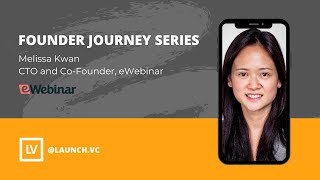
A recorded interview (Founder Journey Series) with Melissa Kwan where she recounts her entrepreneurial path: starting with Flatworld Applications (mobile apps for real estate), pivoting to Spatio/Spacio (iPad-based open-house lead-gen), which was acquired in January 2019; then founding eWebinar — an automated webinar SaaS combining prerecorded video with live chat and timed interactions — to automate repetitive demos and trainings. The conversation covers challenges of entrepreneurship (funding expectations, defining personal success versus VC-driven benchmarks), work-life balance (living and traveling between New York, Vancouver, Amsterdam), the timeliness of automated webinars (COVID acceleration), practical founder habits (GSD mindset), and advice to build a company aligned with the lifestyle you want.
Questions this video answers
January 2019.
October 2020 (discussion references 'we are in October 2020 right now').
Around 2010–2011 (she says she's been an entrepreneur 'over nine years' and 'maybe 2010, maybe 2011').
Chapters
Today on Founder Journey. When do you know it's the right time to quit your job, to pursue your entrepreneurial dream? And when you do, how do you deal with rejection? How do you deal with people telling you that your business is never going to be big enough, it'll never scale? Or maybe that you're not good enough to run this company?
3, 2, 1.
Hey, everyone. Really excited to have Melissa Kwan joining us today. Melissa and I actually met probably eight plus years ago when we started Launch Academy. Her company, Spacio was actually.
It was Hack Hut. It was not Launch Academy. It was Pre Launch Academy.
Pre Launch Academy. A lot of people don't know, but the original incantation of Launch Academy was Hack Hut. But we'll get into that another day. But tell us about the company that you started with and where you are today.
Actually, when I met you guys at Launch Academy, it was almost. We were starting to go to these meetups, remember, like there was nothing in Vancouver. We would meet up at a restaurant.
Bar. Restaurant, yeah.
And just hang out and chat. And there'd be like maybe 30 or 40 people every Friday. And then that morphed into Launch Academy or Hatcut, and that really brought the community together. And when I met you guys, I had a company called Flatworld Applications and we built mobile apps for real estate developments. So instead of walking to a sales center, which everyone in Vancouver knows, getting a paper brochure, we were the iPad interactive broker brochure for that and context.
This is 2012, or actually 2011. 2012, right.
I think it was earlier than that because I've been an entrepreneur for over nine years, so it must have been like 2010, maybe 2011.
Yeah. So the real estate market again, trying to jump into mobile and putting stuff in apps that was all new to them. And so you were breaking some serious ground here and trying to change an industry.
But I struggled with that. Right. Like, I think it's. It's really hard to be in a city that, like Vancouver is. Is vibrant and it's innovative, but it's not big enough. Right. So it's not like New York, where it's really the real estate capital of the world. So it was hard because I was creating something that wasn't typically on a budget and I had to convince someone to invest in something that is not on their Excel sheet. So that company was okay, but it turned into an agency model where we didn't raise any money and everything was self funded. I was funding a lot of it and we said yes to a lot of things. That we shouldn't have. And what started as a product ended up as a custom app. I think that's a familiar story to a lot of people.
Yeah. And I think a lot of our audience that are listening, they're not in New York, they're not in the Bay Area, they're in cities around the world that are just not big enough or not advanced. And so this is probably a common story that a lot of people are faced with. But you persevered and you overcame that and built into custom app. And then. So Flat World. Did Flat World morph into Space IO or Spatio?
I remember those days when I would dig for hours and hours and hours on LinkedIn to find another developer to call. Like real estate developer to call so I could pitch them this product. There was one day I looked on LinkedIn for so many hours that they locked me out because they thought I was a bot. So like every day I would look for new leads to call the next day and I would just set amount. Like I would set a few hours aside every day to find new leads. And I remember the last cold call I made. I'm like, this cannot be my life. Because you know the agency model, right? Like you sell a product, you get an invoice, you sell another product, you get an invoice. Right. So it was kind of a rat race. Right. So I realized that I needed to build a product that we could sell to everyone instead of having this like custom apps that we sell to one person at a time. So that company morphed into Spatio, which is. It still is. That company was acquired, but it is an open house lead gen system. So walking into an open house instead of checking in on a piece of paper, we were the iPad check in for that. So I was already in the industry. So it was just kind of innovating within the industry that I already knew.
Okay. And a bit of context for audience. So Spatio did get acquired. So this was what, 2019?
It was last year? Yeah, 2019, January.
And you were able to exit out or are you still part of the company or how does that.
So that's always an interesting story, right? I mean, personally, I was just spending so many years in real estate already I was ready for something else and the acquirer knew that, which was nice because I didn't have to pretend to be someone else and something else that's to sell the company. But I did have a two year contract with them, which is pretty common in acquisitions. You want to make sure that the company merges and the team merges and the system merge well, and that would come up next January, but I negotiate a bit of an earlier exit. So since July of this year, I've transitioned into a consulting role to kind of oversee the rest of the rest of the acquisition. And I'm slowly kind of on my way out.
That's awesome. The hustle never ends and now you're onto a new project. E Webinars. Tell us about that. Tell us about the industry.
Yeah. So e Webinar I started two months after Spatio was acquired. I went to my CEO at the time and I said, hey, like I have to do something else. Like, I think an entrepreneur, you never stop being creative, right? Like you're an entrepreneur because you like making things or you like taking risks or you like discovering things. Yeah. And that doesn't really go away. And I think as a fellow CEO, like he really understood that as well. And he also knew, like, if he said no, it would make each of us very hard. And E Webinar is interesting because it's a product that I wish existed when I was selling Spatio, like selling the products in Spatio. So what ewebinar is, is it's an automated webinar solution. So it saves people from doing the same presentation over and over again by combining a video with live chat and real time interactions that you can program that pops up at different points in time. So when I was selling the Spatio product, It was a SaaS product and I was constantly doing these demos, trainings, onboarding, sales pitches that were all exactly the same. So all these years I wish there was a product that would alleviate me from the computer because I was just, I was traveling a lot and I was just constantly tied to my computer. So after Spatio was acquired, I knew this was the problem that I wanted to solve. And it was something that I could see a lot of my friends and a lot of my peers lived with as well. So it was something that I didn't really wait that long and just started shortly after.
And did that just get amplified like 10x because of COVID and now everybody working from home and not being able to do these in person meetings.
Well, I think it's interesting, right, because I think the problem existed before already. Like otherwise I wouldn't have experienced it. I'm not the first person to do it. I'm committed to be the first company to do it. The best out of all the people that are out there. But it's interesting, right, because the industry is such that they're so focused on live broadcast, like Zoom Gotowebinar. Like, all those solutions are what we call live broadcast companies. And yes, as people are thinking about the future of work, being able to work from home, not wanting to commute, as people are looking to outsource, those solutions have really taken off, I would say in the past three years, as we can see, you know, with Zoom, like, zoom has become like a household name now. I would say automated webinars is still not quite there, but that's why I chose to do it, because as people, as people get more zoomed out, as you would say, like, what's the next step? Right. Like, it still requires a lot of time and energy. Right. Like it still requires you to, you know, put your face on. Right. So, like, what's the next step of automating the Zoom? And that's a problem I wanted to solve. But what it looks like, I think is, oh, it's so timely. Right. Because of the pandemic. But I started this a year and a half ago. But that's what it takes, right? Like, yes, it is timely, but whatever you decide to start today, it will take a year, a year and a half to get out the door. So what other people see as timeliness is maybe it's just luck.
Yeah, I'm actually working on this whole new blog series called the Two Year Build. And it's two years before you build something that you actually know is gonna be worth quitting your job about.
Yeah, I'm actually surprised when people tell me that they start generating revenue within six months. Like, that's something I wish we could do. I guess there's like so many things that you can do.
I think a lot of times people don't capture the six to eight, ten months prior to that that they were still toying around with the idea. It's more like, when did I start taking this serious? Or when did I quit my job and then I was able to make revenue in six months. Well, yeah, but you still worked on it part time on the side of your desk for six to eight months.
Well, the crazy thing about, the crazy thing about E Webinar is of the past few years that I was living this problem. I told you so many people to build an automated webinar solution. Like, anytime someone had, you know, an acquisition or they were looking to do something, I would just give them the idea, like, do this. But I guess that's how the world is, right? Like, that's like people have an idea and they're so Scared of telling people, like, ideas are diamond dozen, but execution is hard, right?
But that's also one of the problems that a lot of people have is they don't listen to the pain points of people and they've got this preconceived idea of what they want to do. But you were right there vocalizing, I've got this pain. Please solve this for me. But it took you getting acquired to step up and do yourself right?
But starting a company requires so much more than wanting to solve a problem, right? Because the world has so many problems for many people to solve. Starting a company is dedicating the next five to ten years to it. So if you don't connect with that problem, if you don't understand it and if you're not truly passionate about it, like, of course you're not going to go and solve it, right? Like, it's going to be really hard. So I get it. But it's just comical because now I'm doing it, everyone's like, oh, my God, how did you think of it? It's like, well, I told everybody for years, not even for two months, like, I told everyone for at least three years that this is what they should do.
That's actually a good segue for us to break away from e webinars in the industry. And I'll talk about you as an individual, your founder journey. What are some of the obstacles that you had to overcome, challenge that you're faced with, and just realizing for yourself that this is entrepreneurship is what you want to do and can't get away from.
Well, I think until a person realizes this is what you can't get away from, you don't quit your job, right? So I think the moment you realize I'm going to quit my job and go into this full time, like, you've already made that decision within yourself that you can't not do this. Like, you'll wake up every day being bothered by the fact that someone else is doing it and you're not doing it. And, like, I don't think somebody wakes up and, like, realizes they want to become an entrepreneur. Like, I think it's just inside, it's just who you are. Like, there's a voice that keeps telling you, right? So, I mean, I think that there's many, many obstacles. Running out of money. Like, I don't want to talk about that because everyone runs out of money. The one thing that I really had to overcome, it took years to overcome, was understanding that I get to define what success is for me. Right. Like that's really important because it doesn't matter where you are in the world, whether you're in Vancouver or New York or some smaller town, if you surround yourself with a community that is building companies and doing startups and ambitious, you are almost, you're almost programmed to think that success is what other people think it is.
Right.
Like I like to say a lot, like the media skews your idea of success. Like they only cover people that raise a ton of money, raise money From All Star VCs, cover companies that had big exits and you think that that's what you want.
Right.
Like when you go and do something.
Benchmark, if I haven't raised money from a vc, then I haven't made it yet because that's what everybody else is talking about.
Or if you don't want to build $100 million company or billion dollar company, oh, it's okay, you're just not ambitious enough. You just want to build a lifestyle company. Like, what does that mean, just a lifestyle company? Like for years I was like not, not offended, I guess, but I felt bad when people told me that my company was not scalable or it wasn't big enough or I wasn't going thinking big enough making. And then I was feeling like I wasn't good enough or I wasn't ambitious enough. And then I moved to New York. Right. Where all of that was amplified. So every single day your peers are raising money, closing rounds, like appearing in the media, you're not. So when somebody asked me back then, like, oh, what can spatio be? Where do you want to take it? I told them an answer that I didn't authentically believe. Like I told them something that I thought they wanted to hear because I wanted them to think I was good enough, that I was also successful. Right. But then I realized between Xero and Unicorn, there are so many lifestyle companies that give many families amazing lifestyles.
Yeah. And that's one of the things I get pissed off about is because a lot of the people that are telling these entrepreneurs, oh, you're not thinking big enough, you haven't achieved this milestone of a VC venture or these type of Fortune 500 clients, that entrepreneur is most often not more successful than the person that's telling them that they're pulling in more money into their bank account each year than they are. And yeah, like a lifestyle business is bad, it's just a bad connotation. But it doesn't mean that it's a bad business or a bad lifestyle.
But it's that connotation. But I think for an entrepreneur that's new, or maybe even not new, right? For entrepreneur that's so submerged in that community, like, it's easy to feel that way because everyone's telling you you should be more. Why aren't you more? And then they're telling you that if you don't think this, you don't get validation from an investor, right? And then I realized, like, I was suffering because I was pretending to be this VC investable entrepreneur that I didn't even care about, right? I didn't even want to run my business anymore, but I was doing it because I thought that's what I needed to do. And when I realized that, when I was comfortable saying, actually, I don't want to raise any money, I don't think this can be even a $10 million company. In fact, I don't even want to take this company to that next level. I think this company that I'm building right now is actually better off as a part of a bigger conglomerate because of the space that we were in. And it wasn't until I had the conviction to admit that, that I would say probably 80% of my stress went away because then I was just building my company for me. I was no longer doing it for someone else.
Would you say that that put you in a very different mindset and you were focused in a different way and executing a different way?
Well, yeah, because I didn't. I wasn't down on myself if I didn't close 200,000 this month, right? Like, I wasn't. I wasn't kicking myself if a VC came to me and said, oh, we wanted to talk to you, but then we realized that your company's just not going to be big enough because they do that all the time, right? It doesn't cost them anything to do that. And to your point, like, a lot of people that are giving this advice, including venture capitalists, have never done it themselves. What do they know? They just know it from the textbook and their peers and this herd mentality, right? So I think the biggest thing that I had to overcome was to be comfortable and happy with. With the business I wanted to build and be true to that. And I think a lot of entrepreneurs, especially new ones, should. Should really think about that, right? Especially guys that are thinking about raising capital. Like, ask yourself, why do you need it? Or is it because you want someone else to think you're successful.
With this shift and this new mindset, like, how did that affect other aspects of your life than Your business, like, work life balance. Like, I know you started in Vancouver, you moved to New York, and I know you moved to Amsterdam and then back to New York and back to Vancouver, and now you're back in Amsterdam. So with this new vision and this new self confidence, like, how has this shaped your work life balance?
Well, I think before realizing that, I was always like, a little miserable. Like, I didn't really know it because it was just life, right? Like, you hustle, you go to meetups, and you try to pitch people all the time, like it was just part of your life. But I guess the biggest change was I no longer cared about what other people thought of me. So I was just happier and I didn't care about pretending to be bigger than I was. And then I started noticing that a lot of people around me was telling a story maybe they didn't believe. Like, you know, and people don't like to talk about their struggles, right? It's like they don't want to talk about feeling like that.
So take a step back. So when you were able to notice other people, was that more of a bullshit radar going off and calling bullshit or sympathizing and realizing, oh, that person's not happy or.
It's not that. It's. It's not that they're not happy. It's like you can tell when someone is telling a story that's not authentically themselves. Like, it's, you know, it's what you're, you're. You're pretending what you're supposed to. Yeah, exactly. Like, you're. You're taught to pitch all the time. Every pitch you go to that person tells you to pitch a different way. So then you try it, right? Like, you go out and you try it and you see how people react. Like, people do that. So it wasn't so much like a bullshit radar. It's like, it's just realizing that a lot of these conversations were no longer that authentic, which is fine. Which is like, why a lot of people go to New York. And I think that served me really well. But I think it allowed me to stop caring about what other people are doing, and it allowed me to focus on figuring out how I can be happy with the tasks that I do every day versus, like, competing. There's always, like a little bit of competing happening, right? So it's, it allowed me to be more aware of that and then just rid myself of it.
And then what brought you to Amsterdam?
So speaking of work life balance, I never had any. Like, when I met you, I was just, I was struggling for many years. Like, so many times, like, we ran out of money and I would get a tax return, I would try to patch a hole and then someone would pay us and I would patch another hole. Like, for years I was doing that and I was just exhausted. And luckily we came out of that. And I didn't have work life balance because I didn't have the luxury to like, I was just constantly in survival mode. So I was aware of that. But I made myself a promise that if Spatio ever broke even, I would start to think about myself, like, and my wellbeing, because I was just spending so many years trying to figure out how to pay other people's bills. So about three years ago, when Spatio started to do better, I woke up one day and I asked myself, like, if this is going to be hard for the remainder of this company, like, what can I do for me? And the answer was, if this was going to be hard, I was going to build this company from anywhere I choose. And I was already at that point paying so much money for rent in New York and also traveling. So I decided to give up my place in New York and just travel full time. And I did that for like, probably a little over two years. And Amsterdam was one of the cities that I kept coming back to love the people, like the party scene, the music scene is really good. It's super international. Everyone speaks English. It's like a plane ride and a train ride everywhere else. And after I kept coming back, I was just like, maybe I should just live here. And yeah, so moved here in September.
Of last year and we are in October 2020 right now. So some people that are watching this, it might be posted later than we're actually recording it, but how is Amsterdam right now with COVID and everything else that's happening in the world?
What's funny is I had a 10 day trip in Hawaii planned in March. So we actually left Amsterdam, we went to Hawaii, got stuck there, we ended up staying for three and a half months and. And then we went to in Hawaii and then we went to Vancouver for another three months. So I actually only got back two days ago.
Oh, wow.
So ironically, we got a place so we could stop traveling and then because of COVID we were forced to travel. So we haven't spent a ton of time here. But I got here two days ago and frankly, it's strangely normal. But that's probably because that's probably the cause of why the numbers are just like skyrocketing. Right now I think we're at like 3,500 cases a day, and then France is at like 15,000 a day. So it's like going through this second wave. But there's, for some reason the death rate is extremely low compared to April. They can't figure out why. So they think maybe did it evolve into a different strain? Like, nobody really knows.
Yeah, I think there's a bit of COVID case around the world, right? Yeah. Yeah. So let's move off of COVID I want to talk about the gsd, the get shit done attitude. And this is actually more poignant to what you were just saying earlier about being forced to look at building a venture backlog business and then really having to hustle and pitch all these times. A lot of people might have that misconception that, okay, if you decide, okay, I want to focus on a lifestyle business, you no longer have that GSD attitude and you're coasting. That's definitely not the case. So what does GSD mean to you? And how was that reflective in you once you made that mental transition into focusing on yourself and doing what makes you happy?
Yeah. So it's funny that people think that, right? Because if a non VC investible company is lifestyle business, then that means any company that's not a billion dollars is a lifestyle business. Do you know how amazing your life can be if your company is pulling in 20 million a year, even 10 million a year if you're running a small team, if you're not forced to hire, have a really cool office, forced to expand? Do you know how high your revenue per employee can be? Yeah, Like, I mean, that's an incredible business. And especially with the tools that we have now where you can hire anyone anywhere in the world, like, the cost to start and run a business has never been lower. Right. And like, it's never been easier to find talent. They're everywhere.
So, yeah, like, not just talent, it's also customers using webinars to reach out around the world and do sales around the world. It makes it a lot easier to do it today.
Exactly.
Like, and you own more your company without VC backing.
Think about mailchimp. Like, I don't think they raise venture capital, like, how big they are. Right. And like, is that a lifestyle company? Like, I mean, they must be pulling in hundreds of millions a year. Right. So I think, like, I would. If anyone's listening now and thinking, oh, lifestyle company means like a restaurant, like, I would challenge you to think about a lifestyle company as something that is smaller than A billion to get to that point.
When you talk about restaurants. So I own restaurants for 10 plus years. And when I went into tech and I kind of came in the same time you did and got a lot of this pumping up of certain people in the industry and need to be venture backed. But I look back 10 years later and a lot of those people that were giving me that type of advice, I was actually outperforming them as a restaurant owner than they are as this consultant or VC or whatever.
But it's hard. Building anything is hard, right? Like, before you get to a billion, you have to get to a million. Getting to a million is hard. Getting to 5 is hard. Getting to 10 is even harder. And then I think it starts to. I've never experienced it, but from what I've read, it starts to get a little easier, right? Like the GST attitude never stops. Like, I think like, just as an entrepreneur is just who they are. Like working hard and making sure you execute is just, just who you are. Like, you don't really become that. And I think the challenge is like, I think the parallel to working hard in GSD to what we just talked about is not being affected by other people telling you you're not working hard enough. Because that also happens, right? I remember being in New York, I had a co working space because I didn't know a lot of people. So I put myself in a space where I can meet more people. And I remember, like, we were just building the Spatial product and I didn't have a lot of stuff to do. Like, it was more like we were trying to build a product that I can sell because I've been in sales all my life. And I remember a friend of mine was like, how come you're CEO and you just, you're just always walking around like, how come you're not doing anything? And I'm like, what do you mean? Like, there's nothing really I can do right now. I'm just waiting for the product to, like, I've done everything that I could. And his response was, oh, well, you know, if I was CEO, like, I would have all this stuff to do. I would have. Like, I'm just so busy myself. And I remember thinking, like, why is this person making me feel bad for being effective? Like, in fact, like. Like there's this, you know, this hustle porn stuff that I don't really support, right? Like, just. Because if you're working a lot and many hours, you actually need to reevaluate why you have to work so Much like, out of, like, I don't know, out of a day, I maybe work, I think, like six or 10 hours, but I choose my own time. So it's like half an hour here, two hours here. But I don't let anybody tell me that I'm not working hard enough. And that also happens. So the challenge that I have now, because when you start a company, there's endless things to do, is to be okay at the end of the day, knowing you did your best, because it's easy to fall into doing a lot and then not feeling like you're productive. There's always more work. So GSD to me, 10 years later means, like, being at peace and being okay, that everything I did today was the best I could have done and to not feel bad about it and just watch some tv, go to sleep, and start over.
But a lot of that comes with experience. Like when you were on your first startup, there's a lot of things that you didn't know, and so you spent a lot of time online reading or talking to people and learning. Whereas when you're on your fourth or fifth startup, you already know that stuff. And so you know how to mitigate challenges or opportunities and manage your time more efficiently. And then get to the point where you are now in life, where you understand that there's more to it than just sitting at your desk and pounding away. You have to enjoy life and balance it out.
Well, that's why a lot of this, you can say as much as you want, but you can only learn through experience. Right? And luckily, because of technology, because of, you know, because we have communities, you know, like the ones that you're building. Like, we have these resources. We didn't have these resources 10 years ago. We didn't have like a Y Combinator or techstars. Right? So I think if, like, anyone that's starting a company now or even within the last few years, like, they're super lucky to have all this stuff and just knowing it and hearing this conversation is not enough. Right. A lot of it, you have to. You have to learn through experience, but at least once you've heard, heard it, you're more aware of yourself, right? You're more aware of where you are, and you can make those changes. Like, a lot of the stuff that we have to do, we have to figure it out ourselves. Right? But at least now, you know, like, you can choose to make that change.
Yeah, that's exactly why we're doing these Founder Journey series, is you can't learn these things. From a textbook, but you can hear them from other founders and understand what they've gone through. So that when you are personally faced with it, there's some referenceable material or thoughts and logic that you can try to leverage. But it will never be the same as another founder's journey. You have your own journey that you're on.
Yeah.
It's kind of a good breaking point for us to start to wrap things up. I want you to tell me about one app or one tool that you as a founder cannot live without.
Yeah, I would have to say Slack. I know that's really cliche, but I'm on multiple workspaces and especially if you're founding a company now. What I, what I'm seeing more of now are communities built on Slack. So like Cloud Software association or like communities in the Bay Area built on Slack. So as much as I don't want to be on Slack that much, like it's, it's where communities are living now. More than just your own team.
Yeah. But it's allowed you to build the type of business that you want because it functions the way it does.
I can't even remember what it was like without it. I remember like it was like WhatsApp and then maybe messenger and maybe Skype.
Yeah, no, no, that's a good one. I love Slack as well. And especially for people that travel and are building global businesses, it really does make running your business that much more efficient.
Yeah, for sure.
And now, last bit of advice for entrepreneurs new and old. We've got a kind of a wide ranging audience. We've got people that are jumping into entrepreneurship for the first time straight out of high school, straight out of college. We also have other entrepreneurs that are leaving their nine to five jobs to pursue something new and tackle a challenge or a problem that they're really passionate about. What's your advice for being an entrepreneur in today's world?
So my top advice, and it's just something that I was able to do myself. Before you do anything, before you start a company, ask yourself, what kind of lifestyle do you want to lead? Not what problem you want to solve. What kind of lifestyle do you want to lead? Because whatever you get yourself into, it's the next five to 10 years. And if you're not building a company that fits your lifestyle, you're going to suffer. So if you focus on having a great lifestyle first and setting all those things up, then everything around you, including your company, is going to thrive as a result of you being happy.
That's awesome advice. It is a long term commitment. You have to be dedicated towards it and you have to make sure that the people that you surround yourself understand that and are willing to accept that as well. Not just team members but family members as well.
Well, my first business I actually built because I thought I needed to solve a certain problem and I ended up suffering for it. So definitely think about like what kind of life you want to build first.
Awesome. And then as an entrepreneur, we want to close this out by giving you a chance to give out a call to action. What do you want from our audience? What can our audience do for you?
Yeah, if you or someone you know can take advantage of E webinar please let them know our website it's just ewebinar.com and again what we are is we're an automated webinar solution. We combine pre recorded video with live chat and real time interactions to deliver an engaging experience for attendees every single time without the host being there. So where we have the most impact is with customer success teams that are doing demos and trainings with sales and marketing teams that use E webinar as a top of the funnel lead gen products and also for recruiting teams that are always trying to recruit new agents like real estate or financial companies.
Yeah, I really see a lot of lot of applications for U webinars. Even ourselves we've been looking at and trying to figure out ways that we can integrate into our workflow and sales process.
Yeah, let us automate and clone yourself.
Yeah. I don't know if people want more of me out there, but they're gonna get it.
I do.
Awesome. Melissa, thanks for taking the time. I know it's late in Amsterdam right now as well, so really appreciate you being flexible with your hours. This is Melissa Kwan, founder of E Webinar and a great entrepreneur that we hope you will like and follow.
Thanks so much for having me.
Launch. Ventures is for entrepreneurs by entrepreneurs. If you enjoyed today's episode of Founder Journeys, please like share, follow and check out our link in bio for all the other good stuff.
More from Ray




A Founder's Story. Creating the World’s First Laundry Robot — Joshua Rabanne, Laundrx

Bits&Bytes with Sherry Li, Assistant Professor at Berklee, Co-Founder of ICTUS Audio

Why This Young Person Left Child and Youth Care To Work in Tech - Bits & Bytes with Samson Li




