Accelerate Your Business Value, Sell Your Business |Stephen Cummings
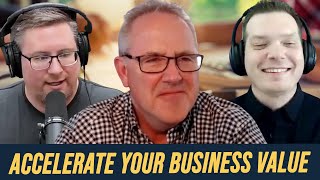
Stephen Cummings explains why most business owners fail to sell. About 80% of owners' wealth sits in their business, yet 75-80% of businesses brought to market don't sell. Starting planning 3-5 years ahead and assembling the right advisors—financial, legal, tax, investment banking—dramatically improves outcomes.
Chapters
The preparation to sell a business is a complex matter. Building value, as every business owner will know, is a complex matter and therefore it does require professional assistance to execute. There is a team of professionals that needs to be brought together to help business owners in various respects. We want to see that the business owner understands what he needs to achieve from an exit. He needs to understand that very well, given that typically 80% of his wealth is tied up in his business. 80% plus. So it is pretty much the largest asset that a business owner has and needs careful handling.
Why business owners and private companies should be ideally positioned to be attractive to third party buyers we are honored to be joined today by a very special guest, Mr. Stephen Cummings. And Stephen is the managing partner of Resolve Partners, which is a niche business advisory firm dedicated to helping business owners envision and drive growth and optimal value for their company. Now we'll invite Steven to share some things about his background and what has, you know, his path, his journey to what he's doing for business owners here currently. And we're going to have a great discussion. And so welcome, Stephen, to Wealth Without Bay Street. It is a pleasure to have you. Thanks for being with us.
Thank you very much, Jason and also Richard. Great to meet you both.
I think a good place for us to begin would be to maybe share a little bit about your organization. And in addition to that, what are some of the common pitfalls that you see when you're dealing with business owners or private companies who are looking ahead and thinking ahead about being attractive to a third party buyer?
Well, thanks for that question, Jason. So as you say, I'm the managing partner of Resolve Partners. It's a boutique firm. We have specialist partners in different disciplines who can help business owners with their challenges in particular areas. Just before we get onto the specifics, just as a placeholder for everybody, my background is as a financial expert. I trained with Deloitte many years ago and trained and qualified as a chartered accountant. So I'm a CPA in Canada. And following that I became the CFO of a large multinational company. Harlequin Books used to sell many, many books, 185 million around the globe. But I got deep operational experience with from that position. Further to that, I became a partner in a leading venture capital firm here in Toronto and subsequent to that I was a partner in a private equity firm. So I've had experience both operationally on the side of the table being the right hand to the CEO, but also I've sat around the table as a partner, as an investment in an investment firm putting millions of dollars into investee companies to grow them very rapidly. So what I wanted to do on the back of that experience was form Resolve Partners specifically to help business owners in their growth and their growth challenges. And the prime mover for that was some of the demographics that we see at large today that directly affect business owners. So 2/3 of business owners in North America, 2/3 of business owners are own private companies. And many of those business owners are baby boomers. And the average age of a baby boomer today is 65 years old. And so the preparation to transition their largest asset, the company, the business, is becoming more and more important for the wealth of those businesses, protecting the wealth of those business owners. And so we are aligning with that demographic need to help business owners grow value and prepare to sell or transition their companies, depending on, depending on their plan. One of the shocking statistics which your listeners should be aware of, and I certainly was not aware of until I did the research, is that over 75 to 80% of companies that are brought to market do not sell, which is a horrible statistic. There's many underlying reasons for that which we can go into later. But one of the prime things that business owners can do to address that is to start thinking about the planning for that transition position a lot earlier than they otherwise would do. There is certainly value attached, absolute value attached to planning early. And we can go through some of those things. But planning really does drive value. I'll give you a simple example. Some of the tax efficient strategies attached to selling your business have time bars on them. And if you go to a top line lawyer, they will recommend some strategies provided you have the time that need at least two years of a gestation period to be in place in order to be effective. So you can start to see that when time frames like that are on the table, you know, being able to plan what you need to do in order to capture some of the, some of the value that can be on the table needs a length of time, at least as long as that, if not slightly longer, depending on how much business value building you need to do.
Well, you know what's interesting is that on Amazon there are tens of thousands of books on how to start a business, but very few on how to exit one. And so having the right guidance, the right professionals, but recognizing understanding that it is a, it's a time frame, it requires proper planning. And the earlier that the business owner gets going on, you know, getting the right building blocks in place, the better. Because most often and Steven I'm sure you would agree when you're connecting with someone, it's hey, look, I've either had some interest expressed in our business and I'm ready to possibly negotiate a deal and this is happening in the next six weeks and you know, you're thinking, nope, it's going to take a little bit longer than that if you really want to extract the most value out of the deal and put your business in the best light to that potential buyer and not leave money on the table unnecessarily.
So just picking up one of the points that you made, I'm giving both of your background, you'll appreciate this. The sale of it. The preparation to sell a business is a complex matter.
Yeah.
Building value, as every business owner will know, is a complex matter and therefore it does require professional assistance to execute. And there is a team of professionals that needs to be brought together to help business owners in various respects. We'd highly recommend financial advisors like yourself to be around the table from many years prior. And the reason we like to see financial advisors in place is we want to see that the business owner understands what he needs to achieve from an exit. He needs to understand that very well given that typically 80% of his wealth is tied up in his business. 80% plus. So it is pretty much the largest asset that a business owner has and needs careful handling. We also like to see legal advisors around the table that they should be M and A legal advisors, not a general legal counsel. Absolutely can have a general legal counsel around the table, but you need a specialist M and a advisor in place. We also would highly recommend that a sales representative for the transaction is in place as well. If you in my terminology, that's an investment banker. It's a very specialist role bringing prospects to the table and creating a competitive environment. So we would highly recommend an investment banker be around the table as well and obviously an accountant who understands the tax affairs of the company and who understands tax from, from an M and A perspective. So the typically business owners have advisors around the table. It needs some tweaking towards the back end of a, of a business owner's life. And it needs specialists to be in place in order to help drive value through the transaction so that we, we get the right result.
Very good, Rich.
Well, I think it's interesting the statistics that you're sharing with us, Stephen, because the average age of the baby boomers as they're shifting through time, that glut chunk of the population as it's developing through, they're at the Stage, they've been told and instructed their whole life that it's time to look at shutting down. So we're going to see this massive exodus of people trying to get out or transition businesses either to the next generation or to someone who's able to take that business over. And as you identified that 75 to 80% of these businesses that are up for sale in some way, there's no buyers either available or they're not able to be sold in some way. And I think that's really unfortunate. It's almost a crime against these people who spent their lifeblood building this structure in this business. And so for those that are unable to sell, they're not able to get the exit that they're looking for. What do you find happens for them? What's the, what's the common demise of that business that people are going to experience as they look to exit it in some way? They still need to exit. So how does that happen?
Sure. Well, the first thing that needs to happen is a sensible appraisal as to what the options are available to business owners in the particular circumstance that they find themselves in. Some businesses are very well developed, quite sophisticated, and the value drivers have been worked on for many years. And many of the things that a third party acquirer is looking for are in place. And a Bay street firm can absolutely sell those businesses. However, there are other routes for business owners that are not necessarily in that place. For example, they could sell the business to other partners in the firm. They could put together an esop, an employee share ownership plan, whereby employees in the business over time buy an interest in the company. They could do a management buyout with the employees. And so there are various strategies that are certainly available to owners that are really speaking to the inside buyer as opposed to the outside third party buyer where the requirements are a little bit more stringent to execute a transaction. So that's certainly an option and is very commonly an option for business owners. The worst case scenario is that the business assets need to be liquidated and sold in the open market and the owner closes the door of the business and walks away with the residual value in that company. And that is most typically seen where the owner is a large representation of the assets in the business. It is the owner that represents the business. And typically there's not a lot of value in those types of businesses. And often that's the end result. And remember that certainly In Canada, over 90%, I think the, if you look at the statistics, probably 93, 94% of businesses in Canada are less than 10 employee businesses. And often the owner is, the business is very dependent on the owner and therefore it's very tough to sell for anything other than net asset value in the company.
And for, you know, business owners who are tuning into this episode and thinking, gosh, I'm curious, I'm a little curious. What is my company worth? What is that next step that that business owner should take to start going down that path?
Well, there's a, there's a number of ways that value can, can be assessed. There are certainly some pretty good software packages that can be readily found on the market today that by answering a number of questions, both quantitative and qualitative, an owner can get an indication of the value that his company is worth. Okay, so, so, so that, to me, what that does for owners is it gives a ready benchmark which should be used with caution if, if the owner is, is, is in need for whatever reason. There's a bunch of reasons why you might need about a formal valuation, but if he does need evaluation, we'd certainly recommend that if an owner is going to go through a, or wants to go through a transaction process, they should get a formal valuation. And certainly we do that at Resolve, but any of the large accounting firms would do that and there are specialist valuation firms as well. So we'd highly recommend that there are a number of ways of valuing your company. The most common way of doing that is a discounted cash flow approach and certainly evaluator can do that for you. But again, back to time frame, if there's more, if really the owner is intent on selling as soon as possible, then valuation should be attained and a broker should be appointed. And the broker or the investment banker will also confirm the range of value that is appropriate and also give you an indication of likelihood of selling the business, which is important given the probabilities. With a longer period of time, with more planning, there is a much, there's a much broader deep dive that can be done on the business maturity and on assessing the value drivers that have been built in the business. And that gives a much more operational understanding to the owner of where his business value lies and where his weaknesses are. And obviously we would highly recommend for a period of time leading up to when a business is brought to market, we'd highly recommend that weaknesses are either eliminated or reduced in order that when we get to the point where competitive bids are entertained or offers are made for the business, that they fully reflect the value that has been generated rather than focusing on the weaknesses in the business.
Yeah, because the business owner, for the most part, the ones that rich. You can attest to this, that we've interacted with and continue to interact with over the years, is that they just simply don't know where to begin. What professionals need to be advising me in order to really, truly understand, have I created maximum value in the business? Are there things that we could be doing that we need to begin implementing to make our business more attractive, whether it's for internal purchase options with team members or key people in the business, partners, et cetera, shareholders, or, you know, have I. Have I created a little more value than maybe I was aware of? And I need to. That's something that needs to be leveraged in the business even further to further maximize value. And so there's only a few ways that a business owner is going to exit the business. They're either going to sell or attempt to sell. They're going to wind up the business. They're going to get sick, they're going to die unexpectedly or experience a critical illness, whether it's cancer or something that, you know, takes, takes their, their life or in some cases disappear. I mean, we've all heard stories of, hey, you know, these four hunters went on this trip up in Alaska and they found all their gear, but they haven't found any of the hunters. And then anybody who's left in the business has no access to anything. They can't pay the people. They can't, you know, continue to operate it because there's no catastrophe plan in place. What do we do in the event of all of these, you know, probabilities? And so for business owners who are tuning in, even if you're just getting started, if your business is just getting off the ground, it's really important to be taking into consideration how to maximize value right from the inception of your company.
So, Jason, you raise a good point. So we'll just touch, touch on that. I'll give you another statistic which is equally shocking, but reflects the lack of preparation that many business owners have towards getting liquidity on their major asset in their portfolio. So when you think that 75 to 80% of businesses brought to market do not sell, another interesting statistic which is equally shocking, is that 50% of businesses that do sell are sold under distressed circumstances, which is the point that you raised. So let's just think about distressed circumstances, which is very real for business owners that are, should we say, more advanced in age, as we all are. So distress circumstances, as you rightly point out, is death in the worst case scenario, it could be disability, it could be duress, for example, marriage failure or problems with the partners.
Yeah, insolvency.
Divorce, disagreement and absolutely insolvency, obviously. But when businesses are hit with those contingent events, the prices that are achieved in the ultimate sale are likely way less than the number that is in their wealth plan. So their wealth is being damaged and materially hurt. So. But these things happen. And so part of the planning in advance is basically an insurance policy to protect the wealth that you built in order to protect against those unforeseen circumstances that just do come along. And it happens all too often, is the point here. And I'm sure you guys as financial advisors would be first to be continually counseling your business owners that these things happen and that we need to plan to transition. So that's what we certainly sponsor planning. We think that there's huge value to be had in the three to five years ahead of an exit. Let's just think about the exit though. So, you know, you often hear of these, these business owners that, that, that sell in two to three weeks. And it certainly is possible, it is absolutely possible, but it is the exception rather than the norm. And it is highly likely that if you sell within three weeks, there's a huge strategic reason for the buyer to buy or there's a heavy discount price to be paid to mitigate the risk of the very short term transaction timeline. Right. One of the. What I was involved in a fairly large transaction, most, most recently, it was millions of dollars. The transaction was executed perfectly from my perspective. And what I would tell you is that in order to execute a transaction perfectly like that, bring an investment banker on having all the documents prepared, the sales memorandum put in a data room together, having all the analysis available ahead of time in order that you can answer 90% of the questions from the buyers in due diligence, having prepared the management team for management presentations to the buyers when they come to visit the factory or the offices and so on. In order to do that, the minimum time, in my view, that a transaction can be perfectly executed is about six months. Six to nine months is reasonable because stuff always happens. It just does. So six to nine months is the length of time to execute a transaction pretty well. And then if you bolt on ahead of time, another three months to prepare for a transaction at light speed, you're really talking nine to 12 months is an optimal period of time. And that's fast. It is not. It often takes longer. And if you're building a planet, building in a planning Period ahead of that in order to. The reason for building in a planning period is to mitigate risks so that you don't get a price cut at the back end of the negotiation. Right? Or the other major thing for a seller, seller to focus on is if a seller has a selling price in his mind and if the selling price that he wants is not what the market will offer you. And frankly, owners need to be clear that Mr. Market is the dominant player in that conversation. Mr. Market is the dominant player, not what the owner wants necessarily. So if Mr. Market says that the value of your business is not what you want, then what you need is an advisor to help fill the value gap. An advisor will, at the start of a planning period, tell you what he thinks Mr. Market will offer you. And if there's a difference between what your value is today and what you need to get through the transaction, you need to close that gap. And that's what we call value building ahead of time, closing the gap to a zero price, a zero price difference. The other big thing that I just want to mention to business owners when they think about price is, is a couple of things. Firstly, we think about price versus what, what goes into your, the assumption that goes into your wealth plan price need. The, the, the check that you get at the end of a transaction process is, needs to be thought of in terms of the check number less tax, right? Because it's the net receipt after tax that goes into your bank account. So you need to think about the after tax number, not the price that you're being offered in the transaction because there's tax on that. Right. And so, so, so you know, that's a big deal. The other thing that business owners need to understand, and the investment banker will absolutely coach business owners on this is there's a difference between price and terms in the transaction. So you can be offered a price, but when the deal gets papered by the lawyers, the terms can materially affect the value of the deal. So let me give you an example. Let's say your business is valued at $10 million. And let's say you get an offer in the transaction process of $10 million. The $10 million is the sticker number. Great. But what happens is that the buyer will say, well, I'll give you 50% down and we need an earn out for over the next three years and we will pay you on a deferred basis contingent on you making the profit numbers that you said were in your plan. So number one, that increases risk into the transaction for the seller because if you don't achieve those profit numbers, there's a consequence to that and the price gets cut. So there's price you're offered and then there's terms. Terms can be very, very material to the outcome, to the transaction. And so when you plan, when you plan to build value, you need to talk with your advisor about what the likely outcome of a deal negotiation is and what the likely terms are that will be agreed under the transaction because it makes a very material difference to your net take.
Hence, again, why it's so important to be working with the right group of professionals. And it's great that we're talking to you, Stephen Cummings, and we appreciate you being with us. And again, for those who are tuning in, we are going to include in the show notes access to some very valuable resources, the website, all of these great things that you should go and investigate and connect with Steven and his organization. Rich.
Well, I appreciate this is a ton of amazing information that incredible that our business owners need to hear. And anyone watching this later on, or maybe they're not the stage where they're thinking that through now, but we've piqued the interest in them in getting that preparation together so that they can be more mindful of it now as they think about what their future holds. And just some of these, again, shocking statistics that you've given us today, Steven, are tremendously helpful because we all live in the same country and people are experiencing this every day. There's businesses trying to sell, there's baby boomers retiring, there's, there's staff, there's management teams, there's customers that are going to be impacted by these transactions. Then on top of that, you throw a global pandemic in the mix. I'm sure that's had some impact on a few valuations along the last 12 months of this. And I'm sure there's some stories that if we have more time, you could probably tell us a few horror stories there. But we have a market, Mr. Market is going to be involved in dictation of your price. But there are things. The takeaway I'm getting is there are things you can do proactively as the business owner with your team to be able to augment or at least be able to have some control over. Maybe not Mr. Market, but at least what the end result is by putting the effort in up front. The key is it takes a little bit of effort and you need to have a good team of people around you.
Yeah, absolutely. Let me just float some other ideas as well. So I, I did an analysis of some of the largest companies on in the world today and took a look at the asset base of the reported asset base of those companies versus the market value on the stock market, the likes of Google and GE and, and people like that. What you will find if you do that analysis, the different the market value, the open market value that the stock market quotes versus the book value per the financial statements, physical assets and so on. What you will find is there's a difference between mark the on market value and the financial statement. And you know, the bankers and the accountants who are in your network will tell you that that difference is called goodwill. So goodwill is, is, you know, a little, little understood term but let's try and put some color around that. So there are four classifications of intangible assets that typically known as the four Cs. So human capital is part of goodwill. So having a great talent base to execute the business engine the then a component of intangible assets called structural capital. And that's embodied in the processes and the technology that you use within the business in order to execute the business that you do. So it's processes and so on. Then there's social capital, which is the culture of the business that you built and that you know, some businesses are purchased purely for social capital. They want to take on the culture that has been built and build it and learn, learn those successful things that the business owners been able to generate. And then there's customer capital as well. And that's an obvious one for many, many business owners. So recognize that 90% of your value is embodied in those things. The systems, the processes, the people, the ideas, the product development, the culture, the customer base that you have, is it diversified and so on. It is really what drives much of the value in your business. And therefore another way of putting it is what people will pay for is the economic engine that you have built behind your business and it's comprised of all those four types of capital. And to the extent to which that economic engine continues to function and purr along post transfer of the business to a new owner, it's valuable in their hands. To the extent to which it seizes up and dies when the owner is pulled out of the mechanism or if key talent walks out of the door because they don't want to work for the, for the new business. To the extent that economic engine doesn't parallel the value is crimped. And so what business owners need to do is to make sure that the cogs in the wheel of that engine are perfectly aligned, they're integrated and they work very well together, such that if the, the driver of the engine puts his foot on the, the accelerator and the wheels need to turn faster, the business can scale and pump out more production or higher levels of sales. And so that's very valuable, very valuable to a purchaser. And therefore a lot of the value building initiatives are making sure that the purchaser can see the internal workings of the engine in detail and can assess how well that engine is put together and will operate in their hands further.
Down the road, helping make sure that the things that are often less visible or invisible become visible prior to the exit of the business.
Very definitely, absolutely. They will absolutely have visibility through that. Unless a business owner is in the very fortunate circumstance where he can conclude a deal in three weeks and get a check for 100% of the value, which is highly unusual actually. Interesting point. Getting cash on closing of a business, 100% cash for the deal that's being consummated is very unusual. There is normally a holdback. Very often it's 10%. Typically there would be a holdback, just if nothing else, just to be an insurance policy against any of the conditions in the reps and warranties in the purchase and sale agreement, just as an insurance policy that, that that money can be clawed back. So there's typically a clawback mechanism and that money would typically go into what's called escrow, which is essentially a bank account held by a lawyer until the conditions are met. So it's very unusual for 100% cash to be paid on closing. And business owners obviously need to understand that it's more common to see deferred consideration as a component of the deal, which typically can be 10 to 30 to 50% of the transaction price, depending on how risk averse the purchaser is.
Wow, such valuable information. Stephen, thank you. Thank you so much again for being with us. And our wealth without Bay street listeners are undoubtedly their pens are on fire. They're capturing so many notes and we do sincerely appreciate you joining us. And Rich, any closing remarks that you'd like to share?
No, I just really appreciated this because it's a clinic. We just kind of went through a clinic here with Steven and really valuable information for so many and the fact that we've got it captured for people to revisit, go back and rewind, turn the speed down a little bit lower so they can really capture some of those components. Perhaps this could be really, really helpful. Thankfully rewind is pretty easy on YouTube, so that's good help. And I think one of the things we'd like to do in our show, what we always want to do, Stephen, we really recognize first of all the importance of someone's time spending time with us, sharing what they've spent a lifetime building in their own knowledge and value with others. And so for us, we recognize that not all heroes wear capes. And you might not think of yourself as a hero, but when you, you take all this life spent of information and your knowledge, your education, you relate that to business owners who are in need or in crisis and have an ability between adding another zero potentially on their exit strategy that really could be life changing, a life changing event for them. When you think about bringing that value to others, we would just be curious to wonder, when you think about that, who would you like to be a hero to?
So let me just start by saying I'm a very fortunate guy. I'm married to a beautiful lady who we've been married for over 35 years. I'm blessed to have two kids, one of each. I've just got my first grandchild, so I consider myself very fortunate right there off the bat. You know, one of my goals with my business right now is to pass on that wisdom to business owners in order to help them navigate the choppy waters that many of them face for different reasons, but certainly if they're going to enter a transaction environment that many of them have never negotiated before. So we're looking, we're absolutely looking to help people if they need our help, but we're certainly doing education with business owners in many different ways and much of that is free. I was with a women's group two nights ago, and answering the question actually is a really interesting discussion about eight or nine women CEOs, and they were really debating what the job of a CEO was, which, when you think about it, is quite a complex question, really, and it was very interesting to hear the answers. But, you know, we're absolutely. I am. We are absolutely happy to contribute to the community and lead with the education in whatever way we can do. And if people need specific help, we were absolutely looking forward to doing that with them.
Excellent, Stephen, thank you. Thank you for being generous with your time and sharing your knowledge and your wisdom in this space. And our listeners will undoubtedly thoroughly enjoy this episode as well. And so for everyone who's tuned in on the YouTubes, if you just look over here, you're going to see a recommended playlist of additional content that would be valuable and supportive to you. So we thank you sincerely for tuning in to this episode of Wealth Without Bay street, and we look forward to seeing you again. And if you have any thoughts, any lingering thoughts, questions, comments, please go ahead and comment on the episode and be sure to check out all of the valuable resources that we've included in the show notes and we want to wish you and yours a terrific rest of your day. Thanks for tuning in.
More from Richard





How Do You Use a Policy Loan to Buy Dividend Stocks? #dividendstocks #infinitebanking #shorts


Can Compounding Dividends Pay Your Bills? #wealthbuilding #investment #financeeducation


Should a Corporate Policy Offset Your Personal Coverage? #shorts #insurancetips

What Is Human Life Value? #shorts #insurancetips #dividend #wholelifeinsurance